Archive for the ‘Politics’ Category

Low farce as Stefan Löfven gives up – will call a new election on 29th December

December 3, 2014

It has been another busy day in the Swedish parliament and for the political commentators. The 2-month old Red/Green government’s budget (supported by the communistic far Left) was defeated in Parliament. The alternative budget presented by the right-leaning Alliance of opposition parties, was also supported – going against past practice – by the far-right Sweden Democrats, and prevailed. We now have the very odd situation of a Red/Green government now having to administer the opposition’s budget which comes into force on 1st January 2015. It has been a spectacular failure by the Red/Green government after just 2 months in power.

Stefan Löfven, the Prime Minister, could have just resigned and let the speaker try to get a government cobbled together which could manage to get a budget passed. Strictly he could not call a new election since it has been less than 3 months since this parliament first met. Those 3 months are up on December 29th.

Many political commentators called this the most dramatic happening in Swedish politics since 1958! But I thought there was more of low farce than of high drama in the proceedings today. Everybody had announced how they were going to vote yesterday. There was 6 hours of meaningless debate in parliament before the vote.  Each speaker tried to avoid blame. CYA of the lowest order! Löfven called a press conference and lashed out like a very sore loser. He blamed everybody else and then announced that he would be calling a new election on December 29th to be then held on 22nd March next year. He comes from the trade union movement and has had a reputation as a good negotiator in industrial disputes. But his wage negotiation skills were not up to political negotiations. He has moved too far, too fast to the left in appeasing the Greens and the far Left party. So much so that he misjudged his strengths and weaknesses completely. He provided the Sweden Democrats an irresistible opportunity to become the centre of attraction in bringing him down. In fact he also managed with his lurch to the left to alienate the Alliance so much that it became impossible for them to rescue him (even if they had wanted to) from the quagmire of his own making.

So today he threw his hands up in the air and announced he was giving up and that he would call a new election – when he could – and ask the electorate to take the call on his budget. It strikes me that this is not just giving up. It is also a tacit acknowledgement of misjudgements and a lack of competence in managing the process of getting his budget passed.

Maybe he is hoping that before the new election is actually called 26 days from now, that the Alliance or just the Moderate Party (2nd largest party in parliament) will somehow find a way of saving his face by offering him some form of cooperation. Maybe his public announcement that he would campaign together with the Greens is just negotiating tactics. Arithmetically the only way for a majority to form is if the Social Democrats cooperate with the Alliance or just the Moderates. It is highly unlikely that the Moderate Party will just abandon its allies. The chances for the Alliance to form a Grand Coalition with the Social Democrats is extremely small and will extract a heavy price. The Social Democrats would have to dump the Greens and the far Left. That price may be too heavy for the Social Democrats

But I can speculate that if the Social Democrats have the long term in mind and are prepared to dump the Greens and the far-Left, Löfven could retain the post of Prime Minister in a Grand Coalition with the Alliance. They would command a very stable parliamentary majority which could manage to keep the Sweden Democrats completely marginalised. But some of the key portfolios – such as Finance, Defence and Foreign Affairs – would have to go to the Alliance. It may not be politically possible for this crop of politicians, but it could be the best possible thing for the country.

But unless some such cooperation is finalised within the next 26 days, the Swedish parliamentarians would have failed the electorate. And just going back to the electorate may produce the same result and solve nothing.
Amateur dramatics on the Swedish political landscape

December 3, 2014

Yesterday was a busy day in Swedish politics, but it was amateur theatricality and not any high drama. I am left with the perception of some unruly teenagers (the Swedish Democrats) acting like hooligans in a classroom but where the adults (the other parties) have not the faintest idea what to do. They cannot expel the unruly elements and can only threaten not to speak to them. And they are then surprised that the unruliness continues. A most unedifying spectacle.

The Sweden Democrats announced yesterday that they would vote for the opposition’s alternative budget today in parliament rather than merely abstain to allow the red/green government’s budget to pass.

A Government Crisis will therefore be upon is when the vote is taken later this morning.

The government went into full panic mode last night and invited (begged) the opposition alliance (but not the Sweden Democrats or the Left Party) to emergency talks last night. They had to attend of course and they met with the Social Democrats and their Environment Party colleagues. Of course they just reiterated that it was not an opposition’s duty to help the government to pass its own budget and they would just be voting for their own alternative today.

The Swedish Prime Minister, Stefan Löfven, is in a bind. He does not have many options. Once he loses the vote today he can either call a new election (cannot be called before 29th December) or he can dump the green millstone around his neck and try and build a Grand Coalition in the German style with the moderates. Actually this is not that crazy. If he dumps the greens and the far left (who he has accommodated to a great extent so far), it is conceivable that sufficient common ground could be found with the Moderate Party for a very stable, majority government. Of course there would be some areas of ideological conflict but they would both have to leave those differences aside for their term together and revisit them in better days.

My own opinion is that Löfven and the Social Democrats have been weakened rather than strengthened by their association with the Greens and the Far Left. In fact the weight given to these minority parties has – in part – precipitated the crisis. The deep reds and the greens are anathema to the Sweden Democrats. The other parties would like to have no truck with the far-right Sweden Democrats (who I still perceive to be a bunch of junkies and hooligans) even though 13% of the country voted for them. They are attempting to make them political pariahs but they are not being very skillful about it. The other parties are coming across as bullies and are failing to show up the far-right extremists for what they truly are. (They have not yet learned that just shouting how bad the Sweden Democrats are does not address the reasons why their voters shifted their allegiance). Of course, they are all now blaming the Sweden Democrats for the crisis, but the reality is that the Social Democrats have been more than a little incompetent in giving undue weight to the wishes of the greens and the far left in their budget proposition. The bottom line is that the government has not had the skill to put together the support needed to get their budget passed.

All the other 7 parties have been rather clumsy – and inept – in their efforts to marginalise the Sweden Democrats and have only succeeded in catapulting them to the fulcrum of an artificial and ill-conceived crisis. I was listening to some of the comments yesterday from some of the politicians of the past and who are no longer in politics. I can’t help feeling that the current parties are lacking in pondus and could well use some older and more experienced advisors.

I am also quite sure that any sales or marketing manager from industry could teach these political parties a thing or two about how to marginalise a competitor – even in their home market.

Bringing in the extremists from the left or the right will not work.

Swedish political landscape 2014

Swedish political landscape 2014

In Sweden, party politics negates and undermines parliamentary democracy

December 2, 2014

Currently Sweden is caught up in a so-called “Crisis of Government” which only serves to show that the Government itself is completely subservient to party politics and the exercise of Parliamentary democracy by the members of Parliament has become irrelevant. Of course in most parliamentary democracies, the exercise of democracy is always compromised by the party system which ensures that members of parliament represent their parties first and only very rarely their constituents. The members of the Swedish parliament particularly, are party representatives first, spokesmen for their own voters second and don’t even try very hard to represent any broader constituency. Votes in parliament are all settled in advance and the actual proceedings in parliament are for the sake of form and are relegated to be of little relevance. Parliamentary votes are usually just a formality.

But a possible challenge to the cosy, back-room deals is causing a furore.

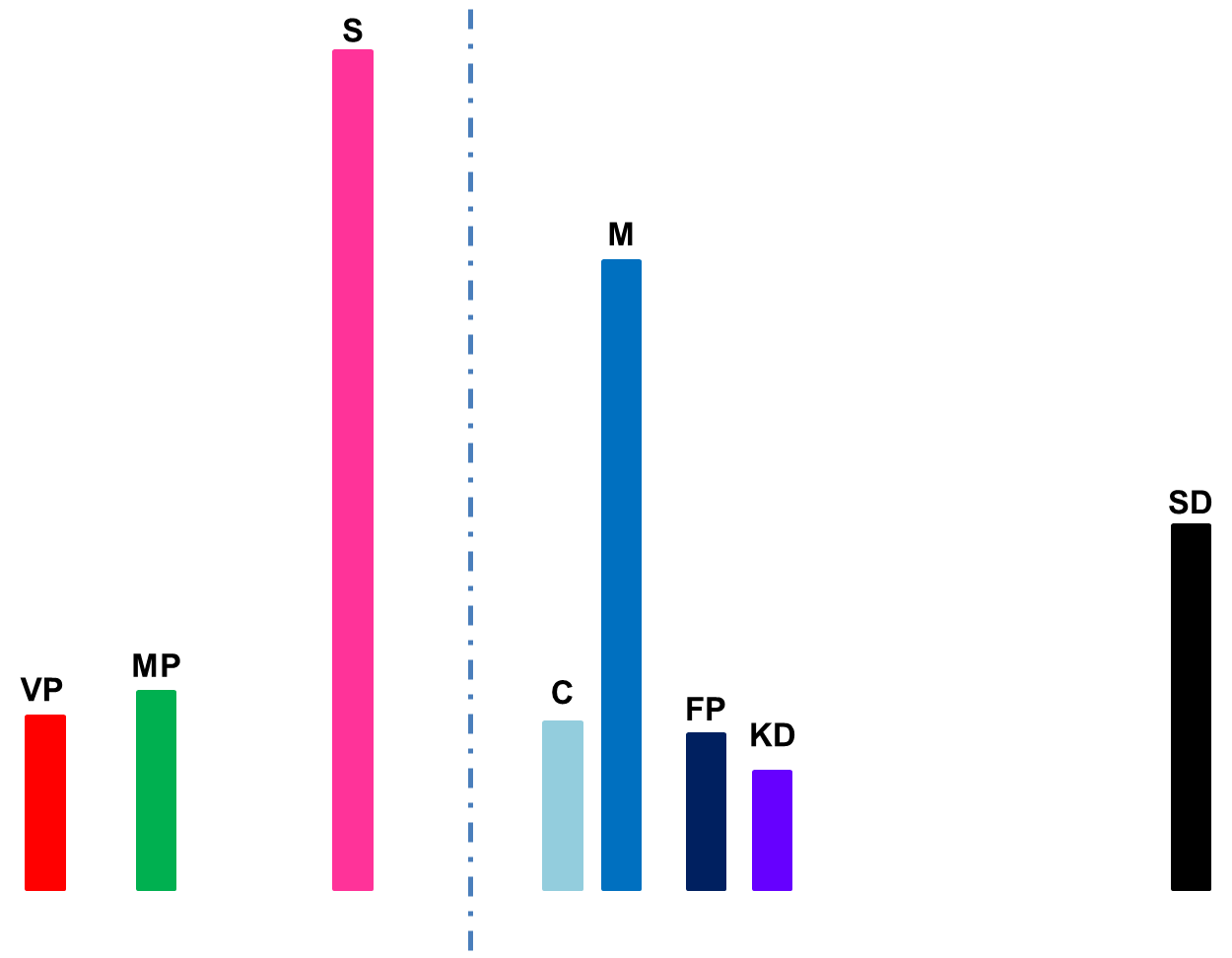
Currently the Swedish Parliament has 349 members from 8 parties.

Social Democrats – 113, Moderates – 84, Sweden Democrats – 49, Environment Party – 25, Centre Party – 22, Left Party – 21, Peoples Party – 19, Christian Democrats – 16.

The Social Democrats and the Environmental Party with 138 seats (of 349) make up the minority government. Adding in the Left Party which supports them from outside the government gives them 159 seats which is still short of a majority. The conservative, market oriented alliance only commands 141 seats. The Sweden Democrats – which is a right-wing, anti-immigration, anti-immigrant party with neo-Nazi roots – is being shunned by all the other parties.  But the balance of power is clearly held by the Sweden Democrats.

The crunch comes tomorrow when the government’s first budget comes up in Parliament for approval. It is normal practice for other parties to oppose by abstaining from voting for the governments budget but instead voting for their own. So even a minority government gets its budget approved as long as all the rest don’t get behind a single alternative budget. The conservative alliance will present their own budget and vote for it but abstain from voting when the government’s budget comes up. The government’s budget has taken on board much of what the Greens and the Left wanted but has ignored the Sweden Democrats and the conservative alliance. It is fairly obvious that the the Greens and the Left are wielding an influence that is far in excess of their strength in parliament. The Greens are leveraging their minority position in a minority government to extort many concessions from the Social Democrats in power.

But now all the parties and all the media are in a tizzy because the Sweden Democrats could challenge the normal cozy, back-room deals usually done by the parties and which are just rubber-stamped by a parliament where all the members stop thinking for themselves and just follow the party line. The Sweden Democrats – who have no chance of getting their own budget passed – are considering backing the budget presented by the conservative alliance. They are perfectly entitled and perfectly within their parliamentary rights to do that since this is closer to their own budget.  But if they do then the choices for the government are limited. They could defer the vote, return the budget to committee and try to come up with something which commands a majority in parliament. Which is, of course, something they should have done in the first place. Or they could call a new election.

The Social Democrats have their knickers in a real twist. They are blaming the Sweden Democrats of not following practice, of extortion and of being irresponsible. They are blaming the conservative parties of allowing the right-wing forces to succeed – by inaction. And that is rather a strange accusation. But I think they protest too much. The Sweden Democrats will decide on their position today. The media are nearly all criticising them for taking so long to announce how they will vote. Which is also rather strange. If all votes are announced before the voting takes place, what then is the purpose of making speeches and arguing and voting in the parliamentary chamber? The democratic powers of parliament have become a matter of form but seem to have no substance.

Why bother with the parliament if all decisions can effectively be taken in the back-rooms outside of parliament.

If the democratic parliament is to have any real meaning then the government needs to present a budget which commands a real majority of the 349 votes where the votes are free and not constrained by party position (i.e. a minimum of 175 voting in favour).

Actually I expect that the Sweden Democrats will chicken out today and the government budget will get passed tomorrow. If they truly represented their voters they would have to make sure that this government budget fails. It will be a lopsided and essentially an undemocratic budget.  It will be undemocratic in that there will be far too much dictated by the Greens and the far Left and well in excess of their due. If the budget passes, it will be a case of tyranny by the minority.

The only really democratic option – which I would like to see – is that the government takes its responsibility which it should have done in the first place. It needs to revise and formulate a new budget which truly commands a free majority in the house.

Juncker’s Christmas present for Europe: used goods in an imaginary wrapping

November 27, 2014

Jean-Claude Juncker announced – with great fanfare – a Christmas present for Europe yesterday. It was a €315 billion investment plan which would generate 1.3 million new jobs.  Sleight of hand is what he is good at as he has proved during his time as Prime Minister of Luxembourg. Do one thing and call it something else. Provide and attract users for clever schemes for tax evasion but call it tax avoidance.

Yesterday’s announcements don’t surprise. They don’t provide any credit for Juncker, the European Commission or the European Parliament. They do confirm for me that the “old” dream of a new European hegemony – mainly shared by French and German and some Italian politicians – is crippling the EU.  Trying to recreate the past with another Holy Roman Empire or a Fourth Reich will only lead to a spurt for separatism and further internal conflicts.

Right now European companies are awash with money which is not being invested. It is not being invested because the political environment does not provide any confidence that a return can be earned. Angela Merkel is seen as being forced to accept wasteful spending because of her grand coalition with the socialists. German energy policy is in a shambles and Germans pay the highest electricity prices in Europe. Even reductions in oil price don’t get passed on to the consumer because the Energiewende has locked the country into an era of high prices to support the unsupportable shift to renewables. The German economy has been stagnating since the coalition assumed office. Francois Hollande is desperately trying to spend more money that France does not have. Northern Italy is being held down by spending in southern parts. In Sweden a new Red/Green minority coalition depends upon support from the far left (a euphemism for old communists) and is busy stopping infrastructure development projects to keep the Greens happy and planning a splurge of public spending to keep the far left happy.

And then comes Juncker with his claim that Europe would have an early Christmas. The European Fund for Strategic Investment (EFSI) is the brainchild of the EU Commissioners and will keep them happy and the bureaucracy growing in a time of “austerity”. And the idiot EU parliament approved it.

Juncker's EFSI

Juncker’s EFSI

The fund is supposed to stimulate infrastructure projects (road, rail, energy, IT, …) but it needs new legislation in each country and will cause a competition between the countries to get their share of the new EU pig-trough. But his €315 billion turns out not to be €315 billion. It is just €21 billion. Oh, and by the way, even this is not real. It is not any new money but just an arithmetic subterfuge. It is just reallocated from other  areas of the EU budget. And if the massive leveraging to get private investment to produce the rest of the €294 billion does not materialise – as it won’t – then the European taxpayer has to pick up the tab. Those few investors who come in will be protected – by taxpayers money – and will lead to further exploitation of EU money by the few. As wih most such grand EU spending schemes new scams will be developed. A few developers and the EU bureaucrats will enrich themselves. And the EU taxpayers will pay – and continue to pay.

Juncker sees himself as Santa Claus. But as Pope Francis said a couple of days ago, Europe is becoming “haggard”. Not that the Roman Catholic Church has much to crow about but with Juncker at the helm it could become an expensive Christmas for Europe. He faces a no-confidence motion today but I don’t hold out any great hopes that he will be rejected by a compliant and self-serving European Parliament.

The EU has become just another cult.

Is Backdoor Regin the US/Israeli successor to the Stuxnet virus?

November 24, 2014

A sophisticated, spying virus, most probably developed by one or more nation states, has been discovered by Symantec. It has been in use since at least 2008 and targets have been in at least 10 countries (mainly in Russia and Saudi Arabia). The virus called Backdoor Regin is a modular tool and is designed to be loaded in multiple stages which is an architecture similar to that used by the Duqu/Stuxnet family of threats. Symantec has released a white paper on Backdoor Regin. Some analysts see industrial targets as the logical next stage after the targeting of state organisations such as by Stuxnet. Backdoor Regin seems to be targeted at businesses and telecom ssytems. Symantec warns that “many components of Regin remain undiscovered and additional functionality and versions may exist.”

fig2-sectors.png

Confirmed Regin infections by sector – Symantec


An advanced spying tool, Regin displays a degree of technical competence rarely seen and has been used in spying operations against governments, infrastructure operators, businesses, researchers, and private individuals. 

An advanced piece of malware, known as Regin, has been used in systematic spying campaigns against a range of international targets since at least 2008. A back door-type Trojan, Regin is a complex piece of malware whose structure displays a degree of technical competence rarely seen. Customizable with an extensive range of capabilities depending on the target, it provides its controllers with a powerful framework for mass surveillance and has been used in spying operations against government organizations, infrastructure operators, businesses, researchers, and private individuals.

It is likely that its development took months, if not years, to complete and its authors have gone to great lengths to cover its tracks. Its capabilities and the level of resources behind Regin indicate that it is one of the main cyberespionage tools used by a nation state.

The Stuxnet family was developed by the US and Israel and targeted the centrifuges at the Iranian nuclear fuel enrichment facility. Here too the second stage was deployed only after years of undetected operation with Stage 1.

Stuxnet, a joint U.S.-Israel project, is known for reportedly destroying roughly a fifth of Iran’s nuclear centrifuges by causing them to spin out of control. …

(The worm was reportedly tested at Israel’s Dimona nuclear facility.) 

Only after years of undetected infiltration did the U.S. and Israel unleash the second variation to attack the centrifuges themselves and self-replicate to all sorts of computers. And the first version of Stuxnet was only detected with the knowledge of the second. ….. 

The target countries reported by Symantec suggest to me that like Stuxnet, the Backdoor Regin spying tool is a US / Israeli development.

Regin uses a modular approach, giving flexibility to the threat operators as they can load custom features tailored to individual targets when required. Some custom payloads are very advanced and exhibit a high degree of expertise in specialist sectors, further evidence of the level of resources available to Regin’s authors.

There are dozens of Regin payloads. The threat’s standard capabilities include several Remote Access Trojan (RAT) features, such as capturing screenshots, taking control of the mouse’s point-and-click functions, stealing passwords, monitoring network traffic, and recovering deleted files. 

More specific and advanced payload modules were also discovered, such as a Microsoft IIS web server traffic monitor and a traffic sniffer of the administration of mobile telephone base station controllers.

fig3-countries.png

Confirmed Regin Infections by Country — Symantec

Regin is a highly-complex threat which has been used in systematic data collection or intelligence gathering campaigns. The development and operation of this malware would have required a significant investment of time and resources, indicating that a nation state is responsible. Its design makes it highly suited for persistent, long term surveillance operations against targets.

The discovery of Regin highlights how significant investments continue to be made into the development of tools for use in intelligence gathering. Symantec believes that many components of Regin remain undiscovered and additional functionality and versions may exist.  Additional analysis continues and Symantec will post any updates on future discoveries


Measuring the success of the War on Terror

November 18, 2014

How should we judge the success of the War on Terror?

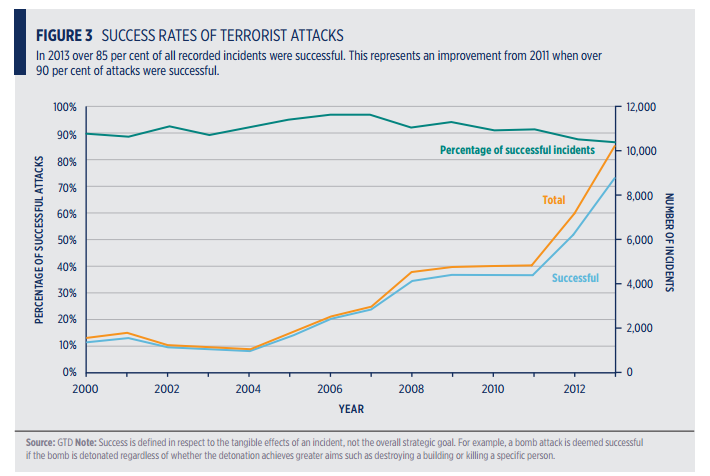
Going by the numbers, terrorism has a high success rate and is increasingly being used as a political tool. George Bush may have unwittingly done more than anybody else – by declaring a War on Terror – to legitimise the use of terror as a tool of effecting political change. He only elevated and enshrined “Terror” as an object worthy of State warfare. My working theory is that giving Terror this elevated status only increases its attractiveness as a legitimate tool for any group which perceives itself to be oppressed or wishes to foment rebellion.

The 2014 Global Terrorism Index has just been released with data upto 2013.

KEY FACTS:

  • 17,958 people were killed in terrorist attacks last year, that’s 61% more than the previous year.
  • 82% of all deaths from terrorist attack occur in just 5 countries: Iraq, Afghanistan, Pakistan, Nigeria and Syria.
  • Last year terrorism was dominated by four groups: the Taliban, Boko Haram, ISIL, and al Qa’ida.
  • More than 90% of all terrorist attacks occur in countries that have gross human rights violations.
  • 40 times more people are killed by homicides than terrorist attacks.

Why not declare a War on Murder since murder kills 40 times more people than terror?

In 2000 deaths from terrorism were 3,361.

The report is here and I have extracted just two telling diagrams. The number of terror deaths have increased dramatically and the “success rate” of terrorist actions remains high at about 90%.

Terrorism Deaths

Terrorism Deaths

Terror success rates

Terror success rates


Don’t rely on politicians to avoid another financial crash; build your own defences

November 17, 2014

I am no expert but I tend to pay attention to the behaviour of experts and those who are supposed to be experts. And I  get worried when politicians start painting alarmist pictures because that indicates that they have no idea what to do.

The number of voices warning about another financial crash are increasing and getting louder. That there are always some financial pundits warning about a coming crash is nothing out of the ordinary. But the number of pundits making such projections (here and here for example) is getting worrying. The US debt is still much too large and is not really being addressed except by printing money. Japan has entered recession. Leftist governments in Europe are getting tired of austerity and good housekeeping (France, Sweden for example) and are preparing to increase public expenditure and to raise taxes. Markets seem overvalued and unless Asian countries – mainly India and China – start consuming and manufacturing again, it is difficult to see a real motor to drive the global economy. Low oil prices will help but the signs of an upswing are not visible yet. No bank is so big that it cannot fail.

It is worth noting that some big investors are also circling the wagons and building up their defenses – and not least among them is Warren Buffet. But what is even more ominous is that the political leaders of the G20 nations are beginning to make noises as if a financial crash is a real risk and outside of their control. David Cameron’s warnings yesterday about a possible financial crash were made immediately following the G20 meeting in Australia. They sound like political positioning when faced with an intractable problem. As if the G20 leaders find themselves powerless and unable to come up with any joint actions to avoid a future financial crash.

The Guardian:

David Cameron has issued a stark message that “red warning lights are flashing on the dashboard of the global economy” in the same way as when the financial crash brought the world to its knees six years ago.

Writing in the Guardian at the close of the G20 summit in Brisbane, Cameron says there is now “a dangerous backdrop of instability and uncertainty” that presents a real risk to the UK recovery, adding that the eurozone slowdown is already having an impact on British exports and manufacturing.

His warning comes days after the Bank of England governor, Mark Carney, claimed a spectre of stagnation was haunting Europe. The International Monetary Fund managing director, Christine Lagarde, expressed fears in Brisbane that a diet of high debt, low growth and unemployment may yet become “the new normal in Europe”.

The message is that the G20 countries are just living in hope and have no concrete plans to avoid a crash. I would have thought that the bottom line is – and always will be – of living within one’s means. And that can only ultimately mean reducing public spending and reducing tax burdens. In any event it is imprudent to be relying on the politicians to avoid a crash. And that means that each individual is on his own and would be well advised to build up whatever defenses he can.

Whether a crash comes or not, and the main threat is, I think, over the next 12- 18 months, it is worth being a little circumspect over the next few months. My list of gradual actions for myself for the next 9-12 months are:

  1. Pay off as much debt as possible
  2. Call in my loans
  3. Protect capital by reducing overall risk exposure
  4. Get out of equities which may be in a bubble (say P/E >30 or where values have risen >50% in 1 year)
  5. Hold onto my blue chips (but check how blue they really are)
  6. Increase my own liquidity towards 25% of assets and in more than one “hard” currency
  7. Have more than one bank
  8. Shift away from the banks which perform poorly in stress tests
  9. Shift away from corporate bonds to government bonds (higher credit rating countries wherever possible)
  10. Buy some gold or silver (gold or silver coins not jewelry)
  11. Defer capital expenditure for the next 12 months wherever possible (car replacement, new kitchen, house extension…)


“Green” ministers in Swedish government off to a rocky start

November 7, 2014

It has only been a month since the new Red/Green government took over in Sweden. So it is early days yet. Inexperience abounds both among the Social Democrats (the senior coalition partner) and among the Environment party ministers. The Social Democrats are running a little scared and appear to be bent on appeasing far left and Green party demands. The far left party is not in government but has an inordinate influence since the coalition itself does not have its own majority. The Green party has already stopped many development projects around Stockholm (as they usually do) and the Social Democrats have not been strong enough to stop their job destruction.

The Green party does not have party leaders – only spokespersons – which is a wonderful way of evading responsibility. They have six ministers in the new government. The group is very politically correct with 3 men and 3 women. But with ages ranging between 31 and 51, I observe that they have little chance of (and no interest in) reflecting the views of the increasing number of senior citizens.

Any new government must have its share of inexperience and I have no quarrel with that. But incompetence in a minister is not so forgivable. They have not particularly enhanced their reputations so far. Instead many have been demonstrating an inexperience which borders on either an embarrassing level of naiveté or some level of incompetence. I don’t have any great expectations of them.

  • Åsa Romson, 42, Deputy Prime Minister and Minister for the Environment and Climate, is usually fairly circumspect in what she says.  She has a doctorate in international environmental rights but her speeches tend to be a string of very politically correct cliches. There is little evidence of an open mind or any great thought beyond the parroting of cliches. She has however demonstrated a sad lack of judgement by appointing a convicted drug trafficker to the Cabinet Office as her closest aide. She has defended her choice on the grounds that he has served his sentence and has paid his debt to society. But she misses the point. It is her judgement in having someone who is known to drink himself senseless and who is a convicted drug trafficker at the highest office of government which is in question. I would have thought that he would be privy to a great many confidential matters and an obvious security risk.
  • Gustav Fridolin, 31, is the Education Minister (!). He has been a peace activist, been arrested by the Israelis in the West Bank  and won Junior Jeopardy at the age of 11. By the age of 19 he was a Member of Parliament. He has also been a TV reporter. He has not attended university or any other form of higher education. Soon after being appointed he addressed all Swedish teachers by YouTube! A remarkably patronising effort directed at teachers as if they were 10 year old children. If I were a teacher I would be horribly depressed by the childish approach of the Education Minister. He too demonstrated some poor judgement when he chose an aide to work within government who was then rejected (after having worked for two days) by the Security Services for being heavily in debt.
  • Per Bolund, 43, is the Deputy Finance Minister and the Minister for Financial Markets and Consumers. He is by education a biologist but never completed his doctorate. He has not made any real blunders yet, though his immediate castigation of Swedish banks when they came through the recent stress tests with flying colours, seemed more a reflex, ideological twitch rather than any considered opinion. As a member of the Environmental party it is not in his genes to ever acknowledge that any part of the finance sector has done well. He is – of course – generally in favour of raising taxes wherever possible.
  • Isabella Lövin, 51, is the Minister of International Development Cooperation (Foreign Aid) and has kept a relatively low profile so far. She made some fine sounding statements about the €16 million Swedish support (out of €1 billion from the EC and the EU)  for helping the African countries fighting Ebola. Unfortunately this was somewhat negated by the subsequent Swedish rejection of a request for treatment of an aid worker suspected to have been infected. She was not the one to make the rejection which was more due to a bureaucratic approach to emergency situations. She has probably supported the government in its largely symbolic – but rather useless – gesture of recognising the state of Palestine. Another “feel good” action without objectives.
  • Mehmet Kaplan, 43, is of Turkish origin and is the Housing and City Development Minister. In July this year he equated the ISIS jihadists with freedom fighters. He has been very active in the past in trying to get subsidies for mosques but his record on Sharia Law and radicalisation of young Muslims is rather ambivalent. The right-wing Sweden Democrats like to target him, but he does gets a little bit of a free ride from the media and other politicians because of his opponents’ fear of being seen as islamophobic and politically incorrect. (A little reminiscent of the politicians who did not dare enough in Rotherham). He has yet to make his mark.
  • Alice Bah Kuhnke, 43, is the Minister of Culture and Democracy and has made a rather inept start. She has a degree in political science and is best known as a children’s programme and talk-show host on Swedish TV. She had a disastrous radio interview where she rejected many questions for being hypothetical. Her attempts to correct the fiasco with her own article in the press only made it worse. Surprisingly she is not comfortable in granting the press access and tries to control and micro-manage their questions. She is also getting herself horribly mixed up whenever she tries to equate culture with ecology and sustainable development. Her take on what constitutes culture leaves a little to be desired.

This group of six do not fill with me any great confidence but it is early days yet.

Maybe they will all grow into their jobs. Maybe they will perform better than my very low expectations.

But as a group they have not started very well. I am left with the impression that they are all a little too light-weight for the responsibilities that they may well fail to carry. There is a real risk that this group of six will only help in bringing this government further into disrepute.

Juncker’s Luxembourg marketed tax avoidance

November 6, 2014

Maybe it’s just my jaundiced vision, but I don’t see the European Commission as being any repository for ethics or good behaviour.

Of course Luxembourg’s economy is dominated by its banking sector. In global competition it depends on its banks and financial institutions having a competitive advantage over other countries. And it now becomes clear that the country’s government did as much as they could to ensure that the country’s laws allowed these institutions to market and exercise this advantage.

Jean-Claude Juncker

Jean-Claude Juncker

It has now been revealed that Luxembourg, its government, its bureaucrats and its institutions have actively marketed their “tax avoidance” services to at least 340 major companies. Much of this was during the time that Jean-Claude Juncker was Prime Minister of Luxembourg between 1995 and 2013. This is the same high-living Juncker who is the new President of the European Commission and declared 3 months ago that he would “try to put some morality, some ethics, into the European tax landscape.”  Juncker lives up to my low expectations of EU mandarins.

Of course tax avoidance is legal and not tax evasion. I have little sympathy for politicians who blame corporations for taking advantage of the rules they themselves make to minimise their tax payments. Any corporation would be failing in its fiduciary duties if it did not legally try to minimise its tax burden. For that matter any individual who for want of being familiar with the rules, payed more tax than he had to – even if it was for philanthropic reasons – would be just a fool.

(This has nothing to do with my view that taxes based on wealth generation are fundamentally counter-productive and should instead be based on wealth consumption or destruction).

The Guardian:

A cache of almost 28,000 pages of leaked tax agreements, returns and other sensitive papers relating to over 1,000 businesses paints a damning picture of an EU state which is quietly rubber-stamping tax avoidance on an industrial scale.

The documents show that major companies — including drugs group Shire, City trading firm Icap and vacuum cleaner firm Dyson, who are headquartered in the UK or Ireland — have used complex webs of internal loans and interest payments which have slashed the companies’ tax bills. These arrangements, signed off by the Grand Duchy, are perfectly legal.

The documents also show how some 340 companies from around the world arranged specially-designed corporate structures with the Luxembourg authorities. The businesses include corporations such as Pepsi, Ikea, Accenture, Burberry, Procter & Gamble, Heinz, JP Morgan and FedEx. Leaked papers relating to the Coach handbag firm, drugs group Abbott Laboratories, Amazon, Deutsche Bank and Australian financial group Macquarie are also included. …….. 

……. The revelations will be embarrassing for the new president of the European Commission, Jean-Claude Juncker, who was prime minister of Luxembourg between 1995 and 2013. In a speech in Brussels in July, Juncker promised to “try to put some morality, some ethics, into the European tax landscape.” He has insisted that the country is not a tax haven.

Pressure is already building on Luxembourg after the European Commission launched a formal investigation into whether Amazon’s tax arrangements in the Grand Duchy amount to unfair state aid. The Luxembourg tax arrangements of Italian carmaker Fiat’s finance unit are also under official scrutiny by Brussels.

Asked recently if such a crackdown risked damaging the economy of Luxembourg, one senior figure closely involved in the G20 reform programme said: “I don’t care. It is like saying: ‘If you fight drugs there will be no jobs in certain parts of Mexico.’” …… 


An anti-Obama wave

November 5, 2014

The results so far seem to apply nationwide and are as clear a “wave” as there can be.

My perception is of an overwhelming urge to vote against Barack Obama first and “for” somebody or something else second. Democratic voters just stayed away. The low voter turnout (c. 38%) is further evidence that it is disillusion with Obama which predominates.

A Red Wave then across the Senate, the House and among Governors. (In most other parts of the world red is the colour of the left and blue the colour of free-market conservatism).

Obama has 2 years left to go and though he has not achieved very much over the last 6 years, even with a Democratic Senate, he will now be reduced to bypassing Congress and issuing Presidential decrees. Increasingly he is going to be irrelevant.

But most likely he will continue his preferred course of “academic inaction”, but even inaction – as we have seen – can do a great deal of damage.