Archive for the ‘psychology’ Category

Another headline chasing psychologist is censured

August 7, 2013

What is it about social psychology and psychologists that causes them particularly to chase notoriety and public attention even to the extent of faking data? Diedrik Stapel and Marc Hauser being recent high profile cases. Could it just be that they are all suffer from a narcissism which can only be satisfied by generating headlines and generally being in the limelight?

Now a certain Geoffrey Miller – supposedly an “evolutionary psychologist” – has been publicly censured by New York University  for essentially behaving like an idiot and then lying about it. After tweeting a stupid and offensive remark he then tried to pass it off as part of a research project! He has now apologised – a bit late – and deleted the tweet. But his self-promotional intentions were recognised. Apparently he researches into how the human mind evolved. (Or as is pretty obvious –  didn’t evolve for some).

“The Tweeting activities of associate professor Geoffrey Miller did not rise to the level of research,” said a statement from the IRB on the university’s website.

“The board concluded that Miller’s Tweets were self-promotional in nature and did not follow research criteria which require specific research questions or hypotheses, systematic methods for collection quantitative and/or qualitative data and criteria for selecting respondents.”

He is an Associate Professor at the University of New Mexico and visiting NYU

The Times Higher Education covers the developments:

A US professor who Tweeted that if overweight PhD applicants “didn’t have the willpower to stop eating carbs” then they “won’t have the willpower to do a dissertation” has been formally censured by his university.
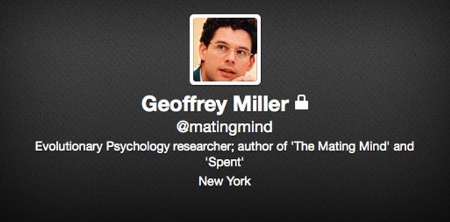
Geoffrey Miller Twitter page

Geoffrey Miller Twitter page

Geoffrey Miller, associate professor of psychology at the University of New Mexico, apologised after sending the Tweet, which he subsequently deleted. He later told UNM it had been part of a research project – a claim dismissed by the university

The institution has now formally censured Professor Miller for “misrepresenting to his department chair and colleagues the motivation for a Tweet”. 

“Miller at first claimed his Tweet was part of a research project, but investigations by the Institutional Review Board at New York University where he was a visiting professor, and the IRB at UNM where he is a tenured professor, concluded that was not correct,” a statement from his university read. 

As part of the censure, Professor Miller will be required to develop “a plan for sensitivity training as it pertains to obesity” in cooperation with the UNM psychology department, and apologise to colleagues for his behavior. 

Professor Miller, who can appeal the censure, will also have his work monitored by the chair of the psychology department, and will be assigned a faculty mentor for three years, with whom he will meet on a regular basis to discuss potential problems.

Closure for Stapel perhaps but social psychology remains “on probation”

June 28, 2013

Another Chapter in the Diedrik Stapel saga comes to an end as he reaches a deal with prosecutors but the exposure of his behaviour has revealed much that is not so uncommon in the field of social psychology. Social psychologists now need to be on their best behaviour to dispell the notion that “fraud” and confirmation bias are their stock-in-trade. Social  Psychology remains on probation and must avoid any hint of misconduct if it is not to lose further ground as an academic discipline ( but it will be quite some time before this discipline becomes a science).

Associated Press (via The Republic): 

THE HAGUE, Netherlands — A disgraced Dutch social psychologist who admitted faking or manipulating data in dozens of publications has agreed to do 120 hours of community service work and forfeit welfare benefits equivalent to 18 months’ salary in exchange for not being prosecuted for fraud.

Prosecutors announced the deal Friday, calling it “a fitting conclusion” to a case of scientific fraud that sent shockwaves through Dutch academia.

Diederik Stapel who formerly worked at universities in the cities of Groningen and Tilburg, acknowledged the fraud in 2011 and issued a public apology last November, saying he had “failed as a scientist.”

He once claimed to have shown that the very act of thinking about eating meat makes people behave more selfishly.

Marc Hauser makes his comeback with “brain-training” for at-risk children

June 4, 2013

Marc Hauser who was terminated / resigned from Harvard for rather suspect data creation (the Hausergate affaire) is now making his comeback with a new enterprise called Risk-Eraser

Risk-Eraser transforms the learning and decision-making of at-risk children by building more effective programs. Our goal is to erase the risk in the lives of at-risk populations.

His program is touted as being evidence-based and involves critical thinking and “brain-training” to give a program which “helps students reach higher goals in both school and in their social lives, enables programs to run more efficiently, and empowers teachers to engage in the most exciting methods of pedagogy”. 

Google Maps: West Falmouth Hwy #376, W. Falmouth, MA, 02574

Some irony in his claim of being “evidence-based” and the line between “brain-training” and brain-washing is rather thin. Brain-washing – even in a good cause – and with vulnerable children would seem to raise a number of ethical issues.

Risk-Eraser, West Falmouth Hwy #376, W. Falmouth, MA, 02574​

Looks nice there.

Currently he is the only member of the team. A Technical team and an Advisory team are said to be “coming soon”.

Marc Hauser, PhD

I am the founder of Risk-Eraser. The company grew out of two passionate interests: to understand human nature and to improve the lives of those less fortunate.  My PhD is in the mind and brain sciences.  I was a professor at Harvard for 19 years.  I have published over 200 papers and six books. I have won several awards for my teaching, and am the proud mentor of some of the best students in my academic areas of interest; these individuals now hold distinguished professorships at major universities all over the world.

 His main transgression may have initially been due to confirmation bias and this may have led to the data “manipulation”.  I am quite sure that not everything Hauser did or does is tainted — but the real problem is that discerning what is or is not suspect is going to be difficult.

To implement any confirmation bias with “at-risk children” could I think be very destructive.  Applying “brain-washing” techniques on “at- risk” children seems itself not to be devoid of risk.

Shamans versus the witch-doctors: psychologists attack the psychiatrists

May 12, 2013

I have the clear perception that psychiatry has gone too far in trying to attribute all kinds of behaviour to being disabilities. The very influential American Psychiatry Association’s Diagnostic and Statistical Manual of Mental Disorders DSM-5 is soon to be released and even describes grief and temper tantrums as disabilities and yet will no longer recognise Asperger’s! And the psychiatrists have the fundamental concept that all such disabilities are susceptible to medication.

Equally, while I recognise the importance of human psychology as a discipline I am less than impressed by the psychology and behaviour of psychologists and especially the academic gyrations of social psychologists.

So this headline in today’s Guardian conjures up images of a pitched battle between shamans and witch-doctors. I distinguish here between shamans who rely on various secret “medicines” to cure the afflicted, while the witch-doctors are the ones who engage in secret rites to free the patients from the spirits who are haunting them. I suppose in this analogy that the psychiatrists are the shamans and the psychologists are the witch-doctors. But the bottom line of course seems to be that psychologists wantb to adjust behaviour by adjusting other behaviour, and they feel threatened by the psychiatrists’ concept that all unwanted behaviour can be medicated away. The pharmaceutical industry – needless to say – tends to support the psychiatrists (what else?).

The GuardianPsychiatrists under fire in mental health battle

British Psychological Society to launch attack on rival profession, casting doubt on biomedical model of mental illness.

There is no scientific evidence that psychiatric diagnoses such as schizophrenia and bipolar disorder are valid or useful, according to the leading body representing Britain’s clinical psychologists.

In a groundbreaking move that has already prompted a fierce backlash from psychiatrists, the British Psychological Society’s division of clinical psychology (DCP) will on Monday issue a statement declaring that, given the lack of evidence, it is time for a “paradigm shift” in how the issues of mental health are understood. The statement effectively casts doubt on psychiatry’s predominantly biomedical model of mental distress – the idea that people are suffering from illnesses that are treatable by doctors using drugs. The DCP said its decision to speak out “reflects fundamental concerns about the development, personal impact and core assumptions of the (diagnosis) systems”, used by psychiatry.

Dr. Lucy Johnstone, a consultant clinical psychologist who helped draw up the DCP’s statement, said it was unhelpful to see mental health issues as illnesses with biological causes.

“On the contrary, there is now overwhelming evidence that people break down as a result of a complex mix of social and psychological circumstances – bereavement and loss, poverty and discrimination, trauma and abuse,” Johnstone said. The provocative statement by the DCP has been timed to come out shortly before the release of DSM-5, the fifth edition of the American Psychiatry Association’s Diagnostic and Statistical Manual of Mental Disorders. ….

…… The writer Oliver James, who trained as a clinical psychologist, welcomed the DCP’s decision to speak out against psychiatric diagnosis and stressed the need to move away from a biomedical model of mental distress to one that examined societal and personal factors.

Writing in today’s Observer, James declares: “We need fundamental changes in how our society is organised to give parents the best chance of meeting the needs of children and to prevent the amount of adult adversity.”

But Professor Sir Simon Wessely, a member of the Royal College of Psychiatrists and chair of psychological medicine at King’s College London, said it was wrong to suggest psychiatry was focused only on the biological causes of mental distress. And in an accompanying Observerarticle he defends the need to create classification systems for mental disorder.

“A classification system is like a map,” Wessely explains. “And just as any map is only provisional, ready to be changed as the landscape changes, so does classification.”

How much of “social-priming” psychology is just made-up?

May 11, 2013

There is a whole industry of social psychologists specialising in – and getting funded for – studying “social priming”. The more astonishing or contra-intuitive the result the more attention, the more publicity and the more funding the researcher seems to get. But it seems that many (maybe most) of these study results are irreproducibleIt is not implausible that priming does (should) affect subsequent behaviour but social psychologists seeking fame through astonishing results (often, it seems, made-up results) have not helped their own cause. The list of questionable “social priming” results is getting quite long:

    • Thinking about a professor just before you take an intelligence test makes you perform better than if you think about football hooligans.
    • people walk more slowly if they are primed with age-related words
    •  A warm mug makes you friendlier.
    • The American flag makes you vote Republican.
    • Fast-food logos make you impatient
    • lonely people take longer and warmer baths and showers, perhaps substituting the warmth of the water for the warmth of regular human interaction

Attention-grabbing results seem to be common among social psychologists of all kinds. A made-up result which says that “the smarter a man is, the less likely he is to cheat on his partner” generates the expected headlines and spots on TV talk shows. Diedrik Stapel made up data to prove that “meat eaters are more selfish than vegetarians”. Dirk Smeesters claimed that “varying the perspective of advertisements from the third person to the first person, such as making it seem as if we were looking out through the TV through our own eyes, makes people weigh certain information more heavily in their consumer choices” and that “manipulating colors such as blue and red can make us bend one way or another”. But Smeesters too has now admitted cherry picking his data. A raft of retractions followed and is still going on.

Nature: 

A paper published in PLoS ONE last week1 reports that nine different experiments failed to replicate this example of ‘intelligence priming’, first described in 1998 (ref. 2) by Ap Dijksterhuis, a social psychologist at Radboud University Nijmegen in the Netherlands, and now included in textbooks.

David Shanks, a cognitive psychologist at University College London, UK, and first author of the paper in PLoS ONE, is among sceptical scientists calling for Dijksterhuis to design a detailed experimental protocol to be carried out indifferent laboratories to pin down the effect. Dijksterhuis has rejected the request, saying that he “stands by the general effect” and blames the failure to replicate on “poor experiments”.

An acrimonious e-mail debate on the subject has been dividing psychologists, who are already jittery about other recent exposures of irreproducible results (see Nature 485, 298–300; 2012). “It’s about more than just replicating results from one paper,” says Shanks, who circulated a draft of his study in October; the failed replications call into question the under­pinnings of ‘unconscious-thought theory’. ….

….. In their paper, Shanks and his colleagues tried to obtain an intelligence-priming effect, following protocols in Dijksterhuis’s papers or refining them to amplify any theoretical effect (for example, by using a test of analytical thinking instead of general knowledge). They also repeated intelligence-priming studies from independent labs. They failed to find any of the described priming effects in their experiments. ……

……. Other high-profile social psychologists whose papers have been disputed in the past two years include John Bargh from Yale University in New Haven, Connecticut. His claims include that people walk more slowly if they are primed with age-related words.

Bargh, Dijksterhuis and their supporters argue that social-priming results are hard to replicate because the slightest change in conditions can affect the outcome. “There are moderators that we are unaware of,” says Dijksterhuis.

But Hal Pashler, a cognitive psychologist at the University of California, San Diego — a long-time critic of social priming — notes that the effects reported in the original papers were huge. “If effects were that strong, it is unlikely they would abruptly disappear with subtle changes in procedure,” he says. ….

CHE: 

This fall, Daniel Kahneman, the Nobel Prize-winning psychologist, sent an e-mail to a small group of psychologists, including Bargh, warning of a “train wreck looming” in the field because of doubts surrounding priming research. He was blunt: “I believe that you should collectively do something about this mess. To deal effectively with the doubts you should acknowledge their existence and confront them straight on, because a posture of defiant denial is self-defeating,” he wrote.

……. Pashler issued a challenge masquerading as a gentle query: “Would you be able to suggest one or two goal priming effects that you think are especially strong and robust, even if they are not particularly well-known?” In other words, put up or shut up. Point me to the stuff you’re certain of and I’ll try to replicate it. This was intended to counter the charge that he and others were cherry-picking the weakest work and then doing a victory dance after demolishing it. He didn’t get the straightforward answer he wanted. “Some suggestions emerged but none were pointing to a concrete example,” he says.

Social psychology and social psychologists have some way to go to avoid being dismissed out of hand as charlatans.

Baboons can tell “more” from “less” – but that is still a long way from counting

May 4, 2013

Being able to distinguish between “more” and “less” is – most likely – a capability that is a pre-requisite for the evolutionary development of the ability to count which itself must lead to the invention of numbers. Recent experiments with baboons demonstrates that they have a clear ability to make quite complex more/less distinctions.

Allison M. Barnard, Kelly D. Hughes, Regina R. Gerhardt, Louis DiVincenti, Jenna M. Bovee and Jessica F. Cantlon.Inherently Analog Quantity Representations in Olive Baboons (Papio anubis)Frontiers in Comparative Psychology, 2013 DOI: 10.3389/fpsyg.2013.00253

From the University of Rochester press release:

… Now a new study with a troop of zoo baboons and lots of peanuts shows that a less obvious trait—the ability to understand numbers—also is shared by man and his primate cousins.

“The human capacity for complex symbolic math is clearly unique to our species,” says co-author Jessica Cantlon, assistant professor of brain and cognitive sciences at the University of Rochester. “But where did this numeric prowess come from? In this study we’ve shown that non-human primates also possess basic quantitative abilities. In fact, non-human primates can be as accurate at discriminating between different quantities as a human child.”

“This tells us that non-human primates have in common with humans a fundamental ability to make approximate quantity judgments,” says Cantlon. “Humans build on this talent by learning number words and developing a linguistic system of numbers, but in the absence of language and counting, complex math abilities do still exist.” ……

……… The baboons’ choices, conclude the authors, clearly relied on this latter “more than” or “less than” cognitive approach, known as the analog system. The baboons were able to consistently discriminate pairs with numbers larger than three as long as the relative difference between the peanuts in each cup was large. Research has shown that children who have not yet learned to count also depend on such comparisons to discriminate between number groups, as do human adults when they are required to quickly estimate quantity. 
Studies with other animals, including birds, lemurs, chimpanzees, and even fish, have also revealed a similar ability to estimate relative quantity, but scientists have been wary of the findings because much of this research is limited to animals trained extensively in experimental procedures. The concern is that the results could reflect more about the experimenters than about the innate ability of the animals. ……..

……… To rule out such influence, the study relied on zoo baboons with no prior exposure to experimental procedures. Additionally, a control condition tested for human bias by using two experimenters—each blind to the contents of the other cup—and found that the choice patterns remained unchanged.

A final experiment tested two baboons over 130 more trials. The monkeys showed little improvement in their choice rate, indicating that learning did not play a significant role in understanding quantity.

“What’s surprising is that without any prior training, these animals have the ability to solve numerical problems,” says Cantlon. The results indicate that baboons not only use comparisons to understand numbers, but that these abilities occur naturally and in the wild, the authors conclude. …….

Too many coincidences? 70 feared dead in Waco explosion after Boston marathon bombs

April 18, 2013

April 18th today.

Update 2! The Waco blast is more likely to have resulted from an industrial fire. Coincidences do happen.

A case of cum hoc ergo propter hoc perhaps.

Update! Upto 70 15 feared dead

=============================

The name “Waco” had not entered my consciousness for many, many years until a TV commentator brought it up after the Boston Marathon bombs on April 15th. He pointed out that it was close to the 20th anniversary of  the Waco siege ending (April 19th  1993) and the 18th anniversary of the Oklahoma bombing (April 19th, 1995) and that it was Patriots Day and Income Tax day and that some form of anti-government, domestic, fanatic, loony-right group could be implicated.

Two letters containing ricin have also been intercepted (one to a Senator and one to the President) but the previous ricin laters were sent in 2003 and 2004 by a “Fallen Angel” – but not in April. Fallen Angel was never caught.

It was all pure speculation  and I dismissed it as yet another “conspiracy theory” (though there are so many of these, that statistics says that some few of these probably must be true).

But I woke up this morning to news reports about a massive explosion at a fertiliser factory in (or near) Waco and that another explosion was expected and that 70 people were feared dead. Fertiliser plants are no strangers to explosions  and “powder” borne explosions can be particularly devastating, and yet … .

To have “Waco” enter my consciousness twice in just 3 days seems weird – and my clear perception is that this is too much of a coincidence:

News.com.au: 

  • Explosion at fertiliser plant north of Waco,Texas
  • Up to 70 people believed to have died  
  • Several people, including children, trapped in buildings

The grim death toll was given by a senior doctor at West hospital following the blast, and reported by local station KHTX, but has yet to be confirmed by other officials.

While West’s Emergency Medical Services Director Dr George Smith was cited as saying as many as 60 or 70 people died, doctors at Hillcrest Medical Centre in Waco said none of the 66 injured taken there had died.

Babies and the elderly are among those injured in the blast, with homes within a four-block radius of the fertiliser plant flattened and several more on fire.

Is Facebook a forum for narcissists (and maybe also for narcissistic researchers?)

March 19, 2013

Facebook is providing a fertile hunting ground for simplistic “research” by a new breed of “researchers”. Social psychology is still just a discipline and has yet to reach the level of a “science”. But I note that surveys of Facebook users is multiplying and seems to have  become a new field of social psychology. The surveys are easily done, usually include a sample size of just a few hundred (small enough to access on a University campus or in a town square) and draw fanciful conclusions to capture the headlines. They provide an easy way to publication. Such “Facebook research” is not “bad science” – if even “science” at all – but much of it is trivial and just provides a quick, cheap way of getting published. In this case the “research” has been done by someone from the School of Computing at the University of Portsmouth.

The University of Portsmouth has issued a press release  about a survey which finds that “Using Facebook to look at old photos of yourself and wall posts that you have written could be as soothing as a walk in the park” and this has received much coverage. But whereas the “researchers” find this beneficial, what they they seem to be describing is a sort of narcissistic – and not very healthy – behaviour. Narcissism is when a healthy self-esteem crosses over into being an unhealthy obsession with one’s self and I would have thought that the survey results are a warning sign. But of course the behaviour described would be considered beneficial – by another narcissist.

Using Facebook to look at old photos of yourself and wall posts that you have written could be as soothing as a walk in the parkAlmost 90 percent of users access the site to look at their own wall posts, and three quarters look at their own photos when they are feeling low, new research has found.

A report by Dr Alice Good, of the University of Portsmouth, has found that this kind of ‘self soothing’ use of Facebook is actually beneficial to the user’s mood, especially if they are prone to feeling low. This directly contradicts previous research that has suggested that looking at Facebook can be bad for your mental health.

Dr Alice Good

Dr Good said: “We were very surprised by these findings, which contradict some recent reports.  Although this was only a small study, we will go on to study larger groups to see if the results remain consistent.”

Dr Good, of the School of Computing, quizzed 144 Facebook users and found that people often use the social network to reminisce, using old photos and wall posts as a form of comfort.

Looking back at older photos and wall posts is the main activity, and the one that made them happiest.

Psychologist Dr Clare Wilson, of the University of Portsmouth says:

“Although this is a pilot study, these findings are fascinating. Facebook is marketed as a means of communicating with others. Yet this research shows we are more likely to use it to connect with our past selves, perhaps when our present selves need reassuring.

“The pictures we often post are reminders of a positive past event. When in the grips of a negative mood, it is too easy to forget how good we often feel. Our positive posts can remind us of this.”

The survey also found that people who have experienced mental health issues are particularly comforted by the site. Dr Good said: “The results indicate we could use self-soothing as a form of treatment for low moods.”

The study has concluded that looking at comforting photos, known as reminiscent therapy, could be an effective method of treating mental health.

Scientists already know that reminiscent therapy helps older people with memory problems.

The use of old photos, items and films can provide a way for people with short-term memory loss to feel comforted by objects that are familiar to them.

This new research shows that it could also an effective treatment for people with depression or anxiety.

The act of self-soothing is an essential tool in helping people to calm down, especially if they have an existing mental health condition. If a patient self soothes there is less chance of a problem escalating.

The report also looked at ways of accessing Facebook, with phones being the most popular method and 94 per cent admitting they had their phone on them at all time, with around 70 per cent actually preferring to access Facebook using their phone over more conventional methods, such as a PC or laptop, suggesting people have a desire for immediacy, both in accessing the site as well as for viewing photos.

This study is part of a larger research project that looks at how applications can support wellbeing and effectively self soothe.

This research is published in the journal ‘Lecture Notes in Computer Science: Universal Access in Human-Computer Interaction’. Springer Berlin / Heidelberg.

Math and Reading gender differences are not affected by level of gender equality

March 18, 2013

A new paper suggests that  math and reading differences between the genders persist  regardless of a country’s “gender equality” level. Though I am not sure why there should be so much surprise about such a finding. That the genders are fundamentally different – I would have thought – was self-evident. That some of the biological differences between the sexes must lie in the brain also seems obvious. It has always confused me as to why legislation – which should be for ensuring the equality of opportunity between the genders – often tries to suppress or deny gender differences in futile attempts to try and make the genders “equal”. We will – I think – only achieve a real equality of opportunity when we truly understand and acknowledge all the inherent differences between the sexes. Legislation can surely help to address behaviour but it cannot do away with the inherent differences. As Prof. Geary states “Educational systems could be improved by acknowledging that, in general, boys and girls are different.” And I would add that equality of opportunity between the genders has to start by acknowledging that men and women are different. It could well be that “Swedish boys fall behind in reading more so than in most other highly developed nations” just because Sweden spends so much effort to create gender equality by suppressing gender difference.

Stoet G, Geary DC (2013) Sex Differences in Mathematics and Reading Achievement Are Inversely Related: Within- and Across-Nation Assessment of 10 Years of PISA Data. PLoS ONE 8(3): e57988. doi:10.1371/journal.pone.0057988

The University of Missouri has a press release:

… even in countries with high gender equality, sex differences in math and reading scores persisted in the 75 nations examined by a University of Missouri and University of Leeds study. Girls consistently scored higher in reading, while boys got higher scores in math, but these gaps are linked and vary with overall social and economic conditions of the nation. 

“Educational systems could be improved by acknowledging that, in general, boys and girls are different,” said David Geary, MU professor of psychological science. “For example, in trying to close the sex gap in math scores, the reading gap was left behind. Now, our study has found that the difference between girls’ and boys’ reading scores was three times larger than the sex difference in math scores. Girls’ higher scores in reading could lead to advantages in admissions to certain university programs, such as marketing, journalism or literature, and subsequently careers in those fields. Boys lower reading scores could correlate to problems in any career, since reading is essential in most jobs.”

Generally, when conditions are good, the math gap increases and the reading gap decreases and when conditions are bad the math gap decreases and the reading gap increases. This pattern remained consistent within nations as well as among them, according to the study by Geary and Gijsbert Stoet of the University of Leeds that included testing performance data from 1.5 million 15-year-olds in 75 nations. The top five percent of scores within nations generally showed girls to be lower in math and boys to be lower in reading. That pattern continued in lower scoring groups until reaching the lowest scoring students, where the math achievement of boys and girls evened out but the reading gap increased, according to Geary.

“The consistent pattern within nations suggests the sex differences are not simply related to socio-economic factors,” said Geary. Socio-economic and cultural factors are important in that they influence the performance of all students, but boys, as a group, respond more strongly than girls, perhaps due to a biological difference in sensitivity to wider conditions.”  For example, in nations with impoverished or violent conditions, boys’ scores tended to fall faster and further than girls. On the other hand, in wealthier, socially stable nations boys’ scores benefitted more than girls. This resulted in boys reducing the reading gap and widening the math gap.

“This finding has important implications for how we interpret the math gap of other countries,” said co-author Gijsbert Stoet of the University of Leeds. “For example, policy makers often take Sweden as an example of being particularly good for reducing the gender gap in science, technology, engineering and math, but they do not realize that Swedish boys fall behind in reading more so than in most other highly developed nations. This is a good example of the inverse relation between the math and reading gaps. This phenomenon urgently needs more attention.” ……

Stapel fraud report blames lack of critical scientific culture

November 28, 2012

The massive Diedrik Stapel fraud broke a year ago and the final investigation report “Failing science: The fraudulent research practices of social psychologist Diederik Stapel” has now been published. The final fraud count is quite staggering. 55 papers, 10 theses and possibly a further 11 publications were fraudulent. That’s 10 PhD students who will have doctorates rescinded or must start from scratch! The report is in Dutch  (pdf): Final Report Stapel Investigation

Human behaviour in all its aspects and including social psychology are certainly disciplines worthy of study and I would not go so far as to say they can never become sciences. But social psychology is certainly  no science yet. Stapel’s behaviour – which is by no means unique for publicity hunting social psychologists – was nothing more than pseudoscience and will not advance the progress of this discipline into becoming a science.

Dutchnews reports:

A report into how a Dutch university professor was able to fake research data for years blames the absence of a critical scientific culture at academic institutions.

Stapel, who was a professor of social and behavioural sciences at Tilburg, was suspended in September 2011 after doubts emerged about research that concluded eating meat makes people anti-social and selfish.

The report, compiled by special commissions from four universities where Stapel worked, concludes at least 55 out of 130 academic papers written by Stapel and 10 graduate student theses he was supervising contain fraudulent data. There are doubts about the authenticity of a further 11 papers.

The 108-page report says colleagues who worked with Stapel had not been sufficiently critical. This was not deliberate fraud but ‘academic carelessness’, the report said. ‘The critical function of science has failed at all levels,’ the report said. 

In a statement, Stapel said he had failed as a scientist. ‘I am deeply, deeply sorry for the pain I have caused others,’ he said. ‘I feel sorry, shame and I blame myself. The truth would have been better served without me.’

…. Finance ministry officials are also investigating Stapel because much of his work was funded by public research money.