Archive for the ‘Religion’ Category

Science cannot reach the places where gods are conceived

November 19, 2024

This post is as an addendum to an earlier post:

Atheism (old or new) lacks “oomph”


The domain of science

There are many questions that science cannot even address, let alone, answer. The process we call “science” starts with many fundamental assumptions (existence and causality for example). Clearly the needs of what we take to be logic require that any field of thought (science in this case) can not penetrate or address its own founding assumptions. It would seem that space, time, matter, energy, life and consciousness are also such assumptions. The scientific method, while incredibly powerful, is inherently limited by its foundational assumptions. Questions like the existence of reality itself, the nature of consciousness, or the ultimate origin of the universe are beyond the scope of scientific inquiry. There are other areas that science cannot directly address:

  • The laws of logic: While science relies on logic to draw conclusions, it cannot prove the validity of logic itself.
  • The uniformity of nature: The assumption that natural laws are consistent across space and time is fundamental to scientific investigation, but it cannot be proven.
  • The objectivity of observation: Science assumes that observations can be made objectively, but human perception and interpretation can introduce biases. All human observations are ultimately subjective.
  • The existence of an external world: While we experience the world as real, the nature of reality itself is a philosophical question that science cannot definitively answer.

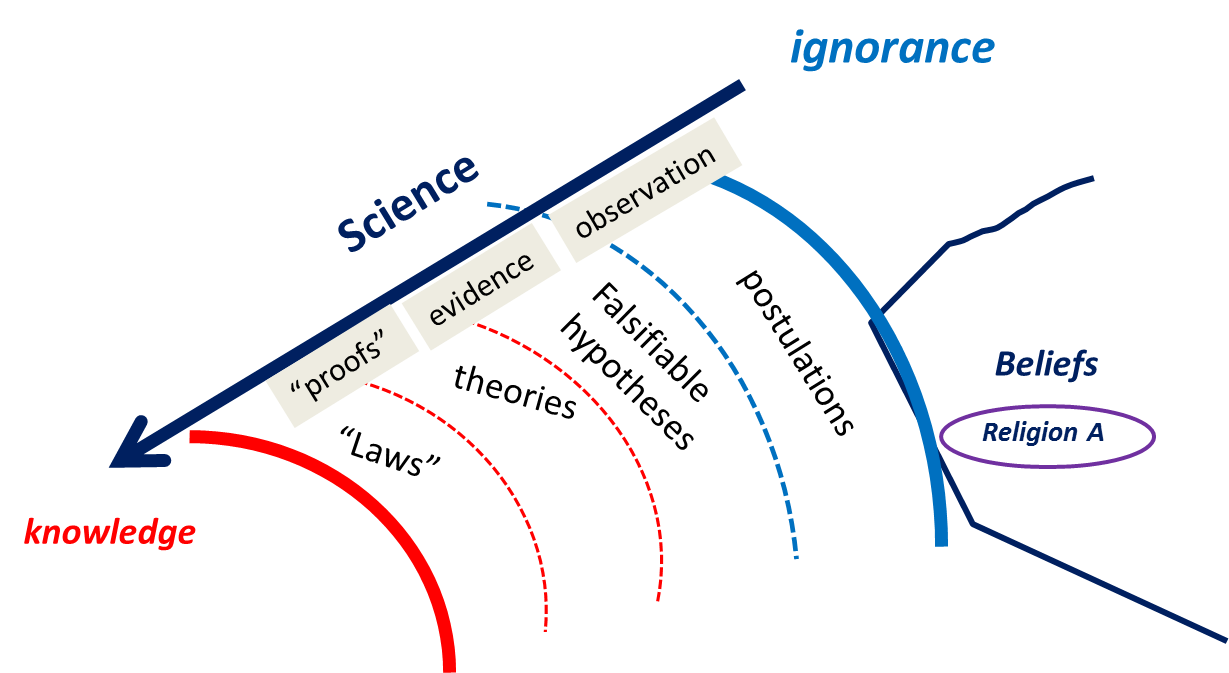
Mysteries and unanswerable questions lead to the invention of gods and supernatural beings by humans.  Initially they are just labels for the answers to the unanswerable questions. (Of course they are later imbued with human characteristics, supernatural powers, families and expanded regions of influence).  The process we call science, though, does not (can not) address the unanswerable questions. Setting science and the gods in opposition is incorrect in logic and in reason. Claiming that “science denies gods” or that “gods are unscientific” are statements that are invalid. Science seeks to explain the natural world through empirical evidence and falsifiable hypotheses. Science simply operates within its own framework, and it doesn’t have the tools to prove or disprove the existence of supernatural beings. Religion addresses questions of meaning, purpose, and the supernatural, which often lie beyond the domain of scientific inquiry.  

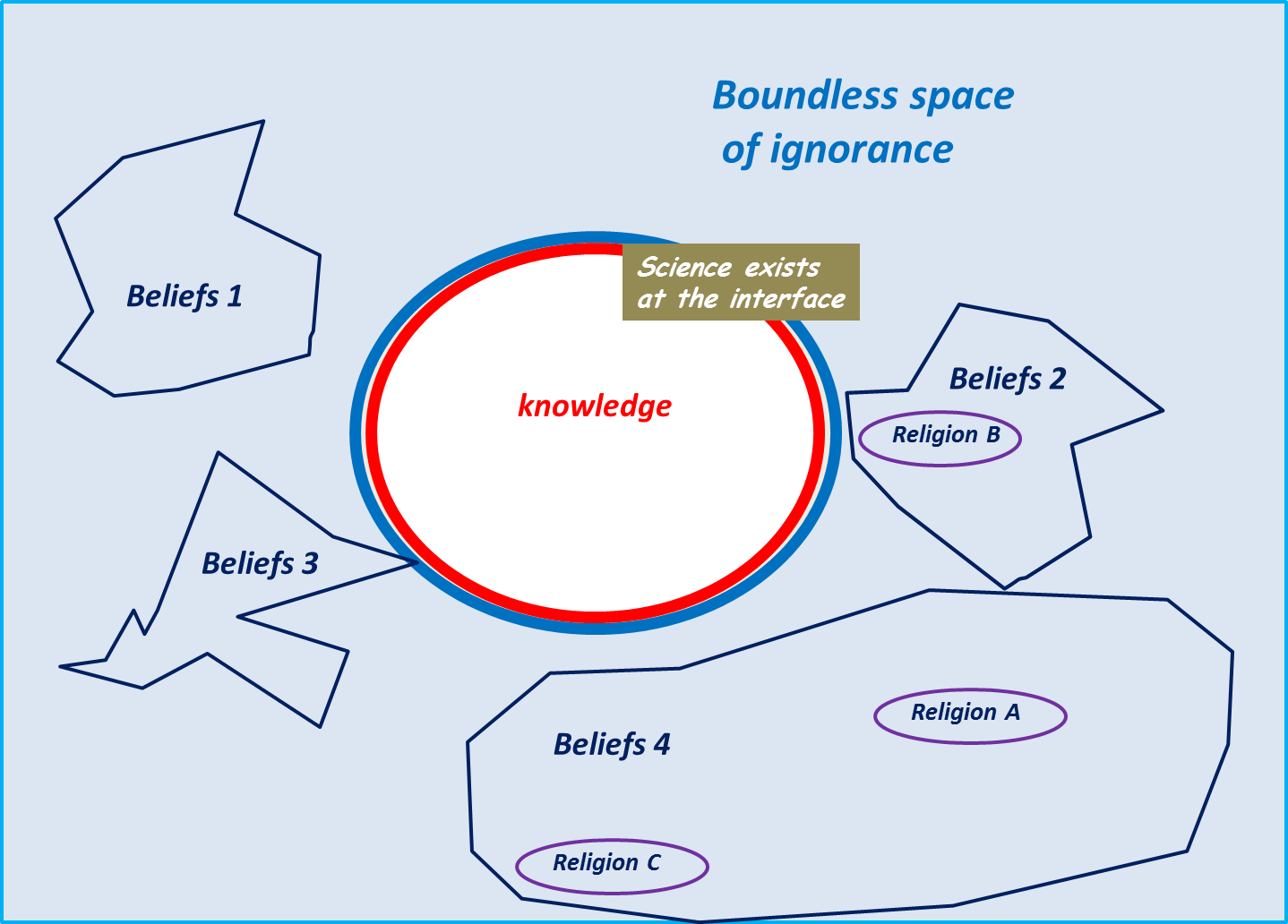
Gods can only be imagined, conceived of and invented in those domains where science cannot reach.


It is my contention that while philosophers (thinkers) may have formulated the mysteries which then could only be “solved” by the invention of a god, that it was politically motivated groups (possibly the earliest priests) who used such gods to create religions as a social control tool. So it seems probable that the invention of gods preceded the invention of religions (though gods are not always needed by religions). The invention of gods likely stemmed from a combination of factors:

  1. Humans abhor the unknown: Humans, ever since they became human, have sought explanations for all they couldn’t understand. Gods were labels for the answers to the unanswerable. They provided answers to the impossible questions like “Why does the sun rise?”, “Why does it rain?” or “Where do we go after death?”
  2. Social Control: Gods and their supernatural powers were used to justify and establish social norms and laws. Disobeying divine rules could lead to just punishment, both in this life and the afterlife.
  3. Creating a social “we”: Shared beliefs in gods fostered a sense of unity and belonging within communities. Rituals and ceremonies centered around gods strengthened social bonds.
  4. As a means of explaining and withstanding loss and suffering: Gods or purported sins against the gods could justify and explain misfortune and suffering as divine tests or punishments.  They provided a sense of purpose and meaning.
  5. As a crutch giving hope and comfort: Gods were used as a vehicle of hope for a better future, both in this life and the afterlife. They provided comfort and solace in times of hardship.

In essence, gods served as a powerful tool for explaining the unexplainable, maintaining social order, creating communities and providing psychological comfort.

It is not implausible that it was early thinkers, or shamans, who pondered existential questions and proposed supernatural explanations. However, it is likely that creating religious institutions, was a political exercise with political objectives. The leaders probably acquired status as priests, and they structured beliefs and narratives into formal or organized religions and used them primarily for social control.

While some might argue that the spiritual benefits of religion are merely a byproduct or a marketing strategy, there is no doubt that many religions offer genuine solace, meaning, and purpose. Religion may have originated as a tool for social control, but it has evolved into something much more complex over time. The origin and evolution of gods and religions requires much more space than I have here. But the key point for this post is that gods were invented because explanations for the great mysteries were sought and could not be found.


Different domains

Ultimately science and gods operate in separate domains. Science operates in the constrained world of what can be observed empirically and where foundational assumptions apply. The invention of gods is always in response to some question or mystery that science cannot address.  Of course, imbuing gods – who are merely labels for the unanswerable – with human or superhuman characteristics is nothing but literary (fictional) license. The problem often arises in that such fictions are taken literally. Others interpret scientific findings as weapons to challenge or deny certain religious beliefs. But strictly they live on different planes in different worlds. The bottom line is that science cannot tread in the places where its unanswerable questions led to the invention of the gods. And the gods cannot exist in the domains where science is constrained to hold sway.


Atheism (old or new) lacks “oomph”

November 4, 2024

Philosophy has two meanings. The word describes either

  1. a way of behaving and living, or
  2. it is the study of the unanswerable questions around us.

The second is the one that interests me the most. But atheism is neither the one nor the other. It has no “ism”. It does not classify as a philosophy. Somebody who tells you he is an atheist is not telling you who he is or what he stands for. He is only telling you who he hates.


Gods, deities, religions (gdr) and the Great Mysteries

I know that gods were invented by man but I find atheism lacking in substance and very unsatisfactory. It is a-theism but effectively has no ism of its own. Atheism, at its core, is no more than a reaction to theism. It defines itself in opposition to the belief in gods or a higher power. Without the concept of a god or gods, atheism could not exist. Gods and deities and religions (gdr) were invented by man when they found mysteries which could not be explained. Gods and deities were labels for the unknown answers to unanswerable questions. Religions came about because it was realised that the labels could be hijacked to coerce people to follow a desired way of life. The second part – the religion part – was nearly always created by the unscrupulous and always as a way of coercing the behaviour of the gullible. Religions always have a political goal and a political objective – the coercion of a particular kind of behaviour. Nevertheless, it seems entirely logical that the gods of the winds and the seas and the mountains and the sun and the moon would be invented when the natural world defied explanation and generated awe and wonder among humans. Gods of creation and destruction and even their anti-gods were inevitable given that humans kept asking but found that there were no answers. (Deities and pantheons of gods probably came about to make for more interesting story-telling and also probably to avoid divine labour disputes and to acknowledge the different skills they possessed)! Man invented gods and then fantasized about men being in the image of the invented gods. Gods and deities were arbitrarily invested with human or supernatural characteristics. Elaborate stories were concocted and theologies built around the concoctions but the Great Questions remained unanswered.

In any event, the Great Mysteries which have been Great Mysteries since the dawn of man and which remain Great Mysteries today are (such as but not restricted to) existence, time, causality, space, matter, energy, life and consciousness. Neither science nor philosophy nor religion or metaphysics or theology are any closer now to providing explanations for these today than homo erectus had available a million years ago. No atheist is closer to answers to the Great Mysteries today than any beatified saint of the Middle Ages. Modern physics and cosmology have no possibility of addressing their own fundamental assumptions. Modern science can not contemplate its own navel. Existence and time and causality and matter and space are merely assumed. They can neither be addressed or penetrated. The spark of life and what makes for consciousness are as mysterious today as in Buddha’s time. The Big Bang is just another creation myth which requires something to come from nothing. Sounds Divine! Quantum mechanics depends upon the God of Random (since random means without cause) and the claim that any form of existence is probabilistic is merely proof of ignorance. (Statistics and probability only come into play in the field of ignorance. If you know something, probability of outcome is meaningless). Physics does not know what the stuff of the fundamental particles is/are. Quantum mechanics does not know what makes waves particles or particles to be waves. (and waves of what, one may ask).

What atheism is

The “new atheism” is really just a virulently aggressive form of old atheism and just as unsatisfactory.

New Atheism is a movement characterized by a group of prominent atheists who argue that religion is not only false but harmful to society. This movement emerged in the early 21st century, primarily popularized by authors like Richard Dawkins, Sam Harris, Christopher Hitchens, and Daniel Dennett.

Key characteristics of New Atheism include:

  • Assertion of atheism: New Atheists openly and assertively declare their atheism, often contrasting it with the more passive or private atheism of the past.
  • Criticism of religion: They argue that religion is not only false but also harmful, leading to irrationality, violence, and oppression.
  • Emphasis on reason and science: New Atheists advocate for a reliance on reason and scientific evidence as the primary means of understanding the world, rejecting religious claims based on faith or revelation.
  • Promotion of secularism: They support the separation of church and state and advocate for a secular society where religious beliefs do not influence public policy or institutions.
  • Public engagement: New Atheists have been highly vocal in their public criticisms of religion, often engaging in debates, writing books, and giving lectures.

While New Atheism has been influential and sparked significant debate, it has also faced criticism for its aggressive tone, ….

Atheism has no “oomph”

A denial of gods, deities and religion (gdr) is existential for atheism. If others did not believe in gdr, no atheism could exist. But neither the old nor the new atheism has any “philosophy”, any “ism”, of any significance that it can call its own. It has no philosophical “oomph”.

Attacking gods and their imagined human attributes is not difficult. When an atheist does so it requires no great intellectual exertion. Taking god-labels literally and attacking them is no great feat. But explaining the reasons why gods were invented in the first place is beyond any atheist. What I find particularly irritating with atheists being smug is that when they attack gdr they are effectively saying “I don’t know what existence is either but I know it isn’t gdr”. It is the worst kind of logical self-contradiction there can be. “I don’t know, but I know it isn’t what you say”. They claim to use reason but fall at the first hurdle. Atheists claim a higher level of ignorance. It reminds me of children arguing. “I don’t know but you don’t either. Yah, boo sucks to you”.

I have observed that the high priests of the atheists sometimes claim – almost as a desperate justification that atheism is more than just a criticism of gdr – that it also has its own distinct philosophical base. They invoke the principles of Empiricism, Naturalism, Skepticism, Humanism, and Secularism as being somehow a part of atheism. But atheists did not invent any of these and none of them need atheism for their existence. Furthermore they forget that the regime of logic and reason they espouse is itself a belief like any other, and is a belief which cannot be proved. Naturalism – and obviously also atheism – are silent on the great mysteries of existence, time, causality, life, space, matter, energy and consciousness. Atheists say they are skeptical of claims that are not supported by evidence or logical reasoning, and are particularly critical of religious claims that are based on faith or revelation. And yet all of science and knowledge are based on impenetrable fundamental assumptions. The Big Bang is just another Creation story and we still have no clue as to how gravity is mediated. The curvature of space-time is a mathematical construct and now String Theory has been discredited and Dark Matter probably does not exist. Atheists often claim to be humanists setting great store on the value of human life and on the importance of reason, compassion, and cooperation. These are just assertions, with no connection as to how things actually are. An atheist’s humanism is simply wishful thinking and lacks any logic as to how the lofty principles of humanism can be compelled to prevail. It is little more than sentimental claptrap. Instead of being the champions of a secular society, they have merely created a new intolerant religion.

The “philosophical elements” supposedly underpinning atheism only succeed in showing up atheism as being a religion on its own. Orthodoxy is defended by the new self-appointed high priests. Heretics are subject to inquisition and torture by YouTube or social media. The worst of the blasphemers are sacrificed by cancellation. Unthinking acolytes serve as the foot soldiers, torturers and executioners representing the high priests of the new religion. Admit it or not there is a virtual High Church of the New Atheism. Their ideas and beliefs are effectively “orthodoxies” assumed or asserted to be true or correct. Certain individuals, such as Richard Dawkins, Sam Harris, and Christopher Hitchens, are treated as “high priests” in the sense that their ideas and arguments are blindly accepted without criticism. There is a high level of intolerance and criticism directed towards those who disagree with the views of new atheists. There are undoubtedly modern “inquisitions” with the public shaming or cancellation or condemnation of those considered heretics. The foot soldiers who deify the high priests then become overly zealous and dogmatic as they blindly imitate and reproduce the ridicule of heretics without any exercise of mind. Just as all unthinking acolytes.

I don’t have much time for gdr. They do not offer me the answers I am looking for. But atheism – new or old – has no substance of any kind to offer either. It only offers petty arguments for attacking gdr. It makes no attempt to address the Great Mysteries of existence, time, causality, matter and energy, life and consciousness. Atheism, in fact, is cowardly in that it attacks labels instead of trying to address the mysteries which led to the invention of the labels.

Somebody who tells you he is an atheist is not telling you who he is or what he stands for. He is only telling you who he hates.

Atheism – old or new – has no good purpose at all. It has no “ism” and it certainly has no “oomph”!


History, heroes, villains and the Jesus/ Judas story

April 19, 2022

Of course history is always just a story. It always contains the biases and prejudices of the historian and always cherry-picks “facts” and speculates as necessary to suit the historian’s agenda. It is, I think, largely unjustified that writing labeled as “history” is considered more “truthful” than works of fiction.

Stories need that their good guys and bad guys be available for the reader to identify with. Very often the plot collapses without the villain. No murder mystery can work unless we first have a murderer. Sometimes the author is actually the villain. A case in point is Edward Gibbon’s “Decline and Fall of the Roman Empire”. Edward Gibbon was not a nice man and his own peculiarities are now invisibly, but permanently, enshrined in his work. Most histories written during the 20th century are distorted by the political positions of their authors. But, not to worry. They are, after all, just works of fiction.

I observe that the Bible like any other story needs its villains for the plot to function. Easter week is just over and I started writing a post about history, the Bible and fiction. But I found I had already written about this 6 years ago which I reproduce below. (One forgets what one has written).

The Easter timeline suggests Judas was eliminated

But I have always been a little doubtful about the way in which poor Judas Iscariot is portrayed. It is not just coincidence that Easter week is a week of mystery.

Without the Resurrection, Christianity could still be a religion and a body of teachings with Jesus as a “great teacher”. But he would not then have demonstrated his divinity. He would not qualify to be the Son of God.

The capture of Jesus, in the plot of the Bible story, is a fundamental and necessary step for the Passion and the Crucifixion and the Resurrection. The role of Judas is utterly crucial to demonstrating the divinity of Jesus, but the Bible story is not very forthcoming as to his motivations. He is a traitor who “fingers” Jesus because Satan enters him. In some Gnostic writings he is a great soul who sacrificed himself for the necessary capture of Jesus – necessary for Jesus’ purposes. Judas was the cashier for the apostles and was entrusted with keeping all their monies. That thirty pieces of silver would be the motive for the betrayal does not convince.

The Bible story is somewhat unsatisfactory also in its details of the death (usually presumed to be suicide) of Judas. From the Bible story he either hanged himself or he fell into a field and burst such that he was disembowelled. The Gospel of Judas – found in the 1970s and dated to 280 AD – is considered a Gnostic text and is not accepted as being part of the Bible. Here Judas has visions of being stoned to death by the other apostles. It is only in the Gospel of Judas that we are told the story from the viewpoint of Judas and that Judas was actually acting on instructions from Jesus.

Consider the timeline of Holy Week in the Bible story.

  1. Day 1: Palm Sunday: Jesus triumphantly enters Jerusalem with all his apostles, riding humbly (?) on a donkey. Spends Sunday night at Bethany a little to the east of Jerusalem at the home of Mary, Martha and Lazarus.
  2. Day 2: Monday: Returns to Jerusalem. Along the way he curses a poor fig tree because it had failed to bear any fruit. The tree withers. He enters the Temple to find it filled with money changers (forex dealers since the Temple only accepted Tyrian shekels) and merchants selling animals for sacrifice. He chases them out with much ado. He returns to Bethany to spend the night.
  3. Day 3: Tuesday: Jesus returned to the Temple in Jerusalem and played hide-and-seek with the priests who challenged his authority and tried to apprehend him. But he evaded them. In the afternoon he and his disciples climbed the Mount of Olives and he made prophecies about the destruction of Jerusalem. He spent the night again in Bethany. Matthew reports that Judas negotiated his deal with the Sanhedrin on this day.
  4. Day 4: Wednesday: The Bible is silent about this day. It is presumed Jesus and his disciples stayed in Bethany and took it easy.
  5. Day 5: Thursday: Jesus sent Peter and John to “prepare” (presumably to reserve it as well) the Upper Room in Jerusalem (The Cenacle) for the Passover feast which would begin at twilight and continue on Friday. At twilight he washed the feet of his disciples and then began the Passover meal – the Last Supper. He prophecies that he will be betrayed by one of his disciples – which they each in turn deny. He identifies the traitor as being Judas by giving him a piece of bread soaked in the dish and as soon as he does so,  “Satan enters Judas” (?). From the Upper Room they all went to the Garden of Gethsemane. Here, late that evening, he is betrayed by Judas and arrested by the Sanhedrin and taken to the home of Caiaphas where the Sanhedrin Council have gathered.
  6. Day 6: Friday: Early on Friday morning, Judas is found dead. By the 3rd hour (9 am) the trial of Jesus has started. He is found guilty and forced to carry his cross to Calvary where he is crucified. By the ninth hour (3 pm) he is dead. Around the 12th hour (6 pm) his body is removed from the cross and is laid in a tomb guarded by Roman soldiers.
  7. Day 7: Saturday: The tomb is guarded by Roman soldiers all through the Sabbath day until dusk (12th hour – 6 pm). When the Sabbath ends, his body is anointed and prepared for burial by Nicodemus (himself a member of the Sanhedrin Council which found Jesus guilty).
  8. Day 8: Sunday: Early on Sunday several women went to the tomb and found it open and Jesus missing. He “appears” to five people during the day providing “proof” that he has been resurrected.

There are many, many writings by Bible scholars about the whole week. There are many interpretations of the symbolism but there is little controversy about the timeline. It is the timeline itself which makes me think that Judas was murdered. He identifies Jesus for the Sanhedrin on Thursday night and by dawn on Friday he is conveniently dead.

Applying the little grey cells a la Poirot,

  1. Jesus needs that someone close “betray” him.
  2. He picks Judas for that role
  3. He announces to all the apostles that Judas is the betrayer to be
  4. Judas follows instructions and identifies Jesus for arrest
  5. Judas dies before Jesus has even been tried and sentenced

The betrayal, death and resurrection of Jesus was the prophecy that needed to be fulfilled. The story that Judas killed himself in a fit of remorse, before Jesus even came to trial, sounds implausible to me. The accounts of his death also differ too much. Hanging cannot easily be mistaken for falling into a field and bursting. Both hanging and being thrown off a cliff could just as well have been murder as suicide. The parsimonious narrative that fits is that Jesus had to pick somebody – anybody – to be a scapegoat from among his disciples. Just turning himself in would not do, since it would not create the perception of being a martyr to a cause. He chose Judas to be the “betrayer” and put upon him that burden. However, the martyrdom of Jesus needed a “clean” betrayal; not one in which he was himself complicit. Judas was chosen as the scapegoat and had to be sacrificed to the greater cause. Jesus may well have realised that whoever he chose would incur the wrath of the other disciples. Why else did Jesus identify Judas as the betrayer to  the other disciples in advance of being betrayed? And Judas duly betrayed Jesus and incurred the wrath of the others. Before the night was out, and very conveniently, he was dead and the story-line of the betrayal was secure. Possibly Judas had been murdered (executed without trial) by the other disciples for the betrayal and they did not even realise that the story-line required Judas to die.

And since the Bible story is said to be written by his disciples, it is hardly likely that they would either mention that Judas was sacrificed by Jesus or that they had killed Judas to ensure his silence and protect the story-line. So did Jesus manipulate Judas to be the betrayer or did Judas act in full knowledge of his role? Did Jesus manipulate the other disciples to make sure Judas was silenced after he had played his part? It is not surprising that the Gospel of Judas is not accepted within the Bible. For that would mean that Jesus had orchestrated his own capture.

Poor Judas. He may have just been a dupe chosen by Jesus to be the scapegoat. But if he knowingly sacrificed his life and accepted being remembered in perpetuity as the “betrayer” of Jesus, his was probably a very great soul.


Physics theories are remarkably similar to God theories

February 6, 2022

I was listening to lectures by Carlo Rovelli on Loop Quantum Gravity and Sean Carroll on Quantum Wave Theory. While the maths used in modern physics is beyond my capabilities, it is very evident that the leading physicists of today when propounding their theories do not sound so very different to priests talking about their gods.

WSU Master Class: Loop Quantum Gravity with Carlo Rovelli

Mysteries of Modern Physics by Sean Carroll


I take physics to be the all-encompassing field which includes, among other scientific disciplines, astrophysics, astronomy, cosmology, particle physics and quantum mechanics. In one critical sense physics lies at the base of all the physical sciences and thus chemistry must be a sub-set of physics (though no self-respecting chemist would ever openly admit that). Mathematics, of course, is a language (actually many languages) invented to describe the world around us. The more precise and specific a branch of mathematics the more esoteric its application. It appears, at first glance, that physics gives chemistry which gives rise to organic chemistry which, in turn, leads to biochemistry. However, there is a crucial element missing when considering biochemistry as merely a sub-set of chemistry and then of physics. Neither physics nor chemistry can explain how the spark of life which animates biochemistry and biology came to be or why it should be at all. Some other unknown thing, in addition to physics, is needed to convert chemistry into biochemistry and for living things to emerge. The brute empirical fact of the existence of life and living things becomes both a fundamental assumption and a boundary condition for biology.

There are no physics theories which do not start with some fundamental assumptions which generally make up the initial and boundary conditions for the field of study. The field of study does not, cannot, thereafter, penetrate why those assumptions must be. Physics assumes causality and therefore cannot conceive of any non-causal events. (A contradiction arises whenever physics relies upon or invokes a truly random event since such an event must be – by definition – without cause). Biological and medical sciences start with the assumption of the existence of living things and do not, thereafter, concern themselves with the “trivial” question of why life came to be. The scientific process, in every branch of science, assumes that all observations are explainable, that causality prevails, and that the flow of time is regular, one-directional and irreversible. Philosophy and metaphysics sometimes address existence and causality and the nature of time but no science and no logic can address the fundamental assumptions it is itself built upon. Assumptions enable the many fields of study but they also constrain the field of study.

At the level closest to metaphysics lies the Standard Model of Cosmology which, in turn, is built upon the Standard Model of Particle Physics and the General Theory of Relativity. They all need fundamental assumptions which the models themselves cannot address. It is when justifying or explaining these basic assumptions (beliefs) that physicists and cosmologists become indistinguishable from theologists justifying the existence of the Divine.

The current Standard Model of Cosmology (SMC), also called the “Concordance Cosmological Model” or the “ΛCDM Model,” assumes that the universe was created in the “Big Bang” from pure energy, and is now composed of about 5% ordinary matter, 27% dark matter, and 68% dark energy. While the SMC is based primarily upon two theoretical models:

  1. the Standard Model of Particle Physics (SMPP), which describes the physics of the very small in terms of quantum mechanics and
  2. the General Theory of Relativity (GTR), which describes the physics of the very large in terms of classical mechanics;

it also depends upon several additional assumptions. The main additional assumptions of the SMC are:

  1. the universe was created in the Big Bang from pure energy;
  2. the mass energy content of the universe is given by 5% ordinary matter, 27% dark matter, and 68% dark energy;
  3. the gravitational interactions between the above three components of the mass energy content of the universe are described by the GTR; and
  4. the universe is homogeneous and isotropic on sufficiently large (cosmic) scales.

I note that the certainty of our science is based on observation of just part of the 5% of the universe which is observable. The other 95% (presumed to be and labeled dark energy and dark matter) is not observable but is imbued with just those properties needed to make our observations of part of the 5% fit into the Standard Model of the whole. They are, in fact, fudge factors to make observations fit a model. The God of Fudge Factors is brought into play but God forbid that it be considered a God. Dark energy and dark matter are just labels for unknown, magical sources of undetectable, unobservable matter and energy inferred to exist. Dark energy and dark matter are as true, and as slippery as heaven and hell are in theology.

The universe of this Standard Model starts without space, without time, and without any laws governing what causality should be. Physics and cosmology cannot address the question of existence (an assumed initial condition) and therefore resorts to trickery to create something local from a global nothing.

(Net zero)global = (+ something)local + (-something)local-elsewhere

This trick allows matter and energy (locally) to be “created” from a global nothing. We cannot detect enough anti-matter to balance all the matter we observe in our local universe, but don’t worry, it must be out there somewhere else. But that is not all. Just as our ancient ancestors invoked gods when there was no explanation, modern physicists invoke random events happening entirely by chance – as just one probability of many, that just happened to realised. Truly random must be without cause. Anything without cause is remarkably magical. To assign divinity to the magical is just a small step. Whenever it is claimed that it was pure, probabilistic chance that led to our particular universe or parts of it coming into existence, it is no more than an invocation of the Supreme God of Random Events.

Where there is no energy, pure chance allowed the use of this trick such that a

net zero = +(any amount of energy) – (the same amount of energy),

This gives some positive energy (from nothing) while at the same time (what time?) creating an equal amount of negative energy somewhere else (what somewhere else without any space?). Just preceding the Big Bang, Cosmic Inflation started (why?) and created space which allowed the laws of physics to emerge. Time emerged (why?), all entangled with the space, and this all somehow led to the Big Bang. They are all just Creation stories. Listen to cosmologists talking about Cosmic Inflation, or about the appearance of a local positive energy when the net global energy is zero and it is like listening to theology.

Whenever a physicist today claims that something is emergent, it is because that something defies explanation. In fact all the various speculative theories trying to bring quantum theory and gravitation together (string theory, loop quantum gravity, asymptotically safe gravity, causal dynamical triangulation, and emergent gravity) are all theories ultimately about the existence of our universe. When quantum mechanics brings in Everett’s universal wavefunction which collapses to give everything that existed, exists or will exist, we have just reached a God of Wavefunctions which rules them all.  Listening to the avid proponent of any particular theory is not so different to listening to an incomprehensible Sufi mystic. Hearing a string theorist arguing against a loop quantum gravity adherent is very like listening to the noises made by a Sunni arguing against a Shia. 

We need to remember that all God and Physics theories ultimately originate from inexplicabilities. Every mystery allows room for an explanatory theory which can be labeled a god. The Great Mysteries, which in past times would have been couched in terms of the Divine and called theology, are today couched in the language of mathematics and called Physics.

I seem to go around in circles but I can reach no other conclusion than that Gods and Physics theories are both just attempts to explain the inexplicable.


Science needs its Gods and religion is just politics

This essay has grown from the notes of an after-dinner talk I gave last year. As I recall it was just a 20 minute talk but making sense of my old notes led to this somewhat expanded essay. The theme, however, is true to the talk. The surrounding world is one of magic and mystery. And no amount of Science can deny the magic.

Anybody’s true belief or non-belief is a personal peculiarity, an exercise of mind and unobjectionable. I do not believe that true beliefs can be imposed from without. Imposition requires some level of coercion and what is produced can never be true belief. My disbelief can never disprove somebody else’s belief.

Disbelieving a belief brings us to zero – a null state. Disbelieving a belief (which by definition is the acceptance of a proposition which cannot be proved or disproved) brings us back to the null state of having no belief. It does not prove the negation of a belief.

[ (+G) – (+G) = 0, not (~G) ]

Of course Pooh puts it much better.


Science needs its Gods and religion is just politics


Gods and devils and something from nothing

August 8, 2020

No science and no philosophy or theology has still got its head around the something from nothing problem.

Something from nothing:

This is a very handy subterfuge often used in science and mathematics. When looking for something unknown, zero can always be converted into the sum of something and not-something. So it is always possible to imagine what the something is, evoke it from zero and claim that the not-something exists but cannot be found.

0 = X + ~X

Anything can be derived from nothing provided its negative counter-part can also be tolerated (in absentia if necessary).

We observe matter.

We haven’t a clue as to where this matter came from. So we devise the concept of matter and an equivalent amount of anti-matter at the origin of everything. But we cannot find this anti-matter in sufficient quantities to negate all the matter we observe. The global nothing is not preserved. That leads to the next subterfuge. It was all energy to begin with. Some of that energy converted itself into matter. That does not quite explain where that energy came from. Of course “nothing” might have decomposed into lumps of energy and of not-energy. The energy, it is then surmised, is that which is driving the expansion of the universe or the inflation of the universe or both. The lumps of not-energy are more elusive. Where that might be is not yet part of the next subterfuge.

nothing can be anything

This is a powerful technique but still a subterfuge. The existence of matter here in our universe can always be balanced by antimatter somewhere else such that a total nothing can be maintained. But matter and antimatter when they meet annihilate each other creating energy (according to E=mc2). Now that creates the puzzle of where energy came from. But that is easily solved by creating the concept of negative energy. Energy here can be balanced by negative energy there. Negative energy is a concept used in physics to explain the nature of certain fields, including the gravitational field and various quantum field effects.

Modern physics and cosmology are based on the fundamental premise that the Greater Universe is a Great Big Zero.

Of course some resolve the something from nothing problem by invoking a Creator. The same technique (or subterfuge) is also available to theology. But just as resolving the matter/antimatter created energy then leads to negative energy, the invoking of a Creator needs the conjuring of anti-Creators. A Creator here balanced by a Destroyer there. In Hinduism, for example, Brahma is the Creator balanced by Shiva the Destroyer. (Vishnu is the preserver and is in balance anyway). One problem for most religions and theologies is that they must create Devils subservient or inferior to their gods. Theologies collapse if devils are taken to be equally powerful, but negative, gods. Satan, for example, is a fallen angel where the angels were created by God. Thus Satan is more a balance for the Son of God rather than a balance for God. (I ignore the inconsistencies of all-powerful gods incapable of controlling subservient devils).

Heavens need Hells. Gods lead necessarily to Devils. And,

Gods + Devils = Zero.


Related:

Antimatter (CERN):

In 1928, British physicist Paul Dirac wrote down an equation that combined quantum theory and special relativity to describe the behaviour of an electron moving at a relativistic speed. The equation – which won Dirac the Nobel Prize in 1933 – posed a problem: just as the equation x2= 4 can have two possible solutions (x = 2 or x = −2), so Dirac’s equation could have two solutions, one for an electron with positive energy, and one for an electron with negative energy. But classical physics (and common sense) dictated that the energy of a particle must always be a positive number. Dirac interpreted the equation to mean that for every particle there exists a corresponding antiparticle, exactly matching the particle but with opposite charge. For example, for the electron there should be an “antielectron”, or “positron”, identical in every way but with a positive electric charge. The insight opened the possibility of entire galaxies and universes made of antimatter.But when matter and antimatter come into contact, they annihilate – disappearing in a flash of energy. The Big Bang should have created equal amounts of matter and antimatter. So why is there far more matter than antimatter in the universe?

Antimatter:

… In theory, a particle and its anti-particle (for example, a proton and an antiproton) have the same mass, but opposite electric charge and other differences in quantum numbers. For example, a proton has positive charge while an antiproton has negative charge.

A collision between any particle and its anti-particle partner leads to their mutual annihilation, giving rise to various proportions of intense photons (gamma rays), neutrinos, and sometimes less-massive particle-antiparticle pairs. The majority of the total energy of annihilation emerges in the form of ionizing radiation. If surrounding matter is present, the energy content of this radiation will be absorbed and converted into other forms of energy, such as heat or light. The amount of energy released is usually proportional to the total mass of the collided matter and antimatter, in accordance with the mass–energy equivalence equation, E=mc2.

Antimatter particles bind with each other to form antimatter, just as ordinary particles bind to form normal matter. For example, a positron (the antiparticle of the electron) and an antiproton (the antiparticle of the proton) can form an antihydrogen atom. The nuclei of antihelium have been artificially produced with difficulty, and these are the most complex anti-nuclei so far observed. Physical principles indicate that complex antimatter atomic nuclei are possible, as well as anti-atoms corresponding to the known chemical elements.

There is strong evidence that the observable universe is composed almost entirely of ordinary matter, as opposed to an equal mixture of matter and antimatter. This asymmetry of matter and antimatter in the visible universe is one of the great unsolved problems in physics. The process by which this inequality between matter and antimatter particles developed is called baryogenesis.


On the matter of matter (or how something came from nothing)


It’s a Long, Good, Silent, Mourning or Great Friday today.

April 19, 2019

Today is the Friday of the Passion and Death of Jesus Christ. “Good Friday” is probably derived from “God Friday” with “God” being used as an adjective meaning godly or pious. In the Nordic countries it is the Long Friday (Långfredagen). In German-speaking countries, it is Karfreitag (Mourning Friday) or Silent Friday (Stiller Freitag). In Greece and Eastern Europe it is Great Friday.

Fifty years ago, in all countries with a Christian tradition, all signs of merriment or happiness were forbidden by the church and by civil law. There were penalties for smiling and eating meat and dancing. If you were anybody of note you dressed in black. Most of the legal prohibitions for Easter and the period leading up to Easter have disappeared. Some still persist. In Ireland, the sale of alcoholic drinks is prohibited. In Germany, dancing and sports and gambling and the showing of “irreligious” movies is banned (Mary Poppins and Ghostbusters as examples). In the UK, horse racing is banned. In the Philippines, political campaigning is not allowed today.

In the Catholic tradition, all Fridays and the period of Lent are “penitential” days and penance in the form of abstinence and fasting is considered appropriate. Abstinence generally means refraining from any pleasurable activity. Abstinence from eating meat is to be observed on Fridays throughout the year, while abstinence and fasting are to be observed on Ash Wednesday and on the Friday of the Passion and Death of Our Lord Jesus Christ. The abstinence requirements apply to all Catholics over 14 years of age until death. Fasting is not required if you are under 18 or over 60. Traditionally milk and alcoholic drinks do not break the fast but milk shakes do.

Abstinence

The law of abstinence requires a Catholic 14 years of age until death to abstain from eating meat on Fridays in honor of the Passion of Jesus on Good Friday. Meat is considered to be the flesh and organs of mammals and fowl. Also forbidden are soups or gravies made from them. Salt and freshwater species of fish, amphibians, reptiles and shellfish are permitted, as are animal derived products such as margarine and gelatin which do not have any meat taste.

Fasting

The law of fasting requires a Catholic from the 18th Birthday (Canon 97) to the 59th Birthday (i.e. the beginning of the 60th year, a year which will be completed on the 60th birthday) to reduce the amount of food eaten from normal. The Church defines this as one meal a day, and two smaller meals which if added together would not exceed the main meal in quantity. Such fasting is obligatory on Ash Wednesday and Good Friday. The fast is broken by eating between meals and by drinks which could be considered food (milk shakes, but not milk). Alcoholic beverages do not break the fast; however, they seem to be contrary to the spirit of doing penance.


The many, many gods of science

December 27, 2018

Many scientists (and all atheists) deny the gods of religions. Many also deny the existence of the unknowable but then illogically also deny that omniscience is unavoidable.

(Of course omniscience is one of the requirements to be a god).

But science does assume gods – in everything but name.

Many, many gods.


Creation Myths

December 7, 2018

Religions have no answer to the question and merely invoke God (or a god among a a pantheon of appropriate gods). Science has no answer either. No physicist or astrophysicist or cosmologist actually has the faintest idea about where energy and matter came from. The disingenuous claim that a smooth nothing suddenly and spontaneously produced clumps of matter and anti-matter (such that the total remained nothing) is just as far-fetched as any creation myth. Energy is handled similarly. The otherwise homogeneous universe is allowed to have clumps of “something” provided that they can be neutralised by equivalent amounts of “negative somethings”. The Big Bang is just a label for a Big Unknown.

Atheists, of course, don’t even try to answer the question. They are satisfied to say that the answer is unknown but they do know that it is not any kind of conception of God.

The other Big Question is : “How did life begin?”

Religions again have no answer and invoke God or gods. Science has no answer either and puts it down to random chemistry which became biochemistry and which, by accident, led to life.

Neither science nor religions nor philosophy have the faintest idea of what time is.

It’s all just Magic.


Boundaries of inexplicability

November 22, 2018

It is not difficult to imagine a time some 500,000 years ago when the first god was invented by one of our hominid ancestors. I have little doubt that the first god was the God of the Sun. It could be argued that a god of day and a god of night might have come first, but while the distinction between day and night was surely fundamental, the understanding that it is the Sun which causes night and day would have been evident even to most animals (as it is even now). The invention of a god requires an unanswerable question to be posed. Even a modicum of intelligence would find an explanation for day and night in the Sun. It is only when the question of why night would invariably follow day could be posed, that an inexplicable question arose. And the answer was found by invoking the Sun God.

Gods came long before religions. And every god that has ever been invented has been as an answer for an otherwise inexplicable question. Soon after the Sun God was invented came the inexplicable questions which created the need for a Moon God and a Rain God and a Wind God and a God of Thunder. Then came the gods of the seas and the rivers and the plains and the mountains and of earthquakes and of volcanoes. The gods were needed to explain all the easily and often observed, physical realities which surrounded our ancestors and controlled their survival but could not be predicted or explained. Gods were labels for magic. Somewhere along the way came the idea that the gods had discretion to act in a manner favourable or inimical to humans. And then came the giant leap of thought to the idea that human actions could induce the gods to intercede favourably. And so came the invention of prayer and of rain dances and of sacrifices and other ways of attracting first the attention, and then the intercession, of enormously powerful gods. It was then only a little step to praying for the intercession of the gods in matters inimical to enemies. Rationality plays no part, and can play no part, in invoking the irrational.

We need to distinguish between gods and religions. Whereas gods are a product of individual minds and are labels representing explanations for imponderable questions, religions are a societal construct for organising people. Irrational gods were invented by rational minds when faced with inexplicable questions. Religions merely organised these various irrational answers into structures of irrational belief for the “good of the society”. Religions provided lubrication for harnessing the actions of increasingly complex groupings of humans towards the pursuit of desired (sometimes perceived as common) goals. By definition, gods (and religions) operate – and can only operate – in the region of the inexplicable.

As knowledge has grown, some inexplicable questions have found rational explanations but new questions and new boundaries of inexplicability have always been found. In every field of thought humans came across – and continue to come across – boundaries of inexplicability. Knowledge has pushed back these boundaries, but every field of knowledge and thought is constrained within its boundaries of inexplicability. As the perimeter enclosing knowledge has expanded so has the length of the boundary of inexplicability and the volume of the unknown. In fact, every field of thought began  – and still begins – with an initial boundary of inexplicability; its initial fundamental assumptions. While the field of operation of the gods (the inexplicable) has receded, it has, paradoxically, grown in volume.

Gödel’s incompleteness theorems show that one cannot use the laws of arithmetic to prove the fundamental axioms that arithmetic is built upon. Hilbert’s attempts to try and show that all the branches of mathematics can be reduced to a single set of consistent (if unprovable) axioms have so far failed and some believe that Gödel’s theorems show that Hilbert’s program is unattainable. Our intuition suggests that no rational system of logic can be used to prove the very assumptions that the logic system is built upon. Equally the assumptions and rules of one system of logic cannot be used to prove the assumptions of a different system of logic. This applies as much to all branches of science as well as to mathematics and philosophy and to all rational thought. There is no branch of the sciences or mathematics or philosophy which can avoid – or will ever be able to avoid – the use of fundamental assumptions. Note that even assumptions which are taken to be self-evident are never proven and cannot be proved. They just are. When things are – without explanation and without being self-explanatory – they represent a boundary of inexplicability. The more we know, the more we know that we don’t know. Fitch’s Paradox of Knowability is sufficient to convince me that the Unknowable exists. The known, the unknown and the unknowable. What lies beyond a boundary of inexplicability may be unknown but knowable, or it may be unknowable.

The gods are irrational because they lie at or beyond the boundaries of inexplicability and all rational thought is bounded to lie within the bounds of inexplicability. No discipline of rational thought has the means with which to illuminate the regions beyond the boundaries of that system of rational thought. The process of science can push back the boundaries of inexplicability, but cannot illuminate the regions beyond. Science can push back the region where the gods operate but science cannot illuminate the operations of its own, or any other, irrational gods. The fundamental assumptions of all rational thought are invocations of “self-evident truths” which are no different to our ancestors invoking the Sun God as a self-evident truth. I dismiss atheism since it attacks the answers of others as being irrational, without ever addressing the questions. Atheism cannot cope with the unknowable.

The known and the unknown are realms that are self-apparent. Science is the process at the interface of these regions which leads to the growth of the region of the known. All beliefs by definition lie in the region of the unknown. Any statement and its negation ( X and not-X) must both either lie in the region of knowledge, or both in the region of the unknown. It is not possible for one to live in the realm of knowledge and its negation to live in the region of the unknown. A belief in gods lies in the unknown. A lack of belief in gods (which is atheism) is not in itself a commentary on that belief. A denial of the belief in gods cannot then be anything other than belief and cannot shift into the realm of knowledge. A denial of a belief – which by definition lies in the unknown – is to claim knowledge of an unknown thing which is self-contradictory.

The God of the Big Bang and the gods of magnetism and gravitation and the weak nuclear force and the strong nuclear force lie at the edge of current inexplicability. The Religion of Science is replacing the old religions as a social construct for the supposed “common good”. The new gods of science and political correctness have replaced the gods of the sun and the moon and the waves and the wind. Instead of irrational animal gods we have the irrational gods of biodiversity and sustainability. The weather gods have been replaced by the gods of climate in the man-made global warming religion. But they too will be replaced by new gods with new labels when new boundaries of inexplicability are drawn.


God and The Big Bang are both just labels for Magic

January 22, 2018

The Universe was subject to a “Creation Event”. It was not, and then it was, (and if it always was it is even more troublesome). The Origin of Life is also a Creation Event. These two “creations” (of the universe and of life) are the great existential questions which require Magic.

Religion relies on the “inexplicable” to justify the invocation of Gods. God-magic. Atheism relies on the “power of reason” giving the lie to the existence of Gods.  But atheism is merely a rejection of one set of labels and explains nothing. Religions vest their Gods with sufficient attributes to explain away what cannot be explained. Atheism merely ignores the inexplicable or claims the inexplicable to be a consequence of random events. Theologians and physicists alike merely give labels to what they cannot explain – as if the label is in itself an explanation. Anything inexplicable is what Magic is. Of course, Magic itself is just a label. I take the view that the nature of humans is such that some things are unknowable. The Universe exists in dimensions we cannot access or even perceive. We can, through the process of science and reason, discover the laws applying to the universe we perceive but, at every step of increased knowledge, we find new “whys” we cannot address. We now believe there are four fundamental forces of nature (gravitation, electromagnetism, strong nuclear, weak nuclear) but have no idea why they should be just four and not five or a thousand. Depending on how you classify them there are 12 or 57 fundamental particles. Why 12 or why 57 is just as much magic as when the universe was considered to consist of just fire earth water and air. Gravity and electromagnetism are just as magical now as they ever were. You could as well have a gravity-god or space-time magic. “Why time” is the essence of magic. The Origin of Life is also just a label for a Creation Event. There are weird and wonderful theories about this, ranging from a random event in the primordial soup to extra-terrestrial intervention.

All religions and theologians – at best – indulge in lazy thinking. Creation Events are just assigned to an appropriately defined God. Gods are just labels generated to answer unanswerable questions. Physicists and biologists are not quite as intellectually lazy but still resort to labels to explain away inexplicable Magic. Physics and cosmology define their own Creation Event and call it the Big Bang. To resolve all the problems with the Big Bang theory, it is deemed a singularity where the laws of known physics did not apply. It is then stated to be the start of known time which neatly dismisses any need to consider what came before. We still have no idea of how life came to be, or can be, created from non-life. Theologians merely put it down to a convenient God.

Magic = inexplicable.

The universe was created by a magical event and dances to magical tunes played by magical instruments. Life was magically created by other magical music within this universe. Atheists and priests and physicists and theologians all actually believe in Magic. God-magic is no different to Big-Bang-magic or origin-of-life-magic. A belief in a God is just as much a belief in Magic as a belief in the Big Bang is.