Archive for the ‘Science’ Category

Earth Alarmism Day today celebrates human cowardice

April 22, 2015

This started in 1970 and not one of the many catastrophes predicted has come to pass. 22nd April 1970 is when environmentalism buried its frightened head and started humans down the path of subordinating their actions to the fear of imagined, future catastrophes.

“It is already too late to avoid mass starvation.”  Denis Hayes, chief organizer for Earth Day, 1970

“If present trends continue, the world will be … eleven degrees colder by the year 2000. This is about twice what it would take to put us in an ice age.” Kenneth E.F. Watt, in “Earth Day,” 1970.

“By the year 2000 the United Kingdom will be simply a small group of impoverished islands, inhabited by some 70 million hungry people … If I were a gambler, I would take even money that England will not exist in the year 2000.” Paul Ehrlich, Speech at British Institute For Biology, September 1971.

“In ten years all important animal life in the sea will be extinct. Large areas of coastline will have to be evacuated because of the stench of dead fish.” Ehrlich, speech during Earth Day, 1970

“Demographers agree almost unanimously on the following grim timetable: by 1975 widespread famines will begin in India; these will spread by 1990 to include all of India, Pakistan, China and the Near East, Africa. By the year 2000, or conceivably sooner, South and Central America will exist under famine conditions….By the year 2000, thirty years from now, the entire world, with the exception of Western Europe, North America, and Australia, will be in famine.”  Peter Gunter, professor, North Texas State University, Earth Day 1970

Every year since has been the “last chance” to do something about some imagined, looming disaster. Each pending disaster has been based on some belief and the forecast is always for some future time such that no indicating parameters can be measured. Yet doomsayers and their predictions (which all fail) remain the darlings of the media looking for a sensational headline. For “scientists”, doomsaying which cannot be checked in their lifetimes is a certain way to get funding. Acid rain never did threaten the Black Forest. The ozone hole was not caused by man and healed itself. The ice age predicted in the 1970s did not happen. World-wide starvation did not occur. There are more species alive today than ever before (though it is not clear as to why that is a good thing).

Global warming has been absent for 2 decades while carbon dioxide emissions have almost doubled. Most of the global warming that has occurred falls within the bounds of natural variability (as a new paper recently showed). Most predictions about global warming have failed and none has ever been proven. The fantasised link between carbon dioxide in the atmosphere and significant global warming is well and truly broken. Even the link between man-made carbon dioxide emissions and carbon dioxide concentration in the atmosphere is tenuous at best. Sea levels are not increasing any faster than since the end of the last ice age. Global ice coverage is currently at the highest for many years and all the variations in ice extent in modern times are within the bounds of natural variability. The acidity of the oceans is not showing any change beyond that of natural variability. Coral reefs are not dying out.

Population – sans immigration – is already in decline in China and most Western countries. By 2050 population will be in decline in India and by 2100 in the whole world.  In the 4 decades since 1970, world population has doubled from 3.5 billion to 7 billion and fewer people are dying of starvation. More people are being fed today than ever before. Fewer people are dying of disease (but more are dying in wars). In spite of industrial activity and its growth, longevity is increasing all over the world. Gene modified crops are feeding the world. Peak oil did not happen and neither did peak gas. With shale discoveries and the potential of methane hydrates, fossil fuels will be available to humankind for the best part of the next 1,000 years.

Here are some more of the alarmist predictions of that first Earth Day of Cowards in 1970. Paul Ehrlich sticks out as being one of the chief proponents of cowardice:

“At the present rate of nitrogen buildup, it’s only a matter of time before light will be filtered out of the atmosphere and none of our land will be usable.” Kenneth Watt, Ecologist

“Civilization will end within 15 or 30 years unless immediate action is taken against problems facing mankind.”  George Wald, Harvard Biologist

“Population will inevitably and completely outstrip whatever small increases in food supplies we make. The death rate will increase until at least 100-200 million people per year will be starving to death during the next ten years.” Paul Ehrlich, Stanford University biologist

“Scientists have solid experimental and theoretical evidence to support…the following predictions: In a decade, urban dwellers will have to wear gas masks to survive air pollution…by 1985 air pollution will have reduced the amount of sunlight reaching earth by one half….” Life Magazine, January 1970

“By the year 2000, if present trends continue, we will be using up crude oil at such a rate…that there won’t be any more crude oil. You’ll drive up to the pump and say, `Fill ‘er up, buddy,’ and he’ll say, `I am very sorry, there isn’t any.’” Kenneth Watt, Ecologist

“Dr. S. Dillon Ripley, secretary of the Smithsonian Institute, believes that in 25 years, somewhere between 75 and 80 percent of all the species of living animals will be extinct.” Sen. Gaylord Nelson

And all the headlines today read just the same. A celebration of cowardice. My faith is not in catastrophe but in human ingenuity to cope – and thrive – in whatever conditions may prevail. We will manage whether sea level is 100 m lower than today in another ice age or if it rises another 2 m. We will even survive a VEI 8 volcano eruption whenever it comes – and come it will. Primitive man thrived through a number of glacial periods and many greenings of the Sahara. I would prefer an Earth Day which celebrated the ingenuity of man – but that is not the stuff of headlines.

Without scepticism there is no science – only religious belief.

The Lancet: Scientists are “not incentivised to be right”

April 19, 2015

In time, incorrect results get corrected. In time, bad science cannot prevail – or so the belief is. But if all the articles about fraud in funding applications, dodgy peer review, predatory journals, confirmation bias and plain fraud in science are only half true, then most of what is reported as current science is not worth the paper it (isn’t) written on. Results reported are not concerned about being correct but about getting the next tranche of funding. “Politically” correct beliefs are not challenged by younger researchers because research funding will be jeopardised if “authority” is challenged. “Peer reviews” become “pal reviews” and even “self reviews”. Journals manipulate impact factors by “pal citations”.

It should all get corrected in time, except that publication of corroborating results is discouraged as not being original while “negative results” are not considered worthy of publication. A generally accepted but incorrect hypothesis then never gets corrected until an opposing theory is “proven” with positive results.

“In their quest for telling a compelling story, scientists too often sculpt data to fit their preferred theory of the world”.

These two articles, one in The Lancet and one in SMH illustrate the point:

1. The Lancet: What is medicine’s 5 sigma?

“A lot of what is published is incorrect.” I’m not allowed to say who made this remark because we were asked to observe Chatham House rules. We were also asked not to take photographs of slides. Those who worked for government agencies pleaded that their comments especially remain unquoted, since the forthcoming UK election meant they were living in “purdah”—a chilling state where severe restrictions on freedom of speech are placed on anyone on the government’s payroll. Why the paranoid concern for secrecy and non-attribution? Because this symposium—on the reproducibility and reliability of biomedical research, held at the Wellcome Trust in London last week—touched on one of the most sensitive issues in science today: the idea that something has gone fundamentally wrong with one of our greatest human creations.

The case against science is straightforward: much of the scientific literature, perhaps half, may simply be untrue. Afflicted by studies with small sample sizes, tiny effects, invalid exploratory analyses, and flagrant conflicts of interest, together with an obsession for pursuing fashionable trends of dubious importance, science has taken a turn towards darkness. As one participant put it, “poor methods get results”. The Academy of Medical Sciences, Medical Research Council, and Biotechnology and Biological Sciences Research Council have now put their reputational weight behind an investigation into these questionable research practices. The apparent endemicity of bad research behaviour is alarming. In their quest for telling a compelling story, scientists too often sculpt data to fit their preferred theory of the world. Or they retrofit hypotheses to fit their data. Journal editors deserve their fair share of criticism too. We aid and abet the worst behaviours. Our acquiescence to the impact factor fuels an unhealthy competition to win a place in a select few journals. Our love of “significance” pollutes the literature with many a statistical fairy-tale. We reject important confirmations. Journals are not the only miscreants. Universities are in a perpetual struggle for money and talent, endpoints that foster reductive metrics, such as high-impact publication. National assessment procedures, such as the Research Excellence Framework, incentivise bad practices. And individual scientists, including their most senior leaders, do little to alter a research culture that occasionally veers close to misconduct. 

Can bad scientific practices be fixed? Part of the problem is that no-one is incentivised to be right. ……… 

2. SMH: How Australian scientists are bending the rules to get research funding

“Science has become really opaque, especially when it comes to grant funding”, says UNSW climate researcher Ben McNeil. As a result innovation suffers, he says. 

The offences in question range from junior scientists ghost-writing grant applications for senior colleagues to researchers conspiring with others to influence who might review their work.

In one extreme case a cancer scientist discovered his unfunded project idea had been stolen and used by another research group a year later.

The two major schemes that fund research in Australia – the National Health and Medical Research Council (NHMRC) and the Australian Research Council (ARC) – hand out about 1.5 billion dollars a year. The impact of these grants is almost impossible to quantify, but some have resulted in big medical discoveries such as the cervical cancer vaccine and new cancer treatments. They also generate new knowledge, jobs and industries.

While their $1.5 billion budget seems hefty, together the ARC and NHMRC reject about four out of every five ideas each year. In 2013, only 1883 ideas out 9004 received funding. The consequence of researchers’ attempts to “game” the system is that, if undetected, precious money may be allocated to unworthy research projects, potentially at the expense of the next lifesaving vaccine. …… 

While the NHMRC and the ARC say they have no evidence that “gaming” is widespread, a recent survey of 200 health and medical researchers suggests this may not be the case.

Before handing out money, both bodies ask panels of anonymous experts to assess project ideas, as well as the calibre of the people who propose the idea.

When public health researcher Adrian Barnett and two colleagues surveyed researchers about whether they form alliances with others to boost their chances of a better review, they were shocked to see one in five admitted to the practice.

“I knew it was going on, but I didn’t think it’d be as high,” says Barnett, from the Queensland University of Technology.

Dawn lights on Ceres

March 2, 2015
Ceres

This image was taken by NASA’s Dawn spacecraft of dwarf planet Ceres on Feb. 19 from a distance of nearly 29,000 miles (46,000 kilometers). It shows that the brightest spot on Ceres has a dimmer companion, which apparently lies in the same basin. Image Credit: NASA/JPL-Caltech/UCLA/MPS/DLR/IDA

NASA: Dwarf planet Ceres continues to puzzle scientists as NASA’s Dawn spacecraft gets closer to being captured into orbit around the object. The latest images from Dawn, taken nearly 29,000 miles (46,000 kilometers) from Ceres, reveal that a bright spot that stands out in previous images lies close to yet another bright area.

“Ceres’ bright spot can now be seen to have a companion of lesser brightness, but apparently in the same basin. This may be pointing to a volcano-like origin of the spots, but we will have to wait for better resolution before we can make such geologic interpretations,” said Chris Russell, principal investigator for the Dawn mission, based at the University of California, Los Angeles.

Ceres is thought to be covered in an ice crust and there is much speculation about the source of the brightness.  There is not enough light available for these to be reflections. Eruptions of what lies underneath through the ice crust is one theory. The Mission Director has a journal at the Dawn blog:

Dawn is showing us exotic scenery on a world that dates back to the dawn of the solar system, more than 4.5 billion years ago. Craters large and small remind us that Ceres lives in the rough and tumble environment of the main asteroid belt between Mars and Jupiter, and collectively they will help scientists develop a deeper understanding of the history and nature not only of Ceres itself but also of the solar system.  …..

….. Dawn is in the vicinity of Ceres and is not leaving. The adventurer has traveled more than 900 million miles (1.5 billion kilometers) since departing from Vesta in 2012, devoting most of the time to using its advanced ion propulsion system to reshape its orbit around the sun to match Ceres’ orbit. Now that their paths are so similar, the spacecraft is receding from the massive behemoth at the leisurely pace of about 35 mph (55 kilometers per hour), even as they race around the sun together at 38,700 mph (62,300 kilometers per hour). The probe is expertly flying an intricate course that would be the envy of any hotshot spaceship pilot. To reach its first observational orbit — a circular path from pole to pole and back at an altitude of 8,400 miles (13,500 kilometers) — Dawn is now taking advantage not only of ion propulsion but also the gravity of Ceres. On Feb. 23, the spacecraft was at its closest to Ceres yet, only 24,000 miles (less than 39,000 kilometers), or one-tenth of the separation between Earth and the moon. Momentum will carry it farther away for a while, so as it performs the complex cosmic choreography, Dawn will not come this close to its permanent partner again for six weeks. Well before then, it will be taken firmly and forever into Ceres’ gentle gravitational hold. 

Wikipedia:

Ceres (minor-planet designation 1 Ceres) is the largest object in the asteroid belt, which lies between the orbits of Mars and Jupiter. It is composed of rock and ice, is 950 km (590 mi) in diameter, and contains approximately one third of the mass of the asteroid belt. It is the only dwarf planet in the inner Solar System and the only object in the asteroid belt known to be unambiguously rounded by its own gravity. It was the first asteroid to be discovered, on 1 January 1801 by Giuseppe Piazzi in Palermo, though at first it was considered to be a planet. From Earth, the apparent magnitude of Ceres ranges from 6.7 to 9.3, and hence even at its brightest it is too dim to be seen with the naked eye except under extremely dark skies.

Academics, not journalists, responsible for hyping press releases

December 10, 2014

A new paper in the British Medical Journal seems to add substance to the view that many academics and their universities put far too much emphasis on self-promotion by means of exaggeration, sensationalism and alarmism. Science by press release seems to be the new paradigm. Rather than journalists it is the supposedly objective academics themselves who “talk up” their own work.

Sumner P, et al. The association between exaggeration in health related science news and academic press releases: retrospective observational study. BMJ 2014; 349: g7015

Results 40% (95% confidence interval 33% to 46%) of the press releases contained exaggerated advice, 33% (26% to 40%) contained exaggerated causal claims, and 36% (28% to 46%) contained exaggerated inference to humans from animal research. When press releases contained such exaggeration, 58% (95% confidence interval 48% to 68%), 81% (70% to 93%), and 86% (77% to 95%) of news stories, respectively, contained similar exaggeration, compared with exaggeration rates of 17% (10% to 24%), 18% (9% to 27%), and 10% (0% to 19%) in news when the press releases were not exaggerated. Odds ratios for each category of analysis were 6.5 (95% confidence interval 3.5 to 12), 20 (7.6 to 51), and 56 (15 to 211). At the same time, there was little evidence that exaggeration in press releases increased the uptake of news.

Conclusions Exaggeration in news is strongly associated with exaggeration in press releases. Improving the accuracy of academic press releases could represent a key opportunity for reducing misleading health related news.

Bern Goldacre has an editorial in the same issue of the BMJ. He argues that academics must be made accountable for exaggerations about their own work.

I would go much farther than Goldacre. Merely being accountable is not enough – it is liability that is required. I have long had a “thing” about this lack of liability for scientific misconduct Why cannot a concept of tort or “product liability”apply to scientists?.

Goldacre writes:

For anyone with medical training, mainstream media coverage of science can be an uncomfortable read. It is common to find correlational findings misrepresented as denoting causation, for example, or findings in animal studies confidently exaggerated to make claims about treatment for humans. But who is responsible for these misrepresentations?

In the linked paper (doi:10.1136/bmj.g7015) Sumner and colleagues found that much of the exaggeration in mainstream media coverage of health research—statements that went beyond findings in the academic paper—was already present in the press release sent out to journalists by the academic institution itself.

Sumner and colleagues identified all 462 press releases on health research from 20 leading UK universities over one year. They traced 668 associated news stories and the original academic papers that reported the scientific findings. Finally, they assessed the press releases and the news articles for exaggeration, defined as claims going beyond those in the peer reviewed paper. ……. 

Over a third of press releases contained exaggerated advice, causal claims, or inference to humans. When press releases contained exaggeration, 58% to 86% of derived news stories contained similar exaggeration, compared with exaggeration rates of 10% to 18% in news articles when the press releases were not exaggerated.

Academics and their institutions are surrounded and protected by a shield of supposed objectivity and good faith. But in the unprincipled hunt for funding between institutions and for academic advancement among researchers, there is a significant amount of falsified and manufactured research results. And then the shield protects them from having any liability. Accountability – if found out – leads to relatively mild consequences. If liability for the scientific “product” is introduced, then the taking of responsibility and accountability will automatically follow.

Climate mumbo jumbo lacks scientific temper

December 9, 2014

The Constitution of India actually requires that all citizens develop “scientific temper”. It is a term that is in common usage in India but not often referred to elsewhere. The concept is not new and similar ideas were expressed by Darwin but the term “scientific temper” seems to have been established mainly by Jawaharlal Nehru in his 1946 Discovery of India.

“… the scientific approach, the adventurous and yet critical temper of science, the search for truth and new knowledge, the refusal to accept anything without testing and trial, the capacity to change previous conclusions in the face of new evidence, the reliance on observed fact and not on pre-conceived theory, the hard discipline of the mind—all this is necessary, not merely for the application of science but for life itself and the solution of its many problems.” — Jawaharlal Nehru (1946) The Discovery of India

The questing, skeptical mind that Nehru admired is not so very different from that of Kipling’s narrator

I keep six honest serving-men
  (They taught me all I knew);
Their names are What and Why and When
  And How and Where and Who.
I send them over land and sea,
  I send them east and west;
But after they have worked for me,
  I give them all a rest.

Rudyard Kipling (1902) – Just So Stories

The new Indian government has refocused on promoting scientific temper among children as part of marking the 125th anniversary of Nehru’s birth. But this has also led to a debate about scientific temper and how in India it must coexist with superstition, quackery and pseudo-science (astrology, homeopathy ….).

Scientific temper is thus not a private matter. Article 51A(h) places on all citizens the duty to develop a scientific temper and therefore we cannot be “chalta hai” about these events since social behaviour is impacted by it and a culture of fatalism created by it. We must rally behind the Prime Minister’s call to spread scientific temper. We must revive the debate of the 1980s on the nature of scientific temper. The Prime Minister must give us his views on the relation between scientific temper and astrology. …….

…… It is reported that when Mangalyaan was launched — the satellite which India was able to place in Mars’ orbit in the first attempt, the only country to be able to do so — the Chairman of the Indian Space Research Organisation (ISRO), Dr. Radhakrishnan, went, the day before the launch, to pray at Tirupati for its success. When asked, he is reported to have said that he did not want to leave anything to “chance.” The Mars mission was successful. ………….  Was it the puja at Tirupati or the science at ISRO that worked?

And I observe as the UN meets for its annual climate jamboree in Lima that they still continue to believe in models which are contradicted by data. The global warming acolytes could do well to abandon the mumbo-jumbo and to return to basics with Kipling’s “What and Why and When, And How and Where and Who” and start displaying some scientific temper It is high time for the so-called climate scientists to exhibit 

the refusal to accept anything without testing and trial, the capacity to change previous conclusions in the face of new evidence, the reliance on observed fact and not on pre-conceived theory,

That man-made carbon dioxide has any significant impact on global warming or on climate is a pre-conceived theory and real data contradicts the model predictions based on these pre-conceived theories. There has now been no global warming for over 18 years while man made carbon dioxide emissions have increased by  over 70%.

Professor at Imperial College driven to his death?

December 8, 2014

This is sad and rather depressing.

On his blog, Professor David Colquhoun, FRS reports on the case of Professor Stefan Grimm of Imperial College who seems to have been bullied to his death.

Publish and perish at Imperial College London: the death of Stefan Grimm

This week’s Times Higher Education carried a report of the death, at age 51, of Professor Stefan Grimm: Imperial College London to ‘review procedures’ after death of academic. He was professor of toxicology in the Faculty of Medicine at Imperial.

Now Stefan Grimm is dead. Despite having a good publication record, he failed to do sufficiently expensive research, so he was fired (or at least threatened with being fired).

“Speaking to Times Higher Education on condition of anonymity, two academics who knew Professor Grimm, who was 51, said that he had complained of being placed under undue pressure by the university in the months leading up to his death, and that he had been placed on performance review.”

Having had cause to report before on bullying at Imperial’s Department of Medicine, I was curious to know more. 

Martin Wilkins wrote to Grimm on 10 March 2014. ………

……. It didn’t take long to get hold of an email from Grimm that has been widely circulated within Imperial. The mail is dated a month after his death. It isn’t known whether it was pre-set by Grimm himself or whether it was sent by someone else. It’s even possible that it wasn’t written by Grimm himself, though if it is an accurate description of what happened, that’s not crucial.

No doubt any Imperial staff member would be in great danger if they were to publish the mail. So, as a public service, I shall do so. ……

Read the rest at DC’s Improbable Science

Academic progress and goodness of research are not necessarily connected.


Philae unanchored and bounced – but now stable – on 67P/Churyumov-Gerasimenko

November 13, 2014

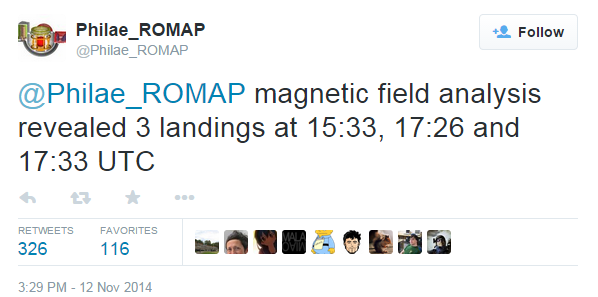
Philae successfully separated from Rosetta and arrived at Comet 67P/Churyumov-Gerasimenko. It did land but its anchoring harpoons apparently failed to fire.  Magnetic field data indicates that Philae has touched down at least 3 times. After the first, the lander bounced and took over 2 hours to touch down again. It bounced again and then touched down 7 minutes later. It is hoped that it has come to rest with the 3rd touchdown but this will not be confirmed till this morning. (Update! It has just been confirmed that the lander is on the surface, stable and sending pictures. Its attitude is not known but full data transmission seems to have been established. Data on the tomography of the comet’s nucleus is also being transmitted).

A remarkable achievement after a 10 year journey. Now the Rosetta orbiter will remain in close proximity to the comet and will accompany it as it approaches the Sun. The Rosetta mission is due to end in December 2015. “By then, both the spacecraft and the comet will have circled the Sun and be on their way out of the inner Solar System”.

Philae bouncing

The Rolis instrument on Philae took this picture on descent:


The image shows comet 67P/CG acquired by the ROLIS instrument on the Philae lander during descent on Nov 12, 2014 14:38:41 UT from a distance of approximately 3 km from the surface. The landing site is imaged with a resolution of about 3m per pixel.

The ROLIS instrument is a down-looking imager that acquires images during the descent and doubles as a multispectral close-up camera after the landing. The aim of the ROLIS experiment is to study the texture and microstructure of the comet’s surface. ROLIS (ROsetta Lander Imaging System) is a descent and close-up camera on the Philae Lander. It has been developed by the DLR Institute of Planetary Research, Berlin. The lander separated from the orbiter at 09:03 GMT (10:03 CET) and touched down on Comet 67P/Churyumov–Gerasimenko seven hours later.

XKCD captures the spirit of CERN

October 22, 2014

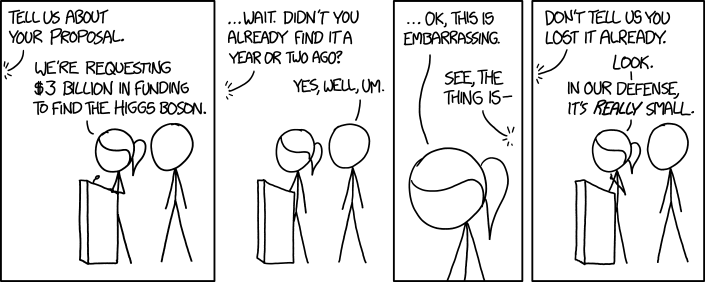
This one from xkcd is very apposite!

Higgs Boson

“It could have been another particle not inconsistent with the Higgs boson – or something like it. And it’s really small” – cartoon by xkcd/1437

Study shows that season of birth affects personality – sounds like astrology

October 20, 2014

A new study to be presented at the European College of Neuropsychopharmacology (ECNP) suggests that there may be something in astrology after all. The study is being presented at the ECNP Congress in Berlin. The researchers from Hungary find statistically significant links between season of birth and mood disorders.

astrology

I have always thought of astrology being ridiculously fanciful and horoscopes just so much hokum. But a tiny little part of my brain is always a touch uncertain. Clearly the seasons are controlled by the Earth’s relative position and its motion around the Sun. If the season of birth can affect personality then the effects of the Sun and other celestial bodies become real. That the moon may have effects on the results of cardiac surgery is apparently not just rubbish. The lunar nodal cycle does seem to correlate with happenings on Earth. The mechanisms leading to most lunar effects on tides and sedimentation and geologic accumulations and tidal flows and sea surface temperatures and climate can be put down to some interplay of gravitational forces. It is not such a long stretch to think that the gravitational effects of the larger planets may have some quite unlooked for effects on life on Earth.

Back in the days of psychedelia and Hair, we used to think that strange things would take place as the age of Aquarius dawned,  “When the moon is in the seventh house, And Jupiter aligns with Mars”.

Neuropsychopharmacology however is something quite new for me and sounds almost as arcane as astrology.

 Neuropsychopharmacology, is an interdisciplinary science related to psychopharmacology (how drugs affect the mind) and fundamental neuroscience, and is the study of the neural mechanisms that drugs act upon to influence behavior.

Professor Xenia Gonda is a clinical psychologist and pharmacist currently working as assistant professor at the Department of Clinical and Theoretical Mental Health at Semmelweis University, Budapest.

AlphaGalileo: According to lead researcher, Assistant Professor Xenia Gonda 

“Biochemical studies have shown that the season in which you are born has an influence on certain monoamine neurotransmitters, such as dopamine and serotonin, which is detectable even in adult life. This led us to believe that birth season may have a longer-lasting effect. Our work looked at over 400 subjects and matched their birth season to personality types in later life. Basically, it seems that when you are born may increase or decrease your chance of developing certain mood disorders”.

“We can’t yet say anything about the mechanisms involved. What we are now looking at is to see if there are genetic markers which are related to season of birth and mood disorder”.

The group found the following statistically significant trends:

  • cyclothymic temperament (characterized by rapid, frequent swings between sad and cheerful moods), is significantly higher in those born in the summer, in comparison with those born in the winter.
  • Hyperthymic temperament – a tendency to be excessively positive –  were significantly higher in those born in spring and summer
  • Those born in the winter were significantly less prone to irritable temperament than those born at other times of the year.
  • Those born in autumn show a significantly lower tendency to depressive temperament than those born in winter.

 Commenting for the European College of Neuropsychopharmacology, Professor Eduard Vieta (Barcelona) XY said:

“Seasons affect our mood and behavior. Even the season at our birth may influence our subsequent risk for developing certain medical conditions, including some mental disorders. What’s new from this group of researchers is the influence of season at birth and temperament. Temperaments are not disorders but biologically-driven behavioral and emotional trends. Although both genetic and environmental factors are involved in one’s temperament, now we know that the season at birth plays a role too. And the finding of “high mood” tendency (hyperthymic temperament) for those born in summer is quite intriguing.”

Sea surface temperature and the 18.6 year lunar nodal cycle

October 15, 2014

There is a growing body of scientific papers (some reported in my post here) which show long period connections between the 18.6 year lunar nodal cycles and sea level, tidal sedimentation, tidal mixing, sea surface temperature, Arctic climate and even drought. The mechanisms by which these influences are transmitted are hypothesised but are not known.

Compared to solar cycles the lunar cycles are not well known:

The lunar nodal cycle is not something that is very well known but it is another celestial cycle which is clearly not to be ignored. Naturally the IPCC takes no notice of solar cycles, planetary cycles or lunar cycles and all these are lumped into what could be considered “natural variability”.

(Sourced from Wikipedia)

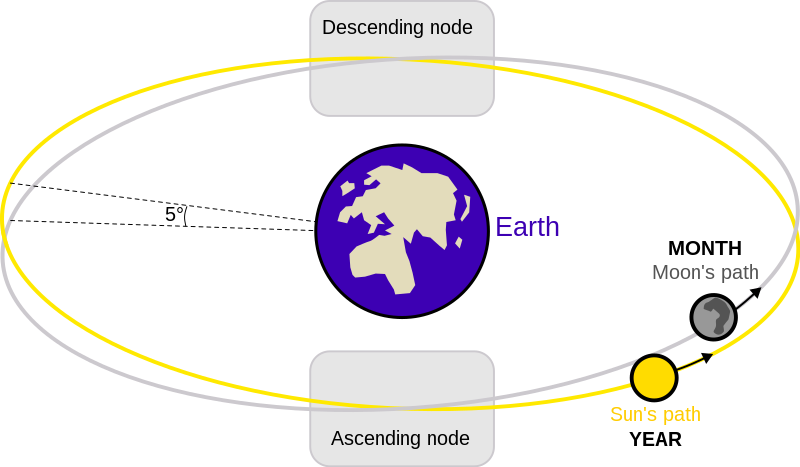
The lunar orbit is inclined by about 5 degrees on the ecliptic. The moon  therefore can lie up to about 5 degrees north or south of the ecliptic. The ecliptic is the plane of the apparent path of the Sun on the celestial sphere, and is coplanar with both the orbit of the Earth around the Sun and the apparent orbit of the Sun around the Earth.

File:Lunar eclipse diagram-en.svg

Lunar eclipse orbital diagram: wikipedia

The lunar nodes precess around the ecliptic, completing a revolution (called a draconitic or nodical period, the period of nutation) in 6793.5 days or 18.5996 years.

The effects of the 18.6 year lunar nodal cycle on climate on tides and geological sediments and on weather and climate have long been of interest (though not apparently for the IPCC).

The lunar nodes and the nodal cycles were known even to ancient astronomy (Greek, Hindu, Tibetan…) and has found a place in both Eastern and Western astrology. Since astrology is not considered “scientific”, suggestions that the lunar nodal cycle has any impact on the earth’s geology and climate are very often treated with ridicule. Yet the undoubted lunar effects on tides and tidal sedimentation and (therefore) geologic events are not disputed. The nodal period also controls when eclipses can occur.

Eclipses occur only near the lunar nodes: Solar eclipses occur when the passage of the Moon through a node coincides with the new moon; lunar eclipses occur when passage coincides with the full moon. A lunar eclipse may occur if there is a full moon within 11° 38′ (Celestial Longitude), of a node, and a solar eclipse may occur if there is a new moon within 17° 25′ of a node.

It is not surprising that the ancient astrologers/astronomers attributed many effects to the lunar nodes and the nodal cycles:

In Hindu astronomy, the ascending node is called Rahu and the descending node is called Ketu. Rahu and Ketu are thus the north and the south lunar nodes. Rahu represents the severed head of an asura, that swallows the sun causing eclipses. Times of day considered to be under the influence of Rahu are considered inauspicious even today in many parts of India (for weddings, starting journeys …..)

A new paper considers the effects of the 18.6 year lunar nodal cycle on Sea Surface Temperature (SST) and the Pacific Decadal Oscillation (PDO).

S. Osafune, S. Masuda and N. Sugiura, Role of the oceanic bridge in linking the 18.6-year modulation of tidal mixing and long-term SST change in the North Pacific, Geophysical Research Letters, DOI: 10.1002/2014GL061737

HockeyShtick reports:

A paper published today in Geophysical Research Letters finds a “significant contribution” of the 18.6 year lunar-tidal cycle to “wintertime sea surface temperatures near the center of action of the Pacific Decadal Oscillation [PDO] in the eastern Pacific,” and that

“This result supports the hypothesis that the 18.6-year tidal cycle influences long-term variability in climate; thus, knowledge of this cycle could contribute towards improving decadal predictions of climate.” [which IPCC climate models do not incorporate]

The approximately 60-year long Pacific Decadal Oscillation [PDO] in-turn profoundly affects global climate and interacts with other ocean and atmospheric oscillations. A very simple climate model based solely upon the sum of the sunspot integral, Pacific Decadal Oscillation [PDO], and Atlantic Multidecadal Oscillation [AMO] explains 96% of climate change over the 20th century: …..


Paper Abstract:The impact of the 18.6-year modulation of tidal mixing on sea surface temperature (SST) in the North Pacific is investigated in a comparative study using an ocean data synthesis system. We show that remote impact through a slow ocean response can make a significant contribution to the observed bidecadal variation in wintertime SST near the center of action of the Pacific Decadal Oscillation in the eastern Pacific. A comparative data synthesis experiment showed that the modified SST variation is amplified by bidecadal variation in the westerly wind. This relationship between SST and wind variations is consistent with an observed air–sea coupled mode in the extratropics, which suggests that a midlatitude air–sea interaction plays an important role in enhancing the climate signal of the 18.6-year modulation. This result supports the hypothesis that the 18.6-year tidal cycle influences long-term variability in climate; thus, knowledge of this cycle could contribute towards improving decadal predictions of climate.

I am of the opinion that climate is predominated by solar effects which are mediated primarily by the oceans over multidecadal periods and only over shorter periods by the atmosphere. And if lunar nodal cycles influence the tidal flows and tidal mixing then they will also influence the climate – also on the decadal scale.

We dance to a celestial music and the moon provides the variations on the climate themes set by the sun.