Archive for the ‘scientific misconduct’ Category

Closure for Stapel perhaps but social psychology remains “on probation”

June 28, 2013

Another Chapter in the Diedrik Stapel saga comes to an end as he reaches a deal with prosecutors but the exposure of his behaviour has revealed much that is not so uncommon in the field of social psychology. Social psychologists now need to be on their best behaviour to dispell the notion that “fraud” and confirmation bias are their stock-in-trade. Social  Psychology remains on probation and must avoid any hint of misconduct if it is not to lose further ground as an academic discipline ( but it will be quite some time before this discipline becomes a science).

Associated Press (via The Republic): 

THE HAGUE, Netherlands — A disgraced Dutch social psychologist who admitted faking or manipulating data in dozens of publications has agreed to do 120 hours of community service work and forfeit welfare benefits equivalent to 18 months’ salary in exchange for not being prosecuted for fraud.

Prosecutors announced the deal Friday, calling it “a fitting conclusion” to a case of scientific fraud that sent shockwaves through Dutch academia.

Diederik Stapel who formerly worked at universities in the cities of Groningen and Tilburg, acknowledged the fraud in 2011 and issued a public apology last November, saying he had “failed as a scientist.”

He once claimed to have shown that the very act of thinking about eating meat makes people behave more selfishly.

How much of “social-priming” psychology is just made-up?

May 11, 2013

There is a whole industry of social psychologists specialising in – and getting funded for – studying “social priming”. The more astonishing or contra-intuitive the result the more attention, the more publicity and the more funding the researcher seems to get. But it seems that many (maybe most) of these study results are irreproducibleIt is not implausible that priming does (should) affect subsequent behaviour but social psychologists seeking fame through astonishing results (often, it seems, made-up results) have not helped their own cause. The list of questionable “social priming” results is getting quite long:

    • Thinking about a professor just before you take an intelligence test makes you perform better than if you think about football hooligans.
    • people walk more slowly if they are primed with age-related words
    •  A warm mug makes you friendlier.
    • The American flag makes you vote Republican.
    • Fast-food logos make you impatient
    • lonely people take longer and warmer baths and showers, perhaps substituting the warmth of the water for the warmth of regular human interaction

Attention-grabbing results seem to be common among social psychologists of all kinds. A made-up result which says that “the smarter a man is, the less likely he is to cheat on his partner” generates the expected headlines and spots on TV talk shows. Diedrik Stapel made up data to prove that “meat eaters are more selfish than vegetarians”. Dirk Smeesters claimed that “varying the perspective of advertisements from the third person to the first person, such as making it seem as if we were looking out through the TV through our own eyes, makes people weigh certain information more heavily in their consumer choices” and that “manipulating colors such as blue and red can make us bend one way or another”. But Smeesters too has now admitted cherry picking his data. A raft of retractions followed and is still going on.

Nature: 

A paper published in PLoS ONE last week1 reports that nine different experiments failed to replicate this example of ‘intelligence priming’, first described in 1998 (ref. 2) by Ap Dijksterhuis, a social psychologist at Radboud University Nijmegen in the Netherlands, and now included in textbooks.

David Shanks, a cognitive psychologist at University College London, UK, and first author of the paper in PLoS ONE, is among sceptical scientists calling for Dijksterhuis to design a detailed experimental protocol to be carried out indifferent laboratories to pin down the effect. Dijksterhuis has rejected the request, saying that he “stands by the general effect” and blames the failure to replicate on “poor experiments”.

An acrimonious e-mail debate on the subject has been dividing psychologists, who are already jittery about other recent exposures of irreproducible results (see Nature 485, 298–300; 2012). “It’s about more than just replicating results from one paper,” says Shanks, who circulated a draft of his study in October; the failed replications call into question the under­pinnings of ‘unconscious-thought theory’. ….

….. In their paper, Shanks and his colleagues tried to obtain an intelligence-priming effect, following protocols in Dijksterhuis’s papers or refining them to amplify any theoretical effect (for example, by using a test of analytical thinking instead of general knowledge). They also repeated intelligence-priming studies from independent labs. They failed to find any of the described priming effects in their experiments. ……

……. Other high-profile social psychologists whose papers have been disputed in the past two years include John Bargh from Yale University in New Haven, Connecticut. His claims include that people walk more slowly if they are primed with age-related words.

Bargh, Dijksterhuis and their supporters argue that social-priming results are hard to replicate because the slightest change in conditions can affect the outcome. “There are moderators that we are unaware of,” says Dijksterhuis.

But Hal Pashler, a cognitive psychologist at the University of California, San Diego — a long-time critic of social priming — notes that the effects reported in the original papers were huge. “If effects were that strong, it is unlikely they would abruptly disappear with subtle changes in procedure,” he says. ….

CHE: 

This fall, Daniel Kahneman, the Nobel Prize-winning psychologist, sent an e-mail to a small group of psychologists, including Bargh, warning of a “train wreck looming” in the field because of doubts surrounding priming research. He was blunt: “I believe that you should collectively do something about this mess. To deal effectively with the doubts you should acknowledge their existence and confront them straight on, because a posture of defiant denial is self-defeating,” he wrote.

……. Pashler issued a challenge masquerading as a gentle query: “Would you be able to suggest one or two goal priming effects that you think are especially strong and robust, even if they are not particularly well-known?” In other words, put up or shut up. Point me to the stuff you’re certain of and I’ll try to replicate it. This was intended to counter the charge that he and others were cherry-picking the weakest work and then doing a victory dance after demolishing it. He didn’t get the straightforward answer he wanted. “Some suggestions emerged but none were pointing to a concrete example,” he says.

Social psychology and social psychologists have some way to go to avoid being dismissed out of hand as charlatans.

Faking the rythm: infantile academic spat at Rutgers University

May 7, 2013

Oh Good Grief!

As if the field of psychology did not have enough scandal and fakery already.

A childish spat between academics at Rutgers and infantile behaviour by Robert Trivers, a Professor of Anthropology who ought to know better. His opponent is William Brown, now a Senior Lecturer at the University of Bedfordshire.  But in this infantile academic spat it does seem as if the “establishment” are circling the wagons. I suspect that Robert Trivers, and Nature and other psychology heavyweights will prevail — but only to the further discredit of the discipline and its narcissistic  “star performers”.

Can’t they just both be spanked — in public? or put in the stocks?

A study featured in Nature in 2005 has drawn suspicion from university officials and one of its authors.

Nature: 

Few researchers have tried harder than Robert Trivers to retract one of their own papers. In 2005, Trivers, an evolutionary biologist at Rutgers University in New Brunswick, New Jersey, published an attention-grabbing finding: Jamaican teenagers with a high degree of body symmetry were more likely to be rated ‘good dancers’ by their peers than were those with less symmetrical bodies. The study, which suggested that dancing is a signal for sexual selection in humans, was featured on the cover of this journal (W. M. Brown et al. Nature 438, 1148–1150; 2005).

But two years later, Trivers began to suspect that the study data had been faked by one of his co-authors, William Brown, a postdoctoral researcher at the time. In seeking a retraction, Trivers self-published The Anatomy of a Fraud, a small book detailing what he saw as evidence of data fabrication. Later, Trivers had a verbal altercation over the matter with a close colleague and was temporarily banned from campus. 

An investigation of the case, completed by Rutgers and released publicly last month, now seems to validate Trivers’ allegations. Brown disputes the university’s finding, but it could help to clear the controversy that has clouded Trivers’ reputation as the author of several pioneering papers in the 1970s. For example, Trivers advanced an influential theory of ‘reciprocal altruism’, in which people behave unselfishly and hope that they will later be rewarded for their good deeds. He also analysed human sexuality in terms of the investments that mothers and fathers each make in child-rearing. …. 

In 2008, Trivers sought to retract the paper, but found the editors at Nature reluctant to do so. The paper remains unretracted, although a spokeswoman for Nature says that the case is under “active consideration”. (Information available to Nature’s research-manuscript editors is not generally shared with its reporters.) ….

…. Last year, the investigation concluded that there was “clear and convincing” evidence of fabrication by Brown, who it alleged had altered overall asymmetry measures of dancers to support the notion that better dancers were more symmetrical. The report was not published for more than a year, at which point Trivers posted it online. Rutgers has sent a copy to the NSF’s inspector-general, who is reviewing it to determine what action, if any, to take. ……

Brown, now a psychologist at the University of Bedfordshire, UK, denies fabricating the data. He criticizes the Rutgers investigation for comparing his data set with the one from Trivers’ group rather than the original hard copies of the source data.

Why is the New York Times publicising fraudster Stapel’s book?

April 30, 2013

I would not have expected the New York Times to be an apologist and a publicist for a fraudster.

The case of Diedrik Stapel and all the data he faked by just making them up to fit his pre-determined results will always bring discredit to the field (not science) of social psychology. But Stapel is now busy creating a new career for himself where his fraud itself is to be the vehicle of his future success. He has written a book about his derailment and the adoring media have not only forgiven him but are now playing an active part in his rehabilitation: in  humanising him and publicisng his book. The con continues and the media are (perhaps unwitting) partners to the con.

The New York Times ran a long “analytical” article about Stapel and his fraud a few days ago. A long interview with Stapel and ostensibly a “neutral” piece the article is entirely concerned with humanising the “criminal”.  It seems to me that Stapel is very successfully continuing to manipulate the media which earlier used to idolise him for his ridiculous “studies” (eating meat made people selfish!). But if you look at the NYT piece as a piece of marketing material for a book written by a discredited author it all makes sense. In fact the NYT article might just as well have been commissioned by the publishers of the book

NYT:  …. Right away Stapel expressed what sounded like heartfelt remorse for what he did to his students. “I have fallen from my throne — I am on the floor,” he said, waving at the ground. “I am in therapy every week. I hate myself.” That afternoon and in later conversations, he referred to himself several times as tall, charming or handsome, less out of arrogance, it seemed, than what I took to be an anxious desire to focus on positive aspects of himself that were demonstrably not false. ….. 

Stapel did not deny that his deceit was driven by ambition. But it was more complicated than that, he told me. He insisted that he loved social psychology but had been frustrated by the messiness of experimental data, which rarely led to clear conclusions. His lifelong obsession with elegance and order, he said, led him to concoct sexy results that journals found attractive. “It was a quest for aesthetics, for beauty — instead of the truth,” he said. He described his behavior as an addiction that drove him to carry out acts of increasingly daring fraud, like a junkie seeking a bigger and better high. ….

The report’s publication would also allow him to release a book he had written in Dutch titled “Ontsporing” — “derailment” in English — for which he was paid a modest advance. The book is an examination of his life based on a personal diary he started after his fraud was made public. Stapel wanted it to bring both redemption and profit, and he seemed not to have given much thought to whether it would help or hurt him in his narrower quest to seek forgiveness from the students and colleagues he duped.

The New York Times : The mind of a con man Published: April 26, 2013

“The book is an examination of his life based on a personal diary he started after his fraud was made public.”  writes our intrepid NYT reporter.

Really? – and how much of this self-serving “diary” was faked or just made up?

Willingly or otherwise, the New York Times (and the reporter Yudhijit Bhattacharjee) are being duped and manipulated by a consummate fraudster.

US Interior Department clears itself of misconduct

April 11, 2013

Internal inquiries set up to look into alleged misdeeds of any organisation always have a vested interest in protecting the organisation. Even those which have “independent members” but who are “hired” by the organisation are never truly independent. But what is often forgotten is that no internal inquiry about wrong-doing can ever in fact prove innocence by proving the negative – that wrong-doing did not take place. The only two options that are open as conclusions are that “wrong-doing did take place” or “no evidence of wrong-doing was found”. The latter is not a declaration of innocence.

Internal inquiries are usually the result of specific allegations and such inquiries are established mainly as a political ploy and to deflect criticism. Most such inquiries take the default position as being that no wrong-doing has occurred and require wrong-doing to be proven. But this is exactly the opposite of what they ought to be doing. They should – and maybe this should be mandatory for all internal inquiries – use the null hypothesis “that the alleged wrong-doing did take place” and the task is to see if there is evidence that this hypothesis is false. The presumption, I think must be that of guilt and cannot take the comfortable and rather cozy position of presumed innocence. Especially so in cases of alleged scientific misconduct. The onus should be on the impugned researcher to demonstrate the integrity of his evidence or data or images and not the other way around.

And therefore I take the findings of this internal inquiry conducted by the US Department of the Interior about alleged misconduct with a very large bushel of salt. Ironically the complaint was made by their own Integrity Officer. And considering that they have introduced new policies about integrity and have thereafter rejected all allegations of misconduct, it could be thought that the new standards are more about protecting the organisation rather than of protecting integrity.

The Record Searchlight:  

The U.S. Department of the Interior has rejected complaints of scientific misconduct made by its former scientific integrity officer, who accused the department of skewing information in favor removing dams on the Klamath River.

A panel hired by the department did not agree with Paul Houser’s claims that officials falsified scientific materials and circumvented policy on scientific integrity to garner public support for dam removal.

Houser filed a complaint last year, claiming a press release announcing the release of a draft environmental analysis cherry-picked facts to garner public support for removing four dams on the Klamath River. The press release also included a summary of key findings in the report that Houser said failed to include possible uncertainties about the information.

The panel’s report, titled “Independent evaluation of the scientific record pertaining to the allegations of Dr. Paul Houser,” says there was nothing unusual about the press release and key findings.

“It (the press release) was not intended as document on which to base a secretarial decision or to announce to the public such a decision,” says the report, which was written in August 2012, but not released to the public until this month.

Houser issued a rebuttal to the report blasting the department’s scientific integrity policy and the panel, claiming it was not independent, that its members were not qualified to investigate his claims and that the probe was inadequate. …….

………. 

The Interior Department has a web page listing the findings from all of its closed scientific integrity cases over the past two years. The findings on the 12 complaints say they were without basis.

“We seem to be getting more and more excuses why there was no misconduct,” Ruch said.

Prior to the department’s press release being issued in September 2011, Houser took his complaints to Interior Department officials, who changed it. But two weeks after raising issues over the release, Houser was placed on probation within the department.

Houser’s position was abolished last year and he was told he was “not a good fit” for the job of scientific integrity officer, PEER said. After losing his job, Houser filed a whistleblower complaint with the government.

Houser and the government “resolved” the whistleblower complaint last year. The resolution included an agreement that neither Houser or the department would comment on it. The department’s panel did not consider Houser’s claims of retaliation during its investigation.

“If Interior’s own scientific integrity officers are not shielded from reprisal for doing their jobs, how in heaven’s name could one expect a staff scientist to push back against political shenanigans?” Ruch said.

When hockey sticks are not robust …

April 1, 2013

I had almost got the 1st of April out of my system but I could not resist noting that when things are not “robust” they break and the broken pieces don’t stay put.

This gets classified as misconduct.

The Marcott Filibuster

Marcott et al:  ” … 20th century portion of our paleotemperature stack is not statistically robust, cannot be considered representative of global temperature changes, and therefore is not the basis of any of our conclusions”.

Not robust

Not robust

The McIntyre – The Bane of Climate Dogma and Mighty Slayer of Hockey Sticks

March 17, 2013

Steve McIntyre is

known in particular for his statistical critique, with economist Ross McKitrick, of the controversial hockey stick graph, which shows a sharp, and arguably unprecedented, increase in late 20th century global temperature.

He is at his sleuthing best again and Science will soon have to retract this new “hockey stick” paper

A Reconstruction of Regional and Global Temperature for the Past 11,300 Years, by Shaun A. Marcott, Jeremy D. Shakun, Peter U. Clark and Alan C. Mix, Science 8 March 2013: Vol. 339 no. 6124 pp. 1198-1201 DOI: 10.1126/science.1228026

This paper is apparently based on Marcott’s PhD thesis but the thesis contains no hockey stick!

By the time the paper was published a hockey stick had appeared.  In the most generous interpretation  the paper was “modified” to fit in with global warming dogma before being published in Science. A less generous – but more likely –  interpretation is that this is just fraud instigated probably by the global warming pundits who were the reviewers of the Science paper.

McIntyre’s latest post is a breathtaking indictment of the paper:

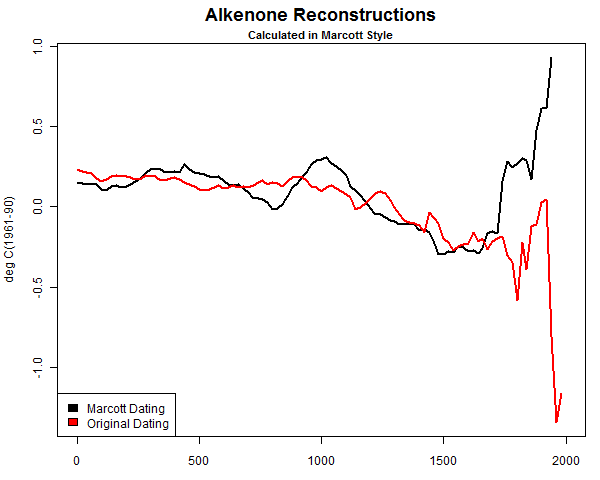
Marcott, Shakun, Clark and Mix did not use the published dates for ocean cores, instead substituting their own dates. The validity of Marcott-Shakun re-dating will be discussed below, but first, to show that the re-dating “matters” (TM-climate science), here is a graph showing reconstructions using alkenones (31 of 73 proxies) in Marcott style, comparing the results with published dates (red) to results with Marcott-Shakun dates (black). As you see, there is a persistent decline in the alkenone reconstruction in the 20th century using published dates, but a 20th century increase using Marcott-Shakun dates. (It is taking all my will power not to make an obvious comment at this point.)
alkenone-comparison
Figure 1. Reconstructions from alkenone proxies in Marcott style. Red– using published dates; black– using Marcott-Shakun dates.

Read More

The media went bonkers in reporting the Marcott paper  and this diagram will now go down in infamy:

marcott et al

This scandal is causing much attention ( here and here) but there is a deafening silence from the authors, from Science and from the – no doubt – anonymous reviewers.

I cannot draw but I have a clear image of a lone McIntyre battling against the Hockey Sticks. Perhaps a Josh can do justice to the image in my head.

The McIntyre slaying the Hockey Stick

The McIntyre slaying the Hockey Stick

Finale! Climategate 3.0 released and speculation about Mr. FOIA is rife

March 14, 2013

The anonymous disseminator of the Climategate emails (Climategate and Climategate 2.0) has been dubbed Mr. FOIA in the blogosphere. He still remains anonymous but he has now released the password for the large email dump he released under CG2.0. The password has been released to some selected bloggers  in the hope that they will have the time to sift through them, leave out any personal or irrelevant indiscretions and focus on the unprofessional and unethical manipulations of data by the “climate science” clique/hierarchy that was first revealed in Climategate.

We shall no doubt be hearing much over the next few weeks as this “crowd-sourced” analysis of the emails proceeds.

Mr. FOIA has probably achieved more than any other single individual in applying some brakes to the runaway train that was the global warming orthodoxy before Copenhagen. There is much speculation as to the identity of Mr. FOIA and my current speculative summary of his profile is:

    • not resident in the US or UK (>99%)
    • unlikely (<30%) to be usually resident in one of the old Commonwealth countries (Australia, Canada, S. Africa, India, N. Z., ….)
    • probably (>99%) not a native English speaker but with a formidable command of English
    • has possibly (>60%) been assigned to the University of East Anglia for some time (any faculty)
    • may have been (c. 30%) temporarily assigned to the CRE of the UEA
    • high probability of being resident in Europe (>70%)
    • could possibly (>30%) be originally from Scandinavia/Baltic States/N. Europe
    • has spent considerable time in the IT/programming fields (>99.9%)
    • IT experience perhaps only as support for his mainstream activities (>60%)
    • probably (>95%) male
    • probably (>75%) “white”
    • probably (>80%) aged under 50
    • probably (c. 80%) now agnostic/humanistic
    • probably (>50%) brought up as a Protestant/Lutheran
    • probably (> 50%) prefers wine to beer
    • probably (>50%) prefers beer to whiskey
    • probably (>60%) prefers soccer to baseball
    • probably (>80%) does not play golf

A photograph of Phil Jones – one of the Climategate stars – in his office from Tom Nelson’s blog.  I can see why FOIA requests are far too time consuming for him! A good thing that the science is settled. If only Phil had learnt to use Excel.

Phil Jones in his office with his data. Good thing the science is settled.

Shocking gender inequality in scientific misconduct

January 22, 2013

Apparently men are more likely than women to commit scientific fraud according to a new study. Of course the study only deals with misconduct and frauds that have been found out.

Important areas that the study does not address are – for example – :

  1. Whether women are being denied the same opportunities to cheat that their males colleagues obviously have and if so how this can be rectified, or
  2. Whether women cheat as much as men but are better able to conceal their misconduct and avoid being found out and if so what training or ability their male colleagues lack, or
  3. Whether this behaviour is due to the more aggressive nature of the male species and whether all male research should be subjected to greater scrutiny.

Whatever the reasons this kind of gender inequality should not to be tolerated in a modern society. Further study is clearly needed and I think there is plenty of room here for a number of PhD theses in social psychology. That is not to say that immediate actions to promote gender equality should be delayed. For a start quotas for women found to be committing misconduct could be introduced at all research institutions.

Male scientists are far more likely to commit fraud than females and the fraud occurs across the career spectrum, from trainees to senior faculty. The analysis of professional misconduct was co-led by a researcher at Albert Einstein College of Medicine of Yeshiva University and was published today in the online journal mBio.

“The fact that misconduct occurs across all stages of career development suggests that attention to ethical aspects of scientific conduct should not be limited to those in training, as is the current practice,” said senior author Arturo Casadevall, M.D., Ph.D., professor and chair of microbiology & immunology and professor of medicine at Einstein, as well as editor-in-chief of mBio.

He added, “Our other finding – that males are overrepresented among those committing misconduct – implies a gender difference we need to better understand in any effort to promote the integrity of research.”

In a previous study, Dr. Casadevall found that misconduct is responsible for two-thirds of all retractions of scientific papers. The finding was unexpected, since earlier research had suggested that errors account for the majority of retracted scientific papers.

Researchers embarked on the current study to better understand those who are guilty of scientific fraud. They reviewed 228 individual cases of misconduct reported by the United States Office of Research Integrity (ORI) from 1994 through 2012. ORI promotes the responsible conduct of research and investigates charges of misconduct involving research supported by the Department of Health and Human Services.

An analysis determined that fraud was involved in 215 (94 percent) of the 228 cases reported by the ORI. Of these, 40 percent involved trainees, 32 percent involved faculty members, and 28 percent involved other research personnel (research scientists, technicians, study coordinators, and interviewers).

Overall, 65 percent of the fraud cases were committed by males, but the percentage varied among the academic ranks: 88 percent of faculty members who committed misconduct were male, compared with 69 percent of postdoctoral fellows, 58 percent of students, and 43 percent of other research personnel. In each career category, the proportion of males committing misconduct was greater than would have been predicted from the gender distribution of scientists. The gender difference was surprisingly large among faculty, said Dr. Casadevall, who also holds the Leo and Julia Forchheimer Chair in/of Microbiology & Immunology. Of the 72 faculty who committed fraud, just 9 were female – one-third of the expected 27 if females had committed fraud at the same rate as males.


“Serious scientific misconduct” but NUS tries to brush it all under the carpet

December 21, 2012

The National University of Singapore is not going to win any prizes for transparency.

It is perfectly understandable that they would like that the massive “serious scientific misconduct” by Alirio Menendez had never occurred but they would seem still be in a state of denial when they refuse to reveal any details. Some 70 of his papers were suspect  and the NUS admits that more than 20 papers are involved but say little else. The NUS – which is desperately trying to buy its way to a reputation – would do better to take a lead in being transparent and – as Retraction Watch points out – follow the example of  “University of ConnecticutErasmus Medical CenterTilburg University, and others who’ve been involved in high-profile misconduct cases”.

Retraction Watch has this update on the Melendez saga:

Alirio Melendez, a former National University of Singapore immunologist whose story we’ve been following here since a retraction in September of last year, committed misconduct on an “unprecedented” scale, according to the university, involving more than 20 papers.

Nature’s Richard van Noorden has the scoop:

After a 19-month investigation, the National University of Singapore (NUS) today says that it has determined that one of its former scientists, the immunologist Alirio Melendez, has committed “serious scientific misconduct”.  The university found fabrication, falsification or plagiarism associated with 21 papers, and no evidence indicating that other co-authors were involved in the misconduct, it says.

Melendez has retracted five papers so far, as we’ve reported, but NUS wouldn’t give the whole list. They tell Nature:

“It’s standard procedure that for research-misconduct investigations such a report and the list of papers would be kept confidential,” an NUS spokesperson explained to Nature. She said that the university is now contacting journal editors and co-authors about each of the papers involved, and added that normally the university would not make a public statement at all, but in this case “the scientific misconduct uncovered was unprecedented”. When asked whether the report would remain permanently under wraps, she added: “I don’t think it will be released at a later date.”

Translation: Well, there you have it, folks, please move along, nothing to see here. It’s “standard procedure” to sweep misconduct investigations under the carpet, so we’ll just keep doing things our way, thank you very much. We released a statement this time because the misconduct was “unprecedented.” But misconduct with precedent? We’re not going to release reports about that.