Archive for the ‘Sport’ Category

Bjørndalen – and the “sense of Wow”!

February 9, 2014

Ole Einar Bjørndalen40 years old, 6th consecutive Olympic Games, 20 years of competition at the highest level, 12 Olympic medals, 7 Olympic Golds  (so far), all in the biathlon. Wow! On only the second day of the Sochi games and my “sense of Wow” has been well and truly engaged.

I watched the 10km biathlon sprint yesterday at Sochi and Bjørndalen, in spite of missing one target in the shooting, was strong enough in the skiing sections to win. He was not the favorite since his results this season have not been spectacular and he has generally been considered the veteran in the twilight of his competitive career. Wow!

His Olympics career has been both long and spectacular:

Bjoerndalen Olympics medals (2014-02-09) Wikipedia

Bjoerndalen Olympics medals (2014-02-09) Wikipedia

He still has the chance of winning a few more medals.

BBCNorway’s Ole Einar Bjoerndalen equalled the record for most medals won at the Winter Olympics as the 22nd Games got under way in Sochi, Russia. Bjoerndalen, 40, won the biathlon 10km sprint to take his tally to 12 medals, matching compatriot Bjoern Daehlie. 

Bjoerndalen finished ahead of Austria’s Dominik Landertinger and Czech biathlete Jaroslav Soukup to claim the seventh Olympic gold medal of his career.

“This victory has been a four-year job and it has been many years since I won (an individual gold medal), but life is too short to give up,” said Bjoerndalen. “I think this is one of my most important victories.” The Norwegian will get the chance to break Daehlie’s record in the men’s pursuit on Monday, but he played down comparisons between the pair. “It’s difficult to compare us at this time because Bjorn was some years ago and now we have a lot more disciplines,” he said.

The only faint shadow I perceive is that the achievements at Sochi not be later spoilt by revelations about doping. Whether or not Lasse Viren ever indulged in blood doping, some other Finnish athletes of his day did but it was not illegal at the time (1970’s). The Norwegian ski team in the 1990’s have also been accused of dirty tricks. The intense Alpine skiing events have had their share of rumoursMarit Bjoergen also won a gold yesterday in the skiathlon. She takes asthma medicine and has had dispensation to do so when it contained a banned substance (which is no longer banned upto certain quantities). In any event she has also faced accusations from her peers that her asthma inhaler was performance enhancing. I suppose being able to breathe is performance enhancing. But I thought that Pistorius being allowed to use blades to run in the summer Olympics was ridiculous. Why not allow a javelin thrower with a weak arm to use a “spear-thrower” attachment to his arm?

Usain Bolt generates a sense of Wow and there are no indications that he is anything but “clean”. But so did Ben Johnson generate the same sense of Wow when he won. And even Lance Armstrong. More often than not rumours of dirty tricks have – much later – been found to be true and sometimes banned.

I have a feeling that athletic team directors and doctors are continuously looking for legal performance enhancing methods and it takes a little time before any new methods discovered become widely known, spread and are then banned (like blood doping).  For an armchair spectator like me it is “the sense of Wow” which attracts and captures my imagination. I just hope that my  “sense of Wow” – not just at Bjørndalen’s fantastic achievements are not deflated and destroyed by later revelations of dirty tricks – even if they are not illegal for now. 
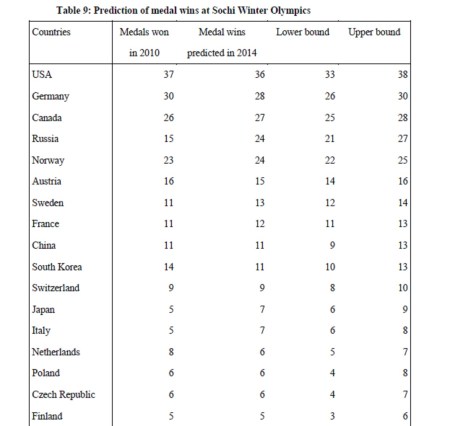
Is PwC plagiarising Andreff’s Sochi Olympic result predictions?

February 7, 2014

In November last year I posted about this paper which used economic factors to develop a model for Olympics medal results and then used the model to predict medals won at the Sochi Winter Olympics starting today. Today Price Waterhouse Coopers (PwC) have with great fanfare made their predictions for the winter Olympics. In their press release they make no mention of this earlier paper

W AndreffEconomic development as major determinant of Olympic medal wins: predicting performances of Russian and Chinese teams at Sochi Games, in Int. J. Economic Policy in Emerging Economies, 2013, 6, 314-340.

The PwC predictions are slightly different but remarkably similar to the results published by Andreff. They claim to have looked at the same factors as Andreff did. They make the same prediction of home advantage for Russia as Andreff did. I don’t have access to their full report but their press release makes absolutely no reference to the earlier paper and seeks to take credit for the analysis. If their report makes no acknowledgement of the work by Andreff then it does look very much like plagiarism by PwC. Even if their “econometric” model has been developed independently, it is still a plagiarism of ideas if an acknowledgement of Andreff’s analysis has not been made.

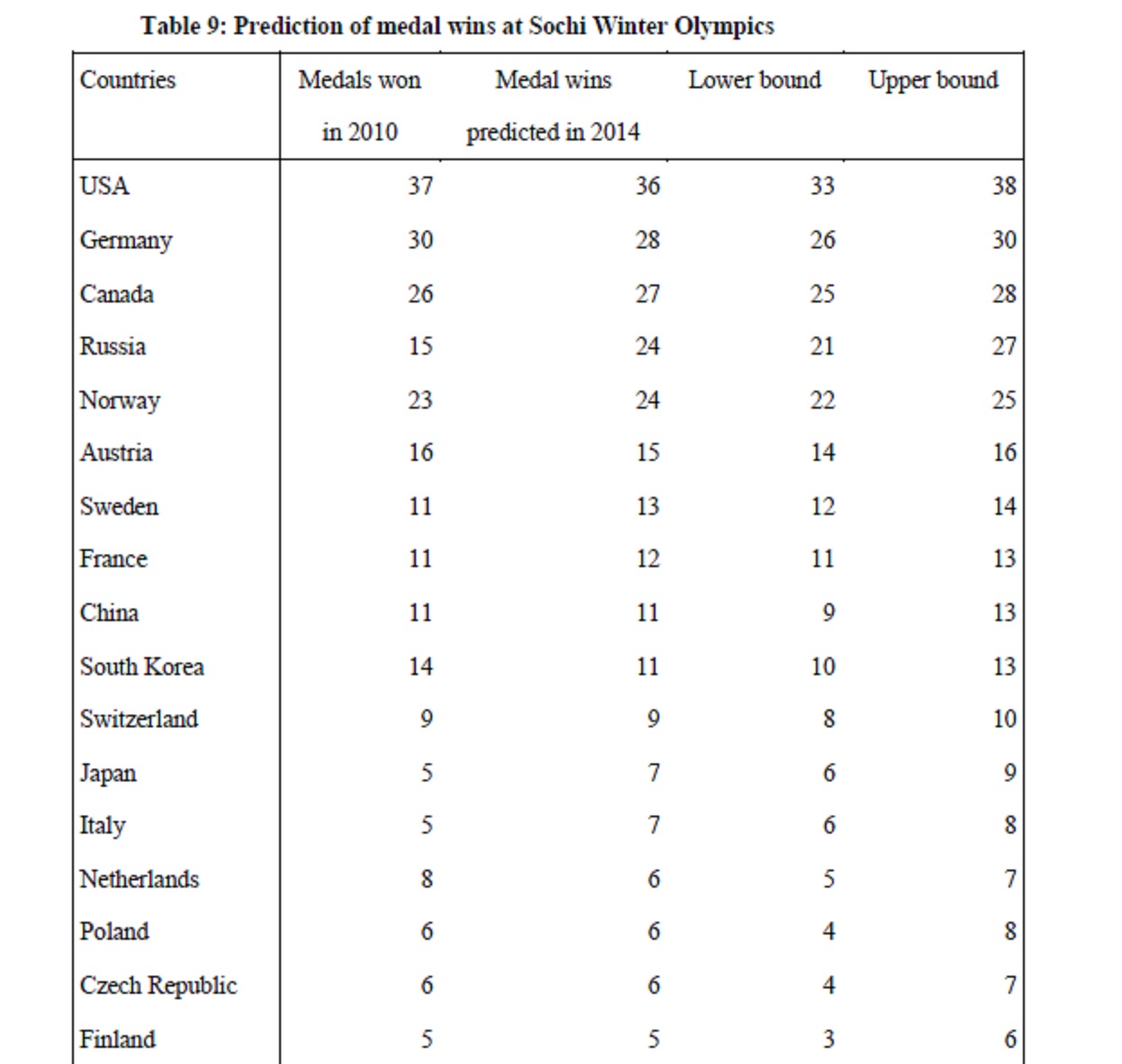
Andreff Result Predictions:

Medal predictions Sochi 2014 - M Andreff

Medal predictions Sochi 2014 – M Andreff

PWC Medal Predictions

PWC sochi predictions

PWC sochi predictions

Press Release via ConsultantNews:

London, 31 Jan 2014As with the Summer Olympics, home advantage could play a key part in how the Winter Olympics medals are shared out next month – with hosts Russia looking set to capture a record haul.

But the hosts – along with close rivals Germany, Canada, Austria and Norway – will have their work cut out to catch the US team. Further down the table, after their London 2012 Olympics success, the GB team may have to settle for just a couple of medals. And unfortunately the cool Jamaican bobsled team don’t even make it into the running. 

Once again, economists at PwC have used their skills to project the likely medal tally – this time for the Olympic Winter Games at Sochi starting on 7 February. Their analysis is based on econometric modelling, testing the historic correlation between a range of socio-economic metrics and historic medal success.

The modelling results show that the size of the economy is significant in determining success, with total GDP appearing as a significant variable. However, a large economy is not sufficient on its own for a strong performance. Climate is an important factor, with snow coverage and the number of ski resorts per head having a significant and positive impact on medal shares.

Larger, developed countries with the right climate dominate the top of the projected medals table; but Austria and Norway demonstrate that a smaller economy is not a barrier to success, with a greater estimated medal haul than countries such as China and France.

William Zimmern, PwC economist, said: “While this is a light-hearted analysis, it makes an important point of how organisations can use economic techniques to help make better business decisions. The purpose of our model is not to forecast medal totals with complete accuracy, but rather to increase the predictive power of medal projections over and above using historic medal results alone.

The model allows us to make better, more confident and more informed forecasts. Businesses can use similar techniques to do the same.”

Home advantage – PwC

We used regression analysis to produce the results in Table 1, employing a Tobit model to estimate medal share for the 28 countries which have won at least one medal in the last three Winter Olympics. The variables used were total GDP, ski resorts per head, level of snow coverage, medal shares in the previous two Winter Olympics, and dummies for countries with a “tradition” of winter sports and for host countries.

I have worked with PwC many times during my career. They are very effective but they are not slow in trying to take credit wherever they can – even if it is undeserved. And their ethics are generally as lacking as is endemic in their industry (audit/consultancy).  A little bit of plagiarism by PwC – and not for the first time – would not be a great surprise.

Putin’s Sochi is “ready” but journalists are missing their basic luxuries!

February 5, 2014

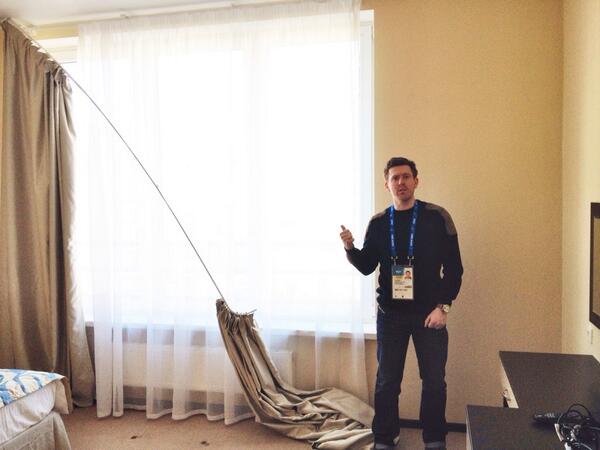
Putin’s winter games open in Sochi on Friday and journalists have started arriving. But Putin is probably a little indignant that they are nowhere near as hardy as he is and expect all manner of luxuries ranging from

View image on Twitter

Twitter image Harry Reekie @CNN

  • one room per person (Putinities can manage with 11/room)
  • curtains
  • toilet paper
  • heating
  • internet
  • elevators that work
  • running water
  • hotel lobbies
  • reception desk
  • water safe to wash in
  • water safe to drink
  • flooring
View image on Twitter

Twitter image @wyshynski

ReutersRussian officials have declared Sochi ready for the Games, on which President Vladimir Putin has staked his and his country’s reputation. But days before they open on Friday, the organizers acknowledge that not all the new hotels are ready, despite the Games’ $50-billion price tag. ……. 

macho putin

Although no athletes are affected, officials from two countries said they were turned away when they arrived at night in Krasnaya Polyana because their hotels were not ready. They too have been temporarily moved elsewhere.

The International Olympic Committee (IOC) has urged the Russian organizers to sort out the problems quickly and says only about three percent of the newly built accommodation – around 700 rooms – are not ready for guests.

Macho Putin is not impressed by these namby-pamby types. 

Related posts:

Sochi Winter Olympics: Champions of Corruption

Economic model predicts Olympic medals at 2014 Sochi winter games

Sochi Winter Olympics: Champions of Corruption

January 28, 2014

A new site defines the Champions of Corruption at the Sochi Winter Games.

The site asserts:

sochi champions of corruption

Athletes are not the only people who compete in Sochi. Officials and businessmen also took part in the Games and turned them into a source of income. The Anti-Corruption Foundation honored the most distinguished money siphoners in five different sports

Classic Embezzlement, Arkady Rotenberg  

Verbal Freestyle, Vladimir Putin 

Ecological Multi-Sport, Vladimir Yakunin 

Pair Contract, Alexander Tkachyov and Roman Batalov 

Figure Lending, Vladimir Potanin

The site is ostensibly anti-corruption but the objectives are clearly political:

The AustralianAlexei Navalny, an anti-corruption campaigner who ran for mayor of Moscow last September, has used the site to combine data gathered during his own investigations with media accounts and other activists’ reports. According to Mr Navalny’s Encyclopaedia of Spending, the athletes are not the only people who compete: “Officials and businessmen also took part in the Games and turned them into a source of income.”

His site honours five “champions of corruption”, including President Vladimir Putin, who is accused of lying about the cost of the project when he claimed it was $US6.5 billion. Mr Putin has rejected the claims.

German football team builds its own resort in Brazil for the World Cup

December 16, 2013

The construction program for the 2014 Brazilian World Cup venues is well behind schedule. A number of deaths have occurred at the various construction sites. Two workers were killed when a crane collapsed onto the roof of the Corinthians Arena in Sao Paulo in November. Another was killed at the Palmeiras arena in Sao Paulo which is/was to be a training ground for some of the teams. The latest accidents were at the Arena Amazonia in Manaus, the capital of Amazonas. The Arena is scheduled to host four group stage matches during the competition. Two deaths on Saturday bring the death toll at this Arena to three. A 23 year old construction worker was found dead and is said to have suffered a heart attack. (At 23!) Another worker fell 35 meters after a cable snapped. Work is so far behind at most sites that accelerated, 3-shift programs are being conducted to catch up. Inevitably safety procedures are being given less priority. Some have refused to work and a general strike over safety standards has been called for and further threatens the schedule.

soccer.si.com: Less than a month away from the Dec. 31 FIFA-imposed deadline for Brazil to deliver all 12 of its tournament venues, half are still unfinished, with three of those having no realistic shot of wrapping up before February.

Hotels and transport arrangements are also behind schedule.

TelegraphThere have been disputes and delays to the new light rail vehicle system in another host city, Cuiaba, while in the north-eastern settlement of Natal, mobility projects had to be abandoned and redesigned because of a shortage of time.

Accommodation is also a concern with a shortage of hotels in Rio de Janeiro and Recife, according to the Brazilian Association of Hotel Industries (ABIH). This week, workers at Rio’s Gloria Hotel, which is due to open before the World Cup, told Jornal do Brasil that the renovations were falling well behind.

But the German Football Association is not taking any chances. Winning the Cup is a serious business and they do not place much confidence in the assurances that facilities will be ready. They could not find the hotels to pass muster. So they are taking matters into their own hands and are building their own resort for their players. Der Spiegel writes: Unable to find a suitable location to set up shop in Brazil during the upcoming 2014 World Cup, the German football team has decided to simply build its own. The remote beachside camp will “help minimize strain” on players, the team manager says”.

A digital rendering of the luxurious beachside retreat provided by the German Football Association.

A digital rendering of the luxurious beachside retreat to be provided by the German Football Association.

The team’s beachside “resort” will be located in the sleepy village of Santo André in the state of Bahia, population just around 1,000, the paper wrote. It’s the first time in history that the German team has built its own World Cup facility from scratch, it added.

Coach Joachim “Jogi” Löw, his players and the team’s staff will spend the tournament living in 13 houses, with a soccer playing field and press center about a kilometer away. An airfield just 15 kilometers off will facilitate travel to the match sites.

Bild reports that the construction site entrance already bears the colors of the German flag — black, red and gold.

The location of “Camp Bahia” is “very remote,” Bild added. Some 30 kilometers away from the Porto Seguro resort area, most travelers get there via an old ferry across the Joao de Tiba River.

Economic model predicts Olympic medals at 2014 Sochi winter games

November 29, 2013

Update! See post of 7th February 2014 about PwC’s predictions.

==============================================

Two economists believe that the number of medals that will be won by any country at the 2014 Winter Olympic games in Sochi will be determined primarily by GDP. They have developed an economic model, tested it against previous Olympic results from 1964 to 2010 and have found that other factors have only a minor effect. They have used their model to make predictions for the 2014,  XXII Olympic Winter Games at Sochi in Russia!

Medal predictions Sochi 2014 - M Andreff

Medal predictions Sochi 2014 – M Andreff

Economic Prediction of Medal Wins at the 2014 Winter Olympics, Madeleine Andreff and  Wladimir Andreff  (pdf: Andreff Sochi)

There is also a published version of the paper: W Andreff, Economic development as major determinant of Olympic medal wins: predicting performances of Russian and Chinese teams at Sochi Games, in Int. J. Economic Policy in Emerging Economies, 2013, 6, 314-340.

Abstract: Starting from an econometric model successfully used to explain and then predict the distribution of medal wins across nations at the Beijing Summer Olympics, a similar model is elaborated on with some different explanatory variables for estimating the determinants of medals won per nation at Winter Games. A Tobit estimation of the model based on data from 1964 to 2010 shows that GDP per capita, population, the endowment in ski and winter sports resorts, and a host country dummy are significant determinants of medal wins at Winter Olympics. Then the estimated model is used for predicting the sporting outcomes at the 2014 Sochi Games with a focus on Russia and China. The Russian team is expected to perform better than in Vancouver 2010 and to be ranked fourth behind the USA, Germany and Canada while the Chinese team would be ranked ninth, a performance doomed to improve in the future given China’s swift economic development.

In their base study the authors do warn that a pinch of salt would be called for and conclude:

Conclusion
All the above predictions must be taken with a pinch of salt. This is namely due to a number of surprising sporting outcomes. Indeed, there are many unexpected sporting outcomes observed ex post ( i.e. achieved outcomes markedly different from the forecast – even though it happens more with the FIFA World Cup than with Summer Olympics (M. & W. Andreff, 2010). Unexpected or surprising outcomes of a sport game or contest have not really been analysed so far. This happens when opponents in a game (contest) have clearly uneven sporting forces, and the underdog wins the favourite. Elaborating on a metrics to quantify surprising sporting outcomes should be a promising avenue for further research. It will be possible to check after Sochi 2014 whether Winter Olympics are characterised with many or few surprising sport outcomes.
For the time being our recommendation is: do not bet that Russia will win 24 medals at Sochi Winter Olympics! But, if Russia makes it with more than 27 medals you would be allowed to conclude that she performed very well, better than expected with an economic model, and that this must be due to exceptional efforts of Russian athletes and coaches before and during Sochi Games. If Russia would win less than 21 medals, you could join Prime Minister Putin and President Medvedev in complaining that the Russian winter sports squad should really have done better – or that it was unexpectedly bad lucky.

The Russians are expecting to be the leading nation on the total medals table and they will not be pleased if they win less than 21 medals. Heads will roll!

If GDP really is the determining factor it should not be too difficult to devise a handicapping system to level the field of competition.

I am inclined to take this with a bucket rather than a pinch of salt.

Waiting for a new Tendulkar

November 20, 2013

An almost necessary requirement for anyone to be a credible successor to Tendulkar will be for him to enter into Test cricket by the age of 17 or 18 at the latest (Tendulkar joined the Indian Test team at 16).

Two years ago Arman Jaffer exploded into cricket consciousness with 498 runs for his school Rizvi Springfield in a Giles Shield match. He was only 13 at the time. He was selected this summer when he was still 14 as a probable for Mumbai’s Ranji Trophy squad.  He is still only 15 and remains on course to emulate Tendulkar’s particular brand of divinity.

ToIVeteran opener Wasim Jaffer will welcome the introduction of his 14-year-old nephew Arman Jaffer, who was included in a 30-man probables list named by the new panel of Mumbai selectors, ….. Having scored heavily in junior cricket in the past few years, Arman has already made a name for himself as a batting sensation. He slammed a record 498 for Rizvi Springfield in the Giles Shield final back in 2010, and almost broke that mark by rustling up 473 this February in the Harris Shield final at Matunga Gymkhana. This season, Arman steered the Mumbai U-16 team to the Vijay Merchant title by scoring 1046 runs with four hundreds and eight fifties — in six games. It was the first time a batsman had scored more than 1,000 runs in that tournament.

But there are others who could push Arman Jaffer hard. His record of 498 in schools cricket has already been broken, once again by the captain of Rizvi Springfield.

ToIMumbai’s under 16 and Rizvi Springfield captain Prithvi Shaw created the world record by becoming the first batsman to score 500 runs in inter school tournament. The 14 years old Prithvi achieved the milestone against St. Francis D’Assisi in the Harris Shield tournament match on Wednesday. 
Prithvi’s marathon 546 runs knock that came off 330 balls was studded with 85 fours and five sixes.The Mumbai teenager broke Armaan Jaffer’s record of 498 runs. On Tuesday, Prithvi was unbeaten on 257 to put Rizvi Springfield (Bandra) in command against St. Francis D’Assisi (Borivali).

First Post: …. Shaw has amassed 4000 runs in the last three years across the circuit — mainly in school cricket competitions. …… Shaw has already played abroad in England for the Gloucestershire second team — which is just one level below first-class cricket. ”I am a professional and when I see talent I know it. If he keeps up the work, in five years he will arguably be the best batsman in the world,” former English county cricketer and the founder JW cricket academy Julian Wood said about the teenager.

The vintage Tendulkar will be sorely missed of course – though I think he should have retired 4 or 5 years ago. But his straight driving between mid-on and cover came straight from heaven. But there is new talent making itself known. Jaffer and Shaw will be names to watch and I am quite sure they will not be without rivals.

For all schoolboy cricketers it will be a worthy ambition to try and follow in Sachin Tendulkar’s footsteps. But to actually succeed Sachin will not be easy and it may never happen.

Qatar 2022 will achieve more deaths than goals

October 2, 2013

Based on the track record of World Cup Tournaments, the Qatar 2022 championship will see between 100 and 180 goals – most likely around 150.

But this number will be easily exceeded by the number of construction workers who have been killed by then. Already over 70 Nepalese workers have died since 2012 and the total number is probably around 200. By 2022 this number will exceed 1000.

Perhaps FIFA could introduce a safety performance index for the Qatar World Cup? Maybe to have less than 6 deaths per goal?

The Guardian:

Seventy Nepalese builders working in Qatar in the runup to the 2022 football World Cup have died on construction sites since the start of 2012.

Fifteen have died this year, according to a death toll announced by Nepal government representatives in Doha. It is the clearest official data yet on the dangers facing 1.2 million migrant workers in the Gulf kingdom during the $100bn (£62bn)construction drive before the World Cup and came as David Cameron called on Qatar’s leadership to take action. He said zero deaths on the London 2012 Olypmics project showed Doha “it can be done”.

Nepalese trade unions said many of the fatalities were caused by workers without proper safety equipment toppling from the upper floors of buildings. …..

There are 340,000 Nepali workers in Qatar and if the mortality rate was extrapolated across all migrant workers it would suggest that more than 200 foreign workers could have died on Qatari building sites since the start of 2012.

“This reminds us of the industrial revolution 150 years ago,” said Sharan Burrow, secretary general of the International Trade Union Confederation. “Young healthy men are being worked to death in Qatar. Scores are dying from heat exhaustion and dehydration after 12-hour shifts in blazing heat, often during the night in the squalid and cramped labour camps with no ventilation and appalling hygiene.”

Last week the Guardian reported that documents showed 44 Nepalese workers died in Qatar between 4 June and 8 August this year, and that more than half died of heart attacks, heart failure or workplace accidents. It said evidence of exploitation and abuses pointed to “modern-day slavery, as defined by the International Labour Organisation”.

Of course the Qatari government claims that all these numbers are exaggerated, but the reality is that the lives and working conditions of their “guest workers” is of little interest for the Qataris. Foreign workers are expendable and the supply of such workers is endless. In this they are happily supported by the manpower agencies – in Qatar and abroad – whose revenue depends upon the turnover of bodies. Perversely the death of a worker only leads to additional revenue for the agencies who find his replacement. From what I have heard from one such manpower agenciy in India, they get paid for fulfilling their quota of workers to the main contractor of the construction project. They merely deliver bodies to Qatar and the construction site. They only perform a cursory check on the suitability or the abilities of the workers. Two arms and two legs generally seems to enough.

These agencies then pay a cut of their fee to a Qatari owned agency in Qatar and that cut includes the amounts which are passed up the Qatari chain. The construction company in its turn pays an agreed amount for having obtained the contract to the same Qatari chain of beneficiaries – often through the same Qatari agency. The modes of doing business in Qatar are no great secret.

And FIFA buries its head in the sands.

Was Diana Nyad’s Cuba to Florida swim a hoax?

September 8, 2013

Oh dear.

I have the same sense of disappointment as when I read that yet another top athlete has been found to have been using drugs. I suppose we are all  looking for the stories of individuals who exemplify the ever stretching limits of human endurance and achievement. I was thrilled and I had only admiration a few days ago when the publicity machine exploded on 64 year old Diana Nyad having completed a 110 mile swim from Cuba to Florida. It made me feel good to be human. But it may all have been too good to be true.

Yet another “feel-good” bubble may be bursting.

Could the glare of the spotlight be so alluring and so lucrative as to lead to such an elaborate hoax?

CBS News:

Diana Nyad’s 110-mile swim from Cuba to Florida has generated positive publicity and adoration for the 64-year-old endurance athlete — along with skepticism from some members of the small community of marathon swimmers who are questioning whether she accomplished the feat honestly.

… long-distance swimmers have been debating whether Nyad got a boost from the boat that was accompanying her — either by getting in it or holding onto it — during a particularly speedy stretch of her swim. They also question whether she violated the traditions of her sport — many follow strict guidelines known as the English Channel rules — by using a specialized mask and wetsuit to protect herself from jellyfish. ……

 It was her fifth try, an endeavor apparently free from the boat troubles, bad weather, illnesses and jellyfish encounters that have bedeviled Nyad and other swimmers in recent years.

Nyad’s progress was tracked online via GPS by her team, and some critics say they think information is missing. 

Many wonder about a roughly seven-hour stretch when Nyad apparently didn’t stop to eat or drink, recalling her 2012 attempt when she got onto the boat for hours during rough weather. Nyad eventually got back into the water to try finishing, but her team was criticized for delaying the release of that information to the public. 

Malinak said the hours-long spike in Nyad’s speed after 27 hours of swimming is particularly questionable — she went from her normal pace of roughly 1.5 mph to more than 3 mph, then slowed down again as she approached Key West.

War, doping and radiation fears could give 2020 Olympics to Madrid

September 5, 2013

UPDATE! 7th September –

Tokyo Won.

================

Istanbul, Tokyo and Madrid are competing for the right to hold the 2020 Olympics and lobbying is at its peak since the decision is expected on Saturday 7th September.

Madrid was first trailing because the Spanish economy was/is not in the best of shape. Since Tokyo has already hosted the summer games (1964) and two winter games have been held in Japan, this opened the possibility of Istanbul getting the honour for the first time ever . This is their 5th attempt. But now lingering fears of radiation from Fukushima and of Turkey becoming embroiled in war (even though the games are 7 years away) seem to be bringing Madrid to the forefront again. This is Madrid’s 3rd attempt and the summer games were held in Barcelona in 1992.

Tokyo still has the best chance of raising the necessary finance. Both Istanbul and Madrid give cause for concern for financing. The greatest amount of new construction would be needed for an Istanbul games.

The Telegraph:

Fukushima failures threatening to derail Tokyo’s 2020 Olympics bid

The team behind Tokyo’s bid to host the 2020 Olympics Games is scrambling to save its long and expensive campaign from falling victim to the ongoing crisis at the Fukushima nuclear plant. …… Until a few weeks ago, the Japanese capital had been considered the front-runner, thanks to a slick campaign that has emphasised Tokyo’s efficient infrastructure, experience in hosting global sporting events, financial guarantees backed by the government and the fact that Tokyo “is one of the world’s safest and most welcoming cities.”

But recent civil unrest in Turkey and the potential for war in the region are worrisome. Istanbul is struggling also to dispel perceptions of rampant doping in Turkish athletics:

A new “zero tolerance” policy and a reaccredited testing laboratory will help Turkey fight doping following a string of positive cases, the head of Turkey’s bid to host the 2020 Olympics said on Wednesday.

More than 30 athletes were banned by the Turkish Athletics Federation in August and Turkish official Ugur Erdener said this was the result of the country’s new hardline stance and a previous lack of comprehensive testing.

“We understand there is no gain without pain,” Erdener, President of Turkey’s National Olympic Committee, told reporters, referring to the recent positive tests.

“Turkey now has a very aggressive anti-doping system. The lab will also be re-accredited by the World Anti-doping Agency this year. Not in the near future but in this year,” said Erdener who is also a WADA executive committee member.

The rumours are now that Madrid is going to win:

Huffington Post

…..  it seems increasingly likely the IOC will choose the Spanish capital of Madrid.

“To my astonishment, it seems like it’s going to be Madrid,” Wolfgang Maennig, a professor of economics at Hamburg University, told HuffPost.

Maennig, an expert in sports economics, is in Buenos Aires, Argentina, at a sports business symposium. Not coincidentally, representatives of the national Olympic committees are also currently in Buenos Aires, meeting to decide where the Summer Olympics will be held seven years from now.

Maennig said he met with two Olympic officials, including the president of a national delegation he declined to name, and both said Madrid was quickly pulling away as the favorite to host the Olympic Games over candidate cities Istanbul and Tokyo.

“I talked today to the president of a national federation and people are still afraid of Syria and even Iraq, even though that was years ago, affecting Turkey,” Maennig said on Wednesday. “There are also many concerns about the level of radiation in Japan.”

Lobbying is heavy and a great deal of Japanese money is being dangled in front of the IOC. It is said that the Japanese Prime Minister might attend but I would have thought he might find it difficult to get away from the G20 meeting in Saint Patersburg.

Well we shall know in a couple of days.