Archive for the ‘Technology’ Category

Spaceport America gets ready for first commercial passengers to space

November 18, 2010
Simplistic map of Sierra County, New Mexico, i...

Location of Spaceport America: image via Wikipedia

Reuters reports:

The New Mexico Spaceport Authority, which plans to start launching citizen astronauts on suborbital flights within 18 months, has begun soliciting contract bids from local businesses for day-to-day operations of the facility.

Construction of the world’s first commercial passenger space terminal, dubbed Spaceport America, is slated to be finished next year near the town of Truth or Consequences in southern New Mexico. The 2-mile-long main runway was completed in October.

Spaceport America Wednesday, 10 November 2010 04:09 :image spaceportamerica.com

Two other major structures nearing completion at the nearly $200 million facility are the air-fire rescue facility and a 110,000-square-foot hangar, authority spokesman David Wilson said.

To date, 380 wannabe space cowboys have each plunked down $200,000 each to reserve a seat aboard a Virgin Galactic six-passenger spacecraft for a 2-1/2-hour suborbital flight some 70 miles above the Earth, Wilson said.

Under a 20-year lease with the state, Richard Branson’s firm is Spaceport America’s anchor tenant and principal spaceliner, paying lease charges of up to $200 million, plus user fees to operate their own aircraft and to contract with other aerospace companies.

The site has been providing commercial launch services for the aerospace industry since 2006 and is expected to be fully operational by mid-2011. But Virgin Galactic expects to take another year to begin its private passenger service, once its test-flight program is complete.

The authority’s executive director, Rick Homans, this week issued a call for businesses to submit proposals for three major areas of operation of the spaceport.

They include general services, such as maintenance; protective services for site security, safety and environment health management; and technical services, including airfield and launch support, airspace management and flight safety engineering.

Artists impression of Virgin Galactic: image forums.finalgear.com

Virgin Galactic’s VSS Enterprise made its solo flight in October.

Rolls Royce must replace 40 of 80 Trent 900 engines deployed

November 18, 2010

I posted a few days ago that Rolls Royce would need to change out about 40 of the Trent 900 engines on the A380’s in operation with Qantas, Singapore Airlines and Lufthansa.

Now -via Qantas and The Press Association – this number has been confirmed by Rolls Royce:

Up to half of the Rolls-Royce engines of the type which disintegrated on an Airbus superjumbo this month may need to be replaced by the three carriers in Australia, Singapore and Germany, Qantas’s chief executive has said.

Australia’s Qantas, Singapore Airlines and Germany’s Lufthansa fly A380s powered by four giant Rolls-Royce Trent 900 engines, with a total of 80 engines on 20 planes.

Qantas chief Alan Joyce said that Rolls-Royce had indicated that up to 40 of them may need to be replaced.

“Rolls-Royce are still working through the criteria for which engines need to be changed,” he said on the sidelines of an event in Sydney unrelated to the A380 incident. He said that 14 of the 24 engines on Qantas planes may have to be replaced.

Whether Rolls Royce knew about the engine fault and the consequent risk prior to the accident on QF32 remains unanswered and whether the European Regulator (EASA) relaxed its inspection frequency Directive in response to Rolls Royce representations also remains unanswered.

Rolls-Royce cancels Zhuhai Air Show press conference

November 17, 2010

Rolls-Royce, beset by criticism over its public handling of the uncontained failures of its Trent 900 and 1000 engines, has canceled its planned Airshow China show briefing.

The engine-maker offered no explanation for the cancellation, leaving media attending the show only to speculate on its sudden change of plans.

http://www.flightglobal.com/blogs/flightblogger/2010/11/rolls-royce-cancels-zhuhai-pre.html#comments

Rolls Royce scrambling to find Trent 900 replacement engines

November 17, 2010
Mechanic working on a Rolls Royce Trent 900 en...

Trent 900: image via Wikipedia

Rolls Royce is asking Airbus to return new engines destined for new aircraft so that they can be supplied to Qantas, Singapore Airlines and Lufthansa for their operations. This in turn is having a knock-on effect on future A380 deliveries.

In the meantime Qantas seems to be having a rash of minor issues which have caused aircraft to return after cockpit fires, bird hits and lightning strikes.

The European Regulator (EASA) has not commented on why they relaxed their Airworthiness Directive and whether this was done in response to representations from Rolls Royce. The engine maker is also silent on whether they knew of the Trent 900 problem and the risk for an engine fire prior to the uncontained explosion of an engine on QF32.

Reuters reports on the logistics problems faced by Rolls Royce:

British enginemaker Rolls-Royce has asked Airbus to return Trent 900 engines from A380 superjumbo production lines so they can be used to replace faulty ones on aircraft already in service.

The Airbus A380 — the world’s largest passenger aircraft with an average list price of about $350 million — has been hit by safety concerns after a Rolls-Royce engine partly disintegrated mid-flight, forcing a fully laden Qantas plane to make an emergency landing in Singapore on Nov 4.

Rolls-Royce’s move could be another blow to a much-delayed A380 program as Airbus was scheduled to deliver over a dozen Rolls-Royce-powered A380s — primarily to Singapore Airlines, Qantas and Lufthansa by the end of next year.

“Until this problem is fully resolved I think the situation with the delivery of A380 to customers … will be in jeopardy,” Standard & Poor’s analyst Sukhor Yusof said. But both Singapore Airlines and Qantas, with a combined 22 A380s still to be delivered, said on Tuesday they had not been informed of any delivery delays.

Airlines using the Rolls-Royce Trent 900 engines have been ordered by European aviation authorities to undertake major tests, which analysts said were so strenuous they would likely disrupt schedules.

“I can confirm that Rolls-Royce is arranging to supply some new engines from the production line to replace some engines removed from the serviced aircraft,” an Airbus spokesman in Singapore said, without saying which airlines would receive those engines.

Shares in Rolls-Royce, which on Friday said fixing the fault would lead to only slightly slower profit growth, have suffered during its probe and were 0.2 percent down at 596.50 pence by 1130 GMT on Tuesday, around 9 percent below their last trade before the Qantas incident. Airbus parent EADS has lost 5 percent since the incident and hit a one-month low on Monday. Its shares were 1.3 percent down at 17.78 euros. Qantas is down 4.9 percent since the incident. Airbus said last week that the problem with the Rolls-Royce engine could have an impact on its earnings and delivery target for 2011 but did not give details, and airlines contacted on Tuesday had no knowledge of delivery timetable changes.

China’s Comac enters market to challenge Airbus and Boeing

November 16, 2010

http://www.flightglobal.com/articles/2010/11/16/349735/zhuhai-10-comac-announces-launch-c919-order-for-up-to-100-jets.html

The Commercial Aircraft Corp of China (Comac) has announced a launch order of up to 100 aircraft for its C919 narrowbody. Chinese carriers Air China, China Southern Airlines, China Eastern Airlines, Hainan Airlines, Chinese lessor CDB Leasing Company (CLC) and GECAS are the launch customers, says Comac at Airshow China 2010 in Zhuhai.

Comac C919

Half of the 100 orders are firm while the remaining are options, says Comac general manager Jin Zhuanglong. Air China, China Southern and China Eastern have ordered up to 20 C919s each, he adds. He did not give a detailed breakdown for the remaining orders. GECAS says it has ordered up to 10 aircraft, half of which are firm orders.

“Today is a very important milestone for us. The order shows that our product has been accepted by the market,” says Jin. The C919 is scheduled to have its first flight in 2014, with entry into service in 2016. The joint definition phase is ongoing, and is scheduled to wrap up early next year following a design review at the end of this year.

Comac says it aims to complete its detailed design work in 2012, before first flight in 2014.

The C919 comes in two initial versions for 156 or 168 passengers and will compete with the Boeing 737 (next generation) and the Airbus A320. CFM will supply a version of the LEAP-X engine, the LEAP-X1C, to power the aircraft

Air India’s first Dreamliner gets its colours

November 16, 2010

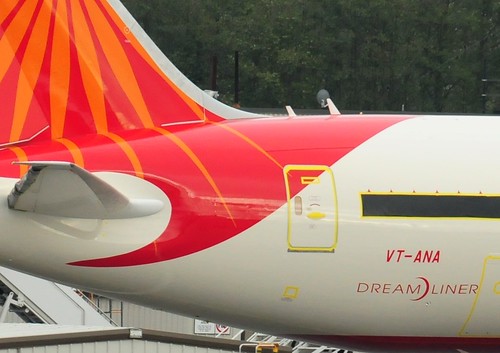
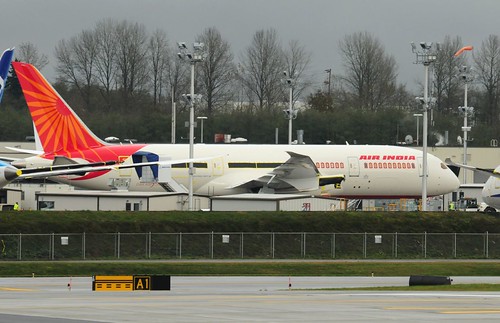
Air India‘s first 787 Dreamliner, registered VT-ANA, has been moved from the paint hangar to the Everett flight line. Airplane 25 is slated for a second quarter 2011 delivery to the Indian flag carrier.

Air India has 27 Dreamliners on order.

The VT prefix on Indian aircraft continues an old tradition and stands for “Viceroy Territory”:

The ICAO, a United Nations agency based in Montreal, was established in 1944 to draw up international regulations and standards for air travel. It is responsible for assigning the codes for airlines, airports and individual aircraft used by air traffic controllers across the world. It assigned the code VT to British India in 1944, three years before the country was divided into the independent states of India and Pakistan. India kept VT, while Pakistan was assigned AP. Britain now uses G. Several other former British colonies and territories still use codes that begin with V, such as Australia (VH), Antigua and Bermuda (V2), and the Falkland Islands (VP-F). Others have changed theirs, such as Fiji, which now uses DQ, and Kenya, which uses 5Y.

Plane 25 will be Air India's first Boeing 787 Dreamliner:Photos Credit Moonm

Air India Dreamliner VT-ANA: photo credit moonm

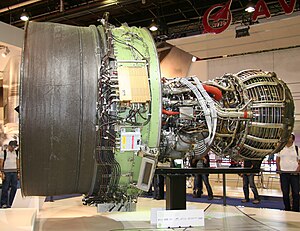
The black plasic on the windows is for  storage. Air India will be using General Electric GEnx engines (and the Rolls Royce Trent 1000 is the only other engine available for the Dreamliner).


General Electric GEnx - Paris Air Show 2009

Image via Wikipedia

General Electric GEnx at the Paris Air Show 2009: image Wikipedia

http://www.flightglobal.com/blogs/flightblogger/2010/11/photo-of-note-air-indias-first.html#comments

Problem with Trent 900 was known before accident and raises ethical questions

November 15, 2010

The diagnosis of the problem with the Trent 900 has come in a matter of days and the solution has already been identified and is under implementation. This convinces me that the problem was already known and so was the solution.

There are at least two  important ethical questions which are raised by the Trent 900 story.

1. The European Aviation Safety Agency (EASA), in August, apparently  relaxed a directive regarding the frequency with which Trent 900 engines were to be inspected. The Directive had been issued originally in January. That in itself  should primarily be a technical judgement call and judgements – especially in hindsight – can always be found to be faulty without raising any issues of ethics. However the ethical issue arises if – as it seems to be – the relaxation in August was initiated by representations from a party (Rolls Royce in this case) who found the original directive too onerous. The ethical standards of both the Regulator (EASA) and of the petitioner (Rolls Royce) then give cause for concern.

2. The second ethical issue arises if Rolls Royce knew in advance of the accident to the engine on QF32 that the engines in use were at risk and that the consequences could have been catastrophic. If this was just a judgement of the probability of failure and that this probability was judged insignificant then it is an issue of bad judgement but not unethical. But an insignificant probability of failure should not have initiated the programme of engine modifications that was apparently ongoing even before the accident. Therefore, if Rolls Royce, knowing full well that the risks were sufficiently high to require that the engines had necessarily to be rectified, kept quiet in the “gamble” that no accidents would occur before they had managed to modify all the “faulty” engines,  then it becomes a case of low ethical standards and not just poor judgement. Reports suggest that Rolls Royce knew that the modifications were necessary more than a year ago but also that the mechanic who revealed this was forced to speak anonymously. This does not give any confidence that there is full transparency and, in fact, strengthens the view that Rolls Royce knew there was a problem. The speed (days rather than months) with which the diagnosis has been made and the solution defined also indicates that the engine failure did not come as much of a surprise and that the problem and the solution were already known.

The mainly technical issues with the engine indirectly raise a more general question for the aviation industry of whether there are conditions where competitive pressures  can be damaging because they increase the risk of potential harm to the general public (who unwittingly become guinea pigs for testing new technologies).

Did Rolls Royce know about the risk for a Trent 900 failure before the Qantas accident?

November 14, 2010

Another new twist to the Rolls Royce Trent story.

First it appears that the regulators (EASA) relaxed their original inspection requirements in their Directive of August. It is not clear if this relaxation was in response to the airlines or to the engine maker requesting a change.

Now it seems that Rolls Royce may well have known (perhaps a year ago) that a number of their engines on “older” A 380s were susceptible to oil leaks and therefore to the potentially catastrophic consequences of a fire. About 40 engines on the Qantas, Singapore Airlines and Lufthansa A 380s have to be changed out.  The newer engines have undergone two modifications compared to the older engines. It seems that Rolls Royce started modifying oil systems on some engines almost a year ago.

If Rolls Royce knew about the risk to the Trent 900 before the flight of Qantas QF32 on November 4th, there is an ethical dimension which needs to be considered.

According to the Herald Sun,

Fourteen of the 24 Trent 900 engines fitted to the six A380s Qantas has grounded are suspected of having an oil leak problem. Another 24 “faulty” engines are on Singapore Airlines jets. The airline has grounded three A380s. Two have been found by the German carrier, which has suffered two Trent incidents.

Revised versions of the engine are being rushed to Qantas.

Sir John Rose, chairman of the British engine maker, issued a statement late on Friday in which he admitted a “specific component in the turbine area of the engine caused an oil fire”, which led to a turbine disc hurtling out. He offered “regret” for causing “disruption”. But he failed to reveal when Rolls-Royce discovered the turbines of the Trent 900 were being exposed to the dangerous oil leaks and the dates of the two upgrades.

Qantas, Singapore Airlines and German carrier Lufthansa installed the original-spec engines on some of their jets. It is understood Qantas has begun record checks to see whether Rolls kept its engineers informed of the design changes to the $25 million engines.

An aircraft mechanic with one of the three airlines claimed Rolls-Royce began modifying the oil lubrication system on the Trent 900 engine in the second half of last year.

Trent 900: European Aviation Safety Agency (EASA) relaxed earlier directive and reduced inspection frequency

November 13, 2010

Now that it seems that the main cause of the uncontained failure of the Trent 900 on Qantas Airbus QF32 has been diagnosed, and that a remedy is being implemented, attention is turning to the Regulators.

In September the FAA issued an Airworthiness Directive (AD) for the Trent 900 based on an AD issued in August by the European Aviation Safety Agency (EASA). Since the incident EASA has now issued an Emergency AD regarding the inspection of wear within the Trent 900.

Yesterday  Joerg Handwerg, a spokesman for the pilots’ union for Lufthansa said that minor problems are routine for any jet engine, but it is possible that the issues were an indication that regulators did not adequately check the engine before approving it for commercial use. “When you see we have a problem with not just one of these engines but several then it points towards that we have a problem in the certification process,” Handwerg said.

Today Business Week (carrying an AP report) writes that “Air agency issued engine warning then eased checks”

Three months before a superjumbo jet engine blew apart and forced an emergency landing, European safety regulators had relaxed their inspection order for the same section of the engine implicated in the dangerous mishap. In January, the European Aviation Safety Agency required airlines to inspect for wear on the shaft that holds one of the Rolls-Royce Trent 900 engine’s turbine discs. The more wear they found, the sooner future inspections would be required.

In August, after Rolls-Royce had inspected several engines, EASA revised its directive. Previously, airlines had to calculate how worn out the part was based on the worst spot. Under the revised directive they calculate the average wear over the entire part. And previously they had to assume the part was wearing out at a worst-case rate. The new rule allows them to calculate the wear rate on each engine. That meant less frequent inspections, which the revised directive said were “sufficient to prevent unacceptable wear.”

The implication here is that the airlines (or Rolls Royce) were finding the inspection regime onerous and EASA responded by rationalising the change to base the frequency of future inspections on “average” wear rather than the “worst case wear” observed. Inspections of course require skilled resources, cost money and increase the down-time of aircraft. It becomes essentially an issue of operational cost. EASA – like all regulators – has to walk the tightrope balancing between public safety interests and the airlines’ need to keep costs reasonable.

Business Week continues that EASA apparently avoided the use of the word “uncontained” in its AD whereas the FAA Directive was more sharply worded:

The European directives warned of the potential for “in-flight shut down, oil migration and oil fire.” The U.S. Federal Aviation Administration went further in adopting a version of the European directive in September, warning of an “uncontained failure of the engine, and damage to the airplane.” Some of the parts inside jet engines rotate faster than the speed of sound. Engines are designed so that even if part of one shatters, pieces of metal aren’t sent rocketing away from the engine. An “uncontained engine failure” with shrapnel-like engine pieces that can damage other parts of the plane is both rare and extremely dangerous.

That’s what happened Nov. 4. Investigators have said that leaking oil caused a fire in the engine of a Qantas A380 that heated metal parts and made the motor disintegrate over Indonesia last week before the jetliner returned safely to Singapore. Experts say the mishap damaged vital systems on the plane, which had been bound for Sydney.

The safety order wasn’t addressing the exact same problem that caused the Qantas engine to disintegrate, but is very similar and involved a turbine next to the one that broke apart, said Chuck Eastlake, a former professor of aerospace engineering at Embry-Riddle University in Daytona Beach, Fla.

The decision to relax the EASA order was likely based on inspections that gave engineers confidence that the wear on parts that could cause an oil leak was predictable enough to allow more time to elapse, Eastlake said. In hindsight that appears not to have been the case, he said.

“That kind of stuff is always a judgment call based on experience,” Eastlake said. “It’s hard to specifically justify a decision like that because it isn’t a matter of plugging numbers into a calculator and out comes an answer.”

John Cox, an aviation safety consultant and former airline pilot, said it’s a question of balancing “what is reasonable to ask the airlines to do against safety. The problem is we had a catastrophic failure. It turned out that apparently at least one engine had substantial wear that inspections didn’t pick up,” he said in a telephone interview from London.

No one from EASA was available to talk about the directive late Friday.

The different communications strategies used by the players involved have varied greatly. Rolls Royce have said remarkably little and even their latest statement was baked into a Trading Report for investors. In such a report the objective is to reassure the audience so that share price holds up and doesn’t crash. The conclusions – in consequence – have to be tailored to these objectives.  In this case the focus was on showing that while there will be some costs, profits for the year will not be hit too hard. Investors – and not passengers – were clearly the audience for this Rolls Royce communication and that is of some concern.

The other players – the airlines, Airbus and the Regulators – have all issued communications according to their interests. In fact, the most detailed information about the accident has come from Airbus sources and not from Qantas or from Rolls Royce. But that is coincidental, since clearly Airbus is greatly concerned that the aircraft not be “unfairly” blamed.  Other manufacturers of parts for the Trent 900 have also been quick to point out that “they are not at fault”. Yesterday SKF and Volvo Aero who are both sub-suppliers to Rolls Royce Trent 900 engines rushed to point out that the components they supply were not involved.

But of course the relationship between the airlines and the manufacturers is a symbiotic one. Business Week goes on:

Qantas spokesman Tom Woodward said Qantas has complied with all safety orders. Rolls-Royce Group PLC said in an update to investors Friday that the Qantas engine incident last week was due to failure in a specific component that caused an engine fire and “the release of the intermediate pressure turbine disc.” The company will be replacing the relevant part “according to an agreed program” as inspections on the engine continue in association with aviation regulators, it said. The company did not provide details. The disc, a plate that holds the turbine blades that move air through the motor, broke apart in last week’s mishap. Lufthansa spokesman Thomas Jachnow said the German airline has been told “that Rolls-Royce will gradually replace a modular part of the engine on all Trent 900 engines.” He added that the “exact parts to be replaced haven’t been finalized yet.”

Airbus Chief Operating Officer John Leahy told reporters in Sydney that new versions of the Trent 900 engine that powers the Airbus A380 superjumbo will not suffer from the oil leaks that appear to have caused the fire on the Qantas flight. He said Rolls-Royce was equipping Trent 900s with software that would shut down a motor with leaking oil before it was put at risk of disintegration. Airbus said it planned to take newer versions of the Trent engine off its A380 production line and ship them to Qantas so that the airline could change the engines on some of its superjumbos.

“We think the engines on the production line will be fine,” The Age newspaper of Melbourne, Australia, quoted Leahy as saying. “The new engines should not have that issue … in terms of this one part that seems to have had a problem with leaking oil.”

The Herald Sun of Melbourne reported that Leahy said Rolls-Royce had made changes to some versions of engine to prevent such problems before the Nov. 4 mishap, but Airbus spokesman Justin Dubon denied the report. He said Leahy was referring to changes to the engines being made in light of the mishap.

Leahy, when asked whether he was suggesting that Rolls-Royce knew about problems with the engines before the Qantas incident, said, “Absolutely not,” according to Dubon. Dubon would not comment on whether changes had been made before the Qantas engine disintegrated, or whether the software Leahy described would be installed on engines already in service, referring those questions to Rolls-Royce. Rolls-Royce and the EASA declined repeated requests to comment about Leahy’s remarks.

A mechanic who works for an airline that uses the engine told The Associated Press, however, that Rolls-Royce made modifications to the oil lubrication system on Trent 900s delivered starting in the second half of 2009. The mechanic spoke on condition of anonymity because he was not permitted to speak to the media. The Qantas flight whose engine blew apart came into service in 2007.

Before last week’s disintegration there were four malfunctions involving Trent 900 engines dating to 2008, three of which centered on the turbines or oil system. All the planes landed safely.

Two of the malfunctions led to EASA warnings, including the directive issued in January and revised in August.

There are three turbines in the Trent 900 engine. The EASA order said wear had been found on parts in the intermediate turbine that could cause an oil leak. The order warned that oil leaking from the intermediate turbine could cause a fire under the adjacent lower turbine, causing the disc in that turbine to fail. Instead, there was an oil fire in the Qantas plane, but it was the intermediate turbine disc that failed. The two turbines are just a few inches apart, said Eastlake, the former aerospace engineering professor.

London-based Rolls-Royce said in an update to investors Friday that the incident will cause full year profit growth “to be slightly lower than previously guided,” but it also said that the company’s other operations will help to offset any losses.

Shares in the company rose after the update — a signal that investors are happy to see a definitive statement after days of silence from the world’s second-biggest engine maker behind General Electric.

There is clearly a need for looking again at the role of Regulators and how they create the balance between “public concern” and the interests of the industry they regulate. This is not unlike the balance in the financial world that regulators and auditors have spectacularly failed to achieve in recent years. This failure has been perhaps the primary cause of the financial crisis.

I cannot help thinking also that when the number of players is limited (as with aircraft suppliers or engine manufacturers) that there is a point beyond which competitive pressure can become counter-productive.

US shale gas challenges Russian natural gas in Europe

November 12, 2010
Natural gas pipelines from Russia to Europe.

Natural gas pipelines from Russia to Europe: image via Wikipedia

“Peak gas”  like “peak food” and “peak resources” and like all “peak scenarios” keeps getting postponed. The US is awash with shale gas and has started re-exporting LNG it had contracted for to Europe challenging the dominance of Russian supplies of natural gas.

Money control reports:

The United States may play a role this winter in loosening Russia’s grip on the European market for natural gas by shipping liquefied natural gas across the Atlantic. Awash with domestic shale gas and with little need to import extra fuel, the United States has started re-exporting LNG cargoes, which firms had previously imported under contract, to countries where gas prices are much higher.

Such shipments could contribute to a growing pool of cheaper LNG going to Russia’s biggest export market this winter. In the longer term, U.S. plans to build plants to liquefy shale gas could create another rival to Russian pipelines. The first re-export cargo from the United States to Britain — a key access point for LNG into northern Europe via an Interconnector pipeline to Belgium — is set to sail over the weekend. “It is a landmark shipment,” said Zach Allen at NATS LNG analysts in Raleigh North Carolina. “LNG has, through the Interconnector, played a major role in reducing intake of Russian gas into western Europe.”

U.S. shale gas has already forced many LNG producers that had hoped to supply the North American market to find alternative buyers, with many cargoes ending up in Europe and driving spot gas prices below the price of oil-indexed Russian gas.

US re-exports to Europe are the latest sign that increases in shale gas production have transformed the global gas market. The International Energy Agency said on Tuesday that a decade-long period of oversupply was likely to push oil-indexed gas sellers to accept lower prices.

In February, Russian gas export monopoly Gazprom postponed it’s Shtokman LNG project because the United States, its target market, did not need more imports. Major European pipeline gas supplier Statoil has been forced to find alternative markets for LNG it had hoped to send to the United States, often selling it into Europe. Qatar, the world’s largest producer and exporter of LNG, has also pushed into both Norwegian and Russian markets by making large deliveries of cheap LNG into Britain and Belgium. US LNG imports have fallen to contractual minimums as gas prices have sagged, forcing importers whose terminals are sitting idle to change strategy and re-export to make the most of higher prices overseas.

US gas at USD 4.1 per million British thermal units (mmbtu) was about USD 3.3/mmbtu below UK prices on Tuesday and just under half the price of Russian gas in Europe in October, according to International Monetary Fund data. About 20 billion cubic feet of gas has already been re-exported from the United States this year, with some sent to Asia, where buyers have paid nearly USD 10 per mmbtu, and some to Latin America and the Middle East.

More of those US loaded cargoes could head to Britain over coming months, given that winter price increases are sharper in northern Europe than in the United States and that imports by South American and Middle Eastern buyers are usually confined to summer.

“US exports to Europe will remain rather exotic, but they underline once again the big risks for Russia of focusing some of its future projects on US markets,” said Valery Nesterov, energy analyst at Moscow-based Troika Dialog brokerage.

Cheniere Energy, operator of the Sabine Pass import terminal in Louisiana, announced plans in June to build a liquefaction plant at the terminal. It said on Tuesday that US bank Morgan Stanley hoped to secure some of its export capacity. Pending approval, the plant would export US-produced shale gas to markets all over the globe from 2015. It would be the first US LNG export plant in 40 years — following the old Kenai facility which supplies Asia from Alaska — and would be well placed to supply Europe. “LNG supplies from the United States can help lower gas prices in Europe and Asia and ultimately help lift prices in the States,” said Mikhail Korchemkin from Pennsylvania-based East European Gas Analysis.