Archive for the ‘Technology’ Category

Rosetta will be woken up Monday at 1000GMT after a two-and-a-half year sleep

January 19, 2014

The European Space Agency will try and wake-up its sleeping Rosetta spacecraft on Monday at 1000 GMT. The spacecraft entered deep space hibernation in June 2011 when it was too far away from the sun to capture much solar energy. If this works it will be a considerable achievement considering that Rosetta was launched 10 years ago  and the communications technology on board is effectively at least two  “generations” old!

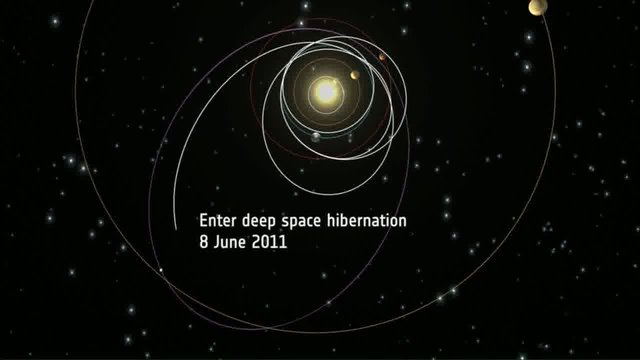
Rosetta trajectory till June 2011

ESA:

At 10:00 GMT on Monday, the most important alarm clock in the Solar System will wake up ESA’s sleeping Rosetta spacecraft.

Rosetta is chasing comet 67P/Churyumov–Gerasimenko and, since its launch in 2004, has made three flybys of Earth and one of Mars to build up enough speed and get on a trajectory towards the comet. It has also encountered asteroids Steins and Lutetia along the way.

Operating on solar energy alone, the spacecraft was placed into a deep space slumber in mid-2011 as it cruised far from the Sun and out towards the orbit of Jupiter. To prepare for its long sleep, Rosetta was oriented so that its solar arrays faced the Sun and put into a once per minute spin for stability.

The only devices left running were its computer and several heaters.

Thirty-one months later, Rosetta’s orbit has brought it back to within ‘only’ 673 million kilometres of the Sun, and there is finally enough solar energy to power the spacecraft fully again. It is time to wake up.

Rosetta’s computer is programmed to carry out a sequence of events to re-establish contact with Earth on 20 January, starting with an ‘alarm clock’ at 10:00 GMT.

Immediately after, the spacecraft’s startrackers will begin to warm up, taking around six hours.

Then its thrusters will fire to stop the slow rotation. A slight adjustment will be made to Rosetta’s orientation to ensure that the solar arrays are still facing directly towards the Sun, before the startrackers are switched on to determine the spacecraft’s attitude.

Once that has been established, Rosetta will turn directly towards Earth, switch on its transmitter and point its high-gain antenna to send its signal to announce that it is awake.

Because of Rosetta’s vast distance – just over 807 million kilometres from Earth – it will take 45 minutes for the signal to reach the ground stations. The first opportunity for receiving a signal on Earth is expected between 17:30 GMT and 18:30 GMT.

Graphic of mission

Rosetta Mission (ESA via BBC)

A garbage disposal system for space junk

January 17, 2014

NASA keeps track of all the debris in orbit. About 13,000 known objects are bigger than 10 centimeters in diameter and there are more than 100,000 pieces of orbital debris between 1 cm and 10 cm. Pieces smaller than 1 cm number in the tens of millions. All pieces of debris larger than 10 cm are carefully tracked using radar and telescopes.

Many schemes have been proposed for trying to get rid of space debris orbiting the Earth. The schemes have ranged from space harpoons, clouds of of ballistic gas, housekeeping, robotic satellites and laser cannon. The Japanese have a plan for an electrodynamic tether to be attached to the debris by a robot arm. the tether then generates an electric field as it orbits around the Earth and the magnetic field then encourages the debris to drop into lower orbits and eventually burn up. A tether is going to be sent up into space at the end of February for a trial.

Electrodynamic tether

SpaceDaily: Researchers at The Japan Aerospace Exploration Agency (JAXA) have developed what they called an electrodynamic tether made from thin wires of stainless steel and aluminium.

The idea is that one end of the strip will be attached to one of the thousands of dead satellites or bits of rocket that are jamming up space and endangering working equipment.

The electricity generated by the tether as it swings through the Earth’s magnetic field is expected to have a slowing effect on the space junk, which should, scientists say, pull it into a lower and lower orbit.

Eventually the detritus will enter the Earth’s atmosphere, burning up harmlessly long before it has chance to crash to the planet’s surface.

“The experiment is specifically designed to contribute to developing a space debris cleaning method,” said Masahiro Nohmi, associate professor at Kagawa University, who is working with JAXA on the project, told AFP. Nohmi said a satellite developed by the university is expected to be launched into space on February 28, with the tether aboard.

“We have two main objectives in the trial next month,” he said. “First, to extend a 300-metre (1,000-foot) tether in orbit and secondly to observe the transfer of electricity.” The actual reeling in of orbiting rubbish will be the objective of future experiments, he said. A spokesman for JAXA said the agency also plans to conduct its own trial on a tether in 2015.

More than 20,000 bits of cast off equipment, including old satellites, pieces of rocket and other fragments are uselessly orbiting the Earth in a band 800-1,400 kilometres (500-900 miles) from the surface of the planet at terrific speed. 

JAXA write:

If we are able to calculate the motion of debris, we can attach a propulsion system for removal. As the propulsion system, we have envisioned an “electrodynamic tether”, which is extremely efficient because it does not require fuel. The end of an electrically conductive cord (tether) is attached to the debris, transferring it to a lower orbit through the Lorentz force generated by the interference between Earth’s magnetic field and the current flowing through the tether, causing it to re-enter the atmosphere. Two methods are being considered for attaching the tether. One is a method of using a robot arm, for example, to hook the end of the tether into a 1-meter-diameter hole in a payload attachment fitting used as a base for mounting the satellite onto the rocket.  Another is a method where the side of the rocket stage, which is extremely thin for reduced weight, is approached and harpooned by the tether end to attach it. This method is considered to be a safer operation since the tether can be attached from a distance of 10 to 20m.

Dreamliner battery fix fails as Tesla recalls 29,000 cars for battery charger fault

January 14, 2014

The overheating problems of lithium-ion batteries and their chargers seem to more serious than just teething problems. Boeing and Tesla continue to have issues with thermal runaway and permanent fixes are proving elusive.

Boeing’s problems with the Dreamliner batteries are not yet over. The fix for its battery problem in March  does not seem to have worked for yet another Japan Airlines aircraft. The lithium-ion batteries are now having issues even with Tesla who have recalled “29,000 Model S vehicle 240-volt charging adapters that could overheat and cause a fire. The company will update software in the electric vehicles and send owners replacement adapters.”

The Telegraph: 

Japan Airlines has temporarily grounded one of its 787 Dreamliners after white smoke was spotted outside the plane, warning lights in the cockpit indicated possible faults with the main battery and charger, and one battery cell appeared to be leaking.

Boeing said it was “aware of the 787 issue that occurred Tuesday afternoon at Narita, which appears to have involved the venting of a single battery cell”.

The incident comes nearly a year to the day after Japan Airlines and All Nippon Airways grounded their 787 fleets after two 787 batteries overheated on two different planes in less than two weeks.

Global regulators grounded the worldwide fleet on January 16, 2013. The planes remained grounded for more than three months while Boeing redesigned the battery, charger and containment system to ensure battery fires would not put the airplane at risk. The cause of the battery problems has not been determined.

On Tuesday, Japan Airlines said maintenance engineers who were in the cockpit saw white smoke from the cockpit. When they went outside the aircraft the smoke had dispersed.

Detroit News:

…. The Palo Alto, Calif., automaker told the National Highway Traffic Safety Administration that its review found that defective or improperly installed wall receptacles that the adapter plugged into could cause problems, including melted adapters and or a fire. While the number of incidents remains small, and Tesla’s review to date points to the building or wiring as the primary cause of failed adapters, “the company has determined that a voluntary recall is appropriate as a precautionary measure,” Tesla said.

Since late 2012, Tesla said 2.7 percent of universal mobile connector adapters have been returned and “showed signs of internal damage only and that stopped vehicle charging.” …

….. In November, NHTSA opened a formal investigation into 13,100 Tesla Motors Model S electric cars after three reports of battery fires that occurred after accidents. ……. The announcement of the investigation came after NHTSA had said in October it would not open a formal investigation after a fire in Kent, Wash., occurred when debris struck the underside of a Model S and caused the battery to catch fire. After a fire in Mexico and a fire earlier this month near Smyrna, Tenn., NHTSA decided to open an investigation.

NHTSA said in both of the incidents in the U.S., fires occurred after the undercarriage of the cars hit metal debris on the road, which damaged the battery tray and caused “thermal runaway.” “In each incident, the vehicle’s battery monitoring system provided escalating visible and audible warnings, allowing the driver to execute a controlled stop and exit the vehicle before the battery emitted smoke and fire,” NHTSA said.

About 3 hours to launch of ISRO’s GSLV-D5 mission

January 5, 2014

ISRO’s GSLV-D5 on the launch pad

Countdown Operations are underway at the Satish Dhawan Space Center on India’s East Coast from where a Geosynchronous Satellite Launch Vehicle will launch on a demonstration flight on Sunday at 10:48 UTC. GSLV is carrying the GSAT-14 communications satellite to Geostationary Transfer Orbit.

Links for live webcast, 3:52 PM IST onwards, today

http://webcast.isro.gov.in/
http://www.24framesdigital.com/isro/webcast/050114/

Chang’e 3’s Jade Bunny begins gambolling on the moon

December 15, 2013

Chang’e 3 landed on the moon on Saturday and her Jade Bunny has now started gambolling on the moon.

China’s first lunar rover separates from Chang’e-3 moon lander early Dec. 15, 2013. Picture was taken from the screen of the Beijing Aerospace Control Center in Beijing, capital of China. (Xinhua/Li Xin)

Xinhua:China’s first moon rover, Yutu, or Jade Rabbit, separated from the lander early on Sunday, several hours after the Chang’e-3 probe soft-landed on the lunar surface.

The 140 kg six-wheeled rover touched the lunar surface at 4:35 a.m., leaving deep trace on the loose lunar soil. The process was recorded by the camera on the lander and the images were sent to the earth, according to the Beijing Aerospace Control Center.

After the separation, the rover and lander will take photos of each other and start their own scientific explorations.

Engineers made final checks of the environment of the landing site, the situation of the probe and the solar incidence angle late night on Saturday and sent signals of separation to Chang’e-3.

Yutu, atop the probe, extended its solar panel and started to drive slowly to the transfer mechanism at 3:10.

The transfer mechanism unlocked at 4:06 with one side reaching the moon’s surface, allowing the rover to descend to the surface following a ladder mechanism.

Chang’e-3 landed on the moon’s Sinus Iridum, or the Bay of Rainbows, at 9:11 p.m. Saturday, making China the third country in the world to carry out such a rover mission after the United States and former Soviet Union. 

In ancient Chinese mythology, Yutu was the white pet rabbit of the lunar goddess Chang’e. The name for the rover was selected following an online poll that collected several million votes from people around the world. 

The rover, 1.5 meters long with its two wings folded, 1 m in width and 1.1 m in height, is a highly efficient robot controlled by the command center from the earth. It will face challenges including temperature differences of more than 300 degrees Celsius on the moon. 

Yutu will survey the moon’s geological structure and surface substances and look for natural resources for three months, while the lander will conduct in-situ exploration at the landing site for one year.


Volvo to test self-driving cars on Gothenburg streets in 2017

December 2, 2013

It is only a matter of time. As I get older it gets easier to drive. As it is, I already rely heavily on the car’s sensors and cameras when parking or reversing and especially at night. For parking in tight spots and getting as close to a wall as possible the proximity sensors work exceedingly well. And I miss them badly in very cold icy weather when my sensors are iced over. In 2017, 100 self-driving (autonomous) cars will be let loose on selected highways around Gothenburg with ordinary individuals as a test driver .

And it will not be long before the cars talk to each other.

Swedish Radio: (free translation)

Claes Tingvall, the Swedish Transport Administration’s Traffic Safety Director says that self-driving cars  cars are a prerequisite to achieving the “zero vision” of no fatalities due to traffic accidents. “One should be very careful with the word paradigm shift but for once, I think, it applies in the case of self-driving cars. If you look a little more into the long run, this is really like a fundamental solution to the problem of safety in a traffic system”, he says. To the question if this is what is needed to finally achieve zero fatalities he says, “Yes it is. And we are getting there”.

Self-driving cars thanks to cameras , GPS and various sensors detect the environment around the car . Therefore they can, all by themselves, can get around in traffic, so that the man behind the wheel can indulge in other things – read a book, for example. These robotic cars can virtually eliminate traffic accidents because computers are better at driving than humans and do not take unnecessary risks. “It is a fact that a machine, in most situations, is better able to deal with driving than a human”, says Claes Tingvall. “It will also be quite a careful driver. It is not going to take the risks that we as individuals are sometimes inclined to take. It will not be racing at 150 km/h at night with a drunken operator behind the wheel”.

Volvo’s autonomous car technology

Automakers around the world are right now intensively researching  self-driving cars. Among others Japanese Nissan has announced its intention of having self-driving models on the roads before 2020. Now Volvo has also joined the party.

The project, called “Drive Me” kicks off next year, and is a collaboration between Volvo, the Swedish Transport Administration, the Swedish Transport Authority , the City of Gothenburg and Lindholmen science park . In 2017, 100 self-driving cars will be let loose on selected highways around Gothenburg with ordinary individuals as a test driver .

“That’s what this kind of self- driving car provides, where it works with and supports the driver. It has its ears and eyes open and can intervene in situations when necessary. The effects will be enormous”, says Claes Tingvall.

Chinese Jade Bunny took off for the moon tonight

December 1, 2013

UPDATE!! 1st December 2013 2030 GMT

Xinhua: The probe’s carrier, an enhanced Long March-3B rocket, blasted off from the Xichang Satellite Launch Center in southwest China at 1:30 a.m. Chang’e-3 is expected to land on the moon in mid-December to become China’s first spacecraft to soft land on the surface of an extraterrestrial body.

It is also the first moon lander launched in the 21st century. The probe entered the earth-moon transfer orbit as scheduled, with a perigee of 200 kilometers and apogee of 380,000 kilometers. “The probe has already entered the designated orbit,” said Zhang Zhenzhong, director of the launch center in Xichang. “I now announce the launch was successful.”

========================

Various Xinhua reports

China will launch the Chang’e-3 lunar probe to the moon at 1:30 a.m. Monday from Xichang Satellite Launch Center, The Chang’e-3 programme encompasses a lander and a moon rover called “Yutu” (Jade Rabbit). The Chang’e-3 mission is the second phase of China’s lunar program, which includes orbiting, landing and returning to Earth. It follows the success of the Chang’e-1 and Chang’e-2 missions in 2007 and 2010.

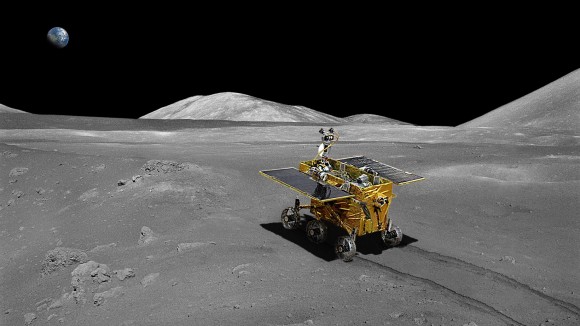
Artist's conception of the Chinese moon rover, called Yutu. Credit: CNSA

Artist’s conception of the Chinese moon rover, called Yutu. Credit: CNSA

The probe will be launched to orbit aboard an enhanced Long March-3B carrier which is more than three meters in diameter and 56.4 meters high. The mission will be the 25th launch of the Long March-3B, which is the most powerful launch vehicle in the Long March fleet.

After entering lunar orbit, Chang’e-3 will go through six stages of deceleration to descend from 15 km above to the lunar surface. The soft-landing processes of the U.S. and former Soviet Union’s unmanned spacecraft had no capacity to hover or avoid obstacles. Chang’e-3, on the other hand, can accurately survey landforms at the landing site and identify the safest spots on which to land.

In order to land quickly, the probe is equipped with high-precision, fast-response sensors to analyze its motion and surroundings. The variable thrust engine (completely designed and made by Chinese scientists) can generate up to 7,500 newtons of thrust.

But the real story I like of Chang’e and her Hou Yi and the reincarnation of Hou Yi as a Jade Bunny is this one from Over A Cuppa Tea. A Jade Bunny is much more evocative than a Jade Rabbit. Chang Er is perhaps a better phonetic rendition of Chang’e.

Once upon a time, there live two immortals in the Heaven, they are Hou Yi and Chang Er. Hou yi and Chang Er were lovers who goes through great obstacle before their love is approved by the Heaven.

The Heaven was ruled by the Jade Emperor and his Empress. One day, ten sons of Jade emperor accidentally transformed into the sun, and revolves around the earth playfully, causing great drought and suffering to the mortals below.

Worried and concern for the mortals, the Jade emperor summons the imperial archer, Hou Yi to help him solve the problem. Hou Yi then went to Earth and shot down nine of the Jade Emperor’s sons. The emperor had thought that Hou Yi would not harm any of his sons. Now that his sons are dead, the emperor was very furious. In anger, the emperor took away Hou Yi and his wife’s immortality and condemn them to live on Earth forever.

Chang*e and her jade bunny on the moon

Chang Er was grief stricken with her loss of immortality. Hou Yi could not bear to see his saddened wife, and so, he decided to steal the immortality pill from the heavenly medicine manufacturer so that both of their immortality could be restored. He manage to steal the pill from heaven, and brought it to Chang Er. He told her that they only need to take half of the pills to regain immortality.

In the meantime, the Jade Emperor found out about the stolen immortality pill, and command an imperial guard to retrieve the pills and catch both Hou Yi and Chang Er so that he could punish them for their misdeed.

And so, the imperial guard went down to earth in pursuit of the couple and the pill of immortality. But the guard himself was tempted by the idea of immortality. So he waited until Hou Yi is not at home, and attacked Chang Er who is defenseless at home. He demanded for the pill but Chang Er refused to hand it to him. Hou Yi, who seems to forget his arrows went back home to get it and discovered that his wife is in danger. He fought the imperial guard courageously.

Unfortunately, Hou Yi is an archer, not a fighter. He was stabbed right in his heart in front of Chang Er. Chang Er was grief stricken, and wishes to die with her husband too. However, Hou Yi’s dying wish was for Chang Er to regain her immortality and live happily for all eternity.

So, Chang Er took out the pill from her sleeves and swallowed the whole pill so that the guard would not be able to get it and obtain immortality. Right after swallowing the pill, Chang Er started to float towards the sky, and after flying for some time, she landed on the moon. She cried and grieve for her husband’s death.

Her cries was heard by a group of Jade Bunnies that lives on the moon. They went to her and listened to her story. These Jade Bunnies were captivated by Chang Er’s beauty and kindness towards them, so they built a palace for her to stay, knowing that she could never return to Heaven or Earth. They hailed her as their goddess and pledge allegiance to her. These bunnies can be seen pounding on the face of the moon on some cooking utensil.

It is believed that these Jade Bunnies are trying to make resurrection pills so that they could revive their Goddess’s love. It’s said that the resurrection pills is shaped like a mooncake. But it’s not dictate anywhere on whether Hou Yi was revived or not, but in many folklore, it’s told that Chang Er would bestow blessing of love and happiness to lovers who pray hard and sincere enough to the moon during mid-autumn.

According to my husband, however, there’s only one Jade Bunny on the moon, and it’s actually the reincarnation of Chang Er’s husband. He told me that the Jade Empress took pity on the couple, and so reincarnate Hou Yi as a Jade Bunny so that Chang Er will not be lonely on the moon. That explains why Chang Er can always be seen with a bunny everywhere she goes on the moon.
Heigh-ho, ISRO, it’s off to Mars we go

November 30, 2013

UPDATE!!

Trans-Mars injection has been completed successfully.

  • Trans Mars Injection (TMI) operations completed successfully. The liquid engine burn time was 1328.89 sec and the imparted incremental velocity was 647.96 m/sec.
  • Trans Mars Injection (TMI) operation began at 00:49 hrs (IST) on Sunday Dec 01, 2013.
  • Forward rotation of spacecraft, to put it into the right orientation to perform Trans Mars Injection (TMI) operation has been completed successfully at 00:30 hrs IST on Dec 1, 2013

=================

A big night for ISRO and congratulations are due! And not least for ISRO’s coverage of the event – almost live – on their Facebook page. (I have not been too enamoured of the ISRO website but somebody did a great job on the live updates).

The Indian Mars Orbiter (Mangalyaansuccessfully completed its final burn in earth orbit and has been inserted into a Trans Mars Trajectory (to be confirmed). It may just be one small step in Man’s exploration of space but it is a giant leap for ISRO. After spending a month in 6-ever increasing orbits around Earth the craft now has a 300 day journey to get to Mars with the possibility of 3 mid-course corrections before the liquid engine has to be fired up again to enter into orbit around Mars.

So far, so good!

A number of “firsts” for the Indian Space Research Organisation (ISRO) and, no matter what may now happen, a great many accomplishments already in the bag. The lack of a sufficiently powerful rocket necessitated that the craft first enter earth orbit and then the month-long, laborious compared to NASA, procedures where the space craft engine had to be used  to first to increase the earth orbits and then – tonight – be fired for an extended time (23 minutes) to be inserted into a heliocentric Trans Mars Trajectory.

Mission Operations Complex ISTRAC  Bangalore.

Mission Operations Complex ISTRAC Bangalore.

Photo

One hour before the final engine firing the craft was put under the control of its on-board computer which was to carry out the final burn. Forward rotation of the spacecraft to put it into the right orientation for the burn was carried out and completed about 20 minutes before firing. Engine firing started on schedule just before the craft reached perigee. The actual burn of the 440 N Liquid Engine lasted its planned 23 minute long firing entirely under local on-board computer control. The objective was to impart an incremental velocity of 648 m/s and the indications are that that was achieved. The engine firing manoeuver seems to have gone exactly to plan. The orbit determination team have now to confirm now confirmed the trajectory actually achieved.

The new heliocentric orbit is yet to be confirmed. confirmed

The ISRO chorus (with apologies to Walt Disney)

Heigh-ho, ISRO

It’s off to Mars we go

We keep on working all day long

Heigh-ho, ISRO 

Photo: Liquid Engine propels MOM into Mars Transfer Trajectory and India into interplanetary space !Trans-Mars injection has been completed successfully.

Liquid Engine propels MOM into Mars Transfer Trajectory and India into interplanetary space !Trans-Mars injection has been completed successfully. ISRO


Moment of truth approaches for India’s Mars Orbiter Mission

November 28, 2013

When everything is for the first time,achievements are incremental and there are very many critical “moments of truth” to meet and overcome. But now comes a very large “moment of truth” as ISRO prepares to inject the Mars Orbiter spacecraft into its Trans Mars Trajectory.

India’s Mars Orbiter (Mangalyaan) is currently in its final orbit around the earth and is scheduled to fire its 440 Newton liquid engine at 0049 hours IST on Sunday morning ( 1919 GMT Saturday 30th November).  It entered its final Earth orbit yesterday which has an orbital period of 5575 minutes (just under 4 days) and it should be approaching apogee later tonight (early hours of Friday morning) and the next engine burn will take place at perigee. Currently apogee is about 193,000 km from earth and perigee is around 350km.

The spacecraft must first be manoeuvred into the right attitude using its thrusters for the firing of its main engine which must then be fired to impart the correct change of velocity (delta-vee). Both, an incorrect attitude and/or an incorrect delta-vee are potential sources of error. Three mid-course corrections are planned  (the first on December 11th) but the margin of error allowable is still extremely small. Too low a velocity change could leave the craft in earth orbit or put it into a heliocentric orbit which does not get close enough to Mars. Too high a delta-vee would also put the craft into a heliocentric orbit which would eventually decay into the sun. I believe there is no chance of achieving a velocity high enough to escape the sun. And even if the velocity change is correct but the direction is too far in error then just another orbital path around the sun would result.

NDTV:“The trans-Mars injection- we are planning to depart on December 1, 2013 early hours of 00:49 hours IST and we are going to burn a liquid engine for duration of roughly 23 minutes which will impart an incremental velocity of 648 metres per second consuming a fuel of 198 kgs,” ISRO Scientific Secretary V Koteswara Rao told reporters in Bangalore.

K. Radhakrishnan, ISRO Chairman. (For the) trans-Mars injection and its insertion into the Martian orbit, the firing of the liquid engine is done in a closed loop mode. Here, a precision accelerometer is used to estimate the incremental velocity added as the liquid engine burns and when the accelerometer gives a feedback that the required incremental velocity added to the spacecraft has been achieved, the burning of the liquid engine is automatically terminated. So, minor variations in the performance of the liquid engine will not matter because we are cutting off its burning based on the delta-v that is achieved. That is why we call it closed loop of firing. … The spacecraft’s propulsion system, i.e., the 440 Newton liquid engine, will complete its first phase of operations on December 1. It has to be re-started for its operation on September 24 (2014).

MOM Trans Mars Injection ISRO

MOM Trans Mars Injection ISRO

ISRO: This voyage is achieved by a combination of navigation and propulsion technologies, governed by the gravity of Sun and Mars, and assisted by the 440 N Liquid engine. Further fine tuning of the trajectory is achieved using the Attitude and Orbit Control Thrusters during the Trajectory Correction maneuvers planned en route.

… on December 11, we plan to have one small firing for mid-course correction of the spacecraft. There may be one more mid-course correction during the helio-centric phase, and subsequently, a fortnight before the spacecraft’s arrival near Mars, there will be one more mid-course correction. So there will be three mid-course corrections between December 1, 2013 and September 24, 2014. 

Mangalyaan is eventually to be placed into a Martian orbit, with a periapsis height of 365 km, apoapsis height of 80,000 km and an orbital period of about 77 hours.

So on Saturday I shall have as many of my fingers crossed as I can manage. I suspect there will be many others doing the same across India.

Political statues in India cost more than the Mars Orbiter Mission

November 24, 2013

A very critical moment for the Indian Mars Orbiter Mission (Mangalyaan) comes a week from today when the spacecraft’s engine has to be fired as it reaches perigee in its Earth orbit, to insert  it into  a trajectory to reach Mars some 10 months later.

The Mission has been criticised both in the West and in India (here and here for example) as being too expensive, too elitist and the wrong priority for a developing country like India. I think such criticism misses the point. The Indian Mars Orbiter Mission is primarily a test of technology and capability and self-confidence and self-belief”. The cost pales in comparison with the spend on religious festivities and what other much less productive projects can cost. As an example of what frugal engineering can achieve, the inspiration and ingenuity it can foster is immeasurable.

Manoj KumarPatairiya writes in the New York Times:

If the Mars Orbiter successfully reaches the vicinity of the planet in September 2014, after 300 days’ journey into deep space, it will make India the first Asian country and the fourth in the world to reach the red planet. …. The mission has, however, started an intense debate. While its supporters trumpet its incredibly low cost of around $75 million (a fraction of the cost of a similar American expedition), critics question the logic behind spending any amount when India is dealing with such deep-rooted problems as widespread hunger, poverty and corruption. ……. 

But U. R. Rao, a former chairman of the Indian Space Research Organization, compared the $75 million spent on the mission to the amount Indians spend on Diwali crackers for one day: “For going all the way to Mars, just one-tenth of the money is being spent. So, why are they shouting?”

Part of the reason the mission is so much less expensive is that it is able to take advantage of existing deep space communications systems and navigation support from NASA. But India is becoming known for its low-cost innovations in many diverse fields, including health care, renewable energy, sanitation, mobile technology and tablet computers. Indian scientists like to share this anecdote: “Americans spent millions to develop a pen that will not leak in space, whereas Russians used a pencil!”

The cost of the Indian Mars mission is about $75 million and just to put it into perspective:

  • Mayawati’s park in Noida was constructed at the cost of $130 million, and has 24 huge statues of elephants, and one of herself.
  • the total cost to build the Narendra Modi sponsored “Statue of Unity” is estimated to be about $340 million

Politicians will of course argue that the “feel-good” effects generated by such monuments to themselves or their heroes are well worth the cost!

If the MOM succeeds in its main objectives, there is even a case for using the window that is coming in 2018 to attempt a manned trip around Mars and back in 501 days.