Archive for the ‘US’ Category

Reward for fraud: $285 billion in Pentagon contracts

February 3, 2011

The Corruption Perception Index produced annually by Transparency International becomes meaningless relative to the scale of fraud and corruption with large contracts in the developed world and which do not seem to be reflected in the CPI.

An AP report carried by 660news.com reports:

Hundreds of defence companies that defrauded the U.S. military between 2007 and 2009 still received $285 billion in contracts from the Pentagon during the same period, a U.S. senator said Wednesday.

Citing a January report prepared by Pentagon acquisition officials at Sanders request, the senator said the bulk of the contracts, just over $280 billion, went to 211 companies that had civil judgments against them or settled fraud charges of more than $1 million.

During the same period, 30 defence contractors were convicted of criminal fraud, but still were awarded $682 million in new work, according to the Pentagon’s report.

Among the contractors listed in the report is AEY Inc., a Miami, Florida-based company that received a $300 million contract to supply ammunition to Afghan security forces. AEY got the work despite a record of poor performance on other government contracts.

The fraud involved shipment of millions of rounds of banned Chinese-made military ammunition that was repackaged to appear of Albanian origin. After nearly $67 million in payments, the Afghan ammunition contract was terminated in May 2008. The owner of AEY was sentenced to four years in federal prison after pleading guilty in 2009 to a fraud conspiracy charge.

In the report, defence officials listed a series of actions the military has taken to guard against contractor wrongdoing, including the formation of a working group focused on procurement fraud.

I am quite sure that many lobbyists, middlemen, bureaucrats and politicians all received their share of the largesse in these Defence Contracts. The margins available in Defence contracts far exceed those available in other large infrastructure contracts.

Related posts:

  1. https://ktwop.wordpress.com/2011/01/12/corruption-in-the-european-union-is-alive-and-well/
  2. https://ktwop.wordpress.com/2011/01/07/chief-risk-officer-of-bayerische-landesbank-arrested-for-50-million-bribes/

Queensland sees off Yasi: Preparedness ensures it was no Katrina

February 3, 2011

Cyclone Yasi has come and gone.

Its speed was a blessing in disguise and has ensured that it is already well inland and reducing in strength. It has left behind a trail of destruction but few (if any) serious injuries or fatalities. The township of Cardwell was warned to evacuate, but about 100 residents chose not to leave and they have not been contacted as yet.

BBC:

Worst hit were the coastal towns of Tully, Mission Beach and Cardwell, with hundreds of houses destroyed. The cities of Cairns and Townsville were relatively unscathed but are being lashed by heavy rains; warnings of further storm surges have been issued. Queensland Premier Anna Bligh said there had been no reports of deaths or serious injuries so far.

The similarities of Yasi to Katrina is apparent but the differences in their respective impacts is quite striking.

This may be partially due to geography and demographics and the speed with which Yasi drove inland, but observing both from across the world leads me to the perception that the primary differences between Queensland and Louisiana were

  • the preparedness of the government and the population,and
  • the sense of civic duty in Queensland, and
  • the level of trust in the state government institutions, and
  • the level of perceived duty within the institutions

The thought of Queensland police looting after Yasi as some New Orleans police did after Katrina is  inconceivable. It’s just my perception but I believe it shows the difference between institutions having a fundamental belief that they have a duty to the population they serve and others where the concept of duty is much less developed.

Cyclone Yasi compared to Hurricane Katrina

credit bbc


Ice in Dallas as super-storm ranges from Texas to Maine

February 2, 2011

Dallas Morning News:

Rain, sleet and snow pushing ahead of the coldest weather in more than 20 years left broad swaths of North Texas virtually impassable Tuesday. And with below-freezing temperatures locked in until at least Friday, conditions won’t improve soon.

Low temperatures Wednesday morning will be in the single digits across much of the Dallas area, and the afternoon will warm only to the low 20s, forecasters said, meaning the snow and ice that paralyzed the region Tuesday will linger, especially along neighborhood streets.

Crews work to clear a wreck involving an 18-wheeler on northbound I-35E at Pleasant Run Road. Photo: Jim Mahoney/Staff Photographer

New York Times:

A paralyzing 2,000-mile swath of winter at its snowy, icy, messy worst pushed eastward across the United States on Tuesday, disrupting the rhythms of everyday life and punctuating this season’s recurring lesson that humankind has no dominion over nature.

Airlines canceled thousands of flights. Governors called out the National Guard. Schools closed early, if they opened at all. Interstate highways became treacherous ribbons of black ice. Top officials from the Department of Homeland Security and the Federal Emergency Management Agencyapprised President Obama of their battle plans for foul weather threatening more than 30 states.

By Tuesday evening, the storm had brought Tulsa to a virtual halt with more than a foot of snow, layered the roadways of St. Louis with an icy sheen, and draped Chicago with a swirling snowfall so thick that the white-gray sky and the gray-white ground blurred into one enveloping test pattern. All the while, the storm was moving inexorably to the Northeast, where many people watched the televised weather reports — of blinding snow and stranded cars — and imagined their Wednesday. …..

The National Weather Service was issuing warnings for certain areas that read like snippets from a disaster-movie screenplay:

“DANGEROUS MULTIFACETED AND LIFE-THREATENING WINTER STORM … BEFORE MAKING DECISION TO TRAVEL … CONSIDER IF GETTING TO YOUR DESTINATION IS WORTH PUTTING YOUR LIFE AT RISK … DO NOT TRAVEL! IF YOU ABSOLUTELY MUST TRAVEL … HAVE A WINTER SURVIVAL KIT WITH YOU.”

Rex Benz of Moline, Ill., did not let conditions stop him from his job search recently. Todd Mizener/The Dispatch, via Associated Press


Space shuttle Discovery prepares for final mission

February 1, 2011

Only 3 more flights – money permitting – for an iconic series of space craft before they are retired.

BBC:

The US shuttle Discovery has rolled out for what should be its final mission. The orbiter completed its slow journey to the Kennedy Space Center’s Launch Pad 39A overnight, Monday into Tuesday.

Discovery’s flight to the space station is scheduled to begin on 24 February. With its crew of six astronauts, the ship will deliver a storeroom to be attached to the 350km-high platform, along with further supplies and spares.

NASA last tried to launch the vehicle in November but technical hitches, including cracks on its giant external fuel tank, kept the ship on the ground. The agency said engineers had now fixed those defects and carried out further work to strengthen the tank.

President Barack Obama and the US Congress have determined that the shuttle fleet should be retired this year. Discovery is the oldest of the three surviving orbiters. First launched in 1984, it has since completed 38 missions, travelling some 230 million km in the process. Endeavour is expected to fly to the station in April. Atlantis will go no earlier than June, if Nasa has sufficient money left in its shuttle programme budget.

Following the fleet’s retirement, the plan is for US astronauts to fly to the space station on Russian Soyuz rockets until perhaps the middle of the decade.

Discovery

Space shuttle Discovery : image NASA


25 years since Challenger exploded; almost 8 years since Columbia was destroyed

January 28, 2011

The Space Shuttle Challenger’s maiden flight was on 4th April, 1983, and it completed nine missions before breaking apart 73 seconds after the launch of its tenth mission, STS-51-L on 28th January, 1986.

A sombre anniversary today.

A special ceremony is taking place at the Kennedy Space Center’s visitor complex this morning. Members of the NASA family and the public will gather to honor those who died aboard space shuttle Challenger.

Twenty-five years ago the STS-51L crew boarded Challenger for a six-day flight. It was just after liftoff when things went wrong. Challenger was in the air for 73 seconds before the orbiter exploded. …. According to investigators’ findings, the cause of the explosion was an O-ring that failed in one of the solid rocket boosters. Cold weather was cited as a contributing factor.

File:Challenger explosion.jpg

The breakup of the space shuttle Challenger: 28th January 1986: Wikipedia

Challenger crew; El Onizuka,Christa McAuliffe, Greg Jarvis, Judy Resnik, Mike Smith, Dick Scobee, Ron McNair: image christa.org

Today is also 4 days short of 8 years since the space shuttle Columbia was destroyed during rentry.

Space Shuttle Columbia (NASA Orbiter Vehicle Designation: OV-102) was the first spaceworthy Space Shuttle inNASA’s orbital fleet. First launched on the STS-1 mission, the first of the Space Shuttle program, it completed 27 missions before being destroyed during re-entry on February 1, 2003 near the end of its 28th, STS-107. All seven crew members were killed.

The investigation found that 82 seconds after launch a large piece of foam insulating material from the external tank broke free and struck the leading edge of the shuttle’s left wing, damaging the protective carbon heat shielding panels. This damage allowed super-heated gases to enter the wing structure during re-entry into the Earth’s atmosphere and caused the destruction of the Columbia.

Columbia was commanded by Rick Husband and piloted by William McCool. The mission specialists were Michael Anderson, Kalpana Chawla, David Brown, Laurel Clark; and the payload specialist was Israeli astronaut Ilan Ramon: image NASA

Currently the 3 operational orbiters are the

Space Shuttles Discovery, Atlantis anEndeavour.


Snow in all US States except Florida

January 12, 2011

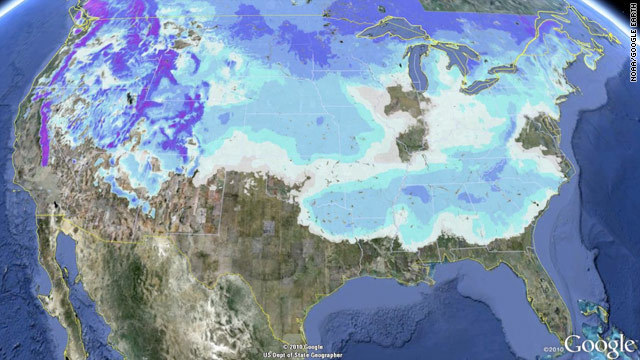
A map of snowfall in the United States is revealing right now: 49 states have snow on this 1/11/11 and only one does not.

From the southern snow storm heading north, which is affecting air travel, to the pending storm in New York City, and flurries out west, there’s plenty of white stuff going around.

The lone state without a flake? It’s the Sunshine State…Florida. Locals are celebrating the fact, though interestingly, parts of the state saw snow just days ago.

Even Hawaii has snow, in Mauna Kea on the Big Island.


Now conservationists come out against wind power

January 3, 2011
Whooping Crane

Whooping crane: Image via Wikipedia

Officials with American Bird Conservancy on Wednesday cited data from the U.S. Fish and Wildlife Service that estimates 400,000 birds of various species are killed by turbine blades annually reports the Omaha World Herald.

One of the nation’s largest bird conservation groups says rapid construction of wind energy projects will endanger several avian species……That includes the whooping crane, a famous migratory bird and annual visitor to central Nebraska.

“Golden eagles, whooping cranes and greater sage-grouse are likely to be among the birds most affected by poorly planned and sited wind projects,” said Kelly Fuller, a spokeswoman for the conservancy.

“Unless the government acts now to require that the wind industry respect basic wildlife safeguards, these three species will be at ever greater risk.”

Officials with Nebraska Public Power District and MidAmerican Energy Co. said potential wind farm developments are carefully examined by experts and conservationists to determine their ecological impact.

“We monitor for bird kills but haven’t seen anything of significance,” said Mark Becker, an NPPD spokesman. “But we have not heard of any endangered species or any endangered birds being killed in Nebraska.”


Honda takes to the air

December 24, 2010

From the WSJ:

Honda Motor Co. says the first FAA-conforming version of the small business jet it has been working on for years made its first flight. The plane, called the HondaJet, flew from the company’s Honda Aircraft Co. operation at Piedmont Triad International Airport in Greensboro, N.C.

HondaJet first flight:image Honda Motor Co.

While an earlier version called a proof-of-concept aircraft has logged more than 500 hours of flight testing, flying the version built to Federal Aviation Administration rules is what really counts toward bringing the plane to market. Honda’s project is part of a renewed and growing intersection between automobiles and aviation that is occurring around personal- and business-transport. Honda touts the same qualities for the plane, such as “dynamic performance” and efficiency, as it does for its cars. The company has said it is essentially applying lessons learned in auto manufacturing to the aircraft business

HondaJet First Conforming Flight

HondaJet First Conforming Flight: image Honda Motor Co.

Honda says it will build five FAA-conforming jets for testing before ramping up production in 2012. The company says it has more than 100 orders for the light business jets, which have a top speed around 483 mph and a ceiling of 43,000 feet. Honda plans to deliver the first one in the third quarter of 2012.

HondaJet interior

First flight video is at http://hondajet.honda.com/

US: Polar bears are “threatened” but not “endangered”

December 23, 2010
Polar Bear (Sow And Cub), Arctic National Wild...

Polar Bear (Sow And Cub), Arctic National Wildlife Refuge, Alaska: Image via Wikipedia

In spite of a great deal of PR from alarmist and global warming lobbies in the past week, the US has decided not to change the status of polar bears from “threatened” to “endangered”.

From the Washington Post:

The U.S. Fish and Wildlife Service told a U.S. District Court judge Wednesday that the threatened designation will not change because polar bears were not considered to be in danger of extinction at the time of the listing in 2008.

“The Service explained how its biologists had concluded in 2008 that the polar bear was not facing sudden and catastrophic threats [and] was still a widespread species that had not been restricted to a critically small range or critically low numbers,” the agency said in a statement.

Kassie Siegel, director of the Climate Law Institute at the Center for Biological Diversity, called the administration’s decision “a huge disappointment.” Arctic ice, the bears’ hunting ground, is melting and bears are starving to death, she said.

“It’s a wasted opportunity to do the right thing,” Siegel said. “The government’s own studies show about an 80 percent chance of extinction of two-thirds of the world’s polar bears in the next 40 years.”

AS WUWT reports

Some enironmentalists heads are exploding right about now. This pretty well slams the door on the polar bears threatened by global warming meme. Now we know why there was a flurry of questionable press releases this past week like these:

Polar bears no longer on ‘thin ice’: researchers say polar bears could face brighter future: a combination of greenhouse gas mitigation and control of adverse human activities in the Arctic can lead to a more promising future for polar bear populations and their sea ice habitat

Polar bears: On thin ice? Extinction can be averted, scientists say
Cutting greenhouse gases now is the key

Polar bears still on thin ice, but cutting greenhouse gases now can avert extinction

or as the BBC puts it

Polar bears not endangered, US confirms

US shale gas challenges Russian natural gas in Europe

November 12, 2010
Natural gas pipelines from Russia to Europe.

Natural gas pipelines from Russia to Europe: image via Wikipedia

“Peak gas”  like “peak food” and “peak resources” and like all “peak scenarios” keeps getting postponed. The US is awash with shale gas and has started re-exporting LNG it had contracted for to Europe challenging the dominance of Russian supplies of natural gas.

Money control reports:

The United States may play a role this winter in loosening Russia’s grip on the European market for natural gas by shipping liquefied natural gas across the Atlantic. Awash with domestic shale gas and with little need to import extra fuel, the United States has started re-exporting LNG cargoes, which firms had previously imported under contract, to countries where gas prices are much higher.

Such shipments could contribute to a growing pool of cheaper LNG going to Russia’s biggest export market this winter. In the longer term, U.S. plans to build plants to liquefy shale gas could create another rival to Russian pipelines. The first re-export cargo from the United States to Britain — a key access point for LNG into northern Europe via an Interconnector pipeline to Belgium — is set to sail over the weekend. “It is a landmark shipment,” said Zach Allen at NATS LNG analysts in Raleigh North Carolina. “LNG has, through the Interconnector, played a major role in reducing intake of Russian gas into western Europe.”

U.S. shale gas has already forced many LNG producers that had hoped to supply the North American market to find alternative buyers, with many cargoes ending up in Europe and driving spot gas prices below the price of oil-indexed Russian gas.

US re-exports to Europe are the latest sign that increases in shale gas production have transformed the global gas market. The International Energy Agency said on Tuesday that a decade-long period of oversupply was likely to push oil-indexed gas sellers to accept lower prices.

In February, Russian gas export monopoly Gazprom postponed it’s Shtokman LNG project because the United States, its target market, did not need more imports. Major European pipeline gas supplier Statoil has been forced to find alternative markets for LNG it had hoped to send to the United States, often selling it into Europe. Qatar, the world’s largest producer and exporter of LNG, has also pushed into both Norwegian and Russian markets by making large deliveries of cheap LNG into Britain and Belgium. US LNG imports have fallen to contractual minimums as gas prices have sagged, forcing importers whose terminals are sitting idle to change strategy and re-export to make the most of higher prices overseas.

US gas at USD 4.1 per million British thermal units (mmbtu) was about USD 3.3/mmbtu below UK prices on Tuesday and just under half the price of Russian gas in Europe in October, according to International Monetary Fund data. About 20 billion cubic feet of gas has already been re-exported from the United States this year, with some sent to Asia, where buyers have paid nearly USD 10 per mmbtu, and some to Latin America and the Middle East.

More of those US loaded cargoes could head to Britain over coming months, given that winter price increases are sharper in northern Europe than in the United States and that imports by South American and Middle Eastern buyers are usually confined to summer.

“US exports to Europe will remain rather exotic, but they underline once again the big risks for Russia of focusing some of its future projects on US markets,” said Valery Nesterov, energy analyst at Moscow-based Troika Dialog brokerage.

Cheniere Energy, operator of the Sabine Pass import terminal in Louisiana, announced plans in June to build a liquefaction plant at the terminal. It said on Tuesday that US bank Morgan Stanley hoped to secure some of its export capacity. Pending approval, the plant would export US-produced shale gas to markets all over the globe from 2015. It would be the first US LNG export plant in 40 years — following the old Kenai facility which supplies Asia from Alaska — and would be well placed to supply Europe. “LNG supplies from the United States can help lower gas prices in Europe and Asia and ultimately help lift prices in the States,” said Mikhail Korchemkin from Pennsylvania-based East European Gas Analysis.