Archive for the ‘Wildlife’ Category

Offshore oil rigs promote a richer marine life than at coral reefs

October 24, 2014

A 15 year study of the oil platforms off the California coast shows that they promote a rich and varied fish and marine life. They are greater than at estuaries and reefs on the California coast and richer even than at the famed coral reefs of Polynesia.

Don’t expect the WWF to support offshore oil rigs anytime soon! Or to admit that the oil rigs off the Santa Barbara coast are more beneficial to marine life than the wind and solar farms in California are to avian life which they regularly chop and fry.

More fool them.

JT Claisse et al, Oil platforms off California are among the most productive marine fish habitats globally, PNAS, doi: 10.1073/pnas.1411477111

NatureWorldNews:

A recent study has determined that large oil or gas platforms off the California coast are actually serving as ideal bases for highly productive marine habitats, boasting a stunning amount of healthy aquatic life.

That’s at least according to a study recently conducted by researchers from Occidental College, the University of California, and the Bureau of Ocean Energy Management off the West Coast.

The study, published Monday in the journal Proceedings of the National Academy of Sciences (PNAS), details how fish communities that have made their homes under well-maintained oil rigs are up to 27 times more productive than California reefs.

…. This was determined after a research team annually surveyed 16 oil or gas platforms and seven rocky reefs along the Californian coast for 15 years, starting in 1995.

They paid special attention to fish population count, size, and diversity in these unique habitats. From this, they worked out the weight of fish supported each year per square meter of sea floor for each habitat. They even reportedly accounted for the chance that some fish “just passing through” could affect the data.

In a surprising show of data, the researchers determined that the productivity of rig-based communities supported 105 to a whopping 887 grams of fish per square meter of habitat. By comparison, the most productive reef they examined, a coral reef in Mo’orea, French Polynesia, had a fish productivity of 74.2 grams per square meter per year. …

….. “The platform structures support a diverse community of invertebrates that, along with floating resources such as plankton, provide the base of the food web supporting fish,” he explained.

If handled properly, Claisse and his colleagues add, man-made structures can actually be beneficial to the ocean floor.

Abstract

Secondary (i.e., heterotrophic or animal) production is a main pathway of energy flow through an ecosystem as it makes energy available to consumers, including humans. Its estimation can play a valuable role in the examination of linkages between ecosystem functions and services. We found that oil and gas platforms off the coast of California have the highest secondary fish production per unit area of seafloor of any marine habitat that has been studied, about an order of magnitude higher than fish communities from other marine ecosystems. Most previous estimates have come from estuarine environments, generally regarded as one of the most productive ecosystems globally. High rates of fish production on these platforms ultimately result from high levels of recruitment and the subsequent growth of primarily rockfish (genus Sebastes) larvae and pelagic juveniles to the substantial amount of complex hardscape habitat created by the platform structure distributed throughout the water column. The platforms have a high ratio of structural surface area to seafloor surface area, resulting in large amounts of habitat for juvenile and adult demersal fishes over a relatively small footprint of seafloor. Understanding the biological implications of these structures will inform policy related to the decommissioning of existing (e.g., oil and gas platforms) and implementation of emerging (e.g., wind, marine hydrokinetic) energy technologies.

Sleeping walruses and oysters and pigs with wings

October 4, 2014

(with due deference to Lewis Carrol)

`The time has come,’ the Walrus said,
    `To talk of many things:
Of shoes — and ships — and sealing-wax —
    Of cabbages — and kings —
And why the sea is boiling hot —
    And whether pigs have wings.’

……..

`A loaf of bread,’ the Walrus said,
    `Is what we chiefly need:
Pepper and vinegar besides
    Are very good indeed —
Now if you’re ready, Oysters dear,
    We can begin to feed.’

…….

`The ice is growing,’ the Walrus said,
    `And oysters could be few; 
We’d better make the most of it
    While the sea is wonderfully blue.
Just fish for dinner gets rather trite,
    but we could find a seal or two.’

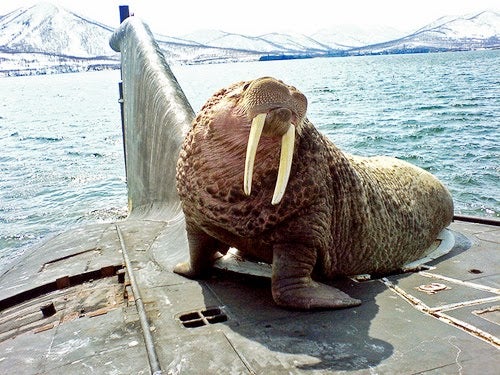
Walrus asleep on the deck of a Russian submarine (2013) image Imgur

image source: http://i.imgur.com/jct1HZt.jpg

Waking up

Waking up

http://i.kinja-img.com/gawker-media/image/upload/elisgw76tgzwtek7pti2.jpg

Annual walrus and melting ice alarm regurgitated by gullible media

October 2, 2014

The Gullible Guardian has this headline today:

Flights re-routed to avoid walrus stampede on Alaska beach

But far from being anything unusual this is an annual event.

Back in 2010 I posted

Walrus and melting ice story was a hoax

These claims of melting ice and unprecedented walrus behaviour are regurgitated by the Global Warming media year after year and by the ever less credible WWF. As zoologist Dr Susan Crockford points out, such stampedes are nothing new and are not due to low ice cover and the alarmist hype is blatant nonsense. 

Mass haulouts of Pacific walrus and stampede deaths are not new, not due to low ice cover

Large haulouts of walruses — such as the one making news at Point Lay, Alaska on the Chukchi Sea (and which happened before back in 2009) — are not a new phenomenon for this region over the last 45 years and thus cannot be due to low sea ice levels. Nor are deaths by stampede within these herds (composed primarily of females and their young) unusual, as a brief search of the literature reveals.

The attempts by WWF and others to link this event to global warming is self-serving nonsense that has nothing to do with science.

This may have been one of the biggest onshore gatherings of the animals documented in Northwest Alaska that has been photographed but it is not the only time this has happened.

At least two documented incidents like this have occurred in the recent past: one in 1978, on St. Lawrence Island and the associated Punuk Islands and the other in 1972, on Wrangell Island (Fay and Kelly 1980, excerpts below). …….. 

The Walrus Islands — State Game Sanctuary was founded in 1960 and walrus numbers are up sharply since that time.

Best known among the WISGS islands is Round Island, where each summer large numbers of male walruses haul out on exposed, rocky beaches. Round Island is one of four major terrestrial haulouts in Alaska; the others are Capes Peirce (Togiak NWR), Newenham (Togiak NWR), and Seniavin (near Port Moller). Male walrus return to these haulouts every spring as the ice pack recedes northward, remaining in Bristol Bay to feed they haul out at these beach sites for several days between each feeding foray. The number of walrus using the island fluctuates significantly from year to year. However, up to 14,000 walrus have been counted on Round Island in a single day.

That environmental alarmists try and hype this annual event is understandable since they need to justify and reaffirm their religious beliefs. That the mainstream media are gullible enough to regurgitate this nonsense year after year is more disappointing.

Spider Art

September 28, 2014

Spiders were thought to decorate their webs to stabilise them but this is not accepted any more, even though there is no consensus on the reason for the spiders’ art.

Perhaps it is just the spiders’ aesthetic sense.

spider decoration

image from arkinspace.com

A whole gallery of spider art is at Ark in Space.

The structures are known as web decorations but the more scientific name for one is stabilimentum.  In the plural they are known as stabilimenta and the name came about because of a mistake.  When first studied the decorations were believed to be used in stabilizing the web of a spider – and there you have the term stabilimentum – get it?  However, this theory is generally dismissed these days – although it is obvious to one and all why early scientists may have thought this. …..

…. The truth be told, it is quite likely that the purpose and function of stabilimenta are manifold.  It has been discovered that they evolved independently perhaps as many as ten times.  Some spiders make their decorations purely out of their silk.  Other spiders will make them from this and the remains of their egg sacs, not to mention any detritus that just happens to be close to their webs.  The fact that they evolved independently does seem to point towards different functionality. …… 

Some think that the web decorations afford the spider and extra edge in terms of self protection.  It may make spiders appear larger, as already seen, or make them more camouflaged.  It may be the reverse of camouflage – by making the spider more visible then the web itself will be seen by animals like birds that are then less likely to inadvertently damage the web, partially wrecking or even destroying the painstakingly built structure.  So it could well be a kind of ‘stop sign’ to other animals. …… One more modern idea posited is that the stabilimenta are used in order to attract more prey to the web.  You have all seen insects at night flying towards lights?  Ultraviolet light is often used to attract insects and then there is a sharp noise of insect flesh impacting and exploding under the influence of an electric current.  It is now thought that the web decorations reflect ultraviolet light and this makes them attractive to a large number of insect species.  Unwittingly they fly to their deaths.

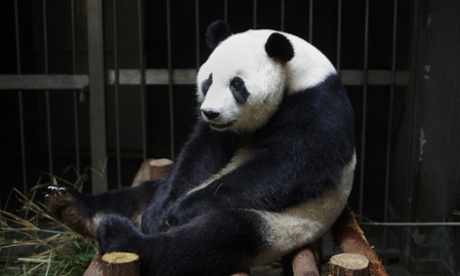
Panda accused of maternity benefits fraud

August 28, 2014

Probably proof that Pandas are evolving – or at least – learning.

Giant panda Ai Hin put on a 'phantom pregnancy', possibly because she wanted special treatment, her Chinese keepers say.

Panda Ai Hin accused of maternity benefits fraud Photograph: STR/AFP/Getty Images

The Guardian:

Hopes that tiny panda paws would be seen in the world’s first live-broadcast cub delivery have been dashed after Chinese experts suggested the “mother” may have been focusing more on extra bun rations than giving birth.

The slated star of the show, giant panda Ai Hin, had shown signs of pregnancy at the Chengdu Giant Panda Breeding Research Centre, according to state news agency Xinhua.

A live broadcast of the event was planned but Xinhua said her “behaviours and physiological indexes returned to normal”, citing experts saying she experienced a “phantom pregnancy”.

The breeding centre, in China’s south-western province of Sichuan, commonly moves pandas that are thought to be pregnant into single rooms with air conditioning and around-the-clock care.

“They also receive more buns, fruits and bamboo, so some clever pandas have used this to their advantage to improve their quality of life,” Wu Kongju, an expert at the base told Xinhua.

Swedish fish thrive on anti-anxiety drugs

August 25, 2014

Silver linings.

Not all man-made waste is detrimental to wildlife. Pike (perch) in waters contaminated with anti-anxiety drugs were found to be more social, had an increased survival rate on hatching and showed more activity 30 days after hatching. Generally the beneficial effects of man-made “contaminants” are neither expected nor looked for. “Most studies of risks from pharmaceutical pollution are conducted along the lines of standard tests for environmental toxins in ecosystems. …. and are structured in a way that hampers the detection of possible positive effects of medicinal contaminants”.

Perhaps anti-anxiety medication (like benzodiazepines or antidepressants or beta-blockers) could be used more widely – intentionally – for the mass treatment of unacceptably anxious or aggressive animals? I particularly like the comment that the fish were more social. I have a vision of man eating tigers being socialised on Prozac!

Nordic Science: Swedish scientists showed in 2013 that pike (or perch) that came in contact with water contaminated with the drug Oxazepam ― commonly used to treat anxiety ― exhibited changes in behaviour. They became more social and even more daring in their hunt for food.

Swedish researcher Tomas Brodin and his colleagues have returned with a new publication about the perch that lived in an experimental environment laced with antidepressants. They actually fared better than fish in water free of the drug. Fewer of the lightly drugged fish died over the course of the experiment.

J Klaminder et al, The conceptual imperfection of aquatic risk assessment tests: highlighting the need for tests designed to detect therapeutic effects of pharmaceutical contaminants, Environ. Res. Lett. 9 (2014) 084003, doi:10.1088/1748-9326/9/8/084003

Abstract

Standardized ecotoxicological tests still constitute the fundamental tools when doing risk-assessment of aquatic contaminants. These protocols are managed towards minimal mortality in the controls, which is not representative for natural systems where mortality is often high. This methodological bias, generated from assays where mortality in the control group is systematically disregarded, makes it difficult to measure therapeutic effects of pharmaceutical contaminants leading to lower mortality. This is of concern considering that such effects on exposed organisms still may have substantial ecological consequences. In this paper, we illustrate this conceptual problem by presenting empirical data for how the therapeutic effect of Oxazepam—a common contaminant of surface waters—lower mortality rates among exposed Eurasian perch (Perca fluviatilis) from wild populations, at two different life stages. We found that fry hatched from roe that had been exposed to dilute concentrations (1.1 ± 0.3 μg l−1) of Oxazepam for 24 h 3–6 days prior to hatching showed lower mortality rates and increased activity 30 days after hatching. Similar effects, i.e. increased activity and lower mortality rates were also observed for 2-year old perch exposed to dilute Oxazepam concentrations (1.2 ± 0.4 μg l−1). We conclude that therapeutic effects from pharmaceutical contaminants need to be considered in risk assessment assays to avoid that important ecological effects from aquatic contaminants are systematically missed.

Climate modelling: Study shows that without access to water fish will die!

August 21, 2014

I am sure all the forecasts based on climate models applied to hydrological models and extrapolated to 2050 are all quite clever. But it is no evidence of anything.

I am not sure why their conclusions are confined to Arizona. I suspect it may be a profound and universal truth that: Without water fish will die!!

My reading of this study (which I put under Trivia):

If the climate develops as we have modelled,

and if the surface water flows are reduced,

and if the connectivity of the water streams is reduced as we have modelled,

then some fish will lose access to water,

and some of those fish will die.

K. L. Jaeger, J. D. Olden, N. A. Pelland. Climate change poised to threaten hydrologic connectivity and endemic fishes in dryland streams. Proceedings of the National Academy of Sciences, 2014; DOI: 10.1073/pnas.1320890111

Significance (In other words an abstract of the abstract)

We provide the first demonstration to our knowledge that projected changes in regional climate regimes will have significant consequences for patterns of intermittence and hydrologic connectivity in dryland streams of the American Southwest. By simulating fine-resolution streamflow responses to forecasted climate change, we simultaneously evaluate alterations in local flow continuity over time and network flow connectivity over space and relate how these changes may challenge the persistence of a globally endemic fish fauna. Given that human population growth in arid regions will only further increase surface and groundwater extraction during droughts, we expect even greater likelihood of flow intermittence and loss of habitat connectivity in the future.

(my bold)

The University of Ohio goes to town with its Press Release : Climate Change will threaten fish…

Fish species native to a major Arizona watershed may lose access to important segments of their habitat by 2050 as surface water flow is reduced by the effects of climate warming, new research suggests. ….. 

“If water is flowing throughout the network, fish are able to access all parts of it and make use of whatever resources are there. But when systems dry down, temporary fragmented systems develop that force fish into smaller, sometimes isolated channel reaches or pools until dry channels wet up again.”…….


Another duck species being exterminated for being successful

August 8, 2014

The inconsistencies in the “conservation” movement and the meaningless defence of “biodiversity” have never been so apparent as in this case where the UK is wiping out all the females of a duck species just because the males are too successful.

Once again an inadequate and failing species is being “protected” by exterminating a successful one for no other reason than that it is successful. The nonsense spouted in the name of “conservationism” is amusing but always expensive and without any real benefit.

The Guardian:

It is American, oversexed and over here, but the days of the ruddy duck in the UK are finally numbered, with the latest culling data revealing that just 10 females remain.

The shooting of the final few – at about £3,000 a bird – will mark the end of half a century of occupation by the species. At their peak, their numbers reached 6,500 but their breeding prowess threatened the native European white-headed duck. 

The invasion began in 1948 when the famed conservationist Sir Peter Scott’s love for ducks led him to import three pairs of the colourful US birds to his Slimbridge reserve in Gloucestershire. But their escape and consequent flourishing in the British countryside led to an anguished debate among ornithologists decades later, as well as a nationwide cull that has cost more than £5m. …… 

Apart from their success in the duck world they don’t seem to pose any particular threat to humans

The problem is that the “sexy” males ruddy ducks (Oxyura jamaicensis) are preferred by female white-headed ducks. The resulting hybrid offspring threatened the survival of the white-headed duck, which was already struggling with habitat loss due to development. “Ruddy duck males are particularly aggressive when it comes to breeding and court females more vigorously,” said Madge. “That makes them more attractive to female white-headed ducks.”

The UK ruddy ducks also spread their wings across Europe, into France, Belgium, the Netherlands and into Spain. The discovery of hybrids in the latter country in the 1990s showed the ducks had grown into a continent-wide threat and that sealed their fate. The following year, an eradication programme began in the UK and a marksmen who has been part of the cull since then told the Guardian the birds fulfil the idea of a sitting duck.

Clearly gender equality is not something for ducks when the females are culled for the “sins” of the males. If ruddy duck males are preferred by the female white-headed ducks (and they have no problem in breeding together) why are these “conservationists” not allowing natural selection to take its course?

If male conservationists were preferred by normal females then perhaps the solution is to eradicate all female conservationists?

Related: Too much biodiversity – time to let some species die out

No mass extinction! Dinosaurs shrank to become birds

August 1, 2014

Sixty five million years ago, the theory goes, a 6 mile long asteroid slammed into the earth and caused the extinction of all non-avian dinosaurs as part of a mass extinction event. Some 50% of all species living at the time – the hypothesis proclaims – vanished in this mass extinction event. It’s the stuff of catastrophe theories and movie scripts.

Smithsonian: Sixty-five million years ago the dinosaurs died out along with more than 50% of other life forms on the planet. This mass extinction is so dramatic that for many years it was used to mark the boundary between the Cretaceous Period, when the last dinosaurs lived, and the Tertiary Period, when no dinosaurs remained. This is called the Cretaceous/Tertiary (or K/T) boundary, and the associated extinction is often termed the K/T extinction event. …….  Most theories focused on climate change, perhaps brought on by volcanism, lowering sea level, and shifting continents. But hundreds of other theories were developed, some reasonable but others rather far-fetched (including decimation by visiting aliens, widespread dinosaur “wars”, and “paläoweltschmertz”­the idea that dinosaurs just got tired and went extinct). It was often popularly thought that the evolving mammals simply ate enough of the dinosaurs’ eggs to drive them to extinction.

But a new paper now suggests that dinosaurs actually shrank as they evolved over 50 million years to become the birds we know today. This still means that it was the dinosaurs vacating space on land which gave rise to the growth of mammal species, but it was not a one-time catastrophic event. No mass extinction then!

No fireworks apparently. Just a gradual, fairly mundane process where the large and cumbersome were deselected as they ran out of the ability to feed themselves and died off.  While the small and the nimble both needed less food and were more capable of getting it.

Michael S. Y. Lee, Andrea Cau, Darren Naish, Gareth J. Dyke. Sustained miniaturization and anatomical innovation in the dinosaurian ancestors of birds. Science, 1 August 2014: Vol. 345 no. 6196 pp. 562-566 DOI:10.1126/science.1252243

University of Southampton Press ReleaseA new study involving scientists from the University of Southampton has revealed how massive, meat-eating, ground-dwelling dinosaurs evolved into agile flying birds: they just kept shrinking and shrinking, for over 50 million years.  

Today, in the journal Science, the researchers present a detailed family tree of dinosaurs and their bird descendants, which maps out this unlikely transformation.  They showed that the branch of theropod dinosaurs, which gave rise to modern birds, were the only dinosaurs that kept getting inexorably smaller.  

“These bird ancestors also evolved new adaptations, such as feathers, wishbones and wings, four times faster than other dinosaurs,” says co-author Darren Naish, Vertebrate Palaeontologist at the University of Southampton.  

“Birds evolved through a unique phase of sustained miniaturisation in dinosaurs,” says lead author Associate Professor Michael Lee, from the University of Adelaide’s School of Earth and Environmental Sciences and the South Australian Museum.  

“Being smaller and lighter in the land of giants, with rapidly evolving anatomical adaptations, provided these bird ancestors with new ecological opportunities, such as the ability to climb trees, glide and fly. Ultimately, this evolutionary flexibility helped birds survive the deadly meteorite impact which killed off all their dinosaurian cousins.”  

Co-author Gareth Dyke, Senior Lecturer in Vertebrate Palaeontology at the University of Southampton, adds: “The dinosaurs most closely related to birds are all small, and many of them – such as the aptly named Microraptor – had some ability to climb and glide.”  

The study examined over 1,500 anatomical traits of dinosaurs to reconstruct their family tree. The researchers used sophisticated mathematical modelling to trace evolving adaptions and changing body size over time and across dinosaur branches.  The study concluded that the branch of dinosaurs leading to birds was more evolutionary innovative than other dinosaur lineages. “Birds out-shrank and out-evolved their dinosaurian ancestors, surviving where their larger, less evolvable relatives could not,” says Associate Professor Lee.


Too much biodiversity – time to let some species die out

July 28, 2014

Conservationists would have us believe that the earth is losing species at an alarming rate and that evil humanity is to blame and therefore more and more species must be protected by “freezing” them into an unnatural existence. Alarmist “conservationism” has led to the ridiculous situation where successful species are termed pests and are eradicated. Hopelessly unfit species – if they are cuddly or otherwise attractive to watch – are protected by being sentenced to a “frozen” existence in zoos or in “protected” and totally unnatural and anachronistic habitats.

I was just watching a program about the highly successful urban coyotes of N. America. They have found a new prey in domestic pets and are thriving. But having adapted successfully to the changing environment they have – needless to say – earned  the status of being declared a pest to be wiped out!!

And yet there have never been more species alive than there are today.

A new review paper warns with great alarm about another impending mass extinction due to the loss of fauna that man has caused. The press release for this paper (why do scientific papers need press releases?) begins thus:

Stanford biologist warns of early stages of Earth’s 6th mass extinction event

The planet’s current biodiversity, the product of 3.5 billion years of evolutionary trial and error, is the highest in the history of life. But it may be reaching a tipping point.

In a new review of scientific literature and analysis of data published in Science, an international team of scientists cautions that the loss and decline of animals is contributing to what appears to be the early days of the planet’s sixth mass biological extinction event.

If biodiversity “is the highest in the history of life” and many species are incapable of adapting to the world they live in, perhaps it is time for them to exit gracefully.

Perhaps the progress of humankind requires that some of these obsolete species must be allowed to disappear.

The dangers of reducing biodiversity are being hyped to a ridiculous extent. Without the mass extinctions of the past, most of the species living today would never have evolved. If the dinosaurs had not gone extinct we would not be around. And the disappearance of the dodo has not increased any threat to humanity.

Related:

Fighting against species extinction is to deny evolution

Genetic adaptation – not stagnating conservation – is the way to help threatened species