Archive for the ‘Winter’ Category

Snow Chaos

December 21, 2010

Just returned from India via Frankfurt through Europe’s coldest December in over 100 years.

Two successive flights to Stockholm were cancelled (due to snow and the logistics of getting aircraft and crew to the right places) and I finally made it home with a delay of about 12 hours. Not too onerous.

But nothing unusual for Stockholm’s Arlanda airport  where operations continued without any fuss at -10°C and masses of snow. Flights cancelled from Arlanda were only those to the UK and Frankfurt!!!!
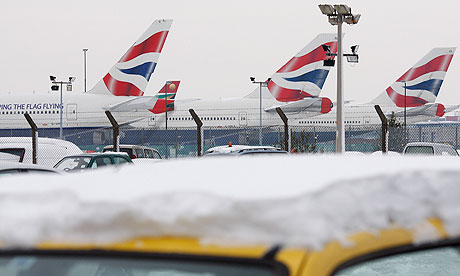
Heathrow

Heathrow snow chaos


UK snow: Christmas cancelled for travellers as Heathrow warns of days of delays

Heathrow authorities effectively cancelled the Christmas plans of hundreds of thousands of travellers yesterday as the Transport Secretary admitted the chaos at Britain’s busiest airport was “not acceptable”.

Amid mounting criticism of Heathrow’s response to the weekend’s snowfall, airline passengers were told to expect delays and flight cancellations “beyond Christmas Day”.

Snow and ice grounded two thirds of flights at Heathrow yesterday, with Terminals One and Three becoming so congested that passengers were told to stay away.

Only one of the airport’s runways was open and staff had cleared just half of the planes’ docking bays. All short-haul flights were cancelled. Some travellers faced a fourth night sleeping in terminal buildings in the hope of getting on a plane.

But even if the next Ice Age is coming I have no doubt that human ingenuity will ensure a successful adaptation.

Sydney shivers! Can’t be climate must be weather.

September 30, 2010

Temperatures in Los Angeles must be due to climate but the cold in Sydney is probably only weather !!!

From the Sydney Morning Herald:

After their coldest winter in 13 years Sydney residents have just experienced their coldest September in five years. “September was an unusual month in terms of the lack of warm days across much of south-eastern Australia,” weatherzone meteorologist Brett Dutschke said.

When both daytime and overnight temperatures were combined, Sydney’s average temperature this month came in at just under 17 degrees. This made it the coldest September in five years, despite being one degree above the long-term norm. It was also the coldest September in terms of daytime temperatures in three years.

Sydney Winter Festival 2010

As far as rainfall goes, Sydney failed to receive the long-term monthly average of 69mm, despite having the normal number of rain days, 10. The city gained only 42mm, the lowest for September since 2007.

“With La Nina likely to peak in the next few months, we are expecting rainfall to increase, trending to near or above average into summer,” Mr Dutschke said. “During this period, daytime temperatures should be near or below average. Overnight temperatures are likely to be close to normal.”

Residents of Melbourne have just experienced their coldest September days in 16 years, Mr Dutschke said. Warmer days ahead will provide Adelaide residents with a good thawing out after enduring their coldest September in 18 years, Mr Dutschke said.

Early snowfall across the Alps, Rockies and Himalayas

September 18, 2010
A panoramic view of distant Himalayan peaks fr...

View from Rohtang Pass

Snow has been falling across the world’s mountain ranges almost a month early. It could portend another long hard winter in the Northern Hemisphere.

  1. 23rd August: It’s winter in The Alps: Hard to belive it’s August, but it has been snowing across the Alps; in some place down to around 2,000m.
  2. 3rd September: A remarkable series of heavy snowfalls has brought up to two feet (60cm) of new snow to the higher slopes of the Alps, raising expectations for the coming winter. Indeed at some glacier ski areas, the 2010-11 season will begin in just a few weeks! The heavy snowfall was particularly intense over Austrian glaciers, several of which are currently open for summer skiing. The Tux glacier near Mayrhofen received more than a foot of new snow causing snow reporting agency http://www.skiinfo.co.uk to issue powder alarms to surprised subscribers to its snow alert email network earlier this week. The alarms are triggered every time there’s a snowfall of 20cm or more in 24 hours. In Switzerland Saas Fee and Zermatt are open for summer skiing too. In Saas Fee’s case it will remain open through to next May while Zermatt’s glacier is open for snow sports all year round. In Italy Cervinia is open this week but closes at the weekend, however Val Senales is currently open and was one of those reporting more than 50cm of new snow.
  3. 15th September: Nearly a month ahead of schedule, the higher reaches of Garhwal Himalayas today received snowfall, sending the mercury plummeting in Chamoli and Rudraprayag districts.  The hills around Badrinath and Kedarnath temples have received snowfall while lower areas received rainfall forcing the people to take out their woollens. Usually, the Garhwal Himalayas experience snowfall during October.
  4. 14th September: Higher reaches of this Himachal Pradesh’s picturesque tourist town experienced season’s first snowfall, on Tuesday. “Hills overlooking Manali received mild spells of snowfall Monday night,” Manmohan Singh, director of the meteorological office in Shimla said.  He said higher hills in Lahaul and Spiti, Chamba, Kinnaur and Kullu districts also experienced mild snowfall. Rohtang Pass, located at an altitude of 13,050 feet, some 50 km from here, was clad in two to three inches of snow. Meanwhile, the minimum temperature in most parts of the state came down due to rains and fresh spell of snow. While Shimla saw a low of 15.6 degrees Celsius Tuesday, it was 8.4 degrees in Keylong – the district headquarter of Lahaul and Spiti district and 11 degrees Celsius in Kalpa village of Kinnaur district.
  5. 17th September: Snow began falling in some areas of north central Montana and along the Rocky Mountain Front early on Friday , leaving some people checking their calendar to see if it is still, in fact, summer. A rain-snow mix in and around Great Falls turned to all snow around 10 am in some areas. Up to an inch of accumulation may be possible throughout Friday, and temperatures will remain in the upper 30s to low 40s. While snow in September is not unusual at higher elevations and in Glacier National Park, many lower elevations also received a dusting, with some areas reporting several inches of snow by mid-day on Friday.
  6. 17th September, Summer snow.  Summer doesn’t officially turn to fall until next week but northcentral Montana skipped right to winter on Friday, with enough snowfall in many areas to stick to the ground until late afternoon.