Clinton has just 20% chance of winning against any Republican says incumbency model

October 14, 2015

According to a model based on how an incumbent fares in an election from 450 elections in 35 democratic countries, any Democrat has only a 20% chance of beating any Republican for the US Presidential election.

Clinton's chances

Clinton’s chances

The model shows that Barack Obama’s current approval ratings are not high enough to allow a successor to get elected, though he would, as an incumbent, have an 80% chance of being reelected himself. With his current approval rating of 45-47%, any successor would only have a 20% probability of winning. Even if Hillary Clinton is an exceptional candidate, it will not be enough to overcome the inexorable hand of this incumbency effect.

Clifford Young and Julia Clark in Reuters:

Elections are not mysterious events subject to the whimsy of unpredictable candidates and voters. They’re actually highly predictable, with a set of variables that influence outcomes in familiar ways. Because of that, we can say, with reasonable confidence, that a Republican will be moving into the White House in 2017.

That conclusion is based on the results of a data model we created, and is primarily the result of two factors, both related to the challenges faced by “successor” candidates — candidates from the same party as the incumbent. First, a Republican will win because voters typically shy away from the party currently in power when an incumbent isn’t running. In fact, a successor candidate is three times less likely to win. Second, President Barack Obama’s approval ratings are too low to suggest a successor candidate will take the White House.

At this point in the election cycle, poll data asking the “horserace” question (“Who will you vote for in November 2016?”) can be very misleading. This far from Election Day, published poll data is off by an average of 8 percentage points compared with the true election outcome. That’s an enormous number when we’re used to elections where candidates win by two to three points.

Time Before Election

Average error of polls (compared to final results)

One week

1.7%

One month

2.7%

Two months

3.8%

Three months

4.8%

Six months

5.8%

Nine months

6.9%

Twelve months

7.9%

Source: Ipsos analysis of 300 polls across 40 markets from 1980 through current

So we created a much larger database of elections by looking beyond the United States to hundreds of presidential and parliamentary elections in democratic countries around the world. This exercise gave us far more data to work with: a sample size of more than 450 elections from 35 countries.

The most important finding from our model is the power of incumbency: if you already hold the office you seek, you are far more likely than not to retain it. Our model showed that incumbents have a threefold greater chance of beating their opponent. When no incumbent is running, successor candidates (in this case, Democrats) are three times less likely to win.

From our database of global elections we also learned about the importance of knowing where the public stands on the direction their country and leadership are going. Are they generally happy or unhappy with the government? There are a few ways to measure this, but the most universal (and therefore the one we use) is approval ratings of the sitting leader or president.

Our model proves the power of presidential approval ratings. It determines that in order for a successor candidate to have better than even chances of winning, the sitting president must have an approval rating of above 55 percent. Because Barack Obama’s average approval rating is now at 45 percent, a successor candidate (i.e. Democrat) is unlikely to win. …….

…… In the coming months, Obama’s approval ratings may tick up. But they would have to pass the 55 point mark to give the Democrats even odds of keeping the White House. This is extremely unlikely, given the fact that presidential approval typically declines over time, and Obama’s ratings are no exception.

Some will argue that Hillary Clinton is special; that her chances are significantly better because, given her popularity and status as a “legacy” candidate, she seems more like an incumbent. But if we go along with that hypothesis and run it through our model, at Obama’s current approval ratings, Clinton’s chances of winning the general election are still less than half.

The Democrats have quite a mountain to summit to retain power past 2016.

The best strategy for Hillary would now be to stop throwing any money down the election drain until Obama improves his approval rating to at least 55%. That would at least give her a 50% chance of being elected.

Opportunities for wealth creation needed rather than just redistribution of wealth

October 13, 2015

Credit Suisse has published its Global Wealth report and its accompanying Databook. The data are based on the world’s adult population of about 4.8 billion. What is immediately obvious is that the wealth is very badly skewed with 71% of the world’s adults having a net worth of less than $10,000, 21% have net worth between $10,000 and 100,000 while just 8% have wealth of over $100,000. (I have also added the line of those in extreme poverty).

However my take is that the pyramid is actually a reflection of wealth creating ability.  The challenge is to make wealth creation opportunity less sensitive to the having of wealth. That suggests to me that it is not just a redistribution from rich to poor that is required in the first instance, but the provision of wealth creation opportunity for those having lower net worth. If extreme poverty can be eliminated, and wealth creation opportunity be made less dependant upon having wealth, then we will have a resultant wealth distribution that automatically matches the wealth creation ability of individuals.

CS global-wealth-report-2015 (pdf)

CS global-wealth-databook-2015 (pdf)

The global wealth pyramid is particularly interesting (wealth being taken as net worth):

It has a large base of low wealth holders and upper levels occupied by progressively fewer adults. We estimate that 3.4 billion individuals – 71% of all adults in the world – have wealth below USD 10,000 in 2015. A further billion adults (21% of the global population) fall in the USD 10,000–100,000 range. While average wealth is modest in the base and middle tiers of the pyramid, total wealth here amounts to USD 39 trillion, underlining the economic importance of this often neglected segment. Each of the remaining 383 million adults (8% of the world) has net worth above USD 100,000. This group includes 34 million US dollar millionaires, who comprise less than 1% of the world’s adult population, yet own 45% of all household wealth. We estimate that 123,800 individuals within this group are worth more than USD 50 million, and 44,900 have over USD 100 million.

Global Wealth Pyramid - adapted from Credit Suisse

Global Wealth Pyramid – adapted from Credit Suisse

The take-away from this depends somewhat on from which side of the political spectrum the data are viewed. Looking from the left it is a strident call to arms to “take from the rich and give to the poor”. But this, I think, is just a little too simplistic. How net worth is distributed generally reflects not only wealth concentration but also wealth creation. Merely redistributing existing wealth will actually reduce the total amount of wealth that is created. The bulk of wealth creation thus lies at the initiative of those having the most wealth. It is this coupling between having wealth and wealth creation opportunities which needs to be addressed. It is wealth creation opportunities for those at the lower reaches of the pyramid which is the real need. It is the cliche – but true – of giving a man a fish (wealth) or teaching him how to fish (or create wealth).

Just redistribution will not increase the world’s wealth creation and it is more likely that it will reduce most for those having the lowest net worth. And that would be entirely counterproductive.

However there is little denying that at the top of the pyramid, the concentration of net worth can be almost obscene. Just 123,800 individuals are each worth over $50 million and 44,900 of them are each worth over $100 million.

Top of the wealth pyramid from Credit Suisse

Top of the wealth pyramid from Credit Suisse

Swedish study says antioxidants also protect cancer cells

October 13, 2015

A new paper from Sahlgrenska Academy in Gothenburg shows that

Antioxidants can increase melanoma metastasis in mice, K Le Gal et al, Science Translational Medicine, 07 Oct 2015:
Vol. 7, Issue 308, DOI: 10.1126/scitranslmed.aad3740

First antioxidants were good for you, then they were of doubtful benefit and now it seems they are positively bad. Many foods containing antioxidants have been touted for their health benefits and have included chocolate, fresh fruits and vegetables, nuts, whole grains, maize, legumes and eggs. Red wine was on the list but the benefits of Resveratrol have already come under a cloud for alleged data tampering.

Of course, perceived antioxidant benefits have not much influenced my own consumption of dark chocolate and red wine. But what the study finds is that  “the overall conclusion from the various studies is that antioxidants protect healthy cells from free radicals that can turn them into malignancies but may also protect a tumor once it has developed”.

So antioxidants can help prevent a cancer developing, but once the cancer is there antioxidants can speed up the progression of the cancer. Dark chocolate and red wine therefore remain on the  “good foods list” for those who do not have any cancerous cells.

Sahlgrenska Press Release:

Fresh research at Sahlgrenska Academy has found that antioxidants can double the rate of melanoma metastasis in mice. The results reinforce previous findings that antioxidants hasten the progression of lung cancer. According to Professor Martin Bergö, people with cancer or an elevated risk of developing the disease should avoid nutritional supplements that contain antioxidants.

Researchers at Sahlgrenska Academy, University of Gothenburg, demonstrated in January 2014 that antioxidants hastened and aggravated the progression of lung cancer. Mice that were given antioxidants developed additional and more aggressive tumors. Experiments on human lung cancer cells confirmed the results.
Given well-established evidence that free radicals can cause cancer, the research community had simply assumed that antioxidants, which destroy them, provide protection against the disease. Found in many nutritional supplements, antioxidants are widely marketed as a means of preventing cancer. Because the lung cancer studies called the collective wisdom into question, they attracted a great deal of attention.

The follow-up studies at Sahlgrenska Academy have now found that antioxidants double the rate of metastasis in malignant melanoma, the most perilous type of skin cancer. Science Translational Medicine published the findings on October 7.
“As opposed to the lung cancer studies, the primary melanoma tumor was not affected,” Professor Bergö says. “But the antioxidant boosted the ability of the tumor cells to metastasize, an even more serious problem because metastasis is the cause of death in the case of melanoma. The primary tumor is not dangerous per se and is usually removed.”

Experiments on cell cultures from patients with malignant melanoma confirmed the new results. “We have demonstrated that antioxidants promote the progression of cancer in at least two different ways,” Professor Bergö says.
The overall conclusion from the various studies is that antioxidants protect healthy cells from free radicals that can turn them into malignancies but may also protect a tumor once it has developed. 

Taking nutritional supplements containing antioxidants may unintentionally hasten the progression of a small tumor or premalignant lesion, neither of which is possible to detect.
“Previous research at Sahlgrenska Academy has indicated that cancer patients are particularly prone to take supplements containing antioxidants,” Dr. Bergö says. “Our current research combined with information from large clinical trials with antioxidants suggests that people who have been recently diagnosed with cancer should avoid such supplements.”


The Left Honourable

October 12, 2015

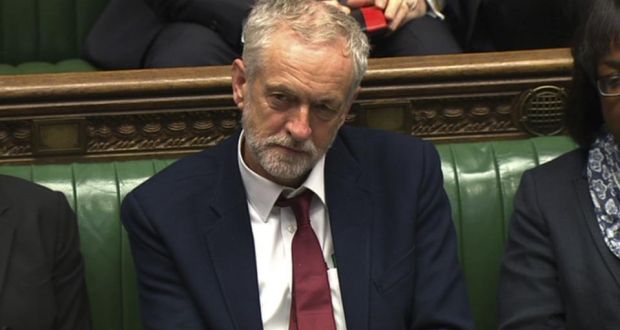
Jeremy Corbyn does not wish to kneel in front of his Queen. He went hiking rather than meet with his monarch. A dastardly act. So he is not yet a member of the Privy Council.

In Parliament he will now have to be referred to as “My Left Honourable Friend/Member”.

The Telegraph:

The Queen’s advisers told Parliament to strip Jeremy Corbyn of his “Right Honourable” status after Number 10 wrongly implied the Labour leader had joined the Privy Council, The Daily Telegraph can disclose.

Mr Corbyn was described on Parliament’s website as “Right Honourable”, which denotes membership of the centuries-old Privy Council, until late last week.

The Labour leader was also described as a “Right Honourable friend” by Prime Minister David Cameron when they faced each other in the Commons last month, days after he was voted in as Labour leader.

However, after Mr Corbyn failed to attend the first meeting of the Privy Council since the summer holidays with the Queen last Thursday, the “Rt Hon” title was removed from Mr Corbyn’s page on Parliament’s website.

The Left Honourable Corbyn (photo Irish Times)

It might seem appropriate, but, of course, there is some difficulty in being both Left and Honourable simultaneously.

Unless Corbyn is also schizophrenic.

The top 10 nanny states of the “free world”

October 12, 2015

A “nanny” state is one which perceives itself as a “free democracy”, but

in which the government insists that it knows best what is good for its subjects and enforces regulations to control individual behaviour under the pretext of the “common good”, “public morality” or of “public health and safety concerns”. 

The top 10 nanny states (11 including the EU) are

  1. Australia
  2. Sweden
  3. EU* 
  4. Norway
  5. UK
  6. Denmark
  7. Singapore
  8. US
  9. Germany
  10. France
  11. Ireland

*Note! The EU is not really a state but the Brussels mentality is fundamentally that of a super-nanny. 

A number of states which would otherwise make the list are excluded because they are not the “free democracies”  they claim to be.

Finally, Swedish opposition acquires a backbone and returns to its job

October 10, 2015

Last December the Swedish, opposition, Moderate-party-led, right-of-centre Alliance, abdicated abjectly from its responsibilities. They signed a so-called December Agreement (DÖ- decemberöverenskommelsen) where they agreed not to oppose, en masse, any critical budget proposition put forward by the minority Socialist/Green government (with the support of the communistic Left party). They agreed to do this, believe it or not, not just for a year or two, but for two whole terms of government (presumably because they thought a quid pro quo could favour them if they were in a minority government after the next election). No doubt they felt it was the only way to get away from the disruptive and looming threat of the right-wing, anti-immigration, Swedish Democrats who hold the balance of power in parliament. The pink/green government, desperate to stay in power, also cravenly agreed to this, even though their budget for 2015 had been defeated and the previous governments budget has applied for 2015. It is ludicrous that they have been in power for a year implementing the previous government’s budget.

At the time, I thought it was a rather despicable Agreement made out of fear and not out of any conviction of what was right. It was an agreement totally lacking in courage and essentially abdicated the role of providing a serious opposition to balance the profligacies of a pink/green (+red support) government. Especially when the weak Socialist leadership was being forced to accept rather childish and incompetent ministers from the Green party. The Greens are sometimes so far to the left of the communists that they approach eco-fascism. The Moderate party had a new party leader then in Anna Kinberg-Batra and she was too inexperienced at the time. She has a reputation for being tough but this toughness has not yet been on display.

DÖ ripped

In any case, the Christian Democrats, a tiny little party but part of the Alliance, have just had their annual congress. (They too have a new party leader, Ebba Busch Thor, but she is extremely lightweight). The party congress rejected the party leadership’s lukewarm recommendation to ratify the Agreement, and voted against it. (I can’t help but feel that Busch Thor and the party leadership actually wanted the rejection but were too scared to openly say so). The consequence is that the December Agreement now stands annulled.

All the Alliance parties have confirmed the annulment. The government parties (socialists, greens and reds) are all moaning about the other parties being unreliable and that they are not to be trusted ever again. The Left communists are most upset at the risk now that the Socialists may abandon them and move to the centre parties to try and cobble together enough support to run a minority government. Probably the best bet for the Social Democrats is to abandon the Greens and The Left and move sharply towards the centre. The Swedish Democrats, who are riding very high in the polls, want a new election.

The government’s budget proposition is waiting to be approved in Parliament but this I think poses no great threat. The other parties have not tabled a joint budget and their individual budget motions will fall. Without a joint budget, which the opposition would have all supported, the Swedish Democrats do not have any opposing motion that they can join to overthrow the government. The Alliance have also said that they have no intention of bringing a no-confidence motion against the government, which the Swedish Democrats then could have taken advantage of.  The Alliance parties don’t want a new election just yet (they have no viable election strategy) and will merely abstain if the SD bring a no-confidence motion themselves.

A crunch could come next autumn in 2016 and even in 2017,  if the Alliance choose to present a joint budget proposition. So we are stuck with the pink/green/red budget for at least a year. It is not a very impressive budget. About 70% of the population will be worse off.

The issue for the Alliance parties will be to develop some kind of a strategy for winning the 2018 election. At the moment they have none. They have to find a way to get back their supporters who have switched their support to the Swedish Democrats. The only strategy visible so far has been to moralise with cliches. Trying to take a high moral position with an electorate already fed-up with sanctimonious preachers has not been very effective.

I could tell them how to do it – not that anybody will listen to me. The first step would be to show some courage. The second would be to start standing up for their own values and not just massaging them – out of fear – to fit perceptions of “political correctness”. (Courage is when fear is made subservient to purpose, but all the Alliance parties have been displaying an abject cowardice in making their actions subservient to fear).

At least we may now finally have an opposition with some backbone – but even that is not entirely certain. But it is an opportunity for Kinberg-Batra to show her mettle.

Is the US now tacitly accepting the Russian strategy?

October 9, 2015

The US has abandoned its fiasco of a $500 million program for the training of “moderate rebels” who could then have provided the physical presence in Syria for getting rid of ISIS (and Assad). So while the rhetoric against the Russian line continues, it seems apparent that the US is not prepared to work directly for the removal of Assad any more. They seem to have reluctantly accepted that Assad need to stay for some indefinite transition period. But that is precisely the path that the Russians are trying to follow. So even if the US has not exactly thrown the “moderate rebels” under a bus, it seems that they are not going to go very far out of their way to support them with more than some arms and some money.

The US may not have completely abdicated, but seems to be taking a political back seat. Regime change is on hold. They may well content themselves – like any good back-seat driver – with criticising the competence of, and the direction being taken by, the Russian driver.

There is a risk now that Saudi Arabia, and the Gulf states will start throwing large sums of money into Syria. Ostensibly it will be for Sunni rebel groups, but much will end up with ISIS and other extreme groups. Iraq of course has joined Iran, Hezbollah and the Assad regime in the Russian coalition.

BBC:

The US is to end its efforts to train new Syrian rebel forces and says it will shift to providing equipment and weapons to existing forces.

Its $500m (£326m) programme was heavily criticised after it emerged that US-trained rebels had handed vehicles and ammunition over to extremists. ……. 

Quoting an anonymous US Department of Defense source, the New York Times reported that the US would no longer recruit Syrian rebels to go through its training programmes in Jordan, Qatar, Saudi Arabia or the United Arab Emirates.

Instead, it would establish a smaller training centre in Turkey, where “enablers” – mostly leaders of opposition groups – would be taught operational manoeuvres like how to call in airstrikes, the newspaper said. 

The failure of the programme underscores the wider problem of the inability to create large and effective moderate forces on the ground. It will also have wider repercussions since the programme helped to coordinate support activities between the Americans, the Gulf states, Turkey, and Jordan. The risk now is that those countries may push on with more separate initiatives backing individual client groups.

The end-game is not certain but the Russian end-game is the only one around.

And one equals two and 2=3, 4=5……

October 9, 2015

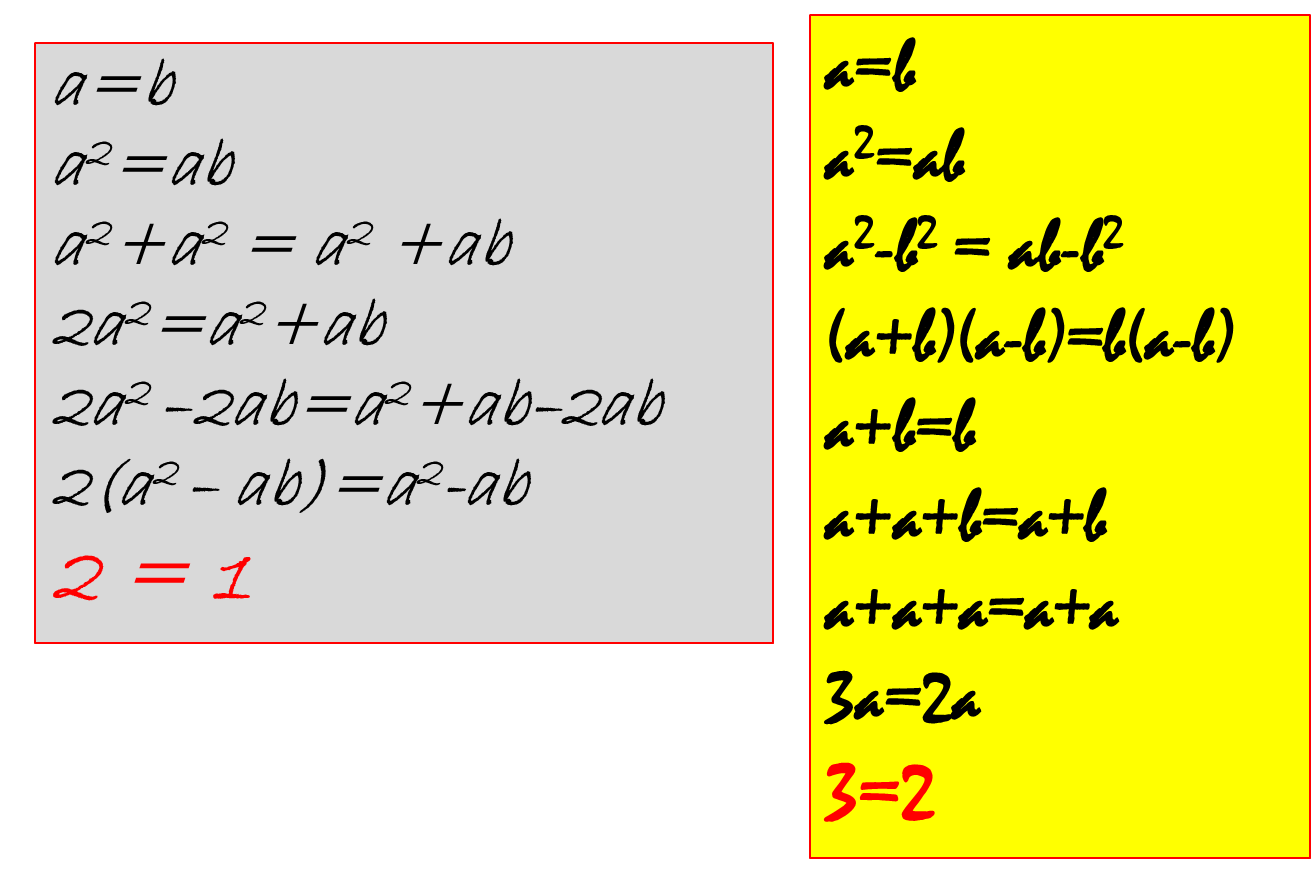
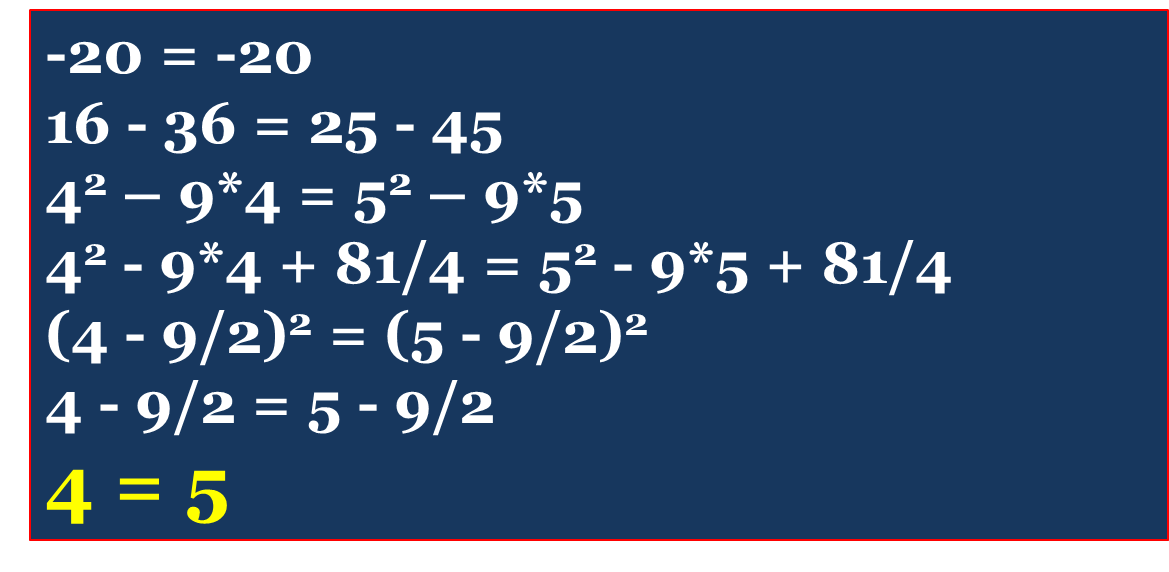
I haven’t seen these in a long, long time but a 12 year old reminded me of the fun available with algebra when messing with hidden zeros and square roots:

And one equals two

And if one equals two….

Why shouldn't 4 be 5

Why shouldn’t 4 be 5?

A few extra copies of p53 and we could also suppress cancerous tumours

October 9, 2015

Elephants should get cancer 100 times more often than humans but instead they have a cancer mortality rate which is at 20-50% of the rate in humans. Cell for cell therefore, elephants are 200 to 500 times less likely to develop cancer than humans. Genetic studies may have revealed why that is so. They have 38 additional copies of a tumor suppressing gene (p53) while humans have only two.

Sounds fascinating. If we could only ingest some additional copies of a specific genes, of which humans have only two, we may be able to suppress cancerous tumours.

Wikipedia tells me that

Tumor protein p53, also known as p53, ……. is any isoform of a protein encoded by homologous genes in various organisms, such as TP53 (humans) and Trp53 (mice). …. p53 has been described as “the guardian of the genome” because of its role in conserving stability by preventing genome mutation. ….. The International Cancer Genome Consortium has established that the TP53 gene is the most frequently mutated gene (>50%) in human cancer, indicating that the TP53 gene plays a crucial role in preventing cancer formation. TP53 gene encodes proteins that bind to DNA and regulate gene expression to prevent mutations of the genome.

Now a new paper reports a study on why elephants rarely get cancers and finds that elephants have 38 copies of p53 whereas humans have only two.

Press Release Huntsman Cancer Institute:

Why Elephants rarely get cancer

…. elephants have 38 additional modified copies (alleles) of a gene that encodes p53, a well-defined tumor suppressor, as compared to humans, who have only two. Further, elephants may have a more robust mechanism for killing damaged cells that are at risk for becoming cancerous. In isolated elephant cells, this activity is doubled compared to healthy human cells, and five times that of cells from patients with Li-Fraumeni Syndrome, who have only one working copy of p53 and more than a 90 percent lifetime cancer risk in children and adults. The results suggest extra p53 could explain elephants’ enhanced resistance to cancer.

Joshua D. Schiffman, MD et al. Potential mechanisms for cancer resistance in elephants and comparative cellular response to DNA damage in humans. JAMA, October 2015 DOI:10.1001/jama.2015.13134

According to Schiffman, elephants have long been considered a walking conundrum. Because they have 100 times as many cells as people, they should be 100 times more likely to have a cell slip into a cancerous state and trigger the disease over their long life span of 50 to 70 years. And yet it’s believed that elephants get cancer less often, a theory confirmed in this study. Analysis of a large database of elephant deaths estimates a cancer mortality rate of less than 5 percent compared to 11 to 25 percent in people.

In search of an explanation, the scientists combed through the African elephant genome and found at least 40 copies of genes that code for p53, a protein well known for its cancer-inhibiting properties. DNA analysis provides clues as to why elephants have so many copies, a substantial increase over the two found in humans. A substantial majority, 38 of them, are so-called retrogenes, modified duplicates that have been churned out over evolutionary time.  

Schiffman’s team collaborated with Utah’s Hogle Zoo and Ringling Bros. Center for Elephant Conservation to test whether the extra gene copies may protect elephants from cancer. They extracted white blood cells from blood drawn from the animals during routine wellness checks and subjected the cells to treatments that damage DNA, a cancer trigger. In response, the cells reacted to damage with a characteristic p53-mediated response: they committed suicide.

“It’s as if the elephants said, ‘It’s so important that we don’t get cancer, we’re going to kill this cell and start over fresh,’” says Schiffman. “If you kill the damaged cell, it’s gone, and it can’t turn into cancer.  This may be more effective of an approach to cancer prevention than trying to stop a mutated cell from dividing and not being able to completely repair itself.”

I don’t understand any of this but can imagine that in a 100 years or so, children will routinely be given “genetic p53 shots”  — as routinely as they get vaccinations today. It’s not as if we don’t already have the gene. So just arranging a few extra copies of a gene we already have, doesn’t sound Frankensteinian and should not lead to developing elephantine features.

US/Nato lack of strategy being shown up by the Russians

October 8, 2015

The US started its regime change efforts in Syria 4 years ago, in 2011,  with the financing, training and encouragement of selected “moderate rebels”. They have no doubt weakened Assad but have also been instrumental in creating ISIS.

The US and Nato have been taking great pains to avoid providing any support to Assad’s regime, and only providing support to their favoured “moderate rebel” groups. Even though it has always been the fanatic groups who have muscled the “moderate rebels” out of the way whenever they have achieved any gains. US and Nato have had no clear strategy. They have attempted regime change with no idea of what is to come afterwards. They have not been able to even contemplate any plausible end-game scenario, because the “moderate rebels” they support are too fractured and diverse in themselves to form any clear alternative to the regime.

By contrast, the Russians have an end-game in view though it is not clear if that can be achieved. But it does at least provide a clear direction and a focus which is lacking in the US/Nato approach.

  1. rendering ISIS and al-Nusra and Al Qaida and other fanatics impotent, even if it means supporting Assad,
  2. a managed withdrawal of Assad, with the regime still in place but without leaving any power vacuum
  3. a political settlement between the regime (sans Assad) and the other “moderate rebels”

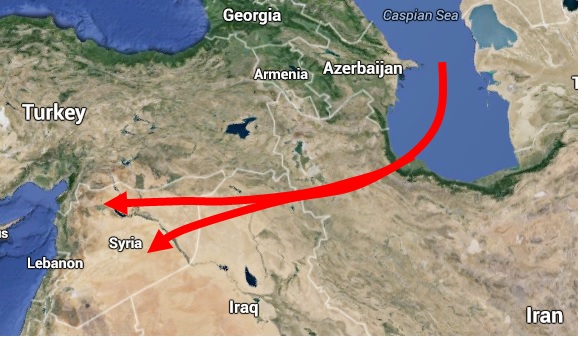
Needless to say, the US and NATO are not amused, though they have no alternatives to suggest when they criticise the Russian cruise-missile strikes from the Caspian Sea. These missiles flew over Iran and Iraq and the strikes were clearly coordinated with them.

4 Russian warships launch 26 missiles against ISIS from Caspian Sea

4 Russian warships launch 26 missiles against ISIS from Caspian Sea

RT:

“Four missile ships launched 26 cruise missiles at 11 targets. According to objective control data, all the targets were destroyed. No civilian objects sustained damage.”

Frigate Dagestan image shipspotting.com

The missiles flew some 1,500 km before reaching their targets. …. Four warships of the Caspian fleet were involved in the missile attacks, the Gepard-class frigate Dagestan and the Buyan-M-class corvettes Grad Sviyazhsk, Uglich and Veliky Ustyug. They fired cruise missiles from the Kalibr NK (Klub) VLS launchers. The missiles used are capable of hitting a target within 3 meters at a range of up to 2,500 km.

Nato countries and the US are highly indignant at these attacks and the Russian violations of Turkish air space, which I suspect, were deliberate and were meant to test limits even if they had no hostile intent.

Nato defence ministers are promising to support Turkey and the Baltic States as if they were directly being threatened by Russia. But that, I think, is because they have no strategy of their own. The US also does not like the Russian strategy but has none of its own.

BBC:

A US-led coalition has been carrying out air strikes against IS in both Syria and Iraq for months. But Western countries support rebels who have been fighting to oust Mr Assad since 2011. ….

But US Defence Secretary Ash Carter said coalition forces fighting IS in Syria would not co-operate with Russia. “We believe Russia has the wrong strategy,” he said. “They continue to hit targets that are not IS.”

Protesting too much, I think.

The problem for the US is that the boots on the ground to defeat ISIS are not going to come from their pet “moderate rebels”. They can only come from the Assad regime, Hezbollah, Iran and Iraq (along with a thousand or two Russian “advisors”).