US/Nato lack of strategy being shown up by the Russians

October 8, 2015

The US started its regime change efforts in Syria 4 years ago, in 2011,  with the financing, training and encouragement of selected “moderate rebels”. They have no doubt weakened Assad but have also been instrumental in creating ISIS.

The US and Nato have been taking great pains to avoid providing any support to Assad’s regime, and only providing support to their favoured “moderate rebel” groups. Even though it has always been the fanatic groups who have muscled the “moderate rebels” out of the way whenever they have achieved any gains. US and Nato have had no clear strategy. They have attempted regime change with no idea of what is to come afterwards. They have not been able to even contemplate any plausible end-game scenario, because the “moderate rebels” they support are too fractured and diverse in themselves to form any clear alternative to the regime.

By contrast, the Russians have an end-game in view though it is not clear if that can be achieved. But it does at least provide a clear direction and a focus which is lacking in the US/Nato approach.

  1. rendering ISIS and al-Nusra and Al Qaida and other fanatics impotent, even if it means supporting Assad,
  2. a managed withdrawal of Assad, with the regime still in place but without leaving any power vacuum
  3. a political settlement between the regime (sans Assad) and the other “moderate rebels”

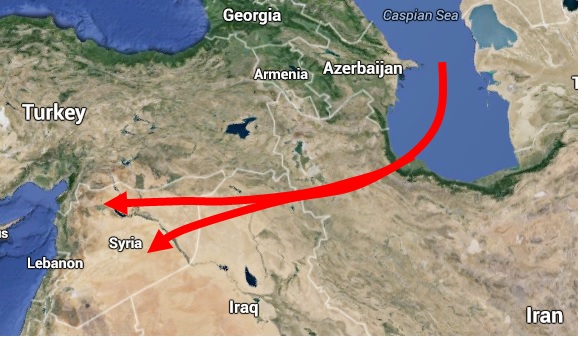
Needless to say, the US and NATO are not amused, though they have no alternatives to suggest when they criticise the Russian cruise-missile strikes from the Caspian Sea. These missiles flew over Iran and Iraq and the strikes were clearly coordinated with them.
4 Russian warships launch 26 missiles against ISIS from Caspian Sea

4 Russian warships launch 26 missiles against ISIS from Caspian Sea

RT:

“Four missile ships launched 26 cruise missiles at 11 targets. According to objective control data, all the targets were destroyed. No civilian objects sustained damage.”

Frigate Dagestan image shipspotting.com

The missiles flew some 1,500 km before reaching their targets. …. Four warships of the Caspian fleet were involved in the missile attacks, the Gepard-class frigate Dagestan and the Buyan-M-class corvettes Grad Sviyazhsk, Uglich and Veliky Ustyug. They fired cruise missiles from the Kalibr NK (Klub) VLS launchers. The missiles used are capable of hitting a target within 3 meters at a range of up to 2,500 km.

Nato countries and the US are highly indignant at these attacks and the Russian violations of Turkish air space, which I suspect, were deliberate and were meant to test limits even if they had no hostile intent.

Nato defence ministers are promising to support Turkey and the Baltic States as if they were directly being threatened by Russia. But that, I think, is because they have no strategy of their own. The US also does not like the Russian strategy but has none of its own.

BBC:

A US-led coalition has been carrying out air strikes against IS in both Syria and Iraq for months. But Western countries support rebels who have been fighting to oust Mr Assad since 2011. ….

But US Defence Secretary Ash Carter said coalition forces fighting IS in Syria would not co-operate with Russia. “We believe Russia has the wrong strategy,” he said. “They continue to hit targets that are not IS.”

Protesting too much, I think.

The problem for the US is that the boots on the ground to defeat ISIS are not going to come from their pet “moderate rebels”. They can only come from the Assad regime, Hezbollah, Iran and Iraq (along with a thousand or two Russian “advisors”).


Evolutionary story of the giraffe’s long neck does not convince

October 8, 2015

A new paper from the New York Institute of Technology reports on fossil studies of the giraffe’s neck vertebrae which show that (press release):

…. the evolution likely occurred in several stages as one of the animal’s neck vertebrae stretched first toward the head and then toward the tail a few million years later. The study’s authors say the research shows, for the first time, the specifics of the evolutionary transformation in extinct species within the giraffe family. ..

“It’s interesting to note that that the lengthening was not consistent,” said Nikos Solounias, a giraffe anatomy expert and paleontologist at NYIT College of Osteopathic Medicine. “First, only the front portion of the C3 vertebra lengthened in one group of species. The second stage was the elongation of the back portion of the C3 neck vertebra. The modern giraffe is the only species that underwent both stages, which is why it has a remarkably long neck.”

…. “We also found that the most primitive giraffe already started off with a slightly elongated neck,” said Danowitz. “The lengthening started before the giraffe family was even created 16 million years ago.” ….

….. the cranial end of the vertebra stretched initially around 7 million years ago in the species known as Samotherium, an extinct relative of today’s modern giraffe. That was followed by a second stage of elongation on the back or caudal portion around one million years ago. The C3 vertebra of today’s giraffe is nine times longer than its width — about as long as an adult human’s humerus bone, which stretches from the shoulder to the elbow.

Clearly one evolutionary pathway has given us the modern giraffe with its ridiculously long neck, but there was also a pathway which led to the shortening of the neck

As the modern day giraffe’s neck was getting longer, the neck of another member of the giraffe family was shortening. The okapi, found in central Africa, is the only other living member of the giraffe family. Yet, rather than evolving a long neck, Danowitz said this species is one of four with a “secondarily shortened neck,” placing it on a different evolutionary pathway.

But I find the story that the elongation of the giraffes neck was due to natural selection, as a consequence of a survival advantage for longer necked individuals in time of drought, somewhat unsatisfactory. The idea that it was sexual selection at play (a longer neck providing the males with better fighting ability) is even more unsatisfactory.

Let us suppose that a prolonged drought led to all middle size shrubs dying out or at least becoming unavailable to ancestral giraffes through competition. It would have had to have been a very selective drought that allowed only grasses and very low shrubs to survive along with the leaves of taller bushes and trees. We need to remember also that for such a natural selection to work, all the shorter necked giraffes needed to die out and thus be de-selected. It is not impossible that the shorter necked animals were just crowded out by more efficient herbivores which led to the longer necks opening up a niche not available to the other herbivores. But I find the arguments for the extinction of shorter necked giraffes while other herbivores prospered somewhat unconvincing.

The evolutionary pathway to the longer neck is still a mystery.

Why not longer legs? I like this homage to Gary Larson by evolution-outreach.com

Brian Switek reviewed the various theories a few years ago and pointed out

… significant neck elongation began around 14 million years ago during the Late Miocene — after the lineage to which the relatively short-necked okapi split off — and by about 5 million years ago giraffes of modern proportions had evolved. ……..  it appears that the elongation of giraffe necks occurred during a global pattern of aridification in which grasslands replaced forests.

For the moment, the question of “How did the giraffe get its long neck?” must be answered with “We do not yet know”

Switek wrote that five years ago – but it still applies.

We still don’t know.

We are outsourcing our digital memories

October 7, 2015

Prior to about 1995, I held all  telephone numbers important to me in my head. Now, I can remember my own mobile number but not my wife’s. In fact there are very few mobile numbers I bother to keep in my memory at all. I rely entirely on my phone. But it must be that I have taken a decision in my subconscious not to clutter my memory with these numbers – since they are so easy to access on my device.

A new study suggests that we are damaging our long term memories by our dependence upon our digital devices. I am not convinced. I suspect they asked the wrong questions. They have not, I think, considered or sought the type of new long-term memories that are built up instead. The study is by Kaspersky Lab and therefore needs to be taken with a very large bushel of salt. It is I think rather narrow and a little trivial.

Kaspersky-Digital-Amnesia (pdf)

Connected devices enrich our lives but they have also given rise to the potentially risky phenomenon of Digital Amnesia. Many people underestimate just how exposed their externally-stored memories can be, rarely thinking about the need to protect them with IT security, such as anti-virus software. Kaspersky Lab is committed to helping people understand the risks their data could be exposed to, and empowering them to tackle those risks. 

Digital Amnesia

I cannot see that the volume of long term memories is affected. The content of the long term memories we unconsciously choose to hold changes.

BBC:

An over-reliance on using computers and search engines is weakening people’s memories, according to a study.It showed many people use computers instead of memorising information. Many adults who could still recall their phone numbers from childhood could not remember their current work number or numbers of family members.

Maria Wimber from the University of Birmingham said the trend of looking up information “prevents the build-up of long-term memories”. The study, examining the memory habits of 6,000 adults in the UK, France, Germany, Italy, Spain, Belgium, the Netherlands and Luxembourg, found more than a third would turn first to computers to recall information.

The UK had the highest level, with more than half “searching online for the answer first”. But the survey suggests relying on a computer in this way has a long-term impact on the development of memories, because such push-button information can often be immediately forgotten.

“Our brain appears to strengthen a memory each time we recall it, and at the same time forget irrelevant memories that are distracting us,” said Dr Wimber. …….

….. Among adults surveyed in the UK, 45% could recall their home phone number from the age of 10, while 29% could remember their own children’s phone numbers and 43% could remember their work number.

The ability to remember a partner’s number was lower in the UK than anywhere else in the European survey. There were 51% in the UK who knew their partner’s phone number, compared with almost 80% in Italy.

The study from Kaspersky Lab, a cybersecurity firm, says that people have become accustomed to using computer devices as an “extension” of their own brain.

It describes the rise of what it calls “digital amnesia”, in which people are ready to forget important information in the belief that it can be immediately retrieved from a digital device.

The study highlights how, as well as storing factual information, there is a trend to keep personal memories in digital form. Photographs of important moments might only exist on a smartphone, with the risk of their loss if the device is lost or stolen.

My own observations about myself are that I no longer bother memorising digital information which is easily accessed on devices, but I find (or I think I find) I can remember qualitative information (colours, pictures, past conversations, smells, ideas) in much greater detail than I used to.


The magical speed of an inconstant time

October 7, 2015

It has always bothered me that time apparently only began 13.8 billion years ago with the Big Bang. I find it equally as difficult (or easy) to conceive of 20 billion years ago as 13.8 billion years ago. But even 13.9 billion years ago is disallowed by the Big Bang, which is a very unsatisfactory state of affairs. I need time to go back indefinitely long.

And so I distinguish between perceived time and eal time. eal time, of course is magical. It is only by definition that we take the passage of time to be constant. Of course this is just perceived time. And we perceive time only as a consequence of change. But eal time does not have to elapse at a constant rate.

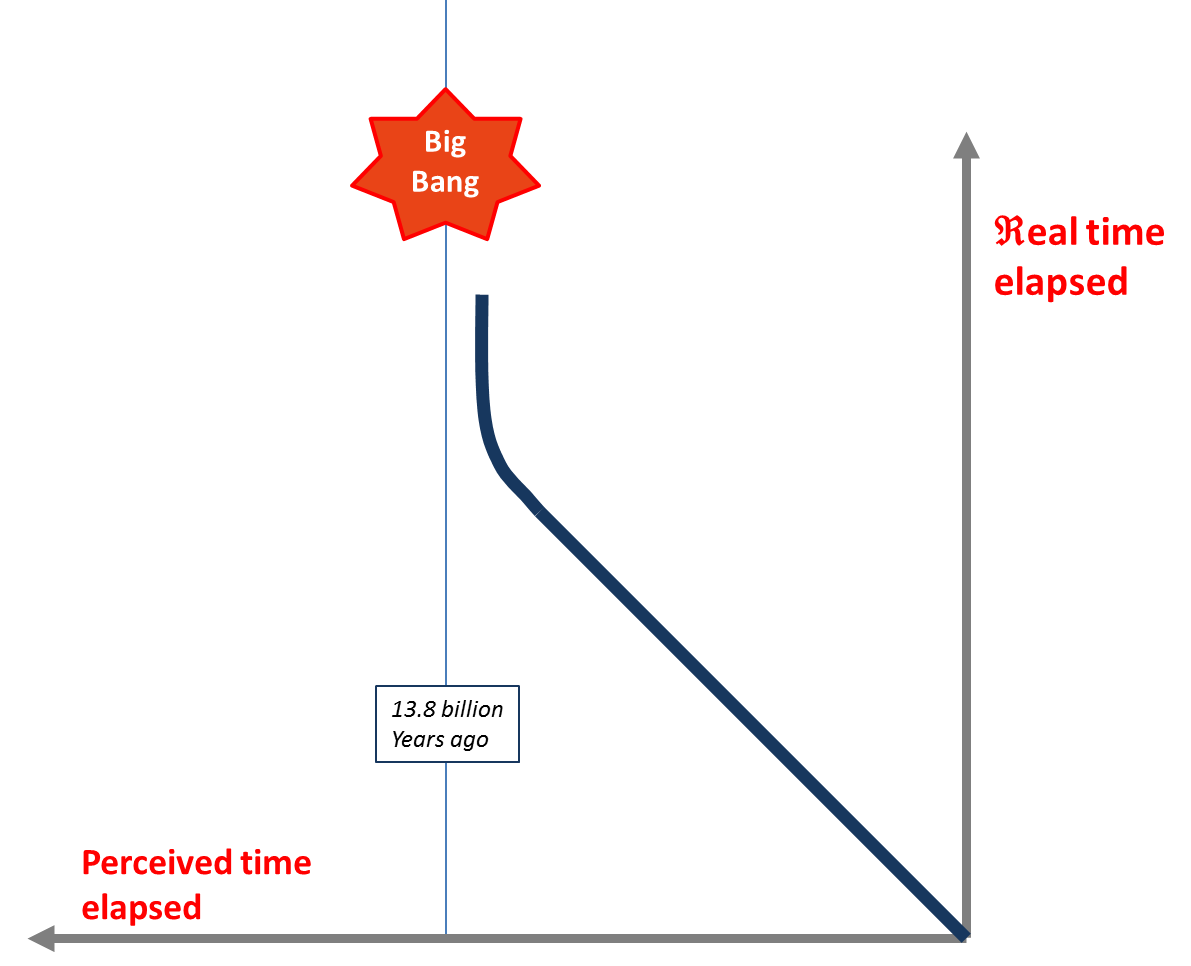
The Big Bang does not, apparently, mathematically permit of a time older than 13.8 billion years. Magical eal time, of course, goes back to infinitely long ago. All can be resolved merely by accepting that ℜeal time elapsed at zero rate at the Big Bang and then gradually built up to the rate of elapse we are subject to now.

“One second is the time that elapses during 9,192,631,770 (9.192631770 x 10 9 ) cycles of the radiation produced by the transition between two levels of the cesium 133 atom”.

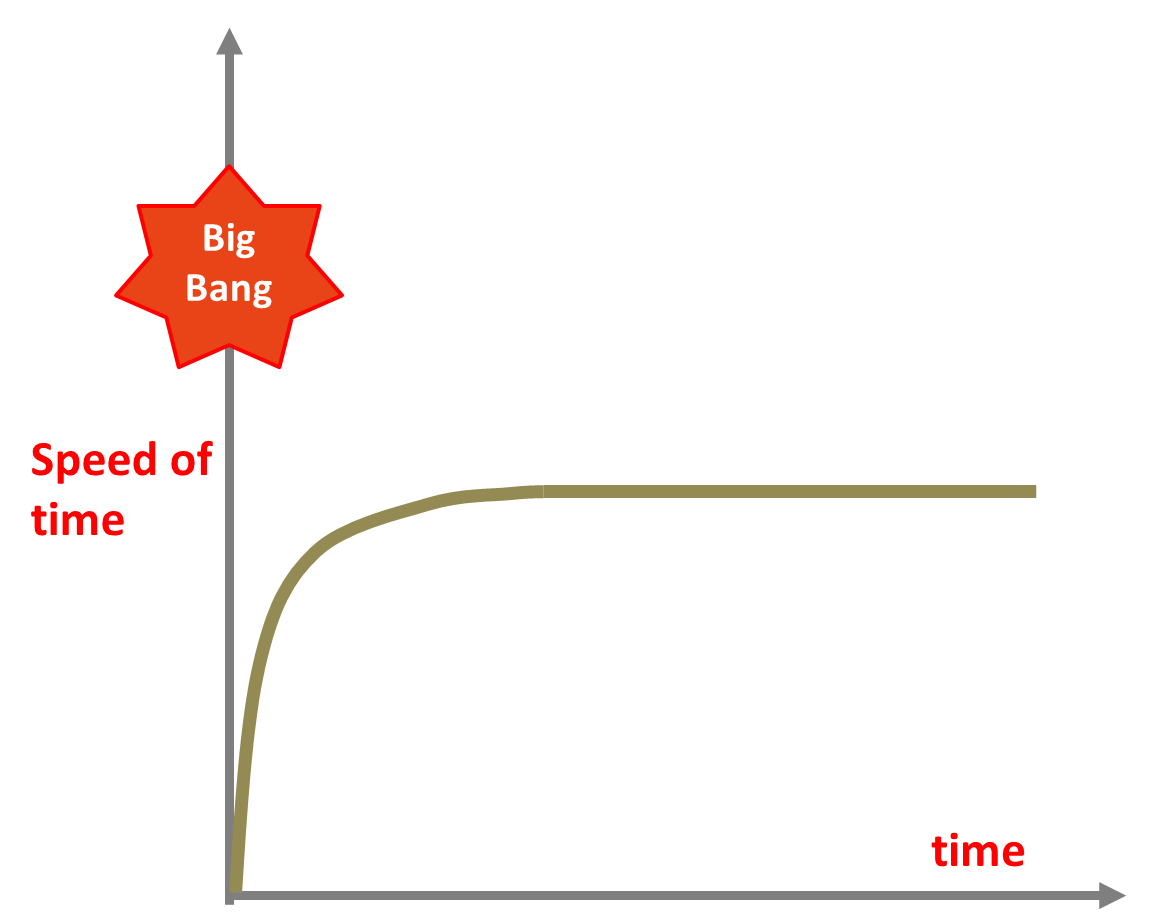
At the Big Bang, even change had to get started. All change, all motion, all vibrations, all oscillations and all radiation had to start from zero. The atoms and the elements had to come into being. Cesium had to have come much later. These cycles of these oscillations of even the very first atoms may be regular now. But they would all have had to start somewhere (somewhen) and start from zero. The speed of oscillation had to build up from nothing (implying an infinite period) to that applying today. Which means that close to the Big Bang as atoms were ratcheting up their oscillations, the period between cycles would have been longer, starting infinitely long and reducing rapidly (in apparent time) to what is observed today. Closer to the Big Bang, eal time, as opposed to apparent time, would have elapsed more slowly and the period between cycles of all radiation would have had to start from infinity. The very speed of time would have been slower.

speed of time

At the Big Bang, the speed of eal time would have been zero. A perceived picosecond of elapsed time would actually have been after the elapse of many, many trillions of eal time years. The perceived age of the universe of 13.8 billion years of perceived time would have been infinitely long ago in eal time.

Real time

Real time

The death of the Universe will then see eal time either slowing down again for an imploding Universe (or time speeding up for the reverse).

The Big Bang inherently requires an inconstant time.


Tomorrow, 7th October, the world will end in fire

October 6, 2015

Here we go again.

The world ends tomorrow in fire. This time it is the eBible Fellowship who reckon that the gates of Heaven were closed on 21st May 2011. Then by some strange and convoluted machinations they come to the end of the world 1600 days later – which brings us to tomorrow – 7th October 2015.

You have been warned. Prepare to meet thy doom.

I would if I could, but I have a cold.

ebible:In our previous Bible pamphlet entitled: “Spiritual
Judgment Began May 21, 2011” we demonstrated God’s
propensity toward bringing spiritual judgments to pass; the
judgment upon mankind in the garden of Eden; the
judgment of God upon the Lord Jesus Christ in the garden
of Gethsemane; and the judgment upon the corporate
churches of the world. These were all spiritual judgments
and in bringing about a spiritual judgment on the world
(beginning May 21, 2011) the Lord is following this biblical
pattern.
On May 21, 2011 the Bible indicates that God shut the door of heaven.

…. Therefore, 1600 furlongs may be viewed as 1600 days. If we go 1600 days from May 21, 2011 we arrive at October 7, 2015. We now have a time path that leads us to the date of October 7, 2015. ….

…. The Bible reveals to us that God has been punishing the unsaved people of the earth since May 21, 2011 and, simultaneously, through the number 1600, the Bible also reveals that God has been severely trying all those that are considered true believers. October 7, 2015 would be the 1600th day since May 21, 2011 and, therefore, the testing would be finished on that day.

Even the Guardian is impressed.

The Guardian: The eBible Fellowship, an online affiliation headquartered near Philadelphia, has based its prediction of an October obliteration on a previous claim that the world would end on 21 May 2011. While that claim proved to be false, the organization is confident it has the correct date this time.

“According to what the Bible is presenting it does appear that 7 October will be the day that God has spoken of: in which, the world will pass away,” said Chris McCann, the leader and founder of the fellowship, an online gathering of Christians headquartered in Philadelphia.

“It’ll be gone forever. Annihilated.”

McCann said that, according to his interpretation of the Bible, the world will be obliterated “with fire”.

When the population implosion threatens …..

October 6, 2015

By 2050, virtually all parts of the world, except some parts of Africa, will be witnessing a decline in population. Until then, migrations of peoples will serve to maintain the ratio of productive to “non-productive” people. (By then, the non-productive will probably be defined as those under 20 and those over about 70). But going forward, migration from declining source populations will no longer be able to provide even a temporary solution.

The fundamental decline in fertility rates will be a consequence of the widespread acceptance of women’s rights, the increasing liberation of women in Asia and Africa, and the ready availability of contraception and abortion. Increasing longevity will mitigate population decline to some extent but will exacerbate the declining ratio of productive/unproductive population. The threat will be of an accelerating decline. Alarmism will no longer be about “population explosions” but about the coming “population implosion”. The decline of rural populations will threaten food supplies, though mitigated by increasing automations and genetically modified crops. Growth will be limited, not so much by capital or raw materials, but by the availability of personnel. In developed countries, tax revenues will stagnate or begin to decline.

Sustainable communities, somewhat smaller than the current nation states, will start husbanding their people resources and their (local) tax revenues. “National” programs – health, education and even infrastructure – will increasingly shift to be “local”. The immigration issue of the day will be about preventing any influx of non-productive peoples. Incentives will be offered to attract productive businesses and people. Some isolated areas already below critical populations or population-mixes, which survive only on subsidies, will be “abandoned” financially. That will, in turn, shift people to areas which exceed the critical mass for the provision of welfare and other services. Successful communities will be those which attract productive people and provision of local jobs, education and health services will be the competitive factors. Education services provided will be linked to performance. Health services to be provided for any individual will be judged by the cost of the service against the benefit of the individual’s remaining productive life. Health services for the elderly will gradually be removed from welfare services and will all have to be purchased. Assisted deaths for the elderly will be as readily available as abortions.

The globalisation paradigm which would have been in effect for a century will shift to a new “localisation” meme.

As power to raise revenues is devolved increasingly to smaller, sustainable communities, “national” defense budgets will be slashed. Expansionism will no longer make any sense. Conflicts may still occur over resources (water, rare metals, rare earths ….) but will decline as population declines. Virtually every local government will then be engaged in trying to increase fertility rates. Tax breaks and extra payments will be available for every child. “Political correctness” will shift to the having of many children. But all these measures will not have much effect in increasing fertility rates.

Surrogacy will pay very well until the artificial womb is developed. That will be the game changer. Then community governments will move to control artificial fertilisation from donor sperm and eggs. The birth of children will move into the “public” sphere. Genetic scanning will be increasingly used prior to allowing a foetus to develop in an artificial womb. Humans will then only be required to supply their sperm or their eggs. They will no longer be required to perform as parents. Mating will no longer be an activity connected to the production of children. The children will be brought up in community creches. The fertility rate will become a completely controllable parameter. Eventually, so will the genetic make up of the children being produced. Some will have their genes tailored to meet some specific community need. Others will be mass-produced when “drones” are required in large numbers. The most powerful committee in any community will then be that which chooses which egg will be fertilised by which sperm.

It is population decline which will lead inevitably and remorselessly to the Brave New World.

Evolution of the desk

October 5, 2015

Update: I am informed by the producer of the video that the attribution of the original video below should be to Best Reviews, http://bestreviews.com#reviews

My apologies to Best Reviews.


From Harvard Innovation Lab

Published on 20 Oct 2014
video courtesy of: bestreviews.com/best-computer-desks#hist­ory-of-the-computer-desk
photography by dougthomsen.tv / engineering by anton georgiev

Only problem is that my desk actually looks like this:

desk

Whose boots will prevail in Syria?

October 5, 2015

It does not require rocket science to see that ISIS will only, can only, be defeated finally by boots on the ground.

The US and its partners assumed that “moderate rebels” in Syria would provide the boots on the ground to take over, once they had managed to get rid of Assad. But the assumption that the “moderate rebels” formed any sort of cohesive group which could bring stability has proven to be grossly wrong. They are so splintered and fractured and cover such a wide range of objectives that they can only ensure instability. The further assumption that the rag-tag being supplied with weapons and money to effect regime change, did not also include radical and fanatic Sunnis and Wahabis has been at best, incompetent, and at worst, disastrous. The Russians are, it seems, making a different calculation.

Any scenario which pictures the defeat of ISIS will require that their followers are left with no physical or political space to occupy and control. And that is going to require that their space is then occupied by someone else. Air attacks by the US led coalition or by Russia can only prepare the way, but without a real physical presence the effects of such air attacks can only be temporary. Without filling up the space with some form of political stability, any political vacuum will always provide room for the fanatics.

Of a Syrian population of about 23 million, 9 million are displaced and are refugees within Syria or abroad. Around 3 million are estimated to have left Syria. Around 75% of the Syrian population were Sunni muslims, 12% were Alawites (a secretive branch of Shia Muslims) and about 8% were Christians. Assad is of course an Alawite. As Shias the regime is supported by the Hezbollah from Lebanon and from Iran’s Shia (90% of Iran’s population are Shia and about 9% are Sunni). If Assad were to step down, but was replaced by another Alawite, then the Alawites, many of the Christians and even some of the moderate Sunnis, could probably live with a regime which provided stability. The fly in the ointment is financial support for the various Sunni and Wahabi rebel groups in Syria (including the hard-line terrorist groups such as Al Qaida, al-Nusra and ISIS) which comes mainly from Saudi Arabia and the Gulf States. US support for rebel groups in Syria has, under Saudi influence, often supported the Sunni line. ISIS cannot be politically suffocated as long as its external financing continues.

Even with a defeated ISIS, sympathisers will still remain. But they will not be in control. A “defeat” can only mean that they no longer have any control over any settlements within which they might still exist, and that they have no safe havens within which to hole-up. That cannot happen unless control over all geographical areas effectively lies with some body – or bodies – that reject the fundamental claims of the Islamic State.

The mutual hatred between ISIS and Shia Muslims is a key factor. No Sunni rebel group fighting against Assad is not without some sympathy for ISIS. This virtually disqualifies any of the current rebel groups being supported by the US coalition, from being capable of supplying the political control needed to squeeze out ISIS. Certainly the US and its coalition partners are not going to supply the physical presence on the ground. The Russians are not going to send in troops beyond military advisors to Assad either.

So who does that leave? Whose boots on the ground are going to prevail?

The Russian calculation seems to be that the regime (later without Assad) together with Hezbollah, Iraqi Shias and some Iranian presence will be sufficient to defeat ISIS and squeeze them out. It is not impossible, but the Saudis will not take kindly to that. That would be seen as an unacceptable blow to the Sunni ego.

And then whether such an end-game is allowed to stand will depend upon whether the US is prepared to satisfy the Saudis by challenging the Russians (and the Iranians and Hezbollah) in their support of the Assad regime. I suspect that the Russians are calculating that Obama will only keep shifting his red line rather than actually cross it. As long as the Russians keep the eventual stepping down of Assad as being inherent in their plans, Obama will, reluctantly, go along.

It seems a highly dangerous path to this end-game where the regime (without Assad) but with help from Hezbollah and Shias from Iraq and Iran supply the boots on the ground to get rid of ISIS. But at least it is an end-game which is not impossible. And it seems to be the only one available. The US and their European partners seem not to have thought very far beyond the removal of Assad.


Nobel week starts today

October 5, 2015

This the schedule (Swedish time) for announcing the awards

PHYSIOLOGY OR MEDICINE – Monday 5 October, 11:30 a.m. at the earliest
PHYSICS – Tuesday 6 October, 11:45 a.m. at the earliest
CHEMISTRY – Wednesday 7 October, 11:45 a.m. at the earliest
PEACE – Friday 9 October, 11:00 a.m.
ECONOMIC SCIENCES – Monday 12 October, 1:00 p.m. at the earliest
LITERATURE – The date will be set later

I find the economic science and peace prizes are little more than nonsense (with a few exceptions). The literature prize is not so bad but does get bogged down by political correctness from time to time. But to each his own.

Some Nobel trivia:

105 Nobel Prizes in Physiology or Medicine have been awarded between 1901 and 2014.

38 Medicine Prizes have been given to one Laureate only.

11 women have been awarded the Medicine Prize so far.

32 years was the age of the youngest Medicine Laureate ever, Frederick G. Banting, who was awarded the 1923 Medicine Prize for the discovery of insulin.

87 years was the age of the oldest Medicine Laureate ever, Peyton Rous, when he was awarded the Medicine Prize in 1966 for his discovery of tumour-inducing viruses.

58 is the average age of the Nobel Laureates in Physiology or Medicine the year they were awarded the prize.

The Thomson Reuters prediction page is here. The medicine predictions are for work on human gut microbes, proteins and T-cells.

Extreme poverty at all time global low while population is at an all time high

October 5, 2015

Being poor is a relative term. To be in “extreme poverty” is an absolute measure. To be “poor” does not require being in “poverty”. The “poor” relative to the “rich” will always be with us and are just as necessary as the “rich”. In fact, that distinction between rich and poor is necessary as long as humans are to be considered individuals with aspirations and not just clones. Income inequality is often equated – especially by those with communistic leanings – with poverty, but this is simply wrong. Income inequality may be an indicator of the ratio of “poor” to “rich” but to be “poor” need have nothing to do with being in “poverty”. “Poverty” is not necessary and the goal is to eliminate extreme poverty by 2030.

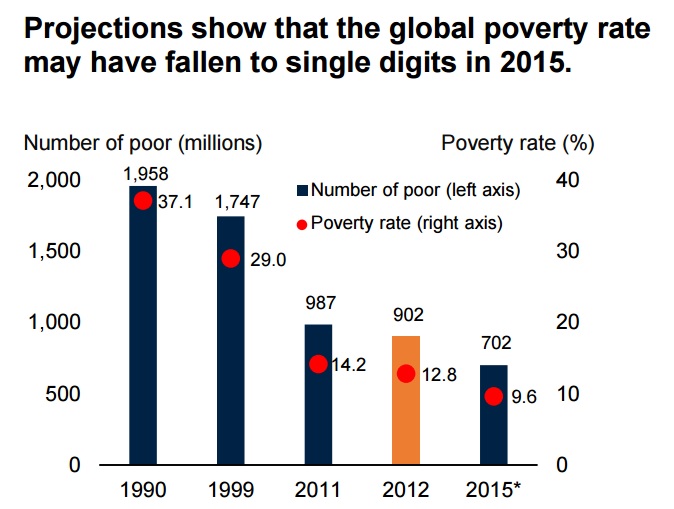
The 2015 World Bank Research Note on Extreme Poverty is now out. In 2015, for the first time ever, and in spite of the global population being at an all time high, the number of people in extreme poverty has reduced to less than 10%. In spite of the population increase, the total number in extreme poverty is at the lowest in 25 years. But that is still 700 million (900 million in 2012) in extreme poverty. Sub-Saharan Africa and S Asia are where the misery is concentrated.

Extreme Poverty - World Bank 2015

Extreme Poverty – World Bank 2015

Press Release:

The number of people living in extreme poverty around the world is likely to fall to under 10 percent of the global population in 2015, according to World Bank projections released today, giving fresh evidence that a quarter-century-long sustained reduction in poverty is moving the world closer to the historic goal of ending poverty by 2030.

The Bank uses an updated international poverty line of US $1.90 a day, which incorporates new information on differences in the cost of living across countries (the PPP exchange rates). The new line preserves the real purchasing power of the previous line (of $1.25 a day in 2005 prices) in the world’s poorest countries. Using this new line (as well as new country-level data on living standards), the World Bank projects that global poverty will have fallen from 902 million people or 12.8 per cent of the global population in 2012 to 702 million people, or 9.6 per cent of the global population, this year.

Extreme Poverty contributions - World Bank 2015

Extreme Poverty contributions – World Bank 2015