IPL 2022 – Only 6 teams left with a real chance

May 5, 2022

We are at the sharp end of the IPL.

10 teams. 14 matches each. 

70 matches in total before the play-offs. (We are now at match 50 later today).

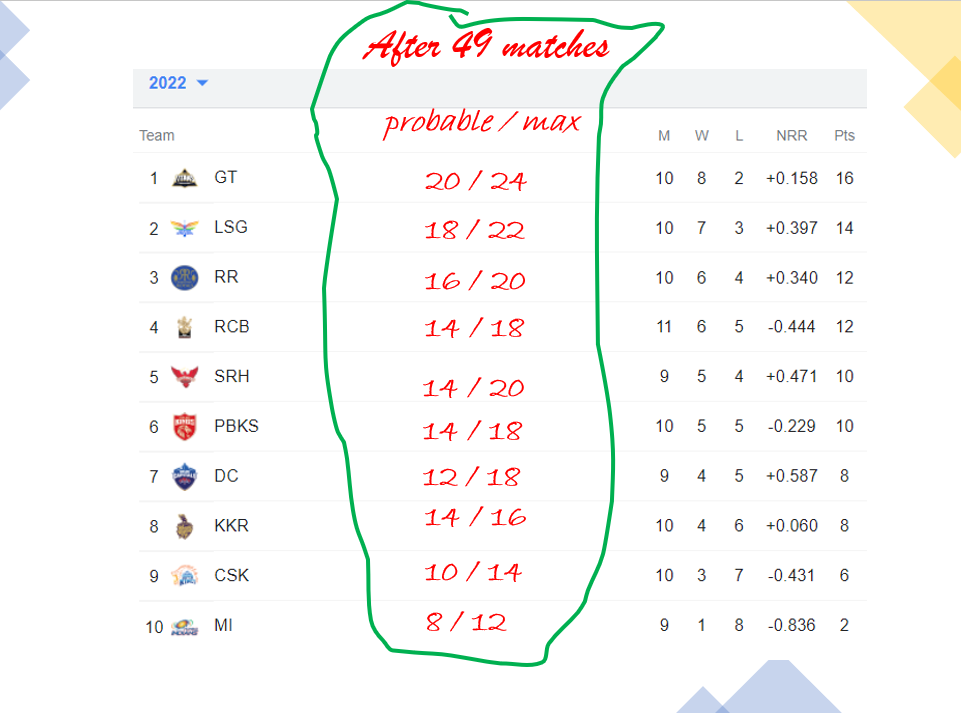
The arithmetic is straightforward. A total of 140 points to be played for. In theory every team could win seven matches and end up with 14 points with everything to be decided by net run rate. In any event, net run rate will be needed to determine the final four. The fight for fourth place could well involve 3 – 4 teams on the same number of points.

Gujarat Titans have qualified with aplomb and Mumbai Indians are humiliatingly eliminated I think. I don’t think DC, KKR or CSK will make it either and that leaves 6 teams with a chance to make the play-offs. A number of the “young” captains have not excelled. Pant, Shreyas Iyer and Jadeja have been found wanting.

The most outstanding, match-winning performance so far was in match 14 on 6th April with Pat Cummins’ 50 off just 14 balls as he blasted Kolkata Knight Riders to a 5 wicket win over Mumbai Indians.

My take on the current status. 


“Good conduct” is not an evolutionary survival trait

May 4, 2022

What passes for “good conduct” today is not so very different to what it was at least 5,000 years ago. It is very probable that it has not changed very much for much longer than that. To lie, to rob, to cheat, to harm, to murder and to rebel against established societal authority have all been considered “bad conduct” in human societies from long before recorded history is available. The earliest known codes of laws go back to Babylonian (Hammurabi -1800 BCE) and even to Sumerian times (Urukagina – 2400 BCE). Codes of conduct can be inferred to even earlier times with the beginnings of Dharma in the pre-Hindu Indus-Saraswati Valley, in ancient Egypt and in ancient China. 

Code of Hammurabi

Definitions of what constitutes “good conduct” must originate with the earliest societies of hunter gatherers and must therefore precede the spread of farming, the growth of cities and even the beginnings of semi-permanent settlements at the end of the last ice age (c. 12,000 years ago). It is not unreasonable that the Golden Rule (Do to others as you would have them do to you) emerged as a core definer of good conduct around 40 – 50,000 years ago. 

50,000 years is not insignificant in evolutionary time. For humankind it represents around 2,500 generations of natural selection. But our conduct has not improved. Evolutionary changes can be observed in humans and they are not small. All the races we identify today have emerged in that time. The changes are continuing but it is not apparent over our short lifetimes as to what the future holds for us. The changes are sufficient that it is not very likely that a human from 50,000 years ago would be able to breed successfully with a human from today.

Wikipedia – Human traits that (have) emerged recently include the ability to free-dive for long periods of time, adaptations for living in high altitudes where oxygen concentrations are low, resistance to contagious diseases (such as malaria), light skin, blue eyes, lactase persistence (or the ability to digest milk after weaning), lower blood pressure and cholesterol levels, retention of the median artery, reduced prevalence of Alzheimer’s disease, lower susceptibility to diabetes, genetic longevity, shrinking brain sizes, and changes in the timing of menarche and menopause.

Humans are the only species which has shown the capability of interfering with the conditions determining natural selection. We started neutralising the effects of environment on us when we built shelters and gained control over fire. We now create our own bubbles in which we live and nullify the impact that climate and weather once had on natural selection. We use technology to minimise the impact of natural disasters on the evolution of our kind. Of course, the greatest impact humans have had on natural selection has come in the last 200 years or so with the great advances of medical knowledge. Being weak – mentally or physically – is no longer a de-selector for survival and reproduction. Natural selection no longer favours the “fittest”. Choice of mates is no longer (entirely) based on physical superiority. We deselect some characteristics before birth (Down’s Syndrome). Whether we admit to it or not, we employ a kind of eugenics by default. We have begun artificial selection (AI) though we are not quite sure what we are selecting for.

But it is not at all obvious that “good conduct” is any more prevalent among humans today than it was 50,000 years ago. We continue to lie, cheat, do harm, murder and flout established authority. As individuals we do so utilising the most advanced technologies available to humankind, always one step ahead of the established authorities. No doubt there is a genetic component to “good conduct”, but natural selection has not found any benefit in promoting it. In today’s age of entitlements, survival and reproduction by transgressors is actually protected. The genetic components of “bad conduct” are given a protected status. As societies we continue to war on each other for quite frivolous reasons with the most wonderful new weapons. In fact weapons production leads many technology advances – as it always has done.

The inescapable conclusion I come to is that “good conduct” is not a survival trait and has no impact whatsoever on the evolution of the species. In fact, “bad conduct” may well be preferred by the selection forces we have now brought into play. What evolution will result in remains to be seen. But it is highly probable that our conduct will not be any better than it is now. There is a chance it could be much worse.

When the tree falls in the forest, the sound is only due to language

May 1, 2022

The classic, cliched question goes:

“If a tree falls in a forest and no one is around to hear it, does it make a sound?”

The non-philosophical part of question is easily answered.

  • If a tree falls within an extant medium, and
  • there is consequent vibration within that medium, and
  • there is an organ which can detect such vibrations, and
  • the organ generates impulses, and
  • it sends these impulses to a brain, and
  • that brain interprets the impulses as something the brain itself labels as sound, then
  • there will be sound.

If the tree fell in a vacuum there would be no vibration of anything. No medium, no sound. No ear, no sound. No brain. no sound. In fact, if we did not have ears connected to our brains our language would be unable to come up with words for ears, hearing or sound. If we had no word for sound then there might well be vibrations when the tree fell, but there would be no sound. The non-philosophical answer then becomes that if we had no word in language for sound then there would be no sound. When a dog or a bat detects vibrations at frequencies that our ears cannot detect then such signals never reach our brains to ever be classified in our language as sound. What an animal might interpret in its brain when its ears detect signals is whatever that animal interprets it or labels it to be.  Only if we define the word sound to loosely mean what any brain may interpret on receiving signals from any ear-like organ, could we say that the animal discerns sound.

The philosophical part of the question, however, which considers perception, observation and existence is much more interesting. There are many things we cannot directly experience with our limited senses. But we can infer and/or deduce that they exist by their interactions with other things giving changes which we can observe directly. We extend our senses by creating wonderful instruments which then produce changes observable directly by our traditional senses. We “see” in the ultraviolet or the infra-red only because our cameras convert these UV or IR signals into images that do fall within our visible range.

But what of all that we cannot observe, directly or indirectly, by our limited senses and our finite brains? Is it so that if something cannot be observed, cannot be perceived, cannot be inferred to exist by any interaction it has with anything else in this universe, then it does not exist? Or is it merely that we are ignorant of its existence? Philosophy is, of course, about asking unanswerable questions. Once a question can be answered it leaves the field of philosophy.

Take bongism for example. We cannot observe it, perceive it, infer it or deduce it. It has no known interactions with anything else in this universe. But it is the imbalance in bongism which caused all existence in the first place. It is the answer to the question “Why do things exist at all?”.

Does bongism exist?

It must do, since I have a word for it.


Banning what is not illegal is what? immoral/unethical/ stupid/ clever/ ……

April 27, 2022

We live in forbidding times.

The 20th century in a sociological sense will be looked back upon as a time when fear – and many undue fears – governed society. It is remarkable that it is so called “liberal” societies who have the greatest overabundance of legislation banning things. Authoritarian societies start with the default position that everything is forbidden unless explicitly allowed. Liberal societies pretend to start with the position that everything is allowed unless explicitly banned. And what is banned is then driven by cowardice in an atmosphere of fear. They then generate a mountain of legislation to ban what cannot be done, said, written, eaten, or worshipped. Legislation bans some from being parents and takes their children away. Dogs are not allowed to run free and people are banned from politically “incorrect” behaviour. Bakers are not allowed to reject unwelcome customers. To give offense is banned. Sellers are forced to sell to unwelcome buyers. Feelings are not allowed to be hurt. Snowflakes melt. Safe spaces are created in which the sanctimony virus is nurtured. Most so-called liberal states have become Nanny states. There is more suppression of individuality today in so-called liberal states than in many dictatorships.

If some behaviour is not banned it is clearly not illegal even if not specifically being identified as being legal. Many companies and organisations ban behaviour and actions which are not banned by legislation. They go well beyond the legislative limits of what is not allowed in law to restrict their own employees or their customers or their users. It is obvious overreach.

But is the overreach illegal? or just immoral or unethical? or just “contrary to the will of the people”.

“Don’t walk on the grass”, “Don’t eat here”, no beer at a football match, keep your dog on a leash, no loudspeakers , and so on, are some of the more innocuous examples. Of course “free speech” does not actually exist – anywhere. It is “cabined, cribbed, confined” by legislation and extra-legal sanctimony. But overreach is overreach and some of it is vicious. The social media groups such as Facebook and Twitter are cases in point. They have taken it upon themselves to become moral police. They ban posts which clearly are not in contravention of any legislation in accordance with their own view of what is acceptable. They go further and, arbitrarily and selectively, ban some people from participating.

It is in that context that Elon Musk’s comments about Twitter should be read.

“The extreme antibody reaction from those who fear free speech says it all. By “free speech”, I simply mean that which matches the law. I am against censorship that goes far beyond the law. If people want less free speech, they will ask government to pass laws to that effect. Therefore, going beyond the law is contrary to the will of the people.”

I stopped using LinkedIn, Facebook and Twitter some time ago. Musk’s take-over of Twitter – if it goes through – is probably the best thing that has happened to social media. But I doubt I will be returning to Facebook or Twitter or LinkedIn anytime soon.


Rishabh Pant behaved like a spoilt brat. Needs sacking from the captaincy.

April 22, 2022

Update!

Well they were fined as expected.

But Pant needs a public spanking.


Watching the IPL from far-away Sweden is wonderful escapism for me.

But there were ugly scenes today as Rajasthan Royals and Butler took Delhi apart. Delhi fought well on the field but a wonderful game was ruined by the antics of a spoilt brat.

Rishabh Pant is an exciting cricketer to watch. But as a captain of Delhi Capitals he comes up wanting – and badly wanting. His behaviour today was not just disgraceful in itself but he was encouraged by a bunch of idiots in his dugout. I note that Ricky Ponting was not there. Perhaps he might have prevented Pant from bringing the game into disrepute. But he could not have stopped Pant from bringing himself into disrepute.

No doubt there will be some nominal slapping of wrists and some fines levied. But what he needs is a real spanking and to be sacked from the job of captain. He is certainly no role model as captain.

ESPN

Ugly scenes as Rishabh Pant sends off Pravin Amre onto the field after threatening to call his players off. What has happened is this: with 36 runs required off the last over, Rovman Powell has hit the first three for sixes. The third one is a high full toss, which has not been called a no-ball on the field, but the DC dugout is remonstrating immediately. The replay shows it is touch and go, possibly high, but not blatantly so. But the laws and the rules say you can check no-balls only if a wicket has fallen of the ball. DC want it referred.


History, heroes, villains and the Jesus/ Judas story

April 19, 2022

Of course history is always just a story. It always contains the biases and prejudices of the historian and always cherry-picks “facts” and speculates as necessary to suit the historian’s agenda. It is, I think, largely unjustified that writing labeled as “history” is considered more “truthful” than works of fiction.

Stories need that their good guys and bad guys be available for the reader to identify with. Very often the plot collapses without the villain. No murder mystery can work unless we first have a murderer. Sometimes the author is actually the villain. A case in point is Edward Gibbon’s “Decline and Fall of the Roman Empire”. Edward Gibbon was not a nice man and his own peculiarities are now invisibly, but permanently, enshrined in his work. Most histories written during the 20th century are distorted by the political positions of their authors. But, not to worry. They are, after all, just works of fiction.

I observe that the Bible like any other story needs its villains for the plot to function. Easter week is just over and I started writing a post about history, the Bible and fiction. But I found I had already written about this 6 years ago which I reproduce below. (One forgets what one has written).

The Easter timeline suggests Judas was eliminated

But I have always been a little doubtful about the way in which poor Judas Iscariot is portrayed. It is not just coincidence that Easter week is a week of mystery.

Without the Resurrection, Christianity could still be a religion and a body of teachings with Jesus as a “great teacher”. But he would not then have demonstrated his divinity. He would not qualify to be the Son of God.

The capture of Jesus, in the plot of the Bible story, is a fundamental and necessary step for the Passion and the Crucifixion and the Resurrection. The role of Judas is utterly crucial to demonstrating the divinity of Jesus, but the Bible story is not very forthcoming as to his motivations. He is a traitor who “fingers” Jesus because Satan enters him. In some Gnostic writings he is a great soul who sacrificed himself for the necessary capture of Jesus – necessary for Jesus’ purposes. Judas was the cashier for the apostles and was entrusted with keeping all their monies. That thirty pieces of silver would be the motive for the betrayal does not convince.

The Bible story is somewhat unsatisfactory also in its details of the death (usually presumed to be suicide) of Judas. From the Bible story he either hanged himself or he fell into a field and burst such that he was disembowelled. The Gospel of Judas – found in the 1970s and dated to 280 AD – is considered a Gnostic text and is not accepted as being part of the Bible. Here Judas has visions of being stoned to death by the other apostles. It is only in the Gospel of Judas that we are told the story from the viewpoint of Judas and that Judas was actually acting on instructions from Jesus.

Consider the timeline of Holy Week in the Bible story.

  1. Day 1: Palm Sunday: Jesus triumphantly enters Jerusalem with all his apostles, riding humbly (?) on a donkey. Spends Sunday night at Bethany a little to the east of Jerusalem at the home of Mary, Martha and Lazarus.
  2. Day 2: Monday: Returns to Jerusalem. Along the way he curses a poor fig tree because it had failed to bear any fruit. The tree withers. He enters the Temple to find it filled with money changers (forex dealers since the Temple only accepted Tyrian shekels) and merchants selling animals for sacrifice. He chases them out with much ado. He returns to Bethany to spend the night.
  3. Day 3: Tuesday: Jesus returned to the Temple in Jerusalem and played hide-and-seek with the priests who challenged his authority and tried to apprehend him. But he evaded them. In the afternoon he and his disciples climbed the Mount of Olives and he made prophecies about the destruction of Jerusalem. He spent the night again in Bethany. Matthew reports that Judas negotiated his deal with the Sanhedrin on this day.
  4. Day 4: Wednesday: The Bible is silent about this day. It is presumed Jesus and his disciples stayed in Bethany and took it easy.
  5. Day 5: Thursday: Jesus sent Peter and John to “prepare” (presumably to reserve it as well) the Upper Room in Jerusalem (The Cenacle) for the Passover feast which would begin at twilight and continue on Friday. At twilight he washed the feet of his disciples and then began the Passover meal – the Last Supper. He prophecies that he will be betrayed by one of his disciples – which they each in turn deny. He identifies the traitor as being Judas by giving him a piece of bread soaked in the dish and as soon as he does so,  “Satan enters Judas” (?). From the Upper Room they all went to the Garden of Gethsemane. Here, late that evening, he is betrayed by Judas and arrested by the Sanhedrin and taken to the home of Caiaphas where the Sanhedrin Council have gathered.
  6. Day 6: Friday: Early on Friday morning, Judas is found dead. By the 3rd hour (9 am) the trial of Jesus has started. He is found guilty and forced to carry his cross to Calvary where he is crucified. By the ninth hour (3 pm) he is dead. Around the 12th hour (6 pm) his body is removed from the cross and is laid in a tomb guarded by Roman soldiers.
  7. Day 7: Saturday: The tomb is guarded by Roman soldiers all through the Sabbath day until dusk (12th hour – 6 pm). When the Sabbath ends, his body is anointed and prepared for burial by Nicodemus (himself a member of the Sanhedrin Council which found Jesus guilty).
  8. Day 8: Sunday: Early on Sunday several women went to the tomb and found it open and Jesus missing. He “appears” to five people during the day providing “proof” that he has been resurrected.

There are many, many writings by Bible scholars about the whole week. There are many interpretations of the symbolism but there is little controversy about the timeline. It is the timeline itself which makes me think that Judas was murdered. He identifies Jesus for the Sanhedrin on Thursday night and by dawn on Friday he is conveniently dead.

Applying the little grey cells a la Poirot,

  1. Jesus needs that someone close “betray” him.
  2. He picks Judas for that role
  3. He announces to all the apostles that Judas is the betrayer to be
  4. Judas follows instructions and identifies Jesus for arrest
  5. Judas dies before Jesus has even been tried and sentenced

The betrayal, death and resurrection of Jesus was the prophecy that needed to be fulfilled. The story that Judas killed himself in a fit of remorse, before Jesus even came to trial, sounds implausible to me. The accounts of his death also differ too much. Hanging cannot easily be mistaken for falling into a field and bursting. Both hanging and being thrown off a cliff could just as well have been murder as suicide. The parsimonious narrative that fits is that Jesus had to pick somebody – anybody – to be a scapegoat from among his disciples. Just turning himself in would not do, since it would not create the perception of being a martyr to a cause. He chose Judas to be the “betrayer” and put upon him that burden. However, the martyrdom of Jesus needed a “clean” betrayal; not one in which he was himself complicit. Judas was chosen as the scapegoat and had to be sacrificed to the greater cause. Jesus may well have realised that whoever he chose would incur the wrath of the other disciples. Why else did Jesus identify Judas as the betrayer to  the other disciples in advance of being betrayed? And Judas duly betrayed Jesus and incurred the wrath of the others. Before the night was out, and very conveniently, he was dead and the story-line of the betrayal was secure. Possibly Judas had been murdered (executed without trial) by the other disciples for the betrayal and they did not even realise that the story-line required Judas to die.

And since the Bible story is said to be written by his disciples, it is hardly likely that they would either mention that Judas was sacrificed by Jesus or that they had killed Judas to ensure his silence and protect the story-line. So did Jesus manipulate Judas to be the betrayer or did Judas act in full knowledge of his role? Did Jesus manipulate the other disciples to make sure Judas was silenced after he had played his part? It is not surprising that the Gospel of Judas is not accepted within the Bible. For that would mean that Jesus had orchestrated his own capture.

Poor Judas. He may have just been a dupe chosen by Jesus to be the scapegoat. But if he knowingly sacrificed his life and accepted being remembered in perpetuity as the “betrayer” of Jesus, his was probably a very great soul.


The subjectivity of objective

April 18, 2022

Absolute objectivity is a mirage. Objectivity, in itself, is always a value judgement and always subjective. There is no observation, no experience, no proposition, no fact, no truth, no logic which has not been filtered through human cognition and all its shortcomings. Nothing is completely objective. Nothing I write can be objective. That is a truth which comes before the beginning.

Let us start there.

Objective is not a useful word in framing an insult. “You objective scoundrel” somehow elevates a “scoundrel” and detracts from the insult. I cannot think of an example where being objective is considered bad. An objective evil or an objective crime are word combinations without meaning. At worst, objective is perceived as neutral. In regard to human thoughts and actions we assume that they are either based on logic and reason or on feelings and emotion. They are not necessarily opposed but it is implicit in our language that they are different. We perceive reasoning to be more objective than emotional reactions.

We allow the ability to distinguish objective from subjective to reside only in animate things having brains. We do not even allow artificial brains that ability. We know that brains are where both logic and reason on the one hand, and feelings and emotions on the other, reside. But we connect being objective with a brain’s exercise of logic and reason and untainted by emotions. Language does not permit an emotional rationality. Being subjective is also of a brain but is a characteristic of the individuality of that brain and its attendant emotions. Subjectivity is undefined without a brain which generates both reason and emotion. The practice of science and the law thus set a high value on the thing we call objectivity, whereas we appreciate, and expect, an individualistic subjectivity from an author or a musician or a painter or a teacher or a tennis champion.

But in seeking objectivity we are chasing a mirage.

Read the rest of this entry »

Call him Anonymous

April 6, 2022

Call him Anonymous.

He was born in a middle-size town to middle-class parents and he was then one of about 1,700 million people alive. He was an only child and rarely met his two cousins. He did not want for food or clothing and enjoyed an unremarkable but comfortable childhood. He was not bullied and did not bully anyone else. He was never beaten and never struck anyone. He finished school in the middle of his class. He went to an unremarkable university and graduated, without honours but without any adverse comments. He joined a large textile company as a junior clerk in the accounts department.

In due course he married his unremarkable cousin (twice removed) who was two years older and they had three unremarkable children. One died (a cot-death) in infancy. His children grew up unremarkably and without any great upheavals in their lives. He bought a house and a little car. His wife worked as a shop accountant before their children were born and also after they were teenagers. They did not want for food and clothing and they could afford an unremarkable holiday for a week or two every year. During the War he was seconded as an accountant to the Amy Pay Office. After the war he returned to his textile company employer. His performance as an accountant was always adequate and his career progressed unremarkably through the accounts department. By the age of fifty he had risen to be the Deputy Manager of the Reports and Financial Statement Department. His parents died unremarkably in their 80s.

His wife and he both retired at 60 and their combined pensions allowed them to continue living unremarkably in their house. She continued with her Lunch Club and Dramatic Society and he had his annual subscription to the Football and Bridge Clubs. Their children – and later 2 grandchildren – visited them in the summer and at Christmas. They were always invited to his company’s annual Christmas Party until the company was wound down and vanished after 120 years in business. She died quietly after a stroke when she was 78 and he continued living in his unremarkable little house for another 15 years. When he was 92 his children and the City authorities moved him to a home for the aged. His house was sold and the proceeds together with his pension were sufficient to ensure that he was cared for at a better than average home. He never became senile but his physical abilities gradually withered away. His children continued visiting him once or twice a year. He had no other visitors.

He died 11 years later at 103. It was a quiet death and his heart just stopped beating one night. It was during the pandemic and nobody could visit him. The Home organised his cremation and the disposal of his ashes in consultation with his children. This was in an environmentally approved tip since immersion of the ashes in the local river was not allowed. A short memorial service was live-streamed a month later and 4 people logged in.

He died alone among 7.5 billion people on the planet.

There is no doubt he did exist. An unremarkable living, a forgotten life

His name? Call him Anonymous.


And where lies the truth about Ukraine?

March 29, 2022

I believe very little of the ridiculous propaganda narratives either from the Western media or from the less accessible Russian sources.  The narrative in the Western media dominates the media space that is accessible to me. The counter-view is not politically correct and is largely ignored but the politically correct story that I am being bombarded with lacks somewhat in credibility.

What I do observe is the real oil and gas prices (spot price rather than futures), the real prices of food in the markets and the real performance of the world stock markets. Asia and the Middle East are resisting the wholesale acceptance of the NATO propaganda and are making their own nuanced judgements. And what I observe suggests that the Western media narrative which is flooding the air-waves is heavily (probably intentionally) flawed.

The Guardian’s view is utterly predictable and just a little too sanctimonious. The counter-view published by ANI may also be rather biased but is a necessary balance for the childish narrative peddled by the bulk of the Western media.

Well, time will tell, but I suspect that the end-game will include further “autonomous”, Russian speaking regions established in Eastern Ukraine and that Ukraine will be forced to give up its aspirations for any membership of NATO for the foreseeable future.


Holi Sleep today but happiness follows on the 20th

March 18, 2022

18th of March 2022

In India Holi is being celebrated today while the rest of the world celebrates(?) Annual Sleep Day. But not to worry – Happiness Day follows on the 20th (along with Flour, Oral Health, French Language and Storytelling).

March madness continues.

(In case you were wondering, the UN’s annual Russian language day is to be celebrated around the world on 6th June).


I observe that when humans virtuously associate in international groups the collective intelligence exhibited is significantly lower than the lowest common intelligence. Intelligence increases fast when sanctimony and self-assessments of virtue are discarded.