Web ads may not be the dominating revenue model in the future

June 11, 2015

I find web ads always irritating and sometimes so intrusive that they have put me off the site altogether. Now I use Adblocker with Chrome, which works very well and this allows me to visit and stay on sites which I would otherwise have avoided. Apparently Apple will also allow ad blocker apps with Safari (iOS9) and clearly they see it as a way of improving the experience of their users. But what Apple plans will allow more than just ad blocking:

“Content Blocking gives your extensions a fast and efficient way to block cookies, images, resources, pop-ups, and other content.”

Effectively Apple are offering”ghostery” rather than ad blocking:

Quartz: Ghostery is a popular browser extension for all major desktop browsers. It blocks all content pulled in from third-party servers.

The way the modern web works is this: if you go to a website, it only sends some text and images your way. But it also pulls in data from dozens of analytics tools, ad servers, ad exchanges, web analytics firms, social buttons and trackers, and various other forms of online surveillance that serve you ads, measure you responses, gauge your profile, figure out your shoe size, and so on. Ghostery stops all of it. Apple’s content blocker appears to allow developers to do something similar.

Why is Apple doing this? Joshua Benton at Nieman Lab lays out three ways of looking at it: either Apple is serious about all its recent privacy talk, or it is out to get Google and Facebook, or it wants people to look at the ads served by its own iAds service on its new News app. Perhaps it is a mix of the three.

But what is clear is that small businesses that rely entirely on online advertising are going to have to rethink how they make money.

In fact it could be a way for Apple not only to to differentiate themselves from their competitors but also to develop some brand loyalty from among the increasing number of web and mobile users who are just irritated and get no added value from the ads and 3rd party content.

Since using Adblocker I have returned to many sites which I had abandoned because of their intrusive ads. Typically on the news sites, “quality” news sites have upto 5 ads blocked per web page while the “tabloids” have 10 – 20 ads blocked. One tentative conclusion that I come to is that the experience of getting the “news” is inversely proportional to the number of ads on the page.

Surfing some of the news sites just now I found the number of ads being blocked as below:

NYT – 5, Wa Po – 3, Huff Po – 13, CNN – 5, NY Post – 9, CBS News – 18

The Telegraph – 13, The Guardian – 5, The Independent – 19, Daily Mail – 12, The Times -8, BBC – 4, The Mirror – 38

The Hindu – 3, Times of India – 5, Hindustan Times -6

Expressen – 7, Svenska Dagbladet – 2, Dagens Nyheter – 7, Aftonbladet – 21

Der Spiegel -3, Deutsche Welle – 0, Reuters – 17, Le Monde – 4, El Pais – 6

So by my simple reckoning, without an adblocker, The Mirror provides about the worst experience and Deutsche Welle, SvD, BBC, Der Spiegel and Le Monde offer the least intrusion and disturbance to their readers.

Boozy chimps, Hanuman and the “drunken monkey” hypothesis

June 11, 2015

A new paper reports on chimpanzees in Guinea exhibiting long-term and recurrent ingestion of ethanol. The study was carried out over 17 years and found chimpanzees using leaves to drink fermented palm sap. Many consumed sufficient to produce “visible signs of inebriation”. Local humans also tap the sap of the raffia palm trees to make a palm wine.

The human trait of imbibing intentionally fermented drinks is at least as old as the oldest known archaeological records of ancient civilizations. Stone jugs for alcoholic drinks have been found which date back to at least 10,000 BCE . It is quite likely that the origin of alcoholic drinks predates the arrival of agriculture some 15,000 years ago. And that would suggest that the origin lies with the accidental (and fortuitous?) consumption of over-ripe and partially fermented fruits and berries leading eventually to an intentional fermentation. But that takes the origin back to the time before modern humans had even arrived on the scene and when their primate ancestors relied on fruits and berries for their diet.

Kimberly J Hockings, et al, Tools to tipple: ethanol ingestion by wild chimpanzees using leaf-sponges, Royal Society of Open Science, 

Abstract: African apes and humans share a genetic mutation that enables them to effectively metabolize ethanol. However, voluntary ethanol consumption in this evolutionary radiation is documented only in modern humans. Here, we report evidence of the long-term and recurrent ingestion of ethanol from the raffia palm (Raphia hookeri, Arecaceae) by wild chimpanzees (Pan troglodytes verus) at Bossou in Guinea, West Africa, from 1995 to 2012. Chimpanzees at Bossou ingest this alcoholic beverage, often in large quantities, despite an average presence of ethanol of 3.1% alcohol by volume (ABV) and up to 6.9% ABV. Local people tap raffia palms and the sap collects in plastic containers, and chimpanzees use elementary technology—a leafy tool—to obtain this fermenting sap. These data show that ethanol does not act as a deterrent to feeding in this community of wild apes, supporting the idea that the last common ancestor of living African apes and modern humans was not averse to ingesting foods containing ethanol.

The study provides support for the “drunken monkey” hypothesis which “proposes that human attraction to ethanol may derive from dependence of the primate ancestors of Homo sapiens on ripe and fermenting fruit as a dominant food source. Ethanol naturally occurs in ripe and overripe fruit when yeasts ferment sugars, and consequently early primates (and many other fruit-eating animals) have evolved a genetically based behavioral attraction to the molecule”.

In fact there were natural selection benefits in being “drunken monkeys”. The chimpanzee paper begins:

The ‘drunken monkey hypothesis’ states that natural selection favoured those primates with an attraction to ethanol (commonly referred to as alcohol) because it was associated with proximate benefits (e.g. acting as an appetite stimulant or a cue to finding fruit, or as an unavoidable consequence of a frugivorous diet, etc.), consequently increasing caloric gains.

Hanuman chasing the Sun — image Wikipedia

It is a short mental step from monkey-ancestors to ancient civilizations and mythology. The Indian monkey-god, Hanuman was supposed to be both celibate and teetotal. But his depiction as a “monkey” is probably a later invention. Ancient texts suggest that the young Hanuman was so enamoured of red fruit that he tried to eat the Sun, thinking it was just another ripe fruit. Quite possibly his red fruit were over-ripe, partially fermented and intoxicating. The resulting disfigurement to his jaw and face (burnt and swollen) is what may have given him his appearance. There is a hint that he was of an ancient people (species), half-human and half-monkey, which has become extinct. An ancient ancestor perhaps, and one addicted to intoxicating fruit. Clearly he was put off alcohol for ever. Interestingly, mythology and ancient ayurvedic medicine agree that alcohol in moderation is medicinal and good but taken in excess is a poison and bad. Of course in the Ramayana, all the good guys are vegetarians and teetotal while all the bad guys eat meat and consume an excess of alcohol. The Mahabharata is much more equivocal. Here even the good guys are allowed to drink.

Another theory: MH370 nosedived into the ocean with no resulting debris

June 10, 2015

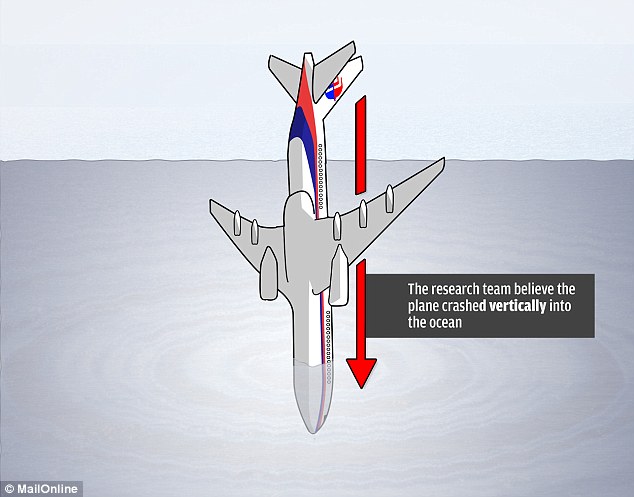
Another theory about the MH370 disappearance. Mathematics shows that if the pilot nosedived vertically into the ocean, it might explain why no debris has been found.

“The true final moments of MH370 are likely to remain a mystery until someday when its black box is finally recovered and decoded. But forensics strongly supports that MH370 plunged into the ocean in a nosedive.”

Goong Chen, Texas A&M mathematician

Texas A&M University at Qatar mathematician Goong Chen has theorized the ill-fated plane plunged vertically into the southern Indian Ocean in March 2014.

The researchers’ computer simulations lead to the forensic assertion that a 90-degree nosedive explains the lack of debris or spilled oil in the water near where the plane is presumed to have crashed. The research was the cover story in the April 2015 issue of Notices of the American Mathematical Society (see the team’s paper here.)

Chen is an applied mathematician teaching and researching at Texas A&M at Qatar who has been a faculty member in the Department of Mathematics at Texas A&M University’s main campus in College Station, Texas, USA since 1987. He led the interdisciplinary team of collaborators from Texas A&M, Penn State, Virginia Tech, MIT and the Qatar Environment and Energy Research Institute (QEERI) in simulating and modeling what might have happened to the plane. His research is supported by the QNRF National Priority Research Project Grant #5-674-1-114.

The researchers used applied mathematics and computational fluid dynamics to conduct numerical simulations on the RAAD Supercomputer at Texas A&M at Qatar of a Boeing 777 plunging into the ocean, a so-called “water entry” problem in applied mathematics and aerospace engineering. The team simulated five different scenarios, including a gliding water entry similar to the one Capt. Chesley B. “Sully” Sullenberger skillfully performed when US Airways flight 1549 landed in the middle of New York City’s Hudson River, a feat that’s referred to as “the miracle on the Hudson.”

Chen said based on all available evidence — especially the lack of floating debris or oil spills near the area of the presumed crash — the mostly likely theory is that the plane entered the water at a vertical or steep angle.

……. The fluid dynamics simulations indicate, for a vertical water entry of the plane, that there would be no large bending moment, which is what happens when an external force, or moment, is applied to a structural element (such as a plane), which then causes the fuselage to buckle and break up. As the vertical water-entry is the smoothest with only small bending moment in contrast with other angles of entry, the aircraft is less likely to experience “global failure,” or break-up on entry near the ocean surface, which would explain the lack of debris or oil near the presumed crash site.

Based also on the suggestions of other aviation experts, Chen said in such a situation the wings would have broken off almost immediately and, along with other heavy debris, would have sunk to the bottom of the ocean, leaving little or no trace to be spotted.

MH370 nose dive -- Daily Mail

MH370 nose dive — graphic by Daily Mail


Birth month (hence month of conception) linked to disease risk (in New York)

June 10, 2015

Back to Astrology.

M. R. Boland, Z. Shahn, D. Madigan, G. Hripcsak, N. P. Tatonetti. Birth Month Affects Lifetime Disease Risk: A Phenome-Wide Method.Journal of the American Medical Informatics Association, 2015; DOI:10.1093/jamia/ocv046

This is not so much a medical study as a data analysis of the health records of 1.7 million people in New York. It is about correlations and not about causations but could, of course, lead to insights about causations. While the study and all the headlines focus on month of birth, I note that month of birth automatically implies month of conception. I would have thought that there was a greater chance of any genetic effects being associated with the time of conception rather than the time of birth. And if the time of conception is really of some significance, then it begs the question whether the “quality” of sperm or ova are affected by time or follow some seasonal or cyclic pattern.

In any event, the association of season with health suggests that the sun is playing a role. And if the sun can play a role (gravitational?) then so can the moon and other celestial bodies. Which sounds suspiciously like Astrology.

The study finds

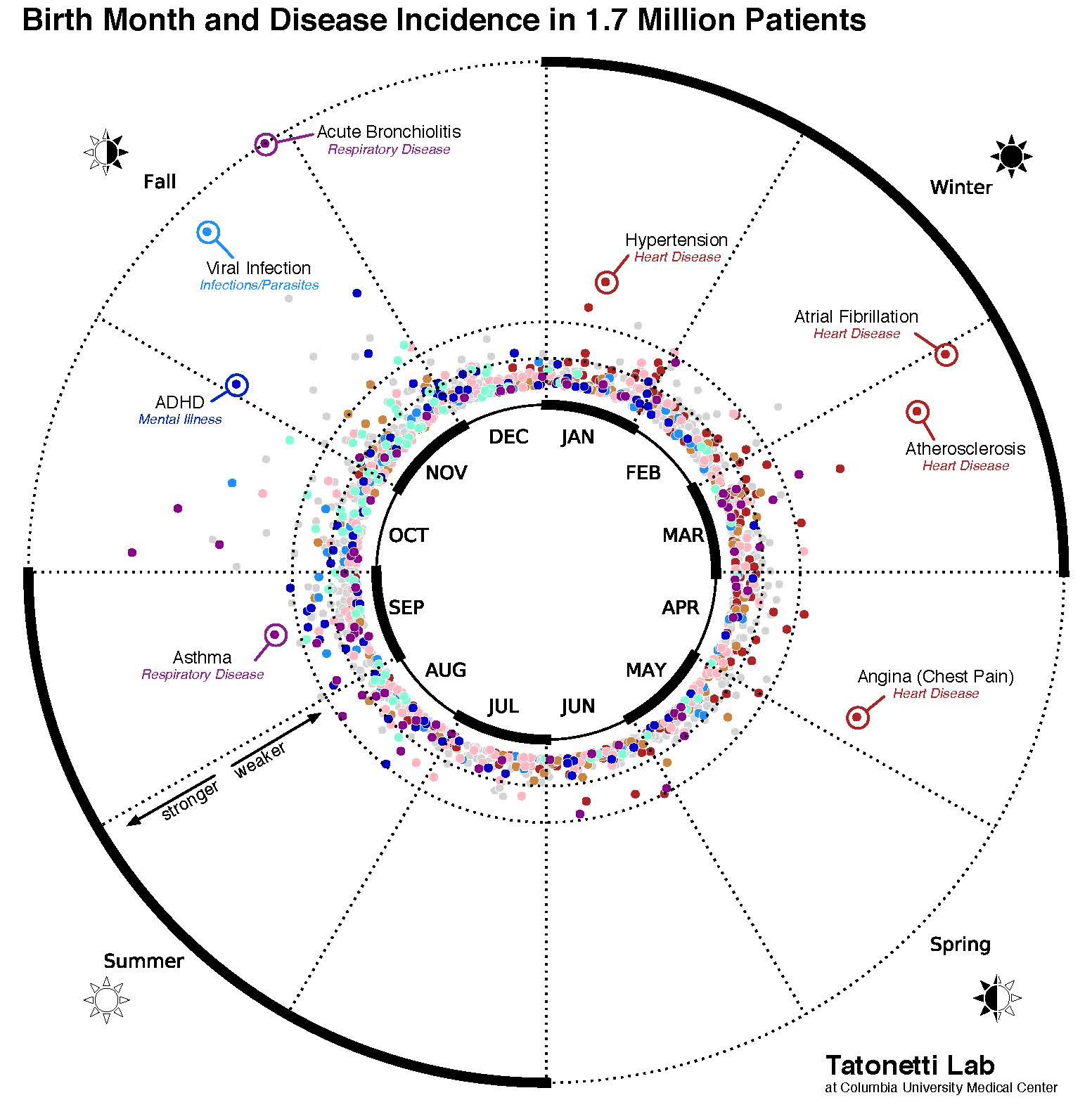
  • Overall, babies born in October had the highest risk of disease, and those born in May had the lowest risk.
  • Asthma risk was highest for July and October babies.
  • November babies were at the highest risk for developing ADHD.
  • Babies born in March faced the highest risk for heart problems including atrial fibrillation, congestive heart failure and mitral valve disorder.
  • Winter babies were at a higher risk of neurological problems.

Babies born in October would have been conceived in December and those born in May would have been conceived in July. And that means that conception during the summer holiday period produces babies with less risk of disease than babies conceived during the Christmas holidays.

Press Release: Columbia University scientists have developed a computational method to investigate the relationship between birth month and disease risk. The researchers used this algorithm to examine New York City medical databases and found 55 diseases that correlated with the season of birth. Overall, the study indicated people born in May had the lowest disease risk, and those born in October the highest. The study was published this week in the Journal of American Medical Informatics Association. ……. 

Earlier research on individual diseases such as ADHD and asthma suggested a connection between birth season and incidence, but no large-scale studies had been undertaken. This motivated Columbia’s scientists to compare 1,688 diseases against the birth dates and medical histories of 1.7 million patients treated at NewYork-Presbyterian Hospital/CUMC between 1985 and 2013. …….. The study ruled out more than 1,600 associations and confirmed 39 links previously reported in the medical literature. The researchers also uncovered 16 new associations, including nine types of heart disease, the leading cause of death in the United States. The researchers performed statistical tests to check that the 55 diseases for which they found associations did not arise by chance. ……

……….. The new data are consistent with previous research on individual diseases. For example, the study authors found that asthma risk is greatest for July and October babies. An earlier Danish study on the disease found that the peak risk was in the months (May and August) when Denmark’s sunlight levels are similar to New York’s in the July and October period.

For ADHD, the Columbia data suggest that around one in 675 occurrences could relate to being born in New York in November. This result matches a Swedish study showing peak rates of ADHD in November babies.

The researchers also found a relationship between birth month and nine types of heart disease, with people born in March facing the highest risk for atrial fibrillation, congestive heart failure, and mitral valve disorder. One in 40 atrial fibrillation cases may relate to seasonal effects for a March birth. A previous study using Austrian and Danish patient records found that those born in months with higher heart disease rates—March through June—had shorter life spans.

Tatonetti Lab disease and time of birth

Tatonetti Lab disease and time of birth

Ignoble Royals

June 9, 2015

Monarchy and monarchists, by their very nature, must tend towards dictatorship.  A hundred years ago, the Labour revolutions and adoption of universal suffrage forced the opposing concept of benevolent dictatorships to harden into a concept of fascist dictatorships. Nobility and noblesse oblige, which characterised and made palatable the behaviour of benevolent monarchs, were no longer required. They are now a thing of the distant past. Since the early part of the 20th century and following World War 1, the very idea of “nobility” died. Members of royal families were now concerned with retaining their positions, their privileges and their personal wealth, and had not the freedom or the room to exercise or demonstrate their “nobility”. Most Royalty in Europe had little choice – if they were to remain Royalty – other than to become Ignoble. Leading up to and during World war 2, three common factors – a controlled breeding of the masses,  a hatred of the Jews and opposition to the Reds, made the now Ignoble Royals natural allies of the Nazis and Hitler.

That the Duke of Windsor – probably encouraged by his wife Wallis Simpson – was quite a strong Nazi sympathiser is no great secret. A new book by Karina Urbach – Go Betweens for Hitler  (OUP £20) – brings out some further details of his extensive contacts and his actions in support of a Nazi victory (which would have brought him back to the throne). He even supported the bombing of Britain to bring the war quickly to a close in favour of Germany. Since Royal correspondence between the British and German branches of the House of Windsor (actually the House of Saxe-Coburg & Gotha, renamed in 1917) is still being kept secret, it can only be deduced from other records that the British Royals had quite extensive links with their German  cousins – who were nearly all Nazi sympathisers.

Members of the Royals (in any country) are inherently opposed to communism. In Europe they were very often anti-semitic and were already eugenicists (in the Nazi style) with their support of their own breeding programs. (In the event, inbreeding has actually led to a clear decline in intelligence among the Royals, with significant non-royal admixtures only coming through to strengthen their gene pool in the last 2 generations or so). A belief in controlling the breeding of the masses, a hatred of the Jews and an implacable opposition to communism – made the Royals natural allies of the Nazis and Hitler.

Urbach writes about her book in The Conversation:

Intelligence reports and German, Spanish and Russian documents show members of the British royal family were indeed far closer to Nazi Germany than has previously been recognised. …. One key to this Anglo-German network is Charles Edward Duke of Coburg (1884-1954). …… Coburg was part of a wider group of go-betweens – private individuals who were used for secret negotiations by Hitler. My investigation into Coburg’s work sheds new and damning light on the Duke of Windsor, a relative and confidante of Coburg. …….

After the failed Hitler Putsch of 1923, Coburg hid several Hitler supporters on the run in his castles. Hitler would not forget this great favour and later rewarded Coburg by making him a general. But he also needed him for something more secretive. In 1933 the Führer was short of international contacts and did not trust his own foreign ministry.

He therefore used members of the German aristocracy for secret missions to Britain, Italy, Hungary and Sweden. Coburg was particularly useful in London from 1935 to 1939 and was received in Britain due to his sister Alice Countess of Athlone’s tireless work. She was Queen Mary’s sister-in-law and fought for Coburg’s acceptance. This resulted in him not just being welcomed in British drawing rooms, but most importantly, by the royals, including the Duke of Windsor.

……. The Soviet intelligence services were convinced of the Duke of Windsor’s treachery when war broke out. …….. In 1940 they reported that he was conducting negotiations with Hitler to form a new English government and conclude a peace with Germany contingent on a military alliance against the USSR. …….. 

Like his relative Coburg, the Duke of Windsor was anti-Semitic. In June 1940 Don Javier Bermejillo, a Spanish diplomat and old friend of Windsor – he had known him since the 1920s – reported a conversation he had had with the Duke to his superiors …. that the Duke of Windsor blamed “the Jews, the Reds and the Foreign Office for the war”. Windsor added that he would like to put Anthony Eden and other British politicians “up against a wall”. Bermejillo stated that Windsor had already made similar remarks about the Reds and the Jews to him long before he became King in 1936. In another conversation on June 25 1940 Bermejillo reported that Windsor stressed if one bombed England effectively this could bring peace.

…….

Prince Philip’s connections are no secret but they are now part of the convenient loss of collective memory.

Ryan Paul: ….. Not only was he trained in the Hitler Youth curriculum, but his German brothers-in-law, with whom he lived, all became high-ranking figures in the Nazi Party. ……. 

During 1931-1932, Philip’s four older sisters married as follows: Margarita to a Czech-Austrian prince named Gottfried von Hohenlohe-Langenburg, a great-grandson of England’s Queen Victoria; Theodora to Berthold, the margrave of Baden; Cecilia to Georg Donatus, grand duke of Hesse-by-Rhine, also a great-grandson of Queen Victoria; and, Sophie to Prince Christoph of Hesse.

Three of Philip’s brothers-in-law were part of a group of German aristocrats who were Anglophile and pro-Nazi at the same time …… 

The Ignoble Royals were not just in Britain and were quite widespread. Prince Bernhard, the consort of Queen Juliana and the the father of Queen Beatrix of the Netherlands, was a member of the Nazi party and of the SS. After the War he converted his fascist tendencies to become eco-fascism as the first head of the WWF. (When he was forced to resign after the Lockheed scandal, he handed over the eco-fascist baton to Prince Philip). Gustav V and the remaining aristocracy in Sweden approved of Nazi actions against the Red Menace. Currently he is said to have been opposed to their Jewish policies but there is some whitewashing involved. Leopold III of Belgium was born Prince Leopold of Belgium, Prince of Saxe-Coburg and Gotha and tried to walk the tightrope between Hitler and the Allies. He did try to keep Belgium neutral but he surrendered to the Germans without his government’s approval and was seen by some as a traitor.

While many Royals eventually opposed Hitler and the Nazis (especially after it was clear that they would not win), royalty and business and bankers (of the non-Jewish kind) all over Europe, were strong, and even enthusiastic supporters of Hitler before the War. In fact, they helped with funding the growth of the National Socialists and his “election” to power.

Nobility is not something that is a characteristic of European royalty any longer. It is not even a behavioural requirement since they have no power to wield. And so they have degenerated to the point that much of their behaviour is that of spoilt brats and ignoble.

Wanted! A leader in the White House

June 8, 2015

After 7 years as President, Barack Obama’s Iraq strategy is still ” not complete”. His Syria and Ukraine “strategies” are only conspicuous by their absence.

Once upon a time and a fairy tale or three ago, I had very high expectations of President Obama. He had set the expectations himself with his rhetoric. There was nothing he couldn’t. But all that he will have accomplished by the end of his two terms is to have been the first “black” President of the United States – and he can’t even take credit for that.

I have a theory that world development proceeds in steps and that these discrete steps are dependent upon the number of “leaders” available at any time in the world to work together. With “leaders” I mean those who take people along with them towards some vision of the world and are not mere “followers”. For the last 150 years the “leader” of the US has been, is, and must be a necessary – but insufficient – ingredient. The world stagnates or even moves backwards in the time when the political leaders are “followers”. A critical mass of “leadership” is not possible when the President of the US is a follower. It would seem that for the last 7 years we have had a “follower” in the White House whose actions are subordinated to his fears. It is paralysis by analysis which reigns. The closest to a leader in Europe has been Angela Merkel but even she has  not communicated any vision of Europe – let alone the world – to chase.

The clarity of a vision is important for leadership. A “consensus” vision is diffuse and muddled – almost by definition. My hypothesis is that real “leadership”, if existing simultaneously in 5 key countries/regions of the world, can provide the necessary and sufficient conditions to create new wonders. If the “leaders” of the US, Russia, Europe (whichever of France, Germany or the UK qualifies) together with China and India actually shared a vision of what could be done and “led” their people along that path, there would be a paradigm shift and a step-change to a level not ever seen before.

BBC: The US does not yet have a “complete strategy” for helping Iraq regain territory from Islamic State (IS), President Barack Obama has said.

Business Insider: “When a finalized plan is presented to me by the Pentagon, then I will share it with the American people,” Obama said. “We don’t yet have a complete strategy because it requires commitments on the part of the Iraqis as well.” ………. Obama said in September that the goal was to “degrade, and ultimately destroy, ISIL,” but that goal still seems far off.

ISIS Islamic State Iraq Syria control

Graphic Business Insider / Reuters

The development of proportional representation in democracies is a natural inhibitor of “leaders” and “leadership”. The focus on consensus politics means that, very often, it is the “lowest common”  standards and goals that apply. This turns even very good leaders into mediocre followers. The coming together of a critical mass of “political leadership” in the world cannot be predicted. But it will surely happen some time.

It might even happen in my lifetime, but looking at the field of Presidential candidates in the US, the next President of the US is likely to be another follower, and it will not happen anytime soon.

Swedish Council for Novel Therapies sets a limit for cost of medication to preserve life

June 8, 2015

The Swedish Council for Novel Therapies (NT-rådet) has recommended that certain medicines should not be given to patients if they are too expensive – even if the alternative is death. The recommendation is to the Counties who run the hospitals on behalf of the country’s health service. Effectively it means that patients who have atypical hemolytic-uremic syndrome (a-HUS) can no longer be prescribed Eculizumab. There is no known cure for this quite rare (1:500,000) genetic condition  which attacks the kidneys:

Atypical hemolytic-uremic syndrome is a disease that primarily affects kidney function. This condition, which can occur at any age, causes abnormal blood clots (thrombi) to form in small blood vessels in the kidneys. These clots can cause serious medical problems if they restrict or block blood flow. Atypical hemolytic-uremic syndrome is characterized by three major features related to abnormal clotting: hemolytic anemia, thrombocytopenia, and kidney failure.

With a population of just under 10 million, Sweden may have about 20 individuals suffering from this genetic condition. Eculizumab (trade name Soliris) is a medication that has recently been approved for the treatment of aHUS, an ultra-rare genetic disease that causes abnormal blood clots to form in small blood vessels throughout the body, leading to kidney failure, damage to other vital organs and premature death. But it costs approximately €430,000 per year for ongoing treatment.

Clinical trials in patients with aHUS demonstrated inhibition of thrombotic microangiopathy (TMA), the formation of blood clots in small blood vessels throughout the body, including normalization of platelets and lactate dehydrogenase (LDH), as well as maintenance or improvement in renal function.

The medicine does not cure the condition but inhibits the expression of some its fatal effects. It gives a patient a chance to live on.

But as Swedish Radio reports, the Swedish Council for Novel Therapies has decided that this cost of keeping a patient living is too high. For this council, the value of the life of a patient suffering from a-HUS is clearly less than about SEK 4 million per year.

Clearly there is an economic cost benefit analysis to be made for all medical treatment. Clearly also an unlimited cost for keeping someone alive is also not possible. But what about the value of the life to be prolonged? Even assuming that there is some cost limit which is not be borne, the “forbidden” cost level cannot just be an absolute value which takes no note of the value of the life preserved. If cost-benefit is to be the guiding factor, then should not all health costs be balanced against the life or the quality of life to be preserved?

Swedish Radio:

The Swedish Counties’ council of experts, the Council on Novel Therapies, has decided to discourage counties from using a drug for a very rare and life-threatening blood disorder. The reason is that the medicine will cost 4.5 million kronor per patient annually – making it one of the most expensive in the world. A small group of patients could thus eventually die of the disease that brings inflammation, clots and kidney failure. 

“I think it is a completely unreasonable decision. One can not deny the patients with this difficult disease to receive treatment. Although there is plasma and dialysis treatment, survival is most certainly not so long as with this treatment. So I think that they have to change their decision”, says chief physician Ingela Fehmarn-Ekholm.

The disease is called aHUS (atypical hemolytic uremic syndrome), where the blood cells break down and patients become anemic and can get blood clots, stroke, and renal failure.

Ingela Fehrman Ekholm describes one of the patients she treated with the new drug. Before it came, he had donated a kidney to his daughter who suffered from the disease, but the girl did not survive.

A year later he  himself got aHUS. After several years of dialysis and three kidney transplants, he received the new medicine. “It is now almost three years, absolutely no side effects and kidney works great and he feels great”, says Fehmarn-Ekholm.

But it would seem that for this patient, Stefan Persson, the treatment will not be able to continue if this recommendation is followed.

However the statement from the Chairman of the Council almost reads as if it is just a game – a price negotiation with the manufacturer with the death of patients being played out as one card in the game.

Stefan Back is the Chairman of the Council of Novel Therapies that has taken the decision stop using the medicine Soliris.

He believes that the responsibility lies with the manufacturer, who failed to show why the drug has such a high price.

“It is regrettable that it had to come to this because it’s not an easy decision to make. It leads to anxiety with the patients and we hope that the company will deliver significantly better economic evidence and perhaps a lower price”.

A price negotiation where patients’ lives and their peace of mind are just another card to play.

Indian monsoon sets in, risk for deficiency remains but so far, so good

June 8, 2015

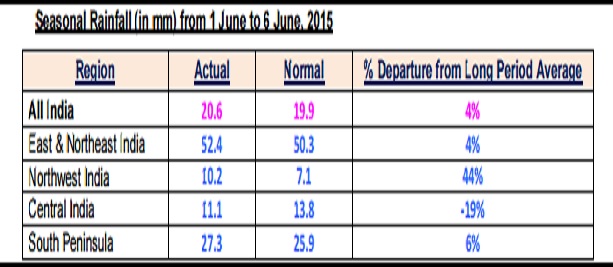
The long range forecast was revised a few weeks ago and there is a risk that this year’s monsoon may be somewhat deficient. But the onset has not been much delayed and the first week’s rainfall is slightly above “normal. The second LRF cast a shadow over the markets when it was announced. But the pessimism may have been overdone.

2nd stage Long Range Forecast:

  • Rainfall over the country as a whole for the 2015 southwest monsoon season (June to September) is likely to be deficient (<90% of LPA).
  • Quantitatively, monsoon season rainfall for the country as a whole is likely to be 88% of the long period average with a model error of ±4%.
  • Region wise, the season rainfall is likely to be 85% of LPA over North-West India, 90% of LPA over Central India, 92% of LPA over South Peninsula and 90% of LPA over North-East India all with a model error of ± 8 %.
  • The monthly rainfall over the country as whole is likely to be 92% of its LPA during July and 90% of LPA during August both with a model error of ± 9 %.

The monsoon onset was just a couple of days “late” compared to the forecast date (which is in itself always a warning sign). Furthermore, this year could be an El Nino (albeit weak El Nino) year which could depress rainfall levels. One week into the 13 week monsoon season, however, rainfall is running at 4% above the long term average.

monsoon advance June 6th 2015

monsoon advance June 6th 2015

The northern and western ends of the front are progressing well but the central section is well behind its “normal” advance. In terms of rainfall distribution the north-east and the south which usually receive the highest rainfall by this time are running slightly ahead of normal. The central and north-west region receive low levels of rainfall in  this period but the north-west is running 44% above normal while the central regions are deficient and running at -20%.

rainfall till 6th June 2015

The warnings about potential deficiency has led to the government planning measures for those farmers who are not “covered” by irrigation networks and are solely dependent upon rainfall.

But, so far, so good.

Documents confirm that FIFA sent $10 million from South Africa to Jack Warner

June 7, 2015

Even though South Africa tried to hide their payment, it seems irrefutable that the South African government arranged matters such that FIFA’s accounts grew by $10 million as they were awarded the 2010 World Cup. Earlier revelations showed that the South African government (and apparently approved by President Mbeki) saw to it that the National Lottery payed the government $10 million less than they should have and payed it instead to the South African Football Association. They in turn payed the $10 million to the 2010 World Cup Local Organising Committee who then received $10 million less from what was due from FIFA, thus effectively completing a transfer of $10 million. A payment which was eventually debited from the government’s account and eventually credited to FIFA.

From South Africa to jack Warner via FIFA

Now the BCC reports that the payments of the $10 million from FIFA to accounts personally controlled by Jack Warner have also been confirmed. How Jack Warner delivered the votes he may have committed to South Africa is not clear.

A BBC investigation has seen evidence that details what happened to the $10m sent from Fifa to accounts controlled by former vice-president Jack Warner.

The money, sent on behalf of South Africa, was meant to be used for its Caribbean diaspora legacy programme. But documents suggest Mr Warner used the payment for cash withdrawals, personal loans and to launder money. The papers seen by the BBC detail three wire transfers by Fifa.

In the three transactions – on 4 January, 1 February and 10 March 2008 – funds totalling $10m (£6.5m) from Fifa accounts were received into Concacaf accounts controlled by Jack Warner.

…… The documents reveal how the money was spent and moved around.

JTA Supermarkets, a large chain in Trinidad, received $4,860,000 from the accounts. The money was paid in instalments from January 2008 to March 2009. The largest payment was $1,350,000 paid in February 2008. US prosecutors say the money was mostly paid back to Mr Warner in local currency. ……. The documents also show $360,000 of the Fifa money was withdrawn by people connected to Mr Warner. …… Nearly $1.6m was used to pay the former Fifa vice-president’s credit cards and personal loans. The documents show the largest personal loan Mr Warner provided for himself was $410,000. The largest credit card payment was $87,000.

American Pharoah triumphs – but Secretariat’s records still stand

June 7, 2015

Lat night American Pharoah won the Belmont Stakes and with it the first Triple Crown since 1978. In the 1970s we saw 3 Triple Crown winners starting with Secretariat in 1973 after a gap of 25 years and followed by Seattle Slew in 1977 and Affirmed in 1978.

Kentucky Derby and Preakness Stakes winner American Pharoah stands while being bathed following his morning workout at Belmont Park in Elmont, New York June 3, 2015.

American Pharoah: photo Shannon Stapleton /Reuters via The Daily Beast

Comparisons are of no great significance but back in 1973, Secretariat caught my imagination in a manner that no horse ever had before – not even Silver or Trigger.  Last night, American Pharoah faced a much larger field in the Belmont Stakes than Secretariat did. He won quite comfortably by five lengths and a time of 2:26.65, the sixth-fastest time in Belmont history.

Trying to compare the two horses, 37 years apart is meaningless. When Secretariat won the Belmont he won by 31 lengths and he was till going away at the finish line. He set winning times in all the three Triple Crown events. The Kentucky Derby(1:59.4), the Preakness Stakes (1:53), and the Belmont Stakes (2:24). But, 37 years later Big Red’s record times in all three races have not yet been beaten. The longest time a human athletics record has lasted was Bob Beamon’s long jump record which lasted 23 years (though 47 years later, his Olympic record still stands). To hold one record for so long is impressive enough, but Big Red still holds his records for 3 major races.

American Pharaoh has ensured his place in equine history. But it is still Secretariat – “The Tremendous Machine” – which embodies the Triple Crown in my imagination. “That is a record which may stand forever”.