The freedom of hypocrisy

April 29, 2015

There is a fundamental human right which needs to be included in the UN Human Rights Convention.

And that is the inalienable human right to be freely hypocritical.

Charlie Hebdo’s cartoons – many in very poor taste – were an “expression of freedom of speech”. In fact very few of Hebdo’s cartoons are actually clever or funny though nearly all are smutty. (And it is their lack of any real intellectual content which makes me think that the PEN award to Charlie Hebdo may be a tribute to the 12 who were killed but it is certainly not for any journalistic excellence).

I must admit that I see no great insult to women generally in exhorting women who are potential customers for weight loss products to be “Beach Body Ready”. Or any insult to mis-shapen men like me in exhortations to get “magnificent abs” so that we can wear – and show off – our Calvin Klein underwear!

But how is it that the very same people who so strenuously defended Charlie Hebdo’s “rights” to publish material seen as insulting by others, now want this – to me rather inoffensive – advertisement to be banned? And banned on the grounds that it is insulting to women and sexist. I don’t much care for the colour of her bikini, and I think that anybody who believes weight loss advertisements is more than a little gullible, but I think the right of Protein World to earn their bread by advertising their products is absolute.

An insult may be meant or not, but it is only perceived in the mind of the receiver. And even when an insult is meant, but it is not perceived to be an insult, then it is no insult.

A Protein World advert displayed in an underground station in London. More than 44,000 people have signed a petition to have the adverts removed.

A Protein World advert displayed at a London Underground station. More than 44,000 people have signed a petition to have the posters removed. Photograph: Catherine Wylie/PA

It is no different in principle to this

or this one

sharpmagazine.com

I suspect that just as with the lunatics who attacked Charlie Hebdo, the fault lies in the minds of those who are irrationally insulted.

Help is often restricted by the ability to receive – be it Nepal or Baltimore

April 28, 2015

The news today about the riots and looting currently ongoing in Baltimore got me to wonder why in 2015 such behaviour is still possible in the US? Even with a black (or more accurately, half-black) President and a black Attorney General (Holder followed by Lynch). One hundred and fifty years after the Civil War, and after over 5 decades of “affirmative action”, why are “African Americans” still at the bottom of all social and economic league tables in the US? Why are they – as a group – being overtaken even by the “new immigrants” from Asia?

Could it be that the efforts to lift the African American community have been misguided, or that the particular measures on offer have not been capable of being received?

Take the situation in Nepal.

There is much international help on offer but much is not getting through because of the limitations on the ability (infrastructure and personnel) to receive it. The current death toll of over 4,000 may turn out eventually to be closer to 10,000 .

Planes arriving in Kathmandu have been slow in being unloaded and then the relief supplies have been stuck on the ground because many of the airport workers have left for their own damaged homes and injured relatives. The airport was never designed to handle this level of traffic. The aftershocks are continuing and everything comes to a halt when one occurs.

Relief and medical teams from India and China remained undeployed for many hours because there was nobody available to direct them where to go. And when the “authority” of who would decide was settled, they had no information as to where the teams could be best deployed. Infrastructure was poor in any case but is now damaged. Highways into the remote areas are blocked. Power and water distribution has been hit hard. Foreign teams arriving in Kathmandu have not had the local support necessary readily available. In fact, just finding the necessary support for the foreign teams (guides, interpreters, vehicles, maps, intelligence) itself has overloaded the few organised resources available. The Nepalese Army is overwhelmed. Many Gurkha villages have been hard hit and the primary concern of some of these Gurkha soldiers is to get to their villages and their relatives.

Even in Kathmandu itself – let alone relief and rescue in remote areas – heavy lifting equipment is limited. Even when available they cannot reach “at least 19” areas of the city because of the narrow lanes which have to be negotiated or because of rubble blocking their access.

It is often underestimated or forgotten that the provision of anything (help or education or technology) – once the will to provide is established – is still restricted by the ability to receive.

I am reminded of the struggles we had with “technology transfer” where the will and readiness to transfer technology was often restricted by the ability to receive and absorb technology. I recall that our efforts to open new factories in rural areas were severely limited by the ability of local villagers to absorb the change from working in a field to working in a factory.

The ability to receive trumps the will to give.


And so it begins! UK writes off its over 75s

April 27, 2015

National health services all over Europe are facing an increase of costs as longevity increases. It is only a matter of time before state health services encourage those considered “too old” to expedite their exit from life and save them from the costly obligations of providing care. The first stage is when some medical services are denied for those considered too old and these initial indicators are already visible. Expensive treatments will be the first to go. I have already posted about prostate cancer treatment being denied to those considered too old (over 70) in some parts of Sweden. Physicians already discourage elderly patients – perhaps unconsciously – from expensive or long treatment as a matter of routine.

And now I read that patients over 75 are going to be encouraged by the UK NHS to start planning their exits. Private health insurance premiums for the elderly are already on the rise. Perhaps the over 75s will be uninsurable soon. Ostensibly it is just to get them to sign a “non-resuscitation” declaration – but it is the start. Next they will be asked to choose their preferred method of assisted dying. The sad part is that this is no longer about providing care or about dying with some semblance of dignity. It is all about saving cost.

And if you ever read about an over 75 who was not resuscitated after suffering complications from an ingrowing toe-nail, you can at least be sure that a great deal of money was saved.

Daily Mail:

Doctors are being told to ask all patients over 75 if they will agree to a ‘do not resuscitate’ order. New NHS guidelines urge GPs to draw up end-of-life plans for over-75s, as well as younger patients suffering from cancer, dementia, heart disease or serious lung conditions.

They are also being told to ask whether the patient wants doctors to try to resuscitate them if their health suddenly deteriorates.

The NHS says the guidance will improve patients’ end-of-life care, but medical professionals say it is ‘blatantly wrong’ and will frighten the elderly into thinking they are being ‘written off’.

In some surgeries, nurses are cold-calling patients over 75 or with long-term conditions and asking them over the phone if they have ‘thought about resuscitation’. 

Non-resuscitation is the new euphemism for assisted death. And it is also only a little further along this road before the assisted death is not even a voluntary choice but is mandated for all who are past a certain age and have the misfortune to be hospitalised. A mandatory death age to follow a mandatory retirement age. Maybe those past the mandatory age of death will not be actively terminated in their own homes but woe betide them if they are ever hospitalised.

Great Himalayan earthquake is still waiting to happen

April 27, 2015

This earthquake in Nepal – devastating as it was – has not released enough of the pent-up strain under the Himalayas. The death toll now exceeds 3,500 and most are due to collapsing buildings.

It would need about 50 such quakes with magnitude 7.9  or one super quake of magnitude 9 to release all the slip built up over centuries. The Indian tectonic plate is being subducted under the Eurasian tectonic plate with the Indian Plate moving North East at about 6 -7 cm per year while the Eurasian Plate is moving Northwards at about 2 cm per year. There is a net 2 – 3 cm of slip to be accumulated – or to be relieved by some form of energy release – every year.

The Great Himalayan Earthquake has still to come. The scale of loss of life and devastation will be magnified greatly if the Great quake is located in the central Himalayas such that the tremors extend into the densely populated Gangetic Plain. The central Himalayas have not seen any large quakes for about 700 years and the pent-up energy is ominous. It is highly unlikely that either in Nepal or in the vulnerable regions of India, that buildings will be sufficiently “earthquake-proofed” to minimise the loss of life (and over 90% of the loss of life is due to the collapse of buildings).

Down to Earth: … It has been hypothesised for long that a large earthquake, called the “great Himalayan earthquake”, can strike anytime, but its time and place cannot be predicted. In many locations in the Himalayan belt there is enough energy stored currently to lead to one.

At a magnitude of 7.9 on the Richter scale, the April 25 earthquake has caused devastation but it is not the anticipated “great Himalayan earthquake”.  This does not qualify as a great earthquake which needs to be of magnitude 8, says Roger Bilham, geologist with the University of Colorado Boulder who studies the seismicity of the Himalayan area. “The earthquake is in a region that is being compressed by18 mm each year,” he says. The amount today’s earthquake slip would have been exactly right to release all this accumulated stress, he adds. His team has identified some areas where the great Himalayan earthquake is anticipated (see image). The question mark shows the area where an earthquake is potentially possible but the magnitude is not known.

himakayan

Anticipated Himalayan Earthquakes

 “This (Nepal earthquake) has unfortunately not come as a surprise. We expected an earthquake of high magnitude in the region between Kathmandu and Pokhara,” says Paul Tapponnier from Nanyang Technological University’s Earth Observatory of Singapore who also studies earthquakes in the area. Tapponnier’s earlier work showed that the quakes in 1255 and 1934 were ground-breaking quakes or when ruptures develop in the earth’s crust and the pent up energy in the earth is released. As the areas west or east of the 1934 Nepal ground rupture do not have records of earthquakes, they are at a greater risk of a major earthquake.

In a paper published just two months ago scientists from the Jawaharlal Nehru Centre for Advanced Scientific Research conclude that “the frontal thrust in central Himalaya may have remained seismically inactive during the last ~700 years. Considering this long elapsed time, a great earthquake may be due in the region”.

The Himalaya has experienced three great earthquakes during the last century—1934 Nepal-Bihar, 1950 Upper Assam, and arguably the 1905 Kangra. Focus here is on the central Himalayan segment between the 1905 and the 1934 ruptures, where previous studies have identified a great earthquake between thirteenth and sixteenth centuries. Historical data suggest damaging earthquakes in A.D. 1255, 1344, 1505, 1803, and 1833, although their sources and magnitudes remain debated. ….. Age data suggest that the last great earthquake in the central Himalaya most likely occurred between A.D. 1259 and 1433. While evidence for this rupture is unmistakable, the stratigraphic clues imply an earlier event, which can most tentatively be placed between A.D. 1050 and 1250. …. Rupture(s) identified in the trench closely correlate with two damaging earthquakes of 1255 and 1344 reported from Nepal. The present study suggests that the frontal thrust in central Himalaya may have remained seismically inactive during the last ~700 years. Considering this long elapsed time, a great earthquake may be due in the region.

Other scientists also estimate that this current quake has dissipated only a very small part of the energy stored under the Himalayas and waiting to be released:

Indian Express:

“We know there is a huge amount of accumulated strain in this area. It is due for a major earthquake, perhaps a series of earthquakes, bigger than 8 on the Richter scale. That is the kind of energy that is estimated to be accumulated there. This was certainly not one of those earthquakes that is probably imminent. In terms of energy release, I would say this would not have released even four or five per cent of the energy that is estimated to be stored there,” said Harsh K Gupta, former director of the Hyderabad-based National Geophysical Research Institute and a former member of the National Disaster Management Authority.

Prof Sankar Kumar Nath of IIT Kharagpur, who has studied seismic activity in the Himalayan region, said the energy released from Saturday’s earthquake “was equivalent to the explosion of about 100mn tonnes of TNT, comparable to the energy in detonation of small nuclear bombs”.

“This earthquake would only be classified as medium in terms of energy released. That area, the 2500-km stretch from the Hindukush region to the end of Arunachal Pradesh, is capable of generating much bigger earthquakes, even nine on Richter scale,” he said.

“If you look at it differently, we are actually lucky that only a 7.9-magnitude earthquake has come. I would be very happy to have a few 7.9-magnitude earthquakes than a 9-magnitude earthquake which would be absolute disaster. The trouble is that in terms of energy release, which is what causes the damage, it would take 40 to 50 earthquakes of magnitude 7.9 to avoid an earthquake of magnitude 9,” he said.

In Sweden “abortion rights” come into conflict with “rights to conscience”

April 27, 2015

There are no such things as “absolute” human rights. There are only privileges which various societies variously deem to be the rights of their members (and sometimes of their non-members). “Rights” are nothing more than “privileges” granted by a body which claims the authority to grant such privileges. Very often such “rights” are granted even though the body granting the privilege has not the power or capability to ensure the privilege, even where the body is a State and has introduced legislation about it.

(I note in passing that no Law of God or Man ensures – or can ensure – compliance with the Law. It is only the Laws of Nature which enjoy 100% compliance and where compliance is inherent within the existence of the Law. Which suggests to me that the Laws of Nature rank higher than the Law of any god or of any man).

I do not look to any body or society to grant me the “right” to have an opinion (or to think or to breathe for that matter). I just have opinions on virtually everything but I claim no “right” that others must listen to or pay any attention to my opinions. And even if every other person disagrees, it remains my opinion. Opinions are neither right or wrong – they exist in a cognitive space which is undisturbed by rightness or wrongness. And so I have opinions also about abortion and infanticide and eugenics. I take “life” as originating from parents and passing from their sperm and eggs to the conception of a new identity and then a birth as all being part of the same continuum. I think a new “identity” is created at the moment of conception and am therefore uncertain as to

…. what is it that makes aborting a foetus and preventing a child from being born much less disturbing than terminating the existence of that same child after birth?

Whether to have an abortion or not is entirely a matter for the woman concerned – in my opinion. Whether others should assist her or not is a matter for them – in my opinion. But in Sweden where the State has determined that abortion is a “privilege” it has granted under certain circumstances, it has also – to try and ensure compliance – made it a duty and obligatory for health care workers to assist in such abortions. And that impinges on the “rights” of those workers in their choice whether to help or not.

Swedish Radio:

The abortion issue can sail up as a conflict area within the conservative Alliance parties. The new Christian Democrat leader Ebba Busch Thor has reiterated the call for a conscience clause. But the proposal was rejected by the Liberal Party leader Jan Björklund. “It is not reasonable. Health care operates under legislation to be able to perform abortions under certain criteria and conditions. Then the staff who are in health care must perform accordingly” says Jan Björklund.

The Christian Democrats have long called for the introduction of a conscience clause which would means that midwives who do not want to perform abortions should be able to avoid it. But the previous party leadership with Göran Hägglund at the top, decided not to pursue the matter.

Ebba Busch Thor, who yesterday was elected as the new Christian Democrats leader, has in several interviews in recent months raised the conscience clause and she now wants to get the party to run with it. This would then be a change of course for the Christian Democrats.

If this is what happens Busch Thor can expect to meet resistance from Alliance colleague Jan Björklund. “For the Liberal Party this is not an issue. We are different parties and of course we have different views on some issues. It’s nothing new. Then if the Christian Democrats intend to pursue this type of question harder, we would of course have discussions in the Alliance” he said.

Anna Starbrink, the Liberal Party’s strong woman in Stockholm and responsible for health care is upset. “The woman’s right to abortion must be that which rules. There can be no doubt about it. If a woman seeks an abortion, she should not be questioned and met by staff who refuse to perform their duties. It nibbles the right to abortion at the edges. If it hampers women from getting an abortion, the law would have been sidelined” says Anna Starbrink.

In Sweden abortion is available “on demand” upto the 18th week of pregnancy. Between the 18th and 22nd week permission is needed from the National Board of Health and Welfare (Socialstyrelsen). In very special cases, later abortions are permitted if the foetus is not viable.

Currently around 25% of all known pregnancies in Sweden end in abortion. It is interesting to compare this figure with infant mortality rates (infant deaths in the first year after after birth). In today’s Sweden this figure is at about 0.3%. But todays abortions are comparable to the infant mortality rates of 300 years ago:

High infant mortality rates plagued communities throughout Europe until the beginning of the twentieth century. Even in the middle of the 1800s, a quarter of all babies born in many European countries died before their first birthday. At the start of the nineteenth century in France, less than one half of children lived to be ten years old. In Sweden as a whole, the infant mortality rate in the late 1700s was about twenty percent.

Medical science it would seem has enabled the dramatic reduction in infant mortality and has also enabled an equivalent increase in the number of abortions. After-birth, involuntary termination of life has been replaced by a before-birth, voluntary termination.

While it seems logical that every women decide for herself if she wishes to have an abortion or not, it does not seem logical – to me – that others should be forced – coerced by the threat of losing their jobs – to participate in her decision.

Does the Swedish “right to have an abortion” override the individual’s “right to have a conscience”?

Death toll in Nepal still rising as aftershocks put rescue efforts on hold

April 26, 2015

A strong 6.7 magnitude aftershock hit Nepal this morning, 25 hours after the primary quake, as the death toll continues to climb. At least 30 shocks of magnitude greater than 4.0 have been felt. Kathmandu airport which was open has been closed till 4pm local time because of the aftershocks. Rescue efforts have been put on hold while the aftershocks continue. Air Traffic Control staff have been evacuated from the airport for now.

Indian Air Force Mi-17 helicopters reached Mount Everest and began ferrying injured back to Kathmandu with the first relief flights reaching this morning. So far the IAF has deployed 5 helicopters and another 6 are on their way. It is feared that 65 mountaineers on Mt. Everest may have been killed at the base camp and in the avalanche yesterday. The aftershocks have caused at least 3 further avalanches on Everest today.

Tremors from the aftershocks have been felt in Delhi, UP, Bihar, W.Bengal, and Assam. The final toll may exceed 2,000 as rescuers reach more remote regions.

USGS:

  1. Aftershock: 6.7 magnitude, 17km S of Kodari, Nepal2015-04-26,  07:09:08 UTC, 10.0 km deep
  2. Secondary quake: 6.6 magnitude, 49km E of Lamjung, Nepal2015-04-25, 06:45:21 UTC, 14.6 km deep
  3. Primary quake: 7.8 magnitude, 34km ESE of Lamjung, Nepal, 2015-04-25, 06:11:26 UTC, 15.0 km deep

Both India and China see Nepal as being within their natural “sphere of influence” and a hint of that competition is visible as the two countries now lead the international rescue efforts. In addition to a Chinese medical team that was already in Nepal, three further medical teams from neighboring Sichuan, Chongqing and Yunnan have gone to Tibet.

Xinhua:A 62-strong China International Search & Rescue Team left for Nepal early Sunday. With six sniffer dogs and relevant rescue and medical equipment, the team is expected to arrive in Kathmandu midday Sunday on a chartered plane, according to the China Earthquake Administration.

India sent two relief planes of air force to disaster-struck zones hours after the quake took place. Indian Prime Minister Narendra Modi called up his Nepalese counterpart Sushil Koirala, and assured him of all help. Two military aircraft, a C-130 Hercules and a C17 Globemaster, took off from the Hindon air base in Delhi to Kathmandu with relief workers, medicines and blankets, said Press Trust of India.

Disaster teams from the UK, US and Israel are already on their way as well and many other countries have offered assistance.

Adjusted (fiddled) data showing global warming to be investigated

April 26, 2015

“Global” temperature is necessarily a construct. It is “calculated” by taking raw temperature data as measured at particular locations, massaging this data according to algorithms devised by those calculating the “global temperature, applied to areas where there are no measurements by some other algorithms (oceans, poles, forests and deserts), adjusting past data and then coming up with a “global” temperature.

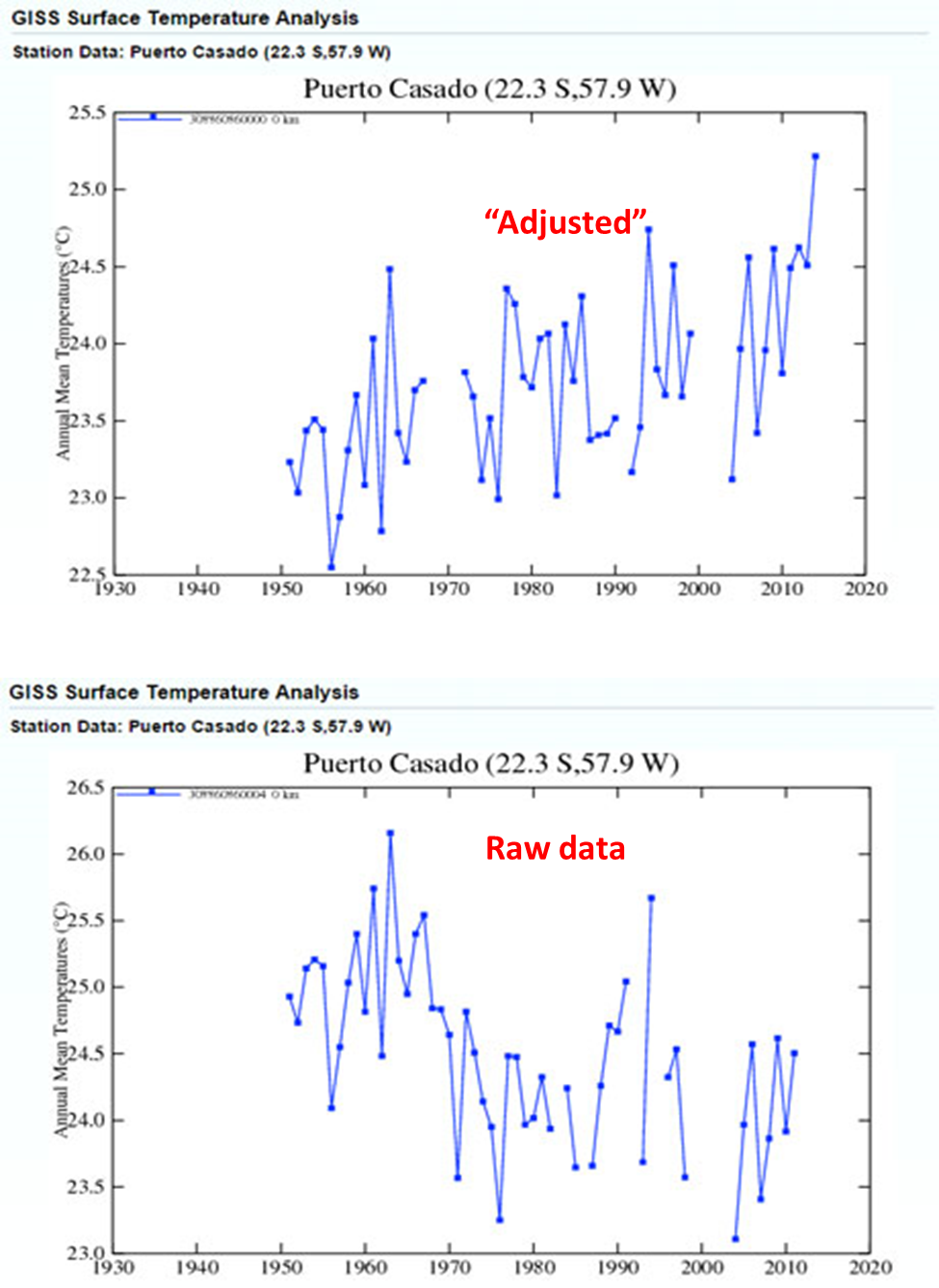
Raw data is never used without “adjustment”. Remarkably the adjustments invariably cool the past. Every year, data from the past is further adjusted! The trends and results presented represent more the adjustment algorithms used rather than the parameters themselves. As this example of “adjustment” of raw data from Puerto Casada to convert an actually measured cooling trend into an adjusted warming trend illustrates

Cooling the past: Puerto Casada From raw to adjusted data

Cooling the past: Puerto Casada From raw to adjusted data

Studies have already shown that, in the US, Australia, New Zealand, the Arctic and South America, in far too many cases, temperatures have been adjusted to show a stronger and clearer warming trend than is justified by the raw data.

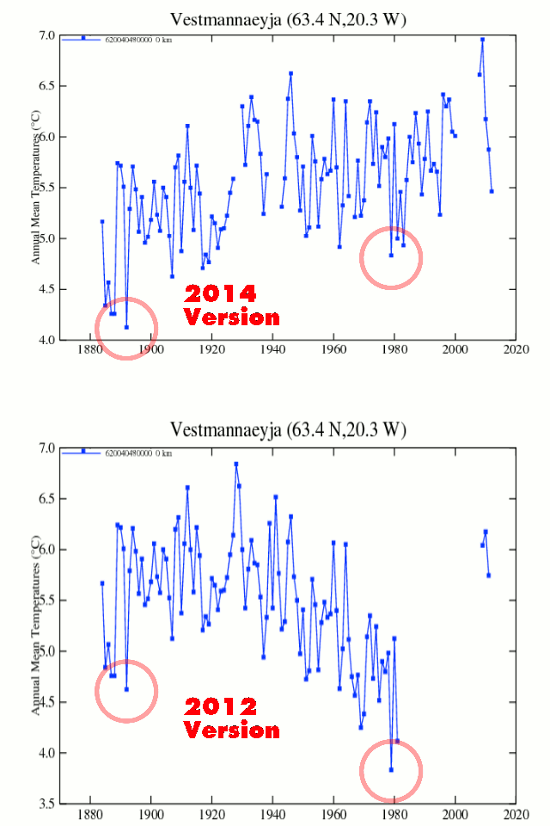
As RealScience shows with this more dramatic example from Vestmanneyja

vestmannaeyja

https://stevengoddard.files.wordpress.com/2015/01/vestmannaeyja.gif?w=640

An investigation now to be carried out by an international team is to establish a full and accurate picture of just how much of the published record has been adjusted in a way which gives the impression that temperatures have been rising faster and further than was indicated by the raw measured data.

Christopher Booker writes in the Daily Telegraph:

…. something very odd has been going on with those official surface temperature records, all of which ultimately rely on data compiled by NOAA’s GHCN. Careful analysts have come up with hundreds of examples of how the original data recorded by 3,000-odd weather stations has been “adjusted”, to exaggerate the degree to which the Earth has actually been warming. Figures from earlier decades have repeatedly been adjusted downwards and more recent data adjusted upwards, to show the Earth having warmed much more dramatically than the original data justified.

So strong is the evidence that all this calls for proper investigation ………  The Global Warming Policy Foundation (GWPF) has enlisted an international team of five distinguished scientists to carry out a full inquiry into just how far these manipulations of the data may have distorted our picture of what is really happening to global temperatures. 

The panel is chaired by Terence Kealey, until recently vice-chancellor of the University of Buckingham. His team, all respected experts in their field with many peer-reviewed papers to their name, includes Dr Peter Chylek, a physicist from the National Los Alamos Laboratory; Richard McNider, an emeritus professor who founded the Atmospheric Sciences Programme at the University of Alabama; Professor Roman Mureika from Canada, an expert in identifying errors in statistical methodology; Professor Roger Pielke Sr, a noted climatologist from the University of Colorado, and Professor William van Wijngaarden, a physicist whose many papers on climatology have included studies in the use of “homogenisation” in data records.

Their inquiry’s central aim will be to establish a comprehensive view of just how far the original data has been “adjusted” by the three main surface records: those published by the Goddard Institute for Space Studies (Giss), the US National Climate Data Center and Hadcrut, that compiled by the East Anglia Climatic Research Unit (Cru), in conjunction with the UK Met Office’s Hadley Centre for Climate Prediction. All of them are run by committed believers in man-made global warming.

Since “global” temperature – by definition – is a calculated construct it is inevitable that data must be “applied” in some way to make this calculation.

But no matter what the calculation method, rewriting history is suspect. When the data of the past keeps being adjusted, and adjusted again, and always systematically downwards, and when all the adjustments invariably cool the past more than the present, then the apparent trend in global temperature has little to do with any definition of global temperature and is merely a trend of the adjustments.

Nepal earthquake toll near 1500 with casualties also in India and Tibet

April 25, 2015

The Indian Tectonic Plate is being subducted under the Eurasian Plate. The collision is still going on with the Indian Plate moving North East at about 6 -7 cm per year while the Eurasian Plate is moving Northwards at about 2 cm per year. The subduction occurs in fits and starts and relies on earthquakes to release the slip pressure. The likelihood of a single Himalayan earthquake of magnitude 8 or a series of magnitude 7 quakes was discussed a few years ago

If a great earthquake has not occurred on a specific segment in the Himalaya for 200 years, that segment will slip 4m because the convergence rate between India and Tibet is roughly 2cm each year. If it has not occurred for 500 years the segment would slip 10m, enough for an event that would measure 8, or Magnitude Eight on the Richter Scale. The time interval between great earthquakes thus determines the amount of slip that will occur in the next one.

…. A large segment of the Himalaya between Kathmandu and Dehradun has a record of several earthquakes but only two large ones: an event in 1803 and another in 1833. If these were great earthquakes then there is now roughly 3m of slip ready to go. However, if they were magnitude 7 earthquakes, then there may be more than 20m of slips availabIe for a future great earthquake.

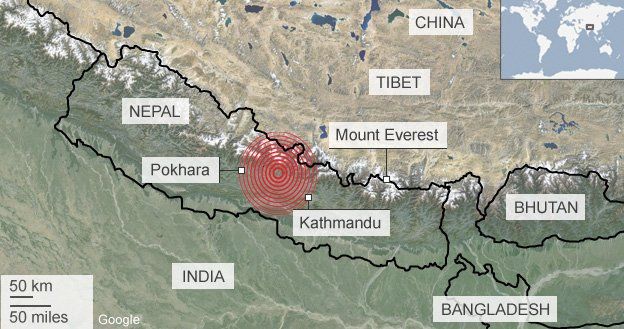
Nepal earthquake map

graphic: BBC

It would seem that this earthquake near Kathmandu was a large one (7.8 magnitude) and may have released around 5 – 8 m of slip but as has been pointed out there may be a total of around 20m of slip waiting to occur. The current quake has so far seen some 16 aftershocks of magnitude 4.5 or greater. Deaths in India are over 40 and the Indian government is mounting a large rescue effort in support of the Nepali government, “Fifty doctors have arrived from India to provide emergency services. India dispatched as many as four aircraft including a C-130 plane carrying three tonnes of relief supplies and a 40-member rescue team to Nepal.” Three more planes are to follow carrying a mobile hospital and medical supplies.

FirstPost: The quake measuring 7.9 on Richter scale, which was followed by 16 aftershocks of magnitude 4.5 or greater, striking heavy casualties in Kathmandu and injuring thousand others. Hundreds were feared missing across the country. “Army estimates death toll as much as 1457 so far,” Nepal’s Finance Minister Ram Sharan Mahat tweeted. …….

The earthquake around 11:56 am with epicentre at Lamjung, around 80 kilometers northwest of Kathmandu, had its impact in several cities in Bihar, West Bengal and Uttar Pradesh and tremors were felt across vast stretches of east and North East India. It was also felt in Southern and Western parts of India, China, Bhutan and as far as Pakistan and Bangladesh.

The US Geological Survey reports:

The April 25, 2015 M 7.8 Nepal earthquake occurred as the result of thrust faulting on or near the main frontal thrust between the subducting India plate and the overriding Eurasia plate to the north. At the location of this earthquake, approximately 80 km to the northwest of the Nepalese capital of Kathmandu, the India plate is converging with Eurasia at a rate of 45 mm/yr towards the north-northeast, driving the uplift of the Himalayan mountain range. The preliminary location, size and focal mechanism of the April 25 earthquake are consistent with its occurrence on the main subduction thrust interface between the India and Eurasia plates.

Although a major plate boundary with a history of large-to-great sized earthquakes, large earthquakes on the Himalayan thrust are rare in the documented historical era. Just four events of M6 or larger have occurred within 250 km of the April 25, 2015 earthquake over the past century. One, a M 6.9 earthquake in August 1988, 240 km to the southeast of the April 25 event, caused close to 1500 fatalities. The largest, an M 8.0 event known as the 1934 Nepal-Bihar earthquake, occurred in a similar location to the 1988 event. It severely damaged Kathmandu, and is thought to have caused around 10,600 fatalities.

Was this the big earthquake that was predicted in the Himalayas?

In an interview to The Hindu in May 2013, Vinod Kumar Gaur, seismologist with the Centre for Mathematical Modelling and Computer Simulation, had said: “Calculations show that there is sufficient accumulated energy [in the MFT], now to produce an 8 magnitude earthquake. I cannot say when. It may not happen tomorrow, but it could possibly happen sometime this century, or wait longer to produce a much larger one.”

In a study published in the journal Nature Geoscience in December 2012, a research team led by Nanyang Technological University (NTU) discovered that massive earthquakes in the range of 8 to 8.5 magnitudes on the Richter scale had left clear ground scars in the central Himalayas

High resolution imagery and dating techniques showed that in 1255 and 1934, two great earthquakes ruptured the surface of the Earth in the Himalayas. The 1934 earthquake broke the surface over a length of more than 150 km.

India (finally) puts Ford Foundation and Greenpeace on watch list

April 25, 2015

The Indian government has put the Ford Foundation and Greenpeace on their “watch” list. It was about time. The Ford Foundation serves as an instrument of the CIA and the US government in prosecuting foreign policy and Greenpeace has degenerated into a home for the far-left and the communists who have been left homeless since the collapse of Marxist (and Maoist) ideologies.

NGOs, “not for profit” organisations and charities often take advantage of the misperception of an implied objectivity or impartiality or of being apolitical. A very few such organisations may come close to being so but the vast majority exist to promote a particular view or support a particular group of people or to carry out particular kinds of projects. In every instance they are deeply – and inevitably – political. Nothing wrong with that of course but it is a common misperception to think that being non-profit they are somehow above politics. They are sometimes funded by governments, sometimes used by governments and sometimes used by opposition to governments. They are sometimes used as a cover for espionage (industrial and by states) and sometimes to “promote democracy” by undermining some other view. They sometimes provide much needed education and health care. And sometimes they use education or health services as a cover for carrying out political or religious indoctrination. Madrasas funded from Saudi Arabia as being educational are purely religious and political. The ostensible reason for the existence of the organisation is often used to cloak a hidden agenda. So-called charity workers and others in the field may not even be aware of the hidden agenda they are promoting.

In most cases these organisations enjoy tax breaks. When they receive government funding it is often to enable governments to covertly act in a manner they can not as a government. They are sometimes used for money laundering and sometimes are just a scam for extracting funds from donors. Even so-called charities may actually donate to others less than 10% of the money they raise. Sometimes they do good and often they don’t.

But the bottom line is that they are all – without exception – political. The political standpoint may be implicit or it may be explicit but it is always there. There is no “human rights” charity or NGO which does not have a political agenda. There is no “centre for democracy” which does not have some political agenda which – perforce – is in conflict with the prevailing “authority” or “government”. ISIS, after all, would qualify as a “not for profit” NGO. There is no “wildlife protection” NGO which does not promote a political agenda which may be as simple as preventing poor farmers from clearing forests to grow more crops, or the development of a highway.

I have no doubt that some NGOs – and usually those without the backing of Big Funds – bring attention to and take action in areas that are desperately necessary but which fall between the cracks of government or public policy. But when an NGO is funded by the Ford Foundation or the Bill & Melinda Gates Foundation, I am automatically suspicious about the hidden agenda in that organisation’s objectives.

Many organisations – Greenpeace, the WWF and the FoE as examples – which once had some worthy aims and even did some good work have -since 1991 – been hijacked by the far-left and communists who had no place else to go. In India it is not surprising that the Maoists and the Naxals and other “dissenting and seditious” groups have become the beneficiaries of such NGOs. During my time in the Indian corporate world (2000 -2007) I met with many NGOs seeking corporate funds – but I was not too impressed. Even less so when I found that at remote sites where we were executing projects, the protection money (sometimes even ransom money for our engineers) being demanded by local mafiosos were to be channeled through some ostensibly do-gooding NGO.

The Ford Foundation has for long been used and is still used by the CIA (and the US government) as a vehicle for promoting US policy.

Global Research: The CIA uses philanthropic foundations as the most effective conduit to channel large sums of money to Agency projects without alerting the recipients to their source. From the early 1950s to the present the CIA’s intrusion into the foundation field was and is huge. A U.S. Congressional investigation in 1976 revealed that nearly 50% of the 700 grants in the field of international activities by the principal foundations were funded by the CIA (Who Paid the Piper? The CIA and the Cultural Cold War, Frances Stonor Saunders, Granta Books, 1999, pp. 134-135). The CIA considers foundations such as Ford “The best and most plausible kind of funding cover” (Ibid, p. 135). The collaboration of respectable and prestigious foundations, according to one former CIA operative, allowed the Agency to fund “a seemingly limitless range of covert action programs affecting youth groups, labor unions, universities, publishing houses and other private institutions” (p. 135). The latter included “human rights” groups beginning in the 1950s to the present. One of the most important “private foundations” collaborating with the CIA over a significant span of time in major projects in the cultural Cold War is the Ford Foundation.

….. History and contemporary experience tells us a different story. At a time when government over-funding of cultural activities by Washington is suspect, the FF fulfills a very important role in projecting U.S. cultural policies as an apparently “private” non-political philanthropic organization. The ties between the top officials of the FF and the U.S. government are explicit and continuing. A review of recently funded projects reveals that the FF has never funded any major project that contravenes U.S. policy.

So I was not too surprised to read that the Ford Foundation and Greenpeace India have been put on the Indian government’s watch list.  My surprise is that the Ford Foundation with its CIA connections has been allowed to fund – albeit indirectly – dissension and sedition within India for so long.

Zee News (PTI): The United States on Friday expressed concern over India’s crackdown on Ford Foundation and Greenpeace, and said it is seeking “clarification” on the action.

“We are aware that the (Indian) Ministry of Home Affairs suspended the registration of Greenpeace India and has placed the Ford Foundation on a prior permission watch list,” State Department Deputy Acting Spokesperson, Marie Harf, told reporters at her daily news conference.

“We remain concerned about the difficulties caused to civil society organisations by the manner in which the Foreign Contributions Regulations Act has been applied,” she said in response to a question.

“We are concerned that this recent ruling limits the necessary and critical debate within Indian society and we are seeking a clarification on this issue with the appropriate Indian authorities,” Harf said.

In a crackdown on foreign funding to NGOs, the Union Home Ministry has put the Ford Foundation of the US on its “watch list” and ordered that all funds coming from the international organisation have to be routed only with its nod due to “national security concerns”.

The Home Ministry said it has decided to keep a watch on all activities funded by Ford Foundation and by exercising the powers conferred under Section 46 of Foreign Contribution Regulation Act 2010, directed Reserve Bank of India to ensure that funds coming from it be brought to the notice of the Home Ministry.

The Ministry said it wanted to ensure that funds coming from Ford Foundation is utilised for “bonafide welfare activities without compromising on concerns of national interest and security”.

The move came after Gujarat government asked the Home Ministry to take action against Ford Foundation as it alleged that the US-based organisation was “interfering in the internal affairs” of the country and also “abetting communal disharmony” through an NGO run by social activist Teesta Setalvad.

Early this month, the Home Ministry had frozen seven bank accounts of Greenpeace India and barred it from receiving foreign funds for allegedly violating FCRA and “prejudicially” affecting the country’s public and economic interests.

Non-profit does not mean non-partisan or apolitical.

For me NGOs is a dirty word.

The silence of an owl

April 24, 2015

Soundless flight