Pvt Jogendra Nath Sen (1887 – 1916) of the 15th West Yorkshire Regiment

March 7, 2015

A rather poignant story about Jogendra Nath Sen of Bengal and Leeds.

JN Sen by Caroline Jaine

JN Sen by Caroline Jaine

Born in Chandernagore in 1887, Jogendra Nath Sen left from Calcutta in 1910 and travelled to Leeds University to study electrical engineering (54 years before I also travelled from Calcutta to the UK though I was on my way to the Midlands and mechanical engineering). He graduated with a Bachelor of Science degree and took up employment with Leeds Corporation at their Electric Lighting Station when the First World War broke out. He was one of the first to volunteer when the 15th West Yorkshire Regiment (Leeds Pals) was formed a month later in September 1914 (service number 15/795). He served first in Egypt and then on the Western front. He was killed during heavy shelling in the trenches of Bus-les-Artois on the night of 22 May 1916 and is buried in the Sucrerie Military Cemetery at Colincamps.

In spite of his education, the colour bar of the time prevented his ever reaching any rank higher than Private. He was not permitted even to be a non-commissioned officer, and to be a regular officer was completely out of the question. Twenty five years later the situation was somewhat changed when my father enlisted for WW2.

15th (Service) Battalion (1st Leeds)
Formed in Leeds in September 1914 by the Lord Mayor and City.
June 1915 : came under orders of 93rd Brigade, 31st Division.
December 1915 : moved to Egypt. Went on to France in March 1916.
7 December 1917 : amalgamated with 17th Bn to form 15th/17th Bn.

Leeds University has published this account of their  former student:

The unlikeliest of Pals? An Indian soldier alone among Yorkshiremen

A shattered pair of spectacles in an Indian museum has helped shed light on the fascinating story of a lone non-white soldier among Yorkshire volunteers fighting on the Western Front.

Jogendra Sen, a highly-educated Bengali who completed an electrical engineering degree at the University of Leeds in 1913, was among the first to sign up to the 1st Leeds “Pals” Battalion when it was raised in September 1914.

He remained the only known non-white soldier to serve with the 15th West Yorkshire Regiment during the First World War. Despite his education, he was thwarted in his attempt to join up as an officer and unable to progress beyond the rank of private. 

Killed in action near the Somme in May 1916, aged 28, the bachelor is thought to have been the first Bengali to have died in the war. Private Sen’s name is on the University’s war memorial. 

His story caught the attention of Dr Santanu Das, Reader in English at King’s College London and an expert on India’s involvement in the First World War. On a visit in 2005 to Sen’s home town of Chandernagore – a former French colony – Dr Das came across Sen’s bloodstained glasses in a display case in the town’s museum, the Institut de Chandernagore.

He said: “I was absolutely stunned when I saw the pair of glasses. It’s one of the most poignant artefacts I’ve seen – a mute witness to the final moments of Sen’s life. It was astonishing that something so fragile has survived when almost everything else has perished.”

A contemporary photograph shows Private Sen relaxing with his fellow Pals – who knew him as Jon – wearing what is thought to be the same spectacles Dr Das found almost a century later. ……… 

……. Known as Jon to his fellow soldiers, he was among the first to sign up to the Leeds Pals shortly after the outbreak of war, while working as assistant engineer at Leeds Corporation Electric Lighting station.

A comrade, Arthur Dalby, told historian Laurie Milner in 1988: “We had a Hindu in our hut, called Jon Sen. He was the best educated man in the battalion and he spoke about seven languages but he was never allowed to be even a lance corporal because in those days they would never let a coloured fellow be over a white man, not in England, but he was the best educated.” 

The battalion had been formed in September 1914 by mayor Edward Brotherton. Some 20,000 people gathered to wave off the first recruits from Leeds on September 25. 

The title “Leeds Pals” is unofficial, but as it suggests, pals battalions were often made up of friends from the same street, school, factory, church or even university. Heavy losses inflicted on such battalions from towns and cities across the country were therefore felt even more keenly back home.

Private Sen ended up in Number 16 Platoon (D Company) of the 15th (Service) Battalion (1st Leeds) Prince of Wales’s Own (West Yorkshire Regiment) – often abbreviated to the 15th West Yorkshire Regiment or 1st Leeds Pals. ….

…. Sen’s personal effects were sent from York back to his brother in India in 1920. Along with a graduation picture, regimental cap badge, notebooks, snaps and a pocket knife was – somewhat tantalisingly – an undated photograph of a well-dressed young woman taken in a Scarborough portrait studio. It bears the inscription “Yours with love, Cis”. 

Nothing more was known about the mystery woman, who also gave the young soldier a book of quotes about the value of friendship inscribed: “With the very best of good wishes in this world + after, To Jogi, my dear brother, From his loving sister, Cis”.

But then researcher Ruth Allison was able to identify her as Mary Cicely Newton (nee Wicksteed), who may have met Sen through her connection with Mill Hill Chapel. Their relationship appears to have remained a platonic one. 
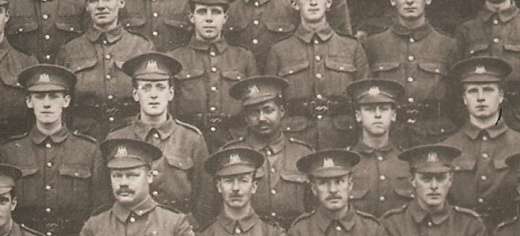
David Stowe also did much research on Jogendra Nath Sen and his account is here,

PTE. JOGENDRA SEN: A LEEDS PAL AND SON OF LEEDS

I first came across the name Jogendra Nath Sen in 2010 when researching the Leeds University Roll of Honour. More recently my attention was drawn to the work of Dr Santanu Das after he had lectured at a Legacies of War event at the University of Leeds.1 Dr Das is an expert on the Indian soldier and his work in that area is impressive. However, as I began to read his work on Jogendra Nath Sen I realized the archive in Chandernagore, where he had located several artefacts belonging to Sen, had caused confusion by mislabeling the collection and mixing Jogendra Nath Sen with his doctor brother who shared the same initials.2

This article seeks to not only correct that confusion, but also answer the question posed by Dr Das: ‘Now, was Dr Sen, a member of the elite Indian Medical Services, fighting as a British imperial subject, or as a Bengali (a member of the ‘non-martial’ race) or as a resident of Chandernagore, which was a French colony, or all three?’3Using both local and national sources it might be impressed that Jogendra Sen had settled into the local community and even joined a local battalion at the outbreak of war. It might be further impressed that Jogendra Sen was a volunteer who had made Leeds his home. ……… 

Sexual perks for senior Australian surgeons

March 7, 2015

Senior Australian surgeons, it seems, regularly expect sexual gratification from their juniors as part of their due.

The President of the Australian Medical Association in New South Wales, Dr. Steven Smith, however seems remarkably complacent and quite content to allow demographics to solve the problem. He is just waiting for the tide to turn.

“”But we know increasingly and the trend is that every graduating year for medicine is more female than male as far as the graduate numbers. And as such, there is a tide to turn.” – ABCnet

Sydney Morning Herald:

A senior surgeon has been criticised for her “appalling” suggestion that surgical trainees should stay silent if they’re sexually assaulted by a colleague because coming forward could ruin their careers.

Dr Gabrielle McMullin, a Sydney vascular surgeon, says sexism is so rife among surgeons in Australia that young woman in the field should probably just accept unwanted sexual advances.

She referred to the case of Caroline, who won a case against a surgeon accused of sexually assaulting her while she was completing surgical training at a Melbourne hospital. But the woman was unable to get work at any public hospital in Australasia after the legal victory, Dr McMullin told ABC radio at a book launch at Parliament House in Sydney on Friday night.

“Her career was ruined by this one guy asking for sex on this night. And, realistically, she would have been much better to have given him a blow job on that night,” Dr McMullin said.

“What I tell my trainees is that, if you are approached for sex, probably the safest thing to do in terms of your career is to comply with the request; the worst thing you can possibly do is to complain to the supervising body because then, as in Caroline’s position, you can be sure that you will never be appointed to a major public hospital.”


ABC: …. Dr McMullin told the ABC the story of a neurosurgical trainee in Melbourne suggested this was the case.

“Caroline was … the daughter that you’d wish to have. She excelled at school. What she always wanted to be was a neurosurgeon,” she said. “At the hospital Caroline ended up training at, one surgeon took her under his wing. But things got uncomfortable. “He kept asking her back to his rooms after hours. But after this one particularly long [work] session, she felt it was rude to refuse and they ended up back in his rooms, where, of course, it was dark and there was nobody else around, and he sexually assaulted her.

“She was horrified. She ran out of the office. She didn’t tell anyone.” 

Dr McMullin said the surgeon began to give Caroline bad reports and faced with the prospect of failing after years of hard work, Caroline finally complained. After a long and gruelling legal process, Caroline won her case. 

“However, despite that victory, she has never been appointed to a public position in a hospital in Australasia,” Dr McMullin said.

“Her career was ruined by this one guy asking for sex on this night. And realistically, she would have been much better to have given him a blow job on that night.

“The worst thing you could possibly do is to complain to the supervising body, because then, as in Caroline’s position, you can be sure that you will never be appointed to a major public hospital.”

Gods and religions as tools for control of social behaviour

March 6, 2015

Religions (belief in systems of supernatural punishment – BSP) and then those based on Moralising High Gods (also to mete out punishment for social transgressions) were, no doubt, originally invented as a means of social control in societies of increasing size and/or complexity. It has been suggested that Moralising High Gods (MHG) were a necessary condition which probably enabled the growth of complexity in, and success of, such societies. (Effectively then, a means for getting large numbers to behave themselves and as a cheap substitute for – and perhaps a complement to – an expensive police force in complex societies).

A new paper in the Proceedings of the Royal Society (B) reports on studies of religious beliefs in 96 Austronesian cultures and suggests that a belief in a “Big God” was not necessarily the driver of developing social complexity.

Joseph Watts et al, Broad supernatural punishment but not moralizing high gods precede the evolution of political complexity in Austronesia, Proceedings B, The Royal Society, DOI: 10.1098/rspb.2014.2556

Abstract: Supernatural belief presents an explanatory challenge to evolutionary theorists—it is both costly and prevalent. One influential functional explanation claims that the imagined threat of supernatural punishment can suppress selfishness and enhance cooperation. Specifically, morally concerned supreme deities or ‘moralizing high gods’ have been argued to reduce free-riding in large social groups, enabling believers to build the kind of complex societies that define modern humanity. Previous cross-cultural studies claiming to support the MHG hypothesis rely on correlational analyses only and do not correct for the statistical non-independence of sampled cultures. Here we use a Bayesian phylogenetic approach with a sample of 96 Austronesian cultures to test the MHG hypothesis as well as an alternative supernatural punishment hypothesis that allows punishment by a broad range of moralizing agents. We find evidence that broad supernatural punishment drives political complexity, whereas MHGs follow political complexity. We suggest that the concept of MHGs diffused as part of a suite of traits arising from cultural exchange between complex societies. Our results show the power of phylogenetic methods to address long-standing debates about the origins and functions of religion in human society.

Philip Ball comments in Nature:

All human societies have been shaped by religion, leading psychologists to wonder how it arose, and whether particular forms of belief have affected other aspects of evolved social structure. According to one recent view, for example, belief in a “big God” — an all-powerful, punitive deity who sits in moral judgement on our actions — has been instrumental in bringing about social and political complexity in human cultures.

But a new analysis of religious systems in Austronesia — the network of small and island states stretching from Madagascar to Easter Island  — challenges that theory. In these states, a more general belief in supernatural punishment did tend to precede political complexity, the research finds, but belief in supreme deities emerged after complex cultures have already formed. …

The most common examples of religions with MHGs — Christianity and Islam, the dominant representatives of so-called Abrahamic religions — are relatively recent and obviously postdated the appearance of complex societies. But the question is whether earlier MHGs, for example in Bronze Age civilisations, catalysed sociopolitical complexity or resulted from it. …

…. Watts and his colleagues pruned the 400 or so known Austronesian cultures down to 96 with detailed ethnographic records, excluding any in which contact with Abrahamic religions might have had a distorting outside influence. They range from native Hawaiians, who hold polytheistic beliefs, to the Merina people in Madagascar, who believe in a supreme God.

The team considered two classes of religion: MHGs and a broader belief in systems of supernatural punishment (or ‘BSP’) for social transgressions, such as those enacted through ancestral spirits or inanimate forces such as karma. Although both schemes see religious or supernatural agents as imposing codes of moral conduct, BSP does not assume a single supreme deity who oversees that process.

Six of the cultures had MHGs, 37 had BSP belief systems and 22 were politically complex, the researchers concluded. They used trees of evolutionary connections between cultures, deduced from earlier studies of linguistic relationships, to explore how the societies were inter-related and exchanged ideas. That in turn allowed them to test different hypotheses about MHGs and BSPs — for example, whether belief in MHGs precedes (and presumably then stabilizes) the emergence of political complexity.

But it seems to me that the distinction between BSP (with punitive supernatural forces) and MHG (with punitive moralising high gods) is largely a matter of degree. MHG is a natural progression with the identifying of the supernatural forces in human terms – and therefore – allowing some sections to claim some special alliance with the god having supernatural force. A god without supernatural force clearly would not qualify. Worshipping a Sun-god is different to worshipping the Sun only in that it allows the priests of the Sun-god to identify with the god. Priests of the Sun (rather than a Sun-god) just don’t have the same credibility and thus authority. It is not by accident that all gods are in the recognisable image of man (and that applies even to the elephant god Ganesh and the monkey god Hanuman). That allows the “priests” and the “prophets” to establish themselves in a position of social power (allied to the political power). It seems to me to be a logical extension of “calling on supernatural forces” for social control to become “calling on a specific supernatural god” as a cost-effective, self-policing method to control the masses in an increasingly complex society.

It also seems quite apparent to me that a small clan would have no need of a religion since the “leader” would exercise his social control directly and by the force of his personality or his strong right arm. It would be the increasing numbers of the society and his inability to exercise control – even with some rudimentary police force – which would lead to some measure of self-policing becoming necessary. And that would drive the invocation of a system of super-natural punishments for transgressions. And so religion would have been born. “Correct” behaviour was a requirement to placate the supernatural forces and avoid punishment. Thereafter it was just a matter of increasing numbers and/or complexity which would have led to the definition of “humanised” gods and their chosen cadre of priests.

A religion (BSP) then is no more than a tool for developing the self-policing of the social behaviour of the masses. And then religions need to “humanise” supernatural forces into gods and moralising high gods (MHG) only when a ruling class needs to secure its power over the unwashed masses.


Idiotic – but expected – Indian government ban on BBC rape film

March 5, 2015

The banning of a BBC film by the BJP and the Court in Delhi, because it reported on an interview with one of the Delhi rapists, is – at best – idiotic. Leslee Udwin had received all necessary permissions to interview the rapist in jail – from the government and from the jail authorities. The film is banned in India but was broadcast in the UK last night.

Of course the real reason for the knee-jerk banning (with little or no exercise of mind either by the government or the Court) is that what the rapist/murderer said is no different from what the male members of the BJP think. He showed absolutely no remorse and contended that if his victim had not struggled and had accepted being raped she would not have been killed. The BJP – and especially their spiritual leaders – all firmly believe that in every instance of rape it is the behaviour of the woman which has invited the rape. And it is not just the BJP of course. It is the mind-set which still prevails in most of rural India (and especially it seems in northern India where the male-female ratio is heavily skewed towards males). It is exacerbated when droves of macho young men migrate to the urban areas and continue to treat women as prey – just as they do with women of “lower caste” in their villages. And the so-called god-men with their fossilised minds don’t help.

DNA:

Mukesh Singh is a man without remorse, retelling in staccato, precise detail how he and his friends raped and grievously wounded the 23-year-old physiotherapy intern on a moving bus on the night of December 16, 2012, and why they were not in the wrong. She was.

His lawyers are equally blasé, men who have little compunction in echoing the view that a girl who goes out at night has only herself to blame — or words to that effect — with one going on to say that he would burn his daughter alive in public were she to have premarital sex. 

The death row convict is the unrepentant, boastful face, the defence lawyers the brazen reflection of a deeply misogynistic society that views as brutal a crime as rape as a consequence of something wrong that a woman has done. And the twin mirrors have found currency in the documentary India’s Daughter by British filmmaker Leslee Udwin that will be telecast by BBC on International Women’s Day on March 8; the chilling testimonies being played out on television prime time, the likes of Mukesh Singh and lawyers ML Sharma and AP Singh, who are not forwarding legal points in a client’s defence but just articulating their views, entering our homes as channels replay the interviews.

…….. there is a degree of voyeurism in a film which has a rape convict expounding at length before a TV camera on his crime and saying that the girl should have just “submitted herself quietly to the rape”. There is also the uneasy question of whether a filmmaker would be given similar licence in Britain to get a rapist’s views out in the public domain. And that, too, when the appeals of three of the convicts against their death sentence are still pending.

There’s another point to ponder — how Udwin got permission to interview a death row convict in Tihar jail when rights activists are consistently denied access to prisoners while probing a case.

…. The various arms of the Indian establishment have reacted true to type — with home minister Rajnath Singh declaring that the government would take all steps to stop the telecast, Delhi Police registering an FIR and a court stepping in on Wednesday to restrain the broadcast of the film.

And that is really no answer.

The knee-jerk ban culture, as we have seen repeatedly, is short-term, ill-advised and serves little or no purpose. The freedom of expression, however uncomfortable, cannot be selective. India’s Daughter may have touched a raw nerve and putting the how and why in question, but seeking a blackout is not the way out.

The simple reality is that Udwin should never have been given permission to interview a rapist/murderer awaiting execution. The BJP as the party in government is responsible for such permission being given. Just bureaucratic and administrative incompetence I think rather than any sinister conspiracy. The subsequent banning both by the Delhi Court and the government however, is a typical reflex, reactive action of guilty consciences with no exercise of mind.

Before time began

March 5, 2015

In the what, when there was no when,

It was the where before time began,

Nothing pre, nothing post, no before nor after,

Without any forces, or any slower or faster.


All matter in space hung still in the firmament,

And each particle stayed fixed within its own element,

Nothing went up so there was no coming down,

With nowhere to fall, nothing could go around.


In that what, when there was no when,

Nothing was stirring not even the zen.

Nothing could change not even a thought,

He was as bored as could be, with what He had wrought.


And so in that where, before time began,

His mind exploded in a mighty Big Bang.


And the rest is history.

The four fundamental forces of magic

March 4, 2015

From XKCD.

For all we know of why they exist, we might just as well name the four fundamental forces of nature as Magic Forces I, II, III and IV.


Should Jihadi John have been killed at birth?

March 4, 2015

I was listening to a discussion this morning about who was to blame that Jihadi John (Mohammed Emwazi ) is what he is. The consensus seemed to be that it was not his parents, it was not the UK, it was not “the system”, it was not his schooling, it was not his childhood friends and it was not his University. Some blame clearly attached to the radical preachers he had been exposed to, but the primary blame and culpability lay with Jihadi John himself. In effect with his genes. His nature not his nurture.

(Of course I ignore all his companions and partners in cruelty and barbarity who think he is some kind of a hero destined for paradise).

And that brought to mind this story from last week about the quality control of Danish pigs:

TheLocal.seSwedish supermarket giant Ica has promised action after it emerged that hundreds of thousands of underweight piglets are killed every year in Denmark by banging their heads against the floor.

Hans Aarestrup, head of the Danish organization for swine producers, Danske Svineproducenter, told Swedish Radio’s news programme Ekot on Monday that about half a million piglets are killed every year for “humane” reasons.

“Instead of waiting for the weakest pigs to die, we kill them. The most humane way is to grab them by their hind legs and hitting them on the floor,” he said.

In the latest edition of Danske Svineproducenter’s magazine, they estimate that a farm with one thousand sows could save half a million Danish kroner a year if they put down all newborn pigs weighing less than a kilo, under the headline “Could it be a win-win situation to kill pigs at birth?”. …

We exercise quality control over all our manufactured goods. We exercise quality control over all domesticated pets and livestock. Even the Swedish indignation about the manner of the killing of the Danish piglets is about the method – not about the quality control. We cull wolves and deer and reindeer and even “threatened species” (lions, tigers, giraffes) in an effort to maintain “healthy genes”.  We even exercise some quality control over humans before birth when we abort severely disabled foetuses.

Suppose now that gene testing at birth (or before) could have revealed the monster that Jihadi John was going to become. The underlying assumption is that his genes alone – and not his nurture – were to blame. Suppose that gene testing had revealed that he was like an underweight Danish piglet. That there was “high” probability that his gene mix would lead him to be a monster. Should quality control have kicked in? Should he then have been “eliminated” at birth?

And who else would then fail to pass the quality control gate at birth and end up in the “reject” pile? There is a case for a new eugenics.

IKEA charges the way of things to come

March 2, 2015

It’s the IKEA desk today and it will not be long before it is everywhere in your office or in your home. IKEA is now rolling  out a line of its desks that will wirelessly charge all your devices that are capable of being wirelessly charged. It will surely not be so long till the day when your devices are automatically and wirelessly charged anywhere in your office or in your home.

IKEA Skrivbord och arbetsbord

WPC Press Release:

Global home furnishings retailer IKEA today announced a product launch of Qi-powered bedside tables, lamps and desks that eliminates cable mess and makes it easier to stay connected with always-charged mobile devices.

IKEA said the wireless charging home furnishings will be available in Europe and North America this April, followed by a global rollout. The announcement girds support for Qi – the leading global wireless charging standard from the Wireless Power Consortium.  

“IKEA is delivering on its vision of making life at home better with this innovative, stylish and useful new collection that show consumers the beauty and simplicity of wireless charging,” said Menno Treffers, WPC chairman. “We applaud IKEA for its unmatched insight and their unique passion for making wireless charging affordable and simple for consumers.”

Qi is the most widely deployed wireless power standard, available in 3,000 hotels, restaurants, airports and public locations worldwide. There are now more than 80 Qi-enabled smartphones, 15 models of Qi-enabled cars and countless Qi mobile accessories in the market today.

“Our belief is that mobile phones are vital parts to people’s lives at home and their desire to stay connected, and Qi addresses an unmet need to keep devices powered,” said Bjorn Block, Range Manager for Lighting and Wireless Charging, at IKEA. “As a member of WPC, we value the access to the leading and most advanced global standard for wireless charging.”   

During Mobile World Congress, WPC will showcase the latest Qi-enabled products at booth 5C41, Hall 5.

About the Wireless Power Consortium and Qi
Established in 2008, the Wireless Power Consortium is an open, collaborative standards development group of more than 200 company members. WPC’s members include Belkin, ConvenientPower, Delphi, Freescale, Haier, HTC, IKEA, LG, Microsoft, Motorola, Nokia, Panasonic, PowerbyProxi, Royal Philips, Samsung, Sony, TDK, Texas Instruments, Verizon Wireless and ZTE. These companies — large and small competitors and ecosystem partners, from all parts of the industry and all parts of the globe — collaborate for a single purpose: to design and evolve the world’s most useful, safe and efficient standard for wireless power. This global standard is called Qi, and it has become the world’s leading method for transferring electrical power without wires. Qi is designed into 80+ mobile devices, 15 models of cars, has more than 700 registered products that are enjoyed by more than 50 million users worldwide. 

Dawn lights on Ceres

March 2, 2015
Ceres

This image was taken by NASA’s Dawn spacecraft of dwarf planet Ceres on Feb. 19 from a distance of nearly 29,000 miles (46,000 kilometers). It shows that the brightest spot on Ceres has a dimmer companion, which apparently lies in the same basin. Image Credit: NASA/JPL-Caltech/UCLA/MPS/DLR/IDA

NASA: Dwarf planet Ceres continues to puzzle scientists as NASA’s Dawn spacecraft gets closer to being captured into orbit around the object. The latest images from Dawn, taken nearly 29,000 miles (46,000 kilometers) from Ceres, reveal that a bright spot that stands out in previous images lies close to yet another bright area.

“Ceres’ bright spot can now be seen to have a companion of lesser brightness, but apparently in the same basin. This may be pointing to a volcano-like origin of the spots, but we will have to wait for better resolution before we can make such geologic interpretations,” said Chris Russell, principal investigator for the Dawn mission, based at the University of California, Los Angeles.

Ceres is thought to be covered in an ice crust and there is much speculation about the source of the brightness.  There is not enough light available for these to be reflections. Eruptions of what lies underneath through the ice crust is one theory. The Mission Director has a journal at the Dawn blog:

Dawn is showing us exotic scenery on a world that dates back to the dawn of the solar system, more than 4.5 billion years ago. Craters large and small remind us that Ceres lives in the rough and tumble environment of the main asteroid belt between Mars and Jupiter, and collectively they will help scientists develop a deeper understanding of the history and nature not only of Ceres itself but also of the solar system.  …..

….. Dawn is in the vicinity of Ceres and is not leaving. The adventurer has traveled more than 900 million miles (1.5 billion kilometers) since departing from Vesta in 2012, devoting most of the time to using its advanced ion propulsion system to reshape its orbit around the sun to match Ceres’ orbit. Now that their paths are so similar, the spacecraft is receding from the massive behemoth at the leisurely pace of about 35 mph (55 kilometers per hour), even as they race around the sun together at 38,700 mph (62,300 kilometers per hour). The probe is expertly flying an intricate course that would be the envy of any hotshot spaceship pilot. To reach its first observational orbit — a circular path from pole to pole and back at an altitude of 8,400 miles (13,500 kilometers) — Dawn is now taking advantage not only of ion propulsion but also the gravity of Ceres. On Feb. 23, the spacecraft was at its closest to Ceres yet, only 24,000 miles (less than 39,000 kilometers), or one-tenth of the separation between Earth and the moon. Momentum will carry it farther away for a while, so as it performs the complex cosmic choreography, Dawn will not come this close to its permanent partner again for six weeks. Well before then, it will be taken firmly and forever into Ceres’ gentle gravitational hold. 

Wikipedia:

Ceres (minor-planet designation 1 Ceres) is the largest object in the asteroid belt, which lies between the orbits of Mars and Jupiter. It is composed of rock and ice, is 950 km (590 mi) in diameter, and contains approximately one third of the mass of the asteroid belt. It is the only dwarf planet in the inner Solar System and the only object in the asteroid belt known to be unambiguously rounded by its own gravity. It was the first asteroid to be discovered, on 1 January 1801 by Giuseppe Piazzi in Palermo, though at first it was considered to be a planet. From Earth, the apparent magnitude of Ceres ranges from 6.7 to 9.3, and hence even at its brightest it is too dim to be seen with the naked eye except under extremely dark skies.

Sång till Lotta

March 1, 2015

I heard a lovely piece of music on the car radio a few days ago. It took me quite some time to track down what it was. I am not sure if this fine version is the one I heard. It’s the Sång till Lotta, composed by Jan Sandström and played  here by Stefan Schulz, bass trombone of the Berlin Philharmonic and accompanied by Tomoko Sawano.

Not very long but a very delicate bass trombone suggesting heaps of controlled strength.

One phrase reminds me of the clarinet in Ennio Morricone’s theme from The Mission