The atom at the centre of the Earth

February 10, 2015

Last year it was 150 years since Jules Verne published his Journey to the Centre of the Earth. His basic premise was that some volcanic vents extended all the way from the surface to the Earth’s centre. His not unreasonable plot then made his heroes descend into the Icelandic volcano Snæfellsjökull, encountering many adventures, including prehistoric animals and natural hazards, before eventually coming to the surface again in southern Italy, at the Stromboli volcano”.

But physically reaching the centre of the Earth is probably more distant than even a human colony on a planet around Alpha Centauri. Speculations and models about what the Earth’s core is like is primarily based on the analysis of seismic waves and the manner in which they travel through the various layers making up the Earth’s interior.

A new analysis suggests that the Earth’s inner core has a further inner core. And probably that inner core has another inner core and so on ad infinitum! And even the one atom of Iron, right at the centre of the Earth, itself has an inner core called a nucleus.

Xiaodong Song et al. Equatorial anisotropy in the inner part of Earth’s inner core from autocorrelation of earthquake coda. Nature Geoscience, Feb 9, 2015

Song et al

Press ReleaseThe inner core, once thought to be a solid ball of iron, has some complex structural properties. The team found a distinct inner-inner core, about half the diameter of the whole inner core. The iron crystals in the outer layer of the inner core are aligned directionally, north-south. However, in the inner-inner core, the iron crystals point roughly east-west. (See graphic for a visual map of the inner core.)

Not only are the iron crystals in the inner-inner core aligned differently, they behave differently from their counterparts in the outer-inner core. This means that the inner-inner core could be made of a different type of crystal, or a different phase.

“The fact that we have two regions that are distinctly different may tell us something about how the inner core has been evolving,” Song said. “For example, over the history of the earth, the inner core might have had a very dramatic change in its deformation regime. It might hold the key to how the planet has evolved. We are right in the center – literally, the center of the Earth.”

But this is all still modelling. It looks unlikely that we will be able to design a probe – let alone a vehicle – which can actually reach the centre of the Earth anytime soon. The centre of the Earth lies about 6,000km from the surface. The deepest level accessed physically by humans has been the 3400m that South African gold miners sometimes go down to. The deepest naturally occurring place that can be visited is probably the 2080m to the bottom of the Voronya cave in the Western Caucasus. The deepest oil wells are about 10 km deep. Possibly the deepest hole ever achieved is the Kola bore hole which reached 12,200m.

But who can tell? Maybe Jules Verne’s mysterious volcano tubes will one day be found.

Noted while visiting Delhi

February 6, 2015
  1. Returning through Munich, the airport security staff reminded me of automated robots. They once again demonstrated that their jobs required them to suppress the one key behavioural factor which makes them human. They were not rude by any means, but they were required to provide pre-determined responses to given stimuli. They had no freedom to deviate from their trained responses and were required – under all circumstances – not to think for themselves. Of course, this is not the only job which requires humans to refrain from exercising their minds. But it begs the question – Are we still human if /when we suppress the differentiating ability to think?
  2. During my week in Delhi I noticed no signs of the new “Clean India” campaign supposedly underway. The piles of rubble and the 95% syndrome were all too clearly visible. Even in the areas visited by Barack Obama (he left Delhi on the day I arrived), the “clean-up” was as superficial as it usually is. The winter gloom and choking dust in the air were essentially unchanged.
  3. There is a new “gender game” which is catching on among middle-class, spoilt, educated girls in India. The game consists of accusing some middle-aged male – preferably in a crowded place – of having groped her and filming the accusation and the response on a smart phone. Of course the film is uploaded on You Tube along with any hulabaloo created. The winners are those who cause the greatest outrage and get the greatest number of hits. I note that poor and oppressed girls who have the greatest reason to complain about real harassment are not players. I note also that many of the players are not particularly attractive and speculate that it is a new way of seeking and getting attention. It is part of the global wave of narcissism promoted by the social media and selfies.
  4. The winter weather in Delhi is entirely unaffected by any global warming. Even the Urban Heat Island effect provides no respite for those who live on the street.
  5. Driverless cars should be tested in Delhi. If they can survive here they can survive anywhere! The protocol to be programmed in for the use of the horn could be particularly challenging.
  6. Obama’s visit was – for most Delhiites – a non-event. A small diversion and a small inconvenience providing some photo-ops for some politicians. It was largely forgotten within 2 days. (It is my theory that the inherent racism in most Indians leads to the negatives for Obama as half-black being greater than his positives for being American).
  7. Street stalls in Delhi were selling a “standard meal” for Rs 20 – 30 (30 – 50 US cents). This consists of a thali containing a portion of rice, 4 – 5 chappatis, two vegetable dishes, a portion of dal, one papad and a portion of yogurt or raita. The number of chappatis on offer was the competitive factor being used by two adjacent stalls. The same meal at a subsidised factory canteen costs about Rs 70 and around Rs 250 at a clean dhaba with plastic chairs. And at the Bukhara restaurant a the ITC Maurya Hotel (where Obama stayed and where we had our last dinner in Delhi), something similar would set you back Rs 3,000 – $50.
  8. The ubiquitous TV news channels – which are very Delhi-centric – were drooling over the State elections due tomorrow. They were never of any quality but they seem to have deteriorated even further. The news anchors and journalists running the “reality news shows” who I had some respect for once upon a time, have completely prostituted themselves to the perceived ratings. I am afraid that journalistic integrity is something that Arnab Goswami, Rajdeep Sardesai, Barkha Dutt and Shekhar Gupta   – among many others – have long since abandoned.

I returned to a snow blanketed landscape and spent over an hour breaking and scraping frozen snow off my car before I could move. It was round 10ºC at night in Delhi, but it felt colder than the -6ºC I have returned to.


MH 370: Anything but an “accident” as Malaysian government abandons reason

January 30, 2015

I have been traveling for the last few days and blogging will be light for a few days yet.

Yesterday the Malaysian government declared the vanishing of MH370 to have been an “accident”!

There are many theories, but the one thing that is certain is that this was no accident. It is entirely impossible that the aircraft could have changed direction and flown westwards or that it could have performed its altitude changes by “accident”.

The Malaysian government has done many, many silly things, but this announcement abandons reason. It also assumes that all the world is a fool.

Deliberate action was involved.

Obama (or his advisors) are too scared to visit the Taj Mahal?

January 24, 2015

Unlike during Bill Clinton’s visit to Agra and the Taj Mahal in 1997, when Agra was turned into a ghost town, this time the Indian government has declined to have the entire city vacated of people and animals just so that Barack and Michelle Obama can visit. It would seem that the security team of the “most powerful person in the world” relies so heavily on only allowing Obama to move into empty spaces that his visit to the Taj Mahal, planned for Tuesday 27th January, has been reportedly cancelled! The US President is not up to making a visit that is made by around 12,000 visitors every day (on average), by around 4 million every year and by up to 300,000 during a long holiday weekend.

It occurs to me that every new security measure introduced – whether for the “ordinary man” or for Barack Obama – is a victory for the terrorists. The bottom line is that if Barack Obama does not visit the Taj Mahal on Tuesday it will be because he (and/or his advisors) were too scared to do so. You could say that they have been well and truly “terrorised”Airport security is primarily driven by the lobby for the manufacturers of security and scanning equipment. They have enjoyed a bonanza since 9/11. It is fairly obvious that the supposed benefits for passengers (which can never be demonstrated) are dwarfed by the benefits to the manufacturers.

The Hindu:

U.S. President Barack Obama is believed to have cancelled the Agra leg of his India visit. The President, who will be the chief guest at the Republic Day celebrations, was scheduled to visit the Taj Mahal with his wife, Michelle, on January 27.

Official confirmation of the cancellation of the Agra leg of his tour is still awaited. “It’s possible that he might leave India earlier,” a government source said, adding that no reason had been given for the cancellation of the Agra visit.

Obama’s security team and the Indian government have been at odds over his 3 day visit.

FirstPostAs the date of the United States President Barack Obama’s India visit nears, disagreement between the security agencies of US and India is getting sharper. ..

…… a number of special requests made by the US secret service to the Indian security agencies and the Indian government have been turned down. Sources in the Ministry of Home Affairs and the Ministry of External Affairs in India confirmed that some of the demands made by the secret service are rather unrealistic.

Here are five areas that the US agencies are disappointed with the Indian security arrangements:

  1. Extended outdoor time

The American president has never been on an outdoor event for more than 45 minutes. However, the Republic Day celebrations in Delhi last for almost two hours. The secret service had requested Indian agencies to either cut short the event or ensure that Obama will not be attending the event for more than 45 minutes.

But the Indian government has refused to oblige, according to a source in the Home ministry. To make things worse between the agencies, the number of tableaux participating in the parade could be increased from 20 to 25. It means that the event may end up extending the function further, beyond the usual two hours. This has not gone down well with the US Secret Service, but the Indian government too is not willing to budge.

  1. No Fly zone over NDMC area

The US security agencies had earlier asked the Indian government to clear airspace over Delhi on January 25 and 26, according to sources in the MHA. In this case too Indian agencies refused to oblige. Following this, it was decided that commercial planes will be kept clear of the airspace over the New Delhi Municipal Corporation area during the event.

However, the US Secret Service had more recently asked the government for a five-kilometre radius no-fly zone (both commercial and the Indian Air Force) imposed around Rajpath during the event. That has also been turned down by the government as it is tradition for the Indian Air Force to do a flypast on Republic Day.

  1. Airspace security over Yamuna Expressway

The Americans are also unhappy about the fact that while the airspace over the 165-kilometre long Yamuna Expressway to Agra, has not been declared a no-fly zone for commercial aircraft while the US President’s convoy is travelling on it. We have restricted the highway from public use for as long as the US President’s convoy is travelling through it. They have two F-35 raptors doing surveillance of the sky and will be flying on top of the President’s convoy. In addition to that, there are a number of security measures taken to ensure that any threat is detected beforehand. I don’t see why they should be upset,” an official at the Ministry of Home Affairs said.

  1. Indian anti-terrorist squad unsatisfactory

Sources also revealed that the US secret service officials said that the Indian commandoes gave unsatisfactory results in the aptitude test on security along with surprise checks conducted by the agency. As a result, the Central Intelligence Agency is bringing their Concealed Anti-Terrorists (CAT) squads to the national capital.

  1. Agra visit

Former US President Bill Clinton called Agra a ‘ghost town’ after his visit to the city on March 20, 2000. But that’s because city was cleared of people for his security. The US Secret Service wanted the same measure extended to President Obama, but the Indian agencies have denied that request as well.

Obama, during his earlier trip had reportedly skipped visiting the Taj due to the fact that the city did not pass the security scanner. “This time around we had issued directions for security arrangements to the state government way in advance,” a senior administrative official at the Ministry of External Affairs said. “But, we want to avoid clearing the city completely. It is an inconvenience for the general public and we wish to maintain an ‘organic’ look of the city rather than it feeling like a deserted town,” he added.

In India 2,000 female foetuses are aborted every day

January 22, 2015

What used to be female infanticide 100 years ago has now become gender selection by abortion of female foetuses in India today. The male/female ratio is skewed towards males (on average around 900 females / 1000 males). However in some of the northern States the ratio is alarmingly below this level and in some districts the ratio is less than 800 females / 1000 males. Not only in rural India but even in urban areas, gender determination of a foetus (which is illegal) is offered by unscrupulous doctors along with abortions of unwanted female foetuses. Ancient levels of female infanticide have been more than replaced by the abortion of female foetuses. It has been suggested that this practice may even have been exported into the immigrant population of the UK of Indian origin. Even though the fertility rate in India is declining strongly the demographics show some clear danger signs.

Some of the demographics are worrying.

  1. The ratio of women to men is low (average 909 women per 1000 men). Haryana, Rajasthan, Punjab and Uttar Pradesh have women /men ratios of less than 900 per 1000. I suspect that it is these states which have the lowest levels of emancipation of women and tend to have the highest fertility rates as well. It is clearly the level of development in the state – and not least the emancipation of women – which impacts the fertility rate.
  2. The shortage of women in urban areas (Delhi – 887/ 1000), is probably also due to the general shift of young males seeking employment from rural to urban areas. I wonder if this is also one of the contributing causes for the higher incidence of rape and sexual harassment in places like Delhi.
  3. Countrywide, the mortality rates for infants and children upto 5 years old is higher for girls than for boys.
  4. Abortion rates for female foetuses are also higher than for male foetuses.

In 2010 it was estimated that about 600,000 female foetuses were aborted every year. Now in 2015, it is thought that this is up to 2,000 female foetuses being aborted every day!

Expressing concern over the adverse sex ratio in the country, Union minister Maneka Gandhi today called for a need to fight the scourge of female foeticide which claims “2000 lives of girls daily.” …….

…. “The situation is so alarming that in 70 villages, not even a single girl can be found for the past many years,” she said, adding while in some villages the sex ratio was as low as 500.

Now Prime Minister Modi is leading a campaign to “Save your daughters, educate your daughters” (‘Beti Bachao Beti Padhao’). In the 12 districts of Haryana  State chosen for the initial campaign, the sex ratio varies between 775 to 837 females per 1,000 males.

(The) Government’s ambitious ‘Beti Bachao Beti Padhao Scheme’ to improve the child sex ratio (CSR) will be launched by Prime Minister Narendra Modi on January 22. The issue of decline in CSR is complex and multi-dimensional and the scheme will address the issue within the broad framework of survival, protection and education of girl children.

Under the scheme, a multi-sectoral strategy governed by the core principles of respecting, protecting and fulfilling the rights of girls and women, including the ending of gender based violence will be adopted, a statement issued by Women and Child Development Ministry said.

Modern technology in the hands of a medieval mind can be rather dangerous.

Saudi Arabia is a role model for IS

January 22, 2015

The main difference is that Saudi Arabia is a very rich country and is recognised by every other country as a legitimate state. It is an important “ally” of the US and Europe. It is still a monarchy. Women drivers are considered so dangerous that they are tried in terrorism courts. But the punishments for crimes, and what they consider crimes are remarkably similar to the self-proclaimed Islamic State.

Barbarous behaviour remains barbarous.

If the behaviour which is characteristic of being barbarous or being civilised is a matter of genetics, there is a very good case for eugenics.

Washington Post reports:

Following the lashing of blogger Raif Badawi and leaked footage that showed the public execution of a woman accused of beating her daughter, Saudi Arabia’s harsh interpretation of sharia law and its use of capital punishment have come under international scrutiny.

For many, the Saudi justice system sounds not unlike that of the Islamic State, the extremist Islamist group which has struck fear in much of the Middle East.

This week, Middle East Eye, a Web site that focuses on news from the region and is frequently critical of Saudi Arabia, contrasted a set of legal punishments recently announced by the Islamic State with the corresponding punishments in Saudi Arabia.

IS vs Saudia Arabia Middle East Eye

IS vs Saudia Arabia Middle East Eye

While Saudi Arabia isn’t particularly forthcoming about its use of capital punishment (and Middle East Eye doesn’t cite its source) and accurate information from within the Islamic State’s self-proclaimed caliphate is hard to ascertain, information from news sources and human rights organizations suggest the chart is at least broadly accurate.

One key difference between the Islamic State and Saudi Arabia, of course, is that the latter is a key U.S. ally in the region – and a member of the U.S.-led coalition fighting the Islamic State. Some experts argue that the fundamentalist brand of Islam practiced by both has theological links, however, and Riyadh’s recent crackdown has been interpreted as an act of appeasement for Saudi hard-liners.

Wealth inequality: The poor are not poor “because” the rich are rich

January 21, 2015

In the run-up to Davos, the headlines have been about 1% of the world’s population owning half the world’s wealth. (The Wealth “bible” is the Credit Suisse Wealth Report). The richest 80 people (0.1% of the 1%) have more wealth than the poorest half of the world’s population. Obama is talking about an additional tax on the wealthy. In his State of the Union address yesterday he declared that the economic crisis was over and about “spreading the wealth”. He prioritised the working families and the “middle class”. In Davos, 2,500 delegates arrived in 1,700 private jets.

Most people on the left of the political divide want more to be taken from the rich to be “given” to the poor. The Robin Hood syndrome. Note that when the intention is to “give to the poor” and not for “making the poor greater creators of wealth”, the driving force is mainly envy. It is when the desire to deprive the rich is more important than any desire to improve the lot of the poor. Concern is over-ridden by envy. Sometimes it seems to me that the real difference between left and right is that the left wants to spread the consumption of existing wealth (and hope that total wealth increases), while the right want to focus on creating wealth (and hope that it trickles down and gets equitably distributed).

But there is a fundamental fallacy in the view that the poor are poor because the rich are rich. There may well be some of the rich who are exploiting some of the poor and where the poor are not getting a just opportunity to be creators of wealth. There may well be members of the rich who create no wealth but remain rich because of inherited wealth. But by far the greatest majority of the rich are rich because they created more wealth than others. The real question is whether each individual gets an equitable opportunity to create wealth and then gets to retain an equitable portion of the wealth he has created. (It is a different matter but I still do not understand why it is the creation and the retention of wealth that attracts more penalties in the form of taxation than the destruction or consumption of wealth).

What constitutes wealth is a different matter, but no matter what definition is used, wealth is not something static. The “wealth of the world” is always changing. It is constantly being created and consumed and destroyed. The key point is not how much the rich have but whether the “poor” are increasing their creation of and their stock of wealth.

And the simple fact is that the “poorer half” of the world has been steadily increasing its wealth creation and its wealth retention. Between 2000 and 2014 the total stock of “wealth” in the world increased by over 250%!

Wealth Report Figure 1 Credit Suisse

Wealth Report Figure 1 Credit Suisse

It is during periods of growth that inequality reduces and this is very striking when comparing the 2000-2007 period with the 2007-2014 period.

Inequality trends for individual countries are explored in more detail in Table 2, with countries listed in order of the increase in inequality since 2000. The most striking feature is the contrast in experience before and after the financial crisis. In the period from 2000 to 2007, 12 countries saw a rise in inequality while 34 recorded a reduction. Between 2007 and 2014, the overall pattern reversed: wealth inequality rose in 35 countries and fell in only 11. The reason for this abrupt change is not well understood, but it is likely to be linked to the downward trend in the share of financial assets in the early years of this century, and the strong recovery in financial assets since 2007.

The “poor” have to leave the ranks of the poor. They are not poor because the rich are rich – but because they do not have the opportunities to create and retain wealth. And that will only come in growing economies and not by increasing public expenditure where the emphasis is on consuming existing wealth rather than creating new wealth.

Who do you write your CV for?

January 20, 2015

The Independent today carries an article pointing out that for entry level positions the screener/employer spends 8.8 seconds on average on the first assessment of a CV.

It is my experience that far too often CV’s are written to satisfy the ego of the author rather than to suit the employment process that is being entered into. If done properly the CV can even be a tool to first ensure selection for interview and then to steer the interview process towards the strengths of the aspirant. In fact the first page must be written primarily to get past a screener and be called for an interview. Thereafter the entire CV can help to steer the subsequent process.

Writing Your CV

How to use your CV to “control” the subsequent interview

…… The process must start not with the applicant’s credentials and his capabilities but with the capabilities and experience being sought. Every CV – before being written – must consider that it has to be directed at two classes of readers and has two principal objectives:

  1. First it must lead a “screener” to select the applicant for a subsequent interview.
  2. Second it must encourage the interviewer – either before the interview or even during the interview – to travel down preferred paths leading to a conclusion in favour of the applicant.

A screener who is selecting candidates to be called for interview may spend less than a minute on looking at a CV. He rarely gets past the first page.

Independant:

Young people may spend hours preparing their CV for employers to pore over, but research shows that just 8.8 seconds is spent studying any one person’s curriculum vitae in a process that has become “Tinderised”.

According to the UK’s youth programme, National Citizen Service, the pressure on employers to get through hundreds of CVs for entry level jobs has doubled, leading to less time being spent on prospective employees’ initial applications.

The average number of applications to these roles over the past two years leaped from 46 in 2013 to 93 today, and out of the 500 employers surveyed, one in 10 larger businesses, who staff more than 250 people, say they are seeing more than 400 applications for entry level jobs advertised.

Iran prepares to resist Saudi Arabia even with $25 oil price

January 19, 2015

Iran needs $72 per barrel for its budget. That Iran (along with oil shale production) is one of the targets of Saudi Arabia’s oil price strategy seems very clear. They have the lowest cost of extraction and with their accumulated reserves they could probably withstand 5 -8 years with a price lower than $50. However their strategy will be completely nullified if there is growth in demand (for example with an economic recovery in China) before they have brought the shale oil producers and Iran to their knees. The question now is how low the price can go?

Light crude price February 2015

Light crude price February 2015

The Iranians are girding their loins for a battle and are adjusting their budgets to be able to withstand a longer period with relatively low prices. Iran probably wants to avoid precipitating a further fall but I suspect that just mentioning their worst fears – in the present atmosphere – will only ensure that those fears come true. It would seem, from the almost belligerent Iranian stance, that prices will now almost certainly drop to around $25 per barrel within the next 6 -12 months.

Reuters:

Iran sees no sign of a shift within OPEC toward action to support oil prices, its oil minister said, adding its oil industry could ride out a further price slump to $25 a barrel.

The comments are a further sign that despite lobbying by Iranand Venezuela, there is little chance of collective action by the 12-member OPEC to prop up prices – entrenching the reluctance of individual members to curb their own supplies.

In remarks posted on the Iranian oil ministry’s website SHANA, Oil Minister Bijan Zanganeh called for increased cooperation between members of the Organization of the Petroleum Exporting Countries. ……. 

Oil has plunged by more than half since June 2014 to below $50 a barrel on Monday, pressured by a global glut and OPEC’s refusal at its last meeting in November to cut its output. ……. 

OPEC decided against a production cut despite misgivings from non-Gulf members such as Iran and Venezuela, after top producer Saudi Arabia argued the group needed to defend market share against U.S. shale oil and other competing sources. ……… 

Zanganeh said Iran had no plans to cut its own oil production and that it had no further meetings with Saudi Arabia – Iran’s main political rival in the Gulf – since the OPEC meeting.

Last week, Iranian President Hassan Rouhani said countries behind the price fall would regret their decision and warned that Saudi Arabia and Kuwait would suffer alongside Iran from the price drop.

Zanganeh said Iran’s budget should be based on oil at $72 per barrel, but Iran could withstand lower oil prices. “Even if the oil price goes down to $25 a barrel, the oil industry will not be threatened,” the Fars news agency quoted him as saying.

Galapagos conservation project prevents the evolution of ninja turtles

January 19, 2015
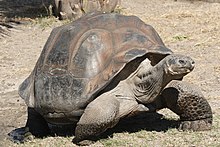
Adult Galápagos tortoise

Adult Galápagos tortoise

Giant tortoises are to be found only on the Aldabra Atoll in the Seychelles and on the Galapagos Islands in Ecuador.  Pinzón Island is home to the giant Galápagos tortoises of the endemic subspecies Chelonoidis nigra duncanensis. Pinzón is a tiny island covering 18 km2 right at the geographical centre of the Galapagos chain.

Galapagos Islands

The basic story is simple and just another example of a misguided conservation project where a successful species is exterminated to ensure the survival of an unfit species. The unfit species in this case is a reptile, the giant Galapagos tortoise which has been threatened by rodents of the black rat variety. Of course, black rats are politically incorrect and nasty and “vermin”, while the giant reptiles are seen as “cute” and “amusing” and “loveable”, even though the species is proving incompetent to adapt. (If rats had only been white they would probably be protected).

The rats preceded Darwin

By the time Darwin arrived in the Galapagos in 1835, the rodents had long since settled in. Mice and black rats were probably the first to arrive, introduced by pirates or whalers in the seventeenth century; since the 1980s, Norway rats have found their way there too.

Since 2012 a “conservancy project” has spent some $3 million to eradicate the rats and this now seems to have succeeded since new tortoise hatchlings have been observed for the first time in 150 years. That’s all very well, but there does not seem to be any one speaking up for the persecuted, murdered rats who, after all, have been present for over 300 years. They have been attacked by conservationists for over 50 years and -against all odds – have still thrived. Why this species-discrimination? Whatever happened to rodent rights?

In fact the rhetoric used by the conservationists reminds me of the language used by extreme, right-wing, anti-immigrant political parties:

“I just hated the immigrant killers because I could see what they were doing,” says Felipe Cruz, a lifelong conservationist who grew up on Floreana, one of four inhabited islands in the archipelago. In the early 1980s, Cruz spent nine months of the year camped in the Floreana highlands deploying a cocktail of rodenticide …… 

I find the analogy between conservationists as “specists” and right-wing, nationalistic, anti-immigration political parties as racists, quite revealing. Just as with conservationists who support politically correct species and try to exterminate the politically incorrect, right-wing extremists also support certain politically correct human races and try to exclude and remove the politically incorrect races. It is no great secret that even among immigrants in Europe there are “politically correct” races and those which are “politically incorrect”. The politically incorrect races are to be kept out. And conservationists all over Europe try to protect the unfit but politically correct species while destroying or keeping out the immigrant species.

But what conservationists are forgetting in their euphoria over killing all the rats on Pinzón is that without the rats there is no chance of the mutation needed to create Master Splinter and without Master Splinter there is no possibility that the Ninja Turtles will ever become a reality.

The Turtles’ sensei and adoptive father, Splinter is a Japanese mutant rat who learned the ways of ninjutsu from his owner and master, Hamato Yoshi. ……… Splinter was Hamato Yoshi mutated into a humanoid rat instead of being just Yoshi’s pet.

Master Splinter superherohype.com


Further Reading:

http://www.nature.com/news/invasive-species-the-18-km2-rat-trap-1.12992

http://www.galapagos.org/blog/pinzon-tortoise-survey-part2/

http://www.theguardian.com/science/animal-magic/2015/jan/16/rat-eradication-galapagos-tortoise-pinzon

http://en.wikipedia.org/wiki/Splinter_(Teenage_Mutant_Ninja_Turtles)

http://en.wikipedia.org/wiki/Teenage_Mutant_Ninja_Turtles