“That is not who we are” – Barack Obama. Oh Yes it is!

December 10, 2014

I heard Barack Obama trying to make the best of the CIA torture report released by the Senate yesterday. “One of the things that sets us apart from other countries is that when we make mistakes, we admit them. ……… brutal, and as I’ve said before, constituted torture, in my mind. And that’s not who we are.

But of course it is “who we are”. Certainly admitting a self-judged, wrong-doing – after the event – is also part of “who we are”. But the fact of the wrong-doing remains part of the behaviour which constitutes “who we are”. It does not vanish with a subsequent apology.

While behaviour includes what one says, what one does always overrides if the two are in conflict. So, while the US is certainly to be commended on admitting some wrong-doings after the event, it is also quite clear that that behaviour is – at times – quite acceptable. “American Values” clearly do allow torture under certain conditions. Abu Ghraib and My Lai are part of the reality of the behaviour of the US military. Such behaviour is what they are, notwithstanding that the behaviour was later declared to be “wrong”. Those values are ingrained and it is almost certain that some “torture”and some mistreatment of detainees is ongoing right now, to be apologised for later – if revealed. I conclude that torture itself is not against American Values. The Value could actually be formulated thus:

Torture is wrong but permitted, as a last resort, in special circumstances and must be apologised for if later revealed.

The map of all the countries who were complicit – actively or passively – with CIA’s torture program includes most of the countries who speak loudest and most sanctimoniously about human rights. Add to this all the other countries (Russia, China, India, South American countries, …. ) who also use torture in some form, and I come to the conclusion that there is not a single country today where some form of torture (physical as well as mental) is not at least tolerated under some specific conditions. Nobody claims that torture is a “good thing”, but every country also accepts that it can be justified. The concept of “absolute human rights” is fundamentally flawed. The “human rights” that any society is prepared to bestow upon those within or without that society is dynamic and variable.

Currently “what humans are”, all around the world, includes the use of torture – knowing that it is “wrong” – under certain conditions when deemed absolutely necessary.

There are no absolute values either, just as there are no absolute human rights. How should we judge the behaviour of an ISIS executioner with that of a CIA torturer? An ISIS executioner carries out his bloody beheadings in the belief that he is doing “right” in accordance with his values. A CIA torturer carries out his miserable activities knowing that it is “wrong” but that it is in a “good” cause and justified by his values.

I suppose they will both be gathered to the bosoms of their angry gods in their respective heavens.
Academics, not journalists, responsible for hyping press releases

December 10, 2014

A new paper in the British Medical Journal seems to add substance to the view that many academics and their universities put far too much emphasis on self-promotion by means of exaggeration, sensationalism and alarmism. Science by press release seems to be the new paradigm. Rather than journalists it is the supposedly objective academics themselves who “talk up” their own work.

Sumner P, et al. The association between exaggeration in health related science news and academic press releases: retrospective observational study. BMJ 2014; 349: g7015

Results 40% (95% confidence interval 33% to 46%) of the press releases contained exaggerated advice, 33% (26% to 40%) contained exaggerated causal claims, and 36% (28% to 46%) contained exaggerated inference to humans from animal research. When press releases contained such exaggeration, 58% (95% confidence interval 48% to 68%), 81% (70% to 93%), and 86% (77% to 95%) of news stories, respectively, contained similar exaggeration, compared with exaggeration rates of 17% (10% to 24%), 18% (9% to 27%), and 10% (0% to 19%) in news when the press releases were not exaggerated. Odds ratios for each category of analysis were 6.5 (95% confidence interval 3.5 to 12), 20 (7.6 to 51), and 56 (15 to 211). At the same time, there was little evidence that exaggeration in press releases increased the uptake of news.

Conclusions Exaggeration in news is strongly associated with exaggeration in press releases. Improving the accuracy of academic press releases could represent a key opportunity for reducing misleading health related news.

Bern Goldacre has an editorial in the same issue of the BMJ. He argues that academics must be made accountable for exaggerations about their own work.

I would go much farther than Goldacre. Merely being accountable is not enough – it is liability that is required. I have long had a “thing” about this lack of liability for scientific misconduct Why cannot a concept of tort or “product liability”apply to scientists?.

Goldacre writes:

For anyone with medical training, mainstream media coverage of science can be an uncomfortable read. It is common to find correlational findings misrepresented as denoting causation, for example, or findings in animal studies confidently exaggerated to make claims about treatment for humans. But who is responsible for these misrepresentations?

In the linked paper (doi:10.1136/bmj.g7015) Sumner and colleagues found that much of the exaggeration in mainstream media coverage of health research—statements that went beyond findings in the academic paper—was already present in the press release sent out to journalists by the academic institution itself.

Sumner and colleagues identified all 462 press releases on health research from 20 leading UK universities over one year. They traced 668 associated news stories and the original academic papers that reported the scientific findings. Finally, they assessed the press releases and the news articles for exaggeration, defined as claims going beyond those in the peer reviewed paper. ……. 

Over a third of press releases contained exaggerated advice, causal claims, or inference to humans. When press releases contained exaggeration, 58% to 86% of derived news stories contained similar exaggeration, compared with exaggeration rates of 10% to 18% in news articles when the press releases were not exaggerated.

Academics and their institutions are surrounded and protected by a shield of supposed objectivity and good faith. But in the unprincipled hunt for funding between institutions and for academic advancement among researchers, there is a significant amount of falsified and manufactured research results. And then the shield protects them from having any liability. Accountability – if found out – leads to relatively mild consequences. If liability for the scientific “product” is introduced, then the taking of responsibility and accountability will automatically follow.

Swedish House Rules (for the next coalition)

December 9, 2014
  1. No party may cooperate with, or take the support of, the Sweden Democrats 
  2. Without the Sweden Democrats no minority coalition can survive.
  3. Any coalition must command a majority (175 seats)
  4. If the Left Party is included in any way then no party from the right of the divide will participate
  5. The Moderates or any parties to the right of the Moderates, will not participate if the Environmental Party (MP) is included
  6. The Centre Party may participate with a mildly left coalition provided it does not include the Left party

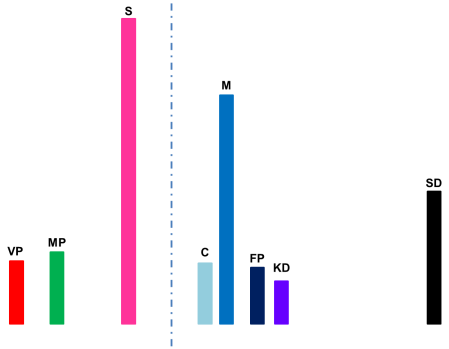
Currently the Swedish Parliament has 349 members from 8 parties.

Social Democrats – 113, Moderates – 84, Sweden Democrats – 49, Environment Party – 25, Centre Party – 22, Left Party – 21, Peoples Party – 19, Christian Democrats – 16.

Swedish political landscape 2014

Swedish political landscape 2014

Following these rules and assuming that the current composition of parliament is not much changed after the extra election in March 2015, only two possible majority coalitions are arithmetically possible:

  1. A Grand Coalition of the Social Democrats and the Alliance group of parties, or
  2. A grand coalition of the Social Democrats and the Moderates

The simple rule is that it has to be a coalition of the middle ground. That excludes the Sweden Democrats on the extreme right and the Left and the Environmental parties on the extreme left.

One consequence is that no matter what majority coalition is formed, the Sweden Democrats will be the largest party in opposition.


Climate mumbo jumbo lacks scientific temper

December 9, 2014

The Constitution of India actually requires that all citizens develop “scientific temper”. It is a term that is in common usage in India but not often referred to elsewhere. The concept is not new and similar ideas were expressed by Darwin but the term “scientific temper” seems to have been established mainly by Jawaharlal Nehru in his 1946 Discovery of India.

“… the scientific approach, the adventurous and yet critical temper of science, the search for truth and new knowledge, the refusal to accept anything without testing and trial, the capacity to change previous conclusions in the face of new evidence, the reliance on observed fact and not on pre-conceived theory, the hard discipline of the mind—all this is necessary, not merely for the application of science but for life itself and the solution of its many problems.” — Jawaharlal Nehru (1946) The Discovery of India

The questing, skeptical mind that Nehru admired is not so very different from that of Kipling’s narrator

I keep six honest serving-men
  (They taught me all I knew);
Their names are What and Why and When
  And How and Where and Who.
I send them over land and sea,
  I send them east and west;
But after they have worked for me,
  I give them all a rest.

Rudyard Kipling (1902) – Just So Stories

The new Indian government has refocused on promoting scientific temper among children as part of marking the 125th anniversary of Nehru’s birth. But this has also led to a debate about scientific temper and how in India it must coexist with superstition, quackery and pseudo-science (astrology, homeopathy ….).

Scientific temper is thus not a private matter. Article 51A(h) places on all citizens the duty to develop a scientific temper and therefore we cannot be “chalta hai” about these events since social behaviour is impacted by it and a culture of fatalism created by it. We must rally behind the Prime Minister’s call to spread scientific temper. We must revive the debate of the 1980s on the nature of scientific temper. The Prime Minister must give us his views on the relation between scientific temper and astrology. …….

…… It is reported that when Mangalyaan was launched — the satellite which India was able to place in Mars’ orbit in the first attempt, the only country to be able to do so — the Chairman of the Indian Space Research Organisation (ISRO), Dr. Radhakrishnan, went, the day before the launch, to pray at Tirupati for its success. When asked, he is reported to have said that he did not want to leave anything to “chance.” The Mars mission was successful. ………….  Was it the puja at Tirupati or the science at ISRO that worked?

And I observe as the UN meets for its annual climate jamboree in Lima that they still continue to believe in models which are contradicted by data. The global warming acolytes could do well to abandon the mumbo-jumbo and to return to basics with Kipling’s “What and Why and When, And How and Where and Who” and start displaying some scientific temper It is high time for the so-called climate scientists to exhibit 

the refusal to accept anything without testing and trial, the capacity to change previous conclusions in the face of new evidence, the reliance on observed fact and not on pre-conceived theory,

That man-made carbon dioxide has any significant impact on global warming or on climate is a pre-conceived theory and real data contradicts the model predictions based on these pre-conceived theories. There has now been no global warming for over 18 years while man made carbon dioxide emissions have increased by  over 70%.

Professor at Imperial College driven to his death?

December 8, 2014

This is sad and rather depressing.

On his blog, Professor David Colquhoun, FRS reports on the case of Professor Stefan Grimm of Imperial College who seems to have been bullied to his death.

Publish and perish at Imperial College London: the death of Stefan Grimm

This week’s Times Higher Education carried a report of the death, at age 51, of Professor Stefan Grimm: Imperial College London to ‘review procedures’ after death of academic. He was professor of toxicology in the Faculty of Medicine at Imperial.

Now Stefan Grimm is dead. Despite having a good publication record, he failed to do sufficiently expensive research, so he was fired (or at least threatened with being fired).

“Speaking to Times Higher Education on condition of anonymity, two academics who knew Professor Grimm, who was 51, said that he had complained of being placed under undue pressure by the university in the months leading up to his death, and that he had been placed on performance review.”

Having had cause to report before on bullying at Imperial’s Department of Medicine, I was curious to know more. 

Martin Wilkins wrote to Grimm on 10 March 2014. ………

……. It didn’t take long to get hold of an email from Grimm that has been widely circulated within Imperial. The mail is dated a month after his death. It isn’t known whether it was pre-set by Grimm himself or whether it was sent by someone else. It’s even possible that it wasn’t written by Grimm himself, though if it is an accurate description of what happened, that’s not crucial.

No doubt any Imperial staff member would be in great danger if they were to publish the mail. So, as a public service, I shall do so. ……

Read the rest at DC’s Improbable Science

Academic progress and goodness of research are not necessarily connected.


RSS YTD Temps Only 7th Highest Since 1998

December 8, 2014

Global warming PR always peaks at the time of a UN climate conference. Last week we had much weeping and gnashing of teeth about 2014 going to be the warmest year ever (based on adjusted temperature data sets). This week has started with glaciers melting everywhere.
In the meantime the satellite record shows that the pause in global temperature continues (over 18 years now) and that ice cover at the poles is pretty close to the average over the last 30 years.

The difference

December 8, 2014

Dress code for football coaches.

The key difference of course being that European football coaches are more formally dressed than the US football coaches.

Reblogged from RealScience

B4QpUtmCcAAsMA3

Using racial profiling is to be banned – except for those who need to use it

December 6, 2014

The point about profiling of any kind is that is tries to tie certain kinds of unwanted behaviour to other visible characteristics as a way of trying to detect such unwanted behaviour before it happens. But in almost every case it tries to increase the probability of detection of what is always a very low incidence rate of a particular behaviour.

For example if more terrorists tend to be bearded than not, then all bearded people are made subject to extra checks even though the incidence of a bearded person being a terrorist may be very low. The liberties of bearded people at large are sacrificed for the potential benefit of finding the “bad”, bearded guy. Or, as is happening in the US, and because certain crimes are more likely to be carried out by black or hispanic people, police detain and check black and hispanics more often just because they are black or hispanic rather than because they have any other indicators. But the connections between behaviour and profiles are a long, long way from being a science. Profiling is a very crude tool.

But using just race or appearance is not just crude, it also uses the ends (finding the “bad guy”) to justify the means (disenfranchising a great many of a particular group). And of course these means then tend to become self-fulfilling. It inconveniences and harasses the many in order to find the very few. It becomes a vicious loop when the means used provoke the very behaviour that is to be detected and avoided. And then to use such a crude tool – as profiling actually is – ends up with a huge amount of collateral damage.

The recent deaths of black people in encounters with white policemen, where the US Grand Juries do just what the prosecutor wants, and finds that policemen have no case to answer, have brought this again in to focus. And so racial profiling is to be banned except for use by the Department of Homeland Security and the Customs. Presumably the justification is that the DHS and Customs are looking at “very serious crimes”. Therefore the trampling on of individual liberties of many can be justified by the level of the potential downside.

VAGazetteAs the Obama administration prepares to announce new curbs on racial profiling by federal law enforcement, government officials said Friday that many officers and agents at the Department of Homeland Security will still be allowed to use the controversial practice, including while they screen airline passengers and guard the country’s southwestern border. …… 

The changes will also expand the definition of profiling to prevent FBI agents from considering factors such as religion and national origin when opening cases, officials said.

But after sharp disagreements among top officials, the administration will exempt a broad swath of DHS, namely the Transportation Security Administration and key parts of U.S. Customs and Border Protection, according to law enforcement officials.

The announcement of the new policy comes at a time of rising national protest over allegations that police engage in profiling when investigating and using force against minorities. The debate has been fueled by the recent deaths of three unarmed African-Americans at the hands of police in Ferguson, Missouri, New York and Cleveland, and the absence so far of criminal charges against the police officers who were involved.

But this logic is flawed. If it is acceptable for use by Customs to look for drug runners, then why is it not also acceptable for policemen doing the same thing? Either it is a good enough tool or it is not.

This action does not actually address the problems displayed at Ferguson or New York. And it is not just that there is a single problem. Policemen in the US, it is clear, profile people by race and do it automatically and unconsciously. They have some justification in real crime rates. Prosecutors and District Attorney’s use the grand juries for political ends – especially in not prosecuting those that they wish to protect. They also use prosecutions to harass political opponents. And thirdly – and that cannot either be ignored – the crime rate among blacks is undoubtedly significantly higher than for other groups (whatever the causes may be).

I suspect that these actions are primarily for the administration to demonstrate that they are doing something – anything – and to defuse the current wave of protests.

Swedish political crisis follows a failure of leadership

December 6, 2014

Leadership and courage do not result from administering a set of rules.  Changing the rules will not produce them either. But even a bad set of rules can be made to work if courage and leadership are present. Minority governments work when the leaders of the minority have the courage and the imagination and the leadership to maintain the temporary majorities necessary and sufficient to govern.

 Contrary to what is being taken as fact, a new general election in Sweden has not yet been called. While the current Red/Green government has had its budget rejected by the parliament and the current Prime Minister, Stefan Löfven, has announced his intention to call a new election, he cannot actually do so until 29th December. The laws require that a new election cannot be called until 3 months after this parliament first met on 29th September. In fact it is perfectly possible – instead – for a no-confidence motion against the government to be called in parliament (10% of members have to call for such a vote) and a simple majority of the vote can shift power from the PM and his government to the speaker of the house. If that happens before 22nd December (Christmas holidays intervening) then Löfven will not be around to call a new election as he intends to do on 29th December. It would then be up to the speaker or any other government which is established to make such a call. In practice Swedish parliaments have never before taken such a bold step and it would take a level of political courage that members of this parliament do not seem to have.

In municipalities all over Sweden a variety of coalitions between the different parties have been formed to create working majorities so that the business of government can continue. It always needs the leader of the largest local party to show some imagination and courage and not a little skill to create these coalitions. Some coalitions sometimes fail on contentious issues which the parties cannot overcome, but then a new coalition emerges so that the business of government continues.

It is this leadership – to first imagine and then to constitute a working majority – which is visible in abundance at local government level which has been absent at the national level. At national level there is now much talk about changing the rules of voting to enable a minority government to govern. This is a red herring. There is much talk also blaming the Sweden Democrat Party of breaking the “Swedish Model”. This, too, is another red herring. The Sweden Democrats may not have followed practice but they certainly broke no rules. 

The Prime Minister, the Social Democrats, their Environmental Party partners and their far Left supporters are all screeching about a failure of the rules and the malicious nature of the Sweden Democrats. Even the opposition is calling for a change of rules. But this is not a case of the failure of the rules. It has been a case of a failure of leadership, a failure of the ability to see what is required to govern and ultimately the skill to govern.

Löfven has not had the imagination to visualise a manner of cooperation with the other parties (whether jointly or separately) which would have given a working majority. He has taken the easy path of not crossing the Left/Right divide. He brought the Greens into government and took the support of the far Left. He effectively raised and strengthened the wall between Left and Right. He missed the first rule of building consensus by allying too closely with small and extreme groups, which immediately alienated all others. As soon as he had allied with one party on the left he made no real efforts to balance that with an ally on the right. Starting from a minority position on the left he only achieved another minority but extreme position which only hardened the position of his opponents. He judged that the opposition would be too fractured to defeat his grouping and that was a strategic blunder. He was reduced later to arguing why the opposition should remain fractured and not come together! But even after the blunder led to the defeat in parliament, he had not the vision or the skill to put together a new working majority. Instead he seems to have abdicated his responsibility to look for a solution and announced his intention to dump the problem back on to the electorate.

Though there are a few voices calling for parliamentarians to table a no-confidence motion, I am not expecting any group of 35 members to show the necessary courage. That will lead to another election on March 22nd. But the issue which should be the deciding issue and which should transcend all others should be that of leadership and the courage to govern.

Finland approves new Russian nuclear plant

December 5, 2014

Russia’s Rosatom had offered a to supply the reactor for the 1,200 megawatt Hanhikivi 1 nuclear power plant for Fennovoima at Pyhäjoki in north-east Finland. The Finnish government had required Finnish ownership of greater than 60% as a condition for granting a license for construction. Construction is planned to start in 2015 for the plant to be in operation in 2024. With Finnish Fortum now taking a 15% share in the project, Finnish ownership now exceeds 65%.

The Finnish parliament has this morning has given the basic approval for construction to start.

Reuters:

Finland’s parliament on Friday approved plans to build a new nuclear plant supplied by Russia’s state-owned Rosatom despite East-West tensions over the Ukraine crisis.

With support from 115 parliamentarians against 74 opposed, the vote comes at a time when the European Union has called for EU member states to curb energy deals with Russia.

The Fennovoima reactor in northern Finland, which will be supplied and fuelled by Rosatom, is expected to begin output in 2024.

Hanhikivi 1

The AES-2006 model proposed for the Hanhikivi site (source: Fennovoima)

NEI: Finland’s Fennovoima and Rusatom Overseas have signed a Project Development Agreement aiming at a nuclear power plant supply contract for Hanhikivi 1 to be signed by the end of 2013.

The companies have set “common targets,” according to which negotiations will be carried out. They are also in talks over the possibility of Rusatom Overseas acquiring a 34% stake in Fennovoima.

The Russian 1200 MW AES-2006 pressurized water reactor (VVER) is being considered for the Hanhikivi 1 project, in northern Finland. The plant corresponds with IAEA and EUR requirements, according to Rusatom Overseas. However, for licensing purposes it “will be adapted to be in accordance with Finnish national safety standards.”

Direct negotiations with Rusatom Overseas begun in April 2013. Talks also started with Toshiba in February 2013, but will now only continue with the Russian firm.

Fennovoima, which is owned by 60 companies representing industry, trade, and energy sectors from all around Finland, said that before a plant supply contract is signed, all of Fennovoima’s owners must decide on their continuation in the project.

Foto: Fennovoima

Image Fennovoima