Homo erectus was making engravings 500,000 years ago

December 4, 2014

Long before any specimens of Homo sapiens were even gleams in the eyes of their hominin ancestors, Homo erectus peoples on Java (how and when did they get there?) were using shells as tools and were making engravings on the shells themselves. A new paper in Nature reports on studies of hundreds of fossil shells from the Homo erectus site Trinil, on the Indonesian island of Java. The shells are part of the Dubois Collection held at the Naturalis Biodiversity Center in Leiden. They have been dated to about 500,000 years ago.

Of course if all Homo Sapiens came Out of Africa (or Africarabia) around 100,000 years ago, then these Homo erectus on Java must have gone extinct without leaving any survivors (unless some of their genes still live on through later admixtures).

Joordens J.C.A., et al. Homo erectus at Trinil on Java used shells for tool product i on and engraving, Nature 10.1038/nature19362.

The 'Pseudodon shell' fossil with the engraving made by Homo erectus op Trinil. (Photo: Wim Lustenhouwer, Vrije Universiteit)

The ‘Pseudodon shell’ fossil with the engraving made by Homo erectus on Trinil. (Photo: Wim Lustenhouwer, Vrije Universiteit)

From the Leiden University Press Release:

Oldest ever engraving discovered on 500,000-year-old shell

Homo erectus on Java was already using shells of freshwater mussels as tools half a million years ago, and as a ‘canvas’ for an engraving. An international team of researchers, led by Leiden archaeologist José Joordens, published this discovery on 3 December in Nature. The discovery provides new insights into the evolution of human behaviour.

‘Until this discovery, it was assumed that comparable engravings were only made by modern humans – Homo sapiens – in Africa, starting about 100,000 years ago,’ says lead author José Joordens, researcher at the Faculty of Archaeology at Leiden University.

A team of 21 researchers studied hundreds of fossil shells from the Homo erectus site Trinil, on the Indonesian island of Java. The shells are part of the Dubois Collection held at the Naturalis Biodiversity Center in Leiden. The shells were excavated at the end of the 19th century by the Dutch physician and researcher Eugène Dubois, the discoverer ofPithecanthropus erectus – now known as Homo erectus.

The discovery of an engraved geometrical pattern on one of the shells came as a total surprise. The zigzag pattern, that can only be seen with oblique lighting, clearly pre-dates the weathering processes on the shell arising from fossilisation. The study has excluded the possibility that the pattern could have been caused by animals or by natural weathering processes and shows that the zigzag pattern is the work of Homo erectus.

By applying two dating methods, researchers at the VU University Amsterdam and Wageningen University have determined that the shell with the engraving is minimally 430,000 and maximally 540,000 years old.This means that the engraving is at least four times older than the previously oldest known engravings, found in Africa. …..

…… This research has shown that these early human-like people were very clever about how they opened these large freshwater mussels; they drilled a hole through the shell using a sharp object, possibly a shark’s tooth, exactly at the point where the muscle is attached that keeps the shell closed. ‘The precision with which these early humans worked indicates great dexterity and detailed knowledge of mollusc anatomy,’ says Frank Wesselingh, a researcher and expert on fossil shells at Naturalis. The molluscs were eaten and the empty shells were used to manufacture tools, such as knives.

A. Shell tool, made by Homo erectus. B. Detail of the sharp edge used for cutting or etching. (Photo: Francesco d'Errico, Bordeaux University)

A. Shell tool, made by Homo erectus. B. Detail of the sharp edge used for cutting or etching. (Photo: Francesco d’Errico, Bordeaux University)


Low farce as Stefan Löfven gives up – will call a new election on 29th December

December 3, 2014

It has been another busy day in the Swedish parliament and for the political commentators. The 2-month old Red/Green government’s budget (supported by the communistic far Left) was defeated in Parliament. The alternative budget presented by the right-leaning Alliance of opposition parties, was also supported – going against past practice – by the far-right Sweden Democrats, and prevailed. We now have the very odd situation of a Red/Green government now having to administer the opposition’s budget which comes into force on 1st January 2015. It has been a spectacular failure by the Red/Green government after just 2 months in power.

Stefan Löfven, the Prime Minister, could have just resigned and let the speaker try to get a government cobbled together which could manage to get a budget passed. Strictly he could not call a new election since it has been less than 3 months since this parliament first met. Those 3 months are up on December 29th.

Many political commentators called this the most dramatic happening in Swedish politics since 1958! But I thought there was more of low farce than of high drama in the proceedings today. Everybody had announced how they were going to vote yesterday. There was 6 hours of meaningless debate in parliament before the vote.  Each speaker tried to avoid blame. CYA of the lowest order! Löfven called a press conference and lashed out like a very sore loser. He blamed everybody else and then announced that he would be calling a new election on December 29th to be then held on 22nd March next year. He comes from the trade union movement and has had a reputation as a good negotiator in industrial disputes. But his wage negotiation skills were not up to political negotiations. He has moved too far, too fast to the left in appeasing the Greens and the far Left party. So much so that he misjudged his strengths and weaknesses completely. He provided the Sweden Democrats an irresistible opportunity to become the centre of attraction in bringing him down. In fact he also managed with his lurch to the left to alienate the Alliance so much that it became impossible for them to rescue him (even if they had wanted to) from the quagmire of his own making.

So today he threw his hands up in the air and announced he was giving up and that he would call a new election – when he could – and ask the electorate to take the call on his budget. It strikes me that this is not just giving up. It is also a tacit acknowledgement of misjudgements and a lack of competence in managing the process of getting his budget passed.

Maybe he is hoping that before the new election is actually called 26 days from now, that the Alliance or just the Moderate Party (2nd largest party in parliament) will somehow find a way of saving his face by offering him some form of cooperation. Maybe his public announcement that he would campaign together with the Greens is just negotiating tactics. Arithmetically the only way for a majority to form is if the Social Democrats cooperate with the Alliance or just the Moderates. It is highly unlikely that the Moderate Party will just abandon its allies. The chances for the Alliance to form a Grand Coalition with the Social Democrats is extremely small and will extract a heavy price. The Social Democrats would have to dump the Greens and the far Left. That price may be too heavy for the Social Democrats

But I can speculate that if the Social Democrats have the long term in mind and are prepared to dump the Greens and the far-Left, Löfven could retain the post of Prime Minister in a Grand Coalition with the Alliance. They would command a very stable parliamentary majority which could manage to keep the Sweden Democrats completely marginalised. But some of the key portfolios – such as Finance, Defence and Foreign Affairs – would have to go to the Alliance. It may not be politically possible for this crop of politicians, but it could be the best possible thing for the country.

But unless some such cooperation is finalised within the next 26 days, the Swedish parliamentarians would have failed the electorate. And just going back to the electorate may produce the same result and solve nothing.

Amateur dramatics on the Swedish political landscape

December 3, 2014

Yesterday was a busy day in Swedish politics, but it was amateur theatricality and not any high drama. I am left with the perception of some unruly teenagers (the Swedish Democrats) acting like hooligans in a classroom but where the adults (the other parties) have not the faintest idea what to do. They cannot expel the unruly elements and can only threaten not to speak to them. And they are then surprised that the unruliness continues. A most unedifying spectacle.

The Sweden Democrats announced yesterday that they would vote for the opposition’s alternative budget today in parliament rather than merely abstain to allow the red/green government’s budget to pass.

A Government Crisis will therefore be upon is when the vote is taken later this morning.

The government went into full panic mode last night and invited (begged) the opposition alliance (but not the Sweden Democrats or the Left Party) to emergency talks last night. They had to attend of course and they met with the Social Democrats and their Environment Party colleagues. Of course they just reiterated that it was not an opposition’s duty to help the government to pass its own budget and they would just be voting for their own alternative today.

The Swedish Prime Minister, Stefan Löfven, is in a bind. He does not have many options. Once he loses the vote today he can either call a new election (cannot be called before 29th December) or he can dump the green millstone around his neck and try and build a Grand Coalition in the German style with the moderates. Actually this is not that crazy. If he dumps the greens and the far left (who he has accommodated to a great extent so far), it is conceivable that sufficient common ground could be found with the Moderate Party for a very stable, majority government. Of course there would be some areas of ideological conflict but they would both have to leave those differences aside for their term together and revisit them in better days.

My own opinion is that Löfven and the Social Democrats have been weakened rather than strengthened by their association with the Greens and the Far Left. In fact the weight given to these minority parties has – in part – precipitated the crisis. The deep reds and the greens are anathema to the Sweden Democrats. The other parties would like to have no truck with the far-right Sweden Democrats (who I still perceive to be a bunch of junkies and hooligans) even though 13% of the country voted for them. They are attempting to make them political pariahs but they are not being very skillful about it. The other parties are coming across as bullies and are failing to show up the far-right extremists for what they truly are. (They have not yet learned that just shouting how bad the Sweden Democrats are does not address the reasons why their voters shifted their allegiance). Of course, they are all now blaming the Sweden Democrats for the crisis, but the reality is that the Social Democrats have been more than a little incompetent in giving undue weight to the wishes of the greens and the far left in their budget proposition. The bottom line is that the government has not had the skill to put together the support needed to get their budget passed.

All the other 7 parties have been rather clumsy – and inept – in their efforts to marginalise the Sweden Democrats and have only succeeded in catapulting them to the fulcrum of an artificial and ill-conceived crisis. I was listening to some of the comments yesterday from some of the politicians of the past and who are no longer in politics. I can’t help feeling that the current parties are lacking in pondus and could well use some older and more experienced advisors.

I am also quite sure that any sales or marketing manager from industry could teach these political parties a thing or two about how to marginalise a competitor – even in their home market.

Bringing in the extremists from the left or the right will not work.

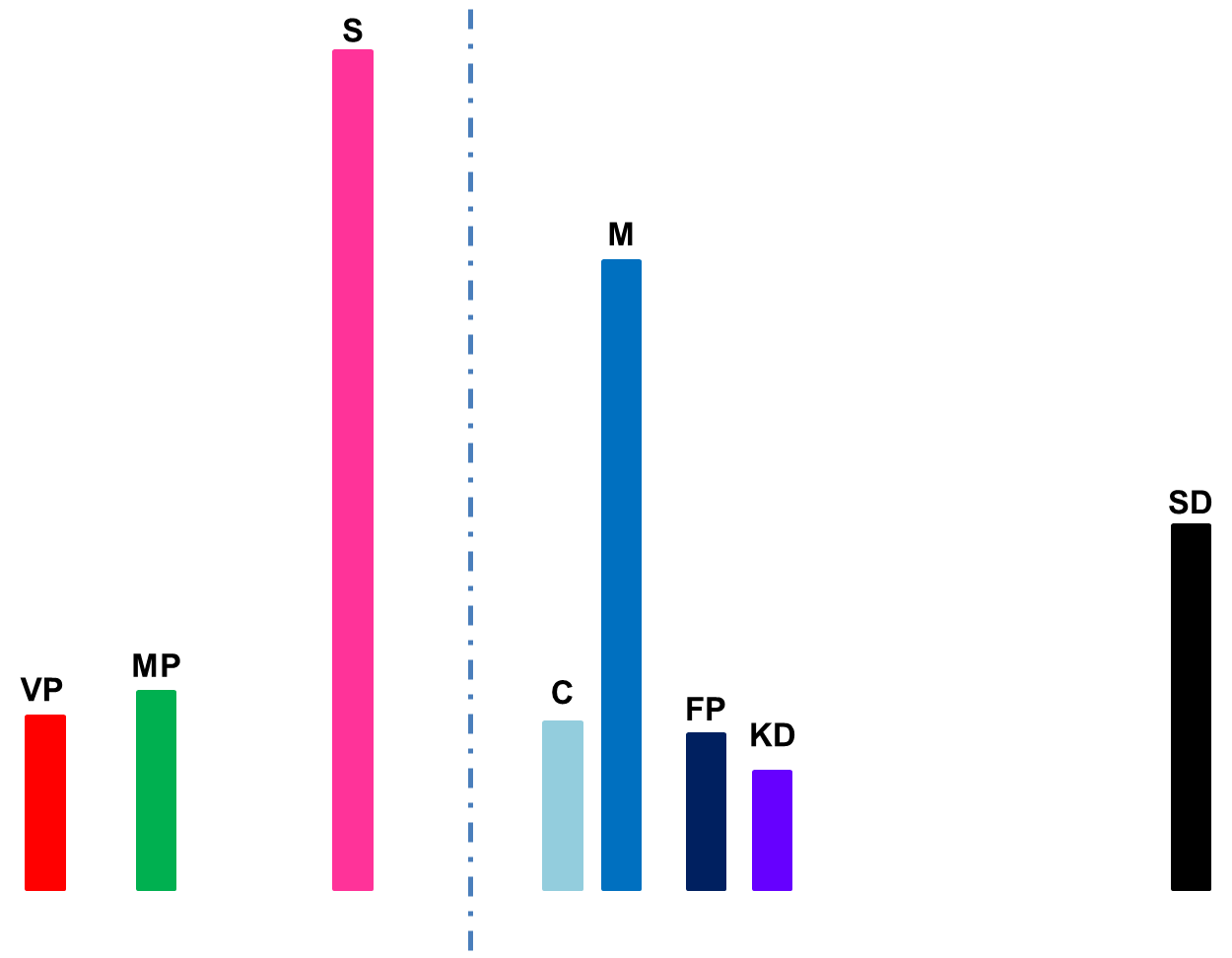
Swedish political landscape 2014

Swedish political landscape 2014

Criminal fathers have stupid sons – Swedish study

December 2, 2014

I first thought this new paper was something of a hoax, but perhaps it isn’t. Our genes are the ultimate multi-taskers. Not only do they combine to cooperate with a variety of other genes to express certain characteristics, each gene seems to take part in many such cooperations in many other teams of genes.. If criminal behaviour is (even partly) genetic, and if intelligence is also (partly) genetic, then it is not impossible that the genetic factors which lead to increased criminal behaviour in the parent may also cause (directly or indirectly) lower cognitive ability (intelligence) in offspring. Of course I would expect that the tendency to have lower intelligence will also be exhibited in the parent.

Swedish and Finnish researchers have looked at data for over 1,000,000 men and “found that men whose fathers had any criminal convictions tended to have lower cognitive-ability scores than men whose fathers had no such history”.

A. Latvala, R. Kuja-Halkola, N. Langstrom, P. Lichtenstein. Paternal Antisocial Behavior and Sons’ Cognitive Ability: A Population-Based Quasiexperimental Study. Psychological Science, 2014; DOI: 10.1177/0956797614555726

From the Association for Psychological Science press release:

Sons whose fathers have criminal records tend to have lower cognitive abilities than sons whose fathers have no criminal history, data from over 1 million Swedish men show. The research, conducted by scientists in Sweden and Finland, indicates that the link is not directly caused by fathers’ behavior but is instead explained by genetic factors that are shared by father and son. …….. 

… Research looking across generations in families has shown that children of parents who engage in “antisocial” behaviors — such as rule-breaking, aggressive, or violent behavior — are at greater risk for various negative outcomes, including criminality, psychiatric disorders, substance use, and low academic achievement. And research has also shown that individuals who engage in antisocial behaviors tend to have poorer cognitive abilities than those without antisocial tendencies.

Latvala and colleagues wanted to combine these two strands of research to investigate how parents’ antisocial behaviors might affect their children’s cognitive development.

“We wondered whether children of antisocial parents also have lower cognitive ability than children of non-antisocial parents, and if so, whether compromised cognitive functioning might be part of the inherited risk for antisocial behavior,” says Latvala.

The researchers took advantage of extensive data collected from Swedish residents, including data on cognitive ability acquired as part of compulsory military conscription and data on antisocial behavior (in this case, defined as criminal convictions) obtained from a national crime register.

Looking at data from over 1,000,000 men, the researchers found that men whose fathers had any criminal convictions tended to have lower cognitive-ability scores than men whose fathers had no such history.

And this association seemed to be influenced by the severity of the fathers’ criminal history:

“Perhaps most surprising was the clear gradient seen in the magnitude of the association with sons’ cognitive ability by severity of fathers’ criminality: The more severe crimes the father had committed, the poorer was the sons’ cognitive performance,” explains Latvala.

But did fathers’ antisocial behavior have a direct causal effect on sons’ cognitive ability, or could the link be explained by shared genetic factors?

To find out, the researchers compared the link between fathers’ criminal history and sons’ cognitive ability across cousins whose fathers had varying relationships to each other.

Specifically, they examined the link in cousins whose fathers were half-siblings (sharing about 25% of their genetic makeup), cousins whose fathers were full siblings or fraternal twins (sharing about 50% of their genetic makeup), and cousins whose fathers were identical twins (sharing 100% of their genes).

If fathers’ antisocial behavior directly caused sons’ lower cognitive ability, the link would remain equally strong across the comparisons of varying genetic relationships.

The data, however, suggested otherwise. When the researchers took the varying genetic relationships into account, the association between fathers’ criminality and sons’ cognitive ability gradually diminished.

Most of earth’s carbon could be in the inner core as iron carbide Fe7C3

December 2, 2014

The composition of the earth’s inner core is inferred from the speed of passage of seismic waves through the earth. It has generally been taken to be crystalline iron with some small amounts of nickel and lighter elements. But it has been necessary to assume that some part of the inner core is liquid to be able to explain why the S-wave travels at only about half the speed it should.

Now a new paper suggests that some of the core could well be iron carbide Fe7C3. The amounts of iron carbide needed would imply that our understanding of the carbon cycle is still in its infancy. Fully two-thirds of the earth’s carbon could be tied up in the inner core.

Bin Chen et al, Hidden carbon in Earth’s inner core revealed by shear softening in dense Fe7C3 , PNAS, doi: 10.1073/pnas.1411154111

The interior of the Earth (wikipedia)


Abstract: Earth’s inner core is known to consist of crystalline iron alloyed with a small amount of nickel and lighter elements, but the shear wave (S wave) travels through the inner core at about half the speed expected for most iron-rich alloys under relevant pressures. The anomalously low S-wave velocity (vS) has been attributed to the presence of liquid, hence questioning the solidity of the inner core. Here we report new experimental data up to core pressures on iron carbide Fe7C3, a candidate component of the inner core, showing that its sound velocities dropped significantly near the end of a pressure-induced spin-pairing transition, which took place gradually between 10 GPa and 53 GPa. Following the transition, the sound velocities increased with density at an exceptionally low rate. Extrapolating the data to the inner core pressure and accounting for the temperature effect, we found that low-spin Fe7C3 can reproduce the observed vS of the inner core, thus eliminating the need to invoke partial melting or a postulated large temperature effect. The model of a carbon-rich inner core may be consistent with existing constraints on the Earth’s carbon budget and would imply that as much as two thirds of the planet’s carbon is hidden in its center sphere.

From the press release:

“The model of a carbide inner core is compatible with existing cosmochemical, geochemical and petrological constraints, but this provocative and speculative hypothesis still requires further testing,” Li said. ” Should it hold up to various tests, the model would imply that as much as two-thirds of the planet’s carbon is hidden in its center sphere, making it the largest reservoir of carbon on Earth.”

It is now widely accepted that Earth’s inner core consists of crystalline iron alloyed with a small amount of nickel and some lighter elements. However, seismic waves called S waves travel through the inner core at about half the speed expected for most iron-rich alloys under relevant pressures.

Some researchers have attributed the S-wave velocities to the presence of liquid, calling into question the solidity of the inner core. In recent years, the presence of various light elements—including sulfur, carbon, silicon, oxygen and hydrogen—has been proposed to account for the density deficit of Earth’s core.

Iron carbide has recently emerged as a leading candidate component of the inner core. In the PNAS paper, the researchers conclude that the presence of iron carbide could explain the anomalously slow S waves, thus eliminating the need to invoke partial melting.

“This model challenges the conventional view that the Earth is highly depleted in carbon, and therefore bears on our understanding of Earth’s accretion and early differentiation,” the PNAS authors wrote. In their study, the researchers used a variety of experimental techniques to obtain sound velocities for iron carbide up to core pressures. In addition, they detected the anomalous effect of spin transition of iron on sound velocities. They used diamond-anvil cell techniques in combination with a suite of advanced synchrotron methods including nuclear resonant inelastic X-ray scattering, synchrotron Mössbauser spectroscopy and X-ray emission spectroscopy.


In Sweden, party politics negates and undermines parliamentary democracy

December 2, 2014

Currently Sweden is caught up in a so-called “Crisis of Government” which only serves to show that the Government itself is completely subservient to party politics and the exercise of Parliamentary democracy by the members of Parliament has become irrelevant. Of course in most parliamentary democracies, the exercise of democracy is always compromised by the party system which ensures that members of parliament represent their parties first and only very rarely their constituents. The members of the Swedish parliament particularly, are party representatives first, spokesmen for their own voters second and don’t even try very hard to represent any broader constituency. Votes in parliament are all settled in advance and the actual proceedings in parliament are for the sake of form and are relegated to be of little relevance. Parliamentary votes are usually just a formality.

But a possible challenge to the cosy, back-room deals is causing a furore.

Currently the Swedish Parliament has 349 members from 8 parties.

Social Democrats – 113, Moderates – 84, Sweden Democrats – 49, Environment Party – 25, Centre Party – 22, Left Party – 21, Peoples Party – 19, Christian Democrats – 16.

The Social Democrats and the Environmental Party with 138 seats (of 349) make up the minority government. Adding in the Left Party which supports them from outside the government gives them 159 seats which is still short of a majority. The conservative, market oriented alliance only commands 141 seats. The Sweden Democrats – which is a right-wing, anti-immigration, anti-immigrant party with neo-Nazi roots – is being shunned by all the other parties.  But the balance of power is clearly held by the Sweden Democrats.

The crunch comes tomorrow when the government’s first budget comes up in Parliament for approval. It is normal practice for other parties to oppose by abstaining from voting for the governments budget but instead voting for their own. So even a minority government gets its budget approved as long as all the rest don’t get behind a single alternative budget. The conservative alliance will present their own budget and vote for it but abstain from voting when the government’s budget comes up. The government’s budget has taken on board much of what the Greens and the Left wanted but has ignored the Sweden Democrats and the conservative alliance. It is fairly obvious that the the Greens and the Left are wielding an influence that is far in excess of their strength in parliament. The Greens are leveraging their minority position in a minority government to extort many concessions from the Social Democrats in power.

But now all the parties and all the media are in a tizzy because the Sweden Democrats could challenge the normal cozy, back-room deals usually done by the parties and which are just rubber-stamped by a parliament where all the members stop thinking for themselves and just follow the party line. The Sweden Democrats – who have no chance of getting their own budget passed – are considering backing the budget presented by the conservative alliance. They are perfectly entitled and perfectly within their parliamentary rights to do that since this is closer to their own budget.  But if they do then the choices for the government are limited. They could defer the vote, return the budget to committee and try to come up with something which commands a majority in parliament. Which is, of course, something they should have done in the first place. Or they could call a new election.

The Social Democrats have their knickers in a real twist. They are blaming the Sweden Democrats of not following practice, of extortion and of being irresponsible. They are blaming the conservative parties of allowing the right-wing forces to succeed – by inaction. And that is rather a strange accusation. But I think they protest too much. The Sweden Democrats will decide on their position today. The media are nearly all criticising them for taking so long to announce how they will vote. Which is also rather strange. If all votes are announced before the voting takes place, what then is the purpose of making speeches and arguing and voting in the parliamentary chamber? The democratic powers of parliament have become a matter of form but seem to have no substance.

Why bother with the parliament if all decisions can effectively be taken in the back-rooms outside of parliament.

If the democratic parliament is to have any real meaning then the government needs to present a budget which commands a real majority of the 349 votes where the votes are free and not constrained by party position (i.e. a minimum of 175 voting in favour).

Actually I expect that the Sweden Democrats will chicken out today and the government budget will get passed tomorrow. If they truly represented their voters they would have to make sure that this government budget fails. It will be a lopsided and essentially an undemocratic budget.  It will be undemocratic in that there will be far too much dictated by the Greens and the far Left and well in excess of their due. If the budget passes, it will be a case of tyranny by the minority.

The only really democratic option – which I would like to see – is that the government takes its responsibility which it should have done in the first place. It needs to revise and formulate a new budget which truly commands a free majority in the house.

ISRO to test ascent of GSLV-III launch vehicle and recovery of human-capable capsule in Christmas week

December 2, 2014

India’s ISRO is developing the GSLV-III launch vehicle to be able to lift payloads of 4,500 – 5,000 kgs directly into a Geosynchronous Transfer Orbit (GTO). The Indian national space agency intends to study the ascent phase of the rocket as well as the recovery of a human capsule, after it lands in the sea with a test flight during Christmas week. Such a lift capacity would allow larger communication satellites to be put into orbit or – for example – a Mars lander to be lifted or even a human-capable capsule. It would also then be able to enter the commercial satellite launch market. Later this week the Indian satellite GSAT-16 is to lift on an Ariane-5 rocket on December 5th, 2014 at 02:08 hrs (IST) from French Guiana.

GSLV-III would be comparable to the two Ariane Space heavy-lift launch vehicles

  1. The Ariane-5  with a payload capacity of 10 metric tons delivered to GTO,  or up to 20 metric tons in LEO, and
  2. The Soyuz with a payload capacity of 3,150 kg. delivered to GTO, or 4,900 kg. into SSO

ISRO: GSLV-Mk III is designed to be a three stage vehicle, with 42.4 m tall with a lift off weight of 630 tonnes. First stage comprises two identical S200 Large Solid Booster (LSB) with 200 tonne solid propellant, that are strapped on to the second stage, the L110 re-startable liquid stage. The third stage is the C25 LOX/LH2 cryo stage. The large payload fairing measures 5 m in diameter and can accommodate a payload volume of 100 cu m. Realisation of GSLV Mk-III will help ISRO to put heavier satellites into orbit.

image actmaniac.com

India is also continuing with the development of a 2-man space capsule though any manned space flight is not yet budgeted for and could – at the earliest – take place during the national 5-year plan for 2017-2022.

Marketing terrorism is becoming obsolete

December 1, 2014

Black Friday is over, today is Cyber Monday and tomorrow is Giving Tuesday. But this kind of marketing terrorism is becoming obsolete.

Obviously the marketing terrorism involving special days has worked – but it has worked not to increase total sales but only to shift consumption patterns. Sales are a little more concentrated on these days and to those stores who offer discounts. They encourage those chasing discounts but discourage those who don’t rely on the discount to make their purchases.

I suspect that rather than representing additional sales which would not otherwise happen, these “discount” days have only shifted buying – which would have happened anyway – to be concentrated to these “special” days and to those stores with the largest discounts. Imbuing artificial meaning into Valentine’s Day, Father’s Day and Mother’s Day, the invention of Black Friday, Cyber Monday and Giving Tuesday, having special “Sales” days after Christmas and the New Year, have all certainly served to change consumption patterns. But they have not really contributed to increasing the total sales. With the new buying pattern no store can afford to be the one that nobody comes to. I suspect also that the increased sale of discounted goods on these special days at just a particular store or chain is no longer worth the additional advertising and promotion costs.

But this kind of marketing is already obsolete. There is no more to be gained by inventing a Brother’s Day or a Sister’s Day or a Cousin’s day or a Children’s Day. On-line information gathering and on-line shopping have taken over. High street stores and even stores in shopping malls are increasingly showrooms for goods where the sales are actually consummated on-line. A few stores have caught on. They are converting their stores to become places to view goods and services and places to pick-up the goods bought on-line. They have realised that the “consumer commitment” has shifted from the store. The real capture of the sale happens on-line and no longer in the store. The store still has a role to play but this role is changing. The store needs to complement the on-line presence and to provide those bits that are missing from the on-line experience (viewing the goods and delivery of the goods). Walk-ins to the store have to be led inexorably to the web-site.

Those who have caught on have realised that the on-line store is open 24/7. The web site has to do an “IKEA” and ensure that the visitor is led through every part of the site and that he willingly parts with his money as he comes across little extras as he buys!!

The father it was who was classless

November 30, 2014

The Obama daughters were clearly not very interested and were wishing they weren’t there. But to call them classless was, as Elizabeth Lauten did, just silly. She got dumped on and apologised and deserved the censure she got as due recompense for her stupidity.

The lack of class though is with Barack Obama (or his idiot advisors but the buck stops with him) who insisted on the totally uninterested girls being there. What were they expecting? If the traditional pardoning of the Thanksgiving turkey was intended to be a mock-sombre but actually comic occasion, then the girls, their costumes and their posture had nothing to contribute. And that could have been predicted. If the intention was to be scornful of the tradition, then the inclusion of a couple of listless girls could make some sense, but he could surely have done a better job of being sarcastic.

As it is I am left with the impression that Thanksgiving is not very important to the Obamas. Pardoning the turkey is a tradition that he does not care very much about and which he follows (including the presence of his reluctant daughters) just as a matter of form. His only objective was then to follow precedent maintaining form but with no substance. Presumably he also forced his daughters to attend as a matter of form.

And that is lacking in class.

Mind you, I have no great expectations of the elegance of behaviour which constitutes class, from current Presidents and Prime Ministers. Barack Obama is not

“as time requireth, a man of marvellous mirth and pastimes and sometime of as sad gravity. A man for all seasons”

Robert Whittington

President Barack Obama, joined by his daughters Malia, right, and Sasha, center, speaks at the White House, in Washington, Wednesday, Nov. 26, 2014, during the presidential turkey pardon ceremony, an annual Thanksgiving tradition. (AP Photo/Jacquelyn Martin)

President Barack Obama, joined by his daughters Malia, right, and Sasha, center, speaks at the White House, in Washington, Wednesday, Nov. 26, 2014, during the presidential turkey pardon ceremony, an annual Thanksgiving tradition. (AP Photo/Jacquelyn Martin)


Outlook dire as a huge depression approaches France

November 30, 2014

Sarko’s back!

The best that France can offer

The best that France can look forward to