Most of earth’s carbon could be in the inner core as iron carbide Fe7C3

December 2, 2014

The composition of the earth’s inner core is inferred from the speed of passage of seismic waves through the earth. It has generally been taken to be crystalline iron with some small amounts of nickel and lighter elements. But it has been necessary to assume that some part of the inner core is liquid to be able to explain why the S-wave travels at only about half the speed it should.

Now a new paper suggests that some of the core could well be iron carbide Fe7C3. The amounts of iron carbide needed would imply that our understanding of the carbon cycle is still in its infancy. Fully two-thirds of the earth’s carbon could be tied up in the inner core.

Bin Chen et al, Hidden carbon in Earth’s inner core revealed by shear softening in dense Fe7C3 , PNAS, doi: 10.1073/pnas.1411154111

The interior of the Earth (wikipedia)


Abstract: Earth’s inner core is known to consist of crystalline iron alloyed with a small amount of nickel and lighter elements, but the shear wave (S wave) travels through the inner core at about half the speed expected for most iron-rich alloys under relevant pressures. The anomalously low S-wave velocity (vS) has been attributed to the presence of liquid, hence questioning the solidity of the inner core. Here we report new experimental data up to core pressures on iron carbide Fe7C3, a candidate component of the inner core, showing that its sound velocities dropped significantly near the end of a pressure-induced spin-pairing transition, which took place gradually between 10 GPa and 53 GPa. Following the transition, the sound velocities increased with density at an exceptionally low rate. Extrapolating the data to the inner core pressure and accounting for the temperature effect, we found that low-spin Fe7C3 can reproduce the observed vS of the inner core, thus eliminating the need to invoke partial melting or a postulated large temperature effect. The model of a carbon-rich inner core may be consistent with existing constraints on the Earth’s carbon budget and would imply that as much as two thirds of the planet’s carbon is hidden in its center sphere.

From the press release:

“The model of a carbide inner core is compatible with existing cosmochemical, geochemical and petrological constraints, but this provocative and speculative hypothesis still requires further testing,” Li said. ” Should it hold up to various tests, the model would imply that as much as two-thirds of the planet’s carbon is hidden in its center sphere, making it the largest reservoir of carbon on Earth.”

It is now widely accepted that Earth’s inner core consists of crystalline iron alloyed with a small amount of nickel and some lighter elements. However, seismic waves called S waves travel through the inner core at about half the speed expected for most iron-rich alloys under relevant pressures.

Some researchers have attributed the S-wave velocities to the presence of liquid, calling into question the solidity of the inner core. In recent years, the presence of various light elements—including sulfur, carbon, silicon, oxygen and hydrogen—has been proposed to account for the density deficit of Earth’s core.

Iron carbide has recently emerged as a leading candidate component of the inner core. In the PNAS paper, the researchers conclude that the presence of iron carbide could explain the anomalously slow S waves, thus eliminating the need to invoke partial melting.

“This model challenges the conventional view that the Earth is highly depleted in carbon, and therefore bears on our understanding of Earth’s accretion and early differentiation,” the PNAS authors wrote. In their study, the researchers used a variety of experimental techniques to obtain sound velocities for iron carbide up to core pressures. In addition, they detected the anomalous effect of spin transition of iron on sound velocities. They used diamond-anvil cell techniques in combination with a suite of advanced synchrotron methods including nuclear resonant inelastic X-ray scattering, synchrotron Mössbauser spectroscopy and X-ray emission spectroscopy.


In Sweden, party politics negates and undermines parliamentary democracy

December 2, 2014

Currently Sweden is caught up in a so-called “Crisis of Government” which only serves to show that the Government itself is completely subservient to party politics and the exercise of Parliamentary democracy by the members of Parliament has become irrelevant. Of course in most parliamentary democracies, the exercise of democracy is always compromised by the party system which ensures that members of parliament represent their parties first and only very rarely their constituents. The members of the Swedish parliament particularly, are party representatives first, spokesmen for their own voters second and don’t even try very hard to represent any broader constituency. Votes in parliament are all settled in advance and the actual proceedings in parliament are for the sake of form and are relegated to be of little relevance. Parliamentary votes are usually just a formality.

But a possible challenge to the cosy, back-room deals is causing a furore.

Currently the Swedish Parliament has 349 members from 8 parties.

Social Democrats – 113, Moderates – 84, Sweden Democrats – 49, Environment Party – 25, Centre Party – 22, Left Party – 21, Peoples Party – 19, Christian Democrats – 16.

The Social Democrats and the Environmental Party with 138 seats (of 349) make up the minority government. Adding in the Left Party which supports them from outside the government gives them 159 seats which is still short of a majority. The conservative, market oriented alliance only commands 141 seats. The Sweden Democrats – which is a right-wing, anti-immigration, anti-immigrant party with neo-Nazi roots – is being shunned by all the other parties.  But the balance of power is clearly held by the Sweden Democrats.

The crunch comes tomorrow when the government’s first budget comes up in Parliament for approval. It is normal practice for other parties to oppose by abstaining from voting for the governments budget but instead voting for their own. So even a minority government gets its budget approved as long as all the rest don’t get behind a single alternative budget. The conservative alliance will present their own budget and vote for it but abstain from voting when the government’s budget comes up. The government’s budget has taken on board much of what the Greens and the Left wanted but has ignored the Sweden Democrats and the conservative alliance. It is fairly obvious that the the Greens and the Left are wielding an influence that is far in excess of their strength in parliament. The Greens are leveraging their minority position in a minority government to extort many concessions from the Social Democrats in power.

But now all the parties and all the media are in a tizzy because the Sweden Democrats could challenge the normal cozy, back-room deals usually done by the parties and which are just rubber-stamped by a parliament where all the members stop thinking for themselves and just follow the party line. The Sweden Democrats – who have no chance of getting their own budget passed – are considering backing the budget presented by the conservative alliance. They are perfectly entitled and perfectly within their parliamentary rights to do that since this is closer to their own budget.  But if they do then the choices for the government are limited. They could defer the vote, return the budget to committee and try to come up with something which commands a majority in parliament. Which is, of course, something they should have done in the first place. Or they could call a new election.

The Social Democrats have their knickers in a real twist. They are blaming the Sweden Democrats of not following practice, of extortion and of being irresponsible. They are blaming the conservative parties of allowing the right-wing forces to succeed – by inaction. And that is rather a strange accusation. But I think they protest too much. The Sweden Democrats will decide on their position today. The media are nearly all criticising them for taking so long to announce how they will vote. Which is also rather strange. If all votes are announced before the voting takes place, what then is the purpose of making speeches and arguing and voting in the parliamentary chamber? The democratic powers of parliament have become a matter of form but seem to have no substance.

Why bother with the parliament if all decisions can effectively be taken in the back-rooms outside of parliament.

If the democratic parliament is to have any real meaning then the government needs to present a budget which commands a real majority of the 349 votes where the votes are free and not constrained by party position (i.e. a minimum of 175 voting in favour).

Actually I expect that the Sweden Democrats will chicken out today and the government budget will get passed tomorrow. If they truly represented their voters they would have to make sure that this government budget fails. It will be a lopsided and essentially an undemocratic budget.  It will be undemocratic in that there will be far too much dictated by the Greens and the far Left and well in excess of their due. If the budget passes, it will be a case of tyranny by the minority.

The only really democratic option – which I would like to see – is that the government takes its responsibility which it should have done in the first place. It needs to revise and formulate a new budget which truly commands a free majority in the house.

ISRO to test ascent of GSLV-III launch vehicle and recovery of human-capable capsule in Christmas week

December 2, 2014

India’s ISRO is developing the GSLV-III launch vehicle to be able to lift payloads of 4,500 – 5,000 kgs directly into a Geosynchronous Transfer Orbit (GTO). The Indian national space agency intends to study the ascent phase of the rocket as well as the recovery of a human capsule, after it lands in the sea with a test flight during Christmas week. Such a lift capacity would allow larger communication satellites to be put into orbit or – for example – a Mars lander to be lifted or even a human-capable capsule. It would also then be able to enter the commercial satellite launch market. Later this week the Indian satellite GSAT-16 is to lift on an Ariane-5 rocket on December 5th, 2014 at 02:08 hrs (IST) from French Guiana.

GSLV-III would be comparable to the two Ariane Space heavy-lift launch vehicles

  1. The Ariane-5  with a payload capacity of 10 metric tons delivered to GTO,  or up to 20 metric tons in LEO, and
  2. The Soyuz with a payload capacity of 3,150 kg. delivered to GTO, or 4,900 kg. into SSO

ISRO: GSLV-Mk III is designed to be a three stage vehicle, with 42.4 m tall with a lift off weight of 630 tonnes. First stage comprises two identical S200 Large Solid Booster (LSB) with 200 tonne solid propellant, that are strapped on to the second stage, the L110 re-startable liquid stage. The third stage is the C25 LOX/LH2 cryo stage. The large payload fairing measures 5 m in diameter and can accommodate a payload volume of 100 cu m. Realisation of GSLV Mk-III will help ISRO to put heavier satellites into orbit.

image actmaniac.com

India is also continuing with the development of a 2-man space capsule though any manned space flight is not yet budgeted for and could – at the earliest – take place during the national 5-year plan for 2017-2022.

Marketing terrorism is becoming obsolete

December 1, 2014

Black Friday is over, today is Cyber Monday and tomorrow is Giving Tuesday. But this kind of marketing terrorism is becoming obsolete.

Obviously the marketing terrorism involving special days has worked – but it has worked not to increase total sales but only to shift consumption patterns. Sales are a little more concentrated on these days and to those stores who offer discounts. They encourage those chasing discounts but discourage those who don’t rely on the discount to make their purchases.

I suspect that rather than representing additional sales which would not otherwise happen, these “discount” days have only shifted buying – which would have happened anyway – to be concentrated to these “special” days and to those stores with the largest discounts. Imbuing artificial meaning into Valentine’s Day, Father’s Day and Mother’s Day, the invention of Black Friday, Cyber Monday and Giving Tuesday, having special “Sales” days after Christmas and the New Year, have all certainly served to change consumption patterns. But they have not really contributed to increasing the total sales. With the new buying pattern no store can afford to be the one that nobody comes to. I suspect also that the increased sale of discounted goods on these special days at just a particular store or chain is no longer worth the additional advertising and promotion costs.

But this kind of marketing is already obsolete. There is no more to be gained by inventing a Brother’s Day or a Sister’s Day or a Cousin’s day or a Children’s Day. On-line information gathering and on-line shopping have taken over. High street stores and even stores in shopping malls are increasingly showrooms for goods where the sales are actually consummated on-line. A few stores have caught on. They are converting their stores to become places to view goods and services and places to pick-up the goods bought on-line. They have realised that the “consumer commitment” has shifted from the store. The real capture of the sale happens on-line and no longer in the store. The store still has a role to play but this role is changing. The store needs to complement the on-line presence and to provide those bits that are missing from the on-line experience (viewing the goods and delivery of the goods). Walk-ins to the store have to be led inexorably to the web-site.

Those who have caught on have realised that the on-line store is open 24/7. The web site has to do an “IKEA” and ensure that the visitor is led through every part of the site and that he willingly parts with his money as he comes across little extras as he buys!!

The father it was who was classless

November 30, 2014

The Obama daughters were clearly not very interested and were wishing they weren’t there. But to call them classless was, as Elizabeth Lauten did, just silly. She got dumped on and apologised and deserved the censure she got as due recompense for her stupidity.

The lack of class though is with Barack Obama (or his idiot advisors but the buck stops with him) who insisted on the totally uninterested girls being there. What were they expecting? If the traditional pardoning of the Thanksgiving turkey was intended to be a mock-sombre but actually comic occasion, then the girls, their costumes and their posture had nothing to contribute. And that could have been predicted. If the intention was to be scornful of the tradition, then the inclusion of a couple of listless girls could make some sense, but he could surely have done a better job of being sarcastic.

As it is I am left with the impression that Thanksgiving is not very important to the Obamas. Pardoning the turkey is a tradition that he does not care very much about and which he follows (including the presence of his reluctant daughters) just as a matter of form. His only objective was then to follow precedent maintaining form but with no substance. Presumably he also forced his daughters to attend as a matter of form.

And that is lacking in class.

Mind you, I have no great expectations of the elegance of behaviour which constitutes class, from current Presidents and Prime Ministers. Barack Obama is not

“as time requireth, a man of marvellous mirth and pastimes and sometime of as sad gravity. A man for all seasons”

Robert Whittington

President Barack Obama, joined by his daughters Malia, right, and Sasha, center, speaks at the White House, in Washington, Wednesday, Nov. 26, 2014, during the presidential turkey pardon ceremony, an annual Thanksgiving tradition. (AP Photo/Jacquelyn Martin)

President Barack Obama, joined by his daughters Malia, right, and Sasha, center, speaks at the White House, in Washington, Wednesday, Nov. 26, 2014, during the presidential turkey pardon ceremony, an annual Thanksgiving tradition. (AP Photo/Jacquelyn Martin)


Outlook dire as a huge depression approaches France

November 30, 2014

Sarko’s back!

The best that France can offer

The best that France can look forward to

Tragic death of Phillip Hughes triggers memories of Nari Contractor

November 28, 2014

Phillip Hughes image rediff.com

The tragic death of Phillip Hughes has triggered some discussion about safety and the design of helmets. But I am not sure that this is the right discussion to have. Hughes was hit on the top of his neck, behind his ear but just below his helmet. He was hooking and had hooked a little early so that he was almost facing long leg at the moment of impact.

I know first hand just how hard a cricket ball is. Forty years ago I was hit on the head by a cricket ball while playing a club match in Birmingham. It was not the bowler in this case and I was not wearing a helmet. I was running between the wickets and the ball was thrown in by a fielder and caught me on the top of my skull – a little forward of centre. Apparently I just crumpled to the ground but came to a few minutes later. I was kept in hospital for a few hours for observation but fortunately suffered only a mild concussion. But I am told that if the point of impact had been an inch further forward or an inch further back, the result could have been far more serious.

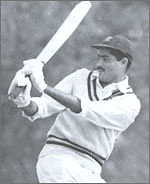
Nari Contractor image sportskeeda.com

But after the Phillip Hughes accident, what comes to my mind is not my little accident but the Charlie Griffith bouncer which caught Nari Contractor on the back of his skull in March 1962. Like Hughes, Contractor was a left-hand bat. This was 52 years ago when as a schoolboy avidly following the tour of the West Indies, I was up at all hours listening to the live radio commentary whenever I could. Helmets were not in use in 1962. India were playing Barbados between the second and third Test matches. Contractor was leading the side after a series win against England and he opened the innings with Dilip Sardesai. Contractor seems to have turned his head due to some distraction from the pavilion. But he was, like Hughes, facing sideways with the back of his head exposed at the time of impact. He suffered a fractured skull and was unconscious for 6 days.  A neuro-surgeon had to be flown in from Trinidad and he went some 24 hours – unconscious – before proper medical treatment began. He needed a blood transfusion and Sir Frank Worrell – the West Indies captain but who was only a spectator at this match – was the first to donate blood. Later Contractor had to have a metal plate inserted for the fracture. He survived and went on to play first class cricket but never again played a Test match.

Contractor is now 80 and spoke about the Hughes accident to the Mumbai Mirror:

“I am not sure if any technology or better technology can prevent such injuries. My injury took place in 1962 and it has taken 52 years for another such injury. You cannot ensure anything in cricket.”

I do agree that safety and safety standards should be reviewed. But without trying in any way to minimise the tragedy of Phillip Hughes demise, it is nether opportune or appropriate, I think, for any knee-jerk reactions.

My point is that all rules for safety or safety equipment are inextricably linked to the skills of the game. Every new rule or new piece of equipment suppresses some skills and encourages others. There is nothing wrong with that of course but it does change the game. There is little doubt that the advent of helmets and chest pads has suppressed the skill of weaving and dodging to avoid being hit by the ball while not taking your eyes off it. On the other hand the use of helmets and other protection has allowed the hook shot – among other shots –  to be played much more confidently and – for the best players –  has led to the development of new skills of shot making. Shot making has never been as inventive as today (to the chagrin of many bowlers) and this is partly due to the lower level of physical risk perceived by the batsmen. For the less skilled players, it could be argued, it has led to a greater proportion of injudicious shot selections because the downside is low. More players try to hook today and fail – but it is safer to do so. The balance between “avoidance” and “playing the shot” is different to that when there were no helmets. The skill of “avoidance” is needed less and is therefore less well developed.

Phillip Hughes was certainly one of the better players of the game. But the game today is not the same game as it was in 1962 when Nari Contractor suffered his injury. But would a player of the 1962 game, brought up without the use of helmets, make the same shot selection that Phillip Hughes did? It is impossible to know but the 1962 batsman would surely have had a different background of risk assessment and a different basis for selecting when to play the hook shot and when to avoid the ball.

Changing the risk level in any game changes the game. But – lest we forget – without risk there is no game.

Break-even price for shale oil could be as low as $40 per barrel

November 28, 2014

UPDATE: Reuters – Saudi Arabia’s oil Minister Ali al-Naimi declares war on US Shale OIL


Yesterday Saudi Arabia got its way at the OPEC meeting and successfully resisted all calls for a cut in production to try and stop the decline of world oil prices.  It seems Saudi Arabia (which has the lowest oil production cost in the world) has chosen the strategy of maintaining an oil price low enough to put a cap on US shale oil production and provide a disincentive for new shale oil wells.

This strategy is premised on the break-even price for shale oil being at or above $80 per barrel for small production sites down to about $30 per barrel for large production sites. For example Credit Suisse estimated these levels as varying between $24 and $85 earlier this year.

shale oil break even estimates credit suisse

shale oil break even estimates credit suisse sep 2014


The US department of Energy puts sustainable break even values between $35 and $54. The Saudi calculations seem to be based on similar estimates. They appear to believe that with current oil prices moving down to about $70 per barrel, some of the smaller US oil shale wells are already uneconomic and that at this price new investment for further production sites will dry up.

But shale oil production costs are declining – fast. Costs are coming down following the learning curve for both capital costs and running costs. The analyst estimates are already out of date. My estimate is that actual break-even points are already down about 20% from those in the Credit Suisse estimate.

So I believe the Saudis have miscalculated. The average break-even world price for shale oil is probably – already – closer to $40 per barrel rather than $60-70 per barrel being assumed. While new investment in shale oil wells may well be toned down by world oil consumption, it will probably not be because world oil price is below some critical threshold. If the Saudis believe that any uptick in consumption will bring the oil price back up to over $80 per barrel, they are following a flawed strategy. We could be in for a decade of relatively low oil prices perhaps with a floor at around $40 per barrel and set by the average break-even for shale oil.

Consumers are still very wary. They are not sure that the reduction in oil price will be sustained and is not just a temporary dip which might lure them into a higher and more vulnerable consumption level. It will take a few months for them to see that OPEC has actually lost control over the world oil price but is still in denial about that. A sustained low oil price is what will trigger a new – and sustained – wave of global growth that is now so badly needed. The cartel is shrinking. New shale oil producers will all be outside the cartel – and the sooner Europe, China and India start production the better. But it is the beginning of the end of the OPEC cartel power.

History will – I think – show that the OPEC cartel lasted for 50 years. It will show that the cartel started in 1973 and that market forces of supply and demand were re-established around 2020.

Minus 52ºC and passengers have to push their plane: Just another day in the Russian Arctic

November 27, 2014

Minus 52ºC and passengers have to push their plane: Just another day in the Russian Arctic

Men pushing aircraft

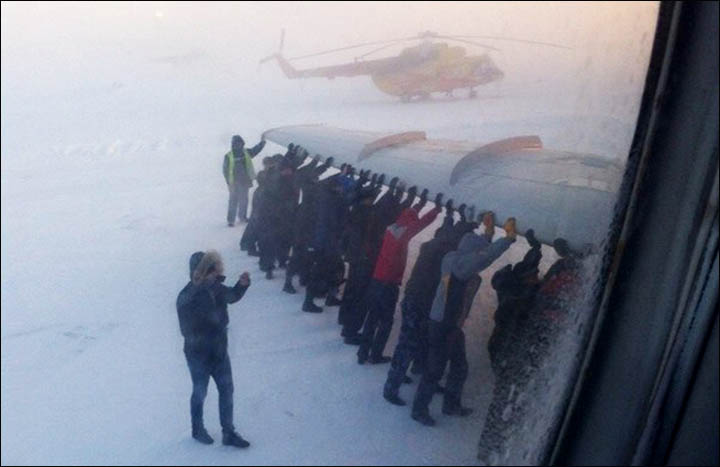
Fearing the UTair service to regional capital Krasnoyarsk could be delayed, many of the 70 passengers used brute strength to free the 30-ton Tupolev 134. Picture: Ivan Ivanov

The Siberian Times:

When their plane literally froze on the ground at Igarka airport, above the Arctic Circle, there was no need to panic. Fearing the UTair service to regional capital Krasnoyarsk could be delayed, many of the 70 passengers used brute strength to free the 30-ton Tupolev 134. ….. 

Vladimir Artemenko, technical director of Katekavia, which ran the flight jointly with UTair, said that the plane was technically serviceable, but the chilly temperatures led it to freeze up.

The airport’s tractor could not move the Tu-134 because its brake pads were frozen. ‘When people pushed the plane, the wheel cranked out, and then the aircraft could continue to move,’ he explained.

The plane later took off and landed safely in Krasnoyarsk. Most of the passengers were oil and gas workers on their way home after a stint in the Arctic production flields. Reports of the incident led to worldwide praise for the stoic Siberians for their ‘can-do chutzpah’, in the words of Agence France Presse. ‘Siberians are so tough that for them pushing a frozen plane along a runway is a piece of cake,’ added Russian daily newspaper Komsomolskaya Pravda.

But the authorities were not amused.

igarska to Krasnoyarsk

igarka to Krasnoyarsk

The amusement did not extend to some officials, however. West Siberian transport prosecutor’s aide Oksana Gorbunova rebuked the plane movers. ‘Passengers were asked to leave the plane and go to the bus standing nearby,’ she said. ‘After that, some of them voluntarily left the bus and went to the plane, trying to assist in moving it using physical force.

‘Naturally, the plane was moved by the truck, because people physically could not do it. It looks like a joke. It would be funny if it could not have dire consequences: people could damage the casing and flaps of the aircraft.’

Airport chief Maxim Aksyonov claimed: ‘Most likely, the plane’s passengers, oil workers, decided to do a kind of ‘selfie’. It was a good joke and it became a big thing on the Internet.’

However, one of the ‘hero’ passengers told Life News insisted the passengers did push the plane. ‘We were on the bus that took us on the plane when we were asked to help the tractor,’ he said. ‘Before that, we had already spent one day at the airport, waiting for our departure.

‘We pushed it a short distance – about five metres, maybe more. I worked for four years on shifts, but do not recall that we pushed the plane previously.’

Video below:


Status of German women directors degraded to be “quota directors”

November 27, 2014

German companies have a reputation for excellence. But this is being sacrificed for the sake of political correctness. Currently every woman company director in Germany can be assumed to be of exceptional competence. When a new quota law goes into force in 2016, every woman director in Germany will be nothing more than a “quota employee”.

Discrimination to fight discrimination is an invitation to failure. I do not find any case of “affirmative action” – which is a euphemism for introducing a new, institutionalised and unjust discrimination ostensibly to correct the effects of some other unjust discrimination – which has actually achieved its objective. No program of enforced quotas has yet succeeded in achieving a condition where the “affirmative action” becomes unnecessary because the original injustice has been eliminated. Quotas or confiscation and rationing, enforced by the state and based on irrelevant criteria, remain a favourite tool of those with socialistic aspirations. But not only don’t they work, they also perpetuate the “injustice” that they are intended to correct.

Fifty years of quotas for the “scheduled castes” in India have only become entrenched and have been counter-productive. Rather than ensuring that the lot of the “disadvantaged” groups have improved such that they can compete fairly for jobs or education places, the “affirmative action” has instead ensured that competence and ability have been removed as requirements for selection. Even worse, the “system” is self-perpetuating and encourages the reduction of standards. Those who were to be helped now only need to be the “best of a bad lot” to be selected. Instead of raising standards, “affirmative action” allows and enables lower standards to become “acceptable”. To be classified as a “scheduled caste” has now become a path to privilege.

The experience  in the US with reservation of places in education and in the work-place for minorities has been no different. Even after over 25 years of “affirmative action” the SAT scores of African-Americans admitted to the top US universities remains significantly lower than the average of all those admitted. But this is only to be expected. Effectively the SAT scores to be targeted by aspirants for admission have been reduced for those qualifying for the privilege. Aiming high has no longer any value. Reserving jobs for women or Latinos or other “disadvantaged” minorities has only succeeded in lowering standards but – what is worst – also in making these lower standards acceptable. The quotas for the employing of ethnic Malays in Malaysia has removed any incentive for such “quota employees” to excel at anything other than being Malay. Quota students or quota employees are not burdened by requirements of superior performance or competence – let alone any expectations of excellence.

It should be obvious by now that I believe that quotas based on having an irrelevant characteristic are counter-productive and contribute to equalising standards only by lowering them. Even when quotas try to bring in minimum qualification requirements, it is inevitable that the criterion becomes being “just good enough” and not “to be best”. The use of quotas automatically and inevitably downgrades the quest for excellence. It is settling for the mediocre.

So I am not very impressed by the new German law which will now force the largest companies to have women constituting 30% of their supervisory boards from 2016.. Again the justification is that it will be a trigger for social change and anyway that there are enough women who are qualified. That misses the point. Women directors for these companies have now been effectively degraded to become quota directors – even where they are there for their competence. They can no longer claim to be the “best available” even if they are. Angela Merkel has had to give in to the socialists on this point. Forty percent of the German cabinet is women. Angela Merkel herself is there because she was the “best” for the job. But note that many of her female cabinet colleagues are there not because of their competence or excellence but only to fill an unwritten quota. Other countries are also considering quotas for women directors – not least in “politically correct” Sweden. For example, I observe when I watch Swedish TV – which is very politically correct – that it is easy to discern when a female presenter or a news reporter has been selected to fill some gender quota rather than for her excellence.

But why stop at women quotas? Why not quotas also for other minorities and abandon excellence or competence? Why should women be more privileged than some other disadvantaged minority? Is the disadvantage suffered by women more important to correct than the disadvantage suffered by a gay person? or an immigrant? Perhaps there will come a day when a German Supervisory Board will have to be at least 30% female, 10% gay, 5% transgender and 15% of immigrant origin! That will be the time when I shall sell any German stocks that I might have.

As an investor in any company I would prefer that the Directors be the best available and affordable and not “just good enough” to fill a compulsory quota.