Is Backdoor Regin the US/Israeli successor to the Stuxnet virus?

November 24, 2014

A sophisticated, spying virus, most probably developed by one or more nation states, has been discovered by Symantec. It has been in use since at least 2008 and targets have been in at least 10 countries (mainly in Russia and Saudi Arabia). The virus called Backdoor Regin is a modular tool and is designed to be loaded in multiple stages which is an architecture similar to that used by the Duqu/Stuxnet family of threats. Symantec has released a white paper on Backdoor Regin. Some analysts see industrial targets as the logical next stage after the targeting of state organisations such as by Stuxnet. Backdoor Regin seems to be targeted at businesses and telecom ssytems. Symantec warns that “many components of Regin remain undiscovered and additional functionality and versions may exist.”

fig2-sectors.png

Confirmed Regin infections by sector – Symantec


An advanced spying tool, Regin displays a degree of technical competence rarely seen and has been used in spying operations against governments, infrastructure operators, businesses, researchers, and private individuals. 

An advanced piece of malware, known as Regin, has been used in systematic spying campaigns against a range of international targets since at least 2008. A back door-type Trojan, Regin is a complex piece of malware whose structure displays a degree of technical competence rarely seen. Customizable with an extensive range of capabilities depending on the target, it provides its controllers with a powerful framework for mass surveillance and has been used in spying operations against government organizations, infrastructure operators, businesses, researchers, and private individuals.

It is likely that its development took months, if not years, to complete and its authors have gone to great lengths to cover its tracks. Its capabilities and the level of resources behind Regin indicate that it is one of the main cyberespionage tools used by a nation state.

The Stuxnet family was developed by the US and Israel and targeted the centrifuges at the Iranian nuclear fuel enrichment facility. Here too the second stage was deployed only after years of undetected operation with Stage 1.

Stuxnet, a joint U.S.-Israel project, is known for reportedly destroying roughly a fifth of Iran’s nuclear centrifuges by causing them to spin out of control. …

(The worm was reportedly tested at Israel’s Dimona nuclear facility.) 

Only after years of undetected infiltration did the U.S. and Israel unleash the second variation to attack the centrifuges themselves and self-replicate to all sorts of computers. And the first version of Stuxnet was only detected with the knowledge of the second. ….. 

The target countries reported by Symantec suggest to me that like Stuxnet, the Backdoor Regin spying tool is a US / Israeli development.

Regin uses a modular approach, giving flexibility to the threat operators as they can load custom features tailored to individual targets when required. Some custom payloads are very advanced and exhibit a high degree of expertise in specialist sectors, further evidence of the level of resources available to Regin’s authors.

There are dozens of Regin payloads. The threat’s standard capabilities include several Remote Access Trojan (RAT) features, such as capturing screenshots, taking control of the mouse’s point-and-click functions, stealing passwords, monitoring network traffic, and recovering deleted files. 

More specific and advanced payload modules were also discovered, such as a Microsoft IIS web server traffic monitor and a traffic sniffer of the administration of mobile telephone base station controllers.

fig3-countries.png

Confirmed Regin Infections by Country — Symantec

Regin is a highly-complex threat which has been used in systematic data collection or intelligence gathering campaigns. The development and operation of this malware would have required a significant investment of time and resources, indicating that a nation state is responsible. Its design makes it highly suited for persistent, long term surveillance operations against targets.

The discovery of Regin highlights how significant investments continue to be made into the development of tools for use in intelligence gathering. Symantec believes that many components of Regin remain undiscovered and additional functionality and versions may exist.  Additional analysis continues and Symantec will post any updates on future discoveries


The Little Ice Age was real and it was global

November 22, 2014

Global warmists like to pretend sometimes that the Little Ice Age and the Medieval Warm Period were not real or that they were just some local phenomena. The usually point to the lack of data from the southern hemisphere to support their claims. They certainly don’t like to admit that global cooling or warming events could have been caused by solar effects which were perhaps connected to the level of solar activity (as indicated by sunspots). New work at the University of Gloucestershire shows that not only was the Little Ice Age real but that it was present in both hemispheres. And that it was probably due to solar effects

AlphaGalileo reports:

UK researchers show Little Ice Age was global, wit.h implications for current Global Warming

Under embargo until 20 November 2014 00:01 GMT

A team of UK researchers has shed new light on the climate of the Little Ice Age, and rekindled debate over the role of the sun in climate change. The new study, which involved detailed scientific examination of a peat bog in southern South America, indicates that the most extreme climate episodes of the Little Ice Age were felt not just in Europe and North America, which is well known, but apparently globally. The research has implications for current concerns over ‘Global Warming’.

Climate sceptics and believers of Global Warming have long argued about whether the Little Ice Age (from c. early 15th to 19th Centuries) was global, its causes, and how much influence the sun has had on global climate, both during the Little Ice Age and in recent decades. This new study helps clarify those debates.

The team of researchers, from the Universities of Gloucestershire, Aberdeen and Plymouth, conducted studies on past climate through detailed laboratory examination of peat from a bog near Ushuaia, Tierra del Fuego. They used exactly the same laboratory methods as have been developed for peat bogs in Europe. Two principal techniques were used to reconstruct past climates over the past 3000 years: at close intervals throughout a vertical column of peat, the researchers investigated the degree of peat decomposition, which is directly related to climate, and also examined the peat matrix to reveal the changing amounts of different plants that previously grew on the bog.

The data show that the most extreme cold phases of the Little Ice Age—in the mid-15th and then again in the early 18th centuries—were synchronous in Europe and South America. There is one stark difference: while in continental north-west Europe, bogs became wetter, in Tierra del Fuego, the bog became drier—in both cases probably a result of a dramatic equator-ward shift of moisture-bearing winds.

These extreme times coincide with periods when it is known that the sun was unusually quiet. In the late 17th to mid-18th centuries it had very few sunspots—fewer even than during the run of recent cold winters in Europe, which other UK scientists have linked to a relatively quiet sun.

Professor Frank Chambers, Head of the University of Gloucestershire’s Centre for Environmental Change and Quaternary Research, who led the writing of the Fast-Track Research Report, said:

“Both sceptics and adherents of Global Warming might draw succour from this work. Our study is significant because, while there are various different estimates for the start and end of the Little Ice Age in different regions of the world, our data show that the most extreme phases occurred at the same time in both the Northern and Southern Hemispheres. These extreme episodes were abrupt global events. They were probably related to sudden, equator-ward shifts of the Westerlies in the Southern Hemisphere, and the Atlantic depression tracks in the Northern Hemisphere. The same shifts seem to have happened abruptly before, such as c. 2800 years ago, when the same synchronous but opposite response is shown in bogs in Northwest Europe compared with southern South America.

“It seems that the sun’s quiescence was responsible for the most extreme phases of the Little Ice Age, implying that solar variability sometimes plays a significant role in climate change. A change in solar activity may also, for example, have contributed to the post Little Ice Age rise in global temperatures in the first half of the 20th Century. However, solar variability alone cannot explain the post-1970 global temperature trends, especially the global temperature rise in the last three decades of the 20th Century, which has been attributed by the Inter-Governmental Panel on Climate Change (IPCC) to increased concentrations of greenhouse gases in the atmosphere.”

Professor Chambers concluded: “I must stress that our research findings are only interpretable for the period from 3000 years ago to the end of the Little Ice Age. That is the period upon which our research is focused. However, in light of our substantiation of the effects of ‘grand solar minima’ upon past global climates, it could be speculated that the current pausing of ‘Global Warming’, which is frequently referenced by those sceptical of climate projections by the IPCC, might relate at least in part to a countervailing effect of reduced solar activity, as shown in the recent sunspot cycle.”

A phrase for Cosby? – “a darker shade of black”

November 22, 2014

The richness of a language lies not only in the number of words it commands but also in the manner in which they can be modified or combined to convey some nuance of meaning and which nuance is then understood as intended.  The modification of or combining of words can be by following existing rules or current conventions of usage and even by the breaking of current conventions. A new modification or word combination only becomes part of the language if

  1. the intended meaning is successfully conveyed, and
  2. the usage of the new word(s)/usage spreads.

Thus while reading about the collapse of the House of Cosby as story follows story about his predatory behaviour with younger girls, the words of one of my favourite songs from the 60s came to mind – Procol Harum’s “A whiter shade of pale”  which was a thinly disguised song about a drunken seduction.

And so it was that later,
As the miller told his tale,
That her face, at first just ghostly,
Turned a whiter shade of pale.

What the word combination “a whiter shade of pale” conveys depends on how it is interpreted in the recipient’s mind. Part of the impact of this song at that time lay in the strange and psychedelic pictures that that particular phrase conjured up. And it triggered for me the thought that Bill Cosby’s past behaviour was proving to be “a darker shade of black”.

And so it was that later,
As the facade began to crack,
that the soul of William Cosby,
showed as a darker shade of black.

Both these phrases use the powerful linguistic trick of invoking something impossible – a state beyond some absolute limit.  The listener/reader gets the point. (Strictly it ought to be “a paler shade of white” since paler than white should be impossible while whiter than pale is not). Other variants of the same linguistic form could be:

  • a blacker shade of dark
  • better than the best
  • worse than the worst
  • greater than the infinite
  • harder than diamond
  • softer than a feather
  • faster than lightning
  • stronger than steel
  • over the top
  • under the bottom
  • hotter than hell
  • colder than space
  • before the beginning
  • after the end
  • rounder than a sphere …….

Equally powerful is the use of antonyms, with one as an adjective for another but which serves to emphasise rather than negate some characteristic.

  • Infinitely small
  • Expanding infinity
  • The living dead
  • An evil goodness
  • A brilliant darkness
  • Surreptitious refulgence
  • A tumultuous lethargy
  • Brawny erudition
  • A restive calm
  • Relaxed turbulence
  • Solicitous indifference
  • An awakening ignorance
  • A concentrated diffusion
  • A historical future
  • A caring predator
  • Robust fragility
  • Enlightened disillusion …..

In the case of Bill Cosby, he is now being engulfed by his past and is surrounded by an expanding halo of an aggressive, licentious and debauched history.

Species that developed while India moved from Gondwana to Asia

November 21, 2014

About 200 million years ago the land mass that is now the India plate was part of Gondwanaland. When this plate broke off from Gondwana around 135 million years ago it included what is now Madagascar but then left Madagascar behind as it began – by tectonic standards – a headlong rush north-eastwards around 90 million years ago. Till the collision of this plate with Asia around 10 million years ago brought about the formation of the Himalayas. For around 80 million years then the Indian land mass was an isolated island “rushing” north-east at between 16-20 cm/year!

From Gondwanaland to modern times image berkeley.edu

Indian plate tectonics (after Wikipedia)

(after wikipedia)


This period was also extraordinarily rich in the evolutionary history of the mammals. It was the time when snakes and ants first appeared. There was a mass extinction event about 66 million years ago. The dinosaurs disappeared and became birds. Birds proliferated and so did large flightless birds. The diversity of mammals exploded, perhaps just because of the space left by the disappearance of the large, unsuccessful dinosaurs. The first pigs and deer developed. The grasses arrived. Carnivorous mammals appeared as their prey increased. The first primates made an entrance. But whatever was evolving on the Indian land-mass was evolving largely in isolation from that taking place in the areas that were to become Africa and Eurasia. But there are tantalising indications that on its journey the Indian land-mass may have been connected for short periods by a land bridge to the Horn of Africa or to what is now Arabia.

A new paper reports on fossils from the edges of an open cast coal mine north east of Mumbai in Western India.

Kenneth D. Rose, Luke T. Holbrook, Rajendra S. Rana, Kishor Kumar, Katrina E. Jones, Heather E. Ahrens, Pieter Missiaen, Ashok Sahni, Thierry Smith. Early Eocene fossils suggest that the mammalian order Perissodactyla originated in India. Nature Communications, 2014; 5: 5570 DOI: 10.1038/ncomms6570

The results suggest that an ancient relative of horses and rhinos lived 54.5 million years ago in what is now India. The findings shed light on the evolution of this group of animals. Several groups of mammals that appear at the beginning of the Eocene, including primates and odd- and even-toed ungulates, might have evolved in India while it was isolated.

John Hopkins Press ReleaseWorking at the edge of a coal mine in India, a team of Johns Hopkins researchers and colleagues have filled in a major gap in science’s understanding of the evolution of a group of animals that includes horses and rhinos. That group likely originated on the subcontinent when it was still an island headed swiftly for collision with Asia, the researchers report Nov. 20 in the online journal Nature Communications.

Modern horses, rhinos and tapirs belong to a biological group, or order, called Perissodactyla. Also known as “odd-toed ungulates,” animals in the order have, as their name implies, an uneven number of toes on their hind feet and a distinctive digestive system. Though paleontologists had found remains of Perissodactyla from as far back as the beginnings of the Eocene epoch, about 56 million years ago, their earlier evolution remained a mystery, says Ken Rose, Ph.D., a professor of functional anatomy and evolution at the Johns Hopkins University School of Medicine.

An artist’s depiction of Cambaytherium thewissi via Science Daily Credit: Elaine Kasmer

The mine yielded what Rose says was a treasure trove of teeth and bones for the researchers to comb through back in their home laboratories. Of these, more than 200 fossils turned out to belong to an animal dubbed Cambaytherium thewissi, about which little had been known. The researchers dated the fossils to about 54.5 million years old, making them slightly younger than the oldest known Perissodactyla remains, but, Rose says, it provides a window into what a common ancestor of all Perissodactyla would have looked like. “Many of Cambaytherium’s features, like the teeth, the number of sacral vertebrae, and the bones of the hands and feet, are intermediate between Perissodactyla and more primitive animals,” Rose says. “This is the closest thing we’ve found to a common ancestor of the Perissodactyla order.”

Cambaytherium and other finds from the Gujarat coal mine also provide tantalizing clues about India’s separation from Madagascar, lonely migration, and eventual collision with the continent of Asia as the Earth’s plates shifted, Rose says. In 1990, two researchers, David Krause and Mary Maas of Stony Brook University, published a paper suggesting that several groups of mammals that appear at the beginning of the Eocene, including primates and odd- and even-toed ungulates, might have evolved in India while it was isolated. Cambaytherium is the first concrete evidence to support that idea, Rose says. But, he adds, “It’s not a simple story.”

“Around Cambaytherium’s time, we think India was an island, but it also had primates and a rodent similar to those living in Europe at the time,” he says. “One possible explanation is that India passed close by the Arabian Peninsula or the Horn of Africa, and there was a land bridge that allowed the animals to migrate. But Cambaytherium is unique and suggests that India was indeed isolated for a while.”


Donkey dreadlocks

November 19, 2014

And something to get away from the infinite cruelty, ugliness and stupidity that is ISIS and the Wahhabi tradition.

Poitou donkey image Ark in Space

The Poitou donkey from South West France.

In the last 30 years their numbers have increased from about 30 to over 500.


“When you meet the unbelievers, strike off their heads” – Quran 47:4

November 19, 2014

It is a good thing there is no such thing as a Paradise where these IS vermin might come to gather. And if there was, it would be a veritable Hell.

No doubt they will quote scripture in their defense.

Quran 47:4 sūrat muḥammad

If you encounter the disbelievers in a battle, strike-off their heads. Take them as captives when they are defeated. Then you may set them free as a favor to them, with or without a ransom, when the battle is over. This is the Law. Had God wanted, He could have granted them (unbelievers) victory, but He wants to test you through each other. The deeds of those who are killed for the cause of God will never be without virtuous results.

translation Muhammad Sarwar

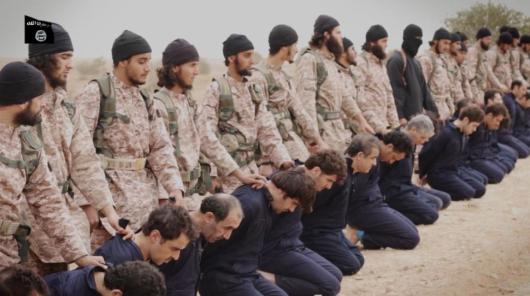
But a mass beheading of unarmed defeated men?

And what would be a fitting treatment for these vermin when they are captured?

May their genes shrivel and wither away. It is a travesty that human evolution has not yet eliminated these defectives.

Climate can only be observed as weather

November 19, 2014

One weather event is not climate but climate can only be observed – ultimately – as weather. Climate is an integration of local weather over space and time. Supposed climate change which does not show up as changes to local weather to give conditions which lie outside the range of normal variability of that local weather, is no change.

Anthropogenic global warming when it is a conclusion which can only be based on “adjusting” raw data or is only that predicted by a model, but which cannot be actually observed, is of little relevance and of no importance. It is certainly a rather stupid basis for policy.

There has been no global warming of any kind (anthropogenic or otherwise) – even with adjusted data – for over 18 years. The anthropogenic component – supposed to be due to on man-made emissions of carbon dioxide – is not discernible, even though carbon dioxide emissions from fossil fuel combustion have increased by some 70% in that time.

The politically correct “policy” of reducing fossil fuel combustion would seem to be of no significance and of little relevance. This particular weather event in North America only adds to the body of evidence that is not consistent with global warming.

Reuters: All 50 U.S. states feeling freezing temperatures

Temperatures in all 50 U.S. states dipped to freezing or below on Tuesday as an unseasonably cold blast of weather moved across the country, while heavy snow prompted a state of emergency in western New York.

In the U.S. South, states were bracing for a record chill from the Arctic-born cold that swept the Rocky Mountains last week.

Every U.S. state, including Hawaii, was bitten by temperatures at the freezing point of 32 degrees F (0 C) or below, the National Weather Service (NWS) said.

Measuring the success of the War on Terror

November 18, 2014

How should we judge the success of the War on Terror?

Going by the numbers, terrorism has a high success rate and is increasingly being used as a political tool. George Bush may have unwittingly done more than anybody else – by declaring a War on Terror – to legitimise the use of terror as a tool of effecting political change. He only elevated and enshrined “Terror” as an object worthy of State warfare. My working theory is that giving Terror this elevated status only increases its attractiveness as a legitimate tool for any group which perceives itself to be oppressed or wishes to foment rebellion.

The 2014 Global Terrorism Index has just been released with data upto 2013.

KEY FACTS:

  • 17,958 people were killed in terrorist attacks last year, that’s 61% more than the previous year.
  • 82% of all deaths from terrorist attack occur in just 5 countries: Iraq, Afghanistan, Pakistan, Nigeria and Syria.
  • Last year terrorism was dominated by four groups: the Taliban, Boko Haram, ISIL, and al Qa’ida.
  • More than 90% of all terrorist attacks occur in countries that have gross human rights violations.
  • 40 times more people are killed by homicides than terrorist attacks.

Why not declare a War on Murder since murder kills 40 times more people than terror?

In 2000 deaths from terrorism were 3,361.

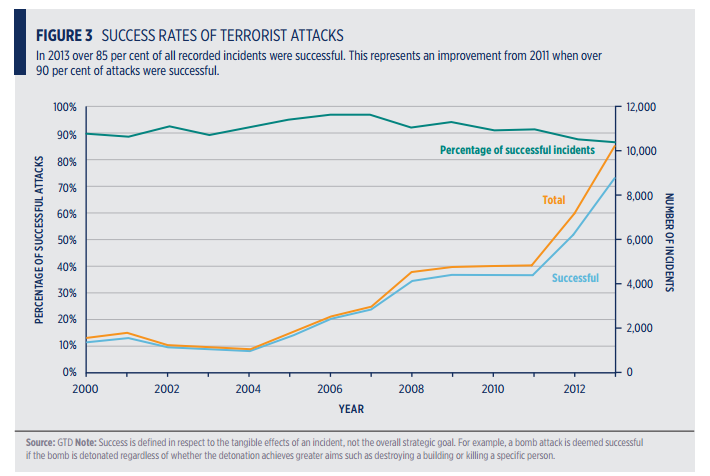
The report is here and I have extracted just two telling diagrams. The number of terror deaths have increased dramatically and the “success rate” of terrorist actions remains high at about 90%.

Terrorism Deaths

Terrorism Deaths

Terror success rates

Terror success rates


Don’t rely on politicians to avoid another financial crash; build your own defences

November 17, 2014

I am no expert but I tend to pay attention to the behaviour of experts and those who are supposed to be experts. And I  get worried when politicians start painting alarmist pictures because that indicates that they have no idea what to do.

The number of voices warning about another financial crash are increasing and getting louder. That there are always some financial pundits warning about a coming crash is nothing out of the ordinary. But the number of pundits making such projections (here and here for example) is getting worrying. The US debt is still much too large and is not really being addressed except by printing money. Japan has entered recession. Leftist governments in Europe are getting tired of austerity and good housekeeping (France, Sweden for example) and are preparing to increase public expenditure and to raise taxes. Markets seem overvalued and unless Asian countries – mainly India and China – start consuming and manufacturing again, it is difficult to see a real motor to drive the global economy. Low oil prices will help but the signs of an upswing are not visible yet. No bank is so big that it cannot fail.

It is worth noting that some big investors are also circling the wagons and building up their defenses – and not least among them is Warren Buffet. But what is even more ominous is that the political leaders of the G20 nations are beginning to make noises as if a financial crash is a real risk and outside of their control. David Cameron’s warnings yesterday about a possible financial crash were made immediately following the G20 meeting in Australia. They sound like political positioning when faced with an intractable problem. As if the G20 leaders find themselves powerless and unable to come up with any joint actions to avoid a future financial crash.

The Guardian:

David Cameron has issued a stark message that “red warning lights are flashing on the dashboard of the global economy” in the same way as when the financial crash brought the world to its knees six years ago.

Writing in the Guardian at the close of the G20 summit in Brisbane, Cameron says there is now “a dangerous backdrop of instability and uncertainty” that presents a real risk to the UK recovery, adding that the eurozone slowdown is already having an impact on British exports and manufacturing.

His warning comes days after the Bank of England governor, Mark Carney, claimed a spectre of stagnation was haunting Europe. The International Monetary Fund managing director, Christine Lagarde, expressed fears in Brisbane that a diet of high debt, low growth and unemployment may yet become “the new normal in Europe”.

The message is that the G20 countries are just living in hope and have no concrete plans to avoid a crash. I would have thought that the bottom line is – and always will be – of living within one’s means. And that can only ultimately mean reducing public spending and reducing tax burdens. In any event it is imprudent to be relying on the politicians to avoid a crash. And that means that each individual is on his own and would be well advised to build up whatever defenses he can.

Whether a crash comes or not, and the main threat is, I think, over the next 12- 18 months, it is worth being a little circumspect over the next few months. My list of gradual actions for myself for the next 9-12 months are:

  1. Pay off as much debt as possible
  2. Call in my loans
  3. Protect capital by reducing overall risk exposure
  4. Get out of equities which may be in a bubble (say P/E >30 or where values have risen >50% in 1 year)
  5. Hold onto my blue chips (but check how blue they really are)
  6. Increase my own liquidity towards 25% of assets and in more than one “hard” currency
  7. Have more than one bank
  8. Shift away from the banks which perform poorly in stress tests
  9. Shift away from corporate bonds to government bonds (higher credit rating countries wherever possible)
  10. Buy some gold or silver (gold or silver coins not jewelry)
  11. Defer capital expenditure for the next 12 months wherever possible (car replacement, new kitchen, house extension…)


Things we have developed beyond – but which I still miss

November 17, 2014

They were not the “good old days” to pine for. Change and development have done more good for more people than I would have thought possible. But there are still some things which have been lost and which I miss. Collateral damage.

My top twenty (but not in any particular order):

  1. The all-purpose milk-man at the door (cheese, bread, onions, potatoes…), every day of the year except one
  2. “My” shoemaker in Chinatown who could cope with my left foot being slightly longer than my right
  3. The policeman on our beat who knew our names (and we knew his)
  4. Dingy, dark, smoke-filled, hole-in-the wall bars
  5. Taxi drivers who knew the way (without a map or a GPS)
  6. Teachers whose job satisfaction lay in that students had learnt
  7. Professors who preferred the elegant solution
  8. Hospitals run by doctors
  9. Heroes who were neither sexual predators nor paedophiles
  10. Banks with real tellers
  11. Banks with money
  12. Shops which provided bags to carry away their merchandise
  13. Airports without security checks
  14. Airlines where service was part of the service
  15. Aircraft where passenger comfort was a fundamental human right
  16. Science where theory was subordinate to data
  17. Scientists who questioned
  18. The environment which included humans
  19. Roads which were not parking lots
  20. Managers who managed