Dutch prosecutor does not rule out possibility of Ukrainian fighter having shot down MH17

October 27, 2014

A few weeks ago I speculated that the finding of a deployed oxygen mask on one of the victims gave some credence to the theory (favoured by Russia) that it was a Ukrainian fighter which may have shot down the ill-fated MH17 aircraft.

The point apparently is that if the aircraft had been brought down by a Russian ground-to-air BUK missile – fired by the rebels – then the aircraft would have failed catastrophically and there would have been no time for the oxygen masks to deploy. All on board would have died almost instantaneously.

If instead MH17 had been brought down by a Ukrainian fighter jet – as the Russians suggest – then the air-to-air missile would not have been as immediately catastrophic as the much more powerful BUK missile. Then there may well have been time for some of the oxygen masks to deploy – even if the aircraft was later “finished off” by cannon fire. ….. 

But the bottom line is that if there was time for the oxygen masks to deploy then it is more likely that a Ukrainian jet was responsible rather than a BUK missile.

Now in an interview with Der Spiegel, the Dutch prosecutor does not rule out the possibility that MH17 may have been shot down from the air.

Der Spiegel: In an interview, the Dutch official leading the investigation of the crash of Malaysia Airlines Flight MH17 over eastern Ukraine addresses reports that German intelligence is convinced the plane got shot down by pro-Russian separatists.

Fred Westerbeke, 52, is the chief investigator with the Dutch National Prosecutors’ Office, which is currently looking into the circumstances behind the crash of Malaysia Airlines Flight MH17 over eastern Ukraine while en route from Amsterdam to Kuala Lumpur on July 17.

SPIEGEL: High-resolution images — those from US spy satellites, for example — could play a decisive role in the investigation. Have the Americans provided you with those images?

Westerbeke: We are not certain whether we already have everything or if there are more — information that is possibly even more specific. In any case, what we do have is insufficient for drawing any conclusions. We remain in contact with the United States in order to receive satellite photos.

SPIEGEL: So you’re saying there hasn’t been any watertight evidence so far?

 Westerbeke: No. If you read the newspapers, though, they suggest it has always been obvious what happened to the airplane and who is responsible. But if we in fact do want to try the perpetrators in court, then we will need evidence and more than a recorded phone call from the Internet or photos from the crash site. That’s why we are considering several scenarios and not just one.

SPIEGEL: Moscow has been spreading its own version for some time now, namely that the passenger jet was shot down by a Ukrainian fighter jet. Do you believe such a scenario is possible?

Westerbeke: Going by the intelligence available, it is my opinion that a shooting down by a surface to air missile remains the most likely scenario. But we are not closing our eyes to the possibility that things might have happened differently.

Two years of $70 oil could be the boost the global economy needs desperately

October 27, 2014

There are two questions here of course:

  1. How will oil price develop over the next 2 years? And the only certain thing is that forecasts will be wrong, and
  2. Can the net difference between the positive effect on oil consuming countries and the negative effects on oil producing countries be sufficient to lift the global ecoonmy out of its doldrums?

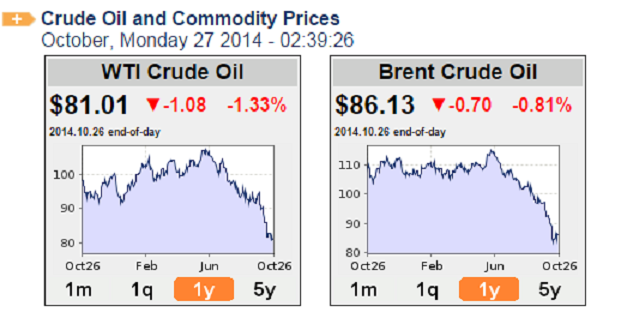
Oil prices have dropped 25% since June and currently WTI crude is at $81 and Brent crude is at $86 – down from around $110 – 115 in June. How far can prices drop and for how long? Of course this depends on supply and demand. But I think there is a new paradigm here and created by the injection of shale oil into the mix. I suspect that shale oil production now establishes a new floor price which means that the prices cannot drop lower than about $60 or possibly even $70. Oil from the traditional, large oil wells can still be produced profitably at much lower prices. But shale oil is more expensive to produce partly due to the costs of fracking but also due to smaller individual wells which last for shorter periods than the large oil wells. This in turn means that there is both a higher investment cost and a higher operating cost for shale oil compared to “traditional” oil. It is thought that as shale oil increases its contribution to the total mix, this production cost will set a floor for all oil at around $60-70 instead of the $30-40 needed for break-even (zero exploration) with traditional oil. The oil companies will maintain profits and dividends by scaling down jobs and their new exploration costs which is the variable they can play with . It is the oil producing countries who will lose tax revenues (offset by increased production – if any).
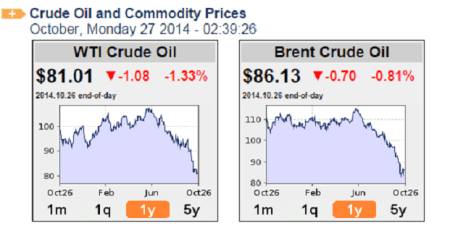
oil price 2710214 oil-price.net

oil price 27102014 oil-price.net

Goldman Sachs have forecast in a new research report that prices could drop to $70 by the second quarter of 2015.

Reuters 27/10: Brent crude futures fell below $86 a barrel on Monday after Goldman Sachs cut its price forecasts for the contract and for U.S. oil in the first quarter of next year by $15.

The U.S. investment bank said in a research note on Sunday that it had cut its forecast for West Texas Intermediate to $75 a barrel from $90 and that for Brent to $85 from $100, with rising production in non-OPEC countries outside North America expected to outstrip demand.

The bank expects WTI to fall as low as $70 a barrel and Brent to hit $80 in the second quarter of 2015, when it expects oversupply to be most pronounced.

Even Saudi Arabia now seems to have accepted that a regime of low prices will last  1 – 2 years.

Reuters 26/10: The recent decline in global oil prices will prove temporary even if it lasts a year or so, since population growth will ultimately bring higher consumption and prices, the chief executive of Saudi Basic Industries Corp said on Sunday.

Mohamed al-Mady was speaking to reporters after the company, one of the world’s largest petrochemicals groups and the Gulf’s largest listed company, reported a 4.5 percent drop in third-quarter net income, missing analysts’ forecasts.

At these price levels for 2 years almost $3 trillion will shift from the “few” producers to the “many” consumers.  But most of this could fuel consumer growth (which it would not do to the same extent when in the hands of the oil producers). The consumer countries will also lose the foreign exchange constraints they must operate under for purchase of oil in US Dollars. It could release monies desperately needed for infrastructure projects. But the consumer countries need the prices to stay low for some time – and I would guess that 2 years is a minimum – for the public funds released to be utilised in “growth” projects.

The Economist: For governments in consuming countries the price fall offers some budgetary breathing-room. Fuel subsidies hog scandalous amounts of money in many developing countries—20% of public spending in Indonesia and 14% in India (including fertiliser and food). Lower prices give governments the opportunity to spend the money more productively or return it to the taxpayers. This week India led the way by announcing an end to diesel subsidies. Others should follow Narendra Modi’s lead.

Producer countries will be hit. Russia has actually been helped by the fall in the rouble which has cushioned – a little – the rouble values of the dropping oil revenue.

The most vulnerable are Venezuela, Iran and Russia.

The first to crack could be Venezuela, home to the anti-American “Bolivarian revolution”, which the late Hugo Chávez tried to export around his region. Venezuela’s budget is based on oil at $120 a barrel. Even before the price fall it was struggling to pay its debts. Foreign-exchange reserves are dwindling, inflation is rampant and Venezuelans are enduring shortages of everyday goods such as flour and toilet paper.

Iran is also in a tricky position. It needs oil at about $140 a barrel to balance a profligate budget padded with the extravagant spending schemes of its former president, Mahmoud Ahmedinejad. Sanctions designed to curb its nuclear programme make it especially vulnerable. Some claim that Sunni Saudi Arabia is conspiring with America to use the oil price to put pressure on its Shia rival. Whatever the motivation, the falling price is certainly having that effect.

Compared with these two, Russia can bide its time. A falling currency means that the rouble value of oil sales has dropped less than its dollar value, cushioning tax revenues and limiting the budget deficit.

There are a number of other effects of $70 per barrel for oil.

Bio-fuels and bio-diesel, which are fundamentally unsound, have stayed alive on the back of subsidies on the one hand and a high oil price on the other. If the prices stay at $70 for 2 years or longer, land currently being wasted on bio-fuels could revert to food production. With lower fertiliser and transport costs in addition, a great deal of pressure on food prices go away. If the floor price is set by shale oil production costs, it may be too low for oil production from tar sands to take off in any big way. Electricity production costs will be bench-marked against the cost of gas turbine combined cycle plants.

But most importantly, another 2 years or longer with the public spending pressures reduced will allow a number of other countries to get their own shale oil (and gas) production going. And that will make Opec and the oil cartel obsolete. Oil and gas price speculation will no longer be possible.

It could provide the start for a long sustained period – perhaps even a decade or two – with oil prices stable at around $70 per barrel.
A waterfall that doesn’t

October 26, 2014

From thisiscolossal.com.

Extreme Winds Cause a Waterfall in England to Blow Upward wind weather waterfalls England

Upflowing water fall

Hikers exploring England’s Derbyshire Peak District earlier this week stumbled onto a rare phenomenon caused by extreme winds. The River Downfall, a 30-meter (98 foot) waterfall was blown back almost vertically by a powerful updraft, making it seem as if the waterfall was simply flowing into nothing. Very cool. (via Twisted Sifter)


Extreme Winds Cause a Waterfall in England to Blow Upward wind weather waterfalls England

Air safety video from Middle Earth

October 26, 2014

Bats attracted to wind turbines because they think they are tall trees?

October 26, 2014

A new study published in PNAS has used thermal imaging to test the the hypotheses that wind speed and blade rotation speed influenced the way that bats interacted with turbines.  They found that the air currents around slow speed turbines could be fooling the bats into thinking they were the air currents associated with tall trees. It is suggested that around trees the air currents led to the bats searching for roosts and nocturnal insect prey that could accumulate in such air flows. Thus bat behaviour which had evolved as being advantageous around tall trees might now be the reason why many bats die at wind turbines.

“Fatalities of tree bats at turbines may be the consequence of behaviors that evolved to provide selective advantages when elicited by tall trees, but are now maladaptive when elicited by wind turbines”.

Paul Cryan et al, Behavior of bats at wind turbines, PNAS, Vol. 111 no. 42,  15126–15131, doi: 10.1073/pnas.1406672111

Significance

Bats are dying in unprecedented numbers at wind turbines, but causes of their susceptibility are unknown. Fatalities peak during low-wind conditions in late summer and autumn and primarily involve species that evolved to roost in trees. Common behaviors of “tree bats” might put them at risk, yet the difficulty of observing high-flying nocturnal animals has limited our understanding of their behaviors around tall structures. We used thermal surveillance cameras for, to our knowledge, the first time to observe behaviors of bats at experimentally manipulated wind turbines over several months. We discovered previously undescribed patterns in the ways bats approach and interact with turbines, suggesting behaviors that evolved at tall trees might be the reason why many bats die at wind turbines.

Fig. 1.

Fig. 1 Still images of night-flying bats (green arrows) at wind turbines that were detected in thermal-infrared video footage. Cameras were positioned 12 m from the base of the turbine, looking up the 80-m monopole toward the nacelle (rectangular machinery enclosure) and rotor, to which three 40-m blades attach. Red circles represent the object identified as a bat by the automated software used for finding their presence in nightly (∼10 h) video recordings. A variety of detection conditions are illustrated, including a bat approaching fast-rotating (14 rpm) …

Abstract

Wind turbines are causing unprecedented numbers of bat fatalities. Many fatalities involve tree-roosting bats, but reasons for this higher susceptibility remain unknown. To better understand behaviors associated with risk, we monitored bats at three experimentally manipulated wind turbines in Indiana, United States, from July 29 to October 1, 2012, using thermal cameras and other methods. We observed bats on 993 occasions and saw many behaviors, including close approaches, flight loops and dives, hovering, and chases. Most bats altered course toward turbines during observation. Based on these new observations, we tested the hypotheses that wind speed and blade rotation speed influenced the way that bats interacted with turbines. We found that bats were detected more frequently at lower wind speeds and typically approached turbines on the leeward (downwind) side. The proportion of leeward approaches increased with wind speed when blades were prevented from turning, yet decreased when blades could turn. Bats were observed more frequently at turbines on moonlit nights. Taken together, these observations suggest that bats may orient toward turbines by sensing air currents and using vision, and that air turbulence caused by fast-moving blades creates conditions that are less attractive to bats passing in close proximity. Tree bats may respond to streams of air flowing downwind from trees at night while searching for roosts, conspecifics, and nocturnal insect prey that could accumulate in such flows. Fatalities of tree bats at turbines may be the consequence of behaviors that evolved to provide selective advantages when elicited by tall trees, but are now maladaptive when elicited by wind turbines.


Winter time tomorrow and the elk are in the garden

October 25, 2014

We change to winter time tonight.

This evening at dusk we had the privilege of two elk (moose) visiting the garden. A mother and a rather large calf it seemed. It was getting quite dark but I managed to get this blurry picture on my I-phone through a window. The calf was just about 2 m from the window. They stayed for about half an hour till they got spooked when I came out of the house.

elk in the garden 20141025 1802

elk in the garden 20141025 1802

I am no hunter and the elk are quite welcome to whatever they can find in my garden. The hunting regulations for this season in our county are:

The moose hunt begins on the second Monday in October, according to Appendix 2 of the Hunting Ordinance (1987: 905)

Hunting for moose calf Monday, October 13 – Wednesday, October 15 2014
(unregistered area)
Licensed area Monday, October 13 – Saturday, February 28 2015
Moose fostering area Monday, October 13 – Saturday, February 28 2015
Recommendations:
1. Cows with calves should not be culled  unless the calf or calves have been shot before the cow.
2. At least 50-60% of the shoot should consist of calves. 
3. Avoid posted restrictions limiting calf shooting.
4. Of the total shoot of adult animals no more than 30% should be males.
5. The variation in moose density and injury rate in different geographical areas should be clearly reflected in the shoot. Avoid assigning the moose shoot solely on an acreage basis.
6. The shoot in January-February should primarily focus on calves

Shale gas in Europe worries Putin

October 25, 2014

It might seem counter-intuitive for Russia to be against the advent and development of shale gas in Europe since they themselves have huge quantities of oil and gas bearing shale in Siberia. But Russia has a very large investment in conventional natural gas production and pipelines (through Gazprom) which must be protected and nurtured. Putin needs to ensure revenues and that exports of conventional natural gas gives them a reasonable return on the investment before moving onto shale gas. About 30% of Europe’s gas comes from Russia. Russia needs Europe to go slow with its own shale gas production and to continue buying Russian gas at reasonably high prices for as long as possible. So much so that Russia has even been supporting anti-fracking groups in Europe. (It is a little ironic when the European anti-fracking alarmists take well disguised Russian funds and play into Russian hands).

The MotleyFool: Now there are accusations that Russia is working hard to keep Europe dependent on its gas supplies. According to Nato chief Anders Fogh Rasmussen, Russia is doing this by funding anti-fracking groups. That’s something that some of the larger groups deny, but it would be hard to suss out where all of their donations come from in the anti-fracking movement.

There are good reasons for Russia to undertake such a covert operation. For starters, Gazprom would suffer greatly if its European business started to slip away. Second, by keeping Europe hooked on Gazprom gas, Russia maintains a strong bargaining position in world politics.

That, however, just gives the United States more reason to come to the aid of its European allies. Right now, the export of U.S. natural gas is severely limited. With the combination of horizontal drilling and hydraulic fracturing (fracking) in the U.S., however, the flow of gas has outstripped demand and pushed U.S. domestic gas prices to record low levels.

While being able to sell natural gas to Europe would be a huge win for Europe politically and U.S. gas drillers financially, it would also be a big win for pipeline operators like Kinder Morgan (NYSE: KMI  ) . Moving natural gas from where it’s drilled to where it’s used made up roughly 50% of Kinder Morgan’s business last year. The business isn’t about natural gas prices, either; it’s about providing a service. CEO Richard Kinder describes it this way: “We operate like a giant toll road.” So, if natural gas starts going overseas, Kinder Morgan will be involved in the process and make money doing it.

The possibility of surplus shale gas from the US entering Europe and depressing sales of Russian natural gas is a nightmare economic scenario for Vladimir Putin. Even the recent drop in oil prices has seriously unbalanced the Russian budget which needs an oil price of over $100 to be in balance.

Putin takes part in final session of 11th Valdai International Discussion Club meeting

Putin at the 11th Valdai International Discussion Club meeting in Sochi

Putin is clearly worried. Russian President Vladimir Putin took part at the plenary session of the Valdai International Discussion Club in Sochi. He talked up the risks with US shale gas to Europe and talking up the benefits of Russian gas.

Tass: Putin: Europe’s transition to American shale gas will be suicidal for EU economies

Russian President Vladimir Putin believes that transition to shale gas will be suicidal for the EU economies. In his speech at the Valdai discussion club on Friday, Putin said that Russia’s trade turnover with the European Union stood at 260 billion dollars in the first half of 2014 even despite sanctions. He assumed, however, that the trade volumes could fall if Russia stopped all gas and oil supplies to Europe.

“We assume that it can happen at the will of our partners in Europe. But it’s hard to imagine,” Putin said, explaining that alternatives to Russian gas and oil supplies were worse.

It is either the crisis-hit Middle East where the “Islamic State” militants have stepped their operations or deliveries of shale gas and shale oil from the United States.

“We can imagine that /deliveries/ of shale oil and shale gas from the United States are possible. But how much it will cost?” Putin asked.

“This is going to be a direct way to reducing their own competitive ability because it is going to be more expensive than our pipe gas or oil delivered from deposits in Russia,” the Russian president went on to say.

“They are simply going to kill their competitive ability. What kind of a colony Europe should be to agree to this option. But I believe that common sense will prevail. The same is true of Asia,” Putin said in conclusion.

For very many reasons the very best thing that Europe (and Asia) could do would be to expedite the production of their own shale gas. It would bring down energy prices, stimulate growth, increase jobs, increase independence from Russia, increase exports, increase competitiveness against the US and consolidate energy intensive industries which are moving out. But this would have to overcome the opposition of the alarmist, European green parties who have a remarkable facility for being counter-productive.

Opposing the development of shale gas in Europe gives Russia the edge on the geopolitical playing field.

More speech gives fewer malignant breast tumours!

October 25, 2014

Who would have thought the ability to develop speech may be linked to the malignancy of breast cancer cells.

A new paper in Cell Stem Cell apparently shows that “silencing the Speech Gene FOXP2 Causes Breast Cancer Cells to Metastasize”. Forkhead box protein P2 (FOXP2) is a protein that in humans is encoded by the FOXP2 gene and which is thought to enable speech and language development in the brain. It is also known to affect tissue development. While Neanderthals had the physical capability for speech it is not known if they had the FOXP2 gene. The new paper reports that suppressing the FOXP2 gene leads to more breast cancer cells turning malignant.

Perhaps the ability to talk is a survival factor for women?

The number of genes may be finite and limited but they are expert not only at multi-tasking but also in working in very many different “teams” with other genes.

Beth Israel Press Release:

It is an intricate network of activity that enables breast cancer cells to move from the primary breast tumor and set up new growths in other parts of the body, a process known as metastasis.

Now a research team led by investigators at Beth Israel Deaconess Medical Center (BIDMC) has identified an unexpected link between a transcription factor known to regulate speech and language development and metastatic colonization of breast cancer.

Currently described online in Cell Stem Cell, the new findings demonstrate that, when silenced, the FOXP2 transcription factor, otherwise known as the speech gene, endows breast cancer cells with a number of malignant traits and properties that enable them to survive – and thrive. …

…….. FOXP2 has primarily been implicated in regulating speech and language development and several reports have described functions for this protein in developmental neurogenesis. Additional reports have also linked FOXP2 to tissue development, such as the lung.

“We were curious and wanted to find out the business of FOXP2 in breast cancer,” he adds. “Surprisingly, we found that its suppression in the tumor cells was sufficient to expand cancer stem cell traits and caused the cancer cells to metastasize much more vigorously.”

These findings agreed with similar results in which the authors determined that miR-199a upregulation and FOXP2 repression are prominent features of aggressive clinical breast cancers and represent independent prognostic parameters for overall patient survival.

“We are one step closer to understanding how cells in the tumor microenvironment, such as MSCs, promote the malignancy of neighboring cancer cells,” says Karnoub. “We’re now more closely investigating FOXP2’s potential role as a metastasis suppressor that needs to be downregulated for metastasis to take place.”


Sweden gets it wrong in rejecting treatment for Ebola infected UNICEF worker

October 24, 2014

Swedish Social Services received a request yesterday to accept a UNICEF worker smitten with Ebola for treatment. They merely responded with a demand for more information and when they did not get that information they rejected the request.

They got it wrong I think.

I imagine the request was urgent in an effort to find a place willing and capable to treat the unfortunate UNICEF worker. The correct response should have been “Yes, in principle, subject to practical feasibility”. To note the limitations or constraints on what help could be provided would have been perfectly in order. But just a counter-request for more information would have been taken – and rightly so – as prevarication and a fundamental unwillingness to help.

I hope that some country with suitable medical services has accepted the unfortunate patient.

From my little experience of emergency situations, the bottom line is that emergency requests for help must be answered YES or NO, and not just generate requests for further information. A YES can – and must – be qualified with the constraints or limitations of what help can be provided. The requests usually originate from the “front line” (whether disease or earthquake or tsunami or typhoon) and it is unreasonable for those receiving requests for help, to burden those at the “front” with more bureaucratic requests for information. Responses must be for the sake of being helpful for those at the “front line” to take a call and make decisions and take actions. A response cannot be – as in this case – something which makes it more difficult for the “front line” to act.

(I would give Fukushima as an example. When the plant engineers and managers at the Fukushima nuclear plant requested permission from Headquarters in Tokyo to use sea water for emergency cooling – which they well knew would permanently disable the plant – TEPCO HQ responded by asking for more information. The “front line” at the plant knew they were no other options but the lack of clear response and unending requests for more information from Tokyo led to many hours (about 6 hours) being lost).

As a response from someone called the “Emergency Management Director” of the National Social Service Board, Sweden’s response left a lot to be desired.

Dagens Nyheter:

On Thursday, Sweden received a request to receive a suspected Ebola infected person who worked for UNICEF in Sierra Leone. But the reflection period was too short and the information was very sketchy and therefore rejected by the National Social Services Board writes expressen.se.

“We had no medical information in general, and requested it, but received no such information. Therefore it was hard to know what to say yes to and what to prepare”, says Johanna Sandwall, emergency management director on the National Social Services Board.

I would suggest that the National Social Services Board has not yet distinguished sufficiently between normal processes and emergency procedures. I take it for granted that Sweden, in fact, does want to assist and is probably among the more capable countries for treating patients.

Silicon Valley’s EFI pays Indian workers $1.21 per hour for a 122 hour week

October 24, 2014
About

Sweatshop in California: Electronics for Imaging in Silicon Valley

The land of milk and honey has a seamy side of its own. There are sweat shops in Silicon Valley in California as well. And this particular sweat shop – Electronics for Imaging (EFI) – which paid workers imported from India $1.21 per hour (in Rupees) and worked them upto 122 hours per week, is no fly-by-night operation but a  company listed on Nasdaq and generated about $200 million in revenue in its last quarter. Taking the cost of living into account and the relative salaries in California and Bangladesh, EFI is worse than the textile companies in Bangladesh.

Business Journal: 

Electronics for Imaging Inc. has been ordered by the U.S. Department of Labor to pay $40,156 in back wages to employees who had allegedly received as little as $1.21 an hour, the San Jose Mercury News reported.

EFI also paid a fine of $3,500 following a federal investigation into its wage and hour practices, which had included paying its workers in Indian rupees and having them work up to 122 hours in the Fremont company’s IT department. …. 

The EFI violations of state and federal labor laws concerned eight employees who were paid to help install a computer network when the company moved its home office from Foster City to Fremont, according to the Mercury News. The data storage provider said that it had brought in some of its IT employees from Bangalore, India, to do the jobs in Fremont between Sept. 8, 2013 and Dec. 21, 2013.

You couldn’t get the hours worked into a 5 day week. 122 hours a week averages to over 17 hours a day for a 7 day week. The EFI defence is remarkable for its callousness – “we unintentionally overlooked laws that require even foreign employees to be paid based on local U.S. standards” the company said in a statement. Who in their right minds would expect foreign workers in California to be paid the local Californian wage?

Not so very different from conditions in Bangladesh:

WarOnWant:

The majority of garment workers in Bangladesh earn little more than the minimum wage, set at 3,000 taka a month (approximately £25), far below what is considered a living wage, calculated at 5,000 taka a month (approximately £45), which would be the minimum required to provide a family with shelter, food and education. 

As well as earning a pittance, Bangladeshi factory workers face appalling conditions. Many are forced to work 14-16 hours a day seven days a week, with some workers finishing at 3am only to start again the same morning at 7.30am.