January 25, 2014
Cool!
The largest known prime number is M57885161, which has 17,425,170 digits and was first discovered in 2013.

largest prime known
Click here for the deep zoom into the digits of the largest prime
THE PRIME CHALLENGE:
The biggest prime number ever discovered is 17 million decimal digits long. Its predecessor, discovered in 2008 was 12 million digits long. Those are huge numbers, but there is also a huge gap between them.
In order to be efficient, the algorithms that have been developed to discover large primes will often leave large areas of unexplored territory in the number-space behind them: the “lost primes”.
We’re challenging you to use cloud computing to find one of those lost primes, and help to increase mathematical knowledge.
Most of the big prime discoveries have used many hundreds of thousands of computers over many years – it takes a lot of computing power to calculate a number that is 17 million digits long. This type of computing power was previously out of reach for casual observers. But cloud computing has changed that and we now all have access to a huge amount of computing power.
This challenge gives everyone the chance to discover new prime number by using cloud computing. We really aren’t expecting to get anywhere near close to the largestrimes ever discovered, but we do expect to find many of the lost primes. The challenge will also highlight which architectures and configurations of cloud computing resources work best for this kind of task.
Tags: largest known prime number, lost prime, prime numbers
Posted in Mathematics | Comments Off on Visualising the number of digits in the largest known prime number
January 25, 2014
Just a few days ago we had the report about atrocities by the Assad regime in Syria commisioned by the Government of Qatar which supports some of the rebel groups in Syria. The report was released on the eve of the Geneva II peace talks.
But at home the Qatar government is cracking the whip to get construction completed for the 2022 FIFA World Cup and in the process has been complicit in the death of at least 193 Nepalese construction workers just during 2013. FIFA makes the appropriate noises but effectively turns a blind eye. They have too much money at stake. In October last year I posted
Based on the track record of World Cup Tournaments, the Qatar 2022 championship will see between 100 and 180 goals – most likely around 150.
But this number will be easily exceeded by the number of construction workers who have been killed by then. Already over 70 Nepalese workers have died since 2012 and the total number is probably around 200. By 2022 this number will exceed 1000.
Perhaps FIFA could introduce a safety performance index for the Qatar World Cup? Maybe to have less than 6 deaths per goal?
The Government of Qatar does not fill me with any sense of operating in good faith and certainly not with any confidence – either for peace in the Middle East or for the 2022 World Cup. They don’t really care how many second-class, immigrant workers lose their lives in any case. But FIFA has no excuse. They are going to easily achieve about 6 deaths/goal for the 2022 World Cup. FIFA is already in the dock for some of the condition of construction workers in Brazil for the 2014 championship, but they should break all records in Qatar. There are 8 years to go and the risk is that by then deaths will exceed 10 per goal for the Qatar championship. Both FIFA and Qatar have blood on their hands.
The Guardian:
The extent of the risks faced by migrant construction workers building the infrastructure for the 2022 World Cup in Qatar has been laid bare by official documents revealing that 185 Nepalese men died last year alone.
The 2013 death toll, which is expected to rise as new cases come to light, is likely to spark fresh concern over the treatment of migrant workers in Qatar and increase the pressure on Fifa to force meaningful change. According to the documents the total number of verified deaths among workers from Nepal – just one of several countries that supply hundreds of thousands of migrant workers to the gas-rich state – is now at least 382 in two years alone. At least 36 of those deaths were registered in the weeks following the global outcry after the Guardian’s original revelations in September. …
… The revelations forced Fifa’s president, Sepp Blatter, to promise that football would not turn a blind eye to the issue following a stormy executive committee meeting. ……
The Pravasi Nepali Co-ordination Committee (PNCC), which has cross-checked the figures from official sources in Doha against death certificates and passports, is still receiving new cases on a regular basis. The Guardian has seen evidence of at least a further eight cases, which would take the 2013 total to 193.
The PNCC called on Fifa’s sponsors to reconsider their relationship with world football’s governing body, which awarded the World Cup to Qatar in December 2010. “Fifa and the government of Qatar promised the world that they would take action to ensure the safety of workers building the stadiums and infrastructure for the 2022 World Cup. This horrendous roll call of the dead gives the lie to those reassurances,” said the PNCC. …..
Tags: deaths per goal, FIFA, Qatar, World Cup 2014, World Cup 2022
Posted in Behaviour, Business, Football, Politics | Comments Off on FIFA/Qatar on track to achieve 6 deaths per goal for 2022 World Cup
January 24, 2014
Following on from my previous post, Norwegian’s troubles with Boeing Dreamliner planes continue. This report from Nordlys.no is about a cancelled Norwegian Dreamliner flight from Bangkok to Oslo on 19th January where passengers took pictures and video of fuel pouring out of the aircraft’s wing while it was taxiing at take-off! The take-off was aborted and the flight cancelled – fortunately

Fuel leaking from the wing of a Norwegian Dreamliner at Bangkok Airport – photo Ann Kristin Balto
Nordlys.no: Ann Kristin Balto of Tromso was one of the 285 passengers waiting 19 hours for the delayed flight from Bangkok to Oslo.
She took the photo which shows how large amounts of fuel flowed out of the right wing of the Boeing 787-8 Dreamliner aircraft, …..
“When they discovered the error, they asked us not to take pictures because of the explosion hazard. Those who had already taken pictures were asked by the cabin crew if they could delete them”, said Balto.
Lasse Hagerupsen, a bank manager from Harstad was in a group of six and also noticed fuel leaking from the aircraft during taxiing.
“As the plane taxied to the runway and was about to take off, more passengers began to smell gasoline. The passengers alerted flight attendants who in turn reported to the cockpit. When the fuel ran out of the wing a half a meter long puddle of fuel was left by plane”. ….
The bank manager confirmed that the attendants did not like that it was photographed. It was described by Norwegian as being due to defects in a valve.
The flight was canceled and the nearly 300 passengers were bussed to different hotels.
This one gives me some goose-bumps. I have seen the devastation from fuel-leak explosions and this could have gone really bad.
But all’s well ……
Tags: Boeing, Dreamliner, fuel leaks, Norwegian
Posted in Aviation, Engineering, Technology | Comments Off on Leaking fuel from the wing captured by Norwegian Dreamliner passengers
January 24, 2014
Whether an aircraft is “available” to fly – whether a flight is scheduled or not – is a measure – mainly – of the intrinsic soundness of that aircraft and its maintenance. The “dispatch reliability” of an aircraft or a type of aircraft is a composite measure of the performance of both the aircraft and the operator.
Aircraft availability and dispatch reliability and availability are two vital signs of any aviation operation. Availability refers to whether the aircraft is available for a flight, whether scheduled or not. An aircraft in for maintenance cannot be flown, and thus is not available. …. At its most basic, aircraft dispatch reliability accounts for whether the aircraft took-off on time and if not, why? If the dispatch performance and/or reliability of the aircraft is poor, then so is the level of service. …….
Read the rest of this entry »
Tags: aircraft availability, Boeing, dispatch reliability, Dreamliner, Norwegian
Posted in Aviation, Engineering, Technology | 2 Comments »
January 24, 2014
Winters and ice pose serious hazards for wildlife.
Closely following the pictures of a frozen shoal of fish and an elk in a frozen lake in Norway comes this picture from The Local of a fox found frozen in the ice on a lake in central Sweden. Presumably the fox fell through thin ice and then drowned or froze to death before being encased in the thickening ice.

frozen fox photo Jeffer Sandström
More pictures of the frozen fox here.
Cold is a killer, warm is good!
Frozen herring
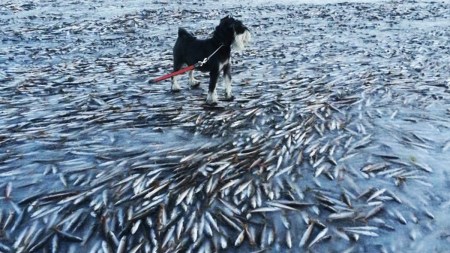
frozen herring lovund (image Norwegian Radio)
Frozen Elk (Moose)

frozen elk in Valnesfjord image Inger Sjoberg
Tags: fox, frozen animals, frozen elk, frozen fish, frozen fox, Sweden
Posted in Wildlife, Winter | Comments Off on Fox found frozen in the ice
January 23, 2014
The Carthaginian Empire supposedly came into being with the Phoenician Queen Elissa (better known as Dido) sometime around 813 BCE. It reached its zenith around 500 years later and by 264 BC controlled the Western Mediterranean.

Carthage in 264 BC (Ancient Encyclopedia)
But they made the mistake of expanding into Sicily and this was the start of their conflict with Rome:
Ancient Encyclopedia:
The Carthaginian trading ships sailed daily to ports all around the Mediterranean Sea while their navy, supreme in the region, kept them safe and, also, opened new territories for trade and resources through conquest.
It was this expansion which first brought Carthage into conflict with Rome. When Rome was weaker than Carthage, she posed no threat. The Carthaginian navy had long been able to enforce the treaty which kept Rome from trading in the western Mediterranean. When Carthage took Sicily, however, Rome responded. Though they had no navy and knew nothing of fighting on the sea, Rome built 330 ships which they equipped with clever ramps and gangways (the corvus) which could be lowered onto an enemy ship and secured; thus turning a sea battle into a land battle. The First Punic War (264-241 BCE) had begun. After an initial struggle with military tactics, Rome won a series of victories and finally defeated Carthage in 241 BCE. Carthage was forced to cede Sicily to Rome and pay a heavy war indemnity.
The Carthaginian Empire effectively came to an end when they lost the third Punic War against Rome
A Roman embassy to Carthage made demands to the senate which included the stipulation that Carthage be dismantled and then re-built further inland. The Carthaginians, understandably, refused to do so and the Third Punic War (149-146 BCE) began. The Roman general Scipio Aemilianus besieged Carthage for three years until it fell.
It is not surprising that most Roman and Greek writings are quite disparaging about Carthage and the customs of the Carthaginians. It is from these accounts by the victors that we learn that the vile Carthaginians were a very nasty lot who indulged in child sacrifice. Many have put this down as black propaganda and a biased view. But apparently this is still a hot topic among archaeologists with the same bones leading to diametrically opposite conclusions.
Read the rest of this entry »
Tags: arape as punishment, barbarism, cannibalism, Carthage, infant sacrifice, Rome, salishi sabha
Posted in Behaviour, History, Religion | Comments Off on Carthaginians were a nasty lot – probably
January 23, 2014
We regularly get deer in our garden (and they eat everything but yellow flowers) but once in a while we are honoured by the moose (Swedish Älg). Two years ago we had a moose cow and her calf who got lost on a foggy morning and ended up in our garden
But this morning at about 0830 (sunrise today was at 0821), we had a lone moose cow which seemed to have spent a good part of the night sleeping in front of my garage. It was wary but didn’t seem much bothered by my presence – about 10 m away – and continued munching on our bushes. It left after a leisurely breakfast about half an hour later.
Just minus 12°C and very light snow and an Urban Moose.

Moose in the garden 2

Moose in the garden January 2014
Tags: Moose, Sweden, Urban moose
Posted in Sweden, Trivia, Wildlife | Comments Off on A garden moose
January 22, 2014
UPDATE!
Climate Audit points out:
The Sydney Morning Herald account adds the remarkable claim that Turney took more passengers into the field even after the evacuation notice had been issued:
A passenger standing near Professor Turney overheard the voyage leader, Greg Mortimer, telling him over the radio to bring passengers back to the ship so it can leave. But minutes later, Professor Turney drove six more passengers into the field. The overloaded vehicle had no space to collect returning passengers.
=============================================
Turney and his tourists from the Ship of Fools have returned.
The BBC covers the return.
But there are still unanswered questions as to who will pay for the expensive international rescue mission. The Aurora Australis had to suspend a resupply mission to Australia’s permanent base in the Antarctic, Casey Station, to take part in the rescue.
The Sydney Morning Herald has a long and – for them – unusually questioning article about the fiasco.
The inside story of how a polar expedition went terribly wrong, leaving dozens of tourists and scientists trapped in the ice.
This account has been reconstructed from interviews with members of the Australasian Antarctic Expedition 2013/14, most of whom wished to remain anonymous, who witnessed events or overheard conversations, and the report the voyage leader, Greg Mortimer, submitted to IAATO.
Mortimer declined to comment on his report.
The Shokalskiy’s captain, Igor Kielev, did not respond to Fairfax Media’s emails.
Chris Turney and Chris Fogwill, the expedition leaders, also declined to comment on specific questions regarding events on December 23.
Nicky Phillips and Colin Cosier travelled on board the Aurora Australis as part of the Australian Antarctic Division’s media fellowship program.
Amazingly, Chris Turney gets an award for “contributing to the understanding natural phenomena”. I suppose it’s a case of rewarding the Fool Who Rushed In!!
JoNova:
The Australian Academy of Science has announced it’s 2014 Academy awards to “celebrate scientific excellence.”
To show how excellent, their excellence is, the Frederick White Prize for scientific achievements contributing to the understanding of natural phenomena goes to Professor Chris Turney, University of New South Wales.
Tags: Antarctic, Chris Turney, Ship of Fools
Posted in Alarmism, Antarctic, Climate, scientific misconduct | Comments Off on Turney’s tourists return
January 22, 2014
If electric vehicles are to succeed they will have to provide the consumer with some real benefits by way of cost or convenience which are more than for feeling good. That in turn depends upon the further development of battery technology and increasing the range of the vehicle on a single charge. The cost of the vehicle and the speed of charging are other key factors.
The supposed environmental benefits are largely illusory since they merely shift the source of power generation (combustion from the internal combustion engine in a vehicle) to a power plant. In the United States this power generation is most likely to be fossil fired (coal or shale gas). A new study shows that even if electric vehicles made up more than 40% of all vehicles, emissions would be largely unchanged. As of 2012 electric vehicles made up about 0.5% of new vehicle sales and about 0.06% (170,000 of 254 million) of all vehicles on the road in the US.
(Phys.org) — A new study from North Carolina State University indicates that even a sharp increase in the use of electric drive passenger vehicles (EDVs) by 2050 would not significantly reduce emissions of high-profile air pollutants carbon dioxide, sulfur dioxide or nitrogen oxides. … The researchers ran 108 different scenarios in a powerful energy systems model to determine the impact of EDV use on emissions between now and 2050. They found that, even if EDVs made up 42 percent of passenger vehicles in the U.S., there would be little or no reduction in the emission of key air pollutants. …..
The energy systems model also showed that key factors in encouraging use of EDVs are oil price and battery cost. If batteries are cheap and oil is expensive, EDVs become more attractive to consumers.
“How Much Do Electric Drive Vehicles Matter to Future U.S. Emissions?” Published: online January 2014 in Environmental Science & Technology pubs.acs.org/doi/abs/10.1021/es4045677

Energy System Model
Abstract
Hybrid, plug-in hybrid, and battery electric vehicles—known collectively as electric drive vehicles (EDVs)—may represent a clean and affordable option to meet growing U.S. light duty vehicle (LDV) demand. The goal of this study is twofold: identify the conditions under which EDVs achieve high LDV market penetration in the U.S. and quantify the associated change in CO2, SO2, and NOX emissions through mid-century. We employ the Integrated MARKAL-EFOM System (TIMES), a bottom-up energy system model, along with a U.S. dataset developed for this analysis. To characterize EDV deployment through 2050, varying assumptions related to crude oil and natural gas prices, a CO2 policy, a federal renewable portfolio standard, and vehicle battery cost were combined to form 108 different scenarios. Across these scenarios, oil prices and battery cost have the biggest effect on EDV deployment. The model results do not demonstrate a clear and consistent trend towards lower system-wide emissions as EDV deployment increases. In addition to the tradeoff between lower tailpipe and higher electric sector emissions associated with plug-in vehicles, the scenarios produce system-wide emissions effects that often mask the effect of EDV deployment.
Tags: Air pollution, EDV's, electric vehicles
Posted in Air pollution, Automobiles, Business, Technology | 2 Comments »
January 22, 2014
The European Commission’s new climate change and energy policy is due to be published today. Leaked reports have been circulating and it is clear that reality and the financial crisis are focusing minds and that expensive “feel-good” policies are being dumped. After 2 decades, meaningless “climate policy” and emissions (read carbon dioxide) limitations have proven to be profligate and counter-productive. Climate has not been influenced in the slightest and European electricity prices are the highest in the world.
It is expected that binding national targets will be scrapped and instead there will instead be EU-wide “goals” or targets.
BBC:
- Binding national targets on renewable energy are expected to be dropped from new EU proposals due to be unveiled on Wednesday.
- The EU executive will also outline a goal on emissions cuts for 2030, set to be 35 or 40% below 1990 levels.
- A source within the Commission said that going forward, there would be a EU wide target on renewable energy for 2030, but it was likely that there would not be binding national targets.
-
As well as proposals on emissions cuts, the Commission will set out its thinking on shale gas. It is likely that they will suggest a series of non-binding recommendations as opposed to a EU wide regulation.
- The Commission will also outline an effort to reform the EU emissions trading scheme (ETS).
-
The Commission’s proposals will go forward for consideration at heads of government meetings in March and June this year. …… that the climate and energy plan may be watered down even further at these meetings.
Tags: carbon dioxide, climate policy, emissions control, EU
Posted in Alarmism, Climate, Emissions, Energy, European Union | Comments Off on Reality bites as EU backs away from climate goals



 The k2p blog