It’s trivia because Halal, Kosher, Vegan and Vegetarian are high principles based on low reasoning and spurious logic.

It’s trivia because Halal, Kosher, Vegan and Vegetarian are high principles based on low reasoning and spurious logic.
It’s Monday morning. All is not well. But I remain an optimist – just.
Viruses are not living, say scientists. Of course, there are other “experts” who say that viruses are alive – sort of. We are both old enough and with other health conditions to put us among the higher risk groups. The probability of not surviving if either of us is infected is now in percentages and no longer in parts per 100,000. We cannot afford to get infected. So we are quite careful. We isolate ourselves and exercise large social distancing. We have become asocial. We have been waiting for the vaccine in the belief that 2021 is going to be annus mirabilis after the annus horribilis that has been 2020. But I am beginning to realize that this is more delusion than belief. After 9 months of self-imposed isolation and asocial behaviour I am beginning to see the coronavirus as a living, evolving form of life which has the purpose of culling humans.
There is a new, mutated strain of the Covid-19 virus, said to be 70% more infectious than its predecessor, running rampant in the UK. It came, it is said, from Spain to the UK in September. It honed its skills in London and is not thought to be more deadly or more severe in its effects. It has already been found in Denmark, the Netherlands and Australia. It is not more deadly but is thought to be 70% more effective in transmitting itself from one host to another. More of the transmission is thought to be air-borne and from the asymptomatic. Air borne means that a safe social distance increases by a factor of about 5. Air-borne means that simple face masks can be penetrated. It is almost as if the mutation is specifically about countering lock-downs, social distancing and face masks. Its next survival step will be to mutate to counteract the vaccines.
The vaccines, they say, will still be effective against this mutation. Our best guess is that we could reach the top of the priority list sometime in March, perhaps as late as April. It takes a month for immunity to develop. That takes us into May before we can begin exercising lost social skills again. That assumes that there is not another wave in Spring and that another more deadly mutation has not appeared. But we are living in a dream world if we think the virus will not continue to mutate. A best case scenario suggests that vaccines will give immunity for about 6 months. The Spring wave is more likely to be of a mutated virus – perhaps this current London virus. But it will change again for the Autumn and the next time around it could be more deadly. And then there will have to be an Autumn wave again as vaccines catch up. Even flu vaccines have their compositions adjusted every year.
Flu viruses are constantly changing, so the vaccine composition is reviewed each year and updated as needed based on which influenza viruses are making people sick, the extent to which those viruses are spreading, and how well the previous season’s vaccine protects against those viruses. More than 100 national influenza centers in over 100 countries conduct year-round surveillance for influenza. This involves receiving and testing thousands of influenza virus samples from patients.
I am getting despondent this Monday morning. 2021 will be another bad year.

Even as vaccinations are due to begin, Europe is struggling with the second wave of the pandemic. The effectiveness of the vaccinations are a little jeopardized by reports that a new, more infectious strain of Covid-19 is sweeping across the UK and is on its way to Europe. Hopefully the vaccines developed in record time will cope even with the new strains of the virus if they are not too dissimilar.
While I welcome the vaccines and will take mine as soon it becomes available to me (probably late February) I am not so foolish, or gullible, as to believe that the science is settled. I have read many, but no convincing explanation, as to where the virus went during the summer of 2020.
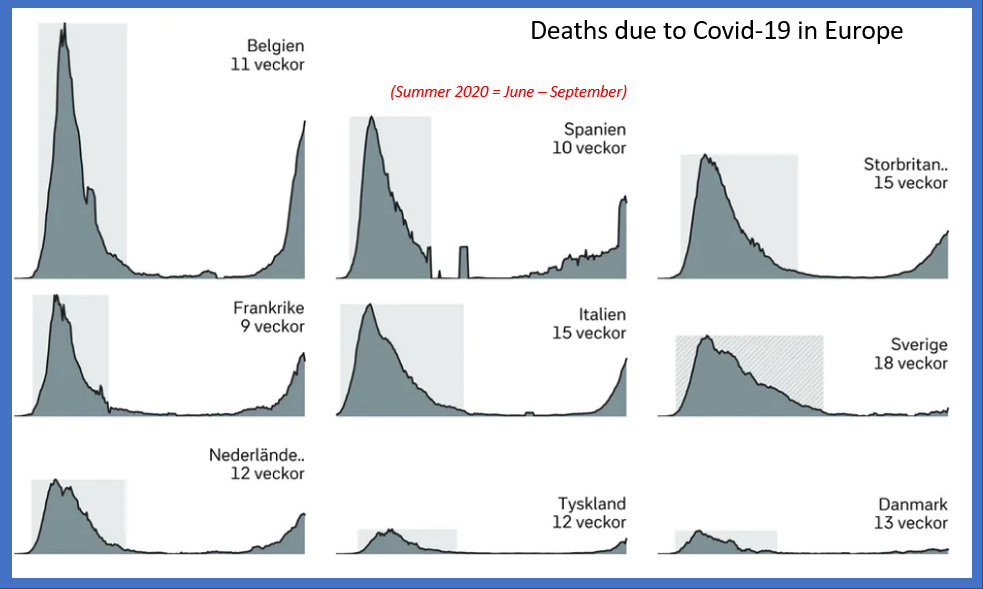
The peaks in late spring, followed by the trough during the summer and the new peaks in late autumn are a common feature across all countries. The same pattern appears in countries applying hard lockdowns as in those with less stringent restrictions. It was clearly not the lockdown regimes which restricted the pattern of deaths in the summer. Yes, of course, people spent more time outdoors in the summer. But when Spain and Sweden exhibit the same pattern, this can be no explanation for the reduction in infection rate over the summer.
There is a great deal of speculation but most of it is just speculation.
Seasonal trends in viral infection are driven by multiple factors, including people’s behaviour and the properties of the virus — some don’t like hot, humid conditions.
Laboratory experiments reveal that SARS-CoV-2 favours cold, dry conditions, particularly out of direct sunlight. For instance, artificial ultraviolet radiation can inactivate SARS-CoV-2 particles on surfaces and in aerosols, especially in temperatures of around 40 °C. Infectious virus also degrades faster on surfaces in warmer and more humid environments. ……… To assess whether infections with a particular virus rise and fall with the seasons, researchers typically study its spread in a specific location, multiple times a year, over many years. But without the benefit of time, they have tried to study the seasonal contribution to SARS-CoV-2 transmission by looking at infection rates in various places worldwide.
A study published on 13 October looked at the growth in SARS-CoV-2 infections in the first four months of the pandemic, before most countries introduced controls. It found that infections rose fastest in places with less UV light, and predicted that, without any interventions, cases would dip in summer and peak in winter. In winter, “the risk goes up, but you can still dramatically reduce your risk by good personal behaviour”, says Cory Merow, an ecologist at the University of Connecticut in Storrs, and a co-author of the study. “The weather is a small drop in the pan.” But Francois Cohen, an environmental economist at the University of Barcelona in Spain, says that testing was also quite limited early in the pandemic, and continues to be unreliable, so it is impossible to determine the effect of weather on the spread of the virus so far. ………… If SARS-CoV-2 can survive better in cold conditions, it’s still difficult to disentangle that contribution from the effect of people’s behaviour …. .
The simple reality is that we don’t know where corona viruses go for vacation during European summers and where the Covid-19 virus went during the summer of 2020.
But it is back.
Numbers are abstract. They do not have any physical existence. That much, at least, is fairly obvious and uncontroversial.
Are numbers even real? The concept of numbers is real but reason flounders when considering the reality of any particular number. All “rational” numbers (positive or negative) are considered “real numbers”. But in this usage, “real” is a label not an adjective. “Rational” and “irrational” are also labels when attached to the word number and are not adjectives describing the abstractions involved. The phrase “imaginary numbers” is not a comment about reality. “Imaginary” is again a label for a particular class of the concept that is numbers. Linguistically we use the words for numbers both as nouns and as adjectives. When used as a noun, meaning is imparted to the word only because of an attached context – implied or explicit. “A ten” has no meaning unless the context tells us it is a “ten of something” or as a “count of some things” or as a “measurement in some units” or a “position on some scale”. As nouns, numbers are not very pliable nouns; they cannot be modified by adjectives. There is a mathematical abstraction for “three” but there is no conceptual, mathematical difference between a “fat three” and a “hungry three”. They are not very good as adjectives either. “Three apples” says nothing about the apple. “60” minutes or “3,600” seconds do not describe the minutes or the seconds.
The number of apples on a tree or the number of atoms in the universe are not dependent upon the observer. But number is dependent upon a brain in which the concept of number has some meaning. All of number theory, and therefore all of mathematics, builds on the concept and the definition of one. And one depends, existentially, on the concept of identity.
From Croutons in the soup of existence
The properties of one are prescribed by the assumptions (the “grammar”) of the language. One (1,unity), by this “grammar” of mathematics is the first non-zero natural number. It is the integer which follows zero. It precedes the number two by the same “mathematical distance” by which it follows zero. It is the “purest” number. Any number multiplied by one or divided by one remains that number. It is its own factorial. It is its own square or square root; cube or cube root; ad infinitum. One is enabled by existence and identity but thereafter its properties are defined, not discovered.
The question of identity is a philosophical and a metaphysical quicksand. Identity is the relation everything has to itself and nothing else. But what does that mean? Identity confers uniqueness. (Identical implies sameness but identity requires uniqueness). The concept of one of anything requires that the concept of identity already be in place and emerges from it. It is the uniqueness of identity which enables the concept of a one.
Things exist. A class of similar things can be called apples. Every apple though is unique and has its own identity within that class of things. Now, and only now, can you count the apples. First comes existence, then comes identity along with uniqueness and from that emerges the concept of one. Only then can the concept of numbers appear; where a two is the distance of one away from one, and a three is a distance of one away from two. It is also only then that a negative can be defined as distance away in the other direction. Zero cannot exist without one being first defined. It only appears as a movement of one away from one in the opposite direction to that needed to reach two. Negative numbers were once thought to be unreal. But the concept of negative numbers is just as real as the concept for numbers themselves. The negative sign is merely a commentary about relative direction. Borrowing (+) and lending (-) are just a commentary about direction.
But identity comes first and numbers are a concept which emerges from identity.

Pfizer vaccine roll out has started.
(Note! Refrigerated transport).

John le Carré: Espionage writer dies aged 89
The Spy Who Came In From The Cold, and Tinker, Tailor, Soldier, Spy author died from pneumonia on Saturday night.
Jonny Geller described him as an “undisputed giant of English literature” who “defined the Cold War era and fearlessly spoke truth to power”. “We will not see his like again,” he said in a statement. Mr Geller said he represented the novelist, whose real name was David Cornwell, for almost 15 years and “his loss will be felt by every book lover, everyone interested in the human condition”. “We have lost a great figure of English literature, a man of great wit, kindness, humour and intelligence. I have lost a friend, a mentor and an inspiration.”
A statement shared on behalf of the author’s family said: “It is with great sadness that we must confirm that David Cornwell – John le Carré – passed away from pneumonia last Saturday night after a short battle with the illness. “David is survived by his beloved wife of almost 50 years, Jane, and his sons Nicholas, Timothy, Stephen and Simon. We all grieve deeply his passing. Our thanks go to the wonderful NHS team at the Royal Cornwall Hospital in Truro for the care and compassion that he was shown throughout his stay. We know they share our sadness.”
The statement said his death was not Covid-19 related.
George Smiley novels
Call for the Dead (1961), A Murder of Quality (1962), The Spy Who Came in from the Cold (1963), The Looking Glass War (1965), Tinker Tailor Soldier Spy (1974), The Honourable Schoolboy (1977), Smiley’s People (1979), The Russia House (1989), The Secret Pilgrim (1990), A Legacy of Spies (2017)

I take skepticism to be the most important characteristic of any scientific inquiry. All “experts”, and especially media proclaimed experts, need to be met with a high degree of skepticism. “Experts” have a high level of knowledge, but only of what is known and what is known may not be very much. The inherent paradox is that it is the “experts” who need to be challenged the most, but can only be challenged by other experts. But the very clear lesson that can be learnt is that little “experts” are dangerous.
In Sweden, the media made an epidemiologist from the Public Health Agency (Anders Tegnell of Folkhälsomyndigheten – FHM) into some kind of a superhero in March. The government abdicated its responsibilities and left the stage free for “experts”. The media hype converted FHM’s limited position that face-masks were of most use within health care into a belief that face-masks were counter-productive in general use. “Flattening the curve” was the slogan being touted by everyone (including me). But epidemiology is more art than science. We know a lot about viruses but we knew very little about how humans behave and how the coronavirus spreads. The WHO was an unmitigated disaster as they tried to hide any information that was critical of China. (Someday China will need to be held accountable and take some responsibility for having failed to contain, and allowing the spread of, the virus). The government (and the Public Health Agency) proved to be utterly incompetent in predicting the behaviour of the young (who were not at great risk) and the effects on the old (>80% of fatalities).
Of course, almost every country has failed to flatten the curve. The Swedish non-strategy has also failed.
The diagram below needs little comment. The top curves were what we were shown everyday in March and April by FHM about what the strategy (or non-strategy) would achieve. The bottom curve is the actual burden on the health services in terms of the number of admitted Covid-19 patients in hospital (excluding intensive care places which are 70% full).
“Flattening the curve” has become a nonsense slogan.

As expected, the FDA’s independent vaccine advisory committee recommended approval of the Pfizer vaccine yesterday, “17 to 4 in favor of recommending the drug for emergency use for people aged 16 years and older, with one of the members withholding”.
A federal advisory panel on Thursday recommended the emergency use of Pfizer’s COVID-19 vaccine. The Food and Drug Administration is expected to approve the drug, kicking off a massive nationwide operation to get nearly 3 million doses of the vaccine to hospitals and drug stores across the country. The experts voted 17 to 4 in favor of recommending the drug for emergency use for people aged 16 years and older, with one of the members withholding. Health care workers and nursing home residents will be among the first to get the vaccine. …….. Clinical trials showed the Pfizer vaccine was nearly 95% effective for adults 18 to 64 and was just as effective for people of all ethnicities. However, some groups — people with weak immune systems, individuals with severe allergic reactions, and pregnant women — could be restricted from getting the shot. However, British health officials on Wednesday warned that people with a history of “significant” allergic reactions to vaccines, medicine, or food should not be given Pfizer’s vaccine. Hahn said the FDA is working closely with its partners in the U.K. to understand what happened with the allergic reactions. “We study the data very carefully to say who should not receive the vaccine and these are the things the FDA does to ensure the safety and effectiveness” of the drug, Hahn said Thursday.
The advisory committee’s recommendation will probably lead to FDA approval by the weekend. The consensus is that the vaccine is safe and 95% effective. The Covid-19 pandemic is clearly out of control and there is a fear – quite justified – that without widespread acceptance of the vaccines the pandemic may continue unchecked. The Spanish flu pandemic (1918 – 21) lasted almost 3 years without any vaccine. Even with widespread and effective vaccination against Covid-19, this pandemic is set to last for at least two years until Spring 2022. Currently there is a widespread, global “information campaign” in favour of vaccination. Sometimes the simplistic and unnuanced messages are, I think, counter-productive. The WHO and UN information programs, in particular, talk down to the “great unwashed” and come close to being brainwashing attempts.
It can be expected that all members of an expert panel on vaccines will generally be in favour of vaccines. A key question then is why 4 of the expert panel did not recommend approval. In the current climate the dissenting expert views are of special importance. Unfortunately there is not much reporting of their views (with some exceptions).
The WSJ has some details:
Archana Chatterjee, dean of the Chicago Medical School at Rosalind Franklin University of Science and Medicine, said she dissented from the recommendation vote because there isn’t enough data justifying including 16 and 17 year olds in an emergency authorization. …. Oveta Fuller, a virologist at the University of Michigan Medical School, also dissented, saying in an interview that she would like to see at least two more months of data on trial participants that could help determine whether the vaccine reduces transmission.
The issue of using placebos in double-blinded trials for some patients and denying such patients vaccines came up (of effectively using humans as guinea-pigs). This is not really an ethical question at all, though the medical profession assuages its conscience by presenting it as such.
……. Doran Fink, deputy clinical director of the FDA’s division of vaccines, said further evaluation of the vaccine after its release will be necessary to see if its benefits continue to outweigh its risk, and whether any labeling changes will be required. Dr. Fink also addressed one major topic that has been in question—whether patients in the Pfizer trial who were randomly assigned to placebo should automatically be switched over and get the vaccine. FDA staffers told the committee they shouldn’t.
Steven Goodman, a Stanford University School of Medicine dean and epidemiologist, described that choice in testimony before the panel as an “ethical dilemma” in which both answers—getting vaccines to placebo patients and developing long-term safety and effectiveness—are right, and neither is unethical. ….. Marion Gruber, director of the FDA’s office of vaccines (and no relation to Bill Gruber), said she is concerned that if there is an unblinding of patients, that might limit the ability of the study to gather enough data about the vaccine’s safety.
Of course, there is no ethical dilemma. It is a simple case of the one being over-ruled by the many. Those patients involved in trials who get placebos instead of the vaccines are effectively human guinea-pigs whose health (and lives) are being adventured, without their knowledge, “for the common good”. Guinea-pigs (human or not) are not required to be told, or to understand, their fate. Their role is only to be counted in the appropriate column.
Throughout human history “the few” have always been sacrificed for “the many”. That, after all, is the essence of democracy. The reality is that the health of those receiving placebos in a vaccine trial is always subordinated to the results of the trial.
The FDA briefing reckons the Pfizer vaccine is safe and effective. (An expected conclusion and the EU will soon follow suit). The trial had around 44,000 participants.

The FDA’s independent vaccine advisory committee meets on Thursday, 10th December to consider emergency use of Pfizer’s coronavirus vaccine.
During the trial, one participant receiving the vaccine had a severe Covid-19 infection while three receiving placebos were severely infected. Four people in the placebo group died during the trial and two died in the vaccine group. None of the deaths are ascribed to the vaccine.
Antibodies are produced within 10 days.
How long immunity may last is not known. The meeting is expected to focus on safety aspects.
Efficacy Summary
In the final efficacy analysis, among participants without evidence of SARS-CoV-2 infection before and during vaccination regimen, vaccine efficacy (VE) for the first primary endpoint against confirmed COVID-19 occurring at least 7 days after Dose 2 was 95.0%, with 8 COVID-19 cases in the BNT162b2 group compared to 162 COVID-19 cases in the placebo group. The 95% credible interval for the VE was 90.3% to 97.6%, indicating that the true VE is at least 90.3% with a 97.5% probability given the available data. For the second primary endpoint, VE against confirmed COVID-19 occurring at least 7 days after Dose 2 in participants with and without evidence of SARS-CoV-2 infection before and during vaccination regimen was 94.6%, with 9 and 169 cases in the BNT162b2 and placebo groups respectively. The 95% credible interval for the VE was 89.9% to 97.3%, indicating that the true VE is at least 89.9% with a 97.5% probability given the available data.
The AstraZeneca/Oxford vaccine and the Moderna vaccines will also soon get approval. Of course the AstraZeneca vaccine costs only about 10% of the cost of the Pfizer vaccine (excluding the storage and logistic costs) and – in the long run – may generate greater revenues if the vaccination becomes a recurring event. My guess is that the costs of the Pfizer vaccine are too high to be sustainable.
2020 comes close to being annus horribilis.
There is much I wish I had not seen or heard or smelled or learnt. But to unsee or unhear or unlearn or unremember or unknow are not permitted, by reality or by language.
Doing is a temporal activity. Undoing in time is fundamentally impossible.
What the brain receives as sensory input cannot be undone.
To forget is human but to undo is divine.



 The k2p blog