Christianity should do more for biodiversity!

September 5, 2013

I kid you not.

A new paper at Oryx – The International Journal of Conservation by Swedish and Australian researchers.

 ” … the Roman Catholic and Orthodox Churches appear to have the greatest per capita opportunity to influence discourse on biodiversity… “

Does this count as science? or advocacy? or is it theological economics?

What were they thinking?

Grzegorz Mikusiński, Hugh P. Possingham and Malgorzata Blicharska, Biodiversity priority areas and religions—a global analysis of spatial overlap, Oryx, available on CJO2013. doi:10.1017/S0030605312000993. 

Abstract:Numerous solutions have been proposed to slow the accelerating loss of biodiversity. Thinking about biodiversity conservation has not, however, been incorporated into the everyday activities of most individuals and nations. Conservation scientists need to refocus on strategies that reshape ethical attitudes to nature and encourage pro-environmental thinking and lifestyles. Religions are central to basic beliefs and ethics that influence people’s behaviour and should be considered more seriously in biodiversity discourse. Using data from the World Religion Database we conducted an analysis of the spatial overlap between major global religions and seven templates for prioritizing biodiversity action. Our analysis indicated that the majority of these focal areas are situated in countries dominated by Christianity, and particularly the Roman Catholic denomination. Moreover, the Roman Catholic and Orthodox Churches appear to have the greatest per capita opportunity to influence discourse on biodiversity, notwithstanding the role of other religious communities in some key biodiversity areas.

From EurekAlert:

A new study carried out by ecologists at the Swedish University of Agricultural Sciences, among others, indicates that if the world’s religious leaders wished to bring about a change, they would be ideally positioned to do so

Leaders of the major world religions can play a key role in preserving biological diversity. A new study carried out by ecologists at the Swedish University of Agricultural Sciences (SLU), among others, indicates that if the world’s religious leaders wished to bring about a change, they would be ideally positioned to do so. …. 

…. Religions strive to be morally good and for centuries have led people in terms of right and wrong. Therefore, says Grzegorz Mikusinski, they have the potential to guide them to “miracles” also when it comes to conservation in the places where the religion has a great influence on society.

– The results show that Roman Catholics, per capita, have the greatest potential to preserve biological diversity where they live, says Hugh Possingham, a researcher at University of Queensland, Australia, and a co-author of the study.

The Catholic Church has just elected a pope, Francis – a name associated with the Catholic Church’s “greenest” saint, Francis of Assisi, the special patron saint of ecology. Let us hope that he and other religious leaders seriously consider the possibility of becoming more involved in the conservation debate. But at the same time scientists need to more actively encourage religious leaders to take part in such a debate.

Many solutions have been proposed to halt the loss of biological diversity. But the notion of conservation has seldom become part of daily life, either among individuals or among nations.

– Conservation research needs to adjust its focus, toward strategies that can change people’s ethical attitudes toward nature and encourage modes of thinking and lifestyles that are good for the environment, says Malgorzata Blicharska, a researcher at SLU and a co-author of the study. Religions are central to fundamental beliefs and ethics that influence people, and they should be taken more seriously in the debate about biological diversity.

Or these religious leaders could just lead the prayers!
War, doping and radiation fears could give 2020 Olympics to Madrid

September 5, 2013

UPDATE! 7th September –

Tokyo Won.

================

Istanbul, Tokyo and Madrid are competing for the right to hold the 2020 Olympics and lobbying is at its peak since the decision is expected on Saturday 7th September.

Madrid was first trailing because the Spanish economy was/is not in the best of shape. Since Tokyo has already hosted the summer games (1964) and two winter games have been held in Japan, this opened the possibility of Istanbul getting the honour for the first time ever . This is their 5th attempt. But now lingering fears of radiation from Fukushima and of Turkey becoming embroiled in war (even though the games are 7 years away) seem to be bringing Madrid to the forefront again. This is Madrid’s 3rd attempt and the summer games were held in Barcelona in 1992.

Tokyo still has the best chance of raising the necessary finance. Both Istanbul and Madrid give cause for concern for financing. The greatest amount of new construction would be needed for an Istanbul games.

The Telegraph:

Fukushima failures threatening to derail Tokyo’s 2020 Olympics bid

The team behind Tokyo’s bid to host the 2020 Olympics Games is scrambling to save its long and expensive campaign from falling victim to the ongoing crisis at the Fukushima nuclear plant. …… Until a few weeks ago, the Japanese capital had been considered the front-runner, thanks to a slick campaign that has emphasised Tokyo’s efficient infrastructure, experience in hosting global sporting events, financial guarantees backed by the government and the fact that Tokyo “is one of the world’s safest and most welcoming cities.”

But recent civil unrest in Turkey and the potential for war in the region are worrisome. Istanbul is struggling also to dispel perceptions of rampant doping in Turkish athletics:

A new “zero tolerance” policy and a reaccredited testing laboratory will help Turkey fight doping following a string of positive cases, the head of Turkey’s bid to host the 2020 Olympics said on Wednesday.

More than 30 athletes were banned by the Turkish Athletics Federation in August and Turkish official Ugur Erdener said this was the result of the country’s new hardline stance and a previous lack of comprehensive testing.

“We understand there is no gain without pain,” Erdener, President of Turkey’s National Olympic Committee, told reporters, referring to the recent positive tests.

“Turkey now has a very aggressive anti-doping system. The lab will also be re-accredited by the World Anti-doping Agency this year. Not in the near future but in this year,” said Erdener who is also a WADA executive committee member.

The rumours are now that Madrid is going to win:

Huffington Post

…..  it seems increasingly likely the IOC will choose the Spanish capital of Madrid.

“To my astonishment, it seems like it’s going to be Madrid,” Wolfgang Maennig, a professor of economics at Hamburg University, told HuffPost.

Maennig, an expert in sports economics, is in Buenos Aires, Argentina, at a sports business symposium. Not coincidentally, representatives of the national Olympic committees are also currently in Buenos Aires, meeting to decide where the Summer Olympics will be held seven years from now.

Maennig said he met with two Olympic officials, including the president of a national delegation he declined to name, and both said Madrid was quickly pulling away as the favorite to host the Olympic Games over candidate cities Istanbul and Tokyo.

“I talked today to the president of a national federation and people are still afraid of Syria and even Iraq, even though that was years ago, affecting Turkey,” Maennig said on Wednesday. “There are also many concerns about the level of radiation in Japan.”

Lobbying is heavy and a great deal of Japanese money is being dangled in front of the IOC. It is said that the Japanese Prime Minister might attend but I would have thought he might find it difficult to get away from the G20 meeting in Saint Patersburg.

Well we shall know in a couple of days.

The sun, the clouds and the climate

September 5, 2013

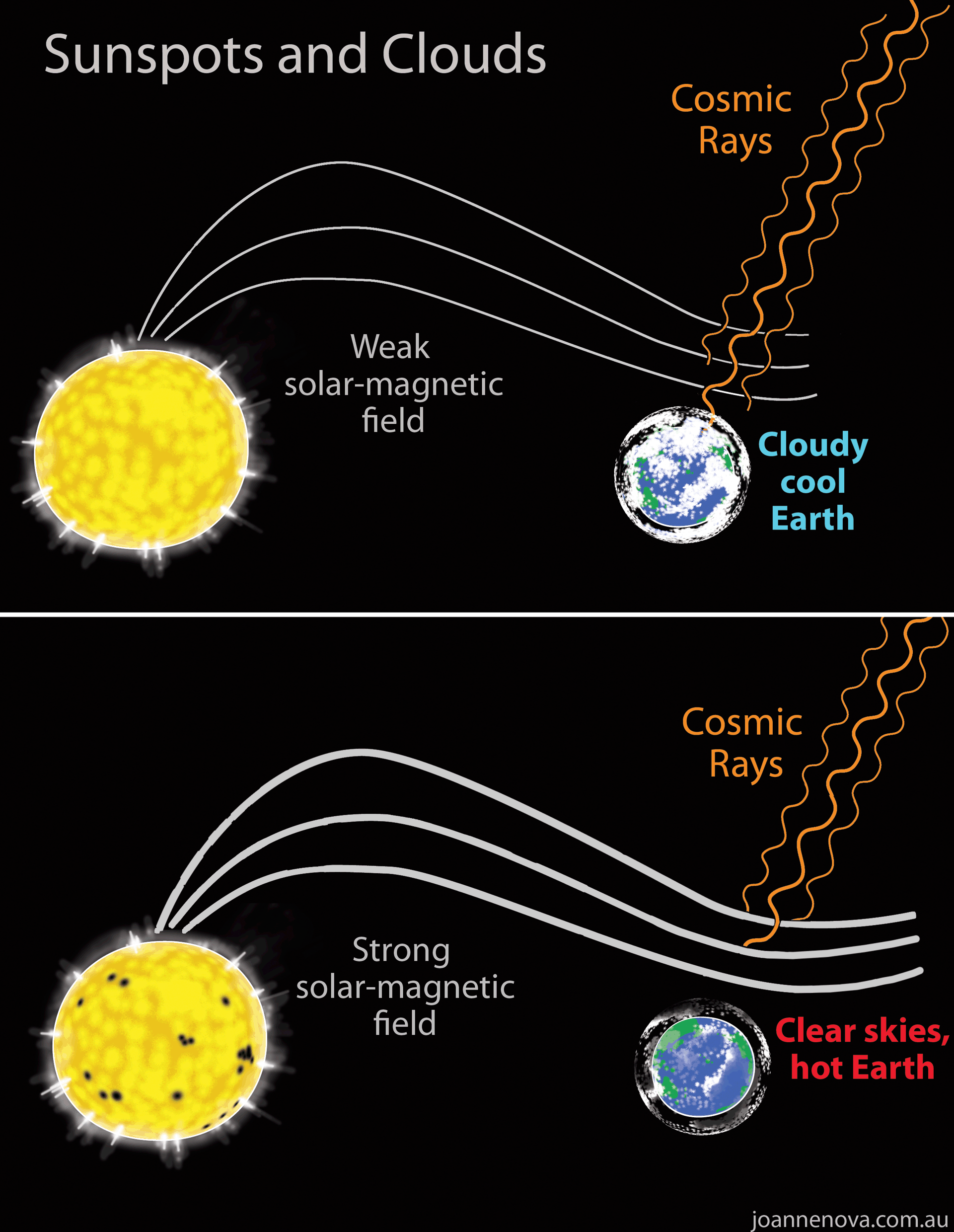
The Svensmark theory is that variations in the Sun’s electromagnetic  behaviour leads to varaiations of the cosmic ray flux reaching earth which in turn impacts cloud formation on earth and that connects to global warming or cooling.  A more active sun leads to fewer cosmic rays which gives fewer clouds and more warming on earth.

Graphic from Jonova

The CLOUD experiments at CERN have shown that cosmic rays can in fact lead to cloud formation. Now Svensmark and his colleagues have published further evidence from the SKY2 experiments which confirm the connection.

H. Svensmark, Martin B. Enghoff and Jens Olaf Pepke Pedersen, Response of cloud condensation nuclei (>50 nm) to changes in ion-nucleation,   Physics Letters A 377 (2013) 2343–2347,

Full paper is available here: svensmark et al 2013

Abstract: In experiments where ultraviolet light produces aerosols from trace amounts of ozone, sulfur dioxide, and water vapor, the relative increase in aerosols produced by ionization by gamma sources is constant from nucleation to diameters larger than 50 nm, appropriate for cloud condensation nuclei. This result contradicts both ion-free control experiments and also theoretical models that predict a decline in the response at larger particle sizes. This unpredicted experimental finding points to a process not included in current theoretical models, possibly an ion-induced formation of sulfuric acid in small clusters.

The Technical University of Denmark has issued a Press Release:

Danish experiment suggests unexpected magic by cosmic rays in cloud formation

Researchers in the Technical University of Denmark (DTU) are hard on the trail of a previously unknown molecular process that helps commonplace clouds to form. Tests in a large and highly instrumented reaction chamber in Lyngby, called SKY2, demonstrate that an existing chemical theory is misleading.

Back in 1996 Danish physicists suggested that cosmic rays, energetic particles from space, are important in the formation of clouds. Since then, experiments in Copenhagen and elsewhere have demonstrated that cosmic rays actually help small clusters of molecules to form. But the cosmic-ray/cloud hypothesis seemed to run into a problem when numerical simulations of the prevailing chemical theory pointed to a failure of growth. 

Fortunately the chemical theory could also be tested experimentally, as was done with SKY2, the chamber of which holds 8 cubic metres of air and traces of other gases. One series of experiments confirmed the unfavourable prediction that the new clusters would fail to grow sufficiently to be influential for clouds. But another series of experiments, using ionizing rays, gave a very different result, as can be seen in the accompanying figure. 

The reactions going on in the air over our heads mostly involve commonplace molecules. During daylight hours, ultraviolet rays from the Sun encourage sulphur dioxide to react with ozone and water vapour to make sulphuric acid. The clusters of interest for cloud formation consist mainly of sulphuric acid and water molecules clumped together in very large numbers and they grow with the aid of other molecules.

Atmospheric chemists have assumed that when the clusters have gathered up the day’s yield, they stop growing, and only a small fraction can become large enough to be meteorologically relevant. Yet in the SKY2 experiment, with natural cosmic rays and gamma-rays keeping the air in the chamber ionized, no such interruption occurs. This result suggests that another chemical process seems to be supplying the extra molecules needed to keep the clusters growing. 

“The result boosts our theory that cosmic rays coming from the Galaxy are directly involved in the Earth’s weather and climate,” says Henrik Svensmark, lead author of the new report. “In experiments over many years, we have shown that ionizing rays help to form small molecular clusters. Critics have argued that the clusters cannot grow large enough to affect cloud formation significantly. But our current research, of which the reported SKY2 experiment forms just one part, contradicts their conventional view. Now we want to close in on the details of the unexpected chemistry occurring in the air, at the end of the long journey that brought the cosmic rays here from exploded stars.”

Simulating what could happen in the atmosphere, the DTU’s SKY2 experiment shows molecular clusters (red dots) failing to grow enough to provide significant numbers of “cloud condensation nuclei” (CCN) of more than 50 nanometres in diameter. This is what existing theories predict. But when the air in the chamber is exposed to ionizing rays that simulate the effect of cosmic rays, the clusters (blue dots) grow much more vigorously to the sizes suitable for helping water droplets to form and make clouds. (A nanometre is a millionth of a millimetre.)

Guardian’s “catastrophe” correspondent supports Rudd: Could be the final straw

September 5, 2013

If anything convinces me even more than the bookies that Rudd will lose the election this weekend, it is that George Monbiot of the Guardian has developed the catastrophe scenario for Australia if Abbot wins. He has the uncanny knack of picking dead – and useless – causes.

For those who have not been exposed to George Monbiot, he is the Guardian’s “catastrophe” correspondent. He can manage to find a looming disaster in every human development. His articles tend to lurch from one catastrophe scenario to the next. That his “catastrophes” never happen and keep disappearing into the future never discourages him. He can always find a new catastrophe. And now he has picked on Tony Abbott! He does write for The Guardian and support for Abbott would not be possible but the demonisation of Abbott – like carbon dioxide – is a Monbiot speciality.

Fighting global warming is his reason for living. He detests – and denies – the hiatus in global warming since it might prove that there is no impending catastrophe. He denies that changes to climate may be due to natural variability. He doesn’t like fracking or the Farmers Union. In fact he doesn’t like fossil fuels of any kind. Coal – he thinks – has been disastrous for Australia. Tourists and sheep in the Lake District should be banned. Exotic trees should be banned and only “native” trees should be planted. He has a fantasy that woolly mammoths could be brought back to life. Neonictinoids are like DDT. The shooting of one of the Boston bombers was an “execution”. Oil companies and tobacco companies are to be shunned. He really does believe in “peak oil” and “peak gas”. Earning money and creating wealth is fundamentally wrong. Faith in the markets is misplaced and only governments can save our living planet. Having resources is a curse. Exploiting such resources is to court eternal damnation. He is a firm adherent of the precautionary principle.

In short he knows best what is best for others.

And he does not like Tony Abbott – probably to Abbot’s great advantage. His headlines can be worth looking at but to read through his articles requires a strong stomach. It’s not just that he does not like humanity; he does not like people doing well. Coal and its exploitation – he believes – has degraded and brutalised Australia.

The Guardian: 

If Abbott is elected, Australia’s natural wonders will gradually be rubbed away

Tony Abbott’s climate policies are about removing the social and environmental protections enjoyed by all Australians to allow the filthy rich to become richer – and filthier.

…. Why? The answer’s in the name. Coalition policies begin with coal: getting it out of the ground, moving it through the ports, stripping away the regulations that prevent mining companies from wrecking the natural beauty of Australia – and from trashing the benign climate on which we all depend. The mining boom in the world’s biggest coal exporter has funded a new, harsher politics. 

… Like the tar sands in Canada, coal has changed the character of the nation, brutalising and degrading public life. It has funded a vicious campaign of mud-slinging against those who argue for the careful use of resources, for peace and quiet and beauty and the health of the living planet. Australia, like Nigeria, Iraq and Saudi Arabia, suffers from a resource curse. …

Read the whole article (if you really must).

Obama arrived 8 minutes early, Swedish Television caught napping

September 4, 2013

It has been a glorious day in Stockholm today. Blue skies, sunshine, 20°C and Obama touched down 8 minutes early. His arrival was being carried live by Swedish TV (Sveriges Television) on one channel and by Independent TV on another.  The Swedish TV channel literally “blacked-out” for about 5 minutes but the Independent channel coped though their audio feed went haywire for a few minutes.

Somebody should have told Obama that the correct form would have been to circle around in a little loop and land precisely on time. While punctuality is almost a religion here, and being late is a qualifier for eternal damnation, being early is not considered very polite either.

I remember the birthday parties for our kids when we were still new to Sweden and I could not quite understand why all the guests – and their parents – were hanging about down the street for a good 5 to 10 minutes before ringing the bell precisely – but precisely – at the appointed time. Mind you I quickly grew to appreciate that punctuality. Especially the custom of always having a  specified start and an end time for birthday parties. The relief after four hours of enduring 30 hyperactive kids when they all disappear at exactly the stipulated time is something close to ecstasy!!

Half the day’s program is over. A joint press conference with the Swedish Prime Minister, Fredrik Reinfeldt has been held. Nothing of any great significance was said. The full transcript is here. The most profound part was when Obama said:

It’s only been a short time, but I already want to thank all the people here for the warm hospitality that’s been extended to me and my delegation. This is truly one of the world’s great cities. It is spectacularly beautiful. The prime minister tells me that the weather is like this year ‘round. 

Only 2 Swedish journalists were permitted to ask questions and behaved themselves very correctly. Of course Syria and Putin and the NSA came up but little was said beyond the level of platitudes. Reinfeldt took the opportunity to mention that Sweden would now give refugees/ asylum seekers from Syria permanent residency and thereby avoided having to support or condemn military action.

But this is the first ever bilateral visit by a serving US President to Sweden and the value is more symbolic and it would be quite wrong to expect this visit to contain much substance on controversial matters. I had lunch today at my circular club and there was some little comment about the “circus” but nobody was really negative to Obama’s visit. Most were quite pleased that the President of the USA was visiting little Sweden.

Apart from the little TV glitch, everything else seems to have gone according to plan.

So far so good.

How long can Germany bear the cost of their Greens?

September 4, 2013

Less than 3 weeks to go for the German elections and the polls put Angela Merkel at 39% with the Social Democrats at 23%, the Greens at 11% and the Far Left at 10%. But polls have been wrong in German elections and sometimes spectacularly wrong:

Reuters:

Eight years ago Angela Merkel stared gloomily at the election results with disbelief when her party crashed to 35.2 percent of the German vote, seven points below the opinion poll forecast.

Her poll lead melted away again on election day four years later, though her conservatives stayed in power despite their worst result since 1949. Indeed her Christian Democrats (CDU) and their Bavarian sister party, the Christian Social Union (CSU), have fallen short of forecasts in the last six elections.

They are leading again as the September 22 vote comes round, but that humbling record explains why Merkel is not letting up, with 56 campaign stops in the month before voters give their verdict.

The chancellor warns in her speeches that supporters will have a “rude awakening” if they place too much faith in polls.

Once highly accurate, voter surveys in Germany have become a less reliable barometer as party allegiances weaken, voter turnout falls, differences between parties disappear and small newcomers crowd the ballot sheet.

The success of the Greens and their profligate policies have been mainly due to the German electorate looking desperately for a “feel-good” factor. My 3 years living in Germany – in the heart of the “old” Eastern Germany – only convinced me that the normally very pragmatic Germans were extremely apprehensive and tentative about touting their undoubted economic successes. They feared to take too much pride in their achievements since it brushed perilously close to Nationalism and all the dark ghosts that evoked. The Green Party – I think – filled this need for somehow “feeling good” about their own achievements in a benign way while avoiding any of the sinister negatives associated with “national pride”.

But this has been an expensive experiment – in money and in jobs. How much longer the Green bubble will continue remains to be seen. It is fundamentally unsustainable and all over Europe it is beginning to penetrate that the cost of “feeling good” for no benefits is a luxury. But German common sense, pragmatism and realism will eventually prevail as the costs of “feeling good” become increasingly obvious.

The Local:

Higher renewable energy subsidies due to be introduced in October will add an extra €40 onto the annual energy bill for a three person household, wrote Der Spiegel magazine in a report published on Monday. 
The cost of supporting German producers of renewable energy is, under German law, passed on to the consumer. The cost per kilowatt hour of green energy is simply added onto their bills. 
Set every October for the following year, this year the cost is set to jump 20 percent from 5.3 cents per kilowatt hour to 6.5 cents, wrote the magazine. 
Perversely, the price hike is necessary because the electricity market is actually being flooded with cheap electricity, wrote the magazine. 
Germany’s green energy producers have been guaranteed fixed rates feed-in-tariffs for 20 years, while recently the electricity stock market price has fallen to its lowest value in years. 
This has led to a widening gap between the falling prices grid operators are able to sell electricity for on the market, and the fixed guaranteed prices they have to pay out to producers of renewable energy. The result is that consumers have to make up the difference.

And consumers can only take so much. My expectation that common sense will prevail is – to no small part – also dependent upon the Greens propensity for being silly. Many of the Greens’ policies are silly without initially being seen to be silly. But calls – by some Green leaders – for a ban on driving cars on weekends and by other Greens for the legalising of incest go beyond silly and enter the realms of “stupid”. It is beginning to dawn on the electorate that the Greens may be a luxury – in money, jobs and in ideas – that Germany can ill afford.

NoTricksZone:

German daily Die Welt writes that one of the leaders of Germany’s influential Green Party is now calling for a ban of car driving in Germany on weekends.

Die Welt writes:

Green parliamentary group leader Fritz Kuhn wants cars of German drivers to be idle on weekends. […] With a driving ban a clear signal against climate change would be made. According to estimates by Kuhn, the citizens would quickly notice, “that you can also get along without cars”.

Fritz Kuhn, the mayor of Stuttgart, cites a ban used in Northern Italy in 150 cities last Sunday in order to fight air pollution. People can use their bicycles or go by foot.

By now readers may be thinking that the German Greens want to ban everything. Though it seems to be that way, this is not true.

There are some things they want to legalize: incest for example. According to FOCUS magazine here:

The incest ruling by the European Court of Justice for Human Rights (EGMR) against a 34-year old man from Leipzig has led to controversial reactions. Green Party politician Hans-Christian Ströbele reacted the most sharply. He wants to permit sex between siblings and other close relatives, and is requesting doing away with the incest laws. It is an isolated relic of another time when adultery was punishable, which we also have done away with,’ Ströbele told news network N24. Paragraph 173 no longer matches ‘in this time of enlightened opinion on marriage and family. It must be abolished’.”

Israel Education Ministry bans sex education material in text books

September 3, 2013

One has to conclude that everything is circular. If you go far enough to the Right you approach the Extreme Left. If you go to the extremes of one religion you approach the extremists of another.

Ultra-orthodox Imams and Rabbis, invariably male, seem to share a similar view of women and sex and sex education.

The Orthodox religious right in Israel has just got its way in its effort to return to good old-fashioned prudery.

Haaretz reports that “Chapters on human reproduction don’t accord with state religious school system’s educational doctrine for junior high schools, says Education Ministry”.

The Education Ministry has asked textbook publishers to eliminate chapters on human reproduction, pregnancy prevention and sexually transmitted diseases from science textbooks used in state religious junior high schools as well as from their teacher manuals.

The Guardian writes:

State education in Israel is divided into religious and secular sectors for Jewish children, with separate schools for Arab children. Many ultra-Orthodox Jews send their children to segregated private schools, with strict controls on curricula, behaviour and dress. Around a quarter of Israeli children attend ultra-Orthodox schools, according to 2010 data – a figure that is steadily rising.

Anat Hoffman, executive director of the Israeli Religious Action Centre, which advocates progressive Judaism, described the education ministry’s move as a “slippery slope. When we start filtering science for modesty reasons, that in the end will hinder our ability to teach science to Israeli children,” she said. …. The move should be seen in the context of the growing influence of rightwing rabbis in Israel. “Modesty considerations are being used as a political tool to keep women ‘in their place’,” she said.

Some elements of the ultra-Orthodox community in Israel have campaigned in recent years to remove images of women from advertising hoardings, and impose gender segregation on buses and in other public spheres.

The education ministry said the changes did not cover pictures of women. “The image of women has a place and expression in school textbooks,” it said.

But what the ultra-Orthodox want in Israel is not so very different from what Hamas wants in Gaza.

Israel National News reported in June this year:

A new law passed by the Hamas government in Gaza banning co-ed schools has left many Christians fearful that their schools are in danger of closure, according to the Beirut-based Al-Akhbar daily.

The new law, which mandates gender segregation in all schools, also bans men from teaching at girls’ schools. The law will likely force Christian educational institutions to close their doors to Muslim and Christian students alike, reported the newspaper.

Mutassim Minawi, director of public relations at Gaza’s education ministry, …… argued that “the Gaza Strip’s culture is conservative and does not favor gender mixing. The majority of Palestinians in Gaza praised the law and only leftist parties criticized it.”

Several months ago, Gaza’s Hamas terrorist rulers took another step towards the implementation of strict Islamic sharia law in the region by introducing a strict dress code for female students at the Al-Aqsa University. A letter distributed to students in November stated that all students should wear “modest clothing” on campus.

Since violently taking over Gaza in 2007, Hamas has enforced a stringent interpretation of Islamic law in Gaza. The terror group has banned women and teenagers from smoking hookahs in public, ordered that women’s clothing stores are not allowed to have dressing rooms, men cannot have hairdressing salons for women and that mannequins shaped like women must be dressed in modest clothing.

Citation stacking rife in Brazil

September 3, 2013

The impact factor of an academic journal is a measure of the average number of citations for articles in the journal. In the academic world it is always better to have your papers published by a “high impact” journal. For editors and publishing houses, impact factor is directly related to revenues earned. Over the years the methods of increasing the number of citations (not self citations, by articles in other journals and preferably from a different publishing house) and the impact factors of journals have become increasingly sophisticated.

Citation stacking has been the method that has developed where editors of journals – sometimes even from quite different publishing houses – have colluded to see to it that articles in their journals cited articles in the others. This has been going on for some time and a year ago THE reported that Thomson Reuters had suspended 26 journals for citation stacking.

“Anomalous citation patterns” is a euphemism for excessive citation of other articles published in the same journal. It is generally assumed to be a ruse to boost a journal’s impact factor, which is a measure of the average number of citations garnered by articles in the journal over the previous two years.

Impact factors are often used, controversially, as a proxy for journal quality and, even more contentiously, for the quality of individual papers published in the journal and even of the people who write them.

When Thomson Reuters discovers that anomalous citation has had a significant effect on a journal’s impact factor, it bans the journal for two years from its annual Journal Citation Reports (JCR), which publishes up-to-date impact factors.

In Brazil the Ministry of Education is obsessed by impact factor. In consequence publishing in high impact factor journals has become a matter of survival in academia.  Journals have been caught in a vicious cycle where nobody wants to publish in their pages because their impact factor is too low and their impact factor falls further because they have insufficient citations.

“By 2009, editors of eight Brazilian journals decided to take measures into their own hands”. 

Ciencia Brasil has been pointing out dubious cases in Brazilian journals for some time. The Brazilian scam has now reached the pages of Nature as Thomson Reuters suspends some Brazilian journals from its rankings for ‘citation stacking:

Brazilian citation scheme outed

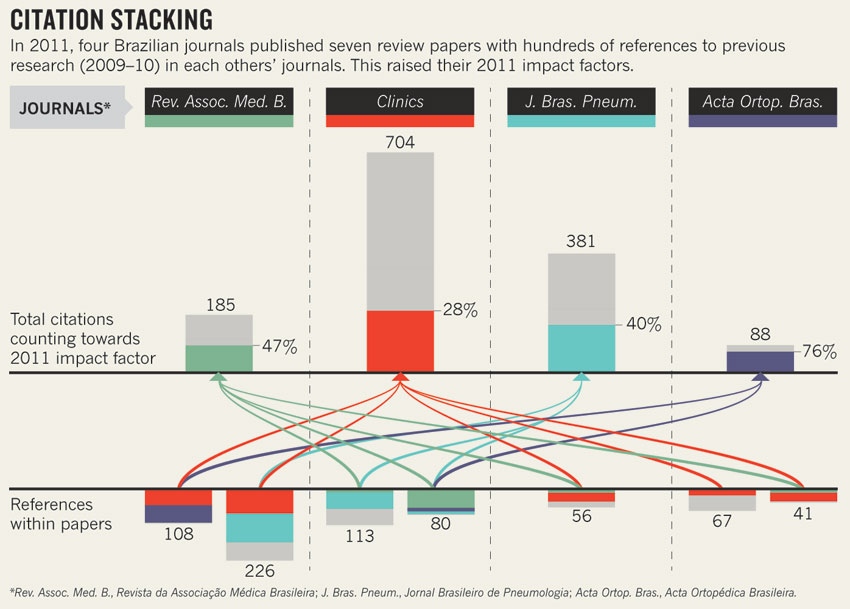
Mauricio Rocha-e-Silva thought that he had spotted an easy way to raise the profiles of Brazilian journals. From 2009, he and several other editors published articles containing hundreds of references to papers in each others’ journals — in order, he says, to elevate the journals’ impact factors.

Because each article avoided citing papers published by its own journal, the agreement flew under the radar of analyses that spot extremes in self-citation — until 19 June, when the pattern was discovered. Thomson Reuters, the firm that calculates and publishes the impact factor, revealed that it had designed a program to spot concentrated bursts of citations from one journal to another, a practice that it has dubbed ‘citation stacking’. Four Brazilian journals were among 14 to have their impact factors suspended for a year for such stacking. And in July, Rocha-e-Silva was fired from his position as editor of one of them, the journal Clinics, based in São Paulo.

…. Editors have tried before to artificially boost impact factors, usually by encouraging the citation of a journal’s own papers. Each year, Thomson Reuters detects and cracks down on excessive self-citation. This year alone, it red-flagged 23 more journals for the wearily familiar practice. But the revelation that journals have gained excessively from citations elsewhere suggests that some editors may be searching for less detectable ways to boost their journals’ profiles. In some cases, authors may be responsible for stacking, perhaps trying to boost citations of their own papers.

The journals flagged by the new algorithm extend beyond Brazil — but only in that case has an explanation for the results emerged. Rocha-e-Silva says the agreement grew out of frustration with his country’s fixation on impact factor. In Brazil, an agency in the education ministry, called CAPES, evaluates graduate programmes in part by the impact factors of the journals in which students publish research. As emerging Brazilian journals are in the lowest ranks, few graduates want to publish in them. This vicious cycle, in his view, prevents local journals improving.

Abel Packer, who coordinates Brazil’s system of free government-sponsored journals, known as SciELO, says that the citation-stacking venture was “unfortunate and unacceptable”. But he adds that many editors have long been similarly critical of the CAPES policy because it encourages local researchers to publish in high-impact journals, increasing the temptation for editors to artificially boost their own impact factors, he says.

Nature 500, 510–511 (29 August 2013) 

Read the article: doi:10.1038/500510a

University of Queensland asks for a paper to be retracted and returns a grant!

September 3, 2013

An unusual event in the academic world. Commendable and exemplary – I think.

The University of Queensland (not to be confused with the Queensland University of Technology – QUT – which has also recently been in the news) has taken the unusual step of asking a major journal to retract a paper published by a former staff member and has returned a grant from an NGO thought to have been awarded on the basis of the discredited paper.

The University Press Release ;

The University of Queensland (UQ) is investigating events that have led to the retraction of a paper published in an academic journal. 

As a result of its investigation to date, UQ has asked the journal that published the paper to retract it on the grounds that: “no primary data can be located, and no evidence has been found that the study described in the article was conducted.” 

A former UQ staff member from the Centre for Neurogenic Communication Disorders Research was corresponding author on the paper. 

Published online in October 2011 in the European Journal of Neurology, the paper was titledTreatment of articulatory dysfunction in Parkinson’s disease using repetitive transcranial magnetic stimulation. 

The journal has agreed to the retraction. 

The paper in question seems to be this one:

B. E. Murdoch(1), M. L. Ng(2) and C. H. S. Barwood(1), Treatment of articulatory dysfunction in Parkinson’s disease using repetitive transcranial magnetic stimulation,  European Journal of Neurology, 19: 340–347. doi: 10.1111/j.1468-1331.2011.03524.x

The paper has been cited 8 times.

Author Information

  1. Centre for Neurogenic Communication Disorders Research, School of Health and Rehabilitation Sciences, The University of Queensland, St. Lucia, Qld, Australia
  2. Speech Science Laboratory, Division of Speech and Hearing Sciences, The University of Hong Kong, Hong Kong, China

*B. E. Murdoch, School of Health and Rehabilitation Sciences, The University of Queensland, St. Lucia, Qld 4072, Australia

ABC News reports:

The University of Queensland says a Parkinson’s disease study published by a former staff member may not have actually been carried out.

The university released a statement today saying that “no primary data can be located, and no evidence has been found that the study described in the article was conducted.”

UQ has asked the academic journal that published the research to retract the article, and the journal has agreed. The university said Professor Bruce Murdoch, a former staff member from the university’s Centre for Neurogenic Communication Disorders Research, was one of the authors of the article.

… The investigation is continuing and the Crime and Misconduct Commission has been informed, the statement said.

UQ has also returned a $20,000 grant from “a non-government organisation” because it fears the money was allocated on the basis of information in the article.

It said there was no National Health and Medical Research Council (NHMRC) funding for the paper.

“By having the paper retracted, the university enables the global scientific community to learn that the research reported in the paper has no place in the body of scientific knowledge and so cannot be used as a basis for further research,” the statement said.

Obama (and entourage of 500) to paralyse Stockholm

September 3, 2013

Arlanda airport and Stockholm are places to be avoided for the next 2 days. Fortunately I don’t have to be in the area till next week.

President Barack Obama and his entourage of some 500-700 people will land at Arlanda airport in Stockholm tomorrow. He will spend a little over 24 hours in the Swedish capital and then leave for Saint Petersburg and the G20 summit on Thursday.

Not only will roads be closed to all traffic, even the subway will shut down while his convoy of some 50 vehicles passes overhead. Some Metro stations will shut down. It will “be the largest interference to public transport that Stockholm has ever seen”. In some areas even cyclists and pedestrians will have to find alternate routes.

On arrival on Wednesday he will have discussions with the Prime Minister and the Swedish Government,

The pair will discuss bilateral relations, regional and global political and economic developments, trade relations, climate and energy policies as well as various foreign policy areas, likely to include Syria. A joint press conference will be held after the meeting at the Rosenbad Conference Centre.

After the meeting, the Reinfeldt and Obama are set to head over to the Great Synagogue of Stockholm to honour Raoul Wallenberg, the Swedish diplomat who saved tens of thousands of Jews from the Holocaust.

Next, the two leaders will motor over to the Royal Institute of Technology (Kungliga Tekniska Högskolan, KTH) for a half hour look at the university’s energy innovation research. The programme will focus on Swedish innovations within the Chemical Science division, with specific attention paid to fuel cells and solar cells.

… Obama and Reinfeldt will then head for dinner, where they will be joined by the prime ministers of Finland, Denmark, Iceland and Norway.

He will likely spend the night at the Grand Hotel and will have lunch with the Royal family on Thursday before returning to Arlanda airport, Air Force 1 and his hop over to Russia.

Some minor demonstrations are expected but they will have far fewer people attending than the various parties being organised by various Swedish-American groups and societies.

Of course it is just a stop-over on his way to Russia and his mind may be preoccupied by Syria. Certainly the horde of journalists trailing in his wake will have little interest in things Swedish and will concentrate on Syria and what may transpire between Obama and Putin in the next few days.

But there are a number of matters that Obama could take up – or avoid – in a bilateral sense:

  1. He could thank someone (who?) for his Nobel Peace Prize. He can still bask in that glory till next week when strikes on Syria are implemented. In any event the prize cannot be revoked.
  2. He could thank the Swedish Government for not considering asylum for Snowden.
  3. He could thank the Swedish Government and prosecutors for cooperating in “stitching-up” Julian Assange.
  4. He will expect and demand that Fredrik Reinfeldt stand behind the US in confronting Putin about Syria. He will not have much resistance from this Swedish Government in that objective.
  5. Some of the UN samples collected in Syria are being analysed in Sweden and Obama will expect that the analysis results not contradict anything he or Kerry have alleged.
  6. He could discuss some joint PR to accompany the publication of the first part of the IPCC report on global warming at the end of the month.
  7. He is likely to avoid any discussion of the current hiatus in global warming firstly because he himself is a believer and secondly because there are more followers of the “global warming religion” in Sweden than there are members of the Swedish church.
  8. He will not expect that Sweden will even address the matter of the NSA’s indiscriminate spying  (and Carl Bildt has confirmed that this is not on the agenda).
  9. He may discuss the “Swedish model” which has received some attention in the US press though the general impression in the US remains that Sweden’s social welfare and health care system is just one little step removed from full-blown communism.
  10. However he may well ask how the the tax rebates for house-work and for house maintenance and repairs have contributed to real job creation.
  11. He is unlikely to discuss the fact that every “green job” in Sweden has cost at least two elsewhere in the economy and how renewable energy has increased the cost of electricity for the consumer.