Australian election show makes a quiet start

August 12, 2013

Elections in a number of countries have fantastic entertainment value.The campaigns, the scandals, the gaffes, the TV pundits, the “fringe” idiots and personal animosities all can contribute to the fun.  Of course a certain amount of distance and having a real interest in the country while not being overly affected by the result does increase the potential. In my case having friends in the country on both sides of the political divide adds to the “fun index”. The US Presidential Elections of course lead in the entertainment ratings. Even though they go on for much too long they usually manage to keep the flow of scandals and blunders coming and the inanity level high enough to maintain the “fun level”.

Generally it requires a strong divide between two major parties to inject some excitement for voyeurs like myself. Single party states don’t provide any level of uncertainty and have too high a level of election violence to have much entertainment value. Proportional Representation – as in most of Europe  – tends to reduce the excitement level but even in the Scandinavian countries does not manage to kill all the fun. Generally in much of Europe the inanity and “fun” comes from the idiot fringe parties – usually on the far right but also from a few remnants of hard Marxists and Maoists.

Following the US Presidential I would put the UK General Election next for fun and games. The political and media circus that accompanies the multiple waves of voting in the Indian General Election are always good entertainment. Then – in my estimation and reflecting my interests – come the Australian, German, French and Japanese Elections.

The first week of the Australian Election campaign called by Kevin Rudd is over. It has been relatively quiet and there has been no heat – yet – and no real fireworks. But I still have hope. Murdoch made his views known – as if there was anybody who did not know what they were. I suspect – but I am not sure – that the days of Murdoch being King-maker (as he was for Tony Blair) have long gone. His stuff is now all pay-walled and the cyberworld has passed him by.

Most of the fun in the first week of this election has actually come from a candidate – Stephanie Banister – representing one of the idiot right fringe parties. She got her knickers properly into a twist and confused the Koran with haram, haram with halal, halal with kosher, Islam with a country and Jews with the worship of Jesus. She quit the next day. Quite amusing but peripheral, short-lived and of little consequence.

Keven Rudd – having disposed ruthlessly of Julia Gillard – flexed his new-found muscles and sacked two of his own candidates. There was a faint whiff of an old gender scandal surrounding one of them and the other was accused of accusing others as being too Catholic and racist. ( A case of against.against= for?). Nobody except some union members, seemed to care very much.

Rudd sees himself as a Shakespearean hero in the assassination of Julia Gillard – “for Gillard is an honourable man” (and “man” here is intentional).  He aroused some feelings of  machismo among his supporters and his party “bounced” in the polls. But that bounce has now withered away and Abbott’s coalition is back in the lead. No real trends are visible yet. Last night there was a pretty tame TV debate. Rudd and Abbott shook hands and came out mewling.  Not much “roar” or “cut and thrust”. Rudd was very cautious and apparently “cheated” and had to make use of “crib-sheets” during the debate. As the SMH put it “More mock and bore than shock and awe, Sunday’s debate was a crushingly dull affair where risk avoidance was the chief aim of both sides.” Tony Abbot got his tongue in a twist and instead of “repository of all wisdom” used the phrase “suppository of all wisdom”! I suppose a suppository – for some – could also be a repository.

As entertainment goes it was not a compelling start. Moscow and Usain Bolt took clear precedence yesterday. But there is still time for the fun and games to get up to speed.

Noted in passing 11th August 2013

August 11, 2013

A little brief this week since we have had some flooding in the cellar following a storm.

We are now busy mopping up.

Chemical analyses of bones leading to recreating the life of archaeological finds.

A new word for my vocabulary – Scripophily.

Carl Zimmer takes George Monbiot to task for being too simplistic about recreating extinct species.

The  Perseid meteor shower  could be visible tonight and tomorrow night.

See Explanation.  Clicking on the picture will download  the highest resolution version available.

The Perseid Meteor Shower
Credit: Sirko Molau, IMO, Archenhold-Sternwarte

THE exam howlers

August 10, 2013

From this years submissions to the THE (not in any order of rank):

  1. “Sex has puzzled biologists ever since it was discovered by Darwin and Mendel.” (winning submission)
  2. “Eugenics was created by Charles Darwin’s cousin Gollum.”
  3. “Britain under the Cromwellian Protectorate was a piranha state.”
  4. “General Franco was supported by right-wing panties.”
  5. “Extremophiles can be defined as those that tolerate extremes of temperature, extremes of pH and extremes of pleasure.” 
  6. “Nigella seeds can cure all disease except death.”
  7. “Ebola could lead to death, in some cases fatal.”
  8. An Egyptian king,”was a pharaoh, not a common pheasant.”
  9. ..“depression rates are higher in areas of high social depravity.” 
  10. In a paper on HIV/AIDS transmission, as an example of “risky” behaviour likely to spread infection, a student listed “sharing a condom”.

  11. “Hadrian’s Wall’s heritage assets include a complex system of forts and earthworms.”
  12. “Stalin was extremely surprised when he was taken from behind by Hitler.”

Some rather interesting exam howlers can be found here.

“Carbon dioxide involved but not determinative in 100,000 year glacial cycles”

August 10, 2013

We are still struggling to explain what initiates an ice age (glaciation) and what causes them to end and the ice sheets to withdraw giving the interglacials.
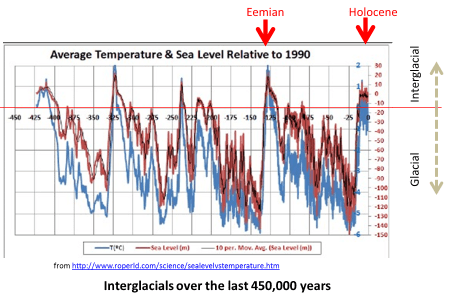
interglacials

That the Milankovitch cycles and variations of insolation are involved in the onset and retreat of glacial periods is clear but the “how” is still elusive. Now a new paper describes a model where the ice sheets and the mutual feedbacks with climate are considered.

“Carbon dioxide is involved, but is not determinative, in the evolution of the 100,000-year glacial cycles”.

Abe-Ouchi A, Saito F, Kawamura K, Raymo ME, Okuno J, Takahashi K, Blatter H: Insolation-driven 100,000-year glacial cycles and hysteresis of ice-sheet volume. Nature, 2013, 500: 190-193, doi: 10.1038/nature12374

ETH Press Release: 

Ice ages and warm periods have alternated fairly regularly in the Earth’s history: the Earth’s climate cools roughly every 100,000 years, with vast areas of North America, Europe and Asia being buried under thick ice sheets. Eventually, the pendulum swings back: it gets warmer and the ice masses melt. While geologists and climate physicists found solid evidence of this 100,000-year cycle in glacial moraines, marine sediments and arctic ice, until now they were unable to find a plausible explanation for it.

Using computer simulations, a Japanese, Swiss and American team including Heinz Blatter, an emeritus professor of physical climatology at ETH Zurich, has now managed to demonstrate that the ice-age/warm-period interchange depends heavily on the alternating influence of continental ice sheets and climate.

“If an entire continent is covered in a layer of ice that is 2,000 to 3,000 metres thick, the topography is completely different,” says Blatter, explaining this feedback effect. “This and the different albedo of glacial ice compared to ice-free earth lead to considerable changes in the surface temperature and the air circulation in the atmosphere.” Moreover, large-scale glaciation also alters the sea level and therefore the ocean currents, which also affects the climate. 

As the scientists from Tokyo University, ETH Zurich and Columbia University demonstrated in their paper published in the journal Nature, these feedback effects between the Earth and the climate occur on top of other known mechanisms. It has long been clear that the climate is greatly influenced by insolation on long-term time scales. Because the Earth’s rotation and its orbit around the sun periodically change slightly, the insolation also varies. If you examine this variation in detail, different overlapping cycles of around 20,000, 40,000 and 100,000 years are recognisable (see box).

Given the fact that the 100,000-year insolation cycle is comparatively weak, scientists could not easily explain the prominent 100,000-year-cycle of the ice ages with this information alone. With the aid of the feedback effects, however, this is now possible.

The researchers obtained their results from a comprehensive computer model, where they combined an ice-sheet simulation with an existing climate model, which enabled them to calculate the glaciation of the northern hemisphere for the last 400,000 years. The model not only takes the astronomical parameter values, ground topography and the physical flow properties of glacial ice into account but also especially the climate and feedback effects. “It’s the first time that the glaciation of the entire northern hemisphere has been simulated with a climate model that includes all the major aspects,” says Blatter.

Using the model, the researchers were also able to explain why ice ages always begin slowly and end relatively quickly. The ice-age ice masses accumulate over tens of thousands of years and recede within the space of a few thousand years. Now we know why: it is not only the surface temperature and precipitation that determine whether an ice sheet grows or shrinks. Due to the aforementioned feedback effects, its fate also depends on its size. “The larger the ice sheet, the colder the climate has to be to preserve it,” says Blatter. In the case of smaller continental ice sheets that are still forming, periods with a warmer climate are less likely to melt them. It is a different story with a large ice sheet that stretches into lower geographic latitudes: a comparatively brief warm spell of a few thousand years can be enough to cause an ice sheet to melt and herald the end of an ice age.

The Milankovitch cycles

The explanation for the cyclical alternation of ice and warm periods stems from Serbian mathematician Milutin Milankovitch (1879-1958), who calculated the changes in the Earth’s orbit and the resulting insolation on Earth, thus becoming the first to describe that the cyclical changes in insolation are the result of an overlapping of a whole series of cycles: the tilt of the Earth’s axis fluctuates by around two degrees in a 41,000-year cycle. Moreover, the Earth’s axis gyrates in a cycle of 26,000 years, much like a spinning top. Finally, the Earth’s elliptical orbit around the sun changes in a cycle of around 100,000 years in two respects: on the one hand, it changes from a weaker elliptical (circular) form into a stronger one. On the other hand, the axis of this ellipsis turns in the plane of the Earth’s orbit. The spinning of the Earth’s axis and the elliptical rotation of the axes cause the day on which the Earth is closest to the sun (perihelion) to migrate through the calendar year in a cycle of around 20,000 years: currently, it is at the beginning of January; in around 10,000 years, however, it will be at the beginning of July.

Based on his calculations, in 1941 Milankovitch postulated that insolation in the summer characterises the ice and warm periods at sixty-five degrees north, a theory that was rejected by the science community during his lifetime. From the 1970s, however, it gradually became clearer that it essentially coincides with the climate archives in marine sediments and ice cores. Nowadays, Milankovitch’s theory is widely accepted. “Milankovitch’s idea that insolation determines the ice ages was right in principle,” says Blatter. “However, science soon recognised that additional feedback effects in the climate system were necessary to explain ice ages. We are now able to name and identify these effects accurately.”

Download video: 

Simulated ice sheet change during the last glacial cycle (mov file, video: Abe-Ouchi et al. 2013)

Abstract: The growth and reduction of Northern Hemisphere ice sheets over the past million years is dominated by an approximately 100,000-year periodicity and a sawtooth pattern (gradual growth and fast termination). Milankovitch theory proposes that summer insolation at high northern latitudes drives the glacial cycles, and statistical tests have demonstrated that the glacial cycles are indeed linked to eccentricity, obliquity and precession cycles. Yet insolation alone cannot explain the strong 100,000-year cycle, suggesting that internal climatic feedbacks may also be at work. Earlier conceptual models, for example, showed that glacial terminations are associated with the build-up of Northern Hemisphere ‘excess ice’, but the physical mechanisms underpinning the 100,000-year cycle remain unclear. Here we show, using comprehensive climate and ice-sheet models, that insolation and internal feedbacks between the climate, the ice sheets and the lithosphere–asthenosphere system explain the 100,000-year periodicity. The responses of equilibrium states of ice sheets to summer insolation show hysteresis, with the shape and position of the hysteresis loop playing a key part in determining the periodicities of glacial cycles. The hysteresis loop of the North American ice sheet is such that after inception of the ice sheet, its mass balance remains mostly positive through several precession cycles, whose amplitudes decrease towards an eccentricity minimum. The larger the ice sheet grows and extends towards lower latitudes, the smaller is the insolation required to make the mass balance negative. Therefore, once a large ice sheet is established, a moderate increase in insolation is sufficient to trigger a negative mass balance, leading to an almost complete retreat of the ice sheet within several thousand years. This fast retreat is governed mainly by rapid ablation due to the lowered surface elevation resulting from delayed isostatic rebound, which is the lithosphere–asthenosphere response. Carbon dioxide is involved, but is not determinative, in the evolution of the 100,000-year glacial cycles.

What’s in a number? Defining a Mamillion

August 10, 2013

The New York Times reports today that the Japanese debt has reached one Quadrillion Yen (1015 Yen).

Japan’s soaring national debt, already more than twice the size of its economy, has reached a new milestone, surpassing one quadrillion yen.

A paltry million is the numeral one followed by six zeros. A billion? Nine zeros. A trillion is getting up there: 12 zeros. But the mighty quadrillion has 15 of them. … 

A quadrillion is a million billion, putting it into the kind of language used by middle schoolers to describe really humongous sums, along with gazillion and bazillion.

Measuring any currency in quadrillions brings to mind the hyperinflation of Germany between the wars, or Zimbabwe in the last decade. But a country with a real currency?

It is such a big and unusual word, describing such a big and unusual number, that its use is inconsistent: Bloomberg News used quadrillion in the headline of an early story on Friday about Japan’s debt, but later in the day the stories and headlines referred to a “thousand trillion,” which is not nearly as much fun.

…  How much is a quadrillion? The entire human body is said to have just 100 trillion cells; it takes 10 of us to make a quadrillion. Jeff Bezos has a personal fortune of some $25 billion, allowing him to plunk down $250 million for The Washington Post, which is essentially how much money he might find by looking behind his sofa cushions. To get to a quadrillion dollars, however, we would have to have 40,000 Bezoses, or as many people as live in Prescott, Ariz.

Neil deGrasse Tyson, the astrophysicist and director of the Hayden Planetarium at the American Museum of Natural History, helpfully offered a few other ways to think about a quadrillion. “It would take you 31 million years to count to a quadrillion — one number per second, never sleeping,” he said in an e-mail, adding that “a quadrillion yen, stacked in 1,000-yen notes, would ascend 70,000 miles high.”

He also wrote, though it is not clear how he would know such a thing, that “the total number of all sounds and words ever uttered by all humans who have ever lived is about 100 quadrillion.”

Numbers from 103 (Thousand) to 10123 (Quadragintillion) with the exponent increasing in steps of 3 and then upto 10603 (Ducentillion) in exponent steps of 30 and then upto 103003 (Milillion) in exponent steps of 300 have been named.

10100 is a Googol and 10Googol is a Googolplex.

But I cannot find a name for the relatively simple concept of one million raised to the power of one million.

A Zillion is undefined but language still needs such a word for a very large indeterminate number. Gazillion is often used instead of Zillion. The word “Million” itself is thought to have come about to represent a “Large Thousand” (from mille = thousand). A million raised to the power of itself would quite definitely be a Large Million.

So I propose a word to represent a “Large Million”, the mother of all millions,  a Ma Million

Mamillion = Millionmillion = 1,000,0001,000,000

Considering the magnitude of the current Japanese debt, it will be some time before the debt of the whole world reaches a Mamillion in whatever currency one cares to choose!.

“Romantic relationships” and their permissibility defined by UConn

August 9, 2013

A minefield where even angels would fear to tread – not that I am saying that the University of Connecticut is being foolish. In fact it is a move that many other Universities have already implemented.

Following the sexual misconduct and child molestation charges against a UConn professor, the University has taken the step of trying to define “romantic relationships” and what is permissible and what is not by adopting a new “Policy Against Discrimination, Harassment and Inappropriate Romantic Relationships”.

UConn romantic policy

Bustle: The University of Connecticut has officially banned romantic relationships between students and faculty members in their “Policy Against Discrimination, Harassment and Inappropriate Romantic Relationships.”

.. The Hartford Courant reports that UConn is defining romantic relationships fairly broadly, quoting Associate Vice President Elizabeth Conklin:

“Romantic is a term of art under the policy — but it is any sexual, intimate, amorous proposal or encounter. The relationship can be once, it can be short term, it can be long term, it can be a marriage — everything in between,” she said. “The intent is to capture it all … When you see it, you know it.”

Undergraduate relationships with faculty are totally banned, while graduate student-faculty relationships are a no-go only if the faculty member is in a position of power over the graduate student. So, in other words, I guess a chemistry grad student could have a relationship with an English professor, as long as they don’t have any kind of professional relationship.

The Courant: 

“The power difference between faculty and staff as compared to students means that any romantic relationship between a faculty or staff member and a student is potentially exploitative or could at any time be perceived as exploitative,” Herbst said.

A romantic relationship, as defined by the policy, “doesn’t have to involve champagne and flowers ……

In the wake of the still-unfolding Miller scandal, UConn said that even suspected relationships may fall under scrutiny.

“Deans, department heads, directors and supervisors should exercise great caution when choosing not to report a rumor of discrimination, harassment or inappropriate romantic relationships,” the university advised.

However, the university will not try to force the breakup of preexisting romantic relationships that would be banned under the new policy. But it will require any employee involved in one to report it within three months of Wednesday’s action by the trustees.

“The faculty member, staff member or graduate student in a position of authority must declare the existence of the relationship to the Office of Diversity and Equity … or the Office of Faculty and Staff Labor Relations,” according to a fact sheet released by UConn.

Also, the university said: “The appropriate dean or vice president … will consider whether steps can be taken to eliminate or minimize the conflict. … All parties will be told that not all conflicts can be eliminated, potentially limiting career or academic options for both of the parties involved in the relationship.”

Fluid jets and fishbones

August 9, 2013

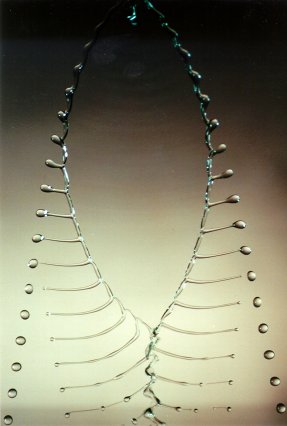
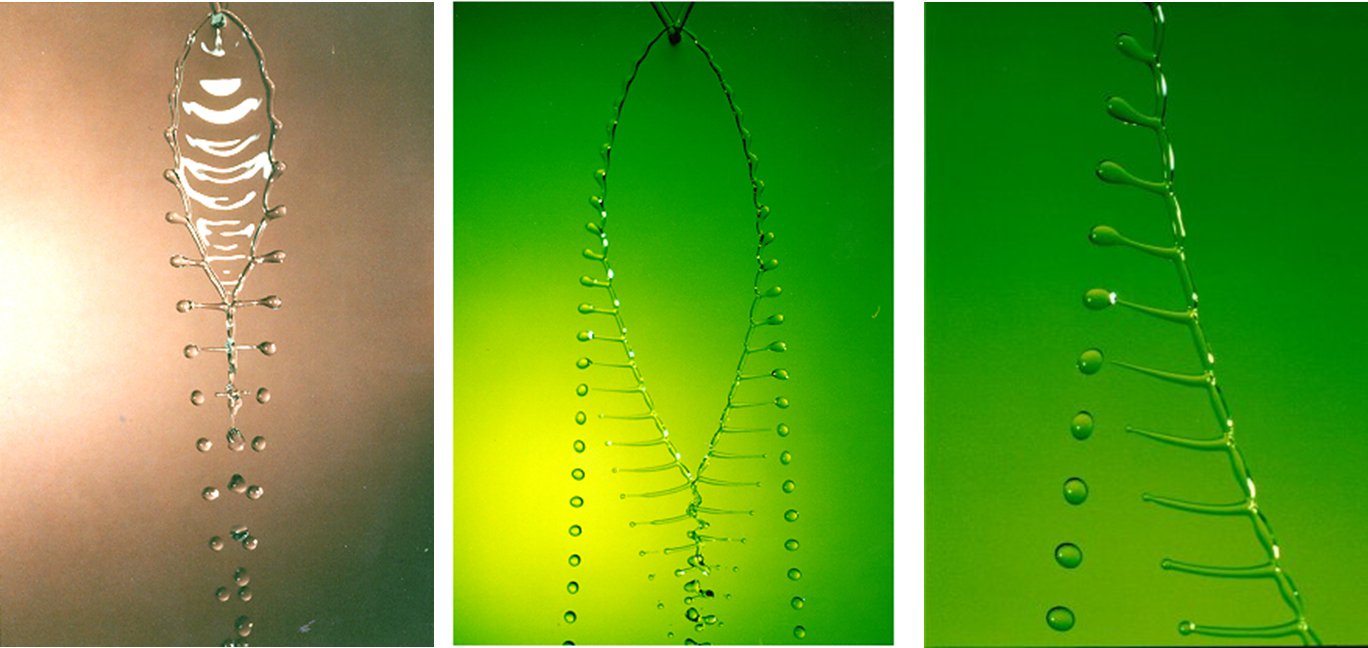
Just a few examples from a striking gallery of pictures by  John W. M. Bush (MIT Mathematics)

Colliding jets and the patterns that ensue.

Fishbone john bush

Fishbone john bush

fluids john bush

colliding jets john bush

We examine the form of the free surface flows resulting from the collision of equal jets at an oblique angle. Glycerol-water solutions with viscosities of 15-50 cS were pumped at flow rates of 10-40 cc/s through circular outlets with diameter 2 mm. … At low flow rates, the resulting stream takes the form of a steady fluid chain, a succession of mutually orthogonal fluid links, each comprised of a thin oval sheet bound by relatively thick fluid rims. The influence of viscosity serves to decrease the size of successive links, and the chain ultimately coalesces into a cylindrical stream. As the flow rate is increased, waves are excited on the sheet, and the fluid rims become unstable.  The rim appears blurred to the naked eye; however, strobe illumination reveals a remarkably regular and striking flow instability. Droplets form from the sheet rims but remain attached to the fluid sheet by tendrils of fluid that thin and eventually break. The resulting flow takes the form of fluid fishbones, with the fluid sheet being the fish head and the tendrils its bones. Increasing the flow rate serves to broaden the fishbones.  In the wake of the fluid fish, a regular array of drops obtains, the number and spacing of which is determined by the pinch-off of the fishbones. 

h/t Science is Beauty


A democratic police state?

August 9, 2013

Being “democratic” has increasingly become the cloak under which the oppression of minorities can be carried out without much criticism. Though constitutions are supposed to enshrine the values and fundamental principles which protect minorities from excesses of the “majority” –  following the majority view is itself the cornerstone for an ostensible “democracy”. And every constitution has built-in mechanisms – usually more complex than just a simple majority vote – by which it can be amended to suit the wishes of the majority.

Which is what happened in Egypt where a democratically elected Muslim Brotherhood put in place a constitution which would have ensured the oppression of non-Muslim minorities. Which is what applies in Russia where the majority feel more comfortable with an authoritarian government. Which is what is happening in Libya after the overthrow of Gadaffi’s regime. Which was happening in Tunisia. Which is happening in Hungary. Which has just happened in Zimbabwe. Which is what threatens in Afghanistan.

But it also happens in well established democracies. Coercive and oppressive measures to be applied to minorities can always be justified in any democracy provided it can be shown to be the “majority” view as expressed by the “democratic institutions” in place. To oppress a minority for “the common good” is always possible and justifiable – even in a supposed democracy.

And so it is also in the US. Actions which are more reminiscent of a police state of the cold-war era can be and are justified because Congress – as a democratic institution – allows it. If it was the objective of the 9/11 terrorists to undermine the democracy of the US, then the US – under the cloak of its “War on Terror” – has itself achieved part of that objective.

Ladar Levison who is the owner of the encrypted email service Lavabit has been forced to cease operation. Presumably because Snowden used the service. He has this to say:

My Fellow Users,

I have been forced to make a difficult decision: to become complicit in crimes against the American people or walk away from nearly ten years of hard work by shutting down Lavabit. After significant soul searching, I have decided to suspend operations. I wish that I could legally share with you the events that led to my decision. I cannot. I feel you deserve to know what’s going on–the first amendment is supposed to guarantee me the freedom to speak out in situations like this. Unfortunately, Congress has passed laws that say otherwise. As things currently stand, I cannot share my experiences over the last six weeks, even though I have twice made the appropriate requests.

What’s going to happen now? We’ve already started preparing the paperwork needed to continue to fight for the Constitution in the Fourth Circuit Court of Appeals. A favorable decision would allow me resurrect Lavabit as an American company.

This experience has taught me one very important lesson: without congressional action or a strong judicial precedent, I would _strongly_ recommend against anyone trusting their private data to a company with physical ties to the United States.

Sincerely,
Ladar Levison
Owner and Operator, Lavabit LLC

The New Yorker writes:

As Kevin Poulsen and others have pointed out, our collective experience has prepared us to guess what is going on here: Levison got either a national-security letter “or a full blown search or eavesdropping warrant.” In the weeks since the Guardian and Washington Post first began publishing stories with Snowden’s documents, the picture of the National Security Agency’s domestic-surveillance practices that’s come together is different from the one most everyone held before we’d ever heard Snowden’s name. And it has left the Administration’s explanations of what it does and doesn’t do looking pretty spotty, and at times just false. …..

…. The extreme example that an unnamed official gave Savage is a search for a phone number the N.S.A. believes terrorists are using to call each other. What about a name? Could the N.S.A. read e-mails from members of the public if they simply discuss the case of someone the government has said is a threat? It sounds like it. This is dangerous; we already have Senators constrained from talking about what they know. We can’t all be afraid to ask questions; for a democracy, the most threatening thing would be the absence of such conversations. ….

Gunboat diplomacy alive and well within the EU

August 9, 2013

Spain and England have a long history of going to war against each other but things have been quiet for some time. The last time Great Britain went to war against Spain was probably in the War of the Third Coalition from 1803-1806. The Spanish State under General Franco was officially non-belligerent during World War II.

David Cameron is still looking for his war like Thatcher found the Falklands and Tony Blair cynically used Iraq. Gibraltar is causing much sabre rattling and British warships have started rushing about (they haven’t got much else to do). But Cameron cannot really expect that he can engineer a suitable casualty-free, armed conflict around Gibraltar which can help him in the next election.

Daily Mail:

Westminster

HMS Westminster will set sail for Gibraltar on Monday -EPA via Daily Mail

A Royal Navy rapid reaction force is to set sail for Gibraltar on  Monday as tensions over the Rock continue to rise.

Ten vessels including the aircraft  carrier Illustrious, two frigates and support ships are heading to the waters off Gibraltar as part of an annual exercise.

But defence officials have revealed that three of them – the frigate Westminster and two support vessels – will call in at the British sovereign base at Gibraltar for three days, beginning on August 19.

In a show of force, the warships will practise ‘a range of operations’ including ‘deterring adversaries’.

Although diplomatic relations between Britain and Spain over Gibraltar have plunged into the deep freeze, the Ministry of Defence insisted that the mission, called Cougar ’13, is a long-planned exercise.

But senior government sources conceded that the timing is convenient since it will reassure the people of Gibraltar after Spain imposed draconian border checks in a  dispute over fishing.

And while the deployment could have been delayed to avoid upsetting the Spanish government, it was not.

A Whitehall source said: ‘The timing is not unhelpful. We could  have decided to call it off or divert it  away from Gibraltar to avoid offending  the Spanish. But there was absolutely no question of that

It is August and it is silly season and European Parliaments are on their summer vacations and politicians are afraid of not being in the public eye.

Arctic summer relatively short and ice melt-rate slow this year

August 9, 2013

The Arctic ice extent usually reaches a maximum in the 2nd week of March and its minimum during the 2nd week of September.

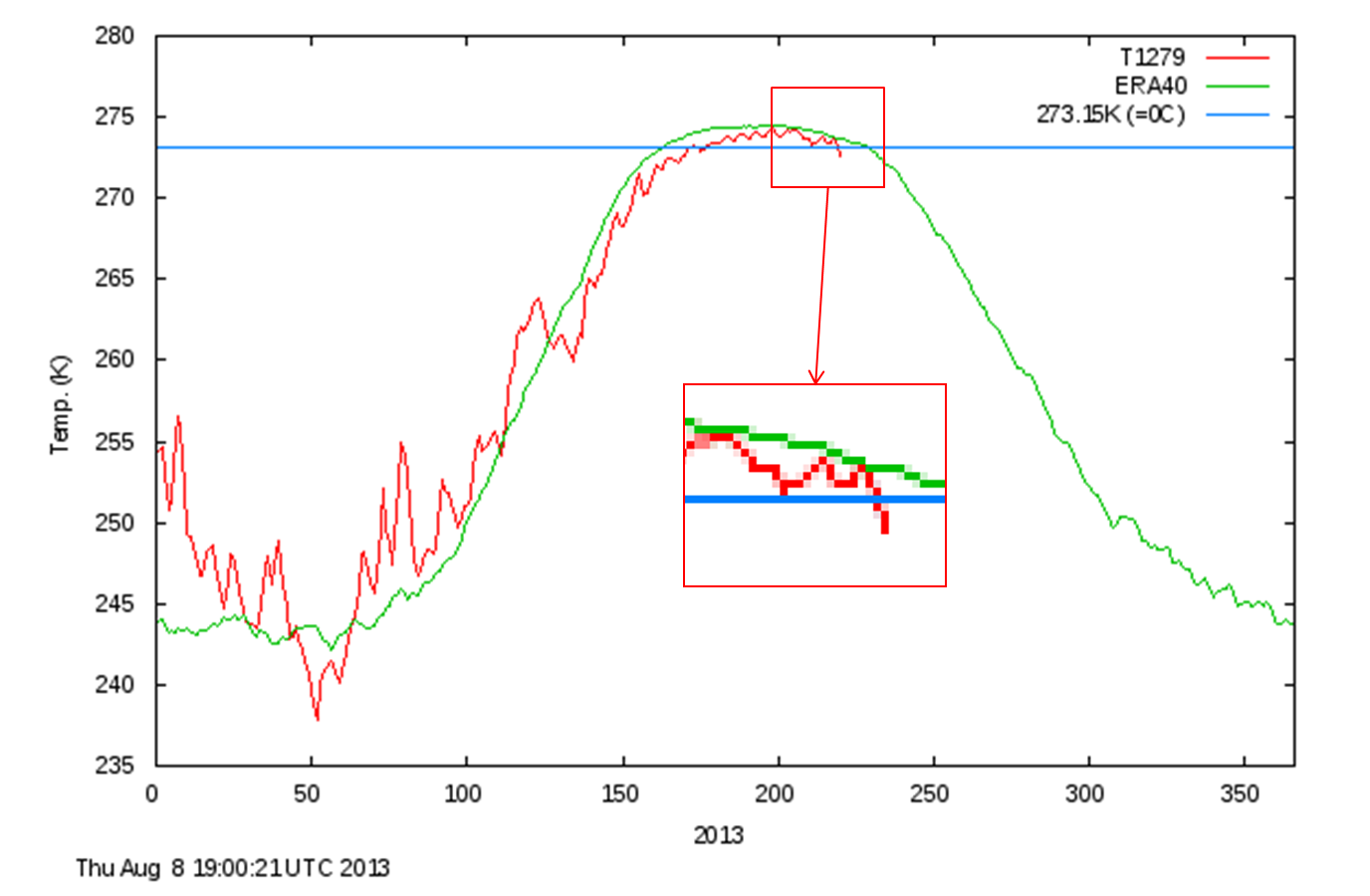
This year the Arctic summer started later than usual (long winter, late spring all over the Northern hemisphere). Now as Arctic temperatures have already dropped below freezing it could turn out to be a rather short. cool summer. Temperatures rose to above freezing about 3 weeks later than the average and seem to have dropped below zero about 2 weeks ahead of the average. In consequence the ice melt-rates have been much lower than for some time (but not unprecedented by a long way).

Arctic Temperatures North of 80° ( from DMI – Danish Centre for Ocean and Ice)

Daily mean temperatures for the Arctic area north of the 80th northern parallel, plotted with daily climate values calculated from the period 1958-2002.

Calculation of the Arctic Mean Temperature

The daily mean temperature of the Arctic area north of the 80th northern parallel is estimated from the average of the 00z and 12z analysis for all model grid points inside that area. The ERA40 reanalysis data set from ECMWF, has been applied to calculate daily mean temperatures for the period from 1958 to 2002, from 2002 to 2006 data from the global NWP model T511 is used and from 2006 to 2010 T799 data are used and from 2010 to present the T1279 model data are used. 

The ERA40 reanalysis data, has been applied to calculation of daily climate values that are plotted along with the daily analysis values in all plots. The data used to determine climate values is the full ERA40 data set, from 1958 to 2002.
More information can be found here.

Daily mean temperature and climate north of the 80th northern parallel, as a function of the day of year. DMI

Daily mean temperature and climate north of the 80th northern parallel, as a function of the day of year. DMI

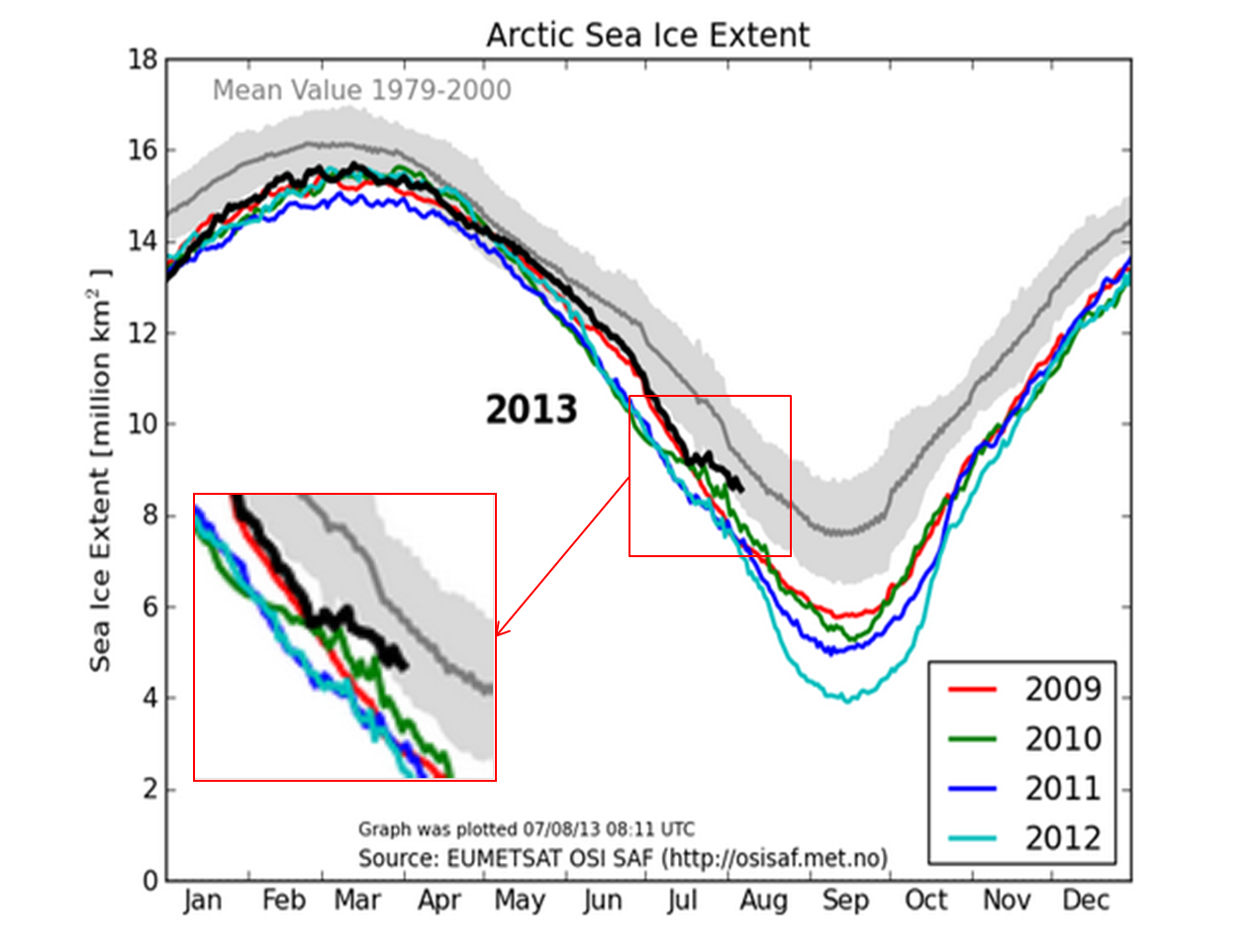
Not surprisingly the ice melt-rate this year has been relatively low and the ice extent relatively high.

Total sea ice extent on the northern hemisphere during the past years, including climate mean; plus/minus 1 standard deviation. The ice extent values are calculated from the ice type data from theOcean and Sea Ice, Satellite Application Facility (OSISAF), where areas with ice concentration higher than 15% are classified as ice.

The total area of sea ice is the sum of First Year Ice (FYI), Multi Year Ice (MYI) and the area of ambiguous ice types, from the OSISAF ice type product.

Sea ice extent in recent years for the northern hemisphere.                        The grey shaded area corresponds to the climate mean                       plus/minus 1 standard deviation.

Sea ice extent in recent years for the northern hemisphere.
The grey shaded area corresponds to the climate mean plus/minus 1 standard deviation.

It looks probable that the ice extent minimum for 2013 will be within one standard deviation of the mean 1979-2000 value.