“Just make up an elemental analysis…..”

August 8, 2013

ChemBark has the details of this case where sloppy writing and/or editing shows up some not so ethical behaviour:

Just make up the data..

Just make up the data ……

This instruction apparently from the senior author to the first author was found inadvertently left in the Supplemental Information for this paper – which has been archived here in case it disappears: SI Emma E Drinkel et al.

What is particularly noteworthy is the casual nature of the instruction to “just make up the data…”. It would almost appear that faking data is a routine and regular procedure. Less shocking but a telling commentary on the review process is that such a statement made it all the way to publication.

Emma E. Drinkel, Linglin Wu, Anthony Linden and Reto Dorta, Synthesis, Structure and Catalytic Studies of Palladium and Platinum Bissulfoxide Complexes, Organometallics, Article ASAP, DOI: 10.1021/om4000067

The affiliations of the authors is given as  the University of Zurich, but the senior author, Professor Reto Dorta now seems to be at the University of Western Australia while Emma Drinkel is in Brazil at the Universidade Federal de Santa Catarina.

ChemBark:

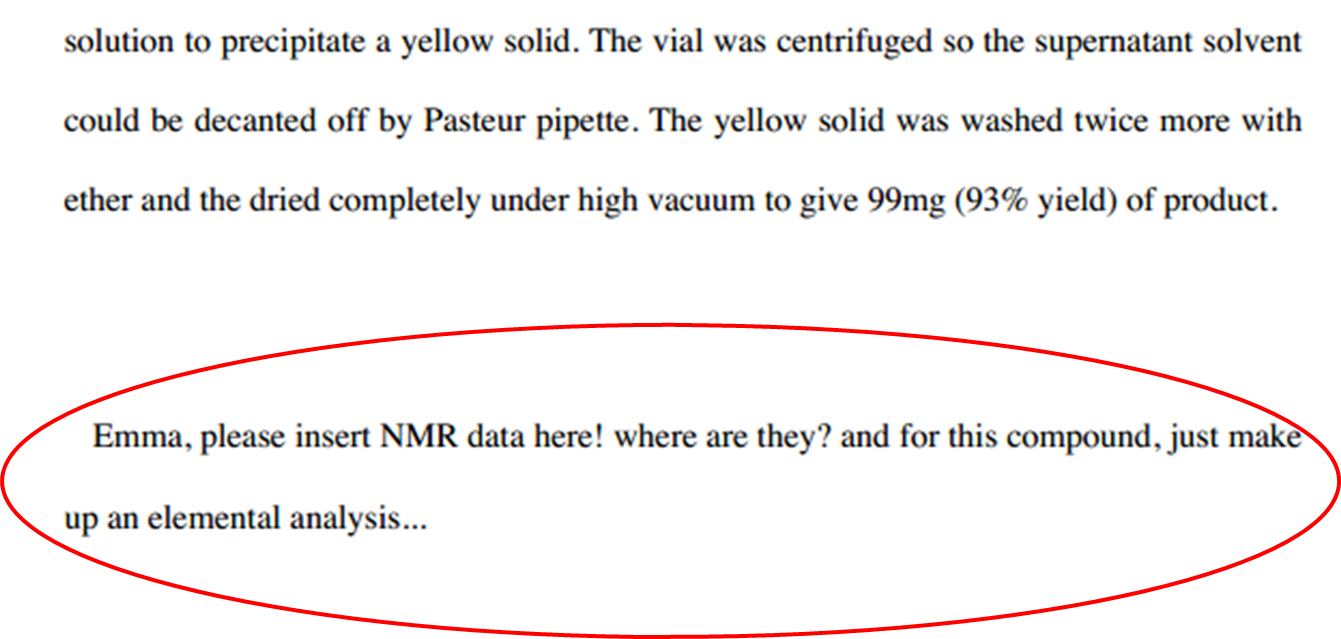
A recently published ASAP article in the journal Organometallics is sure to raise some eyebrows in the chemical community. While the paper itself is a straightforward study of palladium and platinum bis-sulfoxide complexes, page 12 of the corresponding Supporting Information file contains what appears to be an editorial note that was inadvertently left in the published document:

Emma, please insert NMR data here! where are they? and for this compound, just make up an elemental analysis…

This statement goes beyond a simple embarrassing failure to properly edit the manuscript, as it appears the first author is being instructed to fabricate data. Elemental analyses would be very easy to fabricate, and long-time readers of this blog will recall how fake elemental analyses were pivotal to Bengu Sezen’s campaign of fraud in the work she published from 2002 to 2005 out of Dalibor Sames’ lab at Columbia.

The compound labeled 14 (an acac complex) in the main paper does not appear to correspond to compound 14 in the SI. In fact, the bridged-dichloride compound appears to be listed an as unlabeled intermediate in Scheme 5, which should raise more eyebrows. Did the authors unlist the compound in order to avoid having to provide robust characterization for it? ….

Related:

 Insert data here … Did researcher instruct co-author to make up results for chemistry paper?

When Authors Forget to Fake an Elemental Analysis

US and Russia engage in the “disappointment” wars

August 8, 2013

“Disappointed” is the new in-word in diplomatic relations particularly between the US and Russia.

Everybody seems to be disappointed with everybody else.

With this amount of “disappointment” clearly going around there is a real risk of a “depression” setting in.

But at least its better than a “cold” war and a long, long way from a fire-fight”

” Very disappointed”. “Seriously disappointed”. “Deeply disappointed”

The diplomatic winner is the one who can express greater disappointment than the other.

  1. It’s Time to Admit Obama is a Disappointment 
  2. Despite ‘disappointment,’ Obama will travel to Russia
  3. Barack Obama ‘disappointed’ with Russia over Edward Snowden and ‘Cold War mentality’ 
  4.  Russia “disappointed” bilateral talks with US cancelled 
  5.  U.S. ‘deeply disappointed’ at Russian opposition leader conviction 
  6.  US disappointed by Russian court verdict in Magnitsky case 
  7. U.S. Government ‘Disappointed’ Hong Kong Let Snowden Leave 
  8. U.S. ‘very disappointed’ by Russian ban on U.S. meat. 
  9. Putin ‘Disappointed’ by Crushing Hockey Defeat to U.S. 
  10. Moscow Disappointed by EU Ending Syria Arms Embargo – Putin 
  11. U.N. chief “disappointed” by Assad’s speech on Syria crisis
  12. Parents disappointed in Russian adoption ban 
  13. Russia disappointed with US refusal to extradite Viktor Bout 
  14. Russia “disappointed” with UN Syria draft  
  15. US ‘disappointed’ that Britain not to extradite hacker
  16. EU, U.S. Disappointed by Ukrainian Ex-Minister’s Trial 
  17. Pussy Riot members jailed; Obama disappointed 
  18. US expresses “deep disappointment” over Hungary’s transfer of Azeri murderer
  19. Palestinians disappointed with Obama
  20. Netanyahu expresses ‘disappointment’ with Abbas’ UN speech

Ancient Sarmatian burial tomb of noble descendant of the Amazon warrior-women found intact

August 8, 2013
Sarmatian (Amazon) warriior woman (image from RealmsofGold)

Sarmatian (Amazon) warriior woman (image from RealmsofGold)

It is thought that the predecessors of the ancient warrior-women of the Sauromatian culture of central Asia dating from the 6th to the 4th century B.C.  could have been the inspiration for the Amazons of Homer’s Iliad. The Iliad possibly dates from the 8th or the 7th century B.C and describes

a race of fierce women who mated with vanquished male foes and kept only the female children they bore, were believed to occupy the area around the Black Sea. Amazon women also crop up in Greek myths. One of the labors of Hercules, for example, required him to acquire the girdle of the Amazon queen, Hippolyte.

… The works of the Greek historian Herodotus, written around the 5th century B.C., describe a group of female warriors who lost to the Greeks at the battle of Thermodon. Herodotus’ Amazons were taken prisoner and put on ships, but overwhelmed and killed the Greek crew. Unable to sail themselves, the women drifted to the shores of the Black Sea, to the territory of the Scythians, a nomadic culture of Iranian descent. The women, Herodotus says, intermarried with the Scythian men, and convinced their new husbands to move northeast across the flat grassy plains, high mountains, and searing deserts of the Russian steppes, where the group eventually evolved into the Sauromatian culture.

The Sauromatians were succeeded by the Sarmatians from around the 4th century B.C. who were also nomadic and fierce warriors who held their warrior-women  – now evolving into “noble” women –  in high regard:

The culture, which had been expanding its territory, soon shifts its focus. “They become raiders and traders, with forays to the west to interface with the Romans, and they relocate to cities and to areas along large trade routes,” …… “Their wealth increases. We see that in their burial items. We see strong, powerful women, but their role changes. We find burials of women that still retain cultic artifacts, indicating that they were a priestess of some sort, but there is much more gold and more secular ornamentation — more golden cups, more golden jewelry, elaborate things — and less weaponry. This type of evolution is a normal manifestation of culture.” 

Filippovka "Tsar Tumulus" mounds (Google Maps)

Filippovka “Tsar Tumulus” mounds (Google Maps)

The Sarmatians held sway for about 900 years until about 400 AD when they were overrun by barbarians from the West. Now a completely intact tomb of a Sarmatian noble woman dating from about 2500 years ago has been found at the  “Tsar Tumulus” mounds near Filippovka in Southern Russia reports RiaNovosti.

MOSCOW, August 6 (RIA Novosti) – Archaeologists have found the intact burial chamber of a noble woman from a powerful tribe that roamed the Eurasian steppes 2,500 years ago in southern Russia, an official said Tuesday.

The Sarmatians were a group of Persian-speaking tribes that controlled what is now parts of southern Russia, Ukraine and Central Asia from around 500 BC until 400 AD. They were often mentioned by ancient Greek historians and left luxurious tombs with exquisite golden and bronze artifacts that were often looted by gravediggers.

sarmatian trasures (image from en.ria.ru)

sarmatian trasures (image from en.ria.ru)

But the burial site found near the the village of Filippovka in the Orenburg region has not been robbed – and contained a giant bronze kettle, jewelry, a silver mirror and what appears to be containers for cosmetics, said history professor Gulnara Obydennova who heads the Institute of History and Legal Education in the city of Ufa.

“The find is really sensational also because the burial vault was intact – the objects and jewelry in it were found the way they had been placed by the ancient nomads,” she told RIA Novosti.

The vault – located 4 meters (13 feet) underground – was found in the “Tsar Tumulus,” a group of two dozen mounds where hundreds of golden and silver figurines of deer, griffins and camels, vessels and weapons have been found since the 1980s.

The woman’s skeleton was still covered with jewelry and decorations, and her left hand held a silver mirror with an ornamented golden handle, Obydennova said.

The descendants of the Sarmatians include Ossetians, an ethnic group living in the Caucasus region, who speak a language related to Persian.

From Realmsof Gold:

Accomplished horse-breeders and horsemen, Sarmatians were nomadic Indo-European tribes closely related to the Scythians. The Roman historian Ammianus Marcellinus describes Sarmatian tribesmen as “tall and handsome, their hair inclines to blond; by the ferocity of their gaze they inspire dread. They delight in danger and warfare.” 

A fascinating feature of Sarmatian society was the high status accorded to women. Sarmatian warrior queens were renowned in antiquity. Herodotus affirmed that the Sarmatians were descendants of the Amazons and Scythians, whose women “frequently hunted on horseback with their husbands; in war taking the field; and wore the very same dress as the men.” The Sarmatian tradition had it that “no girl should wed till she had killed a man in battle.” In ancient kurgans, sumptuous female burials often included swords and arrowheads together with elegant jewelry inlaid with dazzling gems in the Hellenistic style. Eastern campaigns of Alexander the Great (356-323 BC) spread Greek influences throughout his huge empire and exposed local artisans to new styles. The composite style that emerged is known as Hellenistic. 

The Sarmatians were overrun by the invasions of the Goths and Huns in the 3rd and 4th centuries AD. – 
The porter in red

August 7, 2013

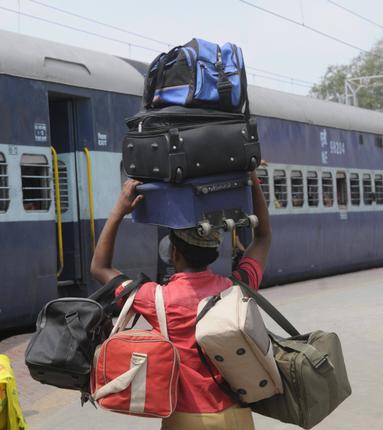
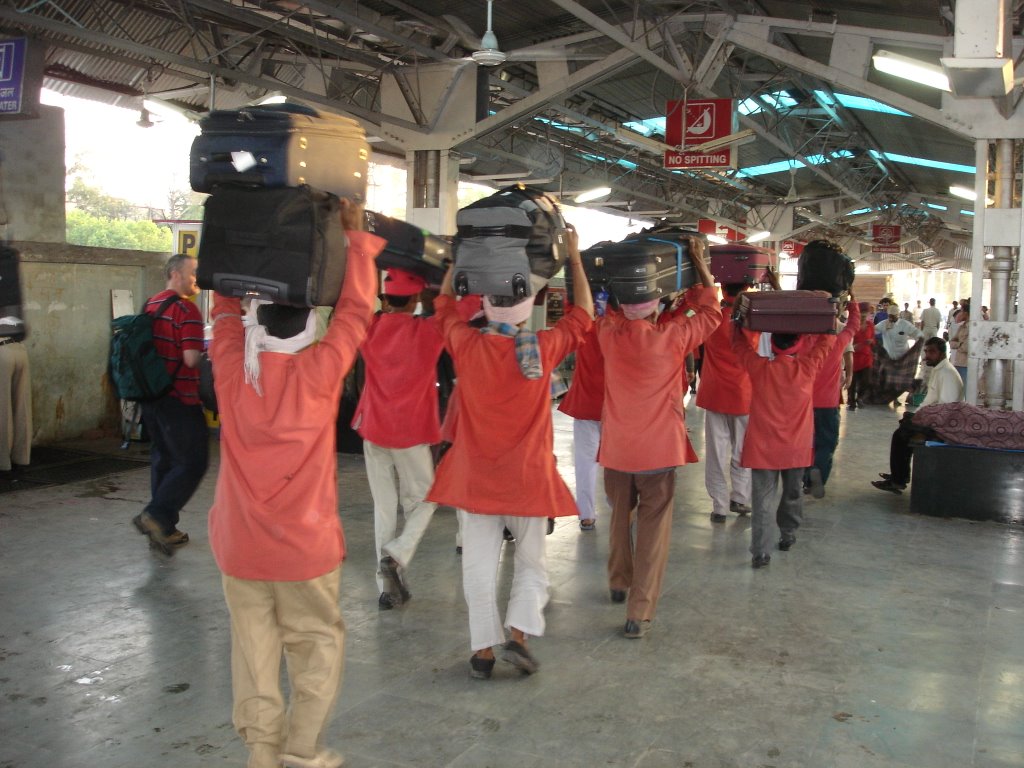
The Hindu carries a story on the tough life of a porter at an Indian Railway Station and it brought back memories from my childhood of travelling the length and breadth of India by train.

An integral part of the memories are about the man in red and his amazing abilities:

  1. first in the number of bags he could carry,
  2. second in the manner in which he got you and your luggage into your reserved seat on an Indian train
  3. while managing to navigate through the crowds ahead of you in spite of his burden
porter at an indian railway station 8The Hindu photo vijaya bhaskar)

porter at an indian railway station (The Hindu photo vijaya bhaskar)

Porters at Jabalpur


Another headline chasing psychologist is censured

August 7, 2013

What is it about social psychology and psychologists that causes them particularly to chase notoriety and public attention even to the extent of faking data? Diedrik Stapel and Marc Hauser being recent high profile cases. Could it just be that they are all suffer from a narcissism which can only be satisfied by generating headlines and generally being in the limelight?

Now a certain Geoffrey Miller – supposedly an “evolutionary psychologist” – has been publicly censured by New York University  for essentially behaving like an idiot and then lying about it. After tweeting a stupid and offensive remark he then tried to pass it off as part of a research project! He has now apologised – a bit late – and deleted the tweet. But his self-promotional intentions were recognised. Apparently he researches into how the human mind evolved. (Or as is pretty obvious –  didn’t evolve for some).

“The Tweeting activities of associate professor Geoffrey Miller did not rise to the level of research,” said a statement from the IRB on the university’s website.

“The board concluded that Miller’s Tweets were self-promotional in nature and did not follow research criteria which require specific research questions or hypotheses, systematic methods for collection quantitative and/or qualitative data and criteria for selecting respondents.”

He is an Associate Professor at the University of New Mexico and visiting NYU

The Times Higher Education covers the developments:

A US professor who Tweeted that if overweight PhD applicants “didn’t have the willpower to stop eating carbs” then they “won’t have the willpower to do a dissertation” has been formally censured by his university.

Geoffrey Miller Twitter page

Geoffrey Miller Twitter page

Geoffrey Miller, associate professor of psychology at the University of New Mexico, apologised after sending the Tweet, which he subsequently deleted. He later told UNM it had been part of a research project – a claim dismissed by the university. 

The institution has now formally censured Professor Miller for “misrepresenting to his department chair and colleagues the motivation for a Tweet”. 

“Miller at first claimed his Tweet was part of a research project, but investigations by the Institutional Review Board at New York University where he was a visiting professor, and the IRB at UNM where he is a tenured professor, concluded that was not correct,” a statement from his university read. 

As part of the censure, Professor Miller will be required to develop “a plan for sensitivity training as it pertains to obesity” in cooperation with the UNM psychology department, and apologise to colleagues for his behavior. 

Professor Miller, who can appeal the censure, will also have his work monitored by the chair of the psychology department, and will be assigned a faculty mentor for three years, with whom he will meet on a regular basis to discuss potential problems.

Stopping the light fantastic

August 7, 2013

The speed of light in a vacuum (c) is the immutable constant. Every shadow in the world is proof absolute that it can be prevented from reaching some places (by prior reflection and absorption). But light can also be slowed-down and stopped and even stored.

Light propagates at speeds less than (c) in different media. 

In 1999, Danish physicist Lene Vestergaard Hau led a combined team from Harvard University and the Rowland Institute for Science which succeeded in slowing a beam of light to about 17 meters per second, and researchers at UC Berkeley slowed the speed of light traveling through a semiconductor to 9.7 km/s in 2004. Hau later succeeded in stopping light completely, and developed methods by which it can be stopped and later restarted.This was in an effort to develop computers that will use only a fraction of the energy of today’s machines.

Back in 2007, Lene Hau showed that light could be “stopped” and then “restarted” a little distance away.

LeneHau.jpg

Lene Hau (image photonics.com)

CAMBRIDGE, Mass., Feb. 8, 2007 — By converting light into matter and then back again, physicists have for the first time stopped a light pulse and then restarted it a small distance away. This “quantum mechanical magic trick” provides unprecedented control over light and could have applications in fiber-optic communication and quantum information processing. 

In quantum networks, information optically transmitted over the network is converted into matter, processed, and then converted back into light. The physicists at Harvard University hope that their discovery could provide a possible way to do this, since matter, unlike light, can easily be manipulated. Their findings were published this week in the journal Nature.  

“We demonstrate that we can stop a light pulse in a supercooled sodium cloud, store the data contained within it, and totally extinguish it, only to reincarnate the pulse in another cloud two-tenths of a millimeter away,” said Lene Vestergaard Hau, Mallinckrodt Professor of Physics and of Applied Physics in Harvard’s Faculty of Arts and Sciences and School of Engineering and Applied Sciences.

But now comes evidence that it can be “stopped” and stored for a whole minute – and maybe even longer.

Georg Heinze, Christian Hubrich, Thomas Halfmann. Stopped Light and Image Storage by Electromagnetically Induced Transparency up to the Regime of One Minute. Physical Review Letters, 2013; 111 (3) DOI: 10.1103/PhysRevLett.111.033601

Abstract: The maximal storage duration is an important benchmark for memories. In quantized media, storage times are typically limited due to stochastic interactions with the environment. Also, optical memories based on electromagnetically induced transparency (EIT) suffer strongly from such decoherent effects. External magnetic control fields may reduce decoherence and increase EIT storage times considerably but also lead to complicated multilevel structures. These are hard to prepare perfectly in order to push storage times toward the theoretical limit, i.e., the population lifetime T1. We present a self-learning evolutionary strategy to efficiently drive an EIT-based memory. By combination of the self-learning loop for optimized optical preparation and improved dynamical decoupling, we extend EIT storage times in a doped solid above 40 s. Moreover, we demonstrate storage of images by EIT for 1 min. These ultralong storage times set a new benchmark for EIT-based memories. The concepts are also applicable to other storage protocols.

Hugues de Riedmatten writes in Physics:

A solid-state device can now store light coherently for up to one minute.

The ability to store light while keeping its quantum coherence properties (e.g., entanglement) plays an important role in quantum information science. It makes it possible to build quantum memories for light, which could become crucial elements in many quantum information processing schemes based on the use of photons, from quantum communication networks to quantum computing protocols. A critical parameter for applications is the duration over which light can be stored. For example, the distribution of quantum bits over complex quantum information networks, and their storage for further manipulation, might require quantum memories with storage time from a few seconds to a few minutes. Writing in Physical Review Letters, Georg Heinze at the University of Darmstadt, Germany, and colleagues report an important step towards this goal by demonstrating a solid-state coherent optical memory capable of storing a classical light pulse, and even a full image, for a duration of more than one minute—the longest light-storage time reported in any system to date.

For charities, charity begins at home

August 7, 2013

There are very few charities and NGO’s that command my unquestioning admiration. There are many where the stated objectives are something I would like to support. But in most cases their objectives do not withstand too much scrutiny. And whenever I try to do some background checks I end up finding that a political agenda lies behind the apparently worthy objective. Distortion of data to suit a political “cause” is all too common. In some cases they have merely become advocacy groups where their ends justify their means. Greenpeace, Friends of the Earth and the World Wildlife Fund – for many of their projects – have embraced coercion and are no longer trustworthy. Even the main stream organisations like the Red Cross in Sweden or Save the Children – for example – have had their share of scandals and cases of embezzlement of funds.

I am always amazed at how little of what is contributed by the general public ends up being disbursed on the ground. There are people with “sticky fingers” at every step of the “charity money trail”.

This in the Guardian only goes to support my view that many of the so-called charities have become organisations where the primary goal is to take care of their own. Once upon a time a charity-worker was one who commanded some admiration for his care for those in need.. No longer. For charities and many NGO’s, top executives – and staff in general – get salaries at such high levels that it can no longer be assumed that altruism plays any part.

Even with charities it seems that Greed – not Altruism – is the name of the game.

Leading charities have defended the income of their chief executives after research revealed that the number receiving six-figure salaries at Britain’s 14 biggest foreign aid charities has risen by nearly 60%, from 19 to 30, over the past three years.

The number of staff on salaries of more than £60,000 at charities – which form the 50-year-old Disasters Emergency Committee (DEC) and co-ordinate disaster relief during global emergencies – increased by 16%, to 192, between 2010 and 2012, the Daily Telegraph reported. Eleven of the executives were paid more than the prime minister’s salary of £142,500 a year in 2013, while some senior staff at some charities had pay rises despite falling revenues and donations.

William Shawcross, the chairman of the Charity Commission, said trustees of the charities should assess pay to judge if it is appropriate. “It is not for the commission to tell charities how much they should pay their executives. That is a matter for their trustees,” he told the newspaper. “However, in these difficult times, when many charities are experiencing shortfalls, trustees should consider whether very high salaries are really appropriate, and fair to both the donors and the taxpayers who fund charities. Disproportionate salaries risk bringing organisations and the wider charitable world into disrepute.”

…. The top earners whose pay increased included Sir Nicholas Young, the chief executive of the British Red Cross, who has received a 12% pay rise to £184,000 since 2010, despite a 1% fall in donations and a 3% fall in revenues.

Justin Forsyth, the chief executive of Save the Children, received £163,000 last year, while Anabel Hoult, its chief operating officer, was paid £168,653. Revenue at the charity has fallen by 3% since 2010, although donations are significantly up. A Save the Children spokesman said the charity paid competitive wages benchmarked against two external salary surveys. “We want to save more children’s lives. We can’t – and shouldn’t – compete with salaries in the private sector, but we need to pay enough to ensure we get the best people to help our work to stop children dying needless deaths.”

The salary of Chris Bain, the director of the Catholic aid charity Cafod, increased by 9% between 2010 and 2012, from £80,000 to £87,000. Over the same period donations and revenue rose 16% and 24% respectively. A Cafod spokesman said its director’s pay “remains much lower than any of his counterparts in the biggest non-governmental organisations, and has only risen in recent years in line with the increase for other Cafod members of staff”.

Richard Miller, the director at ActionAid, saw his pay rise by 8% to nearly £89,000 a year, while revenues and donations fell by 11%. Janet Convery, ActionAid’s director of communications, said: “Richard Miller’s salary is well below the market rate for a chief executive of a major development charity.”

The top paid executive at Christian Aid was Loretta Minghella, a former chief executive of the Financial Services Compensation Scheme, who was paid £126,072 this year, up from £119,123 in 2011. A Christian Aid spokesman said the charity had a “strict policy that requires us to set salaries at or below the median of other church-based and/or international development agencies”.

Yemen a clear target in US drone sights

August 6, 2013

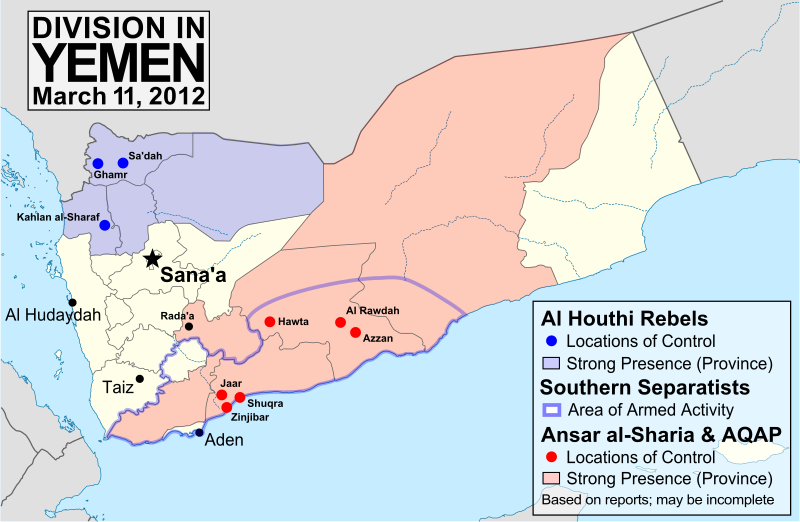
Perhaps it is all connected to the current global alert and threats of terrorist actions supposedly emanating from Yemen, but there certainly seems to be a major US operation ongoing in Yemen.

File:Yemen division 2012-3-11.svg

Yemen Divisions – wikipedia

UPDATE 2:

Drone strikes kill eight suspected militants in Yemen on Thursday 8th August

UPDATE!

Another 7 were killed in Yemen by US drone attacks on Wednesday, 7th August.

============================================

In the last 10 days since July 27th , there have been at least 4 drone attacks killing 17 people in Yemen.

  • July 27th: 6 killed in Abyan province
  • July 30th: 3 killed in drone attack on a car in Shabwa
  • August 1st: 4 killed in drone attack in Habramawt
  • 5th August: 4 killed on Tuesday when two unmanned aircraft fired four missiles at two vehicles in Wadi Abidah district. 

According to the Washington-based New America Foundation, the US killer drone attacks in Yemen almost tripled in 2012. 

The advantage with drone attacks is that they are impersonal, supposed to be clinically accurate, relatively cheap and put no personnel from the attacking side at risk. The downside is that they pre-empt any due process, are subject to the accuracy of very fallible intelligence gatherers and are inherently inhumane being “untouched by human hands”. And the civilians and children who frequently are killed on the ground get brushed under the carpet of “collateral damage”.

All those who have been killed recently in Yemen are said to have been affiliated with Al Qaeda.

But the dead cannot deny their alleged guilt and we will never know.

Apocalypse delayed – Himalayan researchers reverse earlier predictions of water shortages

August 6, 2013

I sense that some of the alarmism and the apocalyptic futures always associated with global warming hysteria are beginning to moderate.

Earlier predictions of water shortages due to the shrinkage of Himalayan glaciers are being reversed by new research which now predicts increased water flow in two Himalayan watersheds.

W. W. Immerzeel, F. Pellicciotti & M. F. P. Bierkens, Rising river flows throughout the twenty-first century in two Himalayan glacierized watersheds, Published online 04 August 2013, Nature Geoscience  (2013) doi:10.1038/ngeo1896

EnergyWire comments:

One of the big unknowns of climate change predictions — and one that has led to considerable contention — lies in knowing the future of water runoff from the Himalayas. The snow- and ice-rich region supplies water for billions of people in Asia and is sometimes referred to as the Earth’s “Third Pole.”

For years, scientists struggled to understand how precipitation will change in these mountains (ClimateWire, Oct. 24, 2011). They have also had difficulty determining how much glacier melt from the mountains contributes to water supply. 

A study out yesterday in Nature Geoscience by Walter Immerzeel, a physical geographer at Utrecht University, suggests that, in at least two major Himalayan watersheds, river flows and runoff should rise until 2100.

“We show that the peak in meltwater is later than we previously thought, which in combination with a projected increase in precipitation results in an increase in water availability until the end of the century,” he said.

The two watersheds Immerzeel reports on in the paper are those of the Baltoro and Langtang glaciers, which feed the Indus and Ganges rivers, respectively. In the Baltoro watershed, this is largely due to more glacier runoff from melt. In the Langtang, increased precipitation drives the extra runoff.

Immerzeel and his co-authors used the output of the latest global climate models from the Coupled Model Intercomparison Project (CMIP5) to look at temperature and precipitation projections. They combined that data with a hydrologic model of glacier responses to climate change.

They found that in both watersheds, runoff from glaciers should increase until the 2040s or 2060s, later than previous estimates, depending on which climate scenarios are applied.

….. In the paper, Immerzeel points out that his new finding contradicts previous work he has published, suggesting that runoff in the Indus and Ganges basin would decrease. At least for now, this is good news for people and farmers who rely on that water, he said.

“Strong increases in water demand are projected in the Indus as the food production needs to grow to feed the quickly rising population,” Immerzeel said. “An increased water availability from the mountains may help to sustain this growing demand.”

Abstract: Greater Himalayan glaciers are retreating and losing mass at rates comparable to glaciers in other regions of the world. Assessments of future changes and their associated hydrological impacts are scarce, oversimplify glacier dynamics or include a limited number of climate models. Here, we use results from the latest ensemble of climate models in combination with a high-resolution glacio-hydrological model to assess the hydrological impact of climate change on two climatically contrasting watersheds in the Greater Himalaya, the Baltoro and Langtang watersheds that drain into the Indus and Ganges rivers, respectively. We show that the largest uncertainty in future runoff is a result of variations in projected precipitation between climate models. In both watersheds, strong, but highly variable, increases in future runoff are projected and, despite the different characteristics of the watersheds, their responses are surprisingly similar. In both cases, glaciers will recede but net glacier melt runoff is on a rising limb at least until 2050. In combination with a positive change in precipitation, water availability during this century is not likely to decline. We conclude that river basins that depend on monsoon rains and glacier melt will continue to sustain the increasing water demands expected in these areas.

Asymmetric reversal of the Sun’s magnetic field is under way – NASA

August 6, 2013

The sun’s magnetic field reverses roughly every 11 years at solar maximum. We are now approaching solar maximum of solar cycle 24 (SC 24) but this magnetic reversal is strongly assymetric according to NASA:

“The sun’s north pole has already changed sign, while the south pole is racing to catch up,” says Scherrer. Soon, however, both poles will be reversed, and the second half of Solar Max will be underway.”

The North pole of the sun switched polarity in mid-2012 which seemed early at the time since solar maximum was not expected till the fall of 2013. It is difficult to imagine that there will not be consequences for the Earth but what those consequences might be is not a “settled science”.

Certainly geomagnetic reversals on Earth have more to do with the flow patterns in the earth’s liquid core and have quite different time periods. The time span between geomagnetic reversals on the Earth vary between 0.1 and 1 million years with an average of 450,000 years.

The latest one, the Brunhes–Matuyama reversal, occurred 780,000 years ago. However,a study published in 2012 by a group from the German Research Center for Geosciences suggests that a brief complete reversal occurred only 41,000 years ago during the last glacial period. The reversal lasted only about 440 years with the actual change of polarity lasting around 250 years.

From Dr. Leif Svalgaard’s research page:

Solar magnetic reversal cycle

The NASA press release says:

August 5, 2013:  Something big is about to happen on the sun.  According to measurements from NASA-supported observatories, the sun’s vast magnetic field is about to flip.

“It looks like we’re no more than 3 to 4 months away from a complete field reversal,” says solar physicist Todd Hoeksema of Stanford University. “This change will have ripple effects throughout the solar system.”

Read the rest of this entry »