Global warming theory lacks a falsifiable hypothesis and climate policy lacks Conditions of Success

June 21, 2013

In Science – to be considered a science – it is the formulation of the falsifiable hypothesis that is critical and ought to determine the subsequent collection or generation of data.

A fundamental requirement before setting out a new policy or embarking on any new course of action should be to define the Conditions of Success (CoS) prior to starting. This is usually so in industry and business – usually explicit but sometimes implicit – especially where investment is to be made or resources are to be used in implementing the new course of action:

  1. What are the objectives to be achieved, and
  2. how will we be able to measure if we are on track.

1. A Falsifiable Hypothesis:

The “global warming” hypothesis is that humans are impacting global climate and specifically that man-made carbon dioxide emissions are causing – through direct and indirect effects – the global climate to warm. But this formulation is virtually impossible either to prove or to falsify. With the many hundreds – if not thousands – of parameters which impact the chaotic system which makes up our climate, it is almost impossible to either collect or generate data which can isolate the effects of just this one parameter.

The prevailing “belief” that this hypothesis is correct is based on being able to say that observed warming is not inconsistent with climate models which include the warming due to anthropogenic emissions of carbon dioxide and that no better models exist. (The hiatus in temperature over the last 20 years is dismissed as being a “temporary” hiatus or due to some unknown effect – such as deep ocean take-up of heat – which is not included in the models). If no observation is permitted to falsify the hypothesis then this is merely a belief and a religion and not science.

However, the same global warming theory can easily be converted into a falsifiable hypothesis if it is formulated thus: “Increasing anthropogenic emissions of carbon dioxide have a significant warming effect on global climate”. This can then be subject to being proved false. The recent hiatus in global temperature then immediately leads to the conclusion that either

  1. the hypothesis is false, or
  2. the hypothesis must be modified to be
  3. “Increasing anthropogenic emissions of carbon dioxide may have a significant warming effect on global climate over long periods in excess of at least 50 years”

And then there is no longer any need for panic.

If the study of climate is ever to become science, the hypotheses will need to be revisited.

2. Conditions of Success

I am always somewhat perplexed that the global warming scare has led to the implementation of policies which – in not a single case – address the Conditions of Success. In no case of “decarbonisation” or carbon taxes or carbon credits or support for renewable energies is there any consideration of the measurements to be made to determine if the actions are having the desired effect.

It has been a blind rush into the support of solar and wind energy with no assessment of the increased electricity prices, the reduction of growth and the subsequent loss of jobs. In no country has there been a definition of the measurable results to be achieved along the way (except for measuring how much money was spent). Just the increase of the capacity of wind and solar power production has been taken to be a success though electricity prices have gone up sharply and no reduction of carbon dioxide concentration has been achieved. All the actions taken over the last 3 decades against the use of fossil fuels have had no impact whatsoever in reducing the rate of increase of carbon dioxide concentration in the atmosphere.

In the US the unexpected advent of shale gas has led to a reduction of carbon dioxide emissions though the global emissions are higher than ever before. And yet the global temperature has been at a standstill for almost 2 decades!

Of course for politicians carbon taxes and the like have become merely a source of revenue where the scare of “global warming” is used as a label merely to prevent resentment against a new tax. These taxes are invariably decoupled from any effects on the changes to carbon dioxide concentration and on global temperature to be achieved.

All these “climate” policies which have produced no reduction of carbon-dioxide concentration or even a reduction in the growth rate and where global temperatures have also failed to increase now seem needlessly self-destructive.

“Climate change policies” will never be credible or of any value until the Conditions of Success for such policies are defined in advance of such policies being implemented.
Carbon Cycle still has many uncertainties

June 20, 2013

How much of the increase in carbon dioxide concentration in the atmosphere is due to the use of fossil fuels is not as certain as many would like to believe. The role of the oceans both in the emission and the absorption of carbon dioxide is far from being understood or quantified. Emissions due to fossil fuel combustion are of the same magnitude as just the error band surrounding the emissions from the oceans and  from the emissions due to transpiration. The primary sources of carbon dioxide in the atmosphere are the oceans and transpiration. The assumption that these emissions are in balance with the absorption by the oceans and plant life is just an assumption based on an assumed equilibrium which is far from certain. I posted a few weeks ago

…. The general assumption is that about 40% of man-made carbon dioxide shows up as this increase with the remainder being absorbed by the enhanced action of sinks.

SOURCES AND SINKS OF CARBON DIOXIDE

The justification for this conclusion is supported by measurements of the falling proportion of  13C  in the atmosphere which is taken to signal the appearance of CO2 from fossil fuel emissions. …… 

The correlation of changes in δ13C with ENSO events and the comparison with a simple model of a series of cascades suggest that the changes in δ13C in the atmosphere have little to do with the input of CO2 emissions from the continuous use of fossil fuels.

Even though the combustion of fossil fuels only contributes less than 4% of total carbon dioxide production (about 26Gt/year of 800+GT/year), it is usually assumed that the sinks available balance the natural sources and that the carbon dioxide concentration – without the effects of man – would be largely in equilibrium.  (Why carbon dioxide concentration should not vary naturally escapes me!). It seems rather illogical to me to claim that sinks can somehow distinguish the source of carbon dioxide in the atmosphere and preferentially choose to absorb natural emissions and reject anthropogenic emissions! Also, there is no sink where the absorption rate would not increase with concentration.

Carbon dioxide emission sources (GT CO2/year)

  • Transpiration 440
  • Release from oceans 330
  • Fossil fuel combustion 26
  • Changing land use 6
  • Volcanoes and weathering 1

Carbon dioxide is accumulating in the atmosphere by about 15 GT CO2/ year. The accuracy of the amounts of carbon dioxide emitted by transpiration and by the oceans is no better than about 2 – 3% and that error band (+/- 20GT/year)  is itself almost as large as the total amount of emissions from fossil fuels. ….. 

Two new papers – in completely different fields – highlight the uncertainty in carbon dioxide emissions from the oceans and from plant and animal life:

1. Interannual variability in sea surface temperature and fCO2 changes in the Cariaco Basin Y.M. Astor et al, Deep-Sea Res. II (2013), http://dx.doi.org/10.1016/j.dsr2.2013.01.002i

The Hockey SchtickA new paper published in Deep-Sea Research finds the ocean is a net source of CO2 to the atmosphere, the opposite of claims by climate alarmists that the ocean removes CO2 from the atmosphere. According to the authors, “At the [research] site, the ocean is primarily a source of CO2 to the atmosphere, except during strong upwelling events.” The paper also notes, “Astor et al.(2005) observed the interactions between physical and biochemical parameters that lead to temporal [over time] variations in fCO2 [CO2 flux from the] sea, finding that even during periods of high production, the CO2 flux between the ocean and the atmosphere decreased but remained positive, i.e. CO2 escaped from the ocean to the atmosphere.” 

The paper corroborates prior work by SalbyHumlum et alFrölicher et alCho et alCalder et alFrancey et alAhlbeckPetterssonand others demonstrating that man-made CO2 is not the driver of atmospheric CO2. This new work confirms the primary source of atmospheric CO2 is out-gassing from the oceans, which is due to decreased solubility with increased temperature.

2. Michael S. Strickland, Dror Hawlena, Aspen Reese, Mark A. Bradford, and Oswald J. Schmitz. Trophic cascade alters ecosystem carbon exchangePNAS, 2013 DOI:10.1073/pnas.1305191110

EurekAlert: …. The study, conducted by researchers at the Yale School of Forestry & Environmental Studies, comes out this week in the Proceedings of the National Academy of Sciences. It looks at the relationship between grasshoppers and spiders—herbivores and predators in the study’s food chain—and how it affects the movement of carbon through a grassland ecosystem. Carbon, the basic building block of all organic tissue, moves through the food chain at varying speeds depending on whether it’s being consumed or being stored in the bodies of plants. However, this pathway is seldom looked at in terms of specific animal responses like fear from predation. …… 

….. The study found that the presence of spiders drove up the rate of carbon uptake by the plants by about 1.4 times more than when just grasshoppers were present and by 1.2 more times than when no animals were present. It was also revealed that the pattern of carbon storage in the plants changed when both herbivores and carnivores were present. The grasshoppers apparently were afraid of being eaten by the spiders and consumed less plant matter when the predators were around. The grasshoppers also shifted towards eating more herbs instead of grass under fearful scenarios.

At the same time, the grasses stored more carbon in their roots in a response to being disturbed at low levels when both herbivores and carnivores were present. In cases where only herbivores were present, the plants stored less carbon overall, likely due to the more intense eating habits of the herbivores that put pressure on plants to reduce their storage and breathe out carbon more. These stress impacts, then, caused both the plants and the herbivores to change their behaviors and change the composition of their local environment.

This disease could kill you deader than SARS could!

June 20, 2013

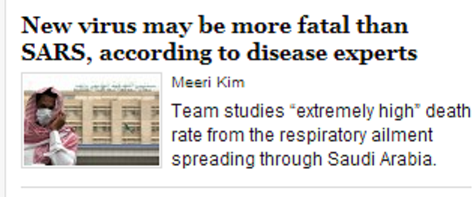
A new virus could kill you deader than SARS could says this headline from the Washington Post today (20th June 2013).

more fatal

more fatal

Popeye approves of carbon dioxide

June 19, 2013

From the HockeySchtick comes news close to Popeye’s stomach (which is of course the way to his heart).

Popeye like CO2, like spinach

Spinach like CO2, Popeye like CO2

A new paper published in Advances in Space Research finds increased levels of CO2 promote spinach productivity and accumulation of vitamin C in spinach leaves. According to the authors, “High light and high CO2 independently one from the other, promoted spinach productivity, and the accumulation of ascorbic acid [vitamin C], while their interactive effect limited the accumulation of nitrate and oxalic acid in the spinach leaves.” Decreased oxalic acid is beneficial for human nutrition because oxalic acid blocks absorption of essential minerals.

Influence of the interaction between light intensity and CO2 concentration on productivity and quality of spinach (Spinacia oleracea L.) grown in fully controlled environment

Author(s): Simona Proietti , Stefano Moscatello , Gene A. Giacomelli , Alberto Battistelli

Abstract: The effects of the factorial combination of two light intensities (200 and 800 μmol m-2 s-1) and two CO2 concentrations (360 and 800 ppm) were studied on the productivity and nutritional quality of spinach (Spinacia oleracea L.) grown under controlled environment. After 6 weeks within a growth chamber, spinach plants were sampled and analyzed for productivity and quality. There were no statistically significant interactions between the effects of light and CO2 for all of the variables studied, except for the nitrate and oxalic acid content of the leaves.High light and high CO2 independently one from the other, promoted spinach productivity, and the accumulation of ascorbic acid [vitamin C], while their interactive effect limited the accumulation of nitrate and oxalic acid in the spinach leaves. The results highlight the importance of considering the effects of the interaction among environmental variables on maximizing production and the nutritional quality of the food when cultivating and modeling the plant response in controlled environment systems such as for bioregenerative life support.

Erdogan blows Turkey’s prospects of joining the EU

June 19, 2013

It is not the protests in Turkey but Erdogan’s hard-handed approach to quelling the protests which may have blown Turkeys chances of joining the EU.

It is his response which provides a “politically correct” cloak under which many of those opposed to Turkey’s membership of the EU can hide. Their opposition is primarily because Turkey is an Islamist nation, but the police actions in Turkey come in very handy to hide behind. They can now use Erdogan’s “undemocratic” behaviour as their visible justification for their opposition. Angela Merkel and Germany have long been opposed to Turkey’s membership but have had to walk the tightrope of opposing while not seeming to be giving in to the neo-Nazis and their anti-Turkish campaigns within Germany. I caught Angela Merkel on TV two days ago and she was “apalled, utterly apalled” at the hard response of Erdogan’s police.

Hurriyet: Chancellor Angela Merkel’s conservatives have rejected Turkish membership in the European Union in their German election programme, saying the country would “overburden” the bloc because of its size and economy.

The Christian Democratic Union (CDU) and its Bavarian sister party, the Christian Social Union (CSU), have long opposed Turkey joining the 27-nation bloc, but haven’t stood in the way of EU accession talks that were launched shortly before Merkel took office.

The German line has hardened in recent weeks however because of Ankara’s tough response to three weeks of protests against Prime Minister Tayyip Erdoğan.

On June 17, Merkel said she was “appalled” at Turkey’s handling of the protests, which have turned into fierce clashes between police firing teargas and water cannon, and masked demonstrators throwing bottles and other missiles.

Turkey’s application to accede to the EU was first made 26 years ago in 1987.

 Turkey has been an associate member of the European Union (EU) and its predecessors since 1963. After the ten founding members, Turkey was one of the first countries to become a member of the Council of Europe in 1949, and was also a founding member of the Organisation for Economic Co-operation and Development (OECD) in 1961 and the Organization for Security and Co-operation in Europe (OSCE) in 1973. The country has also been an associate member of the Western European Union since 1992, and is a part of the “Western Europe” branch of the Western European and Others Group (WEOG) at the United Nations. Turkey signed a Customs Union agreement with the EU in 1995 and was officially recognised as a candidate for full membership on 12 December 1999, at the Helsinki summit of the European Council.

All things going well with the negotiations, membership would be on track for 2015. But there is fundamental opposition to an Islamist country of over 70 million becoming a full member. Sarkozy and the right in France were ( and still are) implacably opposed. For many Austrians, Turkey becoming a member would be close to sacrilege. The Spanish remember El Cid (Rodrigo Diaz de Vivar). Brussels (Barroso) has stated that full membership could – at the earliest – come by 2021. Turkey has implied that 2023 – when modern Turkey is 100 years old – may be a deadline.

In December 2011, a poll showed that as much as 71% of the participants surveyed in Austria, the Czech Republic, France, Germany, Italy, Poland, Spain and the UK were opposed to Turkey’s membership in the European Union.

Erdogan’s response to the protests could well provide the cover for the anti-Islamist forces in Europe to prevent Turkey’s accession to the EU for the foreseeable future.

Global proven oil reserves have never been as high as now

June 19, 2013

So much for peak oil!

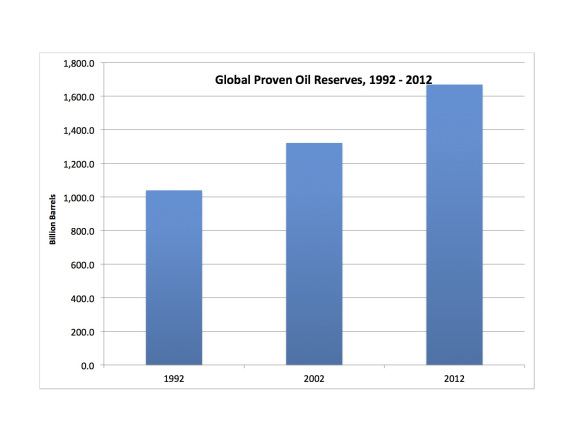
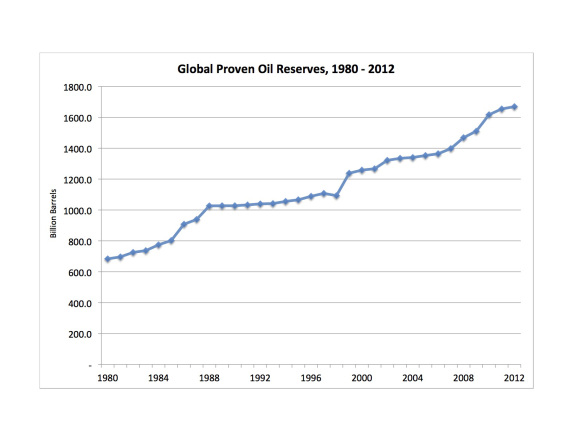
Proven oil reserves have increased by 144% since 1980 and 60% since 1992!

BP’s Statistical Review of World Energy 2013 is now out.

These two images are from Power Line’s Steven Hayward

Like the end of the whole peak oil hypothesis.  The first figure below displays the 60 percent growth in proven global oil reserves over the last 20 years.  This is not just the result of recent technological advances such as directional drilling and fracking: the second figure takes BP’s data back to 1980, which shows a steady increase in reserves throughout the period amounting to a 144 percent increase.  (That kink in the line in the late 1990s corresponds to the collapse in oil prices down to about $10 a barrel at the time.  Simple lesson: price matters.)  

global oil reserves 1992 - 2012 graphic hayward power line

global oil reserves 1992 – 2012 graphic hayward power line

Global oil reserves  1980 -2012 graphic hayward power line

Global oil reserves 1980 -2012 graphic hayward power line

UK Davey prefers “cutting off his nose to spite his face”

June 19, 2013

Ed Davey’s name calling of non-believers was widely reported :

Speaking on Tuesday in Brussels during a during a CBI/EU Corporate Leaders Group event, Davey warned the consequences of inaction in the face of record emission levels were severe, calling on the European Union to adopt a 50% carbon reduction target by 2030.

Davey's nose

Davey’s nose

“There will always be those with a vested interest in the status quo. Who seek to create doubt where there is certainty,” he said. “And you will always get crackpots and conspiracy theorists who will deny they have a nose on their face if it suits them.”

Considering the millions of jobs lost as a direct consequence of subsidising intermittent renewable energy and distorting the market through carbon credits and the like, Davey is clearly one who prefers

“cutting off his nose to spite his face”

Cutting off the nose to spite the face” is an expression used to describe a needlessly self-destructive over-reaction to a problem and I can think of few things as needlessly self-destructive as the the demonisation of carbon dioxide. 

And even without a nose Davey will continue breathing out 3 – 4% carbon dioxide with every breath!!!

Coping with climate change drove innovation

June 18, 2013

When and how innovation occurs sometimes seems random and the corporate world has long pursued the creation of “environments” in which innovation can flourish. And while the very definition of what counts as innovation can be debated, it seems to me that it is a changing environment rather than a static environment which is a key ingredient. And it could well be that the greater the change to be handled then the very necessity of coping with that change could be the “mother of all innovation”.

I suspect that some of the most fundamental innovations have been driven by the need not just to survive but also to thrive in “rapidly” changing and threatening environments. And climate change where “rapid” would mean several hundred if not thousands of years would also have been a powerful driver. One advantage in the stone age would have been that humans would have focused on coping with the change as it unfolded and not wasted too much effort in trying to control the climate.

A new paper addresses how climate change could have driven innovation in the stone age centered around the discovery and establishment of new refuges.

Ziegler, M. et al. Development of Middle Stone Age innovation linked to rapid climate changeNature Communications 4, Article number: 1905.

Abstract: The development of modernity in early human populations has been linked to pulsed phases of technological and behavioural innovation within the Middle Stone Age of South Africa. However, the trigger for these intermittent pulses of technological innovation is an enigma. Here we show that, contrary to some previous studies, the occurrence of innovation was tightly linked to abrupt climate change. Major innovational pulses occurred at times when South African climate changed rapidly towards more humid conditions, while northern sub-Saharan Africa experienced widespread droughts, as the Northern Hemisphere entered phases of extreme cooling. These millennial-scale teleconnections resulted from the bipolar seesaw behaviour of the Atlantic Ocean related to changes in the ocean circulation. These conditions led to humid pulses in South Africa and potentially to the creation of favourable environmental conditions. This strongly implies that innovational pulses of early modern human behaviour were climatically influenced and linked to the adoption of refugia.

PhysOrg reviews the paper:

According to a study by the Universitat Autònoma de Barcelona, the University of Cardiff and the Natural History Museum in London, technological innovation during the Stone Age occurred in fits and starts and was climate-driven. Abrupt changes in rainfall in South Africa 40,000 to 80,000 years ago triggered the development of technologies for finding refuge and the behaviour of modern humans. This study was recently published in Nature Communications.

Archaeological and genetic evidence suggests that modern humans (the modern form of Homo sapiens, our species) originated in Africa during the Stone Age, between 30,000 and 280,000 years ago. The latest  in southern Africa have shown that technological innovation, linked to the emergence of culture and modern behaviour, took place abruptly: the beginnings of symbolic expression, the making of tools from stone and bone, jewellery or the first agricultural settlements.

An international team of researchers has linked these pulses of innovation to the climate that prevailed in sub-Saharan Africa in that period.

Over the last million years the  has varied between  (with great masses of ice covering the continents in the northern hemisphere) and interglacial periods, with changes approximately every 100,000 years. But within these long periods there have been abrupt climate changes, sometimes happening in the space of just a few decades, with variations of up to 10ºC in the average temperature in the polar regions caused by changes in the Atlantic . These changes affected rainfall in southern Africa.

The researchers have pieced together how  varied in southern Africa over the last 100,000 years, by analysing  deposits at the edge of the continent, where every millimetre of  corresponds to 25 years of sedimentation. The ratio of iron (dissolved from the rocks by the water during the rains) to potassium (present in arid soils) in each of the millimetre layers is a record of the sediment carried by rivers and therefore of the rainfall throughout the whole period.

The reconstruction of the rainfall over 100,000 years shows a series of spikes that occurred between 40,000 and 80,000 years ago. These spikes show rainfall levels rising sharply over just a few decades, and falling off again soon afterwards, in a matter of centuries. This research has shown that the climate changes coincided with increases in population, activity and production of technology on the part of our ancestors, as seen in the archaeological records. In turn, the end of certain stone tool industries of the period coincides with the onset of a new, drier climate.

The findings confirm one of the principal models of Palaeolithic cultural evolution, which correlates technological innovation with the adoption of new refuges and with a resulting increase in population and social networks. For these researchers, the bursts of demographic expansion caused by climate change in southern Africa were probably key factors in the origin of modern humans’ behaviour in Africa, and in the dispersal of Homo sapiens from his ancestral home.


Reviews confirm that Medtronic’s spinal treatment “Infuse” provided little benefit

June 18, 2013

In 2011 The Spine Journal took on the morass of hyped scientific papers, multi-million dollar payments to researchers and adverse effects surrounding Medtronic’s Infuse product. As I posted in August 2011

Medtronic is the world’s largest medical device company and Minnesota’s seventh-largest public company based on revenue, which totaled $15.93 billion for the fiscal year that ended April 29. Medtronic’s Infuse product is a bioengineered bone-growth protein that has been used in spinal fusion procedures for the past nine years and is used in about half of the 80,000 anterior lumbar fusion procedures performed every year in the United States.

Now the NY Times reports that 

The controversy reached a climax in 2011, when a medical publication, The Spine Journal, devoted an issue to reports that repudiated the Medtronic-sponsored research, calling it misleading and biased. The journal’s move was significant because it is published by the nation’s biggest group of spine surgeons, the North American Spine Society.

Experts involved in research, like Dr. Zdeblick and Dr. Burkus, defended their work and insisted that their ties to Medtronic had not influenced them. But facing a firestorm, Medtronic agreed in 2011 to provide $2.5 million to Yale University to oversee an independent review of study data.

The resulting examinations, published Monday, involved reviews by two separate teams.

One of the teams, headed by scientists at Oregon Health and Science University in Portland, reported that Infuse appeared to have no advantages over a bone graft and might pose patient risks, including possibly a small added risk of cancer.

The other team, led by researchers at the University of York in England, found that Infuse fused spinal vertebrae more quickly than a bone graft but that the added speed appeared to lack clinical relevance.

Both the British and Oregon teams found no significant difference between Infuse and a bone graft in measures critical to patients, like reducing pain or improving physical function.

…… 

A professor at Yale who oversaw the review, Dr. Harlan M. Krumholz, said that while the two teams had slightly different findings, they pointed in the same direction.

“The general, overall picture is that they failed to find a big benefit,” for Infuse, Dr. Krumholz said. “And they found there might be some harms.”

Doctors and patients, he said, could use the review’s information to decide which treatment was best for them.

Some reviewers also concluded that the Medtronic-financed research had — unwittingly or not — presented a misleading picture.

“Selective reporting or underreporting of outcomes in journal publications may have misrepresented the benefits and harms,” of Infuse, the Oregon group wrote.

The selective reporting or under-reporting or non-reporting of scientific research to suit the commercial interests of the pharmaceutical and medical industries is not likely to disappear anytime soon. And Infuse is still in use and still generates significant revenues for Medtronic.

The review’s results, however, are likely to lead to further drops in Infuse sales. Annual sales of the product, which stood at about $900 million before The Spine Journal’s issue devoted to it, were $528 million in the company’s most recent fiscal year.”

Indian monsoon starts early and vigorously

June 17, 2013

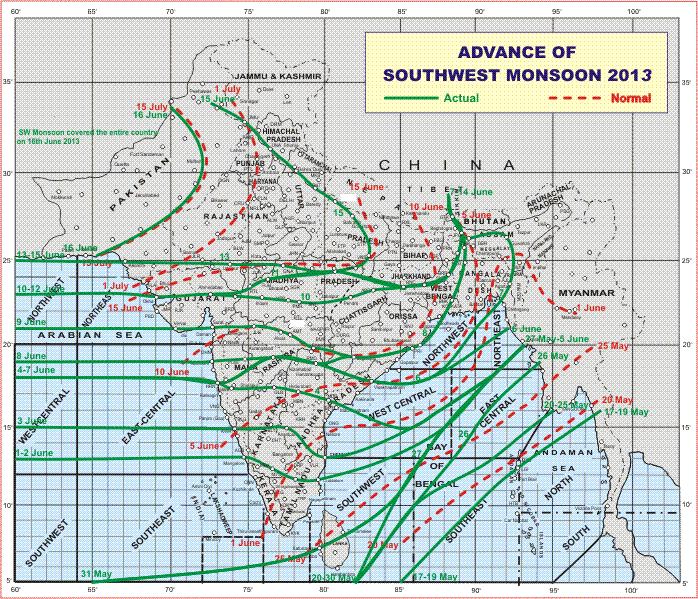
An almost spectacular start to the Indian monsoon and Delhi has received heavy rains almost two weeks earlier than expected. Two weeks of the official 4 month monsoon period (about 15%) are over and the welcome rains have covered the entire country around one month ahead of schedule. Over 30% of the total expected rainfall for a “normal” monsoon has already been received. So much so that the new airport in Delhi was flooded yesterday, not so much because of problems at the airport but because the drainage in the surrounding areas could not cope with the flow draining out of the airport and caused a back-flow!

Temperatures have dropped to a “pleasant” 31°C and it augurs well for my trip to Delhi in a couple of weeks.

Expectations for a “good” monsoon and a subsequently high level of agricultural growth are high.

ToI:The monsoon hit Delhi and its neighbourhood on Sunday, two weeks before time — and in a record sweep, swiftly covered all of northwest India. 

Besides reaching the capital well before the initially predicted date of June 29, a record occurrence unfolded in a span of 24 hours with the rain bearing system reaching the ends ofnorthwest India a full month before the usual July 15 date. The progress of rains to cover all of India as rapidly as happened over Saturday and Sunday last occurred in 1961. 

Delhi recorded 6.1 mm rain till 8.30 am and 45 mm in the next 12 hours. Palam recorded a day’s highest rainfall in the city in two years with 117.8 mm between 8.30 am and 5.30 pm. The showers have been so plentiful that Delhi will see the Yamuna cross the warning level and maybe even touch the danger mark by June 18. 

The city’s maximum temperature sharply fell to 31.5 degrees Celsius, eight degrees below normal while the minimum was 23.7 degrees.

From IMD:

monsoon 16 June 2013

monsoon 16 June 2013