UK shale gas deposits could be 10 times greater than thought

June 27, 2013

Reality bites!

The rush to fracking and shale gas goes on. There is no country which is not going to exploit the potential of much cheaper electricity generation and subsequent growth and job creation (and note that even Obama’s nonsense attack on carbon dioxide to placate the global warming fanatics takes great care to avoid any attack on shale gas). Shale gas recovery – unlike some other technologies – will not need any subsidies.

Now the British Geological Survey has reported that the UK shale gas deposits are huge and much, much larger than originally thought and “peak gas” has disappeared over the horizon.

BBC: 

UK shale gas resources may be far greater than previously thought, a report for the government says.

The British Geological Survey was asked to estimate how much gas is trapped in rocks beneath Lancashire and Yorkshire.

It said there could be 1,300 trillion cubic feet at one site alone, but it is unclear how much could be extracted.

Ministers are set to announce financial benefits for communities where fracking – the controversial extraction technique – takes place.

BBC industry correspondent John Moylan says the government is also likely to announce plans for tax incentives to encourage investment in shale gas, and a streamlining of the process to award drilling permits.

He describes the BGS survey as potentially a “landmark” moment.

The exploitation of shale gas and oil revolutionised the energy industry in the US, although there are questions over whether the same thing can be repeated in the UK. … 

Breaking! Julia Gillard retires to her knitting

June 26, 2013

Well, the election whenever it comes might now be a little more interesting. But Abbott is almost nondescript and Rudd is a more blatant “promise breaker” than even Julia Gillard. It will be fascinating to see how the Australian electorate make their choice of the “least worst” option!

(But I wonder whether it is an inherent disadvantage of “party politics” which constrains choices such that electorates continue to have to choose from among scandal-tainted or otherwise unsavoury individuals – as in Italy for example.)

==========

Update 57 Rudd – 45 Gillard

Gillard the back stabber guillotined by a Kevin Rudd returning from his grave!

=====================

Looks like Kevin Rudd – who not so long ago – stated that he could see no circumstances in which he would lead the Labour Party has managed – finally – to get his revenge and oust Julia Gillard.

The knitting story seems prophetic now.

Julia Gillard Women's Weekly

View of the US after Snowden

June 26, 2013

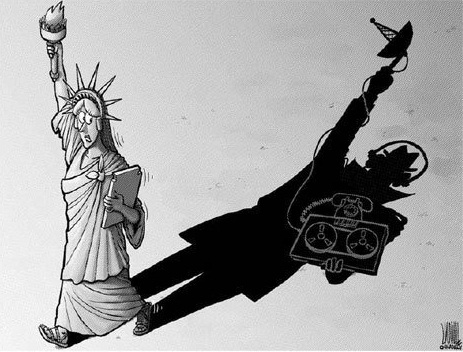
The Snowden affaire allows many to now point fingers at the apparent hypocrisy of the US supporting civil rights in other countries but not at home.

This from the China Daily of 13th June by Luo Jie:

China_statue_of_liberty_cartoon

Climate model results depend upon which computer they run on!

June 26, 2013

Robust models indeed.

Washington Post:

New Weather Service supercomputer faces chaos

The National Weather Service is currently in the process of transitioning its primary computer model, the Global Forecast System (GFS), from an old supercomputer to a brand new one.  However, before the switch can be approved, the GFS model on the new computer must generate forecasts indistinguishable from the forecasts on the old one.

One expects that ought not to be a problem, and to the best of my 30+ years of personal experience at the NWS, it has not been.  But now, chaos has unexpectedly become a factor and differences have emerged in forecasts produced by the identical computer model but run on different computers.

This experience closely parallels Ed Lorenz’s experiments in the 1960s, which led serendipitously to development of chaos theory (aka “butterfly effect). What Lorenz found – to his complete surprise – was that forecasts run with identically the same (simplistic) weather forecast model diverged from one another as forecast length increased solely due to even minute differences inadvertently introduced into the starting analyses (“initial conditions”). ..

……

Carbon dioxide idiocy – perhaps the EPA should make flatulence punishable

June 26, 2013

Reading Obama’s “Climate Plan” almost  drives me to despair at the idiocy of man!

Obama climate action plan

exhaust gas compositions


But only almost.

We have always had idiots and even evolution will not eliminate idiocy. And because like most “policy” statements from whoever is President of the United States, it is 90% rhetoric and 10% substance. He has enough weasel words in there to approve the Keystone XL Pipeline and he will not stop the burning of shale gas or the production of shale oil or the export of coal!! He will continue wasting money on nonsense and subsidising useless things which will prolong the lunacy for a little while.

Every living thing converts carbon to carbon dioxide  – the new pollutant. And the argument that it is a matter of scale does not hold. But perhaps we and all our animals can wear Carbon Sequestration masks? And maybe Obama could make flatulence punishable?

The oceans determine the carbon dioxide concentration and not man. I suppose that it will only be when the carbon dioxide concentration in the atmosphere begins to fall – as it will within 2 decades  – that the lunacy might begin to end.

When is a strawberry dead?

June 25, 2013

An interesting discussion yesterday on BBC Radio

What Is Death?

Series 8 Episode 1 of 6 Monday 24 June 2013

“What Is Death?”

In the first of a new series of the award winning science/comedy series, Brian Cox and Robin Ince are joined on stage by comedian Katy Brand, biochemist Nick Lane and forensic anthropologist Sue Black to discuss why death is such an inevitable feature of a living planet. As well as revisiting such weighty scientific issues, such as when can a strawberry, be truly declared to be dead, they’ll also explore the scientific process of death, its evolutionary purpose and whether it is scientifically possibly to avoid it all together.

The death of a strawberry had apparently been discussed on an earlier program last year:

Brian Cox Strawberry

A fascinating discussion regarding when a cell can be truly considered “dead” though I couldn’t quite agree that death was necessary to evolution. Only birth is of course. It would be pretty crowded without death but life – or death – after procreation no longer has any part to play in the passing on of genes to the next generation or on evolution. With immortality there would, of course, be no need for procreation or for any future generations. But if immortal beings did beget other immortal beings then an Infinite Universe would come in very handy. However, the fertility rate needed for replenishment of the mortal members of a species is unconnected to the longevity of the individuals and I cannot see that death, per se, has any impact on evolution.

As far as the life and death of a strawberry are concerned it seemed to me that the question was essentially meaningless. You could as well ask if your finger could be alive when it no longer was connected to your body. A finger -like a strawberry is never truly alive unless connected to the body that it is a part of and the question of life or death when it is separated from its host body is moot.

Self-replicating fingers – or strawberries – would make John Wyndham’s Triffids seem benign.

Julia Gillard preparing for retirement?

June 25, 2013

The polls suggest that Julia Gillard has little chance at the September (latest November) elections and it would seem that she is preparing for the inevitable.

But Julia as a Madame Defarge like a tricoteuse at her own political “execution” is probably too fanciful.

The Guardian: Australian prime minister, Julia Gillard, has whipped up a storm after appearing in the Australian Women’s Weekly knitting a toy kangaroo for the royal baby.

The photoshoot depicts the prime minister in an armchair, surrounded by balls of wool, with her dog Reuben at her feet.

The pictures have sparked controversy in parts of the Australian media, who have called it “contrived” and “remarkable”. Commentators have pointed out that Gillard has traditionally rejected feminine presentations

Julia Gillard Women's Weekly

Julia Gillard  – Tricoteuse? – Women’s Weekly via The Guardian

It could be that she’s looking for a suitable Royal Honour once she leaves Office. Dame Julia? or maybe she’s just knitting for the coming demise of the Carbon Tax?

Subsidies for renewables have only done harm

June 25, 2013

There is a place for solar and wind and tidal and wave energy.  But intermittent and unpredictable sources as these all are cannot be used to satisfy our base load demands. If used – when available – to augment our conventional sources (mainly fossil fuels, hydro and nuclear power) they can play a very useful role – eventually – in reducing the cost of producing power. But this presupposes that they are competitive with conventional production. And they can be in specific situations and especially in remote locations or where grid power is limited.

But subsidies have rarely enabled new technologies to become commercially viable. They tend to isolate and preserve the developers of the new technology from commercial pressures and are usually counter-productive.  By loading conventional fossil fuel sources with short-sighted and useless taxes and by providing hefty subsidies for building solar and wind power the electricity market has been distorted to a destructive and unsustainable extent. Two articles recently address the utter failure of the subsidy regime.

1. Agence-France Press June 23, 2013 00:31

Spanish downturn a disaster for green energy

Spain’s wind turbine manufacturers are laying off workers and farmers who installed solar panels are facing ruin as austerity policies afflict the long-coddled green energy sector.

Further cuts are expected this summer.

State subsidies to clean energy producers have already fallen by between 12 and 40 percent on average in recent years, industry analysts say.

They could fall by another 10-20 percent in a new energy sector reform expected mid-July, according to the Spanish media. …. 

In the middle of the last decade when the economy was enjoying strong growth, Spain put a cap on the price of green energies and provided “fairly generous” subsidies, said Carlos Garcia Suarez, expert in the sector at the IE Business School. …..

2. The Commentator, 21 June 2013

The ‘Great Renewables Scam’ unravels

In many parts of northern Europe, wind and solar projects may be highly visible facts on the ground. But the headline economic fact behind renewable energy is, and always has been, its sheer and blatant “unsustainability”.

Energy insiders have long known that the notion of ‘renewable energy’ is a romantic proposition – and an economic bust. But it is amazing what the lure of guaranteed ‘few strings attached’ government subsidies can achieve. Even the Big Oil companies bought into the renewables revolution, albeit mostly for PR reasons. Like Shell, however, many quickly abandoned their fledgling renewable arms. Post-2008, they knew, the subsidy regimes could not last. Neither was the public buying into the new PR message.

Now it was just a question of time before Europe’s world leading pioneers of solar and wind power, Germany and the UK, decided they had had enough of the self-inflicted economic pain. And all the signs are – as Germany’s solar sector just went belly up and the UK is made aware of how much every wind job actually costs – that the slow implosion of the renewables revolution is under way.

The plain fact is that installing solar panels, especially in the northern hemisphere, makes about as much economic sense as Iran heading up a UN Human Rights Commission (which it has done by the way). Equally, the viability of windfarms has always been the renewables industry’s worst kept secret.

And yet, aided by aggressive and heavily-funded green lobbies, leftist social engineers, appalling journalism, naive politicians and unscrupulous opportunistic renewable energy entrepreneurs, wind turbines and the photovoltaic industry quickly became established facts on the ground, giving the appearance of economic ‘viability’. Why else would government back them using our cash? …… 

… In Europe, Germany was a major green pioneer, especially regarding solar energy. The UK, being the windiest country in Europe, focused on wind power. In both countries, however – to mix metaphors – the wheels are fast coming off.

In June, the sun finally set on Germany’s solar sector with power companies, large and small, seeing their £21 billion investment in solar energy disappear into the ether. As one German commentator wryly observed: “the sun does send an invoice after all”.

By mid-June the German company Siemens announced it was winding down its solar division with a view to shutting down completely by next spring. Siemens had entered the solar thermal systems market when it bought the Israeli company Solel, believing market growth would be rapid. The gamble failed. Siemens lost around €1 billion.

In March, Bosch signalled its withdrawal from the solar cell and solar module market. Bosch board chairman Franz Fehrenbach, who had been behind the company’s push into solar energy since 2008 has further admitted that the German solar sector generally is “doomed to die”. Bosch will lose even more than Siemens, probably around €2.4 billion.

But it is the private investors who bore the full brunt of the loss as the former hot shots of the stock exchange, Germany’s SolarWorld and Q-Cells, among other solar companies, lost tens of billions in capital investment.

Meanwhile, in the UK, wind power is again making the headlines, but for all the wrong reasons. A new analysis of government and industry figures revealed that every UK wind industry job is effectively subsidized to the tune of £100,000 per year. In some cases it rises to £1.3 million per job. In Scotland, with its 230 onshore windfarms, the figure is £154,000 per job. Even if the highly optimistic maximum projection of 75,000 wind industry jobs by 2020 is realised the figure would only drop to £80,000.

But, as the Renewable Energy Foundation, a UK think-tank, has pointed out, to meet its EU obligation of providing 15 percent of its generated energy from renewable sources by 2020 – a ridiculously untenable goal – the lavish subsidies will need to rise still further to £6 billion per year. Neither do the figures take into account the cost to the country of an exodus of energy-intensive industries; a very real threat if green levies on energy bills continue to rise. European industry and power stations have already turned to burning millions of imported tonnes of American wood pellets in a desperate bid to keep costs down. And that, as has been reported, is to the detriment of fine forests in the US and a resultant impact on CO2 levels. ….

The future for human evolution

June 25, 2013

The future of human evolution is secure as we develop into more robust species.

From The Onion:

Image of Mollusca

ANN ARBOR, MI—In a breakthrough study that researchers say adds important insight into the evolution of Homo sapiens, scientists at the University of Michigan confirmed Thursday that human beings are slowly evolving into mollusks. “Evidence shows that modern humans emerged on the evolutionary timeline about 200,000 years ago, developed into the highly evolved hominids of today, and are now transforming into soft-bodied invertebrates,” said the study’s lead author Dr. Mitch Keneally, adding humans have already started turning into snails, slugs, and octopi, evidenced by their increasingly amorphous figures. “Over the next 1,000 years, we’re going to see people developing gills, a hard protective shell around their torsos, and a large, muscular foot in their dorsal region that will help with locomotion and mucus secretion. The world is changing rapidly, and those who can’t filter seawater aren’t going to be able to survive.” Scientists added that the evolutionary trajectory isn’t all that surprising considering that mollusks themselves descended from monkeys just 5,000 years ago.

Flying Railway Wagons

June 23, 2013

Logo EPFL

Many times when boarding large aircraft I have fantasised about having a cabin module instead of the waiting lounge, where passengers could take their places at leisure. When filled, the module would slide into the aircraft and lock into place just like the modular containers containing baggage. Now Swiss researchers are realising my fantasies with a futuristic concept for a modular aircraft consisting of

  1. A flying wing that includes the cockpit, the motors, and the fuel and
  2. Up to three flexible modules (capsules) that can carry either passengers, freight, or fuel.

Clip Air concept from Ecole Polytechnique Federale de Lausanne

They see their “Clip-Air” craft having modules where the  maximum dimensions of each capsule would becomparable to the fuselage of an A320 with a maximum weight of 30 tons and a length of 30 meters (the length of a train wagon) and where:

  • Dimensions of the flying wing: wing-span of 60 meters
  • Motors: 3, identical to those of the A320 (Swiss version)
  • Passengers: Together, the three modules can carry a total of 450 passengers.

The aircraft would allow passengers to board a module at a railway station and disembark at their destination without ever setting foot in an airport.

Clip Air EPFL

Rail transport’s flexibility in air transport?

How could this conundrum be unraveled? Clip-Air proposes a revolutionary air transport concept based on a flying wing that can carry mobile and interchangeable capsules. On the one hand, the Clip-Air plane is made up of a support structure including wings, engines, fuel and a cockpit. On the other hand, there is the load to be transported: passengers and freight.

The capsule is the equivalent to a conventional airplane’s fuselage, but without motors, without a cockpit, without fuel, without landing gear, or any of the other parts that usually make up a plane. The premise behind Clip-Air is to bring rail transport’s flexibility to air transport and to make airports reach all the way into railway stations.

Potential
Theoretical studies have shown Clip-Air’s potential in terms of transport capacity. In the scenarios that were analyzed, Clip-Air was able to transport more passengers than a standard fleet thanks to a more efficient allocation of the available capacity.

Based on various hypotheses, the estimated costs of Clip-Air are also competitive. In 89% of the analyzed cases, Clip-Air generates a profit. According to the model that is currently being considered, carrying passengers without combined cargo transport, Clip-Air is actually less expensive than a standard fleet, as long as it operates carrying three capsules. The architecture of modular aircraft is remarkably vast, and a flying wing carrying three capsules is but one possible choice. However, whether the aircraft is designed to carry one, two, or three capsules, its modularity is what makes this project strong.

Architecture and design
How should a flying wing be designed? How can the capsules be made as functional as possible? The extraordinary challenge lies in finding the most adapted architecture that incorporates all of the compromises involved in achieving such a project. A team of engineers is working on finding the most optimal design, rethinking everything from the materials used to the details of the attachment system, so that the latest technologies can be leveraged whenever possible.

Energy
Clip-Air is revolutionary in its design, but it must also be so in its choice of fuel. In the current stage of the project, Clip-Air has clearly proven its potential to adapt to tomorrow’s renewable energy challenges. Numerous alternative paths have been explored internally and have demonstrated the utility of a modular architecture (with liquid hydrogen, biofuels, classical fuel).

Security
The complete separation of the cockpit (located under the wing) and the passengers (in the capsules) opens new doors in terms of security with, most notably, a reduced risk due to the decoupling between the fuel reservoirs and the passengers.

Aeronautics
Aeronautical engineers assure that Clip-Air can fly, but many questions remain to be addressed. Future developments of the project will involve aerodynamic simulations and a six meters long flying prototype equipped with propulsion engines to explore the aircraft’s flight performance and the overall feasibility of the project.

Clip Air in “flight”: EPFL