The Wuhan virus and common sense

July 26, 2020

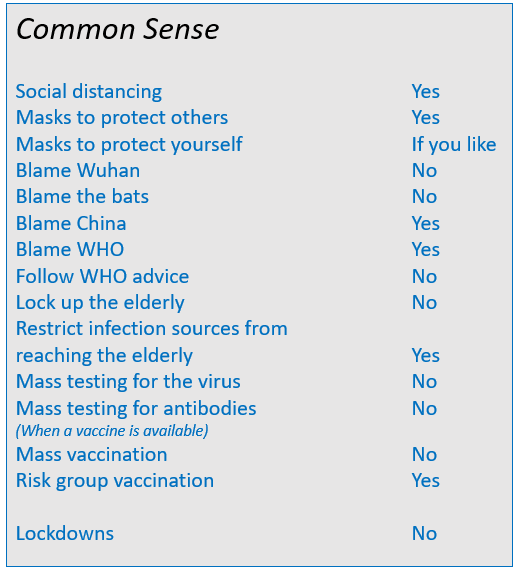
Common sense went on vacation sometime in March 2020.

It seems to be an extended vacation and it is not certain when it will return.

Virus sense

Lockdowns seem to be counterproductive. They solve nothing. Instead they extend the life of the virus and prolong the pandemic. They could have maximized the global death toll. The only positive is that they may reduce the load on the hospitals.

The two areas where Sweden got it wrong were:

  • they did not restrict infection sources from reaching the care homes, and
  • they locked up the elderly in their “infected prisons”

But all the rest they did right.


Epidemiology is still more art than science and sometimes just speculation

July 24, 2020

The Wuhan virus, after 6 months, is still not under control.

I have grown a little tired of being told by all kinds of people that they are just following the science in the fight against the Wuhan virus. What science? There is a widespread delusion that epidemiology is a “settled science”. Epidemiology is, in reality, a mix of science and art and of “social science” (which is always a politicized view of behaviour). It is about “the frequency and pattern of health events in a population”. With a little known virus, as in this case, epidemiology relies on models and speculation. When the speculation is garbage, the model results are also, necessarily, garbage. The model results have ranged from the ridiculously complacent to the grotesquely alarmist, but what they all have in common is that they are/were wrong. Nothing surprising in that. That is the nature of modelling. A mathematical model is nothing more than a crystal ball and model results are always forecasts of the future. The problem lies in the delusion that epidemiology is an exact science and that model results give a sound and certain basis for public policy.

In the absence of a vaccine we are being led (or misled) by politicians blindly following the epidemiologists’ speculations about both the characteristics of the unknown virus and about social behaviour. In the space of 4 months the “best” epidemiologists at the WHO have changed their view of the Wuhan virus from being “non communicable between humans”, to “communicable by liquid droplets between humans”, to now be of “air borne transmission”. The experts have been divided whether transmission is from the symptomatic or from the asymptomatic. There are as many speculative views about when herd immunity can be achieved as there are epidemiologists. No one really knows. Art not science. Herds are always moving and herd immunity depends upon leaving the weak behind. Public policy is floundering as it staggers from lockdowns to no lockdowns to social distancing, from masks to no masks to some masks to masks for some, and from testing those with symptoms to restricted testing to mass testing. There is no certainty about whether testing is to be for the virus or for antibodies to the virus.

The Center for Disease Control has this definition of epidemiology:

Epidemiology is the study of the distribution and determinants of health-related states or events in specified populations, and the application of this study to the control of health problems.

But then they go on:

…. the practice of epidemiology is both a science and an art.

The reliance on speculation and the resulting weaknesses of epidemiology are well known and there are many scientific articles about spurious but statistically significant epidemiological forecasts. This article in the BMJ from 2004 is just an example.

The scandal of poor epidemiological research

Something surely must be wrong with epidemiology when the new editors of a leading journal in the field entitle their inaugural offering, “Epidemiology—is it time to call it a day?” Observational epidemiology has not had a good press in recent years. Conflicting results from epidemiological studies of the risks of daily life, such as coffee, hair dye, or hormones, are frequently and eagerly reported in the popular press, providing a constant source of anxiety for the public.  In many cases deeply held beliefs, given credibility by numerous observational studies over long periods of time, are challenged only when contradicted by randomised trials. In the most recent example, a Cochrane review of randomised trials shows that antioxidant vitamins do not prevent gastrointestinal cancer and may even increase all cause mortality. 
Now Pocock et al describe the quality and the litany of problems of 73 epidemiological studies published in January 2001 in general medical and specialist journals. …… Worryingly, Pocock et al find that the rationale behind the choice of confounders is usually unclear, and that the extent of adjustment varies greatly. They also confirm that observational studies often consider several exposures, outcomes, and subgroups. This results in multiple statistical tests of hypotheses and a high probability of finding associations that are statistically significant but spurious. 

Modern epidemiology starting from – say – the 1854 London cholera outbreak has vastly improved public health. But it is not just a science and it is certainly not a “settled science”. The Wuhan virus is not under control. The various public policy interventions (lockdowns of various kinds and the deselection of the old for treatment) have prolonged, rather than shortened, the outbreak. The lockdowns may have protected health systems while maximizing the number of deaths. In fact, politicians have often abdicated responsibility for public policy to epidemiologists and bureaucrats who have not been best-suited to make political decisions. In other cases public policy has exploited epidemiology to protect the system rather than protecting people.

This is not so much to criticize epidemiology as to criticize the manner in which public policy has misused epidemiology. Epidemiology can only be an input for determining public policy. It cannot replace common sense. And it is not a convenient shelter for politicians to hide behind.


Has “flattening the curve” maximized the number of Wuhan virus deaths?

July 22, 2020

I am beginning to think that the international lockdowns may have been a colossal mistake.

The primary objective of “flattening the curve” was to protect health services, not to minimize deaths.

In theory, flattening the curve should have given the same number of deaths but over a longer period of time. In practice, the flattened curve has kept the pandemic alive for much longer than necessary. The lockdowns have ensured that no general immunity has been achieved anywhere. The total number of deaths could well have been lower with a more intense but short-lived pandemic.


“Flattening the curve” Theory

“Flattening the curve” Actual?

The assumption that the curve can be flattened without affecting the area under the curve is speculative and unjustified. The two curves cannot be equated. The reality is that extending the tail of the curve by attempting to flatten the peak may have done more damage than good.

Have the lockdowns actually saved any lives?

Or have they extended the pandemic such that more lives have been lost than if there had been no lockdowns. And at the cost of a global economic shutdown. Fewer lives lost per day but for a very, very long time as opposed to many lives lost per day over a much shorter period of time.

Flattening the curve may well have maximized the number of deaths.

The Chief Minister of Karnataka State in India actually made some sense yesterday when he said:

“There will be no lockdown in Bengaluru from tomorrow. However, I humbly request the people of Karnataka — with folded hands — to wear masks and to practice social distancing. This is the only way to combat COVID-19, at least till a vaccine is found,  …….. People can resume work and businesses as usual, outside containment zones. A stable economy is essential for the state to combat the coronavirus pandemic effectively.” 

Indeed. Protecting a health service in a collapsed economy is not possible.


So what exactly have the lockdowns achieved?

July 20, 2020

The Wuhan virus continues to lay waste.

Cases are on the rise again.

Deaths are also rising globally.

The pandemic is now expected to continue into 2021.

There will be no reliable vaccine at least until spring 2021.

So, what exactly have the lockdowns and economic disruption achieved?

If anything?

But one thing is certain. The lockdowns have extended the life of the pandemic.

Without any lockdowns there may well have been a sharper peak.

But it could possibly all have been over by now.

The WHO is clueless. It went from “no person-to-person transmission” to “transmission by fluids only” and is now on to “air-borne transmission”.

Alarmist models don’t make for settled science.


Covid puts ethics under pressure in Sweden

July 18, 2020

The Wuhan virus pandemic is bringing many ethical questions about the treatment of the aged into stark relief.

90% of all deaths in Sweden due to the Wuhan virus have been of those over 70 years. I have been less than impressed by the Government and the National Board of Health and Welfare (Socialstyrelsen) in Sweden. Their “remaining useful life” criterion is rational but hypocritical in trying to maintain the pretense of it not being age discrimination. They have effectively removed those over 70 from their definition of the herd to be protected. Even the trade unions were extremely concerned about protective equipment for their members working in the care sector. They threatened to strike at some care homes. I suppose that very few inmates of the care homes are active trade union members.

Suspected cases in care homes were usually kept away from the health care system and its facilities. The health system was under stress but never overwhelmed. Isolating those over 70 certainly helped reduce the pressure on the health services, but did not protect the over 70s from themselves being infected in their care “prisons”. In most cases the inmates were infected by their carers. However, unlike the inmates, the carers had recourse to the hospitals. The isolation also eliminated – probably as intended –  any chance of the +70s participating in any herd immunity that may develop. In the fight against the Wuhan virus, “Official Sweden” (from government to bureaucrats), has taken the position that the over 70s are not part of the herd and are expendable.

Take this ethical question:

When an 80+ year old in a care home contracts a treatable condition (bacterial pneumonia for example), but is misdiagnosed (assumed) to have the Wuhan virus and, without any further testing, is put on “palliative” care (morphine) leading inevitably to death, is it 

    1. unfortunate accident? or
    2. humane care?, or
    3. negligence?, or
    4. incompetence?, or
    5. euthanasia?, or
    6. justifiable manslaughter?, or
    7. murder?

“Official Sweden” has generally taken the comfortable position that such cases  – and there are more than a few – are all “unfortunate accidents”. I would put it less complacently at 3 on the list above or even higher.

The nice thing about “unfortunate accidents” is that nobody is accountable and nobody needs to take any responsibility.


The false alarmist, “environmental” themes which have misled the world

July 16, 2020

False is a kind word. In many cases the “environmental” alarmists have created fake alarms. So much so that real dangers have been ignored while fake crises have been trumpeted. There is little doubt in my mind that the world would have been better prepared for the Wuhan virus pandemic if we had not diverted resources to crises that never were, and probably never will be.

A prominent former alarmist, Michael Shellenberger, has seen some light:

I may seem like a strange person to be saying all of this. I have been a climate activist for 20 years and an environmentalist for 30.

But as an energy expert asked by the US congress to provide ­objective testimony, and invited by the Intergovernmental Panel on Climate Change to serve as a reviewer of its next assessment report, I feel an obligation to apologise for how badly we environmentalists have misled the public.

Here are some facts few people know: 

  1. Humans are not causing a “sixth mass extinction” 
  2. The Amazon is not “the lungs of the world”
  3. Climate change is not making natural disasters worse
  4. Fires have declined 25 per cent around the world since 2003
  5. The amount of land we use for meat — humankind’s biggest use of land — has declined by an area nearly as large as Alaska
  6. The build-up of wood fuel and more houses near forests, not climate change, explain why there are more, and more dangerous, fires in Australia and California
  7. Carbon emissions are declining in most rich nations and have been declining in Britain, Germany and France since the mid-1970s
  8. The Netherlands became rich, not poor, while adapting to life below sea level
  9. We produce 25 per cent more food than we need and food surpluses will continue to rise as the world gets hotter
  10. Habitat loss and the direct killing of wild animals are bigger threats to species than climate change
  11. Wood fuel is far worse for people and wildlife than fossil fuels, and
  12. Preventing future pandemics requires more, not less, “industrial” agriculture.

Shellenberger argues in his book that:

  • Factories and modern farming are the keys to human liberation and environmental progress
  • The most important thing for saving the environment is producing more food, particularly meat, on less land
  • The most important thing for reducing pollution and emissions is moving from wood to coal to petrol to natural gas to uranium
  • 100 per cent renewables would require increasing the land used for energy from today’s 0.5 per cent to 50 per cent
  • We should want cities, farms, and power plants to have higher, not lower, power densities
  • Vegetarianism reduces one’s emissions by less than 4 per cent
  • Greenpeace didn’t save the whales — switching from whale oil to petroleum and palm oil did
  • “Free-range” beef would require 20 times more land and produce 300 per cent more emissions
  • Greenpeace dogmatism worsened forest fragmentation of the Amazon, and
  • The colonialist approach to gorilla conservation in the Congo produced a backlash that may have resulted in the killing of 250 elephants.

There are many other areas where the alarmist themes have become fashionable but are false and sometimes faked.

  • Population implosion rather than population explosion, is the main risk which requires mitigation
  • The ozone hole dances to its own music and not to human emissions.
  • In the 1970s Snowball Earth was imminent.
  • Now, Fireball Earth is upon us.
  • The carbon dioxide concentration in the atmosphere is not, in fact, significantly affected by man-made emissions.
  • There never was an acid-rain crisis in the 1970s.
  • There are more species alive now than ever before, and there are more “failed” species which need to go extinct.
  • Biodiversity is a result, not a goal.
  • At any time and in any biosphere there is an optimum for the number of species that can be supported.
  • There never has been a food crisis or an oil crisis or an energy crisis or a resource crisis.
  • The “water problem” is one of distribution not of quantity or availability.

Alarmist themes gradually dwindle as their catastrophes fail to materialize. But they take a long time to die out and while they live they cause an enormous waste of resources. However they do provide parasitic employment to the otherwise unemployable.


The alarmist population explosion meme bites the dust

July 15, 2020

Alarmist memes eventually die as the world stubbornly refuses to end. The impending catastrophe due to a population explosion has been a popular doomsday scenario pushed by the politically sanctimonious for over 40 years. However, the drop in fertility rates and the coming population implosion has been obvious for years. But it has been politically incorrect to say such a thing.

(See this for example from 2016 Population implosion has started).

The BBC is one of the leaders in pushing politically correct and alarmist themes. But the worm is turning.

Fertility rate: ‘Jaw-dropping’ global crash in children being born

The world is ill-prepared for the global crash in children being born which is set to have a “jaw-dropping” impact on societies, say researchers. Falling fertility rates mean nearly every country could have shrinking populations by the end of the century. And 23 nations – including Spain and Japan – are expected to see their populations halve by 2100. Countries will also age dramatically, with as many people turning 80 as there are being born.

The fertility rate – the average number of children a woman gives birth to – is falling. If the number falls below approximately 2.1, then the size of the population starts to fall. In 1950, women were having an average of 4.7 children in their lifetime. Researchers at the University of Washington’s Institute for Health Metrics and Evaluation showed the global fertility rate nearly halved to 2.4 in 2017 – and their studypublished in the Lancet, projects it will fall below 1.7 by 2100.

As a result, the researchers expect the number of people on the planet to peak at 9.7 billion around 2064, before falling down to 8.8 billion by the end of the century. “That’s a pretty big thing; most of the world is transitioning into natural population decline,” researcher Prof Christopher Murray told the BBC. “I think it’s incredibly hard to think this through and recognise how big a thing this is; it’s extraordinary, we’ll have to reorganise societies.”

………


How to disrupt the reincarnation of dead flies

July 15, 2020

It is summer, windows are open and the house flies have returned. They are not affected by the coronavirus. Fortunately they do not seem to be carriers either.

Based on past experience, fly swatters are kept available in every room.

Of course they reincarnate, so just swatting them only brings temporary relief.  My efforts have now advanced to trying to disrupt their reincarnation process. Empirical evidence suggests that the following actions can gain a few minutes respite even if they cannot stop reincarnation.

  • Wrap the swatted fly in tissue and throw into a waste paper basket
  • Wrap the swatted fly in tissue and throw into a waste paper basket in another room
  • Mash the swatted fly and wrap in tissue and dispose of in a waste paper basket in another room
  • Mash the swatted fly and wrap in tissue and aluminium foil and dispose of in a waste paper basket in another room (based on the hypothesis that the foil disrupts after-death communications)

These actions have gained some respite from recurrent fly attacks, ranging from a few minutes up to an hour when foil-wrapping is employed.

However my latest efforts now involve:

  • swatting the fly,
  • mashing it,
  • wrapping in tissue,
  • further covering with foil into a tight wad, and
  • flushing down the toilet.

This seems to work. 

Of course it may just be that the reincarnation is shifted to somewhere else along the sewage system.


I swat them here, I swat them there,

My wife, she swats them everywhere,

Are they immortal? Are they from hell?

Those damnable Musca domesticels


There can be no intrinsic value to a human life (or to anything)

July 14, 2020
  1. If every human life has a fixed value, and a higher value is a good thing for humankind, then the greater the population of humans the better.
  2. If human life has a variable value, always positive but varying over time and varying by individual, then humankind is still best served by increasing population.
  3. If a human life has a variable value which can even be negative, then the value to humankind must be considered by a value summation over the entire life of an individual.

I question whether value (of anything) can ever be intrinsic. Nothing has value unless

  1. judged by a mind (or a consensus of minds),
  2. against a value scale to judge by.

I read an article recently which argued that life had intrinsic value and the intrinsic value of a human life was greater than that of a cockroach. To whom, I wondered? By what value scale? Qualifying the word value with the word intrinsic is meaningless.

Intrinsic value is often used to define the financial worth of an asset but I am not concerned with that particular use of the words. Philosophy distinguishes between intrinsic and extrinsic value and takes intrinsic value to be a necessary precursor for judgements of morality.

Intrinsic value has traditionally been thought to lie at the heart of ethics. Philosophers use a number of terms to refer to such value. The intrinsic value of something is said to be the value that that thing has “in itself,” or “for its own sake,” or “as such,” or “in its own right.” Extrinsic value is value that is not intrinsic. ….. Many philosophers take intrinsic value to be crucial to a variety of moral judgments. For example, according to a fundamental form of consequentialism, whether an action is morally right or wrong has exclusively to do with whether its consequences are intrinsically better than those of any other action one can perform under the circumstances. ……

The question “What is intrinsic value?” is more fundamental than the question “What has intrinsic value?,” but historically these have been treated in reverse order. For a long time, philosophers appear to have thought that the notion of intrinsic value is itself sufficiently clear to allow them to go straight to the question of what should be said to have intrinsic value. ….. 

Suppose that someone were to ask you whether it is good to help others in time of need. Unless you suspected some sort of trick, you would answer, “Yes, of course.” If this person were to go on to ask you why acting in this way is good, you might say that it is good to help others in time of need simply because it is good that their needs be satisfied. If you were then asked why it is good that people’s needs be satisfied, you might be puzzled. You might be inclined to say, “It just is.” Or you might accept the legitimacy of the question and say that it is good that people’s needs be satisfied because this brings them pleasure. But then, of course, your interlocutor could ask once again, “What’s good about that?”  …….  At some point, though, you would have to put an end to the questions, not because you would have grown tired of them (though that is a distinct possibility), but because you would be forced to recognize that, if one thing derives its goodness from some other thing, which derives its goodness from yet a third thing, and so on, there must come a point at which you reach something whose goodness is not derivative in this way, something that “just is” good in its own right, something whose goodness is the source of, and thus explains, the goodness to be found in all the other things that precede it on the list. It is at this point that you will have arrived at intrinsic goodness. ….  That which is intrinsically good is nonderivatively good; it is good for its own sake. 

But intrinsic is as subjective as value is or morality is. Rather than intrinsic value leading to morality, it is the subjective value scale of morality in a mind, which leads to an assessment of being intrinsic. And the most fundamental value in any mind is it’s own perception of what is good and what is bad. And that is subjective.

The words “intrinsic” and “value”, together and by themselves, are meaningless. In fact, the word “value” alone, only has meaning when assessed by someone as being “of value to someone or to something”, using some subjective value scale. The net intrinsic value of the known universe is zero. But even that assessment is subjective.


All the Chinese viruses from the Spanish flu to the Wuhan coronavirus

July 10, 2020

This is the Wuhan virus and it did come from China. 

Trying to be politically correct is more misleading and probably the cause of more disinformation and self-delusion than any other. Political correctness applied to the scientific process is particularly destructive and gives us the burgeoning levels of fake science. Results are determined before the investigations have begun. For the WHO it is servility to Chinese interests which has prevented the Wuhan coronavirus from being named the Wuhan virus.

It now seems highly probable that even the Spanish flu of 1918 originated from China.

National Geographic:

 The deadly “Spanish flu” claimed more lives than World War I, which ended the same year the pandemic struck. Now, new research is placing the flu’s emergence in a forgotten episode of World War I: the shipment of Chinese laborers across Canada in sealed train cars.

Historian Mark Humphries of Canada’s Memorial University of Newfoundland says that newly unearthed records confirm that one of the side stories of the war—the mobilization of 96,000 Chinese laborers to work behind the British and French lines on World War I’s Western Front—may have been the source of the pandemic. …..

…. The 1918 flu pandemic struck in three waves across the globe, starting in the spring of that year, and is tied to a strain of H1N1 influenza ancestral to ones still virulent today.

There is little doubt that the current pandemic originated from Wuhan though, every so often, some journalist or “scientist” who is part of the China lobby will cast doubt on that. 

RealClearScience:

The Asian Flu in 1956 killed between one and four million people worldwide. SARS in 2002 infected 8,098 and killed 774 in seventeen counties. H7N9 emerged ten years later to strike at least 1,223 people and kill four out of every ten of them. Now, the milder, yet more infectious COVID-19 has sickened more than 70,000 across the globe, resulting in 1,771 deaths.
All of these outbreaks originated in China, but why? Why is China such a hotspot for novel diseases?

“It’s not a big mystery why this is happening… lots of concentrated population, with intimate contact with lots of species of animals that are potential reservoirs, and they don’t have great hygiene required. It’s a recipe for spitting out these kinds of viruses,” Dr. Steven Novella recently opined on an episode of the Skeptics’ Guide to the Universe.

South Central China is a noted “mixing vessel” for viruses, Dr. Peter Daszak, President of EcoHealth Alliance, told PBS in 2016. There’s lots of livestock farming, particularly poultry and pigs, with limited sanitation and lax oversight. Farmers often bring their livestock to “wet markets” where they can come into contact with all sorts of exotic animals. The various birds, mammals, and reptiles host viruses that can jump species and rapidly mutate, even potentially infecting humans. Experts are pretty sure this is precisely what happened with the current COVID-19 coronavirus, which is why, on January 30th, China issued a temporary ban on the trade of wild animals. ………

….. China is also notorious for its misinformation, secrecy, and censorship, which raises the chances that new diseases will fester and spread. Back in early January, Chinese government officials told the public that the new infection’s spread had been effectively halted. This was not true. At the same time, the authoritarian regime bullied health experts who attempted to sound alarm. The young doctor Li Wenliang attempted to warn others about the new coronavirus. He was ‘rewarded’ with a threatening reprimand by police. Li subsequently caught COVID-19 and succumbed to the disease the first week of February.

It may be called the Covid-19 virus but it is the Wuhan coronavirus pandemic