Surprise! 99.8% of Britishers on the Falklands wish to stay British!!

March 12, 2013

While there seems to be very little merit in the Argentine claim to the Falkland Islands (they didn’t discover the islands, they didn’t settle there permanently and they haven’t invested there), the results of the vote by the Falklanders showing that 99.8% wish to remain British is little more than an exercise in packaging.

The numbers for the referendum are interesting:

  • Population – 2841
  • Registered voters – 1649
  • Turnout 92%
  • Votes counted 1517 (excluding 1 spoiled vote)
  • Votes for 1514 (99.8%)
  • Votes against 3

But this reminds me of a Sales Manager I once worked for who managed to convince his new bosses during his annual performance review that he was due a massive bonus because he had achieved a “100% market share of his market”.  He taught me a great deal about what “selling” was all about!

But there is no denying that 99.8% of Britsishers on the Falklands wish to stay British.

I don’t suppose it would be very difficult to identify the 3 people who voted against.

(Alex Salmond should learn his lesson for the referendum on Scottish independence due in the autumn of 2014. As of now only some 20% of the expected electorate are likely to support him in breaking away from the UK and having to reapply to the EU for membership. If he can just make sure that non-permanent residents (say people with less than 3 or 5 generations born in Scotland) and those who have the majority of their assets outside Scotland don’t get to vote, he could  get a much larger market share of his market. He does not stand much chance unless he manages  – more by crook than by hook – to restrict the vote to just his supporters and even if he does – he still won’t win.)

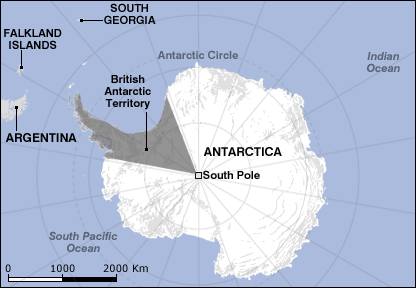
Of course the real interest in “owning” the Falklands – for Argentina and for Britain – is the proximity to Antarctica, the basis it provides for territorial claims and the access it ensures. Territorial claims in  Antarctica have been frozen since 1961 till when 7 nations had registered claims. Currently the entire Argentinian claim falls within the British Antarctic Territory and it must be terribly frustrating for Argentina to find the UK leveraging its ownership of the Falklands all the way to the South Pole.
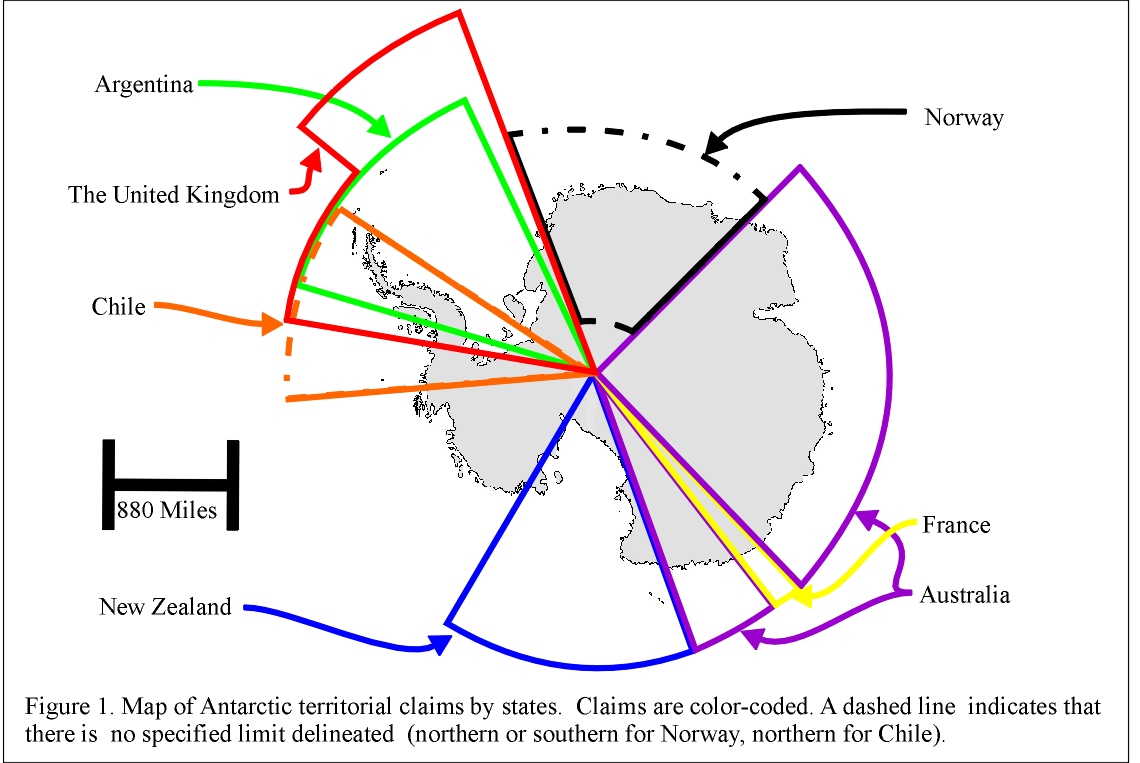
Antarctic territorial claims(graphic - http://geography.osu.edu/grads/jdavis/fig1.jpg)
Antarctic territorial claims
(graphic – http://geography.osu.edu/grads/jdavis/fig1.jpg)

falklands and antarctica (BBC)

falklands and antarctica (BBC)

Greenland votes today on whether to let the Chinese in

March 12, 2013

Greenland flag

UPDATE!

Greenland’s main opposition leader, who campaigned on a platform of greater control and higher taxes of foreign miners, gained the biggest number of votes in a national parliamentary election, underscoring a backlash against the island’s fast globalisation.

Aleqa Hammond’s Siumut party won around 42 percent of votes, or around 14 seats in the 31-seat parliament, meaning she will need to form a coalition. Prime Minister Kuupik Kleist won around 34 percent of votes, according to official results published by Greenland’s national KNR broadcaster.

=====================================================

Not that it is very relevant to the “general” election being held in Greenland today, but I had not really appreciated that Greenland (and half of Iceland and a large chunk of Siberia and part of Japan) are part of the North American Continental plate.  Greenland has been inhabited – off and on – for some 5000 years (from c. 2500 – 3000 BCE) and initially by the ancestors of the Arctic peoples (paleo-Eskimos). The Scandinavian link goes back to around 1200 years ago (900 CE).

 Norsemen settled on the uninhabited southern part of Greenland beginning in the 10th century. Inuit peoples arrived in the 13th century. The Norse colonies disappeared in the late 15th century. In the early 18th century, Scandinavia and Greenland came back into contact with each other, and Denmark established sovereignty over the island. Having been ruled by Denmark-Norway for centuries, Greenland became a Danish colony in 1814, and a part of the Danish Realm in 1953 under the Constitution of Denmark. In 1979, Denmark granted home rule to Greenland, and in 2008, Greenlanders voted to transfer more power from the Danish royal government to the local Greenlandic government. Under the new structure, in effect since June 21, 2009, the Danish government retains control of foreign affairs, national defence, the police force, and the justice system. …

Following World War II, the United States developed a geopolitical interest in Greenland, and in 1946 the United States offered to buy Greenland from Denmark for $100,000,000, but Denmark refused to sell.

Kuupik Kleist, prime minister of Greenland Рус...

Kuupik Kleist, prime minister of Greenland (wikipedia)

The Inuit Ataqatigiit Party which is currently in power in the “Home Rule” Government is a curious mixture of being both left-leaning and somewhat nationalistic. Their target is for an economic and politically independent Greenland and want to reduce the financial support from the Danish government by increasing the rate at which Greenland’s mineral resources are exploited. But to do that they will need labour and it seems that this could come from China. If they win the election today it could open the door for 2,000 – 3,000 Chinese engineers and miners. The opposition Siumut Party seems to have very similar goals but they don’t agree with bringing the Chinese in.

Aleqa Hammond Siumut leader

The BBC reports:

Voters go to the polls in Greenland on Tuesday, in an election dominated by the question of how the territory should exploit its mineral riches. Nearly 70% of 57,000 inhabitants are eligible to vote in Greenland, a Danish territory with partial autonomy.

Many are keen to reduce reliance on Denmark’s annual subsidy of $576m (£387m).

Iron, uranium and rare earths lie underground, but opinions differ over how to extract them. The latest poll predicts a tight race between the governing left-leaning Inuit Ataqatigiit party (IA) and the opposition Siumut party, reports the BBC’s Malcolm Brabant from the Danish capital, Copenhagen.

They will be fighting for 31 seats in a home rule government. There is only one polling station in the capital, Nuuk – a town of 15,000 with only two traffic lights.

The IA – headed by Prime Minister Kuupik Kleist – is in favour of importing cheap, foreign, mainly Chinese labour to mine iron ore. Siumut – led by Aleqa Hammond – is opposed to the plan, which could see Greenland’s population increase by 5%.

The election will be monitored in China, which wants Greenland’s iron for its expanding economy, and in turn by European Union officials who have expressed concern about China’s influence in the territory. ..

Two years on and Japan returns to nuclear power

March 11, 2013

It is two years today since the Great 2011 Tohoku Earthquake and Tsunami and the meltdown at 3 reactors of the Fukushima Daiichi nuclear plant.

It was the most powerful known earthquake ever to have hit Japan, and one of the five most powerful earthquakes in the world since modern record-keeping began in 1900. The earthquake triggered powerful tsunami waves that reached heights of up to 40.5 metres in Miyako in Tōhoku’s Iwate Prefecture and which, in the Sendai area, travelled up to 10 km inland. The earthquake moved Honshu (the main island of Japan) 2.4 m  east and shifted the Earth on its axis by estimates of between 10 cm  and 25 cm.

On 12 September 2012, a Japanese National Police Agency report confirmed 15,881 deaths, 6,142 injured and 2,668 people missing across twenty prefectures, as well as 129,225 buildings totally collapsed, with a further 254,204 buildings ‘half collapsed’, and another 691,766 buildings partially damaged. … 

The tsunami caused nuclear accidents, primarily the level 7 meltdowns at three reactors in the Fukushima Daiichi Nuclear Power Plant complex, and the associated evacuation zones affecting hundreds of thousands of residents.

In the knee-jerk reaction to the Fukushima accident all Japan’s 50 nuclear reactors in operation were shut down. Ongoing nuclear power plant projects were suspended. The global debate was more an emotional wave rather than rational discussion. The fear was real of course but what was generally ignored was that while the earthquake and tsunami killed some 18,000 the Fukushima accident did not cause any direct radiation related fatalities. The reality is that the Fukushima reactors were designed in the 1960’s and yet managed to survive the magnitude 9.1 earthquake but they could not cope with and succumbed to the massive tsunami. After the earthquake the reactors were actually shut down – automatically and in good order – but the emergency power to the cooling systems were knocked out by the subsequent tsunami. The failure was a failure of anticipating and designing for a tsunami that was as large and as powerful as it was. Tsunami’s as large as the 2011 event have occurred in Japan roughly every 1000 years. The Fukushima failure was not so much a fault of the nuclear plant as the failure of the designers in anticipating a sufficiently large tsunami within the lifetime of the plant.

But two years on, some rationality is returning to the debate. Two reactors have been turned back on and construction has gingerly been restarted on the new 1383 MW advanced boiling-water reactor at Oma.

Map credit Washington Post

Washington Post: 

In the aftermath of March 2011 meltdowns in Fukushima that contaminated 700 square miles with radiation and forced 150,000 to flee their homes, most never to return, Japan’s utility companies paused nearly all nuclear-related projects. The accident sparked a global debate about nuclear power, but it was especially fierce in Japan, where all 50 operable reactors were taken offline and work was halted on three new plants where building had been underway.

But two of the existing reactors are back in action, and the resumption of construction at the Oma Nuclear Power Plant here — a project that broke ground in 2008 and was halted by the operator, J-Power, after the accident — marks the clearest sign yet that the stalemate is breaking. ….. 

At the national level, Japan has cycled through three prime ministers since Fukushima — the first fiercely anti-nuclear, the next moderately anti-nuclear, the current one cautiously pro-nuclear. The previous ruling party tried last fall to plot a nuclear phaseout by the 2030s, but anti-nuclear advocates say the pledge was watered down to the point of being meaningless. The new prime minister, Shinzo Abe, plans this month to convene the latest in a series of expert panels to help overwrite the phaseout plan, and its makeup suggests that he prefers a role for nuclear power.

Japan’s anti-nuclear movement, which swelled after the Fukushima accident, could still play a role, but it is politically disorganized and has grown quieter in recent months. Individual activists cite the resumption at Oma as controversial but note that the move did not prompt mass-scale protests. ….. 


Archive of posts on management behaviour

March 10, 2013

A reader has suggested I collect my posts on management behaviour on a separate site, but I am not sure I would be able to do justice to yet another blog even though it would have the advantage of being a much more focused site. However to address – at least partially – the reader’s difficulty in finding some of my past posts on the subject, they are re- linked below. (These and all other posts tagged “management” can be found here).

  1. Ethics and Business  April 19, 2010

  2. Why Forecasts need to be wrong October 7,2010

  3. “Essence of a Manager” released March 29, 2011

  4. The Art of Motivation April 21, 2011

  5. Power and empowerment April 30, 2011

  6. Strength in a Manager: The materials analogy May 8, 2011

  7. Japan Colloquium: Lessons for crises management July 24, 2011

  8. What makes a “good” manager? April 12, 2012

  9. Manager Selection: Using hypothetical scenarios in interviews June 10, 2012

  10. How to use your CV to “control” the subsequent interview November 20, 2012

  11. The need for communication leads to speech and grammar and language February 25, 2013

Flu vaccine strongly linked to narcolepsy in children

March 9, 2013

I believe that massive public health programs every winter for the consumption of flu vaccines are driven more by commercial rather than medical considerations. Now comes the news that the risk of narcolepsy in children is enhanced 14 times by the use of Pandemrix. Indiscriminate use of flu vaccines – especially with their limited effectiveness  – do a major public disservice by providing ammunition for the “anti-vaccination brigade”. Whether the success rate of the flu vaccines is high enough to justify the expense of mass campaigns is not clear for me. Certainly I am uncomfortable with the links  between pharmaceutical companies and those who authorise mass campaigns of vaccination.

(Reuters) – Growing evidence of a link between GlaxoSmithKline Plc’s pandemic flu vaccine and an increase in narcolepsy cases among children who received it in Europe, is giving pause to health regulators weighing approval of a similar vaccine in the United States.

Data published recently in the British Medical Journal found that children in England who received GSK’s Pandemrix vaccine during the 2009-10 H1N1 swine flu pandemic had a 14-fold heightened risk of developing narcolepsy, a chronic and potentially debilitating sleep disorder that can cause hallucinations, daytime sleepiness and cataplexy, a form of muscle weakness precipitated by strong emotion.

Authors of the study – whose results echo those of similar studies in Sweden, Finland and Ireland – said the data had implications for the approval and use of future vaccines that, like Pandemrix, contain AS03, a new adjuvant, or booster, that turbo-charges the body’s immune response to the vaccine.

Scientists believe AS03 may be the culprit in the narcolepsy cases though they have yet to decipher the precise nature of the association.

…. A 14-member panel of advisors to the FDA voted unanimously in November to recommend the vaccine to protect against bird flu. The panel considered early studies from Europe showing an increase in the number of narcolepsy cases but concluded that the potential benefit of the vaccine outweighed the risk.

Since then, however, new data, including the study results from Britain, suggest the scale and strength of the narcolepsy link could be greater than first thought. At least one committee member would like the FDA to reconvene the panel.

…. According to GSK, some 30 million doses of the vaccine were administered across Europe and 800 people, mostly children, developed narcolepsy. While acknowledging an association, the company says there is insufficient evidence to prove Pandemrix is the cause. ……

I am not sure if the numbers (except the revenues and profits) actually add up.


Dark and mysterious ways of Turkish academia

March 7, 2013

Professor Debora Weber-Wulff addresses some of the dark and mysterious ways of Turkish academia on her blog. Academic misconduct is apparently wide-spread, largely ignored and is condoned making for a culture with very dubious ethics which has become self-perpetuating . It does not paint a very pretty picture but it is noteworthy that the picture is coming to light only because of the work of a group of other academics. But to break out of the vicious circle will not be so easy.

The Dark Alleys of Turkish Academia

I published a short note in September 2012 about the work of a group of academics in Turkey. A. Murat Eren has now organized a translation of their work into English so that a wider group of scientists can take a peek into the very dark alleys of Turkish academia. …..

….. And then there is the list of academics in Turkey with the most retractions to their name — and their current occupation. Let me quote these here, because it is so shocking:

Only one of the authors with multiple retracted papers is not affiliated with academia. Anyone who knows how difficult it is to get a paper retracted will understand the depth of concern here. How can these people teach at university and mentor doctoral students when they themselves have multiple retractions to their names?

The same chapter also reports on the Sezen case, one that I blogged about in June 2012.

Eren’s conclusions:

  • Turkey’s bad academia is self-perpetuating.
  • People who have committed ethical violations in their dissertations and publications are allowed to become thesis supervisors. Students who are misguided by these create dissertations that equally violate ethics, publish insignificant or duplicated papers, and some of them become the new academic generation, in turn completing the cycle.
  • One of the major problems that perpetuates this cycle is the difficulty of access to dissertations. University libraries limit access with arbitrary reasons, and improvements in YÖK Thesis Archive are far from solving the problem in practice.
  • Even when a dissertation is accessed and plagiarism is seen, penalties are far from being deterrent, due to legal and executive roadblocks.
  • While advanced societies take science theft very seriously, actors of science theft in Turkey silently go on with their duties, thus deleteriously undermining the credibility of the field.
  • Even though today’s scientists in Turkey are not proactive, and they are mostly mute unless they have to defend themselves, I believe that self-criticism will become a way to reveal and eventually eradicate academical problems in Turkey in the future.

I am indebted to the Turkish scientists who have worked on this. I have corresponded with them and did some proofreading on the English version. I hope that this will shine a bright light down the dark alleys

“Half of deer population in UK should be culled” to protect countryside and birdlife!!

March 7, 2013

There is a large amount of hypocrisy and no small measure of irony here!

The bio-diversity creed seems to have become “Kill off the successful species and protect the unsuccessful ones”.

BBC: Deer: 50% cull ‘necessary to protect countryside’

Around half of the UK’s growing deer population needs to be shot each year to stop devastation of woodlands and birdlife, a group of scientists says. A study published in the Journal of Wildlife Management says this would keep numbers stable.

The deer population is currently estimated at around 1.5 million. The researchers from the University of East Anglia suggest creating a venison market to make a cull ethically and economically acceptable. The Royal Society for the Protection of Animals (RSPCA) commented that any cull must be carried out in a humane and controlled way and be supported by “strong science”.

There are now more deer in the UK than at any time since the last Ice Age. …

…. Dr Paul Dolman, ecologist at the University of East Anglia and lead author, said: “We know deer are eating out the… vegetation of important woodlands, including ancient woodlands.

“Deer are implicated as the major cause of unfavourable conditions in terms of woodland structure and regeneration.

“There is evidence that deer reduce the number of woodland birds – especially some of our much loved migrant birds species like Blackcap and Nightingale, and resident species like Willow Tip. We have a problem.”

Dr Paul M Dolman

Dr Paul M Dolman – Bambi killer

Dr Paul Dolman is one of the “biodiversity” brigade and seems to be a bird-watcher of some note. But like most of this advocacy group he seems more than a little confused. I note that he invokes “strong science” – whatever that may be – to support his vision of a string of farm-shops and gastro-pubs serving venison. It would take more than a few pubs to handle 750,000 deer every year. I like his comment that such meat would be “ethically sourced”! I suppose that makes it all right then. This is not science – it is religion.

“We are not killing something and then incinerating the carcass – what we are talking about is harvesting a wild animal to supply wild free-ranging venison for or tables – for farm shops, for gastro pubs.

“What we are advocating isn’t removing deer from the countryside – what we are advocating is trying to get on top of the deer population explosion and try to control the problems that are being caused.

“And in a way, [venison] provides a sustainable food source where you know where it comes from, you know it is ethically sourced, you know it is safe to eat, and that puts food on people’s tables. As much as I love deer, to be a meat eater but then to object to the culling and harvesting of deer seems to be inconsistent.”

Being on-line and anonymous does not eliminate accountability and responsibility

March 6, 2013

The Washington Post considers the pluses and minuses of anonymity in the on-line world but typically just stays on the fence. “It’s complicated”. In an abundance of indecision and of  “political correctness” it reaches no conclusion.

But I take a rather simplistic and uncomplicated view. “On-line” is just one more medium through which “publishing” can take place. This medium may be much more immediate and with greater global spread than other media. But whatever the medium may be, responsibility and accountability for what is published cannot just vanish. It cannot just disappear into some black hole between an author and his publisher. Either the publisher or the author must take responsibility and be accountable for whatever is published. The publisher controls the medium. Whether he wishes to allow anonymity or not is his prerogative. But if the publisher (the on-line web-site host) allows his authors to keep their identities secret from the public then he must take responsibility and be accountable for what is published.  It is also then his call as to whether he himself wishes to know the identity of those using the platform he provides. Where, however, the author is publicly identified then the publisher is effectively indemnified.

Where comments (on a blog or a web-site or a forum) are allowed anonymously then applying moderation is the host’s call but he cannot escape the responsibility or the accountability for the content he allows.

Anonymity does not eliminate responsibility and accountability. It merely shifts responsibility from the author to the publisher. The buck has to stop somewhere.

Washington Post: It shields the whistleblower from blowback and the deep-background source from getting deep-sixed. It helped women publish novels way back when . . . when that was a pretty novel idea. But it can also embolden the kook to get kookier and the racist to get . . . well, you get the picture.

….. Fey and Pexton, whose thoughts have gotten the viral launch that only a lengthy discussion on NBC’s “Today” show can provide, veer toward an age-old question. Does anonymity make us good? Or does it make us bad? And now that we’ve had a good long while to get used to splashing around online, there’s another question to ponder: Does the Internet make it easier for us to be anonymously bad or anonymously better?

The answer isn’t so simple. Consider 4Chan, a hugely popular and emphatically anonymous Internet board that began as a place to discuss Japanese anime and has swelled into dozens of boards focused on everything from “science & math” to “Sexy Beautiful Women.”

The site can get raunchy. The posters can get rough with each other. Anonymity has the effect of making the users less inhibited, said Michael S. Bernstein, who studied the site’s “/b/ – random” board with colleagues at MIT and the University of Southampton in Britain. That lack of inhibition has led to plenty of “gore, pornography and racism,” Bernstein, now a computer science professor at Stanford University, said in an interview.

But amid all the offensive behavior, Bernstein and his fellow researchers also found that anonymity had a lot of positive effects. One of the most notable was the creation of a culture that fostered experimentation and new ideas. Since no names were being used, the users felt more comfortable taking risks. They’ve ended up contributing to the creation of an Internet culture and to a proliferation of memes. ….

…. The American Association for the Advancement of Science (AAAS), publisher of the respected journal Science, was concerned enough to commission a study that concluded anonymity was something worth striving to preserve. “There was talk at the time about making anonymity difficult or impossible,” said Albert H. Teich, a professor at George Washington University who was director of science and policy programs at AAAS when the study was released.

The scientists wanted the Internet to be a place where political opinions could be expressed freely without fear of repercussions; where, say, a teen struggling to come to grips with his sexuality could discreetly seek advice.

…. Still, he’s torn. Terrorism gives him an argument against anonymity. Protecting contacts who were helping AAAS combat human rights violations in Central America gives him a reason to protect anonymity. …..

Rabbits (or a lack thereof) killed off the Neanderthals!

March 4, 2013

A new paper in the Journal of Human Evolution claims that the diet of the Neanderthals contained far fewer rabbits than that of Modern Humans. The paper then suggests that this was because Neanderthals could not shift from hunting large prey to hunting small animals. The data may well be valid but the interpretations of the data and the conclusions drawn are so lacking in common sense that the entire paper may well qualify as “idiot science”.

Rabbits and hominin survival in Iberia

by John E. Fa, John R. Stewart, Lluís Lloveras and J. Mario Vargas

Abstract

High dependence on the hunting and consumption of large mammals by some hominins may have limited their survival once their preferred quarry became scarce or disappeared. Adaptation to smaller residual prey would have been essential after the many large-bodied species decreased in numbers. We focus on the use of a superabundant species, the rabbit, to demonstrate the importance of this taxon in Iberia as fundamental to predators. We show that the use of the rabbit over time has increased, and that there could have been differential consumption by Neanderthals and Anatomically Modern Humans (AMH). Analysis of bone remains from excavations throughout Iberia show that this lagomorph was a crucial part of the diet of AMH but was relatively unutilised during the Mousterian, when Neanderthals were present. We first present changes in mammalian biomass and mean body mass of mammals over 50,000 years, to illustrate the dramatic loss of large mammalian fauna and to show how the rabbit may have contributed a consistently high proportion of the available game biomass throughout that period. Unlike the Italian Peninsula and other parts of Europe, in Iberia the rabbit has provided a food resource of great importance for predators including hominins. We suggest that hunters that could shift focus to rabbits and other smaller residual fauna, once larger-bodied species decreased in numbers, would have been able to persist. From the evidence presented here, we postulate that Neanderthals may have been less capable of prey-shifting and hence use the high-biomass prey resource provided by the rabbit, to the extent AMH did.

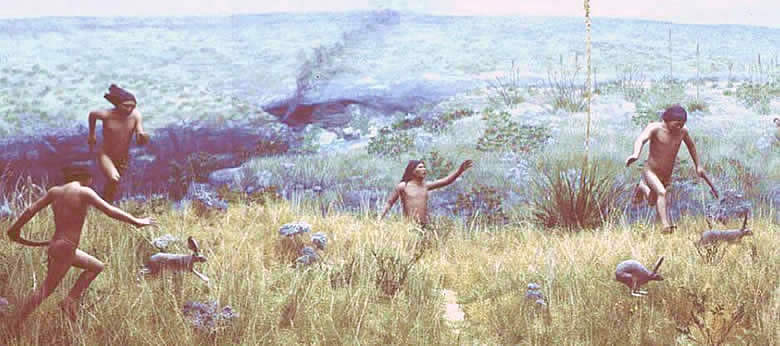
painting of prehistoric hunters

Prehistoric hunters prepare to unleash their throwing sticks at a group of jack rabbits on the run. Painting by Nola Davis, courtesy Texas Parks and Wildlife Department.

That Anatomically Modern Humans ate more rabbits than Neanderthals may well be true but to then leap to the amazing conclusion that Neanderthals were incapable of hunting small prey and then to the even more dubious suggestion that this may have something to do with the demise of Neanderthals as a species takes legitimate speculation into the fantasy worlds of the Land of Painted Caves. We could just as well assume that eating rabbits led to a virulent disease which AMH were immune to but which led to the eradication of the Neanderthal species (except of course for the offspring of those who had mated with AMH) !!

Baby cured of HIV?

March 4, 2013

A baby has apparently been cured of HIV by very early treatment. There are headlines around the world.

A giant leap forward it would seem and it ought to be a cause of great celebration

But my reaction is completely dominated by this one sentence buried within Reuter’s report:

There are no samples that can be used by other researchers to confirm the findings, which may lead skeptics to challenge how the doctors know for sure that the child was infected.

I am extremely wary about hype surrounding “great advances” especially when a huge amount of research funding is possibly at stake.