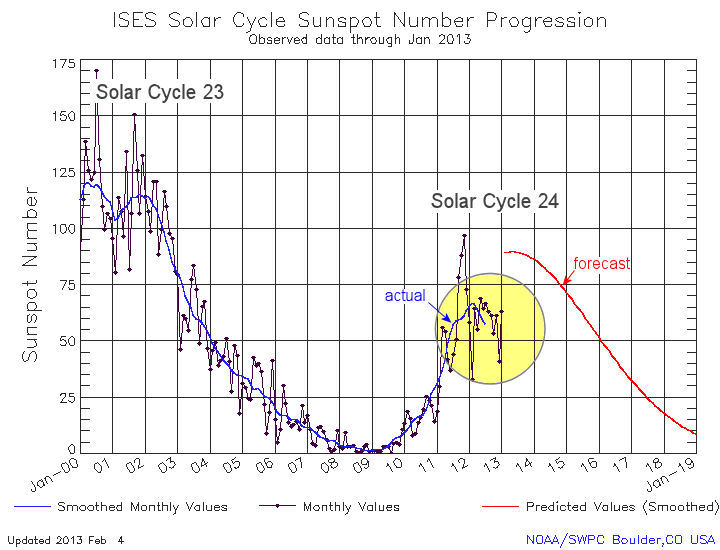
Double peak in Solar Cycle 24? as in SC14 and in SC5?

March 4, 2013

The NOAA/NASA Solar Cycle Prediction Panel is puzzled. They don’t know if we are reaching solar maximum or whether another little peak could be on its way which would shift solar maximum for SC24 to 2014 from 2013.

And should we compare SC24 with SC14 or should it be SC5?

But SC24 will still show the lowest sunspot activity for 100 years. I note that not only SC14 but even SC5 had a double peak – so my expectation remains that this Landscheidt Minimum may be comparable to the Dalton Minimum – though not perhaps to the Maunder Minimum.

credit Dr. Tony Phillips

credit Dr. Tony Phillips

This Sciencecast video is a good summary of what we don’t know:

Landscheidt’s prediction is that this Minimum will last till 2060 so we can expect low sunspot activity for the next 4 sunspot cycles (till SC28).

Landscheidt’s predicted solar minima

The Sc24 –  SC5 comparison looks like a repeating pattern but it would be wrong to assume that the Sun cares about this and it will surely continue to keep us perplexed as it does its own thing.

SC24 compared to SC5

The Big Picture is persuasive – even if we don’t really know what the sun is upto and even less about how the Earth dances to the Sun’s music.

Recent solar activity (Wikipedia) showing the Maunder and Dalton minima

Related:

Solar cycles and the Landscheidt minimum

Theodor landscheidt: Sun-Earth-Man and the Kepler ratios

A Guard fit for a Queen

March 4, 2013

BBC

Police officers outside the King Edward VII Hospital in London, where the Queen has been admitted

Britain’s tallest police officer – PC Anthony Wallyn, who is 7ft 2in – was among the officers standing guard at the hospital on Sunday

PC Anthony Wallyn


An almost hidden message

March 2, 2013

from Ilusoes Optica

How many colours?

Jaguar Land Rover poised to “make in India, export to the emerging world”

March 2, 2013

Jaguar Land Rover sells around 250,000 Land Rovers and about 55,000 Jaguars worldwide.  In 2011/12 this generated about £13.5 billion sales with a profit of £1.5 billion.  They will spend around £2 billion in the 2013 financial year on new products including a new £350 million engine plant in the West Midlands.

JLR’s Strategy (Sustainability Report), JLR Strategy, states:

In 2011 we expanded assembly operations into India, one of our key markets, and announced plans for our first manufacturing facility abroad in another key market, China, through a joint venture with Chery Automobile Company Ltd. We predict Jaguar Land Rover sales will more than double in volume by 2020, largely due to increasing demand in emerging markets.

Now Reuters reports that the emerging market strategy is progressing fast and that JLR is poised to move from just assembly to the complete manufacture of some brands in India. They join the growing number of players who now see India as a sort of export hub to emerging markets.

Jaguar Land Rover (JLR) is investigating the potential of manufacturing cars in India, company sources said, as the British luxury carmaker looks to build on its growth in emerging markets with the help of Indian parent Tata Motors.

JLR, which has ridden a wave of surging demand in China and other emerging markets to post record profits over the past year, is “actively exploring the possibility” of building cars from scratch in India, said one company source.

“The idea is being looked into, with the (Jaguar) XF and (Land Rover) Freelander the obvious candidates,” said another source with knowledge of the matter.

The British brands, which already assemble two models in India using parts and engines shipped from factories in the UK, will also begin assembling its popular Range Rover Evoque in the country soon, the first source said without providing details.

Building cars in India, which has developed into an emerging market export hub for many global carmakers, would allow JLR to skirt high import taxes on luxury cars, which the country’s finance minister proposed raising to 100 percent from 75 percent in his budget speech last week.

… JLR will exhibit a new 9-speed automatic Evoque and an electric-powered version of its Land Rover Defender at the Geneva Motor Show next week.

Bought by Tata for $2.3 billion from Ford in 2008, JLR has defied those skeptical of its future under Indian ownership to roar back into profit over the past three years as the main growth driver for its now-struggling parent.

Continued growth in emerging markets such as India and China, which accounted for 22.3 percent of its sales in the December quarter, is key for JLR as it embarks on an expensive overhaul of its production and product clout. The carmaker is investing $1.7 billion with local partner Chery Automobile Co in a factory in China.

JLR lags rivals BMW AG, Volkswagen AG’s Audi and Daimler AG’s Mercedes-Benz in assembling cars in India, where the luxury market is expected to swell by around six times by 2020 to 300,000 cars a year, according to business consultancy Frost & Sullivan. ….

…. Earlier this year JLR started the assembly of the 2.2-litre diesel version of the Jaguar XF saloon at a plant in Pune, west India, tucked away in a corner of a sprawling production site where Tata builds its heavy duty trucks and hatchbacks.

Screwed together using engines and components shipped from JLR’s Castle Bromwich plant in Birmingham, central England, the company has also been assembling its Land Rover Freelander 2 in Pune since May 2011.

The XF and the Freelander 2 are JLR’s best-selling models in India, where it sold 2,288 cars in the year to March 2012, up 157 percent from the previous year. ….. 
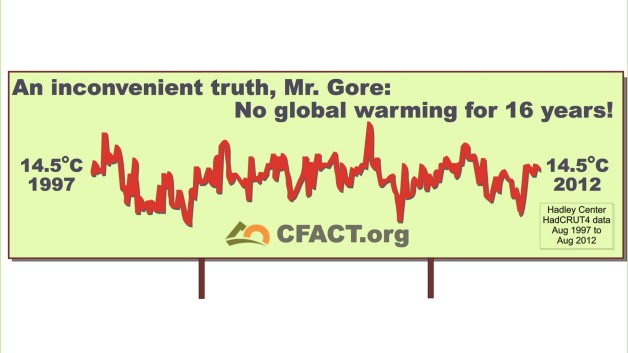
Global warming on hold (courtesy of the sun)

March 2, 2013
  • CO2 lags global temperature.
  • CO2 keeps increasing while temperature stands still.
  • Man made CO2 is about  3.6 % of all CO2 production

An inconvenient truth –  it’s the sun stupid!

16 years

CFACT Billboard

Falcon 9 launches as Dragon sets off on its second cargo supply mission

March 2, 2013

SpaceX has launched CRS-2 — its second  mission to the International Space Station. The Dragon capsule aboard the Falcon 9 rocket will dock with the ISS today, delivering 677 kg of cargo to the astronauts currently there, and will return in about 2 weeks.

Initial thruster problems threatened the mission but these seem to have been solved.

But vexing trouble with the capsule’s rocket thrusters quickly turned the $133 million flight into a high-tech cliff hanger. Six-and-a-half hours after launch, follwoing extensive troubleshooting and analysis, it appeared company engineers had resolved the problem, bringing all four sets of thrusters on line and setting the stage for a delayed rendezvous with the space station.

From Space X press release: 

Hawthorne, Calif. – Today, Space Exploration Technologies (SpaceX) successfully launched its Falcon 9 rocket and Dragon spacecraft to orbit for SpaceX’s second mission under its Commercial Resupply Services (CRS) contract with NASA. Falcon 9 completed its job perfectly, continuing its 100 percent success rate.

“Falcon 9 was designed to be the world’s most reliable rocket, and today’s launch validated this by adding to Falcon 9’s perfect track record with our fifth success in a row,” said Gwynne Shotwell, President of SpaceX.

After Dragon separated from Falcon 9’s second stage approximately nine minutes after launch, a minor issue with some of Dragon’s oxidation tanks was detected. Within a few hours, SpaceX engineers had identified and corrected the issue, normalizing the oxidation pressure and returning operations to normal. Dragon recomputed its ascent profile as it was designed to and is now on its way to the International Space Station (ISS) with possible arrival on Sunday, just one day past the original timeline.

Dragon is the only spacecraft in the world today capable of returning significant amounts of cargo to Earth. Dragon will stay on station for a three-week visit, during which astronauts will unload approximately 1,200 pounds of cargo and fill the capsule with return cargo, for return to Earth. Dragon is filled with supplies for the ISS, including critical materials to support science investigations. Later this month, Dragon will return a payload that includes research results, education experiments and space station hardware.

Updates on the CRS-2 mission can be found at www.spacex.com/webcast. Broadcast quality video may be downloaded at vimeo.com/spacexlaunch and high-resolution photos are posted at spacexlaunch.zenfolio.com.

About SpaceX

SpaceX designs, manufactures, and launches the world’s most advanced rockets and spacecraft. The company was founded in 2002 by Elon Musk to revolutionize space transportation, with the ultimate goal of enabling people to live on other planets. Today, SpaceX is advancing the boundaries of space technology through its Falcon launch vehicles and Dragon spacecraft. SpaceX is a private company owned by management and employees, with minority investments from Founders Fund, Draper Fisher Jurvetson, and Valor Equity Partners. The company has more than 3,000 employees in California, Texas, Washington, D.C., and Florida. For more information, visit SpaceX.com.

Obama’s sequester

March 1, 2013

From this side of the Atlantic, it looks like the sequester in the US is going to come into effect and some $85 billion of public spending will – eventually – be avoided. Last minute chit-chat at the White House has not led to any agreement.

I read that President Obama was blaming Congress and warning of the pain ahead.

Somehow this does not ring true.

The President of the US has or controls all the cards and it is he who sets the agenda. He could – I think –  have reached a compromise with Congress whenever he wanted – if he wanted to. But any compromise he could have reached would have contained spending cuts which he may well know is absolutely necessary but which would not have gone down well with his supporters. I note that the markets are not very perturbed and this also suggests that the pill may be bitter but it may well be the correct thing to do.

It seems to me – albeit from very far away – that Obama is actually using the sequester to do some of what is absolutely necessary but where he can – perhaps – avoid blame for the necessary and unavoidable pain.  The US has been more profligate even than Italy for far too long and the public debt cannot be sustained. But nobody wants to be seen as being responsible for the pain that must be borne. It does not seem to me that Obama wanted a compromise to be reached at all. Hence the almost intransigent positions taken by the White House in discussions with Congress. They were intended to fail.

Nothing is as what it seems. This sequester is actually Obama’s opportunity of getting the US to swallow some very bitter medicine without having to take the blame – and he knows it.

If he signs off on it later today it will be because it is his sequester.

Fighting against species extinction is to deny evolution

February 27, 2013

I was reading an article today about the threat of extinction for leather-backed turtles and once again I started wondering as to why extinction of a species or a language or of an isolated tribe arouses moral outrage or is an emotional matter for so many people. I don’t want these turtles to become extinct just as I don’t want tigers or polar bears or pandas to become extinct. But this is purely an emotional reaction because each of these animals is attractive – to my human eye – in its own right. Outside of TV documentaries, zoos and safari parks I have never seen any of them. I don’t have the same reaction when I read that guinea worms or disease-carrying species of mosquitoes are being eradicated. “Good riddance” is then the predominating feeling that I have. Yet whether a mammal or a bacterium becomes extinct the genetic loss is about the same. That dinosaurs became extinct millions of years ago or even that humans killed off the dodo or the thylacine or the Javan tiger in more recent times arouses some feelings of regret but not any moral outrage or much emotional response from me. The article about the turtles – like most other articles about the extinction of species  – is permeated with the politically correct assumption that extinction would be a “bad thing”. But I never see properly addressed the question as to why the extinction of a species is a “bad thing”.

This is essentially a value-judgement and is taken for granted and yet – in the rational plane – I can only conclude that there is nothing “unnatural” about this. In fact it is this emotional desire that species considered “attractive” should not become extinct when their time is due that is irrational. Normal or natural evolution is always a result of change. It is the result of species responding to change where the individuals of a species most suited to the changed circumstances continue and reproduce. Where the variety existing within a species is insufficient to provide any individuals who can survive and reproduce in the changed environment, the species dies out. It is said that about 90% of all species that have ever lived have become extinct. If they had not there would be no room for the 10% that exist today. Just as homo sapiens would never have evolved without the environmental changes which led to the extinction of the dinosaurs, most of the species alive today would not have succeeded their extinct ancestors if conditions had not led to their extinction. Where a species cannot compete with another – in whatever the prevailing circumstances – it dies out. It makes room for the more successful species.

Siberian Tiger Français : Tigre de sibérie Ita...

Siberian Tiger Français : (Photo credit: Wikipedia)

So what then is the objection to – say – tigers becoming extinct which is not just an emotional reaction to the disappearance of a magnificent but anachronistic creature?  The bio-diversity argument is not very convincing and is of little relevance. To artificially keep an unsuccessful species alive in a specially protected environment has no genetic value. It increases the mis-match between the existing environment and the genetic profile needed to survive in that environment. In fact the biodiversity argument is only relevant for “life” in general and never for any particular species or group of species.  It can serve to maintain a very wide range of genetic material in the event of a catastrophe such that some form of life has a chance of continuing. But given a particular environment biodiversity in itself is of little value.

Returning to the tiger as an example, the variety of individuals within the tiger population does not provide any which have the characteristics necessary for adapting to the reality of co-existing with humans in some form of urban living. Foxes, on the other hand, are evolving within our lifetimes. In a few more fox generations, urban foxes will out-compete their “wild” cousins who may well become extinct. But urban foxes will thrive. Many bird species and insects are throwing up the individuals to succeed in the shadow of the success of the human species. Bacteria and no doubt viruses are also throwing up their survivors. Some bacteria are changing faster than we would like. The polar bears who visit Churchill every year are evolving. Those who know how to forage in human communities have a distinct advantage over their less intelligent brethren. And of those who visit Churchill it is the ones who avoid attacking humans which have the best chance of surviving. (Polar bears are of course thriving and are in no danger of extinction – but that is another story). Langur and rhesus monkey troops in Delhi are in the process of becoming urbanised and “evolving” to succeed in their human-filled environment. These species are not domesticated. They are still wild but they are evolving – by selection – into new species suited to their new environment.

All those species which succeed into the future will be those which continue to “evolve” and have the characteristics necessary to thrive within the world as it is being shaped and changed by the most successful species that ever lived (though we cannot be sure how far some particular species of dinosaur may have advanced). Putting a tiger into a zoo or a “protected” environment actually only preserves the tiger in an “unsuccessful” form in an artificial environment. Does this really count as “saving the species”? We might be of more use to the future of the tiger species if we intentionally bred them to find a new space in a changed world  – perhaps as urban tigers which can co-exist with man.

If a polar bear were to hunt and kill a seal – even if it was the last individual of a seal species – it could be a matter of some regret but it would not generate any moral outrage. And then if the polar bears did not themselves adapt to find alternative food sources – then they too would fail to survive. The loss of a species can always be a matter of some regret but so is the death of any individual. Both are equally inevitable but the regret is mitigated by what comes after.

The thought occurs to me that while there is no doubt that human activity is altering the environment for many species, it is of little benefit to try and deny evolution. Species protection must consist of helping “threatened species”  to evolve and not in standing-still in some artificial environment.

Perhaps the answer is – for example – to breed and train a new species of Siberian tiger to manage vast reindeer herds where they could also be allowed to hunt and devour a few!

Chelyabinsk Meteoroid tracked back to the Apollo asteroid group

February 26, 2013

Astronomers at the University of Antioquia, Medellin in Colombia have back-tracked the trajectory of the Chelyabinsk meteoroid and have concluded that it was from the Apollo asteroid group which regularly intersect with Earth’s orbit. The Apollo group contains at least 5,000 asteroids and more than 240 of these are over 1 km in size. The largest known Apollo asteroid is 1866 Sisyphus, with a diameter of about 10 km.

The Chelyabinsk meteoroid crossed from northeast to southwest on February 15th at an angle of 20 degrees above the horizontal at a speed of about 18 km/s. It is estimated to have been about 17-m in size with an estimated mass of between 7,000 and 10,000 tonnes. It exploded at 03:20:26 GMT over 55° 10′ N, 61° 25′ E at an altitude of 15 to 20 kilometers (9.3 to 12.4 miles) with a force of 500 kilotons – the equivalent of 30 Hiroshima atomic bombs.

The astronomers have published their findings:

A preliminary reconstruction of the orbit of the Chelyabinsk Meteoroid

by Jorge I. Zuluaga, Ignacio Ferrin

http://arxiv.org/abs/1302.5377 (abstract)

complete paper (pdf)

Reconstructing the orbit

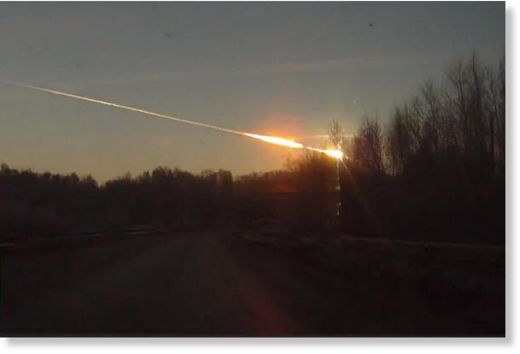
The Chelyabinsk Meteor Friday 15th Feb. 2013: image from http://www.sott.net

BBC:…. Astronomers have traced the origin of a meteor that injured about 1,000 people after breaking up over central Russia earlier this month.

Using amateur video footage, they were able to plot the meteor’s trajectory through Earth’s atmosphere and then reconstruct its orbit around the Sun. Using the footage and the location of an impact into Lake Chebarkul, Jorge Zuluaga and Ignacio Ferrin, from the University of Antioquia in Medellin were able to use simple trigonometry to calculate the height, speed and position of the rock as it fell to Earth.

To reconstruct the meteor’s original orbit around the Sun, they used six different properties of its trajectory through Earth’s atmosphere. Most of these are related to the point at which the meteor becomes bright enough to cast a noticeable shadow in the videos.

…. The results suggest the meteor belongs to a well known family of space rocks – known as the Apollo asteroids – that cross Earth’s orbit.

Of about 9,700 near-Earth asteroids discovered so far, about 5,200 are thought to be Apollos. Asteroids are divided into different groups such as Apollo, Aten, or Amor, based on the type of orbit they have.

MIT Technology Review: 

“According to our estimations, the Chelyabinski meteor started to brighten up when it was between 32 and 47 km up in the atmosphere,” say Zuluaga and Ferrin, who estimate the velocity at between 13 km/s and 19 km/s relative to Earth.

They then calculated the likely orbit by plugging these figures into a piece of software developed by the US Naval Observatory called NOVAS, the Naval Observatory Vector Astrometry. This allowed them to include the gravitational influence on the rock of the Moon and the 8 major gravitational bodies in the Solar System.


The need for communication leads to speech and grammar and language

February 25, 2013

Extracts from a recent lecture

from liu presentation -Communication for Managers

  1. Thinking gives rise to words
  2. Words are not necessary for thought –but they help
  3. Many words and many people give rise to the need for cooperation which needs communication
  4. The need for communication leads to speech and grammar and language
  5. Grammar is not necessary for thought – but it helps
  6. Language is not necessary for communication – but it helps
  7. Speech is not necessary for language – but it helps
  8. Message is an information package
  9. Meaning comes first and is necessary for message and needs an algorithm for the conversion
  10. Information is whatever can be detected by our senses (sensory, aural, visual, olefactory…..)