Junkies versus Non-junkies: Junk genes are not junk — or maybe they are

February 24, 2013

Myopic “scientists” bitching about each other is always interesting. Scientific theories have their own evolutionary life as some wither and die and some – gradually – become accepted and “proven”.  But it is the behaviour of the protagonists of rival theories which is entirely human. Rivalry, back-biting and childish insults in the world of evolutionary biology between junk-gene supporters and junk-gene debunkers are now getting entertaining.

Animation of the structure of a section of DNA...

from wikipedia

In September last year the ENCODE Project made a major splash when they published some 30 papers in front-line journals showing that most of the human genome dismissed earlier as as “junk genes”  did in fact show biological activity and probably had some as yet unknown function. They reported that they had transcribed some 76% of “junk” DNA and that more than 50% of all genes could be accessible to proteins which can control genetic behaviour and they concluded that over 80% of human DNA serves some purpose.

The term “non-coding” DNA, then popularised as”junk” genes, was coined in 1972. This idea  gradually gained favour and by 2003 the human genome was supposed to consist of some  26,000 protein-coding genes within a large amount of non-coding DNA where the non-coding or “junk” DNA represented some 98% of the whole genome. The results of the ENCODE project turned this idea on its head. The junk gene supporters were not amused. It has taken them a little while to circle the wagons and formulate a response to the flood of papers published in September. And the response resorts to unusually harsh language for scientific discourse. It would seem that the “junk” gene protagonists have been prodded in their vitals and feel their life-work and their livelihoods being threatened!

Junkies versus Non-junkies! The battle-lines have been drawn. They have now published an open-access diatribe: On the immortality of television sets: “function” in the human genome according to the evolution-free gospel of ENCODE

The Guardian: “Everything that Encode claims is wrong. Their statistics are horrible, for a start,” the lead author of the paper, Professor Dan Graur, of Houston University, Texas, told the Observer. “This is not the work of scientists. This is the work of a group of badly trained technicians.”

Scientists are being called technicians — no less!

The junkies write:

From an evolutionary viewpoint, a function can be assigned to a DNA sequence if and only if it is possible to destroy it. All functional entities in the universe can be rendered nonfunctional by the ravages of time, entropy, mutation, and what have you. Unless a genomic functionality is actively protected by selection, it will accumulate deleterious mutations and will cease to be functional. The absurd alternative, which unfortunately was adopted by ENCODE, is to assume that no deleterious mutations can ever occur in the regions they have deemed to be functional. Such an assumption is akin to claiming that a television set left on and unattended will still be in working condition after a million years because no natural events, such as rust, erosion, static electricity, and earthquakes can affect it. The convoluted rationale for the decision to discard evolutionary conservation and constraint as the arbiters of functionality put forward by a lead ENCODE author (Stamatoyannopoulos 2012) is groundless and self-serving.

Would the Junkies  – I wonder – allow 98% of their DNA – or that of their children – to be excised if it could be?

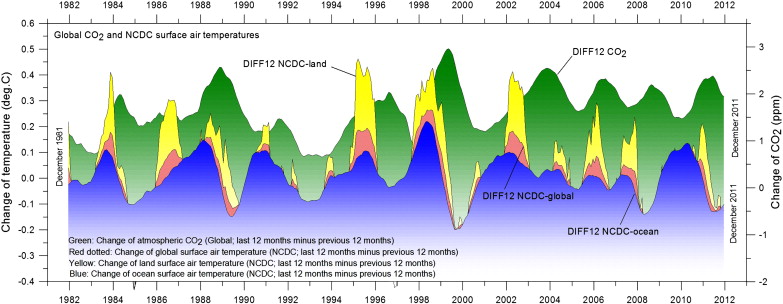
Carbon dioxide lags “global temperature” by 9 – 12 months

February 23, 2013

Just another case of an effect being taken as a cause and yet another nail in the coffin of the “CO2 causes global warming” fantasy.

A new paper in Global and Planetary Change Volume 100, January 2013, Pages 51–69

The phase relation between atmospheric carbon dioxide and global temperature 

by Ole Humlum, Kjell Stordahl and Jan-Erik Solheim

Highlights:

  1.  Changes in global atmospheric CO2 are lagging 11–12 months behind changes in global sea surface temperature. 
  2. Changes in global atmospheric CO2 are lagging 9.5–10 months behind changes in global air surface temperature.
  3. Changes in global atmospheric CO2 are lagging about 9 months behind changes in global lower troposphere temperature.
  4. Changes in ocean temperatures explain a substantial part of the observed changes in atmospheric CO2 since January 1980.
  5. Changes in atmospheric CO2 are not tracking changes in human emissions.
Figure 5 Humlum et al 2013

Fig. 5. 12-month change of global atmospheric CO2 concentration (NOAA; green), change in global surface air temperature (NCDC; blue), land surface air temperature (NCDC; yellow) and ocean surface air temperature (NCDC; red dotted). All graphs are showing monthly values of DIFF12, the difference between the average of the last 12 months and the average for the previous 12 months for each data series.

On being 65!

February 23, 2013

If I’d been out till quarter to three
Would you lock the door,
Will you still need me, will you still feed me,
When I’m sixty-four?

I was 65 last Sunday and still sometimes go out till quarter to three. But I carry a key.

I am now officially “past-it” and this is wonderful. Nothing of earth-shattering significance is any longer expected of me. Anything I can manage to do now makes me an over-achiever.

People ask whether I have “retired” and here in Sweden I am asked if I am a “pensioner”, but I never know how to reply correctly. A “pensioner” is used here as a kind of a label which I find less than flattering. While I have activated some “pensions” as sources of income, I take on consultancy assignments and lecture and write and that also generates some income.  So, yes I have stopped being an “employee” but  no – I have not retired from life  – yet!. I don’t mind if strangers offer me a seat in crowded places!  I don’t mind being called “uncle” when I am visiting India but I’m still getting used to being addressed as “the old man” or as “Grandfather”. I am expected to be opinionated – which I was anyway. My natural arrogance is less offensive or perhaps I have mellowed and have lost some of my cutting edge. I am not dishevelled but I don’t worry much about how I look any more or if my colour combinations are bizarre. I only need to – or wish to – wear a tie once or twice a month. I can even get away with wearing my old shoe-string ties from the 60’s or broad flowered ties from the 70’s. If I could have gotten into some of my old bell-bottomed trousers I would have (and I don’t know why I am still preserving them). I get reminders about influenza vaccinations but they don’t convince me. I get diabetes diets sent to me by post and e-mail but they don’t offer anything better than what common sense tells me. I get special health insurance offers but they are just junk-mail. Investment opportunities for “seniors” come through tele-marketeers or drop through the letter box but I suspect that they use “senior” as a euphemism for “senile”.

Back in my youth when I turned 60 my son – very dispassionately – said to me, “You studied for 20 years , worked for 40 and you have 20 years left. Why would you want to do anything you did not want to?”. At that time I was deciding whether to continue working for a large multi-national or to do my own thing. With the question formulated as my son did, the answer became a “no-brainer”. Well I have been doing what I wanted to since then. Now I have 15 years to go and don’t intend to do anything I don’t want to. I may be past-it but the list of things I want to do – and can do – keeps expanding. Fifteen years won’t come close to being long enough to get through the entire list so I will have to make priorities. Paradoxically, I am in no rush though.

I wrote my first book a couple of years ago and 3 more are burgeoning in my head. I want to get at least a couple of these written and published. I have idle thoughts about combining onions and red chillies with management theory. It will have to be a cookery book on odd numbered pages and management analogies on even numbered pages! That will take some doing and I have no idea  – yet – of how to make it work. I must still organise my books and establish my “library”. I have still to be fully converted to Kindle. Over the years I have visited some 100 countries while “on business” but now I want to see some of those places without the constraints of having “business” to do. I want to retrace my father’s steps in 1942 when he journeyed 3000 miles to freedom and that is a major project spanning 6 countries which may take a year or so to set up. I want to continue lecturing and especially to young graduates as long as I can still maintain relevance and connect with them. I want to continue holding workshops and seminars for managers as long as I can stay abreast of what is happening in industry and I can add value. I want to drive slowly across what was once called Eastern Europe but I have no desire to sacrifice comfort while doing so. I want to go on a leisurely safari in South Africa. I would like to cruise to the Galapagos and Easter Island. I would like to participate – for a day or two – in an archaeological dig. I would like to truly find a fossil in the field (and not from a museum shop).

I don’t believe in catastrophe theories. Generations to come will solve their own problems far more effectively than us trying to anticipate and eliminate their challenges. The world is far from perfect. But more people are being fed and clothed then ever before in the history of humanity. The glass is more than half-full.

To be without the burden of the expectations of others is a luxury and being 65 looks like fun!

The world is lovely, dark and deep,
But I have promises to keep
and miles to go before I sleep

(apologies to Robert Frost)

Noted in Passing – why I write this blog

February 23, 2013

A few weeks ago I started a “Noted in Passing” feature which I hoped would become a regular weekly post with interesting links to other sites about subjects I did not have time to blog about. I find I have now missed a couple of weeks and a weekly post is going to be too onerous and this will now become an occasional feature.

However my failure to be able to keep up the weekly feature led me to review why I actually write this blog and I find that:

  1. I write primarily for myself on any and all topics that interest me and this interest varies over time and with my reading.
  2. I write when time allows and my posts reduce when I am on assignment or if I am travelling abroad.
  3. My posts here increase in frequency when I get “stuck” with my other writing projects but I find that just writing a blog post can often “relieve” the “writer’s block”. (And that I think is because a blog post is not directed at anyone in particular but my other writing is).
  4. I have no commercial interests or consequences connected with this site.
  5. Posts that are vaguely connected to my “6,000 Generations” project are posted on that site – sometimes with a link from this site.
  6. Sometimes what starts out as a blog post then becomes a longer essay which moves into one of my other projects.
  7. I don’t have any particular target profile of my readers because my own views seem to cut across all traditional religious and political boundaries and are often “politically incorrect”.
  8. Where I have actively formed an opinion it is the only opinion of consequence – for me. A consensus view – on anything – is inherently worthy of suspicion. Democracy has no place in science.
  9. I look at blog statistics from time to time but I  find I am not much motivated to “tailor” my posts in response to the statistics. (Typically this site has 400-500 visitors per day – 300 over the weekend – and occasionally a few thousand with 5,000 visitors being the peak for a single day).
  10. I have no political ambitions even though I am quite certain that if everybody agreed with me, all the world’s problems would be solved.
  11. I am content to observe and have no desire to be an “activist”, a “do-gooder” or “unprofessional” (which – it should be obvious – are the 3 most insulting epithets I can imagine).

So this blog is just a place for letting off steam, for getting my thoughts in order, for keeping my writing flowing and generally for developing my own views in areas that are relatively new to me. It is merely an extension of my space in the world – for good or ill.

When posts are of sufficient interest to attract many (or even any) readers then that is just an added bonus.

Callous UN claims immunity to escape compensation for introducing cholera to Haiti

February 22, 2013

The UN has claimed immunity to avoid any compensation for introducing cholera to Haiti.

Sometime in October / November 2010, cholera was introduced into Haiti by Nepali UN troops. These troops were not sufficiently screened by the UN before being deployed and many were carriers of a Nepali strain of cholera. Even though they were being introduced into a region recovering from an earthquake the troops received no information or training regarding good practices regarding sewage handling or preventing the spread of infection.  The outbreak of cholera that was caused by broken sewage pipes from their camp developed into a virulent and catastrophic epidemic  in the infrastructural chaos that prevailed in Haiti after the January 2010 earthquake.  There is little doubt that this was the cause of the outbreak though this has never been acknowledged by the UN. The subsequent efforts made by the UN and the WHO  to fight the epidemic were not also free of criticism. Cheap but untested vaccines were deployed to contain costs. Till UN cholera arrived, Haiti had been free of cholera for over 100 years. Some 600,000 were infected in currently the largest outbreak in the world and almost 8,000 people have died. This virulent South Asian strain of cholera is now established in the Americas.

UN Cholera: image Reuters - Allison Shelley

UN Cholera: image Reuters – Allison Shelley

And now the UN has claimed immunity to avoid having to pay any compensation. The immunity is claimed under its own “UN’s Convention on the Privileges and Immunities of the UN”. Of course the moral compass of the UN is only as good as that of its worst member but considering the overwhelming poverty in Haiti, invoking this convention seems a particularly callous and cowardly path to follow. It would seem that the UN (read the “world community”) does not put a very high value on a Haitian life. Cheap troops, cheap vaccines, cheap practices and no compensation! Perhaps the “world community” represented by the UN believes that Haiti has already received more than its fair share of economic support?

BBC: 

The United Nations has formally rejected compensation claims by victims of a cholera outbreak in Haiti that has killed almost 8,000 people. UN Secretary General Ban Ki-moon called Haitian President Michel Martelly to inform him of the decision.

The UN says it is immune from such claims under the UN’s Convention on the Privileges and Immunities of the UN. Evidence suggests cholera was introduced to Haiti through a UN base’s leaking sewage pipes. The UN has never acknowledged responsibility for the outbreak – which has infected more than 600,000 people – saying it is impossible to pinpoint the exact source of the disease, despite the mounting evidence the epidemic was caused by poor sanitation at a camp housing infected Nepalese peacekeepers. 

In a terse statement, Mr Ban’s spokesman said damages claims for millions of dollars filed by lawyers for cholera victims was “not receivable” under the 1947 convention that grants the UN immunity for its actions. …… 

……. The lawyer, Brian Concannon, said the victims’ legal team would challenge the UN’s right to immunity from Haitian courts, on the grounds that it had not established an alternative mechanism for dealing with accountability issues, as stipulated in its agreement with the government.

He also said lifting immunity would not challenge UN policy, which is protected by the convention, but its practice, such as how to test troops for disease and properly dispose of sewage.

Airbus invokes “Plan B” while Dreamliner remains grounded till the summer

February 20, 2013

The Boeing Dreamliner which was grounded globally on January 16th will remain grounded at least till the end of March and possibly till the summer. United Airlines has removed the Dreamliner from all its schedules till March 30th. But LOT Polish Airlines which flies Boeing 767’s and was hoping for these to be replaced by 5 Dreamliners at the end of March has extended the lease for the 767’s (apparently at Boeing’s insistence) for a further 6 months till October 2013.

All Nippon Airways, which has 17 Dreamliners in its fleet says it has lost 15.4 million of sales revenues just in January. But ANA has kept its profit forecast for the fiscal year through March unchanged at about $44 million.

All Nippon has not asked Boeing for compensation linked to the grounded 787s but will discuss the issue once the total financial effect is more clear, said the executive vice president, Kiyoshi Tonomoto, according to Reuters.

The battery problem has yet to be resolved but there was further evidence that the cells are prone to overheating and thermal runaways.

Bangkok Post: On January 16, the 50 Dreamliners in service around the world were grounded after a battery fire on a Japan Airlines plane parked in Boston, and battery smoke on an All Nippon Airways flight forced an emergency landing. On Tuesday, a Japanese safety board official said that investigators found a battery on the ANA flight that initially was believed to be intact had also been damaged. Detailed examination of the auxiliary power unit battery revealed that two of its eight cells were misshapen.

One market-matching family

The Airbus A350 family . image airbus.com

In the meantime Airbus has invoked Plan B and decided to drop the lithium-ion batteries for the A 350 so as not to jeopardise the intoduction of the aircraft in 2014. With the Dreamliner delays and teething problems, Airbus has a golden opportinity to break into the Dreamliner market with a timely introduction of the A350.

Reuters:  Airbus has dropped lithium-ion batteries of the type that forced the grounding of Boeing’s 787 Dreamliner and will use traditional nickel-cadmium batteries in its crucially important next passenger jet, the A350.

The European planemaker said on Friday it had taken the decision to adopt the batteries used on existing models such as the A380 superjumbo in order to prevent delays in the A350’s entry to service next year. ….. 

“We want to mature the lithium-ion technology but we are making this decision today to protect the A350’s entry-into-service schedule,” an Airbus spokeswoman said. ….

The A350 is due to enter service in the second half of 2014 compared with an initial target of 2012 when it was launched as Europe’s answer to the lightweight 787 Dreamliner. ….

….. Airbus will use the lithium-ion batteries for a maiden flight in mid-year and early flight trials but switch to traditional batteries in time for certification and delivery. …

The lithium-ion battery industry is concerned but not unduly so, since the market for aircraft batteries is just a tiny portion of their market.

Mississippi abolishes slavery!

February 19, 2013
Dr. Ranjan Batra

Dr. Ranjan Batra

I am not sure if this means that it would have been perfectly legal – until now – to have kept slaves in Mississippi.  A clerical error in 1995 is blamed for this “oversight”. The wheels of bureaucracy grind exceedingly slow but I cannot believe that such an “error” was not without motive. I also suspect that this was not addressed till as late as 1995 because – deep down – Mississippi still hankered for the “good old days”.

NY Daily News: Mississippi ratifies 13th Amendment abolishing slavery almost 150 years after its adoption.

The state thought it had approved the amendment in 1995, but a clerical error left the ratification unresolved, learned Dr. Ranjan Batra of Ole Miss, who was inspired by the film ‘Lincoln.’ The state took action, and its support for the amendment became official this month

The State of Mississippi officially ratified the 13th Amendment, which outlawed slavery … nearly 150 years after most of the states in the union did.

The gross delay, fixed earlier this month, was the result of a clerical error that left unrecorded what many state officials thought was its official ratification nearly 20 years ago.

The Mississippi Legislature had actually formally ratified the historic amendment in 1995, which even then was more than a century late, but because the ratification document was never presented to the U.S. archivist, it was never considered official.

According to The Clarion-Ledger, the bizarre error was discovered by a pair of patriotic Mississippians, who, after seeing the movie “Lincoln,” looked up historical accounts of Mississippi’s action and brought to the attention of state officials that they had never, in fact, ratified one of the most important documents in modern history.

The 13th Amendment, which outlawed all slavery and involuntary servitude except as punishment for a crime, was passed by the U.S. Senate on April 8, 1864, and by the House of Representatives on Jan. 31, 1865. …… 

“Bribes are necessary” – Berlusconi; but he does hit a nerve.

February 18, 2013

Bunga-bunga Berlusconi is at it again!

But he is describing a reality which applies not only in 3rd world and developing countries but also in the EU and Japan and the rest of the “developed” world.

This time he was reacting to a string of corruption cases in Italy culminating in the arrest of the Finmeccanica CEO Giuseppe Orsi for involvement in bribes allegedly paid to Indian government officials to secure a helicopter contract. This follows ENI’s CEO Paolo Scaroni being investigated for alleged bribes paid by its Saipem subsidiary to win contracts in Algeria.

From the FT:

Former prime minister Silvio Berlusconi has defended the need for bribery in winning contracts for Italy’s multinationals, as politicians campaigning in general elections have been forced to respond to a welter of corruption scandals revolving around the nexus of politics and business.

“Bribes are a phenomenon that exists and it’s useless to deny the existence of these necessary situations when you are negotiating with third world countries and regimes,” Mr Berlusconi, leader of a centre-right coalition and seeking his fourth stint in office, said on Thursday.

“These are not crimes,” said Mr Berlusconi, describing payments as “commissions”. He also defended state-controlled energy group Eni, whose chief executive Paolo Scaroni is under investigation for alleged bribes paid by its Saipem subsidiary to win contracts in Algeria. Mr Scaroni denies the allegations.

Corruption generally takes two forms:

  1. According to rule: Where a bribe is paid for preferential treatment  in an otherwise lawful process (i.e. to be preferred over a competitor, to have an application approved “out of turn”  or generally for the facilitation of a lawful process in favour of the briber)
  2. Against the rule: Where a consideration is provided to obtain some service that the receiver is not legally authorised to provide (i.e. to a judge for a favourable judgement or to a policeman to not do his bounden duty or to a Professor to pass a failing student).

For both the cases above of Finmeccanica and ENI, the corruption alleged is primarily of the “According to Rule” type. In the first Finmeccanica’s subsidiary Augusta-Westland apparently payed bribes totalling some €51 million to first have specifications altered so that they could bid and then paid bribes for preferential evaluation during technical trials where the trials themselves were tailored to suit their product. The value of the helicopter contract is about €480 million. In the ENI case, CEO Scaroni apparently arranged to pay some €197 million through a Hong Kong company who then paid bribes to Algerian officials to win Sonatrach and other Algerian contracts for their Saipem subsidiary. The contract values add up to some €8.5 billion.

In the Finmeccanica case the “bribes” make up some 10.6% of the contract value whereas for the ENI case the alleged bribes amount to some 2.4% of the contract value. This difference is itself interesting. Profit margins in energy contracts (oil and gas pipelines or equipment or power plants and power equipment)  are generally significantly lower than in defence contracts. Certainly in the power industry – from my own experience – “consultancy” and “agent” contracts – always ostensibly for the supply of specific services – were considered to be at an “acceptable” and justifiable level if they amounted to less than than about 3% of the contract value in a contract with a profit margin of something less than 10% and typically around 7 – 8%. This suggests to me that the helicopter contract probably has a true profit margin of around 25% with a visible margin of around 15% after paying the “commissions” and “software consultancy contracts” of around 10%.

This is bad enough but there is a particular kind of case where I am a little less certain of what the correct and ethical course of action is. I have seen many cases where the “bribe” is effectively structured as a kind of ” private tax” applying to whoever the winner is. A sort of level playing field as regards bribes.

It is made clear to all bidders that the bidder with the lowest visible evaluated price will win. But it is also made clear – privately – to all bidders that there is a minimum “commission” payment  – usually expressed as a percentage – which will apply. The bidder who makes the best (highest) private bid above this minimum also receives the largest amount of “support” during the evaluation procedure  to be able to declare his bid L1 (lowest evaluated price). The highest bribe-bidder does not necessarily win if his product/bid are not quite good enough to also achieve the lowest evaluated price.

The real question for a CEO then becomes:
“Should I decline to bid and jeopardise jobs – and profits – at my own factories, or join the prevailing game and pay the lowest possible bribe I can?”

And by the way – it is not only 3rd world and developing countries where this dilemma appears. And anybody who thinks this does not happen every day in the EU is living in a fantasy. Not least in the area of public procurement.

“Not peer-reviewed” but it seems to work – A new green revolution underway in Bihar

February 17, 2013

The System of Rice Intensification was discovered almost by accident in 1983-84 in Madagascar by the French Jesuit Father Henri de Laulanié. It is a system of managing crops and is not based on fertilisers or insecticides or new gene modifications. As such it does not give rise to a huge number of supposedly “peer-reviewed” publications. Politically correct “scientists” are not keen to accept the benefits of SRI since it is not a   “science”.

Father de Laulanié died in 1995 but SRI has spread globally largely due to the efforts of Norman Uphoff and the International Institute for Food, Agriculture and Development at Cornell University, Ithaca, New York.

SRI field

SRI field wikipedia

Father Laulanié’s unpublished paper from 1992 is here: Laulanie SRI unpublished

This System of Rice Intensification was discovered almost by accident in 1983-84. Due to a lack of time for letting rice seedlings grow for 30 days before being transplanted, students in a farm school at Antsirabe (1,500 meters a.s.l.) were obliged to use their very small nursery twice within a month. ….. Such was the beginning of the System of Rice Intensification.

But now some 3 decades after it was discovered SRI seems to be having a quite dramatic effect in the State of Bihar in India and rice yields have risen by a factor of 2 – 4. So much so that it is being called India’s secod “green revolution”. For Bihar and Chattisgarh – which have long had to put up with being labelled India’s least developed States – SRI is part of a new vigorous and  unexpected growth.

India Today: Bihar’s resurgence begins at the grassroots level. For many years, villages in Bihar saw their youths migrating to other states in large numbers in search of livelihood. It was left to the minuscule minority of do-gooders to stay back and contribute their mite towards a silent agricultural revolution in the state. 

Leading the pack of achievers are five young and doughty farmers from Darveshpura village from Nalanda district who recently created a new world record in paddy cultivation. Sumant Kumar had a bumper yield of 224 quintal per hectare which was enough to eclipse the world record set by a Chinese farm scientist Yuan Longping. Four of his friends from the same village – Krishna Kumar, Nitish Kumar, Ramanand Singh and Sanjay Kumar – also had extraordinary produce.

The achievements in Bihar and Chattishgarh are begining to attract international attention much to the chagrin of the International Rice Research Institute which does not like to acknowledge any advance which does not originate with them. Low tech solutions just aren’t sexy enough to attract funding especially when no large corporation will make any extra profit on new, expensive, high-tech products.
The Guardian: Sumant Kumar was overjoyed when he harvested his rice last year. There had been good rains in his village of Darveshpura in north-east India and he knew he could improve on the four or five tonnes per hectare that he usually managed. …. This was not six or even 10 or 20 tonnes. Kumar, a shy young farmer in Nalanda district of India’s poorest state Bihar, had – using only farmyard manure and without any herbicides – grown an astonishing 22.4 tonnes of rice on one hectare of land. This was a world record and with rice the staple food of more than half the world’s population of seven billion, big news. 
…… It beat not just the 19.4 tonnes achieved by the “father of rice”, the Chinese agricultural scientist Yuan Longping, but the World Bank-funded scientists at the International Rice Research Institute in the Philippines, and anything achieved by the biggest European and American seed and GM companies. ….
……. That might have been the end of the story had Sumant’s friend Nitish not smashed the world record for growing potatoes six months later. Shortly after Ravindra Kumar, a small farmer from a nearby Bihari village, broke the Indian record for growing wheat. ….
…. What happened in Darveshpura has divided scientists and is exciting governments and development experts. Tests on the soil show it is particularly rich in silicon but the reason for the “super yields” is entirely down to a method of growing crops called System of Root Intensification (SRI). It has dramatically increased yields with wheat, potatoes, sugar cane, yams, tomatoes, garlic, aubergine and many other crops and is being hailed as one of the most significant developments of the past 50 years for the world’s 500 million small-scale farmers and the two billion people who depend on them. ……  While the “green revolution” that averted Indian famine in the 1970s relied on improved crop varieties, expensive pesticides and chemical fertilisers, SRI appears to offer a long-term, sustainable future for no extra cost. ….
…… In its early days, SRI was dismissed or vilified by donors and scientists but in the past few years it has gained credibility…..
Low -tech crop management does not lead to a splurge of publications, corporate funding or scientific career advancement. It does not offer the chance for developing new high-tech plants or fertilisers or insecticides. In modern “science”- it would seem – being “peer-reviewed” is more important than being real!
…. The state will invest $50m in SRI next year but western governments and foundations are holding back, preferring to invest in hi-tech research. The agronomist Anil Verma does not understand why: “The farmers know SRI works, but help is needed to train them. We know it works differently in different soils but the principles are solid,” he says. “The biggest problem we have is that people want to do it but we do not have enough trainers.“If any scientist or a company came up with a technology that almost guaranteed a 50% increase in yields at no extra cost they would get a Nobel prize. But when young Biharian farmers do that they get nothing. I only want to see the poor farmers have enough to eat.”

The System of Rice Intensification (SRI)

was developed as a methodology aimed at increasing the yield of rice produced in irrigated farming without relying on purchased inputs. Its main elements were assembled in 1983 by the French Jesuit Father Henri de Laulanié in Madagascar after 20 years of observation and experimentation.[1] However, systematic evaluation and then dissemination of the system did not occur until some 10-20 years later. The productivity and merits of SRI have been debated between supporters and critics of the system since 2004, but the controversy has waned in recent years.

SRI concepts and practices have continued to evolve as they are being adapted to rain-fed (unirrigated) conditions and with transplanting being superseded sometimes by direct-seeding. Regarding the management of rice plants, the basic practices of SRI according to SRI-Rice at Cornell University are:

  • Rice plant seedlings should be transplanted very young (usually just 8-12 days old) with just two small leaves
  • Seedlings should be transplanted carefully and quickly to inflict minimum trauma on the roots
  • Seedlings should be transplanted singly, with only one per hill instead of 3-4 together to minimize root competition
  • Seedlings should be widely spaced to encourage greater root and canopy growth
  • Seedlings should be transplanted in a square grid pattern (25×25 cm, or wider in good quality soil)

Death image in the snow

February 15, 2013

The imprint is angelic in the pristine snow but it reflects the lost quest for survival for the one and survival assured for a few more days for another.  Just the death of a squirrel and a meal for an owl but a striking image.

A natural and extraordinary rendition!

The Wingprint

Angel of Death : image Gavin Murphy

Kyle Hill posts: We have to assume it was a squirrel, but we know how it died. It died squirming and convulsing in the talons of an owl, locked in by the bone ratchets the owl shares with other raptors. Based on what was left behind, we also know that the attacker was likely a Great Horned Owl or a Northern Hawk Owl with a wingspan between 86 and 87 centimeters. All of this we can glean from a striking impression of a deadly strike.