Indignation over N. Korea’s 3rd nuclear test rings hypocritical and hollow

February 12, 2013

(Reuters) – North Korea conducted its third nuclear test on Tuesday in defiance of U.N. resolutions, angering the United States and Japan and likely to infuriate its only major ally, China, and increase penalties against Pyongyang.

But I find the indignation from all countries and the castigation of the North Koreans for a “provocative” and “dangerous” and “destabilising” action less than convincing. “This is in defiance of the UN Security Council resolutions” is the current refrain but it smacks of bully politics and is not rational. Of course the prevailing reality of international affairs is that “might is right”. Whether it is Iraq invading Kuwait or the US invading Iraq or France invading Mali or Russia invading Georgia or Chinese and Japanese  maneuverings around their disputed islands, the ultimate arbiter of international relations is still military strength and the readiness to use force. Force of argument comes a poor second and simple lying a la Bush/Blair is used to bolster military actions.

Israel and her friends are understandably disturbed about the possibility of Iran testing and deploying nuclear weapons. But their threats and exhortations for Iran to refrain from the nuclear path obviously is to maintain their military advantage. But it smacks of hypocrisy and carries little logical weight so long as they maintain their own stocks of nuclear weapons.

The US and Russia maintain their overwhelming stockpiles of weapons while China maintains (and even increases) its own. Pakistan and India will not give up their weapons and there is domestic pressure for India to be at least as “strong” as China and for Pakistan to be at least as “strong” as India. Israel, of course,  will not even admit to having a stockpile and will never permit its crushing military superiority in the Middle East to be undermined. For the UK and France it is now just a matter of lost pride and national ego to maintain their remaining nuclear weapons capability.

Since 16th July 1945 over 2,000 nuclear tests have been carried out all over the world by 10 countries.

  • The United States conducted 1,032 tests between 1945 and 1992.
  • The Soviet Union carried out 715 tests between 1949 and 1990.
  • The United Kingdom carried out 45 tests between 1952 and 1991.
  • France carried out 210 tests between 1960 and 1996.
  • China carried out 45 tests between 1964 and 1996.
  • Israel and South Africa carried out a nuclear test in the South Atlantic in 1979
  • India conducted two tests in 1998 (India had also conducted one so-called peaceful nuclear explosion in 1974.)
  • Pakistan conducted two tests in 1998.
  • The Democratic People’s Republic of Korea announced that it had conducted a nuclear test in 2006 and again in 2009 and now one in 2013.

One estimate of nuclear weapons worldwide (as of December 2012) is here.
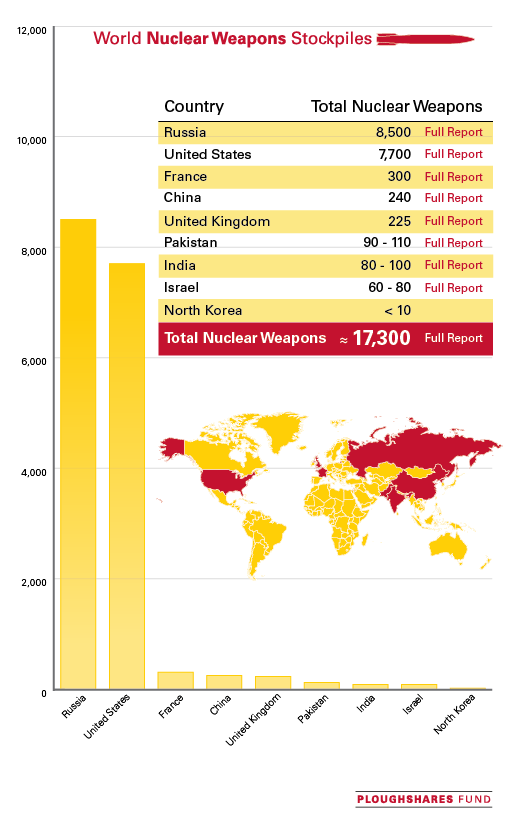
World Nuclear Stockpile Infographic

World Nuclear Stockpile Infographic: http://www.ploughshares.org

Moreover

Under NATO nuclear weapons sharing, the United States has provided nuclear weapons for Belgium, Germany, Italy, the Netherlands, and Turkey to deploy and store. This involves pilots and other staff of the “non-nuclear” NATO states practicing, handling, and delivering the U.S. nuclear bombs, and adapting non-U.S. warplanes to deliver U.S. nuclear bombs.

Personally I believe that the N. Korean nuclear program is due to 2 things:

  1. a paranoia about what the South will do, and
  2. an attempt to develop a better bargaining position before opening up

But I have difficulty to see their 3rd nuclear test as any great threat to world peace (compared say to the possibility of Israel bombing Iran or the Arab Spring going wrong or an expanding African adventure for France and other European countries longing for a return to colonial times).
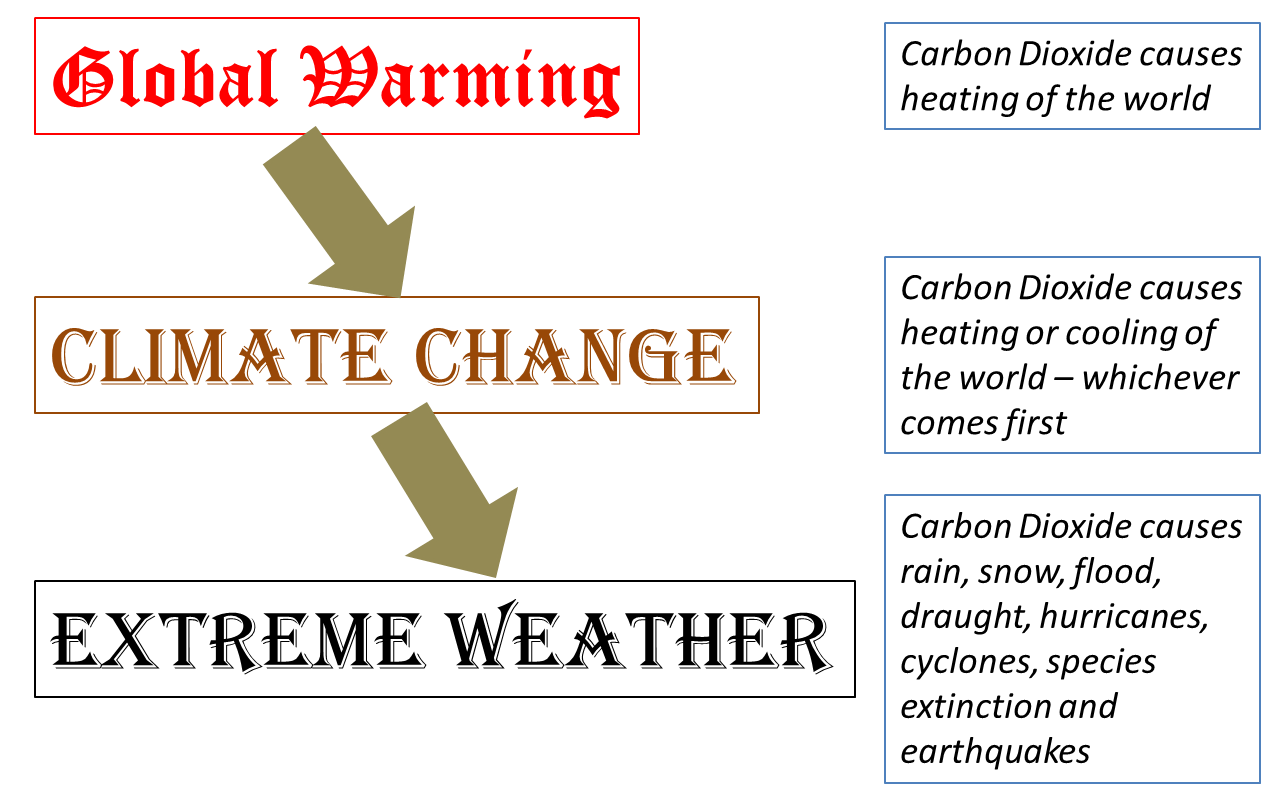
CO2 is bad, bad, bad……

February 12, 2013

Global warming morphs to climate change which morphs to extreme weather but CO2 is just plain bad!!!

CO2 is bad

Volkswagen is streets ahead with its common, global, modular concepts

February 11, 2013

Volkswagen’s Modularer Querbaukasten (MQB) which translates to Modular Transverse Matrix is a concept for sharing core components in a strategy for modular construction of all its transverse, front-engined, front-wheel drive cars. VW has probably taken this further than any other car-maker and are being bench-marked and closely watched by Toyota, Ford and others.  MQB is designed to stretch from the Polo to the Passat. At the top end Porsche are developing a comparable MSB concept (Modular standard matrix). Apart from only one dimension that must be held, the modular concept allows most dimensions to be stretched.

Golf 7 chasis: MQB Flexibility

Volkswagen Group brands (Volkswagen, Audi, Lamborghini, Seat, Skoda, Bentley, Bugatti, Porsche and more) comprise more than 200 individual models of cars. The complexity involved in trying to reduce costs and the number of components, meeting exceedingly strict emission and safety standards all the while reducing waste and consumption is obviously quite huge. MQB not only represents a new car specific part platform, but also an all-new modular engine program and modular production program. With MQB VW can build any vehicle from Polo to Mid-size SUV utilizing the same assembly line.

VW modular matrices

The MQB platform has a common engine mounting system and allows both petrol and diesel motors mounted in the same way and at the same angle of inclination. VW factories around the world could become multi-brand factories with VW’s, Seats, Skodas and even Audis to roll off the same line.

Reuter’s reports:

…. Since the heyday of Henry Ford and his Model T, the world’s automakers have considered the “global car” to be their Holy Grail – the same basic design that can be built, in subtle variations, and sold in different markets. 

Take that fundamental concept, stretch it across many different vehicle types, sizes and brands, then build them by the millions, and you begin to sense the enormity of Volkswagen’s rapidly evolving “mega-platform” strategy and its potential impact on competitors around the globe.

Auto engineer Hackenberg nurtured this bright idea for three decades, after early pitches to auto executives were largely ignored, until somebody finally bought it wholesale. The man who bit was Volkswagen Chief Executive Officer Martin Winterkorn. …… 

The strategy is not without risk. It could, for instance, expose Volkswagen to the threat of a massive global recall if a single part, used in millions of cars, fails.

But rivals have taken note of the power behind its move. Volkswagen’s modular platforms are being benchmarked by most of the world’s top automakers, including Toyota Motor Corp and Ford Motor Co, according to company executives. ….. 

…. VW’s work on its largest mega-platform, known internally as MQB, began in earnest in 2007 and is being implemented over the next four years at a cost of nearly $70 billion, estimates Morgan Stanley. The potential payoff is compelling: Projected annual gross savings by 2019 of $19 billion, according to the bank, with gross margins approaching 10 percent.

The automaker is expected to announce a record profit for 2012 of more than $30 billion later this month (February 22), according to Bernstein Research, whose senior analyst, Max Warburton, observes: “VW looks to have unstoppable momentum — in China, the U.S., Europe and most of the rest of the world.”

Even before MQB was launched in 2007, VW was a leader in using interchangeable components:

At a gathering in Japan five years ago, Renault and Nissan executives lifted the hoods on several VW Group vehicles side by side — including models from Skoda, Seat and Audi brands — and saw trouble.

“They had the same engines, the same clutches, the same ventilation — all identical parts,” says an executive who attended the presentation. “It was a level of commonality that didn’t exist at Renault-Nissan.” 

After a six-year gestation, VW has just begun to implement its sophisticated and highly flexible platform with the deceptively simple label MQB, a German acronym for “modular transverse matrix.” Virtually all of the group’s small and medium front-wheel-drive family models, including the latest generations of the VW Golf and Audi A3, are being designed around MQB as their base.

The new platform features a far greater degree of plug-and-play modularity, flexibility and parts commonality than at Toyota, General Motors Co, Ford and other competitors.

MQB “could be the single most important automotive initiative of the past 25 years,” says Michael Robinet, managing director of IHS Consulting in Northville, Michigan. “It really changes the game.”

With the new mega-platform strategy supporting its 12 brands, from spartan Skoda to Audi, Porsche and Lamborghini, VW is poised to snatch the global sales crown from Toyota as early as next year, according to investment bank Morgan Stanley.

VW envisions enormous leverage from MQB. The plan is to boost global sales to 10 million or more, with roughly two out of every three cars — some 40-plus models totaling 6.3 million sales a year — built on some variation of the MQB platform, according to U.S. research firm IHS Automotive.

None of VW’s competitors has the diversity of brands, the breadth of technology, the sweeping geographic footprint or the deep pockets necessary to support and take advantage of such a wide-reaching initiative as MQB.

Even Toyota, the current global sales leader, is playing catch-up with its German rival. … 

Pope Abdicates – Just old age or is a new church scandal about to break?

February 11, 2013

English: Pope Benedict XVI during general audition

He will be the first Pope to resign since Pope Gregory XII in 1415. A full list of current cardinals is here and his successor will come from those younger than 80 years.

BBC

Pope Benedict XVI is to resign

The Pope is to resign at the end of this month in an entirely unexpected development, the Vatican has confirmed.

The 85-year-old became Pope Benedict XVI in April 2005 following the death of John Paul II. The reasons behind the pontiff’s surprise resignation have yet to emerge. At 78, the former Cardinal Joseph Ratzinger was one of the oldest new popes in history when elected.

Certainly the Pope is not a young man but a health issue was not apparent. He says it is due to his age but I wonder.

Dear Brothers,

I have convoked you to this Consistory, not only for the three canonisations, but also to communicate to you a decision of great importance for the life of the Church. After having repeatedly examined my conscience before God, I have come to the certainty that my strengths, due to an advanced age, are no longer suited to an adequate exercise of the Petrine ministry.

I am well aware that this ministry, due to its essential spiritual nature, must be carried out not only with words and deeds, but no less with prayer and suffering. However, in today’s world, subject to so many rapid changes and shaken by questions of deep relevance for the life of faith, in order to govern the bark of Saint Peter and proclaim the Gospel, both strength of mind and body are necessary, strength which in the last few months, has deteriorated in me to the extent that I have had to recognise my incapacity to adequately fulfil the ministry entrusted to me.

For this reason, and well aware of the seriousness of this act, with full freedom I declare that I renounce the ministry of Bishop of Rome, Successor of Saint Peter, entrusted to me by the Cardinals on 19 April 2005, in such a way, that as from 28 February 2013, at 20:00 hours, the See of Rome, the See of Saint Peter, will be vacant and a Conclave to elect the new Supreme Pontiff will have to be convoked by those whose competence it is.

Dear Brothers, I thank you most sincerely for all the love and work with which you have supported me in my ministry and I ask pardon for all my defects. And now, let us entrust the Holy Church to the care of Our Supreme Pastor, Our Lord Jesus Christ, and implore his holy Mother Mary, so that she may assist the Cardinal Fathers with her maternal solicitude, in electing a new Supreme Pontiff. With regard to myself, I wish to also devotedly serve the Holy Church of God in the future through a life dedicated to prayer.

From the Vatican, 10 February 2013

BENEDICTUS PP XVI

30 million pilgrims seek salvation at the Maha Kumbh Mela today

February 10, 2013

This years Kumbh Mela – which is a “Maha” Kumbh being a one in 144 year event – started on 14th January and will continue  for 55 days. So far there have been 3 fires of significance in the various tent cities that have sprung up to cater for the 100 million visitors expected and some 20 people have been injured. Remarkably, considering the sheer volume of people, there have not been many other serious incidents or any fatalities attributable to the crowds.

(Update! 11th February

It is reported that 36 people – mainly women and children – died in a crush at the railway station on Sunday)

The Kumbh Mela web site tries to explain the fervor (but I don’t share the fervor and am not much the wiser):

The highlight for most pilgrims during a Kumbhmela festival is the observance of a holy bath at the sangam. A holy bath in either of a sacred river has purifying effects, but where the three rivers meet, the purification is said to increase one hundred times. It is further believed that when one takes a sacred bathe at the sangam during the Kumbhmela the potency of the holy water increased one thousand times. For this reason Indians believes that the Kumbhmela is the most auspicious place in the universe to take a holy bath. Armed with this faith pilgrims attend the Kumbhmela and bathe in the Ganges in a mood of solemn reverence.

Today is Mauni Amavasya  and is apparently a particularly auspicious day for these rituals. The Times of India also tries to explain the significance of the day – but their language is rather cryptic:

Astrologers believe that it’s a rare position when Sun and Moon enter and the zodiac sign of Capricorn, because of the transit, on this day. This day is also celebrated as the birthday of Manu Rishi. While Capricorn sign has the yoga of Sun and Moon which increases the significance of this Amawasya, taking a holy dip in Sangam will be giving virtues to an individual, on this day.

kalpavasi

A Kalpavasi

In Hindu mythology Mauna (silence) comes from Muni an ascetic who practised total silence in an effort to achieve a state of oneness with the self. It is therefore supposed to be a day of calmness, of silence and for the stilling of restless minds. It ought to be a day of meditation and contemplation and pilgrims are not supposed to talk to each other. Mauni Amavasya occurs annually on the 15th day of the dark fortnight of Magh (January-February) when both the Sun and the Moon are in Capricorn. It has a special relationship with the Kumbh Mela at Allahabad, being one of its major bathing days. This is reinforced in the annual Magha Mela of the Kalpavasis which views bathing on this day as extremely rewarding.

But I expect there may be some frayed tempers today when 30 million try to wash their sins away.

In any event some 30 million visitors are expected today and some 18,000 security personnel have been deployed. The Parliament House attacker Afzal Guru was executed yesterday in Delhi’s Tihar jail and there are some fears of a reaction

UK has enough shale gas for a millenium

February 9, 2013

Shale gas reserve estimates keep on increasing. We have the peculiar situation where Russia and some of the large oil companies attack shale gas only because some of their existing business may be threatened. But they all also have strong positions with shale gas. But what is clear is that “peak gas” has been postponed by several hundred years and there is no energy crisis in sight.

Peak Gas will never come

The Times has seen advance copies of the British Geological Survey’s new estimates of shale gas reserves in the UK:

Britain could have enough shale gas to heat every home for 1,500 years, according to new estimates that suggest reserves are 200 times greater than experts previously believed. The British Geological Survey is understood to have increased dramatically its official estimate of the amount of shale gas to between 1,300 trillion and 1,700 trillion cubic feet, dwarfing its previous estimate of 5.3 trillion cubic feet.

According to GWPF:

According to industry sources, the revised estimates will be published by the Government next month, fuelling hopes that new “fracking” techniques to capture trapped resources will result in cheaper energy bills.

It is thought that it will be technically possible to recover up to a fifth of this gas, making Britain’s shale rocks potentially as bountiful as those in the US. Experts stressed that it was still much too early to say how much of the gas it would be economic to get out of the ground to heat homes and help to generate electricity. 

In an interview with The Times today, Ed Davey, the Energy and Climate Change Secretary, tries to downplay hopes of a shale gas glut in the UK pushing down household heating bills, which are at record highs. “It is not the golden goose. The experts are clear that they do not expect this to have a major impact on the gas price.”

The UK Onshore Operators Group (UKOOG), which also represents other onshore oil and gas producers, is aiming to win over public opinion about the shale gas industry, in particular by countering claims that the process of fracking poses an environmental menace.

The shale gas industry is gearing up for a year of intense activity after the Government lifted an 18-month moratorium on fracking in December. The ban was imposed in May 2011 after Cuadrilla Resources, the explorer backed by Lord Browne of Madingley, the former chief executive of BP, set off dozens of earth tremors when it began fracking on sites near Blackpool. The company intends to resume fracking this summer to find out more about the size and commercial potential of its reserves.

Other explorers sitting on vast shale gas deposits will also apply for fracking licences soon. Government officials are preparing to hold an onshore oil and gas licensing round this year which could result in more parts of the UK being opened up for shale exploration.


Noted in Passing 9th February 2013

February 9, 2013

A weekly post on things that were interesting or which I would have liked to have blogged about …….

Science and Behaviour

The Fonseca Bust

Hair-dos and archaeology come together in an intriguing article in the Wall Street Journal which shows that there is a logic to hair styling.

MIT research suggests that India joined with Asia 10 million years later than previously thought while Caltech research indicates that that iron melts at higher temperatures than has been reported in the past and that the earth’s core more be a trifle warmer than has been assumed before.

257,885,161–1, which is also the 48th  Mersenne prime, was discovered on the computer of Dr. Curtis Cooper, a professor at the University of Central Missouri.

Global warming hard-liners are having to accept that the world isn’t warming as quickly as their catastrophe theories suggest. But they are not yet giving up on their religious beliefs about the anthropogenic causes of warming. But some more of the alarmism around global warming has to be recanted or at least toned down as new studies show that the Amazon rain forest is far more resilient to climate change than the doomsayers would have us believe.  Back in 1975 when the catastrophe theory of the day was the imminent cooling of the world, there were suggestions that the Arctic should be melted to try to get the world to warm up!!

Apparently certain certain volatile organic gases can promote cloud formation in a way  never considered before by atmospheric scientists. So much for “settled” climate science.

Pain and itching are both sensations which have a protective purpose and are linked to survival. Itching warns of the presence of irritants and it may be that there are a specific set of nerve cells that signal itch but not pain.

Flocking starlings strike an optimal balance between the work of responding to social cues from their neighbors and the need to conserve energy. They do this by coordinating with their seven nearest neighbors and form their characteristic flocks with the least effort.

Sweden is not immune to discrimination against job-seekers who have “foreign” names.

Amherst College seems to be taking sexual violence on campus seriously……

Engineering and Technology

The oil shale boom is having unexpected benefits even for rural banking in addition to changing the face of energy supplies.

The origin of the battery fire that occurred on a Japan Airlines (JAL) 787 at Boston Logan Airport in January has been identified as a single cell in a lithium-ion battery cell. Now the causes of the initiating short-circuit have to be found.

Meanwhile, Boeing has started telling its customers to expect serious delivery delays for the Boeing 787 as far out as this summer.

Bad Science

A mediocre academic, Brett Mills, seeks publicity by claiming that David Attenborough is minimising the prevalence of gay animals!

Earthworms are long revered for their beneficial role in soil fertility, but with the good comes the bad: they also increase greenhouse gas emissions from soils.

The Japanese Education Ministry is eyeing stricter penalties for researchers who misuse public research funds or commit fraud.

Last week, a California woman filed a lawsuit against Pfizer, the maker of Zoloft, alleging that Zoloft works no better than placebo, that Pfizer knew it, and that the company has run a systematic campaign to deceive doctors and the public in order to continue selling the drug.


German Education Minister to appeal against loss of her Doctorate

February 6, 2013
Bundesministerin Dr. Annette Schavan

Bundesministerin Dr. Annette Schavan (Photo credit: AndreasSchepers)

Update! 9th February

Annette Schavan has resigned.

==============

Dusseldorf University has not taken long after opening formal revocation proceedings to strip Annette Schavan – the German Minister for Education and Research- of her Doctorate for plagiarism.

BBC: 

The University of Duesseldorf’s philosophy faculty decided on Tuesday that she had carried out “a deliberate deception through plagiarism”.

The minister has denied the claims and said she will appeal.

An earlier plagiarism row brought an end to the political career of Germany’s defence minister in 2011.

Large parts of Karl-Theodor zu Guttenberg’s 2006 legal dissertations were found by Bayreuth University to have been copied and he stood down before it issued its damning verdict in May 2011.

Using the same words as Duesseldorf’s Heinrich Heine University, it concluded that he had “deliberately deceived”.

When Ms Schavan became the second minister in Chancellor Angela Merkel’s government to be accused of copying her doctorate, in this case by an anonymous blogger, she insisted she had never “knowingly falsely cited any sources” and promised to respond to the accusations.

But the faculty committee concluded that her work, which dealt with the formation of conscience, included a “substantial number of unaccredited direct quotes from other texts”.

In a statement declaring the doctorate invalid and withdrawing it from Ms Schavan, the faculty head Bruno Bleckmann said they had “decided by secret ballot, by 12 votes to two, with one abstention”. 

The minister herself, 57, was said to be on a five-day education and science co-operation trip to South Africa.. Education minister since 2005, she is described as a close colleague of Chancellor Merkel.

Her lawyers reportedly rejected the university’s ruling and said Ms Schavan would appeal.

When the university announced its inquiry, she said she had no intention of standing down.

But the investigation into one of Chancellor Merkel’s closest allies is seen as potentially awkward months before Germans vote in federal elections.

The popular German newspaper Bild said the news was a bitter blow to the chancellor, and wondered whether she would need to find a new education minister at the start of her election campaign.

Related:

Two years of self-imposed exile for zu Guttenberg

Good grief! “Unfriending” leads to avoidance in real life

February 5, 2013

This may not be bad science but it could be a gross exaggeration of its importance to call it trivial science. A study based on 582 responses gathered by Twitter no less! Unfriending someone on social media can apparently lead to real life avoidance. Almost a profound finding.

How does such nonsense get funded? And why does it ever get published? and reported? But it got presented at a Conference in Hawaii. All is explained.

Science Daily:

Unfriending someone on Facebook may be as easy as clicking a button, but a new study from the University of Colorado Denver shows the repercussions often reach far beyond cyberspace.

People think social networks are just for fun,” said study author Christopher Sibona, a doctoral student in the Computer Science and Information Systems program at the University of Colorado Denver Business School. “But in fact what you do on those sites can have real world consequences.”

Sibona found that 40 percent of people surveyed said they would avoid in real life anyone who unfriended them on Facebook. Some 50 percent said they would not avoid the person and the remaining 10 percent were unsure. Women said they would avoid contact more than men.

At this point I had to throw up.

This rubbish comes out of the University of Colorado department of Computer Science and Information Systems.

More shame to them.


Altruism among plants? or do they mean nepotism?

February 2, 2013

There is a suggestion that plants can be “altruistic”  but requires a rather curious definition of altruism as being only when the benefactor is related to the beneficiary. I would have thought that this was a case of nepotism among plants rather than altruism. It does not mirror the altruism observed among animals which are not related.

The research may be fine for all I know but the press release hypes a minor finding and the subsequent publicity is weird.

Colorado University Press Release:

… a study led by the University of Colorado Boulder suggests some plants are altruistic too.

The researchers looked at corn, in which each fertilized seed contained two “siblings” — an embryo and a corresponding bit of tissue known as endosperm that feeds the embryo as the seed grows, said CU-Boulder Professor Pamela Diggle. They compared the growth and behavior of the embryos and endosperm in seeds sharing the same mother and father with the growth and behavior of embryos and endosperm that had genetically different parents.

“The results indicated embryos with the same mother and father as the endosperm in their seed weighed significantly more than embryos with the same mother but a different father,” said Diggle, a faculty member in CU-Boulder’s ecology and evolutionary biology department. “We found that endosperm that does not share the same father as the embryo does not hand over as much food — it appears to be acting less cooperatively.”

A paper on the subject was published during the week of Jan. 21 in the Proceedings of the National Academy of Sciences. Co-authors on the study included Chi-Chih Wu, a CU-Boulder doctoral student in the ecology and evolutionary biology department and Professor William “Ned” Friedman, a professor at Harvard University who helped conduct research on the project while a faculty member at CU-Boulder.

Diggle said it is fairly clear from previous research that plants can preferentially withhold nutrients from inferior offspring when resources are limited. “Our study is the first to specifically test the idea of cooperation among siblings in plants.”

“One of the most fundamental laws of nature is that if you are going to be an altruist, give it up to your closest relatives,” said Friedman. “Altruism only evolves if the benefactor is a close relative of the beneficiary. When the endosperm gives all of its food to the embryo and then dies, it doesn’t get more altruistic than that.”

Science Daily merely reproduces the press release: Some Plants Are Altruistic, Too, New Study Suggests