Padre Pio and religious misconduct

November 17, 2011

Perhaps there has to be a process for retracting sainthoods in cases of religious misconduct?

A new book by Italian historian Professor Sergio Luzzatto suggests that Padre Pio’s stigmata were a fraud and the result of using carbolic acid.

Padre Pio's stigmata are being called into question (Photo: AP)

The Telegraph:

Did Padre Pio fake his stigmata with carbolic acid? That’s the claim made by Italian historian Professor Sergio Luzzatto, who says he has discovered documents including a letter from a pharmacist who supplied carbolic acid for Pio, canonised by Pope John Paul in 2002. The professor has made this claim before, drawing the following reply from the Catholic Anti-Defamation League: “We would like to remind Mr Luzzatto that according to Catholic doctrine, canonisation carries with it papal infallibility. We would like to suggest to Mr Luzzatto that he dedicates his energies to studying religion properly.“

The doctrine of papal infallibility indeed.

The Catholic church and its own priests have done more to defame Catholicism than anybody else in recent times.

Erasmus University, Rotterdam sacks Professor of cardio-vascular medicine for scientific misconduct

November 17, 2011
Don Poldermans

Don Poldermans

Universities in Holland are having a torrid time with another dismissal for scientific misconduct, this time at Erasmus University in Rotterdam. But the seriousness with which investigations are carried out and the speed and decisiveness with which Dutch Universities act is quite impressive.

Professor Don Poldermans, MD, PhD, is was  Professor of Medicine and head of the section perioperative cardiac care of the Erasmus Medical Centre, Rotterdam, the Netherlands. Dr Poldermans received his medical degree at the Erasmus Medical Centre in 1981. He is a fellow of the European Society of Cardiology and an honorary member of the Dutch Society of Anesthesiology. He is active within the Departments of Anesthesiology, Internal Medicine, and Surgery of the Erasmus Medical Centre, Rotterdam, the Netherlands.

Dr Poldermans is actively involved in patient care, education, research, and administration. He supervised 26 PhD students, all working on cardiovascular research. He has published more than 600 manuscripts in several peer-reviewed Journals, including the New England Journal of Medicine, Lancet, JAMA, Circulation, and the Journal of the American College of Cardiology.

Dutch News:

Erasmus University in Rotterdam has sacked a professor in cardio-vascular medicine for damaging the institution’s academic integrity and for ‘scientific misconduct’, the NRC  reports on Thursday.

The professor is accused of faking academic data and compromising patient trust, the paper says. In particular, he failed to obtain patient consent for carrying out research and recorded results ‘which cannot be resolved to patient information,’ the university said.

Don Poldermans has spent years researching the risk of complications during cardio-vascular surgery and has some 500 publications to his name.

A spokesman for Poldermans told the paper he admitted not keeping to research protocols but denied faking data.

Last month, Tilburg and Groningen universities said they planned to take legal action against behavioural science professor Diederik Stapel after an investigation showed he had faked research data in at least 30 scientific papers.

According to Elsevier, an investigation committee brought the fraud to light. It found that Poldermans had taken blood samples and heart echoes from patients without their permisssion and has reported results which cannot be traced to any patient.
“Patients were not physically harmed,” emphasizes Dean and Director Huib Pols. He said he was deeply shocked by the case. Patients who participated in the latest survey receive a letter of apology from the hospital.
Related: Diedrik Stapel faked at least 30 papers

Inspector General finds that Department of the Interior manipulated a scientific report to fit a political agenda

November 17, 2011

The US Inspector General has issued a report of an investigation into how the Department of the Interior manipulated and altered a 30-day report from the National Academy of Engineers. It was in response to the explosion of British Petroleum’s Deepwater Horizon oil rig on April 20th 2010, that the Department of the Interior declared a moratorium on deepwater drilling, which it extended for six months on  May 27th claiming support from the 30 day report. But the executive summary implied – falsely – that the moratorium decision had been peer-reviewed by the National Association of Engineers. The President’s Climate Change Advisor Carol Browner was the key figure involved in altering the language to make the false implication.

What is disturbing is not that politicians make political decisions but it is their cowardice in standing for their own views when they distort and manipulate what professional engineers and scientists say to imply – falsely – that there is objective support for their views.

Read the rest of this entry »

Now Holland cannot afford to subsidise off-shore wind power

November 17, 2011

Most subsidies for the introduction of  uneconomic technologies are in an effort to make them commercially viable. But after 30+ years in the power generation industry I have yet to see a case where this has happened. Instead, subsidies have nearly always been counter-productive. In virtually every case I have seen, subsidies have always been used first to maintain margins rather than to reduce costs. If costs are not reduced then the “indirect” costs for every taxpayer which a subsidy represents eventually end up becoming direct costs for the consumer when the subsidies end.

This is happening to an increasing extent with solar and wind power as subsidies are reduced or withdrawn in the current financial crisis. The costs have then to be borne directly by the consumers and it is not surprising that virtually all countries which have introduced wind power to any extent have seen electricity prices to the consumer increase.

Now it is the turn of the Dutch government to reduce subsidies and pass on the costs directly to consumers.

Reuters reports:

Dutch fall out of love with windmills

Read the rest of this entry »

Supposedly unbiased programs at the BBC were sponsored for millions by vested interests!

November 15, 2011

Many supposedly unbiased, objective BBC documentary programs have been sponsored by vested interests.

Programs about development were sponsored by the Malaysian government to the tune of £17 million. During the Arab spring a program was sponsored by Mubarak’s government. Another program about climate change was sponsored by Envirotrade – a carbon trading company based safely for taxes in Mauritius.  The BBC’s alarmist bias about climate change is notorious but sponsorship by organisations making millions from carbon trading goes a long way to explaining their “objectivity”. The broadcasting regulator, Ofcom, is to investigate.

One media company which made partisan programs for the BBC, FBC Media (UK), has gone into administration. “FBC, incorporated in 1998, was a vehicle for high-profile figures led by founder and chairman Alan Friedman.”

The Independent:

The BBC has owned up to a “nominal fee” programming scandal in which viewers of 15 editorial programmes were hoodwinked by “serious” conflicts of interest of programme makers and a failure to declare that documentaries had outside sponsors.

Read the rest of this entry »

National University of Singapore exonerates Yoshiaki Ito of misconduct

November 15, 2011

Not entirely unexpected that Yoshiaki Ito would be exonerated by the National University of Singapore but the speed of the investigation and the exoneration is noteworthy.

ScienceInsider:

The National University of Singapore (NUS) announced today that it has found no evidence of research misconduct by Yoshiaki Ito, a high-profile cancer researcher accused of data fabrication. However, the finding does not resolve the underlying—and long-running—scientific dispute over whether a gene known as Runx3 is a tumor suppressor.

Read the rest of this entry »

“Offshore wind power is not affordable” – KPMG

November 15, 2011
Any Old Wind That Blows

There are some simple and rather obvious matters that the “green” lobbies prefer to ignore.

  1. In spite of twenty years of subsidies wind power is still not commercially viable without subsidy. Solar thermal power plants enjoy feed in tariffs some 3 times higher than the cost of conventional fossil power generation. Wherever renewables have been used to any extent, electricity prices for the consumer have increased.
  2. Intermittent sources of power (which cease when the wind does not blow, or blows too hard or when the sun does not shine at night or when clouds appear) are – by definition – unreliable. They do not add to the reliable, base-load, generating capacity that any electricity grid requires and must be backed up.  In Scotland for example – as Professor Colin McInnes points out – wind power capacity now exceeds nuclear capacity but only produces about one-third of the energy.
  3. Electricity is energy in motion and cannot be stored as electricity. For any electrical grid, at any instant, generation must, perforce, equal demand – and pumped storage schemes are merely devices to try and ensure such balance. Since the outages of wind and solar power are unpredictable (though it is generally predictable that solar power will not be available at night), and cannot be relied on to meet load demand fluctuations, “balancing power” (usually from gas turbines) must be arranged for whenever wind or solar capacity is added.
  4. In addition to the direct subsidies, whenever wind or solar power is available at times when there is low load, the subsidised regime forces the turning-down of other capacity – to the detriment of that capacity – and adds to the total cost of the grid.
Now – finally – some of the real numbers are beginning to be acknowledged but not, of course, by the green lobbies. KPMG has produced a new report “Thinking about the Affordable” and Power Engineering International reports that:
Read the rest of this entry »

Peter Roebuck committed suicide after accusation of sexual assault on young cricketers

November 14, 2011

Yet another case of predatory behaviour by sports people in authority over young boys. Peter Roebuck committed suicide in S. Africa by jumping out of his hotel window after being questioned by police about drugging and sexually assaulting a young boy. Many people must have known anout his behaviour.

He wrote very well and I always enjoyed his articles. But he had some dark secrets and they are not very pretty. In 2001 he was found guilty of caning 3 young S. African cricketers he was training.

Daily Telegraph Australia: In 2001, the former Somerset cricket captain was given a suspended jail sentence after admitting caning three young cricketers he had offered to coach. Roebuck, of Exmouth in Devon, pleaded guilty to three charges of common assault involving three South African teenagers between 1 April and 31 May, 1999. He had pleaded not guilty to three counts of causing actual bodily harm, which was accepted by the prosecution. Roebuck was sentenced to four months in jail for each count, with the sentences suspended for two years, at Taunton Crown Court. Judge Graham Hume Jones told Roebuck he had abused his power and influence over the boys, who were far from home and far from friends and family.

Update! I see that tributes, and here, are flowing in about his writing and his cricket career. But I am afraid that whatever he may have done well, his sexual predations and the lives of all the young people he has traumatised is too heavy a price.
Better that he had never written a single word if that would have meant that his horrible behaviour to young cricketers under his authority could have been avoided.

Read the rest of this entry »

Japan back to growth with a bang with GDP up 1.5% in 3 months

November 14, 2011

I have faith in Japanese resilience and will still stick my neck out and stay with my forecast that the Japanese economy  will become a global “driver” through 2012 and 2013.

Japanese Gross Domestic Product grew by 1.5 % over the 3rd quarter (July – September) representing an annualized growth rate of 6 percent. This is the fastest rate of growth for 18 months.  The Cabinet Office said today in Tokyo that at 543 trillion yen ($7 trillion), the economic output was back to levels last seen before the March 11th  Great Tohoku quake and tsunami.

The growth seems to have been led by exports rather than the domestic impetus measures to recover from the earthquake or the subsequent spending on rebuilding infrastructure. These probably need 2 more quarters to kick-in but that  means that this growth is still vulnerable to current global weaknesses.

However the optimistic “glass half full” view would be that Japanese exports have grown mainly to Asia and the earthquake rebound  has yet to come. Moreover this has happened in spite of a very high Yen. Any recovery in Europe and N. America would be a further boost to an economy which is large enough to then act as a global motor.

NY Times: 

The rebound underscores the speed at which Japanese industry has been able to get back on its feet after the March 11 earthquake and tsunami, rebuilding factories and re-establishing supply chains severed by the destruction.

Exports jumped 6.2 percent as manufacturers got production back on track. Private consumption, which accounts for almost two-thirds of Japan’s economy, grew 1 percent, helped by a rebound in consumer sentiment and replacement demand in the tsunami zone.

Still, policy makers and economists also worry that the punishingly strong yen of recent months as well as weak growth in major trading partners, like the United States and China, will take a toll on Japanese exports. The crisis at the Fukushima Daiichi nuclear plant, meanwhile, has thrown the country’s energy policy into disarray and cast a pall over Japan’s recovery.

Related: Could the disaster in Japan power a wave of sustainable growth? 


Phobos Grunt is dead and silent …..

November 12, 2011

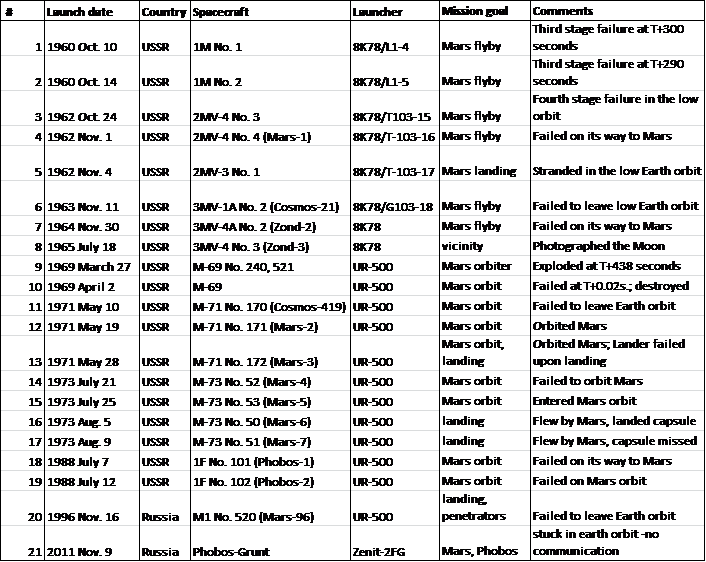
Phobos-Grunt is still circling Earth at an altitude between 128 miles and 210 miles after launching Tuesday from the Baikonur Cosmodrome in Kazakhstan for Mars buit is dead and silent. The jinx goes on and it is now 21 Russian missions to Mars which have failed their main mission goals:

Information from http://www.russianspaceweb.com 

Soviet / Russian Mars Missions
Phobos-Grunt

Phobos-Grunt

SpaceflightNow: Major General Vladimir Uvarov, a former space expert in the Russian military, told the Rossiiskaya Gazeta newspaper he has lost optimism in Phobos-Grunt’s chances for recovery.

“In my opinion, the Phobos-Grunt probe has been lost. This probability is very high. At any rate, it is much higher than the chances for reactivating the probe,” Uvarov told the newspaper. …. 

With 11 tons of toxic hydrazine and nitrogen tetroxide propellant still in its fuel tanks, Phobos-Grunt’s potential re-entry is stirring concerns of space experts after two high-profile returns of large satellites in September and October.