EasyJet has much to learn: Incompetence compounded by “threats of arrest”

January 11, 2011

From the Daily Mail:

Dozens of Easyjet passengers were ordered off a plane and threatened with arrest if they refused – because the overloaded jet was too heavy to take off.

The flight from Birmingham to Geneva was over-filled with 10 tonnes too much fuel so the captain asked the last 37 customers to get off the plane. When some passengers refused to budge they were informed that three police officers were waiting in the airport terminal and would arrest them if necessary.

I have experienced this once on an SAS flight from Copenhagen to Norrköping. We had just seated ourselves when my son cried out “Dad, they’re taking our bags away”. Sure enough they had overfilled the plane with fuel and off-loaded baggage to compensate. But the Captain came out and apologised personally to each affected passenger, explaining that the ground crew had over-filled with fuel according to his instructions which had been based on a passenger manifest which was about 2 hours out-of-date. He acknowledged it was his fault publicly on the loudspeakers and that he had no excuses.  He promised that all baggage would come out on the next flight and would be delivered to our addresses (which did happen). By the time we had landed, the stewardesses had taken down the addresses of the affected passengers and when we landed the kids were plied with toys, puzzles and 2 weeks worth of chocolates and we were given carrier bags full of bottles of wine and champagne left over from the meal service.

What I was particularly struck by was that all the irritation and anger of the passengers was completely neutralised as soon as the captain made his public acknowledgement, admitted the mistake and took responsibility. The mood on the plane palpably changed and by the time we had landed my boys actually thought it was all part of an adventure  organised especially for them. Needless to say they still have a deep seated loyalty to the SAS brand even though SAS has fallen on relatively hard times and we usually have to fly Lufthansa to reach the destinations we need to get to. That Captain had a touch of class.

EasyJet has a lot to learn about what taking responsibility actually means.

If at all possible EasyJet and RyanAir are airlines I avoid like the plague.

Sundog (parhelion) as seen in N. China

January 11, 2011

A parhelion (sundog) combined with a halo is seen in Changchun, capital of northeast China's Jilin Province, Jan. 8, 2011. (Xinhua/Lin Hong)


From Wikipedia:

Sundogs are formed by plate-shaped hexagonal ice crystals in high and cold cirrus clouds or, during very cold weather, by ice crystals called diamond dust drifting in the air at low levels. These crystals act as prisms, bending the light rays passing through them by 22°. If the crystals are randomly oriented, a complete ring around the sun is seen — a halo. But often, as the crystals sink through the air they become vertically aligned, so sunlight is refracted horizontally — in this case, sundogs are seen.

As the sun rises higher, the rays passing through the crystals are increasingly skewed from the horizontal plane. Their angle of deviation increases and the sundogs move further from the sun. However, they always stay at the same altitude as the sun.

Sundogs are red-colored at the side nearest the sun. Farther out the colors grade through oranges to blue. However, the colors overlap considerably and so are muted, never pure or saturated. The colors of the sundog finally merge into the white of the parhelic circle (if the latter is visible).

It is theoretically possible to predict the forms of sundogs as would be seen on other planets and moons. Mars might have sundogs formed by both water-ice and CO2-ice. On the giant gas planets — Jupiter, Saturn, Uranus and Neptune — other crystals form the clouds of ammonia, methane, and other substances that can produce halos with four or more sundogs.

And yet another irreproducible, irrefutable result!!

January 10, 2011

From EurekAlert:

New paper in Nature Geoscience examines inertia of carbon dioxide emissions

New research indicates the impact of rising CO2 levels in the Earth’s atmosphere will cause unstoppable effects to the climate for at least the next 1000 years, causing researchers to estimate a collapse of the West Antarctic ice sheet by the year 3000, and an eventual rise in the global sea level of at least four metres.

The study, to be published in the Jan. 9 Advanced Online Publication of the journal Nature Geoscience, is the first full climate model simulation to make predictions out to 1000 years from now. It is based on best-case, ‘zero-emissions’ scenarios constructed by a team of researchers from the Canadian Centre for Climate Modelling and Analysis (an Environment Canada research lab at the University of Victoria) and the University of Calgary.

The Daily Mail headline proclaims

(and perhaps – following Nostradamus – we should only use quatrains !)

Sea levels will rise by at least 13ft in next 1,000 years, claim scientists

Global sea levels will rise

By at least 13ft in the next 1,000 years

As a result of carbon dioxide emissions,

Scientists have warned.


The ‘unstoppable’ impact of global warming

Will cause a catastrophic collapse

Of the West Antarctic ice sheet

By the year 3000.


“Ongoing climate change following a complete cessation of carbon dioxide emissions” by Nathan P. Gillett, Vivek K. Arora, Kirsten Zickfeld, Shawn J. Marshall and William J. Merryfield will be available online at http://www.nature.com/ngeo/index.html

Or perhaps it should have been published here:

The Journal of Irreproducible Results


Development of stealth fighter aircraft moves East

January 10, 2011

Both China and India are developing 5th Generation stealth fighters; China on its own and India as part of a joint development programme together with Russia.

From http://china-defense.blogspot.com/2010/12/latest-batch-of-j-20-photos.html

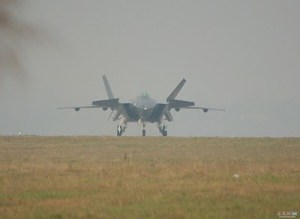
Chinese Chengdu J20 - 5th generation stealth fighter: image http://china-defense.blogspot.com

Rumours from China’s Chengdu Aerospace Corporation (CAC) and the adjoining Aircraft Plant No 132 suggest that a flight of a Chinese-developed fifth-generation fighter prototype would take place by the end of the year. Reportedly, two airframes (numbered 2001 and 2002) have been assembled at the 132 plant.

In August 2008 it was reported that 611 Institute was selected to be the main contractor for the development of the fifth-generation stealthy J-20, and that 601 Institute was the sub-contractor. It was rumored that 611 Institute has started to issue manufacturing drawings for constructing the first prototype, which is expected to fly by 2012, even though the full configuration one won’t fly until a few years later. The latest rumor suggested that a full-scale mock-up had been built at CAC.

From http://www.globalsecurity.org/military/world/china/j-xx.htm

File:Pak fa.jpg

Sukhoi PAK FA T50: image wikipedia

Russia and India are jointly developing the Sukhoi PAK FA / T-50 , which first flew in January 2010. In June 2001, India was offered ‘joint development and production’ of this new 5th generation fighter by Russia. Russia had been trying to sell this concept both to China and India for some time. It seems probable that China declined to participate in this project given a belief that Russia stood to gain more from Chinese participation than did China. That is, it would seem that China had determined that it could produce a superior product without Russian help. With the first flight of the Russian stealth fighter in 2010, an arguably superior Chinese steath fighter might be expected to take to the skies not too long thereafter.

Chinese combat aviation has made remarkable strides in recent years, moving from a collection of obsolete aircraft that would have provided a target-rich environment to potential adversaries. Today China flies hundreds of first rate aircraft, and even flies more Sukhoi Flankers [the aircraft the American F-22 was designed to counter] than does Russia. The Chinese stealth fighter has arrived right on schedule. Chinese military technology is generally rated about two decades behind that of the United States. while the advent of a Chinese counterpart to the F-22 fighter might be disconcerting, the first flight of the prototype American F-22 stealth fighter came on September 29, 1990.

From the Hindustan Times:
New Delhi, December 21, 2010: India and Russia on Tuesday finalised a contract for the biggest defence programme in the country’s history — a $30-billion (Rs 1,35,000-crore) project involving the joint production of 200-250 fifth generation fighter aircraft (FGFA). The aircraft, being called the perspective multi-role fighter (PMF), will exploit the basic design of the Russian Sukhoi T-50 PAK-FA prototype, with modifications thrown in to meet the Indian Air Force’s “more stringent specifications”. The 30-tonne aircraft will be a swing-role fighter with stealth features for increased survivability, advanced avionics, smart weapons, top-end mission computers and 360-degree situational awareness. What will put the co-produced fighter in a different league is its ability to supercruise, i.e. sustain supersonic speeds in combat configuration without kicking in fuel-guzzling afterburners. Currently, the US Air Force’s F-22 Raptor is the only fighter in the world that can supercruise.
The contract for the joint design and development of the FGFA was signed between Hindustan Aeronautics Limited and two Russian firms, Sukhoi Design Bureau and Rosoboronexport. The fighter will be jointly marketed to international air forces. The first prototype flew its maiden sortie in January 2010 and has conducted more than 40 flights. The IAF hopes to induct it by 2018.
A joint statement issued by the ministry of external affairs said Prime Minister Manmohan Singh and Russian President Dmitry Medvedev agreed that the December 2009 pact covering bilateral military cooperation during the next decade would lead to a more substantive engagement cutting across joint research and development, manufacturing and marketing activities.
In the meantime DNA reports:
 

HAL Tejas at Aero India 2009

HAL Tejas: Image via Wikipedia

India today joined a select group of nations manufacturing warplanes with the home-grown Light Combat Aircraft ‘Tejas’ moving a step closer to its induction into the Indian Air Force after getting its Initial Operational Clearance (IOC) here. 

27 years after the project was initiated, defence minister AK Antony handed over the IOC certificate to Air Chief Marshal PV Naik at the HAL airport in Bangalore.

“This is only the semi-finals”, Antony said, adding the LCA would enhance national security and build the country’s own fighter aircraft capabilities.

The aircraft, with an investment of over Rs 14,500 crore ($3.2 billion), has been developed by DRDO’s Aeronautical Development Agency after battling technology denial regimes and sanctions for nearly three decades. “After crossing a number of challenges and accomplishing a significant series of milestones including weapon delivery, in over 1500 sorties, the country is poised for a major turning point with the declaration of the IOC,” Antony said.

The IAF has plans to induct a total of around 200 planes of which orders for the initial 40 have already been placed by the IAF.

The aircraft, which costs between Rs 180 to 200  crore ($45 million)  per piece, is presently powered by American GE-F 404 engine and the advanced GE-414 engines have been chosen for powering the LCA Mk II aircraft, which are likely to be developed by 2014.


Mt. Merapi rumbles on and rains cause cold lava floods

January 10, 2011

Mount Merapi has continued erupting in the past two or three weeks but at much lower intensities than the  fatal eruptions which occurred on October 26 and November 5.

Island Crisis reports that:

YOGYAKARTA, INDONESIA (BNO NEWS) — With heavy rainfall accompanied by sporadic but strong wind currents, Indonesia’s Yogyakarta was hit by the largest outflow of cold lava and mud, locally known as lahar dingin, since October’s Merapi eruptions, local media reported.

The cold lava damaged several bridges and created chaos as traffic flow was cut off for around 18 hours on one of the city’s main highways, which was flooded under meter-deep lahar in several areas. “In addition to destroying the Gempol main bridge on the Putih River, lahar also destroyed bridges in other villages, leading to the isolation of hundreds of residents in seven hamlets,” Heri Prawoto, head of the Magelang district’s Disaster Management Office, told the Jakarta Globe.

But the resilience of humans is amazing.

The Merapi Golf Course in Yogyakarta, covered in ash. image credit: DigitalGlobe.

In Merapi’s Shadow, a Tourism Boom

The golf courses may be covered in volcanic ash, but tourists are flocking to Indonesia to see devastated villages near the recently eruptive Mount Merapi volcano.

Tourists with a curiosity about the aftermath of earthquakes, tsunamis and volcanic eruptions are being courted to the central Javanese city of Yogyakarta, Reuters reports.

The eruptions, which began on Oct. 26, killed more than 350 people and created nearly 400,000 refuges. That destruction, it seems, is a selling point for local travel agencies desperate for tourists’ dollars. “In the new volcano tour package, we’ll take customers to explore the closest village to the peak and see how bad the devastation is,” Edwin Ismedi Hinma, of the local tour agencies association, told Reuters. “Then we’ll take them to a river to watch cold lahars flood past.”


Drawing the line between science and faith

January 9, 2011

Steve McIntyre takes up another case of  somebody publishing a paper but refusing access to the data the paper is said to be based on at http://climateaudit.org/2011/01/06/more-data-refusal-nothing-changes/.

I have always found my simple and absolutely reliable demarcator between science and faith as being the words ” I believe that….”. The moment any statement is a matter of  “belief” rather than ” a conclusion drawn from the evidence” it becomes a matter of faith rather than of  “science”.

The moment an author cannot – for whatever reason – provide the data he has used then he is asking the reader to rely on “faith” or “trust” that the data does exist and is not faked or imagined or invented. For the reader the matter immediately descends to becoming a question of “belief” in the author if nothing else. And the author is surely not God to command an unquestioning belief.

  • Whenever an author refuses access to his data he reduces his own conclusions from being matters of science to becoming matters of “faith”.
  • When such a paper is said to be peer-reviewed then it reduces the group of peers to be little more than the acolytes to a faith.
  • When a journal publishes a paper without insisting that the data be archived and accessible then it reduces the journal in which the paper is being published to being no more than the parish magazine for a cult.

Ozone layer hits record thickness in Sweden: Was there ever an ozone hole problem?

January 9, 2011

Lately there has been an increasing view that some of the catastrophe scenarios about the ozone hole which led to the Montreal Protocol of 1989 were exagerrated and based on poor science. The effects of humans on ozone variations as opposed to natural variations may have been exaggerated. In fact there are now some suggestions that the actions taken were not only unnecessary but that they have not had much to do with the natural increase of ozone layer thickness observed in recent times.

The Local reports:

Sweden’s government weather agency reported on Friday that the ozone layer over southern Sweden reached its thickest levels at the end of last year, surpassing the previous record set in 1991.

Sweden’s Meteorological and Hydrological Institute (Sveriges Meteorologiska och Hydrologiska Institut, SMHI) explained that the weather was particularly favourable at the end of 2010 and it explain why the ozone layer was especially thick at the time. “It is a step in the right direction, but it is still too early to say that the ozone layer has recovered. The favourable weather situation over the last few months has contributed to a record high,” said Weine Josefsson, a meteorologist at SMHI, in a statement on Friday.
The annual value of the ozone layer’s thickness over Norrköping in 2010 stood at a new high of 351.7 Dobson units (DU). The previous record was set in 1991 at 341.8 DU. The November and December values in particular set new records among the measurements regularly made at SMHI since 1988. ……….  Even in Norrland in the country’s north, the values have been positive in the last year. The ozone layer has been measured regularly in Vindeln northwest of Umeå in northern Sweden since 1991 and the latest results were also positive in this area.
However, it is not possible to record complete ozone measurements in the winter, so it is uncertain whether a record was set there as well at the end of last year. In November and December, air flows were affected by a special weather situation over western Europe, resulting in an extra thick ozone layer over this part of the world in these two months.
It is possible that the restrictions on ozone-depleting substances proposed in the Montreal Protocol in 1987 have also contributed to the thickening of the ozone layer. However, this type of measure is effective over a long period of time and it is difficult to distinguish the effect of natural variations in this case.

Widespread corruption within Turkish customs: Bribes pool of $125 million

January 9, 2011

In Transparency International’s Corruption Perceptions Index, Turkey ranks together with countries such as the Czech Republic, Hungary, Saudi Arabia, South Africa and Slovenia but somewhat better than Italy.

A bribery ring composed of customs officials in Turkey and including the Director of the Istanbul Region has been revealed. It appears that the 34 arrested shared a bribes pool which in the period of the 6 month investigation is estimated to have contained about $125 million.

From the magnitude of the bribes pool it would seem that Turkey is well qualified for membership of the European Union and the monetary value of this case compares “well” with the Formula 1 bribery case in Germany – though that involved just one individual(?).

It was announced today that:

Thirty-four individuals serving at the İstanbul Customs Regional Directorate have been detained in a major investigation into bribery and corruption allegations at the customs department. The suspects include the chief director of the İstanbul Customs Regional Directorate.

The operation was carried out on Friday.

The allegations against the suspects include the collection of money paid in bribes in a pool and then the distribution of this money to İstanbul customs officials every Friday on the basis of rank and seniority. The investigators claim Chief Director Lütfi Ekinci was aware of this practice among his staff. Ekinci was detained in Mersin, where he was vacationing in his summerhouse.
The suspects allegedly relied on three methods to take bribes from companies importing goods to Turkey. One was to force companies that had all their documents in order to give money, calling this a “donation.” The other method was showing the value of an imported good to be nine-tenths less than the actual value on paper. In other words, an item that would normally cost TL 10 would be recorded as costing TL 1. A third method the officials used was falsifying documents and showing those products that are subject to higher taxes — such as cigarettes — as if they belong in another taxation category. The difference would be taken by the customs officials and added to the bribery pool. Investigators estimate the amount channeled into the bribe fund was TL 200 million ($125 million)…….. The center of the raids was the İstanbul Atatürk Airport Customs and the Ambarlı Customs Zone, but the raids were staged simultaneously at 20 different addresses. Hayrettin Eker, the İstanbul Atatürk Airport Customs Directorate Cargo Terminal chief, and Smuggling Intelligence and Narcotic Department Chief Coşkun Cihanoğlu were also detained in the operation. Documents and computers in the offices of the two men were seized by the police.

The police found TL 20,000 inside an envelope in Eker’s office. A total of TL 150,000 was found on other customs officials detained in the operation, which the investigators claim was taken in bribes. Investigators say the operations will extend to the companies that were involved in the customs bribery scheme.

Sea of Okhotsk rescues hampered by bad weather and thick ice

January 9, 2011

Freeing the ships – and especially the factory ship Sodruzhestvo – trapped in the Sea of Okhutsk is going to be a slow process. In addition to the Magadan and the Admiral Makarov the icebreaker Krasin has also been deployed. (This is the second Krasin and was built in 1976 in Finland – the original Krasin was built in 1916 and designed by Admiral Stepan Makarov)

The Gulf of Sakahalin is still heavy with ice. In addition to the thick ice of upto 2 m reported earlier, local ice thickness can be 2 – 4 m with chunks upto 25 m thick. Bad weather is also hampering the rescue operations.

Krasin on its way to McMurdo

Icebreaker Krasin: Image via Wikipedia

Itar-Tass:

MOSCOW, January 9 (Itar-Tass) — Russia’s Minister of Transport Igor Levitin chaired on Sunday another meeting on the rescue operation in the Sea of Okhotsk.

“The participants in the meeting discussed the rescue operation in the anomalous bad weather conditions with persistent North-West stormy wind of 25 metres per second, zero visibility and heavy ice,” the Ministry’s press service said. On January 9, the Krasin icebreaker is expected to approach the Admiral Makarov icebreaker.

“If the weather permits, they will pull the Shore of Hope refrigerator to ice-free waters,” the source said. Earlier, the Admiral Makarov towed the Professor Kizevetter research vessel into an easily passable ice area and handed it over to the Magadan icebreaker which led it to open waters.

The third ship, the Sodruzhestvo floating base, remains stranded in the ice. Experts believe that it’s going to be harder to take it out to clear waters because its hull is wider than that of the icebreakers. The Krasin icebreaker is expected to widen the canal for the ship’s passage.

Three Russian vessels, the Sodruzhestvo, the Professor Kizevetter and the Shore of Hope got trapped in the ice of the Sakhalin Gulf, the Sea of Okhotsk, on December 30 of the past year. According to scientists who have carried out research, the thickness of ice in the Gulf in various periods may vary from two to four meters. Some chunks of ice may reach the thickness of 25 meters.

Methane from BP oil spill has vanished – presumed digested by microbes

January 9, 2011
Molecule of methane.

methane molecule: Image via Wikipedia

A new paper online in Science:

Science DOI: 10.1126/science.1199697 A Persistent Oxygen Anomaly Reveals the Fate of Spilled Methane in the Deep Gulf of Mexico, by John D. Kessler, David L. Valentine, Molly C. Redmond, Mengran Du, Eric W. Chan, Stephanie D. Mendes, Erik W. Quiroz, Christie J. Villanueva, Stephani S. Shusta, Lindsay M. Werra, Shari A. Yvon-Lewis and Thomas C. Weber

It adds to the growing body of evidence that the oceans with the help of microbes are much more resilient than they have been assumed to be.

https://ktwop.wordpress.com/2010/09/12/microbes-ate-the-bp-oil-plume/

https://ktwop.wordpress.com/2010/10/20/microbes-consume-methane-10-to-100-times-faster-than-thought/

As Science News puts it:

Methane, the predominant hydrocarbon produced by the BP blowout last year, has all but vanished from Gulf of Mexico waters, a new study reports — presumably eaten up by marine bacteria. That hadn’t been expected to happen for years.

Two-thirds of the hydrocarbons released by the BP accident were forms of natural gas: largely methane, ethane and propane. While Gulf microbes quickly began devouring the larger gas molecules, they initially left tiny methane — which accounted for an estimated 87.5 percent of the gas initially emitted — largely untouched.

Some of the authors of the new paper had reported in the Oct. 8Science finding almost no microbial breakdown of BP methane in June, about a month and a half into the 83-day gusher.

Rates of biodegradation in subsea plumes, where this gas had been accumulating, “indicated methane would persist for many, many years, if not almost a decade,” observes John Kessler, a chemical oceanographer at Texas A&M University in College Station and an author of that earlier report.

To begin quantifying just how slowly that breakdown was proceeding, he and his colleagues returned to the Gulf for three research cruises between August 18 and October 4. Their sampling at more than 200 sites turned up no BP methane. In fact, concentrations of the gas in seawater throughout the spill zone were lower than typical background concentrations for the Gulf, these researchers report online January 6 in Science.

“We were caught off guard,” Kessler says. “But that highlights the beauty of the scientific process. You put together hypotheses based on the information at hand and test them. And whether we’re right or wrong, at the end of the day we’ll have learned something new about the system.”

The new paper’s conclusions “are quite consistent with what we’ve seen,” says microbial ecologist Terry Hazen of Lawrence Berkeley National Laboratory in California. On August 24, his team was the first to report online in Science that BP oil plumes had disappeared.