November 17, 2010
Rolls-Royce, beset by criticism over its public handling of the uncontained failures of its Trent 900 and 1000 engines, has canceled its planned Airshow China show briefing.
The engine-maker offered no explanation for the cancellation, leaving media attending the show only to speculate on its sudden change of plans.
http://www.flightglobal.com/blogs/flightblogger/2010/11/rolls-royce-cancels-zhuhai-pre.html#comments
Tags: Cancelled press conference, Rolls Royce, Trent 1000, Trent 900, Zhuhai China Air Show
Posted in Aviation, Engineering, Technology, Travel | Comments Off on Rolls-Royce cancels Zhuhai Air Show press conference
November 17, 2010

Trent 900: image via Wikipedia
Rolls Royce is asking Airbus to return new engines destined for new aircraft so that they can be supplied to Qantas, Singapore Airlines and Lufthansa for their operations. This in turn is having a knock-on effect on future A380 deliveries.
In the meantime Qantas seems to be having a rash of minor issues which have caused aircraft to return after cockpit fires, bird hits and lightning strikes.
The European Regulator (EASA) has not commented on why they relaxed their Airworthiness Directive and whether this was done in response to representations from Rolls Royce. The engine maker is also silent on whether they knew of the Trent 900 problem and the risk for an engine fire prior to the uncontained explosion of an engine on QF32.
Reuters reports on the logistics problems faced by Rolls Royce:
British enginemaker Rolls-Royce has asked Airbus to return Trent 900 engines from A380 superjumbo production lines so they can be used to replace faulty ones on aircraft already in service.
The Airbus A380 — the world’s largest passenger aircraft with an average list price of about $350 million — has been hit by safety concerns after a Rolls-Royce engine partly disintegrated mid-flight, forcing a fully laden Qantas plane to make an emergency landing in Singapore on Nov 4.
Rolls-Royce’s move could be another blow to a much-delayed A380 program as Airbus was scheduled to deliver over a dozen Rolls-Royce-powered A380s — primarily to Singapore Airlines, Qantas and Lufthansa by the end of next year.
“Until this problem is fully resolved I think the situation with the delivery of A380 to customers … will be in jeopardy,” Standard & Poor’s analyst Sukhor Yusof said. But both Singapore Airlines and Qantas, with a combined 22 A380s still to be delivered, said on Tuesday they had not been informed of any delivery delays.
Airlines using the Rolls-Royce Trent 900 engines have been ordered by European aviation authorities to undertake major tests, which analysts said were so strenuous they would likely disrupt schedules.
“I can confirm that Rolls-Royce is arranging to supply some new engines from the production line to replace some engines removed from the serviced aircraft,” an Airbus spokesman in Singapore said, without saying which airlines would receive those engines.
Shares in Rolls-Royce, which on Friday said fixing the fault would lead to only slightly slower profit growth, have suffered during its probe and were 0.2 percent down at 596.50 pence by 1130 GMT on Tuesday, around 9 percent below their last trade before the Qantas incident. Airbus parent EADS has lost 5 percent since the incident and hit a one-month low on Monday. Its shares were 1.3 percent down at 17.78 euros. Qantas is down 4.9 percent since the incident. Airbus said last week that the problem with the Rolls-Royce engine could have an impact on its earnings and delivery target for 2011 but did not give details, and airlines contacted on Tuesday had no knowledge of delivery timetable changes.
Tags: Airbus, European Aviation Safety Agency, replacement engines, Rolls-Royce Trent 900, Trent 900
Posted in Aviation, Business, Engineering, Ethics, Technology | Comments Off on Rolls Royce scrambling to find Trent 900 replacement engines
November 17, 2010

Haiti: image via Wikipedia
After diplomats confirmed yesterday that the cholera outbreak in Haiti had been brought in by UN personnel from Nepal, cases have also been detected in the neighbouring Dominican Republic.
While the UN is still denying that its troops from Nepal have introduced the disease, it seems that they are carrying out some mis-judged PR exercise in the face of the following:
- the cholera strain found in Haiti is that which is endemic in Nepal,
- the UN military camp has had cases,
- Haiti has not seen cases of cholera for over 100 years until this outbreak, and
- the disease has broken out even in areas which were not affected by the earthquake on 12th January.
It would be quite wrong to blame the poor Nepalese soldiers who face endemic cholera at home but it is certainly an indictment of UN systems and processes that over 1000 have died in Haiti which has not seen cholera for over 100 years.
The BBC reports:
The Dominican Republic has detected its first case of cholera, following the outbreak of the disease in neighbouring Haiti last month.
The patient is a Haitian migrant who had recently returned from his homeland, the health minister said.
The Dominican authorities had stepped up border controls and health checks to try to stop cholera from spreading from Haiti. More than 1,000 Haitians have died of the disease.
Dominican health minister Bautista Rojas said the patient, a 32-year-old Haitian construction worker, was being treated in isolation in the eastern town of Higuey.
Like Haiti, the Dominican Republic had not had a confirmed case of cholera in more than a century until this year.
In Haiti, the government says 1,034 people have died and the disease is still spreading rapidly. The epidemic has provoked fear and anger in Haiti. The country was already struggling to recover from a devastating earthquake in January which killed about 230,000 people in and around the capital Port-au-Prince and shattered its already poor infrastructure. On Monday two people died during violent protests against UN peacekeepers, whom some Haitians accuse of bringing cholera into Haiti. At least one of the men was shot dead by the UN troops.
The UN has said there is no evidence to support allegations that cholera was brought into Haiti by peacekeepers from Nepal, where the disease in endemic.
Tags: Cholera, Dominican Republic, Haiti, Haiti cholera outbreak, Nepal, United Nations
Posted in Environment, Medicine, Natural Disasters, Urban Living | 2 Comments »
November 16, 2010

Red Swamp Crayfish: Image via Wikipedia
Spain is preparing to rid its shores of foreign species of plants and animals that are considered a danger to the ecosystem says The Telegraph.
Successful species which threaten weaker species but which are considered “foreign” are to be eliminated by human intervention – and all in the name of biodiversity!
An exhaustive list of non-native species has been targeted for control or eradication by Spain’s Environment Ministry to protect the country’s own flora and fauna.
The inventory of 168 “alien invaders” that were introduced accidentally or deliberately to the Iberian Peninsula and are now not welcome includes the American mink and raccoon, which found their way from commercial fur farms into Spain’s countryside where their population has boomed.
Other species have been introduced intentionally but are deemed a threat to native varieties. The Zebra Mussel and Red Swamp Crayfish have both been identified as causing serious harm to indigenous species and habitats and with causing “a negative impact on agricultural production”.
The Ruddy Duck, introduced to Europe as an ornamental species, is one of the worst culprits because of its aggressive courting behaviour and willingness to interbreed with endangered, native duck species.
Besides the impact on biodiversity and agriculture some species can also cause problems for human health.
The Asian Tiger mosquito originally native to areas of south-east Asia has in the last couple of decades invaded many countries because of increasing international travel and transport of goods. The insect is a vector for Chikungunya fever which can cause severe illness in humans. Invasive plants species, such as the Galenia pubescens and Water hyacinth are choking the sand dunes of southern Spain and clogging water courses.
But not all foreign species are considered a threat. The draft proposal includes a measure that will exempt from extermination those species considered beneficial to the environment. The Barbary Sheep, native to North Africa and introduced to a national park in Murcia, will be offered protection. Certain fish species, notably carp, pike and bass, will be restocked in the rivers Ebro and Tagus.
Tags: Biodiversity, Introduced species, Invasive species, Spain
Posted in Biodiversity, Environment, Wildlife | 3 Comments »
November 16, 2010

"Turning on the cholera": Image via Wikipedia
It would seem that the cholera tap in Haiti was “turned” on by UN troops.
Translated freely from Svenska Dagbladet:
Violent riots have erupted in Haiti after rumors of the cholera infection
having originated from the Nepalese UN staff – something which the UN denied. But now, the Swedish Ambassador Claes Hammar has confirmed that the rumor is true. ” I’ve had it confirmed by a diplomatic source that the cholera comes from Nepa ” he told Svenska Dagbladet.
Since the earthquake on 12 January, cholera has taken hold in the extreme poor living conditions in Haiti. The epidemic broke out in October and since then more than 900 people have died and 15 000 are believed to be infected.
Violent riots broke out yesterday in the cities of Cap Haitien, Hinche and Milot, when hundreds of people attacked the UN mission, MINUSTAH. The riots began after a rumor that previously infected Nepalese UN personnel took cholera to the island. The UN has always denied the rumors.
But now Claes Hammar, Sweden’s ambassador to the country has confirmed for Svenska Dagbladet that the information is correct. Two weeks ago he visited Haiti. “Yes, unfortunately it is so. It has been shown that the cholera is from Nepal. This is obviously a strain of the disease that is prevalent in Nepal and now it seems that to have ended up in Haiti. I have received the information from a diplomatic source. It is 100 percent accurate. We have taken samples and traced the infection to Nepal”.
Meanwhile, the U.S. Centers for Disease Control and Prevention, found that the cholera epidemic in Haiti came from South Asia, but it had not identified any specific country. Cholera has never previously been detected in Haiti.
The cholera began to spread in areas that were not affected by the earthquake and only after the Nepalese forces arrived. The UN has also accepted that health problems exist at the UN base, but says that the soldiers are not behind the cholera outbreak.
“It is of course very sad that this has happened. But one should not forget the disease spreads because of poor hygiene. The UN is making great efforts to combat the outbreak “, said Claes Hammar.
The violence that erupted yesterday in Haiti occurred just two weeks before presidential and parliamentary elections due on November 28. Svenska Dagbladet can also reveal that, according to an internal UN report it is the notorious rebel leader Guy Philippe, wanted by U.S. authorities for drug smuggling, who is behind the riots. He is thought to have started the riots across Haiti by sending out many text messages in which he asked the locals to attack the UN force. The UN headquarters in Cap Haitien was attacked by hundreds of people who threw stones and bottles.
The violence escalated later in the day, when several police stations were attacked and burned down. A hospital in the town of Milot was attacked by hundreds of people protesting that the hospital was accepting cholera patients. At the same time the Nepalese UN troops were subjected to stone throwing by a large crowd in the town of Hinche. The soldiers responded with tear gas. Local people also opened fire on UN troops in Cap Haitien who were forced to shoot back in self defense, according to a statement from the UN.
Two Haitians have died and dozens were injured in the disturbances. Seven of the United Nations force were injured.
Tags: Cholera outbreak, Guy Philippe, Haiti, UN Nepalese troops, United Nations, United Nations Stabilization Mission in Haiti
Posted in Environment, Medicine, Natural Disasters, Urban Living | 4 Comments »
November 16, 2010
http://www.flightglobal.com/articles/2010/11/16/349735/zhuhai-10-comac-announces-launch-c919-order-for-up-to-100-jets.html
The Commercial Aircraft Corp of China (Comac) has announced a launch order of up to 100 aircraft for its C919 narrowbody. Chinese carriers Air China, China Southern Airlines, China Eastern Airlines, Hainan Airlines, Chinese lessor CDB Leasing Company (CLC) and GECAS are the launch customers, says Comac at Airshow China 2010 in Zhuhai.

Comac C919
Half of the 100 orders are firm while the remaining are options, says Comac general manager Jin Zhuanglong. Air China, China Southern and China Eastern have ordered up to 20 C919s each, he adds. He did not give a detailed breakdown for the remaining orders. GECAS says it has ordered up to 10 aircraft, half of which are firm orders.
“Today is a very important milestone for us. The order shows that our product has been accepted by the market,” says Jin. The C919 is scheduled to have its first flight in 2014, with entry into service in 2016. The joint definition phase is ongoing, and is scheduled to wrap up early next year following a design review at the end of this year.
Comac says it aims to complete its detailed design work in 2012, before first flight in 2014.
The C919 comes in two initial versions for 156 or 168 passengers and will compete with the Boeing 737 (next generation) and the Airbus A320. CFM will supply a version of the LEAP-X engine, the LEAP-X1C, to power the aircraft
Tags: C919 launch order, Chinese commercial aircraft, Comac, Leap-X1C engines
Posted in Aviation, China, Engineering, Technology | 2 Comments »
November 16, 2010
A new on-line paper in the Journal of Medical Ethics has studied the PubMed database for all scientific research papers that had been retracted between 2000 and 2010.
Retractions in the scientific literature: do authors deliberately commit research fraud? by R Grant Steen J Med Ethics doi:10.1136/jme.2010.038125
Abstract
Background Papers retracted for fraud (data fabrication or data falsification) may represent a deliberate effort to deceive, a motivation fundamentally different from papers retracted for error. It is hypothesised that fraudulent authors target journals with a high impact factor (IF), have other fraudulent publications, diffuse responsibility across many co-authors, delay retracting fraudulent papers and publish from countries with a weak research infrastructure.
Methods All 788 English language research papers retracted from the PubMed database between 2000 and 2010 were evaluated. Data pertinent to each retracted paper were abstracted from the paper and the reasons for retraction were derived from the retraction notice and dichotomised as fraud or error. Data for each retracted article were entered in an Excel spreadsheet for analysis.
Results Journal IF was higher for fraudulent papers (p<0.001). Roughly 53% of fraudulent papers were written by a first author who had written other retracted papers (‘repeat offender’), whereas only 18% of erroneous papers were written by a repeat offender (χ=88.40; p<0.0001). Fraudulent papers had more authors (p<0.001) and were retracted more slowly than erroneous papers (p<0.005). Surprisingly, there was significantly more fraud than error among retracted papers from the USA (χ2=8.71; p<0.05) compared with the rest of the world.
Conclusions This study reports evidence consistent with the ‘deliberate fraud’ hypothesis. The results suggest that papers retracted because of data fabrication or falsification represent a calculated effort to deceive. It is inferred that such behaviour is neither naïve, feckless nor inadvertent.
PhysOrg summarises the paper:
The study author searched the PubMed database for every scientific research paper that had been withdrawn—and therefore officially expunged from the public record—between 2000 and 2010. A total of 788 papers had been retracted during this period. Around three quarters of these papers had been withdrawn because of a serious error (545); the rest of the retractions were attributed to fraud (data fabrication or falsification).
The highest number of retracted papers were written by US first authors (260), accounting for a third of the total. One in three of these was attributed to fraud.
The UK, India, Japan, and China each had more than 40 papers withdrawn during the decade. Asian nations, including South Korea, accounted for 30% of retractions. Of these, one in four was attributed to fraud.
The fakes were more likely to appear in leading publications with a high “impact factor.” This is a measure of how often research is cited in other peer reviewed journals. More than half (53%) of the faked research papers had been written by a first author who was a “repeat offender.” This was the case in only one in five (18%) of the erroneous papers.
The average number of authors on all retracted papers was three, but some had 10 or more. Faked research papers were significantly more likely to have multiple authors. Each first author who was a repeat fraudster had an average of six co-authors, each of whom had had another three retractions.
“The duplicity of some authors is cause for concern,” comments the author. Retraction is the strongest sanction that can be applied to published research, but currently, “[it] is a very blunt instrument used for offences both gravely serious and trivial.”
Tags: Journal of Medical Ethics, PubMed, Retracted papers, science fraud, Scientific misconduct
Posted in Behaviour, Ethics, Medicine, Science, Scientific Fraud, scientific misconduct | 1 Comment »
November 16, 2010

Gran Chaco area: Image via Wikipedia
I posted a few days ago about the dangers of the Natural History Museum’s planned 60 – 100 strong “expedition” to the forests of Paraguay.
Today comes news that on Monday Paraguay suspended a British scientific expedition into the remote Chaco woodlands after indigenous rights groups raised concerns over the welfare of protected tribes in the region.
Sponsored by Britain’s Natural History Museum, the 45-member British-Paraguayan expedition planned to conduct a month-long survey of animal and plant life in the sprawling savanna 800 kilometers (500 miles) north of Asuncion, the ministry said in a statement.
The decision to suspend it followed “last minute” concerns raised by indigenous rights groups including Iniciativa Amotocodie, and recommendations by the Washington-based Inter-American Human Rights Commission, the environment ministry said.
“The massive presence of about 60 researchers in the land inhabited by the Ayoreo tribal groups in the remote, northern reaches of Chaco… poses significant risks to their lives and territory,” Amotocodie said in a statement.
The rights groups argued that since the tribes have had very little contact with the outside world they are at risk of contracting diseases that in some cases could prove fatal.
It would have been far better if the Natural History Museum had itself suspended the expedition and had taken the initiative to carry out the consultations which it is now forced to conduct.
Seattle pi:
Paraguay denied authorization Monday for a British-led scientific expedition to catalog plants and animals in the country’s remote northern corner, saying there isn’t enough time to consult with relatives of nomadic Indians who try to remain isolated as they pass through the area.
The non-governmental Amotocoide Initiative, an advocacy group for native Ayoreo Indians who live in the dry forests of northern Paraguay, had warned that scientists might carry European diseases to the Indians, leave trash or otherwise suffer violent encounters.
Isabel Basualdo, director of the biodiversity office of Paraguay’s environmental ministry, said in a statement that the decision follows the recommendation of the Interamerican Human Rights Commission that public hearings and all other legal requirements are complied with before such a visit.
Richard Lane, the British Natural History museum’s director of science, said the expedition had been suspended while consultations take place. “We believe that this expedition to scientifically record the richness and diversity of the animals and plants in this remote region is extremely important for the future management of this fragile habitat,” Lane said in a statement.
But some anthropologists who advocate for the Ayoreos say no outsiders should enter these dry forests, where small bands of people are still trying to live in isolation from the modern world. Irene Gauto, who represents the private environmental group Guyra Paraguay, told The Associated Press that the environment ministry “sent a letter to the British museum arguing that, for now, it’s better to delay the visit of the scientists because there hasn’t been time enough to hold public hearings with the relatives of the forest-dwelling Ayoreos,” one of 20 surviving indigenous groups living in Paraguay.
The trip was to begin Saturday to the Chovoreca and Cabrera-Timane hills near Paraguay’s border with Bolivia and Brazil, about 500 miles (800 kilometers) northeast of the capital. The scientists planned to catalog species on a private cattle ranch within a Paraguayan nature reserve. The ranch’s owners approved the trip and said indigenous people didn’t live there, Gauto said.
The government appeared ready to approve the trip. But the situation changed after a leader of the Totobiegosode subgroup of Ayoreos, Chiri Etacori, said about two dozen nomadic Ayoreos wander through the area.
Tags: "genocide" Expedition, Ayoreo, Indigenous People, Natural History Museum, Paraguay
Posted in Anthropology, Biodiversity, Biology, Environment, Evolution, Science, Social Science | Comments Off on Paraguay suspends Natural History Museum’s “genocide” expedition
November 16, 2010
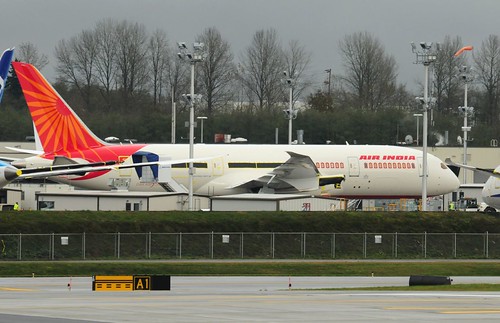
Air India‘s first 787 Dreamliner, registered VT-ANA, has been moved from the paint hangar to the Everett flight line. Airplane 25 is slated for a second quarter 2011 delivery to the Indian flag carrier.
Air India has 27 Dreamliners on order.
The VT prefix on Indian aircraft continues an old tradition and stands for “Viceroy Territory”:
The ICAO, a United Nations agency based in Montreal, was established in 1944 to draw up international regulations and standards for air travel. It is responsible for assigning the codes for airlines, airports and individual aircraft used by air traffic controllers across the world. It assigned the code VT to British India in 1944, three years before the country was divided into the independent states of India and Pakistan. India kept VT, while Pakistan was assigned AP. Britain now uses G. Several other former British colonies and territories still use codes that begin with V, such as Australia (VH), Antigua and Bermuda (V2), and the Falkland Islands (VP-F). Others have changed theirs, such as Fiji, which now uses DQ, and Kenya, which uses 5Y.

Plane 25 will be Air India's first Boeing 787 Dreamliner:Photos Credit Moonm

Air India Dreamliner VT-ANA: photo credit moonm
The black plasic on the windows is for storage. Air India will be using General Electric GEnx engines (and the Rolls Royce Trent 1000 is the only other engine available for the Dreamliner).

Image via Wikipedia
General Electric GEnx at the Paris Air Show 2009: image Wikipedia
http://www.flightglobal.com/blogs/flightblogger/2010/11/photo-of-note-air-indias-first.html#comments
Tags: Air India, Boeing 787, Dreamliner, Genx, Trent 1000, Viceroy Territory, VT-ANA
Posted in Aviation, Business, Engineering, Technology | Comments Off on Air India’s first Dreamliner gets its colours
November 16, 2010
In May this year, one of Jupiter’s characteristic stripes – the South Equatorial Belt (SEB) disappeared.
http://science.nasa.gov/science-news/science-at-nasa/2010/20may_loststripe/
May 20, 2010: In a development that has transformed the appearance of the solar system’s largest planet, one of Jupiter’s two main cloud belts has completely disappeared. Known as the South Equatorial Belt (SEB), the brown cloudy band is twice as wide as Earth and more than twenty times as long. The loss of such an enormous “stripe” can be seen with ease halfway across the solar system.

These side by side images of Jupiter taken by Australian astrophotographer Anthony Wesley show the SEB in August 2009, but not in May 2010.Individual images: Aug. 4, 2009; May 8, 2010.
Anthony Wesley is a veteran observer of Jupiter, famous for his discovery of a comet hitting the planet in 2009. Like many other astronomers, he noticed the belt fading late last year, “but I certainly didn’t expect to see it completely disappear,” he says. “Jupiter continues to surprise.” Planetary scientist Glenn Orton of NASA’s Jet Propulsion Lab thinks the belt is not actually gone, but may be just hiding underneath some higher clouds.
“It’s possible,” he hypothesizes, “that some ‘ammonia cirrus’ has formed on top of the SEB, hiding the SEB from view.” On Earth, white wispy cirrus clouds are made of ice crystals. On Jupiter, the same sort of clouds can form, but the crystals are made of ammonia (NH3) instead of water (H2O).
But now the SEB may be breaking through again.
http://www.spaceweather.com/
Tuesday, Nov. 16, 2010: A turbulent plume is breaking through the giant planet’s cloudtops in the south equatorial zone, heralding the emergence of … what? This Nov. 14th photo from astrophotographer Paul Haese of Glenalta, South Australia shows the plume.

The SEB revival is now underway. Tonight I captured the revival transiting the face of Jupiter. To boot I was lucky enough to include Ganymede with detail and Europa's shadow after a double transit. What a night. Taken with peltier cooled C14 and Skynyx 2-0: Paul Haese
The plume, circled in Haese’s photo and known to astronomers as the “SEB Revival Spot,” is a sign that Jupiter’s South Equatorial Belt (SEB) is about to return. The great brown belt disappeared earlier this year, leaving Jupiter without one of its signature stripes. No one knows where the SEB went, although some researchers have speculated that it sank beneath high altitude clouds and might now be bobbing back to the top.
Christopher Go of the Philippines first noticed the Revival Spot on Nov. 9th. At first it was small and white and required careful astrophotography to detect. Only five days later, it is expanding rapidly and darkening; soon, it could become visible to novices in the eyepieces of backyard telescopes.
Tags: Jupiter, Jupiter's stripes, SEB, Solar System, South Equatorial Belt
Posted in Astronomy, Geosciences, Science, Space | 2 Comments »









 The k2p blog