Hayabusa particles are extra-terrestrial

November 16, 2010

The particles found in Hayabusa have now been confirmed to be extra-terrestrial from the asteroid 25143 Itokawa.

Nikkei News reports:

Capsule from the Hayabusa probe contained particles from the Itokawa asteroid (Kyodo)

The Japan Aerospace Exploration Agency said Tuesday it has confirmed that the particles retrieved from the Hayabusa unmanned space probe after its seven-year space trip are from the asteroid Itokawa.

JAXA says the roughly 1,500 particles it analyzed using electron microscopes are totally different from substances found on Earth. The particles measure only about 10 micrometers in diameter.

The Hayabusa probe is the first exploratory spacecraft to land on a celestial body other than the Moon and then return to Earth.

Problem with Trent 900 was known before accident and raises ethical questions

November 15, 2010

The diagnosis of the problem with the Trent 900 has come in a matter of days and the solution has already been identified and is under implementation. This convinces me that the problem was already known and so was the solution.

There are at least two  important ethical questions which are raised by the Trent 900 story.

1. The European Aviation Safety Agency (EASA), in August, apparently  relaxed a directive regarding the frequency with which Trent 900 engines were to be inspected. The Directive had been issued originally in January. That in itself  should primarily be a technical judgement call and judgements – especially in hindsight – can always be found to be faulty without raising any issues of ethics. However the ethical issue arises if – as it seems to be – the relaxation in August was initiated by representations from a party (Rolls Royce in this case) who found the original directive too onerous. The ethical standards of both the Regulator (EASA) and of the petitioner (Rolls Royce) then give cause for concern.

2. The second ethical issue arises if Rolls Royce knew in advance of the accident to the engine on QF32 that the engines in use were at risk and that the consequences could have been catastrophic. If this was just a judgement of the probability of failure and that this probability was judged insignificant then it is an issue of bad judgement but not unethical. But an insignificant probability of failure should not have initiated the programme of engine modifications that was apparently ongoing even before the accident. Therefore, if Rolls Royce, knowing full well that the risks were sufficiently high to require that the engines had necessarily to be rectified, kept quiet in the “gamble” that no accidents would occur before they had managed to modify all the “faulty” engines,  then it becomes a case of low ethical standards and not just poor judgement. Reports suggest that Rolls Royce knew that the modifications were necessary more than a year ago but also that the mechanic who revealed this was forced to speak anonymously. This does not give any confidence that there is full transparency and, in fact, strengthens the view that Rolls Royce knew there was a problem. The speed (days rather than months) with which the diagnosis has been made and the solution defined also indicates that the engine failure did not come as much of a surprise and that the problem and the solution were already known.

The mainly technical issues with the engine indirectly raise a more general question for the aviation industry of whether there are conditions where competitive pressures  can be damaging because they increase the risk of potential harm to the general public (who unwittingly become guinea pigs for testing new technologies).

Merapi Evacuees Ignore Volcano Threat to Go Home

November 15, 2010

Jakarta Globe:

Thousands of Indonesian families returned to their villages Monday even as scientists warned Mount Merapi volcano remained a severe threat and more bodies were found buried in the ash. Carrying their belongings on motorcycles and pickup trucks, more than 30,000 people had left emergency shelters after the government reduced a 20-kilometre (12-mile) exclusion zone by as much as half in certain districts. Most of the returnees were from Boyolali, Klaten and Magelang districts where the danger zone had been reduced.

Mount Merapi, a sacred landmark in Javanese tradition whose name translates as “Mountain of Fire”, had killed 259 people as of Monday’s count. Disaster Management Agency spokesman Sutopo Purwo Nugroho said 367,548 people were still living in shelters on Monday, about 30,000 fewer than on Sunday.

Merapi spewed clouds of gas and ash as high as four kilometres Sunday but volcanologist Subandrio said this was “small compared to the 14 kilometres in previous days”.

“It’s safe for people to go home as long as they stay outside the danger zone,” he added. The government maintained the 20-kilometre danger zone for Sleman district, on the southern slopes of the mountain, as “there’s still a probability of heat clouds going in that direction”, he said.

In another report The Jakarta Globe says that evacuees leaving the camps have been asked to sign waivers before returning home:

About 600 evacuees left two shelters in Boyolali on Friday to return to their homes in the Selo and Cepogo subdistricts. Volunteers at the shelters tried to persuade them to stay, but the evacuees were insistent. Those who wanted to leave were eventually made to sign a statement saying that they were leaving the shelters voluntarily.

“We will still monitor them and give them food aid because food is still scarce at the mountain slopes,” a volunteer told Metro TV. Another shelter located in Tlogo village, Prambanan subdistrict, Klaten, was almost empty. Most of the 1,200 evacuees had returned to their homes, arguing that their cattle and fields were deserted.

Mount Merapi in 1920

File:COLLECTIE TROPENMUSEUM Rijstvelden bij de vulkanen Merapi en Merbaboe op Java. TMnr 60007940.jpg

Mt. Merapi ca. 1920: Thilly Weissenborn (Fotograaf/photographer). Lux Fotostudio (Fotostudio).wikimedia commons

Did Rolls Royce know about the risk for a Trent 900 failure before the Qantas accident?

November 14, 2010

Another new twist to the Rolls Royce Trent story.

First it appears that the regulators (EASA) relaxed their original inspection requirements in their Directive of August. It is not clear if this relaxation was in response to the airlines or to the engine maker requesting a change.

Now it seems that Rolls Royce may well have known (perhaps a year ago) that a number of their engines on “older” A 380s were susceptible to oil leaks and therefore to the potentially catastrophic consequences of a fire. About 40 engines on the Qantas, Singapore Airlines and Lufthansa A 380s have to be changed out.  The newer engines have undergone two modifications compared to the older engines. It seems that Rolls Royce started modifying oil systems on some engines almost a year ago.

If Rolls Royce knew about the risk to the Trent 900 before the flight of Qantas QF32 on November 4th, there is an ethical dimension which needs to be considered.

According to the Herald Sun,

Fourteen of the 24 Trent 900 engines fitted to the six A380s Qantas has grounded are suspected of having an oil leak problem. Another 24 “faulty” engines are on Singapore Airlines jets. The airline has grounded three A380s. Two have been found by the German carrier, which has suffered two Trent incidents.

Revised versions of the engine are being rushed to Qantas.

Sir John Rose, chairman of the British engine maker, issued a statement late on Friday in which he admitted a “specific component in the turbine area of the engine caused an oil fire”, which led to a turbine disc hurtling out. He offered “regret” for causing “disruption”. But he failed to reveal when Rolls-Royce discovered the turbines of the Trent 900 were being exposed to the dangerous oil leaks and the dates of the two upgrades.

Qantas, Singapore Airlines and German carrier Lufthansa installed the original-spec engines on some of their jets. It is understood Qantas has begun record checks to see whether Rolls kept its engineers informed of the design changes to the $25 million engines.

An aircraft mechanic with one of the three airlines claimed Rolls-Royce began modifying the oil lubrication system on the Trent 900 engine in the second half of last year.

China enters the cricket arena, beat Malaysia by 55 runs

November 14, 2010
Pictograms of Olympic sports - Cricket. This i...

Cricket debut at Asian Games :Image via Wikipedia

I am looking forward to the first time China plays a Test Match at Lords!

Now China has entered the cricket arena.

After Chinese spectators sat through a short video explaining the basics of the game, cricket made its Asian Games debut on Saturday. The crowd swiftly caught on and cheered every run on a slightly parched pitch as China’s women beat Malaysia on a sunny afternoon. “They were the best. In terms of their fielding they were very well drilled,” said Roger Golding, an English spectator in the crowd. “They didn’t miss a trick.”

China has underscored the state’s vast commitment to sports as a symbol of national pride by hiring top coaches and pumping money into less popular sports — and getting very good at them. “It was very strange at first but we’re slowly getting the hang of it,” said 19-year-old Chinese fan Li Zibo of cricket, hugely popular in Commonwealth nations but little-known in China. “It’s very fresh and we’ve never seen it before,” added Deng Xiaozhu, another young spectator who said he had been given a free ticket for the match.

A rapid-fire North American-style commentator was employed to liven up proceedings for the Chinese fans but stands were half-empty even though organisers had said that tickets for all weekend cricket had sold out.

Times of India:

Cricket was last seen at a major multi-sport event at the 1998 Commonwealth Games in Kuala Lumpur, but was dropped for the next three editions in England, Australia and India. Its Asian Games debut has already been marred by India’s refusal to field men’s or women’s teams due to international and domestic commitments.
India, whose huge cricket-mad television audiences make them an attractive proposition for any organiser, are currently hosting New Zealand for a Test and one-day series.
Asia’s other big three – Pakistan, Sri Lanka and Bangladesh – sent second-string teams for the Twenty20 tournament in Guangzhou, robbing the event of its star appeal.
The International Cricket Council, the sport’s ruling body, has identified China as one of the major new markets along with the United States for the development of the sport.

Water levels in the Murray-Darling basin are highest since 2001

November 14, 2010
Second version of a Murray catchment map

Murray Darling Basin: image via Wikipedia

After 10 years of drought, heavy rainfall has left the Murray-Darling Basin now so full of water that controlled spillages are having to be made to prevent levels becoming too high. The Sydney Morning Herald:

AFTER years of drought, there are dams and reservoirs across the Murray-Darling Basin where controlled spilling is taking place to keep levels within specified limits. The amount of water stored in the basin is close to 19,000 gigalitres, the highest level since November 2001. The Bureau of Meteorology water storage website, which monitors more than 25,000 gigalitres of storage, reports that basin storages are now more than 74 per cent full, compared to 29 per cent a year earlier.

Several reservoirs have reached capacity, including the Menindee Lakes, Burrendong Dam and Blowering Reservoir in NSW, and the Hume Dam on the NSW-Victoria border near Albury. A year ago the Hume Dam was at 39 per cent and the Blowering Reservoir at 36 per cent.

A spokeswoman for the Murray-Darling Basin Authority confirmed it had been forced to spill water from the Hume Dam and Lake Menindee to prevent the storages rising above specified levels. More rain is forecast for the Murray-Darling Basin tomorrow and on Monday, but the bureau’s deputy director for water, Robert Vertessy, said it was ”50/50” whether storages would break through the 75 per cent mark because a lot of the rain was expected to fall in areas that have no further capacity.

”What is spectacular is how much it has gone up in the last year,” Dr Vertessey said. In the long term it was very unlikely that basin storages would ever reach 100 per cent because rainfall patterns varied across the basin and some dams, such as the Dartmouth in north-eastern Victoria, had enormous capacity compared to the drainage area they serviced, Dr Vertessey said.

Replenished water storages mean that many farmers are now receiving their full general allocation of water. Trading of temporary water allocations has ground to a halt in many areas and the price of water in one exchange has fallen to $45 per megalitre, down from $200 a year ago and a peak of about $1200 in late 2007.

Meanwhile the Guide prepared by The Murray-Darling Basin Authority came under fire because the computer models used to prepare the Guide did not (or could not) account for some 20% of the water flows in the basin. The Guide has proposed drastic cuts in irrigation flows and this not at all popular with farmers. The Australian reports:

KEY assumptions about water flows in the Murray-Darling Basin guide are under challenge from newly released figures. It emerged that 20 per cent of basin water flows were not included in scientific models. The models were used to recommend cuts of up to 37 per cent in irrigators’ water entitlements.

In technical volumes published with the guide, the Murray-Darling Basin Authority said the complexity of hydrologic modelling made it difficult to consider a large range of scenarios on sustainable diversion limits in a timely way. Hydrologic models have been developed for all major rivers in the basin in conjunction with the states and the CSIRO. “Overall, about 80 per cent of current surface water use under current diversion limits in the basin is explicitly represented in the hydrologic modelling framework,” the guide says.

The National Farmers Federation seized on the concession, saying it would challenge key assumptions in the guide. NFF chief executive Ben Fargher said he would challenge how the plan had identified environmental assets for protection and the modelling for environmental water requirements. “They are saying because of the complexity of all the hydrological models it has been difficult for them to do the modelling, and so they’ve used analytical tools,” he said. “We are not confident in that. In our view it is not robust, not good enough and we are going to challenge it.” NSW Irrigators Council chief executive Andrew Gregson said the guide’s modelling “has holes in it” and the authority needed to be 100 per cent certain, given the enormous ramifications for the communities along the river.

Last night the authority defended the guide and Wentworth Group of Concerned Scientists chief executive Peter Cosier described the science behind it as “some of the best in the world”. The authority said the 20 per cent of water flows not represented in hydrologic models would not affect recommendations about water allocations or environmental flows.

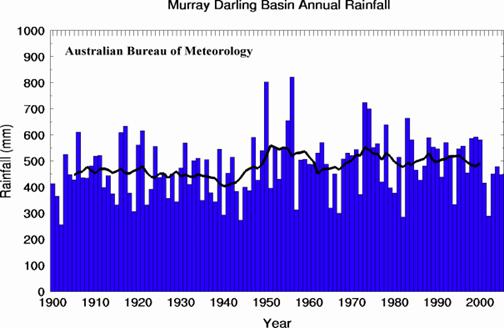
The 10 years of drought have often been attributed to climate change but rainfall records over the last 100 years  suggest that the variation of rainfall and of the subsequent water levels are nothing unusual. Online opinion has this to say:

The Australian Bureau of Meteorology has information on rainfall right back to 1900. The rainfall record for the Murray Darling Basin (see chart below) shows there have been periods of as low rainfall in the past. The 11-year rolling average, the trend line shown in chart, indicates there has been no general increase or decrease in rainfall over the last 100 years. Carbon dioxide levels have increased by about 30 per cent over this same period.

Indeed the rainfall record for the Murray Darling Basin would suggest it is drawing a long bow to blame the current drought on climate change.

Murray Darling Basin Annual Rainfall

Merapi eruptions slowing down but still deadly

November 13, 2010

Mount Merapi volcano continued spewing hot gas ash but not as violently as before. But the death toll continues to climb as people succumb to their injuries.

Mount Merapi spews volcanic material as seen from Argomulyo, Indonesia, Friday, Nov. 12, 2010.(AP Photo/Achmad Ibrahim)

The Jakarta Globe now puts the toll at 240 lives:

Indonesia’s Mount Merapi volcano has killed 240 people since it began erupting late last month, with more than 390,000 people in makeshift camps, an official said. That figure continues to rise as people with severe burns die from their wounds and officials count those who have died from respiratory problems, heart attacks and other illnesses related to the blasts.

In addition, search operations continue for bodies buried under a thick layer of ash that shrouds whole villages. On Friday, soldiers pulled eight more bodies from around one hard-hit village, said Waluyo Rahardjo, who works for the search and rescue agency.

The Associated Press reports:

Ash has continuously shot out of the crater since it roared to life Oct. 26, occasionally canceling international flights into and out of Jakarta, hundreds of miles (kilometers) to the volcano’s west. After the output slowed overnight, an advisory from the Volcanic Ash Advisory Center in Darwin, Australia, showed the ash patch was well clear of the capital. The airport in Yogyakarta, at the foot of the mountain, however, remained closed.

Officials warned residents that less ash does not mean the volcano is finished.

“The activity of Merapi is still high, but the intensity of eruptions is reducing now. But people still should be careful. Merapi is still on high alert,” said Surano, a state volcanologist who uses only one name.

While officials struggle to persuade hundreds of thousands of people who live on the volcano’s fertile slopes not to return to their homes, a new kind of evacuee has been seen in recent days. Villagers checking on their homes and crops have seen Javan leopards — who live in a national park near the crater — heading down the mountain.

The cats likely feel the continuing tremors, said Tri Prasetyo, who runs the park, and are seeking safer ground. It’s also possible that prey is scarce in areas scorched by searing gases.

Aceng , a Java leopard, released back into the wild. Credit IAR

The Javan leopard — a subspecies of the cat only found on the island of Java — is critically endangered, with no more than 250 left in the wild. Some put the total population as low as 50.

Joko Tirtono, the manager of a zoo in Yogyakarta, said zoo keepers are now searching villages where the leopards have been spotted and laying traps in which they hope to capture the cats alive.

George Bush “memoirs” plagiarise advisors’ books

November 13, 2010

Huffington Post runs an analysis of George W Bush’s memoirs “Decision Points” and it seems he (or his ghost writer) has managed a great deal of  “cut and paste” from his advisors’ books. Bush even filches descriptions of events which others witnessed as his own even though he was not present! Considering Nixon’s inability to operate the erase button on a tape recorder, it would seem Bush has come a long way if he actually manged all the “cutting and pasting” on his own.

When Crown Publishing inked a deal with George W. Bush for his memoirs, the publisher knew it wasn’t getting Faulkner. But the book, at least, promises “gripping, never-before-heard detail” about the former president’s key decisions, offering to bring readers “aboard Air Force One on 9/11, in the hours after America’s most devastating attack since Pearl Harbor; at the head of the table in the Situation Room in the moments before launching the war in Iraq,” and other undisclosed and weighty locations.

Crown also got a mash-up of worn-out anecdotes from previously published memoirs written by his subordinates, from which Bush lifts quotes word for word, passing them off as his own recollections. He took equal license in lifting from nonfiction books about his presidency or newspaper or magazine articles from the time. Far from shedding light on how the president approached the crucial “decision points” of his presidency, the clip jobs illuminate something shallower and less surprising about Bush’s character: He’s too lazy to write his own memoir.

Many of Bush’s literary misdemeanors exemplify pedestrian sloth, but others are higher crimes against the craft of memoir. In one prime instance, Bush relates a poignant meeting between Afghan President Hamid Karzai and a Tajik warlord on Karzai’s Inauguration Day. It’s the kind of scene that offers a glimpse of a hopeful future for the beleaguered nation. Witnessing such an exchange could color a president’s outlook, could explain perhaps Bush’s more optimistic outlook and give insight into his future decisions. Except Bush didn’t witness it. Because he wasn’t at Karzai’s inauguration.

In a separate case of scene fabrication, though, Bush writes of a comment made by his rival John McCain as if it was said to him directly. “The surge gave [McCain] a chance to create distance between us, but he didn’t take it. He had been a longtime advocate of more troops in Iraq, and he supported the new strategy wholeheartedly. “I cannot guarantee success,” he said, “But I can guarantee failure if we don’t adopt this new strategy.” A dramatic and untold coming-together of longtime rivals? Well, not so much. It comes straight from a Washington Post story. McCain was talking to reporters, not to Bush.

In a final irony, Bush appears to draw heavily from several of Bob Woodward’s books and also from Robert Draper’s “Dead Certain”. The Bush White House called the books’ accuracy into question when they were initially published.

The similarities between the way Bush recollects his and other quotes may be a case of remarkable random chance or evidence that he and his deputies were in an almost supernatural sync. If so, he essentially shares a brain with General Tommy Franks.

Bush writes: “Tommy told the national security team that he was working to apply the same concept of a light footprint to Iraq… ‘If we have multiple, highly skilled Special Operations forces identifying targets for precision-guided munitions, we will need fewer conventional grounds forces,’he said. ‘That’s an important lesson learned from Afghanistan.’ I had a lot of concerns. … I asked the team to keep working on the plan. ‘We should remain optimistic that diplomacy and international pressure will succeed in disarming the regime,’ I said at the end of the meeting. ‘But we cannot allow weapons of mass destruction to fall into the hands of terrorists. I will not allow that to happen.’

Franks, in his memoir American Soldier, writes: “‘For example, if we have multiple, highly skilled Special Operations forces identifying targets for precision-guided munitions, we will need fewer conventional ground forces. That’s an important lesson learned from Afghanistan.’ President Bush’s questions continued throughout the briefing…. Before the VTC ended, President Bush addressed us all. ‘We should remain optimistic that diplomacy and international pressure will succeed in disarming the regime.’ … The President paused. ‘Protecting the security of the United States is my responsibility,’ he continued. ‘But we cannot allow weapons of mass destruction to fall into the hands of terrorists.’ He shook his head. ‘I will not allow that to happen.’

A Crown official rejected the suggestion that Bush had done anything inappropriate, suggesting that the similarities speak to its inherent accuracy!!

Huffington Post goes on to document at least 16 cases of plagiarism (so far) in the book.

Coal India looking to acquire mines in US, Australia and Indonesia

November 13, 2010

Reuters

State-run Coal India (COAL.BO) is in talks to buy mines from U.S.-based Peabody Energy and Massey Energy , according to a media report citing the company’s chairman. “They expressed interest in offering certain mines to us and we are looking at that,” Partha Bhattacharyya said in a report by the Associated Press carried in the Economic Times newspaper on Saturday. “The discussions are continuing,” the report quoting him as saying. He declined to provide further details.

The Economic Times:

Coal India has budgeted $1.2 billion to buy assets in the US, Indonesia and Australia during the year ending March as it battles a widening gap between domestic coal supply and demand. The company, which last month raised $3.4 billion in the nation’s biggest-ever initial public offering, has near-monopoly control of India’s coal market. Indian companies are increasingly turning to the US to secure vital commodities to fuel the nation’s breakneck growth.

This year, Reliance Industries — India’s most valuable company by market value — bought stakes in three US shale gas companies for a combined $3.4 billion, the largest Indian investment in the US ever made. In 2007, India’s Essar Group acquired Minnesota Steel and is investing over $1 billion to build two plants and run its iron ore mine near Nashwauk, in northern Minnesota. This March, the company spent $600 million to acquire US-based Trinity Coal with mines in Kentucky, West Virginia.

St Louis, Missouri-based Peabody Energy says it is the world’s largest private sector coal company, with 9 billion tonnes of reserves. Richmond, Virginia-based Massey Energy says it is the largest coal producer in the Central Appalachian region, which accounted for 20% of United States coal production in 2007.

Trent 900: European Aviation Safety Agency (EASA) relaxed earlier directive and reduced inspection frequency

November 13, 2010

Now that it seems that the main cause of the uncontained failure of the Trent 900 on Qantas Airbus QF32 has been diagnosed, and that a remedy is being implemented, attention is turning to the Regulators.

In September the FAA issued an Airworthiness Directive (AD) for the Trent 900 based on an AD issued in August by the European Aviation Safety Agency (EASA). Since the incident EASA has now issued an Emergency AD regarding the inspection of wear within the Trent 900.

Yesterday  Joerg Handwerg, a spokesman for the pilots’ union for Lufthansa said that minor problems are routine for any jet engine, but it is possible that the issues were an indication that regulators did not adequately check the engine before approving it for commercial use. “When you see we have a problem with not just one of these engines but several then it points towards that we have a problem in the certification process,” Handwerg said.

Today Business Week (carrying an AP report) writes that “Air agency issued engine warning then eased checks”

Three months before a superjumbo jet engine blew apart and forced an emergency landing, European safety regulators had relaxed their inspection order for the same section of the engine implicated in the dangerous mishap. In January, the European Aviation Safety Agency required airlines to inspect for wear on the shaft that holds one of the Rolls-Royce Trent 900 engine’s turbine discs. The more wear they found, the sooner future inspections would be required.

In August, after Rolls-Royce had inspected several engines, EASA revised its directive. Previously, airlines had to calculate how worn out the part was based on the worst spot. Under the revised directive they calculate the average wear over the entire part. And previously they had to assume the part was wearing out at a worst-case rate. The new rule allows them to calculate the wear rate on each engine. That meant less frequent inspections, which the revised directive said were “sufficient to prevent unacceptable wear.”

The implication here is that the airlines (or Rolls Royce) were finding the inspection regime onerous and EASA responded by rationalising the change to base the frequency of future inspections on “average” wear rather than the “worst case wear” observed. Inspections of course require skilled resources, cost money and increase the down-time of aircraft. It becomes essentially an issue of operational cost. EASA – like all regulators – has to walk the tightrope balancing between public safety interests and the airlines’ need to keep costs reasonable.

Business Week continues that EASA apparently avoided the use of the word “uncontained” in its AD whereas the FAA Directive was more sharply worded:

The European directives warned of the potential for “in-flight shut down, oil migration and oil fire.” The U.S. Federal Aviation Administration went further in adopting a version of the European directive in September, warning of an “uncontained failure of the engine, and damage to the airplane.” Some of the parts inside jet engines rotate faster than the speed of sound. Engines are designed so that even if part of one shatters, pieces of metal aren’t sent rocketing away from the engine. An “uncontained engine failure” with shrapnel-like engine pieces that can damage other parts of the plane is both rare and extremely dangerous.

That’s what happened Nov. 4. Investigators have said that leaking oil caused a fire in the engine of a Qantas A380 that heated metal parts and made the motor disintegrate over Indonesia last week before the jetliner returned safely to Singapore. Experts say the mishap damaged vital systems on the plane, which had been bound for Sydney.

The safety order wasn’t addressing the exact same problem that caused the Qantas engine to disintegrate, but is very similar and involved a turbine next to the one that broke apart, said Chuck Eastlake, a former professor of aerospace engineering at Embry-Riddle University in Daytona Beach, Fla.

The decision to relax the EASA order was likely based on inspections that gave engineers confidence that the wear on parts that could cause an oil leak was predictable enough to allow more time to elapse, Eastlake said. In hindsight that appears not to have been the case, he said.

“That kind of stuff is always a judgment call based on experience,” Eastlake said. “It’s hard to specifically justify a decision like that because it isn’t a matter of plugging numbers into a calculator and out comes an answer.”

John Cox, an aviation safety consultant and former airline pilot, said it’s a question of balancing “what is reasonable to ask the airlines to do against safety. The problem is we had a catastrophic failure. It turned out that apparently at least one engine had substantial wear that inspections didn’t pick up,” he said in a telephone interview from London.

No one from EASA was available to talk about the directive late Friday.

The different communications strategies used by the players involved have varied greatly. Rolls Royce have said remarkably little and even their latest statement was baked into a Trading Report for investors. In such a report the objective is to reassure the audience so that share price holds up and doesn’t crash. The conclusions – in consequence – have to be tailored to these objectives.  In this case the focus was on showing that while there will be some costs, profits for the year will not be hit too hard. Investors – and not passengers – were clearly the audience for this Rolls Royce communication and that is of some concern.

The other players – the airlines, Airbus and the Regulators – have all issued communications according to their interests. In fact, the most detailed information about the accident has come from Airbus sources and not from Qantas or from Rolls Royce. But that is coincidental, since clearly Airbus is greatly concerned that the aircraft not be “unfairly” blamed.  Other manufacturers of parts for the Trent 900 have also been quick to point out that “they are not at fault”. Yesterday SKF and Volvo Aero who are both sub-suppliers to Rolls Royce Trent 900 engines rushed to point out that the components they supply were not involved.

But of course the relationship between the airlines and the manufacturers is a symbiotic one. Business Week goes on:

Qantas spokesman Tom Woodward said Qantas has complied with all safety orders. Rolls-Royce Group PLC said in an update to investors Friday that the Qantas engine incident last week was due to failure in a specific component that caused an engine fire and “the release of the intermediate pressure turbine disc.” The company will be replacing the relevant part “according to an agreed program” as inspections on the engine continue in association with aviation regulators, it said. The company did not provide details. The disc, a plate that holds the turbine blades that move air through the motor, broke apart in last week’s mishap. Lufthansa spokesman Thomas Jachnow said the German airline has been told “that Rolls-Royce will gradually replace a modular part of the engine on all Trent 900 engines.” He added that the “exact parts to be replaced haven’t been finalized yet.”

Airbus Chief Operating Officer John Leahy told reporters in Sydney that new versions of the Trent 900 engine that powers the Airbus A380 superjumbo will not suffer from the oil leaks that appear to have caused the fire on the Qantas flight. He said Rolls-Royce was equipping Trent 900s with software that would shut down a motor with leaking oil before it was put at risk of disintegration. Airbus said it planned to take newer versions of the Trent engine off its A380 production line and ship them to Qantas so that the airline could change the engines on some of its superjumbos.

“We think the engines on the production line will be fine,” The Age newspaper of Melbourne, Australia, quoted Leahy as saying. “The new engines should not have that issue … in terms of this one part that seems to have had a problem with leaking oil.”

The Herald Sun of Melbourne reported that Leahy said Rolls-Royce had made changes to some versions of engine to prevent such problems before the Nov. 4 mishap, but Airbus spokesman Justin Dubon denied the report. He said Leahy was referring to changes to the engines being made in light of the mishap.

Leahy, when asked whether he was suggesting that Rolls-Royce knew about problems with the engines before the Qantas incident, said, “Absolutely not,” according to Dubon. Dubon would not comment on whether changes had been made before the Qantas engine disintegrated, or whether the software Leahy described would be installed on engines already in service, referring those questions to Rolls-Royce. Rolls-Royce and the EASA declined repeated requests to comment about Leahy’s remarks.

A mechanic who works for an airline that uses the engine told The Associated Press, however, that Rolls-Royce made modifications to the oil lubrication system on Trent 900s delivered starting in the second half of 2009. The mechanic spoke on condition of anonymity because he was not permitted to speak to the media. The Qantas flight whose engine blew apart came into service in 2007.

Before last week’s disintegration there were four malfunctions involving Trent 900 engines dating to 2008, three of which centered on the turbines or oil system. All the planes landed safely.

Two of the malfunctions led to EASA warnings, including the directive issued in January and revised in August.

There are three turbines in the Trent 900 engine. The EASA order said wear had been found on parts in the intermediate turbine that could cause an oil leak. The order warned that oil leaking from the intermediate turbine could cause a fire under the adjacent lower turbine, causing the disc in that turbine to fail. Instead, there was an oil fire in the Qantas plane, but it was the intermediate turbine disc that failed. The two turbines are just a few inches apart, said Eastlake, the former aerospace engineering professor.

London-based Rolls-Royce said in an update to investors Friday that the incident will cause full year profit growth “to be slightly lower than previously guided,” but it also said that the company’s other operations will help to offset any losses.

Shares in the company rose after the update — a signal that investors are happy to see a definitive statement after days of silence from the world’s second-biggest engine maker behind General Electric.

There is clearly a need for looking again at the role of Regulators and how they create the balance between “public concern” and the interests of the industry they regulate. This is not unlike the balance in the financial world that regulators and auditors have spectacularly failed to achieve in recent years. This failure has been perhaps the primary cause of the financial crisis.

I cannot help thinking also that when the number of players is limited (as with aircraft suppliers or engine manufacturers) that there is a point beyond which competitive pressure can become counter-productive.