November 16, 2010
http://www.flightglobal.com/articles/2010/11/16/349735/zhuhai-10-comac-announces-launch-c919-order-for-up-to-100-jets.html
The Commercial Aircraft Corp of China (Comac) has announced a launch order of up to 100 aircraft for its C919 narrowbody. Chinese carriers Air China, China Southern Airlines, China Eastern Airlines, Hainan Airlines, Chinese lessor CDB Leasing Company (CLC) and GECAS are the launch customers, says Comac at Airshow China 2010 in Zhuhai.

Comac C919
Half of the 100 orders are firm while the remaining are options, says Comac general manager Jin Zhuanglong. Air China, China Southern and China Eastern have ordered up to 20 C919s each, he adds. He did not give a detailed breakdown for the remaining orders. GECAS says it has ordered up to 10 aircraft, half of which are firm orders.
“Today is a very important milestone for us. The order shows that our product has been accepted by the market,” says Jin. The C919 is scheduled to have its first flight in 2014, with entry into service in 2016. The joint definition phase is ongoing, and is scheduled to wrap up early next year following a design review at the end of this year.
Comac says it aims to complete its detailed design work in 2012, before first flight in 2014.
The C919 comes in two initial versions for 156 or 168 passengers and will compete with the Boeing 737 (next generation) and the Airbus A320. CFM will supply a version of the LEAP-X engine, the LEAP-X1C, to power the aircraft
Tags: C919 launch order, Chinese commercial aircraft, Comac, Leap-X1C engines
Posted in Aviation, China, Engineering, Technology | 2 Comments »
November 16, 2010
A new on-line paper in the Journal of Medical Ethics has studied the PubMed database for all scientific research papers that had been retracted between 2000 and 2010.
Retractions in the scientific literature: do authors deliberately commit research fraud? by R Grant Steen J Med Ethics doi:10.1136/jme.2010.038125
Abstract
Background Papers retracted for fraud (data fabrication or data falsification) may represent a deliberate effort to deceive, a motivation fundamentally different from papers retracted for error. It is hypothesised that fraudulent authors target journals with a high impact factor (IF), have other fraudulent publications, diffuse responsibility across many co-authors, delay retracting fraudulent papers and publish from countries with a weak research infrastructure.
Methods All 788 English language research papers retracted from the PubMed database between 2000 and 2010 were evaluated. Data pertinent to each retracted paper were abstracted from the paper and the reasons for retraction were derived from the retraction notice and dichotomised as fraud or error. Data for each retracted article were entered in an Excel spreadsheet for analysis.
Results Journal IF was higher for fraudulent papers (p<0.001). Roughly 53% of fraudulent papers were written by a first author who had written other retracted papers (‘repeat offender’), whereas only 18% of erroneous papers were written by a repeat offender (χ=88.40; p<0.0001). Fraudulent papers had more authors (p<0.001) and were retracted more slowly than erroneous papers (p<0.005). Surprisingly, there was significantly more fraud than error among retracted papers from the USA (χ2=8.71; p<0.05) compared with the rest of the world.
Conclusions This study reports evidence consistent with the ‘deliberate fraud’ hypothesis. The results suggest that papers retracted because of data fabrication or falsification represent a calculated effort to deceive. It is inferred that such behaviour is neither naïve, feckless nor inadvertent.
PhysOrg summarises the paper:
The study author searched the PubMed database for every scientific research paper that had been withdrawn—and therefore officially expunged from the public record—between 2000 and 2010. A total of 788 papers had been retracted during this period. Around three quarters of these papers had been withdrawn because of a serious error (545); the rest of the retractions were attributed to fraud (data fabrication or falsification).
The highest number of retracted papers were written by US first authors (260), accounting for a third of the total. One in three of these was attributed to fraud.
The UK, India, Japan, and China each had more than 40 papers withdrawn during the decade. Asian nations, including South Korea, accounted for 30% of retractions. Of these, one in four was attributed to fraud.
The fakes were more likely to appear in leading publications with a high “impact factor.” This is a measure of how often research is cited in other peer reviewed journals. More than half (53%) of the faked research papers had been written by a first author who was a “repeat offender.” This was the case in only one in five (18%) of the erroneous papers.
The average number of authors on all retracted papers was three, but some had 10 or more. Faked research papers were significantly more likely to have multiple authors. Each first author who was a repeat fraudster had an average of six co-authors, each of whom had had another three retractions.
“The duplicity of some authors is cause for concern,” comments the author. Retraction is the strongest sanction that can be applied to published research, but currently, “[it] is a very blunt instrument used for offences both gravely serious and trivial.”
Tags: Journal of Medical Ethics, PubMed, Retracted papers, science fraud, Scientific misconduct
Posted in Behaviour, Ethics, Medicine, Science, Scientific Fraud, scientific misconduct | 1 Comment »
November 16, 2010

Gran Chaco area: Image via Wikipedia
I posted a few days ago about the dangers of the Natural History Museum’s planned 60 – 100 strong “expedition” to the forests of Paraguay.
Today comes news that on Monday Paraguay suspended a British scientific expedition into the remote Chaco woodlands after indigenous rights groups raised concerns over the welfare of protected tribes in the region.
Sponsored by Britain’s Natural History Museum, the 45-member British-Paraguayan expedition planned to conduct a month-long survey of animal and plant life in the sprawling savanna 800 kilometers (500 miles) north of Asuncion, the ministry said in a statement.
The decision to suspend it followed “last minute” concerns raised by indigenous rights groups including Iniciativa Amotocodie, and recommendations by the Washington-based Inter-American Human Rights Commission, the environment ministry said.
“The massive presence of about 60 researchers in the land inhabited by the Ayoreo tribal groups in the remote, northern reaches of Chaco… poses significant risks to their lives and territory,” Amotocodie said in a statement.
The rights groups argued that since the tribes have had very little contact with the outside world they are at risk of contracting diseases that in some cases could prove fatal.
It would have been far better if the Natural History Museum had itself suspended the expedition and had taken the initiative to carry out the consultations which it is now forced to conduct.
Seattle pi:
Paraguay denied authorization Monday for a British-led scientific expedition to catalog plants and animals in the country’s remote northern corner, saying there isn’t enough time to consult with relatives of nomadic Indians who try to remain isolated as they pass through the area.
The non-governmental Amotocoide Initiative, an advocacy group for native Ayoreo Indians who live in the dry forests of northern Paraguay, had warned that scientists might carry European diseases to the Indians, leave trash or otherwise suffer violent encounters.
Isabel Basualdo, director of the biodiversity office of Paraguay’s environmental ministry, said in a statement that the decision follows the recommendation of the Interamerican Human Rights Commission that public hearings and all other legal requirements are complied with before such a visit.
Richard Lane, the British Natural History museum’s director of science, said the expedition had been suspended while consultations take place. “We believe that this expedition to scientifically record the richness and diversity of the animals and plants in this remote region is extremely important for the future management of this fragile habitat,” Lane said in a statement.
But some anthropologists who advocate for the Ayoreos say no outsiders should enter these dry forests, where small bands of people are still trying to live in isolation from the modern world. Irene Gauto, who represents the private environmental group Guyra Paraguay, told The Associated Press that the environment ministry “sent a letter to the British museum arguing that, for now, it’s better to delay the visit of the scientists because there hasn’t been time enough to hold public hearings with the relatives of the forest-dwelling Ayoreos,” one of 20 surviving indigenous groups living in Paraguay.
The trip was to begin Saturday to the Chovoreca and Cabrera-Timane hills near Paraguay’s border with Bolivia and Brazil, about 500 miles (800 kilometers) northeast of the capital. The scientists planned to catalog species on a private cattle ranch within a Paraguayan nature reserve. The ranch’s owners approved the trip and said indigenous people didn’t live there, Gauto said.
The government appeared ready to approve the trip. But the situation changed after a leader of the Totobiegosode subgroup of Ayoreos, Chiri Etacori, said about two dozen nomadic Ayoreos wander through the area.
Tags: "genocide" Expedition, Ayoreo, Indigenous People, Natural History Museum, Paraguay
Posted in Anthropology, Biodiversity, Biology, Environment, Evolution, Science, Social Science | Comments Off on Paraguay suspends Natural History Museum’s “genocide” expedition
November 16, 2010
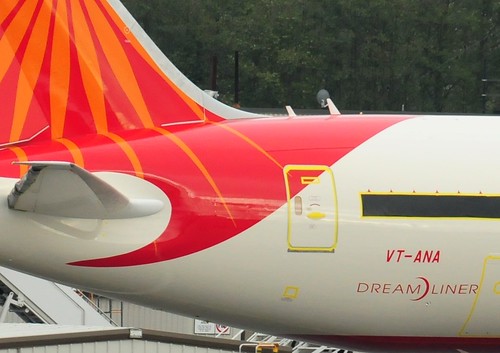
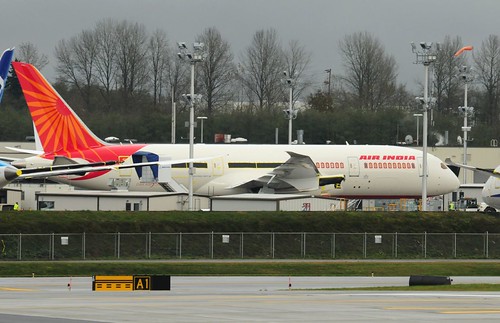
Air India‘s first 787 Dreamliner, registered VT-ANA, has been moved from the paint hangar to the Everett flight line. Airplane 25 is slated for a second quarter 2011 delivery to the Indian flag carrier.
Air India has 27 Dreamliners on order.
The VT prefix on Indian aircraft continues an old tradition and stands for “Viceroy Territory”:
The ICAO, a United Nations agency based in Montreal, was established in 1944 to draw up international regulations and standards for air travel. It is responsible for assigning the codes for airlines, airports and individual aircraft used by air traffic controllers across the world. It assigned the code VT to British India in 1944, three years before the country was divided into the independent states of India and Pakistan. India kept VT, while Pakistan was assigned AP. Britain now uses G. Several other former British colonies and territories still use codes that begin with V, such as Australia (VH), Antigua and Bermuda (V2), and the Falkland Islands (VP-F). Others have changed theirs, such as Fiji, which now uses DQ, and Kenya, which uses 5Y.

Plane 25 will be Air India's first Boeing 787 Dreamliner:Photos Credit Moonm

Air India Dreamliner VT-ANA: photo credit moonm
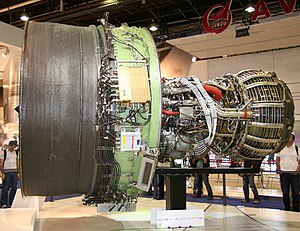
The black plasic on the windows is for storage. Air India will be using General Electric GEnx engines (and the Rolls Royce Trent 1000 is the only other engine available for the Dreamliner).

Image via Wikipedia
General Electric GEnx at the Paris Air Show 2009: image Wikipedia
http://www.flightglobal.com/blogs/flightblogger/2010/11/photo-of-note-air-indias-first.html#comments
Tags: Air India, Boeing 787, Dreamliner, Genx, Trent 1000, Viceroy Territory, VT-ANA
Posted in Aviation, Business, Engineering, Technology | Comments Off on Air India’s first Dreamliner gets its colours
November 16, 2010
In May this year, one of Jupiter’s characteristic stripes – the South Equatorial Belt (SEB) disappeared.
http://science.nasa.gov/science-news/science-at-nasa/2010/20may_loststripe/
May 20, 2010: In a development that has transformed the appearance of the solar system’s largest planet, one of Jupiter’s two main cloud belts has completely disappeared. Known as the South Equatorial Belt (SEB), the brown cloudy band is twice as wide as Earth and more than twenty times as long. The loss of such an enormous “stripe” can be seen with ease halfway across the solar system.

These side by side images of Jupiter taken by Australian astrophotographer Anthony Wesley show the SEB in August 2009, but not in May 2010.Individual images: Aug. 4, 2009; May 8, 2010.
Anthony Wesley is a veteran observer of Jupiter, famous for his discovery of a comet hitting the planet in 2009. Like many other astronomers, he noticed the belt fading late last year, “but I certainly didn’t expect to see it completely disappear,” he says. “Jupiter continues to surprise.” Planetary scientist Glenn Orton of NASA’s Jet Propulsion Lab thinks the belt is not actually gone, but may be just hiding underneath some higher clouds.
“It’s possible,” he hypothesizes, “that some ‘ammonia cirrus’ has formed on top of the SEB, hiding the SEB from view.” On Earth, white wispy cirrus clouds are made of ice crystals. On Jupiter, the same sort of clouds can form, but the crystals are made of ammonia (NH3) instead of water (H2O).
But now the SEB may be breaking through again.
http://www.spaceweather.com/
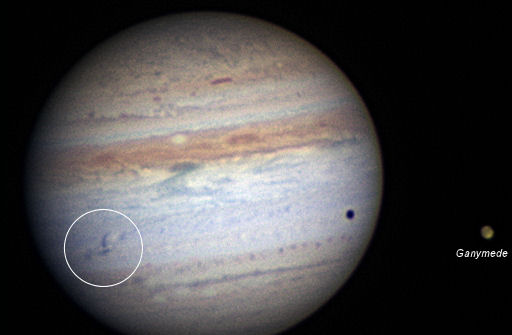
Tuesday, Nov. 16, 2010: A turbulent plume is breaking through the giant planet’s cloudtops in the south equatorial zone, heralding the emergence of … what? This Nov. 14th photo from astrophotographer Paul Haese of Glenalta, South Australia shows the plume.

The SEB revival is now underway. Tonight I captured the revival transiting the face of Jupiter. To boot I was lucky enough to include Ganymede with detail and Europa's shadow after a double transit. What a night. Taken with peltier cooled C14 and Skynyx 2-0: Paul Haese
The plume, circled in Haese’s photo and known to astronomers as the “SEB Revival Spot,” is a sign that Jupiter’s South Equatorial Belt (SEB) is about to return. The great brown belt disappeared earlier this year, leaving Jupiter without one of its signature stripes. No one knows where the SEB went, although some researchers have speculated that it sank beneath high altitude clouds and might now be bobbing back to the top.
Christopher Go of the Philippines first noticed the Revival Spot on Nov. 9th. At first it was small and white and required careful astrophotography to detect. Only five days later, it is expanding rapidly and darkening; soon, it could become visible to novices in the eyepieces of backyard telescopes.
Tags: Jupiter, Jupiter's stripes, SEB, Solar System, South Equatorial Belt
Posted in Astronomy, Geosciences, Science, Space | 2 Comments »
November 16, 2010
The particles found in Hayabusa have now been confirmed to be extra-terrestrial from the asteroid 25143 Itokawa.
Nikkei News reports:

Capsule from the Hayabusa probe contained particles from the Itokawa asteroid (Kyodo)
The Japan Aerospace Exploration Agency said Tuesday it has confirmed that the particles retrieved from the Hayabusa unmanned space probe after its seven-year space trip are from the asteroid Itokawa.
JAXA says the roughly 1,500 particles it analyzed using electron microscopes are totally different from substances found on Earth. The particles measure only about 10 micrometers in diameter.
The Hayabusa probe is the first exploratory spacecraft to land on a celestial body other than the Moon and then return to Earth.
Tags: 25143 Itokawa, extra-terrestrial particles, Hayabusa, Japan Aerospace Exploration Agency, Space probe
Posted in Astronomy, Japan, Science, Space | Comments Off on Hayabusa particles are extra-terrestrial
November 15, 2010
The diagnosis of the problem with the Trent 900 has come in a matter of days and the solution has already been identified and is under implementation. This convinces me that the problem was already known and so was the solution.
There are at least two important ethical questions which are raised by the Trent 900 story.
1. The European Aviation Safety Agency (EASA), in August, apparently relaxed a directive regarding the frequency with which Trent 900 engines were to be inspected. The Directive had been issued originally in January. That in itself should primarily be a technical judgement call and judgements – especially in hindsight – can always be found to be faulty without raising any issues of ethics. However the ethical issue arises if – as it seems to be – the relaxation in August was initiated by representations from a party (Rolls Royce in this case) who found the original directive too onerous. The ethical standards of both the Regulator (EASA) and of the petitioner (Rolls Royce) then give cause for concern.
2. The second ethical issue arises if Rolls Royce knew in advance of the accident to the engine on QF32 that the engines in use were at risk and that the consequences could have been catastrophic. If this was just a judgement of the probability of failure and that this probability was judged insignificant then it is an issue of bad judgement but not unethical. But an insignificant probability of failure should not have initiated the programme of engine modifications that was apparently ongoing even before the accident. Therefore, if Rolls Royce, knowing full well that the risks were sufficiently high to require that the engines had necessarily to be rectified, kept quiet in the “gamble” that no accidents would occur before they had managed to modify all the “faulty” engines, then it becomes a case of low ethical standards and not just poor judgement. Reports suggest that Rolls Royce knew that the modifications were necessary more than a year ago but also that the mechanic who revealed this was forced to speak anonymously. This does not give any confidence that there is full transparency and, in fact, strengthens the view that Rolls Royce knew there was a problem. The speed (days rather than months) with which the diagnosis has been made and the solution defined also indicates that the engine failure did not come as much of a surprise and that the problem and the solution were already known.
The mainly technical issues with the engine indirectly raise a more general question for the aviation industry of whether there are conditions where competitive pressures can be damaging because they increase the risk of potential harm to the general public (who unwittingly become guinea pigs for testing new technologies).
Tags: ethics, European Aviation Safety Agency, Rolls-Royce plc, Trent 900 failures
Posted in Aviation, Engineering, Ethics, European Union, Technology | 5 Comments »
November 15, 2010
Jakarta Globe:
Thousands of Indonesian families returned to their villages Monday even as scientists warned Mount Merapi volcano remained a severe threat and more bodies were found buried in the ash. Carrying their belongings on motorcycles and pickup trucks, more than 30,000 people had left emergency shelters after the government reduced a 20-kilometre (12-mile) exclusion zone by as much as half in certain districts. Most of the returnees were from Boyolali, Klaten and Magelang districts where the danger zone had been reduced.
Mount Merapi, a sacred landmark in Javanese tradition whose name translates as “Mountain of Fire”, had killed 259 people as of Monday’s count. Disaster Management Agency spokesman Sutopo Purwo Nugroho said 367,548 people were still living in shelters on Monday, about 30,000 fewer than on Sunday.
Merapi spewed clouds of gas and ash as high as four kilometres Sunday but volcanologist Subandrio said this was “small compared to the 14 kilometres in previous days”.
“It’s safe for people to go home as long as they stay outside the danger zone,” he added. The government maintained the 20-kilometre danger zone for Sleman district, on the southern slopes of the mountain, as “there’s still a probability of heat clouds going in that direction”, he said.
In another report The Jakarta Globe says that evacuees leaving the camps have been asked to sign waivers before returning home:
About 600 evacuees left two shelters in Boyolali on Friday to return to their homes in the Selo and Cepogo subdistricts. Volunteers at the shelters tried to persuade them to stay, but the evacuees were insistent. Those who wanted to leave were eventually made to sign a statement saying that they were leaving the shelters voluntarily.
“We will still monitor them and give them food aid because food is still scarce at the mountain slopes,” a volunteer told Metro TV. Another shelter located in Tlogo village, Prambanan subdistrict, Klaten, was almost empty. Most of the 1,200 evacuees had returned to their homes, arguing that their cattle and fields were deserted.
Mount Merapi in 1920

Mt. Merapi ca. 1920: Thilly Weissenborn (Fotograaf/photographer). Lux Fotostudio (Fotostudio).wikimedia commons
Tags: evacuees return, Indonesia, Mount Merapi, Volcano
Posted in Environment, Indonesia, Natural Disasters, Volcanos | Comments Off on Merapi Evacuees Ignore Volcano Threat to Go Home
November 14, 2010
Another new twist to the Rolls Royce Trent story.
First it appears that the regulators (EASA) relaxed their original inspection requirements in their Directive of August. It is not clear if this relaxation was in response to the airlines or to the engine maker requesting a change.
Now it seems that Rolls Royce may well have known (perhaps a year ago) that a number of their engines on “older” A 380s were susceptible to oil leaks and therefore to the potentially catastrophic consequences of a fire. About 40 engines on the Qantas, Singapore Airlines and Lufthansa A 380s have to be changed out. The newer engines have undergone two modifications compared to the older engines. It seems that Rolls Royce started modifying oil systems on some engines almost a year ago.
If Rolls Royce knew about the risk to the Trent 900 before the flight of Qantas QF32 on November 4th, there is an ethical dimension which needs to be considered.
According to the Herald Sun,
Fourteen of the 24 Trent 900 engines fitted to the six A380s Qantas has grounded are suspected of having an oil leak problem. Another 24 “faulty” engines are on Singapore Airlines jets. The airline has grounded three A380s. Two have been found by the German carrier, which has suffered two Trent incidents.
Revised versions of the engine are being rushed to Qantas.
Sir John Rose, chairman of the British engine maker, issued a statement late on Friday in which he admitted a “specific component in the turbine area of the engine caused an oil fire”, which led to a turbine disc hurtling out. He offered “regret” for causing “disruption”. But he failed to reveal when Rolls-Royce discovered the turbines of the Trent 900 were being exposed to the dangerous oil leaks and the dates of the two upgrades.
Qantas, Singapore Airlines and German carrier Lufthansa installed the original-spec engines on some of their jets. It is understood Qantas has begun record checks to see whether Rolls kept its engineers informed of the design changes to the $25 million engines.
An aircraft mechanic with one of the three airlines claimed Rolls-Royce began modifying the oil lubrication system on the Trent 900 engine in the second half of last year.
Tags: ethics, European Aviation Safety Agency, Lufthansa, Qantas, Rolls Royce, Singapore Airlines, Trent 900, Trent 900 failure risk
Posted in Aviation, Business, Engineering, Ethics, Technology | 5 Comments »
November 14, 2010

Cricket debut at Asian Games :Image via Wikipedia
I am looking forward to the first time China plays a Test Match at Lords!
Now China has entered the cricket arena.
After Chinese spectators sat through a short video explaining the basics of the game, cricket made its Asian Games debut on Saturday. The crowd swiftly caught on and cheered every run on a slightly parched pitch as China’s women beat Malaysia on a sunny afternoon. “They were the best. In terms of their fielding they were very well drilled,” said Roger Golding, an English spectator in the crowd. “They didn’t miss a trick.”
China has underscored the state’s vast commitment to sports as a symbol of national pride by hiring top coaches and pumping money into less popular sports — and getting very good at them. “It was very strange at first but we’re slowly getting the hang of it,” said 19-year-old Chinese fan Li Zibo of cricket, hugely popular in Commonwealth nations but little-known in China. “It’s very fresh and we’ve never seen it before,” added Deng Xiaozhu, another young spectator who said he had been given a free ticket for the match.
A rapid-fire North American-style commentator was employed to liven up proceedings for the Chinese fans but stands were half-empty even though organisers had said that tickets for all weekend cricket had sold out.
Times of India:
Cricket was last seen at a major multi-sport event at the 1998 Commonwealth Games in Kuala Lumpur, but was dropped for the next three editions in England, Australia and India. Its Asian Games debut has already been marred by India’s refusal to field men’s or women’s teams due to international and domestic commitments.
India, whose huge cricket-mad television audiences make them an attractive proposition for any organiser, are currently hosting New Zealand for a Test and one-day series.
Asia’s other big three – Pakistan, Sri Lanka and Bangladesh – sent second-string teams for the Twenty20 tournament in Guangzhou, robbing the event of its star appeal.
The International Cricket Council, the sport’s ruling body, has identified China as one of the major new markets along with the United States for the development of the sport.
Tags: Asian Games, China, Cricket debut in Asian Games, International Cricket Council
Posted in Behaviour, Cricket, Sport | Comments Off on China enters the cricket arena, beat Malaysia by 55 runs