The flow of time precedes causality

April 26, 2018

All origins, all beginnings presuppose the existence of a flow of time. Our imagination, our language and our thought are incapable of conceiving the non-existence of a beginning. We cannot conceive of anything in the world where a non-beginning is not also a non-existence. If it exists it must have had a beginning. There is no branch of science or field of study or area of thought which is not based on causality. We perceive the world around us through the eyes of causality. We perceive what is and look for what caused what is. We do not question that what is must have had a cause. We do not question either that what will be, will be caused by and follow what is. But causality pre-supposes the existence of a flow of time.

But there is no philosophy or theology or science which can explain

  1. what time is, and
  2. what causes time to flow

One could say that it is the existence of the flow of time which brings about causality. Causality is itself caused by time.

“Perhaps the simplest and easiest to understand is the argument of the First Cause. (It is maintained that everything we see in this world has a cause, and as you go back in the chain of causes further and further you must come to a First Cause, and to that First Cause you give the name of God). That argument, I suppose, does not carry very much weight nowadays, because, in the first place, cause is not quite what it used to be. The philosophers and the men of science have got going on cause, and it has not anything like the vitality it used to have; but, apart from that, you can see that the argument that there must be a First Cause is one that cannot have any validity. I may say that when I was a young man and was debating these questions very seriously in my mind, I for a long time accepted the argument of the First Cause, until one day, at the age of eighteen, I read John Stuart Mill’s Autobiography, and I there found this sentence: ‘My father taught me that the question, “Who made me?” cannot be answered, since it immediately suggests the further question, “Who made God?” ’ That very simple sentence showed me, as I still think, the fallacy in the argument of the First Cause. If everything must have a cause, then God must have a cause. If there can be anything without a cause, it may just as well be the world as God, so that there cannot be any validity in that argument. It is exactly of the same nature as the Hindu’s view, that the world rested upon an elephant and the elephant rested upon a tortoise; and when they said, ‘How about the tortoise?’ the Indian said, ‘Suppose we change the subject.’ The argument is really no better than that. There is no reason why the world could not have come into being without a cause; nor, on the other hand, is there any reason why it should not have always existed. There is no reason to suppose that the world had a beginning at all. The idea that things must have a beginning is really due to the poverty of our imagination. Therefore, perhaps, I need not waste any more time upon the argument about the First Cause.”  Bertrand Russel – 1927

Time, or space-time nowadays, is sometimes considered as a river. The analogy with fluid flow does not help greatly and only raises further questions. Fluids flow (over time and space) as a causal consequence of forces and energies which are not in balance and which seek balance. Fluids flow from a higher pressure to a lower (in a gas pipeline), from a higher level of potential energy to a lower (in a river) or by being physically forced from one location to another (in a pump or a compressor). In the fluid analogy it is particles of the the fluid which are transported over space and time.

If the flow of time is a river then what exactly is being transported? What then is the imbalance, and in what property or state which causes the transportation of the magical thing called time? Rather than addressing the First Cause, perhaps we should be addressing the First Questions.

What is time? and Why does it flow?

The existence of time precedes beginnings. The flow of time precedes causality. The problem of course is that without time, beginning and precede are undefined.

 

Nobel Foundation may cancel 2018 literature prize

April 25, 2018

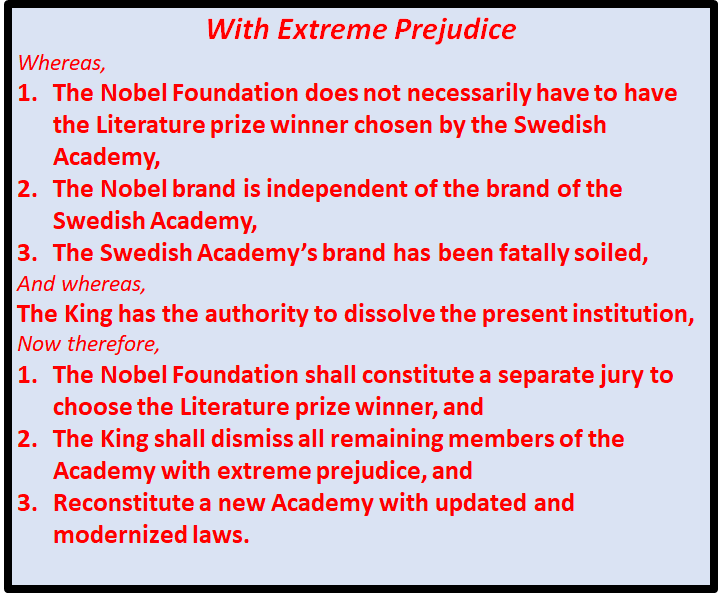
The Nobel Foundation has assigned the Swedish Academy the job of choosing the annual winner of the Literature Nobel Prize. However Horace Engdahl and his ilk have brought the Academy into such disrepute that the Nobel Foundation may find it necessary to distance themselves from the Academy and protect the Nobel brand.

Swedish Radio: 

This year’s award of the Nobel Prize in Literature may be postponed after the crisis in the Swedish Academy.

“We are working on it right now. We will return to the question. You will be notified soon” said permanent secretary Anders Olsson.

The storm around the Swedish Academy continues, and may affect the award of this year’s Nobel Prize in Literature. According to Kulturnytt’s information, there are some within the committee in the Swedish Academy, which chooses the Nobel Prize winner, and the , who believe that the prize can not or should not be awarded this year.

If this Academy chooses, any prize winner would be horribly tainted.

The problem is that those within the Academy who have fatally tarnished it, don’t get it and are in denial. They do not even see what they have done.

The Nobel Foundation needs to cancel this year’s award and to lay down the rules for any newly constituted Academy to choose a winner.

Horace Engdahl and co. have brought the Academy into disrepute (image TT)


Will “Americans” and “Europeans” ever become identifiable races?

April 25, 2018

Race is real and not just an imagined construct of modern times. Even two thousand years ago (about 100 generations) races were recognised and used as a classification. They were somewhat different to those recognised today – but not so very different. In the main, racial attribution followed known or assumed tribal affiliations and visible physical characteristics. Even in Roman times, members of the Celtic tribes and the Germanic tribes and Egyptians and Greeks and Africans were all depicted as differing in physical characteristics and of being of different races. Whether among the various European tribes or the 12 tribes of Israel or the castes established in India, parentage and ancestry manifested as visible, physical characteristics were – and still are – used in race classifications. It is virtually certain that the races that existed 2,000 years before the heyday of the Roman Empire were different again. If 5,000 years ago the Harappans were a race, their genes are now spread all over the sub-continent and they are are no longer identifiable.

Though classification of a race is by the visible attributes it is inevitable that they are accompanied by non-visible attributes. The non-visible attributes may show up as the ability to tolerate high altitude, or the aptitude for long distance running, or for sprinting, or for diving. They may include resistance to some diseases and a propensity for others. The non-visible attributes could include any characteristic dependant upon genetics. And even if politically incorrect to say so, it could include the genetic components of intelligence. Insofar as behaviour is determined genetically, a race may have characteristic behaviours.

  1. Race is a system of classification of humans by clustering their visible, physical attributes. The classification is real but is not static. It is dynamic in that the clustering may change over long time periods (hundreds of generations) as mixing or non-mixing between the clusters occurs. (One hundred generations would need about 2,000 years).
  2. Visible physical attributes are primarily determined by parentage and thus by ancestry and thus by genetics.
  3. Racial classification is therefore a genetic classification but sorted by visible characteristics.
  4. Differences in the visible attributes between clusters are emphasised when the clusters are genetically isolated from each other. Geographic isolation contributes but the critical point is genetic isolation.
  5. A particular race cluster persists only if breeding is constrained to be within and among members of the cluster.

Race is classification by snapshot – a current clustering by physical attributes. The clustering will change slowly over tens of generations but at every time, a snapshot of the current races will exist.

Great Britain has been a melting pot of peoples mainly from across Europe for 2,000 years. But the British “race” is still in flux. The US is often considered a melting pot for the blending of genes and it would then make sense for the gradual emergence of an “American” race. With the surge of emigration into Europe and the decline in fertility of the “native Europeans”, a gradual emergence of a “European” race would also seem probable. However the tendency of immigrant groups to marry among themselves and isolate their particular gene pools, works strongly against the emergence of new races.

If continuous, steady, immigration becomes the new normal and immigrant groups keep to themselves, it may never happen. If it does, I expect it will take more than a thousand years (50 generations) before the world sees an identifiable American or a European race.

But a thousand years hence there will still be clustering of peoples by visible, physical attributes and identification of peoples by the races of the day.

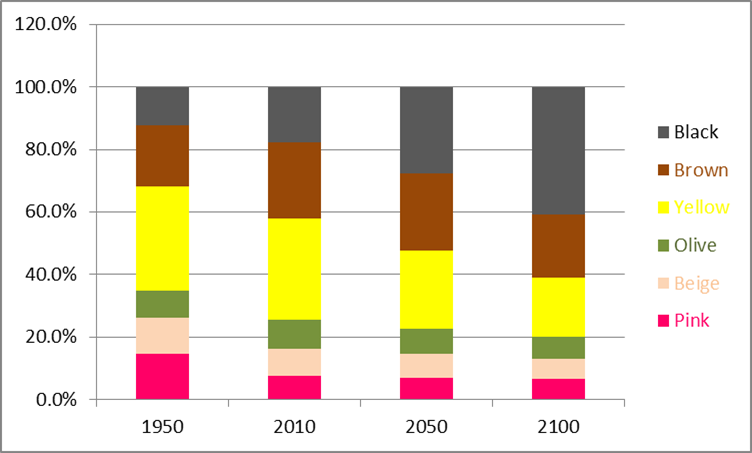
Skin colour is by far the most visible and thus the obvious attribute that is first used as a sorting criterion for race classification. I suspect that skin colour would dominate as the sorting criterion even if some race had some very significant, but less visible difference, such as – say – an extra finger.


Related:

The changing colours of the world’s population


Decimals are too simple

April 22, 2018

Of course all attempts to create a 10 hour day with 100 minutes to each hour and 100 seconds to each minute have failed. Similarly all attempts to divide the circle into 100 parts have not caught on.

The use of 60 is almost as basic as the use of 10.

The origins of base 60

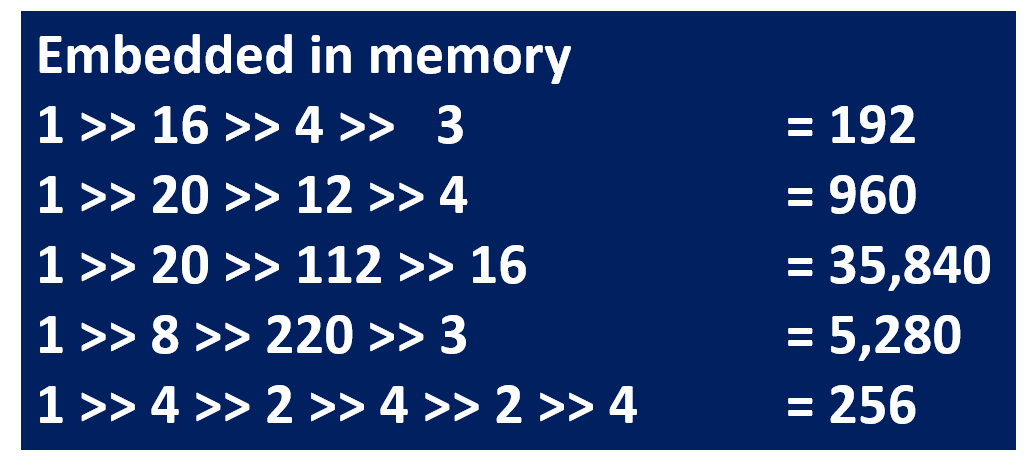
All the non-decimal systems I learnt were embedded in memory before I was 20. I don’t expect many will remember these.

As a child I learned the use of 12 and 60 from my grandmother. The use of 12 was automatic with 4 and 3. Three pice to a pie. 4 pies to an anna and 16 annas to the rupee. When driving around India with my father, miles and furlongs and yards and feet came naturally. Bushels and pecks and gallons and quarts and pints came later as an apprentice in England.

Decimals are simple. But they are also simplistic.

Perhaps too simple.

Rupee, anna, pice, pies

Pounds, shillings, pence, farthings

Ton, hundredweights, pounds, ounces

Mile, furlongs, yards, feet

Bushel, pecks, gallons, quarts, pints


Justice is just a derived concept

April 20, 2018

Many of our fundamental concepts are not in fact fundamental. They are entirely dependent upon and derive from the negation of other concepts. We are all prisoners of our genes, our bodies, our beginnings and our planet. As a concept “freedom” is meaningless without first defining what captivity means. The concept of freedom is not self-sufficient and derives from some concept of captivity which must come first. Similarly, justice derives from a definition of injustice.  Fighting for justice is a misnomer since it always consists of fighting against some injustice. Equality by itself is almost meaningless. It first requires a definition of inequality. Even in the language of mathematics an equality relies on a prior definition of inequality. Bright opposes dark and each relies on and derives from the other.

Other concepts can live on their own and are not merely negations of some other concepts. Even though they lie on the same scale and may oppose each other they refer to some separate norm as a reference and can live independent lives. Happiness has its own scale (as does unhappiness). The concept of beauty does not require the definition of ugly. Liking and disliking and love and hate can all live on their own. Rich and poor lie on the same scale but each refers to a norm and so they are not dependent upon each other. Rich describes a surplus relative to some norm and poor is a deficiency. Wealth and poverty refer to a norm but not necessarily to the other.


Swedish Academy is proving to be a bunch of skunks

April 17, 2018


Extinction is normal

April 17, 2018

Living things evolve, dead things can be remembered but extinction is normal.

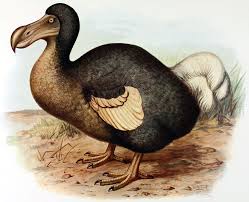
I have no objection to expressions of regret, but I find the hand-wringing and sanctimonious claptrap about the extinction of species, languages and cultures illogical and without thought. I don’t miss the dodo or any of the dinosaurs. I don’t miss Latin or Sanskrit (even though I had to sit through boring lessons in both). It is only a natural course of development that isolated Amazonian tribes have disappeared as their members have joined the rest of the world. I don’t miss the cannibalistic cultures which have disappeared. The recent splurge of nonsense about the “death of the last known male, northern white rhino” was a case in point. It may be a matter of some regret that this particular individual died a natural death, but the end of an unfit sub-species of rhino is not an event requiring the mawkish sentimentality that flooded the media.

Extinction is normal.

Species evolve to survive or they go extinct. Languages evolve and they die when they are of no use to anyone anymore. Cultures evolve and merge with other cultures or they try to remain separate as a distinct, (often racial) identity by isolation and inevitably they die out. The cultures that disappear don’t survive because they are not viable in the world they live in. Regret is one thing, but trying to artificially protect non-viable species, languages or cultures or peoples by putting them in a “zoo” is mawkish and irrational and, ultimately, unethical. Keeping backward tribes isolated to “preserve” their cultures and freezing them into backwardness (by preventing them from merging or being absorbed by the world) is immoral. Freezing individuals from unfit species in a zoo, and neither helping them to evolve nor allowing the species to go extinct, is immoral. Preserving dead languages is of academic interest and does not prevent the extinction of languages which no longer serve a useful purpose.

To the best of our knowledge there are about 7,000 languages recognised today. Depending upon when language began (between 50,000 and 200,000 years ago) between 90 and 99% of all languages are now extinct. Written languages are much younger of course. An extinct language is a matter of history. Some languages evolved and produced versions still in use today. Others did not. We know about some of these because they developed writing and left some records which have survived. Languages die a natural death when they stop being used. Of course there is nothing wrong in speakers of dying languages trying to revitalise them. Governments have sometimes tried to promote particular languages (French, Hindi), and sometimes to suppress some (Welsh, Sami). Languages have been invented (Esperanto or Klingon). Most of these attempts of artificially creating, protecting or suppressing language are futile. The ultimate arbiter of language (and of grammar and of spelling) is usage.  The real question should not be whether a language is “endangered” and should be protected but whether a language serves any useful purpose. If it does, it will survive. If it does not, it should not survive. Endangered languages should be recorded for history and allowed to die in peace.

We don’t know how many species are alive today. Estimates have ranged from 10 million to 14 million, of which over 86 percent have not yet been described. A 2016 study even concludes that Earth currently has 1 trillion species. Whatever the actual number, what is known is that over 99% of all species that ever existed are now extinct. By the time a failing species is formally considered to be endangered, it is almost irrelevant to the ecological system it is embedded in. Tigers, as an example, are restricted only to areas of captivity (whether zoos or reserves). Even in some reserves where they are nominally free, the species is of no great significance to the bio-system. A species may well be going extinct because it is losing habitat to humans, but that in itself is a failure of that species. Some species are adapting to man, but where conservationists intervene to “protect” species they always do so by freezing the species into some form of captivity. They never try to help that species to adapt genetically to survive in its new environment. This form of conservation may be emotionally satisfying for humans but is of little consequence in the sustainable survival of the endangered species. Evolution produces far more failed species than successful ones. The detritus of evolution needs to be cleaned out from time to time. A mass extinction is one way to muck out the evolutionary stables. Currently there are too many species surviving and around 30% probably need to be washed away into extinction.

As with language and species there is much energy and misguided thinking expended in the protection of “indigenous peoples” and outdated, non-viable cultures. Much of this “protection” is about “freezing” these humans and their cultures into unsustainable conditions in what are effectively human zoos or reserves.

There are approximately 370 million Indigenous people in the world, belonging to 5,000 different groups, in 90 countries worldwide. Indigenous people live in every region of the world, but about 70% of them live in Asia.

The long term survival of tribes and indigenous peoples is by them joining or being absorbed by the mainstream or of reaching a critical mass such that they can have an autonomous survival. Genetic isolation (or genetic purity as practiced by some groups) is not sustainable in the long term. The Sentinelese are still apparently in the “stone-age” and both isolated and captive. Is it better (for whom?) to allow them to remain isolated and doomed or to bring them into the mainstream which would effectively eliminate them as a separate but backward culture?

Extinction is normal for peoples, languages, cultures and for species. To struggle against extinction is just a part of survival and also normal. But when extinction does occur, it may be a matter of regret and even of sorrow, but it is normal and morally neutral. But “conservation” by freezing language or culture or species or peoples into a “failed” condition is immoral.


Related:

Evolution is indifferent to species survival

Conservation denies tigers a future as a species

There was no biodiversity to begin with


Eight years

April 16, 2018

I started this blog 8 years ago today as a means of curing writer’s block.

In that objective it has functioned very well. It’s been my relief valve and my therapy whenever I get stuck. Rather than engage in acrimonious comments and discussions when something is not to my liking on other sites, I find my solace in putting my own view down here.

3,862 posts in 8 years is a little over one post per day.

The reality is that I don’t actually post for anyone other than for myself.

Visitors to the site and readers are welcome bonuses, but the primary audience to be satisfied for any author is the author.


The Nobel Brand needs to distance itself from the fecal brand of the Swedish Academy

April 14, 2018

Of course a few public executions of reputation are in order.

In any event, the remaining members need to be dismissed with great publicity and extreme prejudice.


“In triplicate” is being forgotten

April 14, 2018

More than half the world now does not know what a “carbon copy” means.

“Cut and paste” has been used for a very long time with manuscripts but really took off after the advent of the photo-copier.

Seven years ago I posted about the origins of “in triplicate”. At that time a Google search for “triplicate forms” generated over 3.5 million hits. This morning it generated less than 2 million.

Why “in triplicate”? – one for me, one for you and one for Rome

I have a vague recollection that I was once told that it was connected to the use of “carbon paper”  where the quality of the writing was insufficient after the second carbon (third copy). The word “triplicate” is said to have a 15th century origin in Middle English and comes from Latin (triplicatus). There is also a suggestion that pharmacists and their predecessors required 3 copies of everything but I am not clear as to why.

But my preferred story is that the Romans are responsible. It is not inconceivable that Roman administrators in their far-flung empire outposts first started doing things in triplicate.

 “One for me, one for you and one for Rome”.

Or it could just be the mystic, magical power of the number 3!!