Logic is discovered, language is invented

July 9, 2017

Logic is inherent in the universe. It is not a creation of man and is not dependent on observation or what kind of brain perceives the universe.

The laws of logic are taken to be unchanging over space and time. Logic now, is as logic was, and as logic will always be. Logic here, is as logic is there and everywhere.

Language, however, is invented. All languages (including mathematics or chemical notation or Boolean algebra or …..) must have a structure which is compliant with the logic of the universe it is used to describe. We perceive a logic in the universe and express it through the inbuilt logic of our language(s). We use the one to describe the other and they are both the same.

How not?


Nuclear weapons are necessary to avoid another Hitler

July 8, 2017

Yesterday the UN again demonstrated its uselessness. More, it demonstrated, again that majorities are very often wrong and can be just plain stupid.

Countries without nuclear weapons voted among themselves that countries with nuclear weapons should not have them. The stupid voting among themselves that the more intelligent should not be so intelligent.

The UN adopted a global treaty banning nuclear weapons. Only 124 nations of 193 participated. The treaty was adopted by a vote of 122 countries in favor with one NATO member, the Netherlands, voting against and with Singapore abstaining.

The stupidity of the resolution and the vote lies in that neither those who have nuclear weapons, nor those who have experienced a nuclear strike, even participated.


  1. None of the nine countries that possess nuclear weapons — the United States, Russia, UK, China, France, India, Pakistan, North Korea and Israel — took part in the negotiations or the vote.
  2.  Even Japan — the only country to have suffered atomic attacks, in 1945 — boycotted the talks and the vote.
  3. The only NATO country to participate, the Netherlands, voted against.
  4. The other NATO countries not participating were Belgium, Bulgaria, Canada, Czech Republic, Denmark, Estonia, France, Germany, Greece, Hungary, Iceland, Italy, Latvia, Lithuania, Luxembourg, Norway, Poland, Portugal, Romania, Slovakia, Slovenia, Spain, Turkey, United Kingdom, United States.

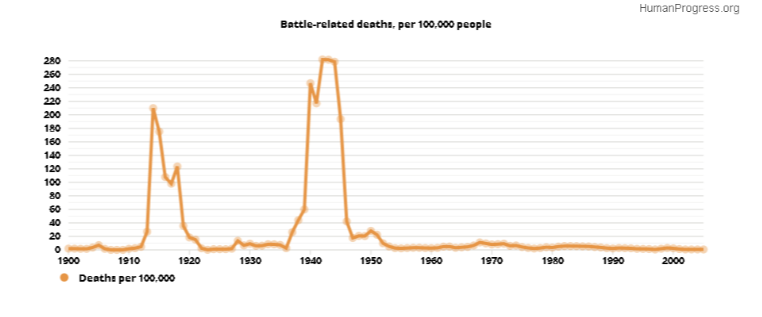
The UN is good at sanctimonious, feel-good resolutions which are “full of sound and fury” but “signifying nothing”. It is, in fact, the presence of nuclear weapons which has put a cap on the number of deaths by war.

Time:

During the 31 years leading up to the first atomic bomb, the world without nuclear weapons engaged in two global wars resulting in the deaths of an estimated 78 million to 95 million people, uniformed and civilian. The world wars were the hideous expression of what happens when the human tendency toward conflict hooks up with the violent possibilities of the industrial age. The version of this story we are most familiar with is the Nazi death machinery, and we are often tempted to think that if Hitler had not happened, we would never have encountered assembly-line murder.

…… As bad as they are, nukes have been instrumental in reversing the long, seemingly inexorable trend in modernity toward deadlier and deadlier conflicts. If the Nobel Committee ever wants to honor the force that has done the most over the past 60 years to end industrial-scale war, its members will award a Peace Prize to the bomb.

Nuclear weapons cannot be uninvented.

The simple fact is that it is the existence of nuclear weapons which has prevented the blood-letting of WW1 and WW2 from happening again.

And which prevents another Hitler from appearing. And which will prevent Kim Jong-un from ever becoming another Hitler.


Science (and the gods) rely equally on magic

July 3, 2017

The fundamental assumptions of science can be written in various ways but, for me, seem to boil down to four:

  1. The Universe exists
  2. Laws of nature (science) exist
  3. All phenomena are constrained to obey the laws of nature (science)
  4. The laws of nature (science) apply everywhere in the universe

The laws of nature are such that compliance with these laws is inbuilt. If there is any non-compliance it is not a law of nature. If compliance is all that we observe then it is a law of nature. But why the laws are what they are are usually beyond explanation.

Assumptions are not amenable to further question. You could apply an “if” to them or question “why” the assumption is true, but that is futile for there are no answers. They are just taken as self-evident and the starting point of rational thought. They are never, in themselves, self-explanatory except in the trivial form. (Assume that 1+1=2. Therefore 2+2=4 and that proves that 1+1=2).

I apply the word “magic” to all that is inexplicable. And all the fundamental laws of nature (science) are built on a foundation of inexplicable magic. How many fundamental particles exist and why? It’s magic. If the laws of science only apply after the Big Bang but don’t apply at the Big Bang singularity itself, what laws did? It’s magic. If the laws apply to a supernova but not inside a black hole, it’s magic. (Never mind that a black hole seems to be a part of the universe where the laws of science do not apply which violates the assumption that the universe is homogeneous and isotropic (Assumption 4 above). Why are there 4 – and only 4 – fundamental forces in nature? It’s magic. How did time begin? It’s magic. Can empty space exist without even the property of dimensions? It’s magic. Can time be a dimension and not have negative values? It’s magic. Dark energy and dark matter are merely labels invoking magic. All science which relies on fundamental assumptions is ultimately built upon and dependent upon a set of inexplicable, fundamental statements. They are just magic.

A fundamental flaw with the claim of physics, that all of history up to just after the Big Bang is explainable by the laws of science, must also mean that all of the future is also fixed and determined by the laws of science applied to conditions now. What will happen was therefore fixed for all time by the Big Bang itself. And that, too, is indistinguishable from magic.

Religions do not just rely on magic, they claim the magic for their gods. Modern, “with-it” religions, which try to be “compatible” with the latest knowledge discovered by science, merely claim that their God(s) pushed the button which caused the Big Bang. That my God is greater than your God is magic. That there is a life after death, or reincarnation, or rebirth or an ultimate state of grace is also just magic.

Shiva, Kali, Jesus, Allah, nirvana, dark energy, dark matter and the Big Bang singularity are all labels for different facets of magic.

Magic, by any other name, is just as inexplicable.


In the galaxy of my childhood

June 30, 2017

Long away and far ago, in the galaxy of my childhood, in a space-time continuum that has ceased to be:

  • Nothing was impossible,
  • Banks were known to handle cash,
  • customers were always right,
  • shop-keepers thanked you for your custom,
  • restaurants were happy for you to eat and dawdle,
  • the milkman brought the cow around every morning and evening to be milked,
  • coffee beans were roasted and ground every morning for the day’s consumption,
  • if it wasn’t raining it was hot,
  • if it wasn’t snowing it was cold,
  • ice cream and chocolate bars came once a week,
  • cakes were for birthdays,
  • a girl could be a tomboy and remain a girl,
  • scientists were skeptical,
  • the postman was always on time,
  • extreme weather was just extreme weather, 
  • newspapers told the truth, and
  • everything was possible


Disillusionment

June 29, 2017

It is one of the worst feelings one can experience. To have reality intrude rudely on illusions one has cherished.

And the worst of the worst is when it is another person who is the disillusionment. When somebody turns out to be not quite what they seem to be.


When acquaintances pass away

June 28, 2017

The bulk of those we “know” are acquaintances and they may number from several hundred and up to a few thousand.

If the Dunbar Number postulation is correct, we can have strong, stable, close relationships with about 150 people (minimum about 50 and maximum about 250). We  can also “feel” strong, one-way relationships with a few public figures we may never have met, and who may not even be aware of our existence (musicians, actors, politicians ….).

When somebody close passes away the measure of our grief and our reactions is dominated primarily by the closeness of the relationship and then by the circumstances surrounding the death. This has probably been much the same for humans through most of history. However it is our reaction to the passing away of acquaintances which may say more about our changing attitudes to life and death.

I am of an age now where hardly a week goes by without the passing away of an acquaintance. I am also of an age where new acquaintances come slowly. So my circle of acquaintances is beginning to reduce. Trying to observe myself, I would generalise my reactions to the death of an acquaintance as follows:

  • Less than 50 years old : Futility, cruel, tragically young
  • In their 50’s                   : Sorrow, regret, before their time
  • In their 60’s                   : Sadness, misfortune, not very old
  • In their 70’s                   : Regret, it happens, a good innings
  • In their 80’s                   : Acceptance, acceptance, acceptance
  • In their 90’s                   : Acceptance, celebration, a long span
  • In their 100’s                 : Wow! Was he/she still alive?

Of course the circumstances of a death also play some part in the reaction  – but not so much, it seems, once an acquaintance has passed 80. The same kind of tragic accident which takes the life of a 50 year old, seems not so tragic when an 80 year old is the victim. A few months ago a good acquaintance died in his 50’s following a bicycle accident, and it all seemed such a terrible waste. About a year ago an 83 year old acquaintance also died following a bicycle accident, but his death did not seem as tragic, and even included a hint of “what on earth was he doing on a bicycle at that age?”

I suppose it is because the probability of an 80 year old dying is so much higher than that of a 50 year old. Our sense of regret and loss reduces as the probability of death increases. The circumstances surrounding the death seem less important.

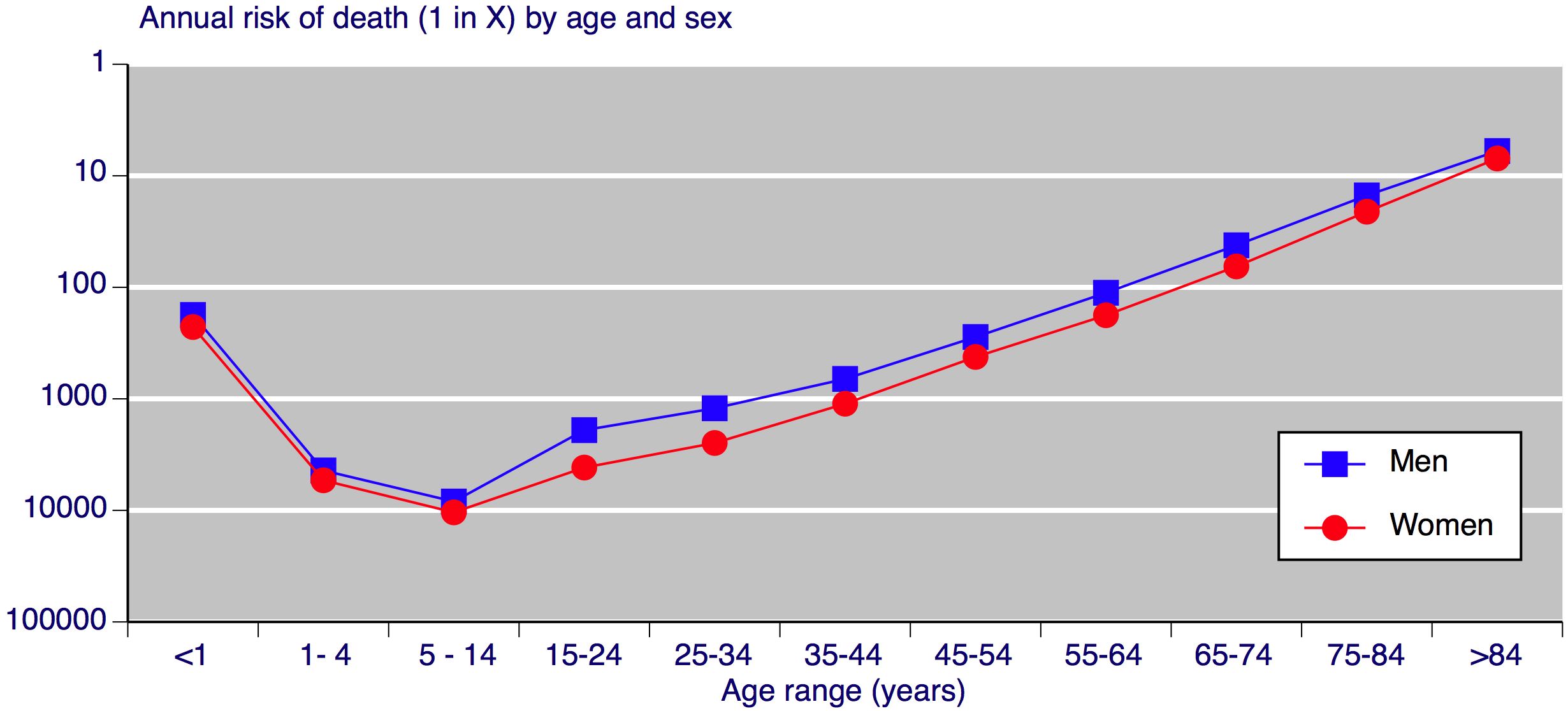
At 50 the probability of death is about 1: 300 but at the age of 80 this has increased to 1:20.

UK data image bandolier

Our reactions, I conclude, are probably strongly influenced by the probability of death of that acquaintance. As longevity changes, the probability of death changes, and our reactions follow suit.


Without first having religions, atheism and agnosticism cannot exist

June 27, 2017

I take science to be the process by which areas of ignorance are explored, illuminated and then shifted into our space of knowledge. One can believe that the scientific method is powerful enough to answer all questions – eventually – by the use of our cognitive abilities. But it is nonsense to believe that science is, in itself, the answer to all questions. As the perimeter surrounding human knowledge increases, what we know that we don’t know, also increases. There is what we know and at the perimeter of what we know, lies what we don’t know. Beyond that lies the boundless space of ignorance where we don’t know what we don’t know.

Religions generally use a belief in the concept of a god (or gods) as their central tenet. By definition this is within the space of ignorance (which is where all belief lives). For some individuals the belief may be so strong that they claim it to be “personal knowledge” rather than a belief. It remains a belief though, since it cannot be proven. Buddhism takes a belief in gods to be unnecessary but – also within the space of ignorance – believes in rebirth (not reincarnation) and the “infinite” (nirvana). Atheism is just as much in the space of ignorance since it is based on the beliefs that no gods or deities or the supernatural do exist. Such beliefs can only come into being as a reaction to others having a belief in gods or deities or the supernatural. But denial of a non-belief cannot rationally be meaningful. If religions and their belief in gods or the supernatural did not first exist, atheism would be meaningless. Atheism merely replaces a belief in a God to a belief in a Not-God.

I take the blind worship of “science” also to be a religion in the space of ignorance. All physicists and cosmologists who believe in the Big Bang singularity, effectively believe in an incomprehensible and unexplainable Creation Event. Physicists who believe in dark matter or dark energy, as mysterious things, vested with just the right properties to bring their theories into compliance with observations of an apparently expanding universe, are effectively invoking magic. When modern physics claims that there are 57 fundamental particles but has no explanation as to why there should be just 57 (for now) or 59 or 107 fundamental particles, they take recourse to magical events at the beginning of time. Why there should be four fundamental forces in our universe (magnetism, gravitation, strong force and weak force), and not two or three or seven is also unknown and magical.

Agnosticism is just a reaction to the belief in gods. Whereas atheists deny the belief, agnostics merely state that such beliefs can neither be proved or disproved; that the existence of gods or the supernatural is unknowable. But by recognising limits to what humans can know, agnosticism inherently accepts that understanding the universe lies on a “higher” dimension than what human intelligence and cognitive abilities can cope with. That is tantamount to a belief in “magic” where “magic” covers all things that happen or exist but which we cannot explain. Where atheism denies the answers of others, agnosticism declines to address the questions.

The Big Bang singularity, God(s), Nirvana and the names of all the various deities are all merely labels for things we don’t know in the space of what we don’t know, that we don’t know. They are all labels for different kinds of magic.

I am not sure where that leaves me. I follow no religion. I believe in the scientific method as a process but find the “religion of science” too self-righteous and too glib about its own beliefs in the space of ignorance. I find atheism is mentally lazy and too negative. It is just a denial of the beliefs of others. It does not itself address the unanswerable questions. It merely tears down the unsatisfactory answers of others. Agnosticism is a cop-out. It satisfies itself by saying the questions are too hard for us to ever answer and it is not worthwhile to try.

I suppose I just believe in Magic – but that too is just a label in the space of ignorance.


“Nigerian” scam letters – why do they continue?

June 26, 2017

The first time I saw a “Nigerian” scam letter was probably around 25 years ago – on paper and delivered by regular post. Since then they have proliferated on emails and paper copies which require some real expenditure for postage are probably obsolete. The stories they present are just as ridiculous now as they ever were and these days such emails hardly ever get past my spam filter.

This morning I noticed two scam letters as I was clearing out my spam folder and I looked at them out of sheer curiosity. One was a very “traditional” Nigerian letter and the other apparently from Brazil. It surprises me that anybody still falls for these but presumably they do since such letters continue. If anything the Nigerian letter is even more inane than those of 25 years ago.

Nigerian letter:

This purports to be from the FBI  in Washington (.jp email address) advising me that together with the IMF they have discovered that $8 million owing to me is lying in an escrow account at the Central Bank of Nigeria. The money has been approved for release to me but a Mrs. Joan B Melvin of New York has claimed to be acting on my behalf because I am ill. I am therefore warned to shun all other contacts and to reconfirm all my personal details to a Mr. Godwin Emefiele at a Nigerian address but an aol email address!!!!! The author of the letter purports to be an Andrew Mccabe of the FBI in Washington  with an aol email address!

Godwin Emefiele is actually the Governor of the real Central Bank of Nigeria but he certainly does not use an aol email address.

Brazilian letter:

Here a certain Robert Phillip (with a .br email address) writes “I have a High Profile Client who has $68million to invest. This client of mine has mandated me to source for someone with wealth of experience in Financial Management that can have her funds invested judiciously with excellent Return on Investment. Therefore if this offer falls within your areas of specialization, you are hereby advised to respond with your Telephone Number and your Personal Profile so we can discuss further.” I am to get in touch  immediately to roph at a gmail address!!!!!

 They do have a certain amusement value though it is the amusement reserved for very bad clowns.(The letters are attached below for the amusement of all). But if it is so that some people are still gullible enough to fall for these, it would be evidence that the world is dumbing down.

The Central Bank of Nigeria, as a central bank of a sovereign country, does not have personal or company accounts. It has this notice on its site:

  • Do you intend to claim an inheritance or lottery?
    The CBN is the apex bank in Nigeria – much like other central banks and reserve banks in other countries. CBN does not maintain accounts for individuals or private companies. If you have received memos, faxes, telephone calls, e-mails, etc in respect of any inheritance claim or lottery win purporting to emanate from the CBN, you must have been contacted by fraudulent scammers. CBN does not keep account of any inheritance or conduct any form of Lottery nor engage in transfers of winnings of any lottery in Nigeria or any other country.

Couldn’t the scamsters at least have tried to make their letters the tiniest bit plausible. They ought to be thrown out of the Scamsters Union for incompetence.

Nigerian letter

Brazilian scam letter


Why does the earth rotate in 24 hours? It’s just magic

June 26, 2017

The rotational speed of a planetary body around its own axis is primarily set by the angular momentum the mass of matter making up the body had when it first coalesced into a planet. What determined that initial angular momentum is unknown. All known effects thereafter (mainly tidal and all fundamentally gravitational effects) slow this rotation. For the last 3,000 years the earth’s rotation has been slowing down to cause the day to lengthen by about 2 milliseconds per century.

Currently the solar (siderial) day has a mean value of about 2 milliseconds greater than 86,400 seconds while the stellar day (relative to the fixed stars) has a mean value of about 86, 164 seconds.

But we have no real understanding of why it is what it is. We can observe that the day length on the planets are:

We have no real explanation for why Mercury and Venus rotate as slowly as they do. But it is believed that at coalescence the angular momentum must have been similar but subsequent gravitational effects (solar gravitation effects on Mercury and “tidal” effects on Venus and it’s thick atmosphere) have drastically slowed the rotation. But this is mainly speculation. It is now thought that even distant Jupiter may be having an effect on Mercury’s orbit and spin.

Mercury spins three times on its axis for every two revolutions around the sun. It was natural to assume the sun was influencing Mercury’s spin. Now scientists have learned that distant Jupiter – largest planet and second-largest body in our solar system – also may also be influencing Mercury’s orbit and spin, which is more complex than scientists realized.

Among the outer planets there is a very rough correlation between the size of the planet and rotational speed. But there are no apparent correlations with mass, density, distance from the sun or any other parameter. All we can say about any planet’s spin is that it depends on the angular momentum of the material which coalesced to form the planet and thereafter it changed due to collisions as the planet formed, subsequent gravitational interactions with other bodies, and tidal interactions.

SciAmIn our solar system, the giant gas planets (Jupiter, Saturn, Uranus, and Neptune) spin more rapidly on their axes than the inner planets do and possess most of the system’s angular momentum. The sun itself rotates slowly, only once a month. The planets all revolve around the sun in the same direction and in virtually the same plane. In addition, they all rotate in the same general direction, with the exceptions of Venus and Uranus. These differences are believed to stem from collisions that occurred late in the planets’ formation. (A similar collision is believed to have led to the formation of our moon.)

Planetary spin (Pinterest)

The laws of physics (as we know them) did not apply at the Big Bang singularity. All the energy (dark, imaginary and real) in the universe and all the momentum in all the materia (dark or otherwise) making up the universe was determined in the singularity when the laws of physics did not apply. How the Big Bang caused matter to gain spin in the first place is also unknown. So the simple answer to why earth’s day is 24 hours long (and why any planet’s rotational speed is what it is) is that we haven’t a clue.

It’s just magic.


Language follows economy: 150 years of US/English hegemony

June 25, 2017

The domination of English as a world language probably begins only about 200 years ago and 1820 is as good a starting time as any.

Language influence, I would suggest, follows economic influence. The predominance of English today is merely a consequence of growth and spread of the English speaking economies. And the role of the US has been decisive in the last 150 years. The Latin of 2,000 years ago which had gained dominance in Europe died during the dark ages, evolved into Italian at home and was replaced by a plethora of local dialects in the rest of Europe. Latin was possibly the first ever which could be considered a “world language”. As a language of international communication it was probably preceded by Greek and Egyptian before that. Perhaps Arabic came close to being an international language during the Middle Ages. As European countries colonised the Americas and parts of Asia, they took their local languages with them. But the key for English was that North America adopted English rather than Spanish (or French or German). The US does not formally have an official language but English is the de facto national language. (According to legend German came close to being adopted in Pennsylvania in 1794).

There is no official language at the U.S. federal level. However, 32 states of the United States … have adopted legislation granting official status to English. Out of 50 states, 30 have established English as the only official language, while Hawaii recognizes both English and Hawaiian as official and Alaska has made some 20 Native languages official, along with English.

…… American schools, public as well as private, require English classes at every grade level, even in bilingual or dual-language learning. Semesters of English composition are required in virtually all U.S. colleges and universities to satisfy associate’s and bachelor’s degree requirements. – Wikipedia

Harald Haarmann writes in his Mosaic of Languages:

Europe has far exceeded all other continents regarding the export of languages. There is no other continent from which so many languages have been spread around the world, taking root elsewhere in the world and giving rise to global language communities. Most world languages, i.e. languages with global communicative functions, are European in origin and belong to the Indo-European family of languages. The result of this language export from the 15th century onward is a vast increase in the numbers of speakers. Today, the majority of speakers of languages such as English, Spanish, Portuguese and French live in regions outside of Europe. The proportion of speakers in Europe compared to those in other continents varies considerably between the individual languages:

German and Russian are Europe-centred, with the vast majority of speakers of these languages living in Europe. Languages such as Portuguese, English and Spanish, on the other hand, have far more speakers overseas, and the speakers in the countries of origin constitute a minority of the total number of speakers.

The spread of language cannot be divorced from economic well-being. Angus Maddison’s important work on historical GDP’s is insightful and fascinating. In his Millenial Perspective of the World Economy he begins:

Maddison world economy Vol 1

Over the past millennium, world population rose 22–fold. Per capita income increased 13–fold, world GDP nearly 300–fold. This contrasts sharply with the preceding millennium, when world population grew by only a sixth, and there was no advance in per capita income. From the year 1000 to 1820 the advance in per capita income was a slow crawl — the world average rose about 50 per cent. Most of the growth went to accommodate a fourfold increase in population. Since 1820, world development has been much more dynamic. Per capita income rose more than eightfold, population more than fivefold. Per capita income growth is not the only indicator of welfare. Over the long run, there has been a dramatic increase in life expectation. In the year 1000, the average infant could expect to live about 24 years. A third would die in the first year of life, hunger and epidemic disease would ravage the survivors. There was an almost imperceptible rise up to 1820, mainly in Western Europe. Most of the improvement has occurred since then. Now the average infant can expect to survive 66 years. The growth process was uneven in space as well as time. The rise in life expectation and income has been most rapid in Western Europe, North America, Australasia and Japan. By 1820, this group had forged ahead to an income level twice that in the rest of the world. By 1998, the gap was 7:1. Between the United States (the present world leader) and Africa (the poorest region) the gap is now 20:1. This gap is still widening. Divergence is dominant but not inexorable. In the past half century, resurgent Asian countries have demonstrated that an important degree of catch–up is feasible. Nevertheless world economic growth has slowed substantially since 1973, and the Asian advance has been offset by stagnation or retrogression elsewhere.

What he writes about population and income applies as well to language

Advances in population and income over the past millennium have been sustained by three interactive processes:
a) Conquest or settlement of relatively empty areas which had fertile land, new biological resources, or a potential to accommodate transfers of population, crops and livestock;
b) international trade and capital movements;
c) technological and institutional innovation.

I would suggest that the spread of English during the colonial expansion (say 1650 – 1850), immediately followed by the economic dominance of the English-speaking US (1870 – present), led to English happening to be the dominant language at just the right time during the explosion of Maddison’s period of technological and institutional innovation. It is being adopted as the language of science and engineering and innovation which has given English the decisive penetration it now has.

World GDP by country 1 – 2008AD (Maddison)

The US became the country with the largest GDP in about 1872. By 1918 (after World War 1) the US economy exceeded that of the UK, France and Germany combined. By 1942 the US economy was larger than that of all of Western Europe. China and India are rising though their per capita GDP is diluted by their large populations.

GDP rising

Within 10 – 20 years the Chinese economy will be significantly larger than that of the United States.

GDP 2030 projection

The question is whether another language will replace English, in time, to reflect the economic realities of the age. I suspect it will not happen for another 200 years – if ever. The position of English as the language of innovation and science and now as the language of the internet presents an inertial barrier that even Mandarin Chinese may not be able to overcome. Hindi and Tamil are the only Indian languages that could even be remotely considered, but either becoming a dominating language is in the realm of fantasy. It is the same type of inertial barrier which will also keep English predominant in Europe, even after BREXIT. In fact, English may have an added strength in a Europe without the UK, as a non-French, non-German, “neutral” language. There are those who name Spanish or Arabic as potential world languages but I find the case for them replacing English less than convincing. The adoption of Spanish would require that the economies of South and Central America (without Brazil but including Mexico) become dominant in the global economy and that is a very remote possibility. German and Russian are too Euro-centric to be considered. The case for French rests entirely – and implausibly – on the economic dominance of France and French-speaking Africa.

Unless the world shifts from the economic growth model that has served us for over 8,000 years (at least) – and I cannot imagine what that paradigm shift could be – I cannot see any language replacing an English (which will of course mutate and change and evolve) as the dominant world language for at least a few hundred years.