The faking of climate data before the Paris conference

February 5, 2017

The “global temperature” is calculated by dividing the world into a grid, determining the temperature applying to each grid element and then “calculating” (not a simple average) a “global temperature” to apply to the world. The problem is that there are actual measurements (raw data) for just about 20% of the grid elements. These 20% are then used to “fill in” temperatures for all the other grid elements. There are algorithms devised first for “correcting” the raw data, then there are those governing the manner in which the corrected data are to be combined to fill in empty grid elements, and further algorithms to be used when combining all the elements of the grid to give a single “global temperature”. The accuracy of the raw data is only about 0.1ºC while the “global temperature” is presented to 0.001ºC, and differences of the order of 0.001ºC are used to make conclusions for  “policy” decisions. Climategate 1 revealed how data has been cherry picked and fudged for the first time. The deception continues.

Dr John Bates (formerly of NOAA) is now blowing the whistle on how the NOAA has manipulated climate data:

John Bates received his Ph.D. in Meteorology from the University of Wisconsin-Madison in 1986. Post Ph.D., he spent his entire career at NOAA, until his retirement in 2016.  He spent the last 14 years of his career at NOAA’s National Climatic Data Center (now NCEI) as a Principal Scientist, where he served as a Supervisory Meteorologist until 2012.

…….. NOAA Administrator’s Award 2004 for “outstanding administration and leadership in developing a new division to meet the challenges to NOAA in the area of climate applications related to remotely sensed data”. He was awarded a U.S. Department of Commerce Gold Medal in 2014 for visionary work in the acquisition, production, and preservation of climate data records (CDRs). He has held elected positions at the American Geophysical Union (AGU), including Member of the AGU Council and Member of the AGU Board. He has played a leadership role in data management for the AGU.

He has a guest post at Judith Curry’s blog.

Climate scientists versus climate data

by John Bates

A look behind the curtain at NOAA’s climate data center.

I read with great irony recently that scientists are “frantically copying U.S. Climate data, fearing it might vanish under Trump” (e.g., Washington Post 13 December 2016). As a climate scientist formerly responsible for NOAA’s climate archive, the most critical issue in archival of climate data is actually scientists who are unwilling to formally archive and document their data. I spent the last decade cajoling climate scientists to archive their data and fully document the datasets. I established a climate data records program that was awarded a U.S. Department of Commerce Gold Medal in 2014 for visionary work in the acquisition, production, and preservation of climate data records (CDRs), which accurately describe the Earth’s changing environment.

The most serious example of a climate scientist not archiving or documenting a critical climate dataset was the study of Tom Karl et al. 2015 (hereafter referred to as the Karl study or K15), purporting to show no ‘hiatus’ in global warming in the 2000s (Federal scientists say there never was any global warming “pause”). The study drew criticism from other climate scientists, who disagreed with K15’s conclusion about the ‘hiatus.’ (Making sense of the early-2000s warming slowdown). The paper also drew the attention of the Chairman of the House Science Committee, Representative Lamar Smith, who questioned the timing of the report, which was issued just prior to the Obama Administration’s Clean Power Plan submission to the Paris Climate Conference in 2015.

In the following sections, I provide the details of how Mr. Karl failed to disclose critical information to NOAA, Science Magazine, and Chairman Smith regarding the datasets used in K15. I have extensive documentation that provides independent verification of the story below. I also provide my suggestions for how we might keep such a flagrant manipulation of scientific integrity guidelines and scientific publication standards from happening in the future. Finally, I provide some links to examples of what well documented CDRs look like that readers might contrast and compare with what Mr. Karl has provided.

Background …..

Read the whole post here.

Of course the mainstream, politically correct media have no time for this. However David Rose of the Mail on Sunday is one of the few reporters who still has the nerve to question the fanatic, religious orthodoxy on this subject.

Exposed: How world leaders were duped into investing billions over manipulated global warming data 

  • The Mail on Sunday can reveal a landmark paper exaggerated global warming
  • It was rushed through and timed to influence the Paris agreement on climate change
  • America’s National Oceanic and Atmospheric Administration broke its own rules
  • The report claimed the pause in global warming never existed, but it was based on misleading, ‘unverified’ data

The Mail on Sunday today reveals astonishing evidence that the organisation that is the world’s leading source of climate data rushed to publish a landmark paper that exaggerated global warming and was timed to influence the historic Paris Agreement on climate change.

A high-level whistleblower has told this newspaper that America’s National Oceanic and Atmospheric Administration (NOAA) breached its own rules on scientific integrity when it published the sensational but flawed report, aimed at making the maximum possible impact on world leaders including Barack Obama and David Cameron at the UN climate conference in Paris in 2015.

The report claimed that the ‘pause’ or ‘slowdown’ in global warming in the period since 1998 – revealed by UN scientists in 2013 – never existed, and that world temperatures had been rising faster than scientists expected. Launched by NOAA with a public relations fanfare, it was splashed across the world’s media, and cited repeatedly by politicians and policy makers.

But the whistleblower, Dr John Bates, a top NOAA scientist with an impeccable reputation, has shown The Mail on Sunday irrefutable evidence that the paper was based on misleading, ‘unverified’ data.

It was never subjected to NOAA’s rigorous internal evaluation process – which Dr Bates devised.

His vehement objections to the publication of the faulty data were overridden by his NOAA superiors in what he describes as a ‘blatant attempt to intensify the impact’ of what became known as the Pausebuster paper. …….

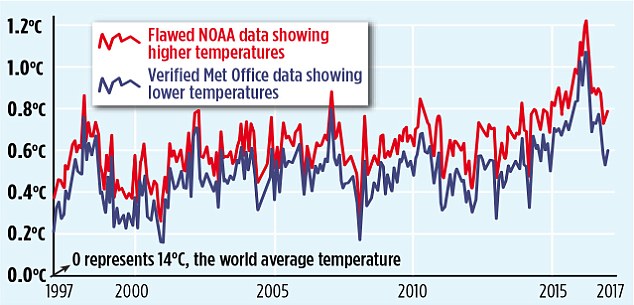
NOAA data manipulation (from David Rose - Mail on Sunday)

NOAA data manipulation (from David Rose – Mail on Sunday)

There will be more whistle-blowers now stepping out from behind the woodwork.


The US Cultural Revolution (as seen from 2050)

February 5, 2017

Paraphrasing freely from a Wikipedia entry:

The US Cultural Revolution, was a sociopolitical movement that took place in the United States from 2016 until 2028. It was set into motion by Donald Trump, when he became President of the United States (ostensibly representing the Republican Party), with the intent to “Make America Great Again”. His stated goal was to preserve ‘true’ American freedoms by reducing the size of government and by purging the leftist and liberal elements that had infiltrated US society and the media, and to re-impose the ideals of freedom of thought as the dominant ideology within the country. The Revolution marked the return of right-of center thought to the mainstream of the United States establishment. 

The Revolution was launched in November 2016, when he was elected President. On assuming office in January 2017,  Trump alleged that leftist elements had infiltrated the government and society at large, aiming to promote a socialist-leaning, “world government”. He insisted that this “wrong thinking” be purged through a reversal of the over-permissive laws of the US. To this end he ensured a majority of right leaning justices in the Supreme Court. He attacked the traditional establishment media by promoting the alternative media channels developing through the internet. Liberal bureaucrats were isolated and marginalized wherever they could not be sacked. Left leaning institutions were starved of government funds. The American heartland responded to Trump’s appeal by voting those considered “too liberal” out of office, all around the country. After the Republicans dominated the elections of 2018, the movement received widespread support from the military, urban workers, and the Republican Party leadership itself. During the same period Trump’s personality cult grew to immense proportions.

Trump officially declared the US Cultural Revolution to have ended after his first term as President in 2020 but its active phase lasted until the end of his successor’s term in 2028. The Trump era coincided (2017-2024) with the economic boom which followed the economic crisis that had persisted all through his predecessor’s term of office (2008-2016). After Trump’s era ended, he was succeeded by another Republican (“Trump’s 3rd term”) and the US began a slow movement back towards the center. However the Trump era saw an irreversible shift away from “big government” and some of the more permissive practices and laws that had crept into the mainstream of US society in the 40 years before Trump.

In 2035, the Republican Party declared that Donald Trump and his US Cultural Revolution was “responsible for the rebirth of the Party, and a return for the country, to the principles of the founding fathers of the United States”.


Death of coal slightly exaggerated

February 4, 2017

Come 2100, I expect the world will still be using fossil fuels for around 70% of its energy needs.

19th January 2017: German court issues permit for Uniper’s Datteln 4 coal-fired power plant

The German Muenster district court on Thursday granted an emission-control permit to Datteln 4, a hard-coal fired power station under construction by utility Uniper that has been held up by an intense legal battle with environmentalists.

Uniper said it aims to begin supplying electricity and district heating from the 1,050 megawatts plant in western Germany in the first half of 2018.

Datteln 4 under construction image uniper

Datteln 4 under construction image uniper

25th January, 2017: Loy Yang B project approved

A major generator of Victoria’s coal-fired electricity is set to be expanded.

ENGIE has welcomed the Environment Protection Authority’s (EPA) recommended approach to granting statutory approval for the turbine upgrade project at the Loy Yang B power station. The approved project will see the retrofit of two turbines with a higher efficiency design to improve the station’s thermal efficiency and increase operating flexibility. The works will occur in 2019 and 2020 during planned outages.

February 1st, 2017: Japanese government planning to build 45 new coal fired power stations to diversify supply

The Japanese government is moving ahead with its plans to build up to 45 new coal fired power stations. The power plants will utilise high energy, low emissions (HELE) technology that use high-quality black coal. Japan is the largest overseas market for Australian coal producers, taking more than a third of all exports. 

February 3rd, 2017: German coal, gas plant output at 5-year high in January

  • January average coal output at 17.3 GW, highest since Feb 2012 
  • Coal, gas ramped up to offset nuclear outages, low wind, demand gains  
  • Day-ahead power average at 59-month high, spot spikes to 2008-high 

German coal and gas-fired power plant output in January rose to its highest in almost five years as cold weather boosted demand while below average wind and record-low winter nuclear availability reduced supply.

February 3rd, 2017: GE helping modernise Serbia’s largest coal-fired power plant

GE’s Power Services will complete the modernisation of Elektro Privreda Srbije’s (EPS) TPP Nikola Tesla, the largest coal-fired power plant in Serbia. 

The power plant features two, 210 MW LMZ steam turbines and four (A3-A6), 308 MW GE units. GE will provide a steam turbine full shaft line retrofit solution for high-pressure, intermediate-pressure and low-pressure turbine modules, as well as a new turbine governing controller system. In addition to the controller, the project includes GE’s advanced 3-D blades, new rotors, rotary blades, stationary blades, inner and outer casings and other associated parts. As part of the agreement, GE will commission a WT23S-106 generator unit – the largest ever installed in Serbia – at the TPP Nikola Tesla B2 site to help improve availability and reliability of the plant. …….. The operating life of the steam turbine unit – an estimated 250 000 working hours – will be extended for an additional 100 000 operating hours, and the maintenance intervals between major overhauls will be extended to nearly 10 years.


Dinosaurs died a cold, dark and miserable death

February 3, 2017

If dinosaurs had not died out, there would not have been the room in the ecosystem for the evolution of the primates (and many other species and perhaps including most birds). Dinosaurs roamed the earth from about 200+ million years ago until about 65 mya. Some mammals did overlap with the dinosaurs but mammal evolution really took off only after the dinosaurs made way for them  The earliest history of primate-like mammals can be traced back to about 65 mya. So, for humans, the extinction of the dinosaurs was existential.

A simulation study from the Potsdam Institute for Climate Impact Research (PIK who, it should be noted, are most famous for exaggerations of sea-rise in their climate models) concludes that it was an asteroid impact and not a volcanic eruption that caused the dinosaur extinction. (I always take “science” from Potsdam with a large pinch of salt since they often could be called the Potsdam Institute for Global Warming Worship).

Brugger, J., Feulner, G., Petri, S. (2017): Baby, it’s cold outside: Climate model simulations of the effects of the asteroid impact at the end of the Cretaceous. Geophysical Research Letters [DOI:10.1002/2016GL072241]

Abstract

Sixty-six million years ago, the end-Cretaceous mass extinction ended the reign of the dinosaurs. Flood basalt eruptions and an asteroid impact are widely discussed causes, yet their contributions remain debated. Modeling the environmental changes after the Chicxulub impact can shed light on this question. Existing studies, however, focused on the effect of dust or used one-dimensional, noncoupled atmosphere models. Here we explore the longer-lasting cooling due to sulfate aerosols using a coupled climate model. Depending on aerosol stratospheric residence time, global annual mean surface air temperature decreased by at least 26°C, with 3 to 16 years subfreezing temperatures and a recovery time larger than 30 years. The surface cooling triggered vigorous ocean mixing which could have resulted in a plankton bloom due to upwelling of nutrients. These dramatic environmental changes suggest a pivotal role of the impact in the end-Cretaceous extinction.

Potsdam has put out a press release:

How the darkness and the cold killed the dinosaurs

66 million years ago, the sudden extinction of the dinosaurs started the ascent of the mammals, ultimately resulting in humankind’s reign on Earth. Climate scientists now reconstructed how tiny droplets of sulfuric acid formed high up in the air after the well-known impact of a large asteroid and blocking the sunlight for several years, had a profound influence on life on Earth. Plants died, and death spread through the food web. Previous theories focused on the shorter-lived dust ejected by the impact. The new computer simulations show that the droplets resulted in long-lasting cooling, a likely contributor to the death of land-living dinosaurs. An additional kill mechanism might have been a vigorous mixing of the oceans, caused by the surface cooling, severely disturbing marine ecosystems.

“The big chill following the impact of the asteroid that formed the Chicxulub crater in Mexico is a turning point in Earth history,” says Julia Brugger from the Potsdam Institute for Climate Impact Research (PIK), lead author of the study to be published today in the Geophysical Research Letters. “We can now contribute new insights for understanding the much debated ultimate cause for the demise of the dinosaurs at the end of the Cretaceous era.” To investigate the phenomenon, the scientists for the first time used a specific kind of computer simulation normally applied in different contexts, a climate model coupling atmosphere, ocean and sea ice. They build on research showing that sulfur- bearing gases that evaporated from the violent asteroid impact on our planet’s surface were the main factor for blocking the sunlight and cooling down Earth.

In the tropics, annual mean temperature fell from 27 to 5 degrees Celsius

“It became cold, I mean, really cold,” says Brugger. Global annual mean surface air temperature dropped by at least 26 degrees Celsius. The dinosaurs were used to living in a lush climate. After the asteroid’s impact, the annual average temperature was below freezing point for about 3 years. Evidently, the ice caps expanded. Even in the tropics, annual mean temperatures went from 27 degrees to mere 5 degrees. “The long-term cooling caused by the sulfate aerosols was much more important for the mass extinction than the dust that stays in the atmosphere for only a relatively short time. It was also more important than local events like the extreme heat close to the impact, wildfires or tsunamis,” says co-author Georg Feulner who leads the research team at PIK. It took the climate about 30 years to recover, the scientists found.

In addition to this, ocean circulation became disturbed. Surface waters cooled down, thereby becoming denser and hence heavier. While these cooler water masses sank into the depths, warmer water from deeper ocean layers rose to the surface, carrying nutrients that likely led to massive blooms of algae, the scientists argue. It is conceivable that these algal blooms produced toxic substances, further affecting life at the coasts. Yet in any case, marine ecosystems were severely shaken up, and this likely contributed to the extinction of species in the oceans, like the ammonites.

“It illustrates how important the climate is for all lifeforms on our planet”

The dinosaurs, until then the masters of the Earth, made space for the rise of the mammals, and eventually humankind. The study of Earth’s past also shows that efforts to study future threats by asteroids have more than just academic interest. “It is fascinating to see how evolution is partly driven by an accident like an asteroid’s impact – mass extinctions show that life on Earth is vulnerable,” says Feulner. “It also illustrates how important the climate is for all lifeforms on our planet. Ironically today, the most immediate threat is not from natural cooling but from human-made global warming.”

Of course the last few lines of the press release are added for political correctness.

One hopes that the simulations used here are not as bad as those used for sea-rise modelling (where they tend to modify and use models so as to give their desired, pre-determined results).


Indian Budget today – Economic Survey published

February 1, 2017

The Indian budget will be presented today and the annual Indian Economic Survey (which forms the basis for the budget) is also out. The Economic Survey is the responsibility of the Chief Economic Adviser to the GoI (this year Arvind Subramanian).

india-economic-survey-2016-17

The budget itself is expected to be mildly expansionist (especially after the jolting brake applied to the economy by the demonetisation circus of the last few months). Certainly some black money was removed from the system but this may be a one-off affair. Certainly, from the anecdotes I hear, the generation of “new” black money has not been slow to start. Maybe demonetisation will have to become an annual affair – or a regular occurrence every so often. But, no doubt, India has made a step-change in the level of electronic transactions being used. It has also brought a huge number of people into the banking system. One of the main concerns for the government is that the cash economy has allowed so many to remain invisible and completely outside the tax base. Considering that only 7 of every hundred voters is even registered for tax, it was imperative for the government to reduce the huge number of the tax-invisible. This they probably have done.

The Economic Survey itself highlights “8 interesting facts”:

  1. Indians on The Move – New estimates based on railway passenger traffic data reveal annual work-related migration of about 9 million people, almost double what the 2011 Census suggests.
  2. Biases in Perception – China’s credit rating was upgraded from A+ to AA- in December 2010 while India’s has remained unchanged at BBB-. From 2009 to 2015, China’s credit-to-GDP soared from about 142 percent to 205 percent and its growth decelerated. The contrast with India’s indicators is striking.
  3. New Evidence on Weak Targeting of Social Programs – Welfare spending in India suffers from misallocation: as the pair of charts show, the districts with the most poor (in red on the left) are the ones that suffer from the greatest shortfall of funds (in red on the right) in social programs. The districts accounting for the poorest 40% receive 29% of the total funding.
  4. Political Democracy but Fiscal Democracy? – India has 7 taxpayers for every 100 voters ranking us 13th amongst 18 of our democratic G-20 peers.
  5. India’s Distinctive Demographic Dividend – India’s share of working age to non-working age population will peak later and at a lower level than that for other countries but last longer. The peak of the growth boost due to the demographic dividend is fast approaching, with peninsular states peaking soon and the hinterland states peaking much later.
  6. India Trades More Than China and a Lot Within Itself – As of 2011, India’s openness – measured as the ratio of trade in goods and services to GDP has far overtaken China’s, a country famed for using trade as an engine of growth. India’s internal trade to GDP is also comparable to that of other large countries and very different from the caricature of a barrier-riddled economy.
  7. Divergence within India, Big Time – Spatial dispersion in income is still rising in India in the last decade (2004-14), unlike the rest of the world and even China. That is, despite more porous borders within India than between countries internationally, the forces of “convergence” have been elusive.
  8. Property Tax Potential Unexploited – Evidence from satellite data indicates that Bengaluru and Jaipur collect only between 5% to 20% of their potential property taxes.
Trade IES 2016-17

Trade IES 2016-17


The Islamic Republic of Gambia is no longer “Islamic”

January 31, 2017

It always strikes me as ridiculous when so-called religious laws (which are just as man-made as any other and are always anachronistic) are allowed to prevail over more recently made, more appropriate laws. This applies especially to countries which claim to be secular but then allow the inflow of people who claim that their own religious law takes precedence over the laws of the country they are emigrating to. Of course, at the present time, this means Sharia law and immigrants who claim that it takes precedence over the laws of the country they are emigrating to.

I wonder why all these countries do not require of immigrants that they attest – in writing – to their acceptance of the local law of the land over any religious law.

The new President of Gambia has realised that there may be more disadvantages to being an Islamic country than advantages. He has changed the name of his country from the “Islamic Republic of Gambia” to “The Gambia”.

gambia-loses-islamic

Gambia loses “Islamic”

IBTimes: 

The Gambia’s new President Adama Barrow has removed “Islamic” from the official name of his country pledging more reforms in the tiny West African nation. In his first press conference since taking over as leader, Barrow said he would soon be overhauling government institutions to make the administration more effective.

“The rule of the law, that will be the order of the day,” said Barrow, adding that The Gambia, where Muslims constitute 90% of the population, would no longer be an “Islamic republic”. The word “Islamic” was added to the country’s name in 2015.

Calling on the nation to unite, the 51-year-old former businessman promised to develop the country by implementing a series of democratic reforms.

“The field will be level for everybody, and in total reconciliation, if people reconcile, that will unite everybody, and we want to hold that line… My government will look at all areas and there will be a complete overhaul of the system,” said the new leader.

A political crisis gripped The Gambia after Barrow’s predecessor, Yahya Jammeh, the autocratic leader who ruled the African nation for 22 years, refused to step down despite losing the polls in December 2016. Jammeh faces a series of human rights abuse allegations forcing him to go into exile as soon as Barrow took oath from neighbouring Senegal.

Maybe it is no longer politically correct to be “Islamic”?


More countries from the SDC list could be added to Trump’s immigration restrictions

January 31, 2017

Seven countries are currently on the US list for immigration restrictions, Iran, Iraq, Libya, Sudan, Yemen, Syria, and Somalia. However there are clear indications from Trump’s chief of staff that other countries could get added to the list. Reince Preibus said on CBS News on Sunday:

“The reason we chose those seven countries was, those were the seven countries that both the Congress and the Obama administration identified as being the seven countries that were most identifiable with dangerous terrorism taking place in their country. …… Now, you can point to other countries that have similar problems, like Pakistan and others. Perhaps we need to take it further. But for now, immediate steps, pulling the Band-Aid off, is to do further vetting for people traveling in and out of those countries,”

These seven countries covered by Trump’s order are also included in a list of countries labeled as specially designated countries (SDCs) that “have shown a tendency to promote, produce, or protect terrorist organizations or their members.”  This list – held by the Immigration and Customs Enforcement department (ICE) consists – it is thought – of 35 countries. The list as of 2011 is still available. However, Barack Obama apparently added Israel to this list but his list was later scrubbed from public view.

While the immigration restrictions are temporary, ostensibly to check screening processes, since these 7 countries are “failed states” and cannot provide sufficient information, government to government, further countries from the list may also be subjected to temporary restrictions. I suspect that this is why Saudi Arabia is not on the list. The government there is fully functioning and has probably promised the US information about travellers. (Much of the support for Saudi support for Sunni, terrorist groups, is from non-governmental sources). Pakistan does not always provide information about terrorists which it has – especially if this is Taliban or Kashmir related. It would not be surprising to see immigration from Pakistan also being subjected to restrictions.

These are countries that harbor and train terrorists. These are countries that we want to know who is coming and going in and out of to prevent calamities from happening in this country.

……….. He was elected president in many respects because people knew that he was going to be tough on immigration from countries that harbor terrorists. And I can’t imagine too many people out there watching this right now think it’s unreasonable to ask a few more questions from someone traveling in and out of Libya and Yemen before being let loose in the United States.


The ICE list as of July 2011

ICE List of Specially Designated Countries (SDCs) that Promote or Protect Terrorists

July 2, 2011

Screening Aliens From Specially Designated Countries

The Department of Homeland Security Office of Inspector General issued a report in May 2011 titled “Supervision of Aliens Commensurate with Risk” that details Immigration and Customs Enforcement’s (ICE) detention and supervision of aliens.  The report  includes a list of Specially Designated Countries (SDCs) that are said to “promote, produce, or protect terrorist organizations or their members”.  The report states that ICE uses a Third Agency Check (TAC) to screen aliens from specially designated countries (SDCs) that have shown a tendency to promote, produce, or protect terrorist organizations or their members and that the purpose of the additional screening is to determine whether other agencies have an interest in the alien. ICE’s policy requires officers to conduct TAC screenings only for aliens from SDCs if the aliens are in ICE custody.

According to the report, ICE provided this list of specially designated countries. ICE policy requires officers to perform a TAC for detained aliens from these countries.

  • Afghanistan
  • Algeria
  • Bahrain
  • Bangladesh
  • Djibouti
  • Egypt
  • Eritrea
  • Indonesia
  • Iran
  • Iraq
  • Israel
  • Jordan
  • Kazakhstan
  • Kuwait
  • Lebanon
  • Libya
  • Malaysia
  • Mauritania
  • Morocco
  • Territories of Gaza West Bank
  • Oman
  • Pakistan
  • Philippines
  • Qatar
  • Saudi Arabia
  • Somalia
  • Sudan
  • Syria
  • Tajikistan
  • Thailand
  • Tunisia
  • Turkey
  • Turkmenistan
  • United Arab Emirates
  • Uzbekistan
  • Yemen


Illegal voting in the US is rampant because voter eligibility is never checked

January 28, 2017

UPDATE! 

Why Trump’s probe of voter fraud is long overdue

All industrialized democracies — and most that are not — require voters to prove their identity before voting. Britain was a holdout, but last month it announced that persistent examples of voter fraud will require officials to see passports or other documentation from voters in areas prone to corruption. 

The real problem in our election system is that we don’t really know to what extent President Trump’s claim is true because we have an election system that is based on the honor system.  …….. The Justice Department has also opposed every effort by states—such as Kansas, Arizona, Alabama and Georgia—to implement laws that require individuals registering to vote to provide proof of citizenship.


It is politically incorrect to question the US voting system. After all, it is the greatest democracy in the world!

But what is notable among all the various politicians and the media who claim there is no significant ineligible voting is that they all just make bald assertions or state “that there is no evidence of illegal voting”. Of course there isn’t. But there is no evidence that ineligible voting is not happening – or that it is not happening on a large scale. First, data on eligibility is never published and, in most cases is not even collected. The onus is surely on the election commissions to check and ensure that voters are all eligible, not for others to prove that some voters are or were ineligible.

Only citizens are supposed to vote in federal elections. Even “green card holders” are not eligible to vote in federal elections. Since 1996, a federal law has prohibited non-citizens from voting in federal elections, subject to punishment by fines, imprisonment, inadmissibility, and even deportation. But while voter registration forms require that a box for citizenship be ticked (a self-declaration), the immigration status for non-citizens is rarely – if ever – checked. There are virtually no prosecutions and even then, only if someone complains against a particular individual.

American Immigration Center:

Non-U.S. citizens are not allowed to vote in the federal elections. Non-U.S. citizens include Green Card holders, those in the U.S. on nonimmigrant visas, undocumented immigrants, refugees and asylees. These categories of immigrants do not have the right to vote for the President of the U.S.

Natural born U.S. citizens and naturalized citizens can vote in the Presidential Elections. U.S. citizens have more rights than legal permanent residents. Green Card holders can remain in the U.S., work here and also bring certain categories of relatives to the country. But they are not granted all the rights granted to U.S. citizens, including the right to vote, serve on juries and work in certain government positions. Though the immigration status granted to legal permanent residents is permanent, they might lose their Green Cards if they commit deportable crimes.

Green Card holders who misrepresent their status as a U.S. citizen and vote in the federal election are more likely to lose their immigration status in the U.S. This misrepresentation can also make them deportable from the country.

Federal law does not prevent non-citizens from voting in state or local elections.

I have heard many anecdotes of green card holders (by definition non-citizens) who did vote in the 2016 US elections. This is not definitive evidence of course but suggests that very little checking is done. What is even more remarkable, and quite amazing, is that neither identification nor proof of status as a citizen is required as a matter of routine when voting.

Plain stupidity.

The bottom line is that no non-citizen is eligible to vote. The opposition to having ID to vote is primarily from politicians who wish to make use of ineligible voting. A large number of the voters – especially in States like California – in the 2016 elections were non-citizens. A significant number were green-card holders.

Stupidity

Stupidity

Add to this that even citizens are permitted to be registered in more than one state. They are not supposed to vote more than once, but there is no check that they do not.

It is not just likely – but is highly probable – that as many as 5 million voters in the 2016 presidential election were ineligible to vote.

As William Campenni writes in American Thinker:

lllegal Aliens Really Do Vote – a Lot

………. A voter registration form was thrust in my hands.  The very first item on these forms, in Virginia and the rest of America, was “I am a citizen of the United States of America,” with YES and NO blocks to check.

“Don’t I need to show you some proof of citizenship?” I asked. She replied “no.”  I asked her how she could verify that I wasn’t lying. Sensing she might be on a slippery slope, she called over a supervisor from the Registrar’s Office and told the woman of my concern.  The official told me they never checked citizenship status because I would be penalized if I lied. Really? So I asked her how she would verify my truthfulness, or those of the dozens of new voters being registered that day.  Defensively, she replied that they checked all registrations for accuracy at the Registrar’s Office when they were turned in.

I called the Registrar Monday, and asked if they do indeed verify citizenship status.  I was told that they didn’t unless someone made a specific complaint against an individual applicant.

……… nobody at the Registrar’s Office is checking citizenship.

The brutal truth is that illegal aliens vote, and in large numbers.  Voter fraud is not exclusive to illegal aliens.  There are also legal aliens (green card, H1B visas, tourist visa holders, etc.) who vote illegally.  And it’s not just Latin Americans.  The non-citizen demographic includes South Asian tech workers, Irish overstays, West and Horn of Africa immigrants, and Asian students. Then there are dual-state voters (college kids, snowbirds, transients), reincarnated voters, and un-purged voters long moved from their precincts.

While few cases are prosecuted, it’s not because few crimes are committed.

So much for the greatest democracy in the world where – in my estimation – upwards of 5% of the votes cast are ineligible.


Southern Hemisphere sea ice growth together with Milankovitch cycles may be the trigger for an ice age

January 27, 2017

The three Milankovitch orbital cycles, due to eccentricity (100,000 years), axial tilt (41,000 years), and precession (23,000 years) have long been thought to be connected to the onsets of glacial or interglacial conditions. New research now suggests that growth of sea ice in the Southern Hemisphere at particular times of the Milankovitch cycles could be the trigger for a new glacial age. The work suggests that different orbital cycles have been predominant at different times.

“For the past million years or so, the 100,000-year glacial cycle has been the most prominent. But before a million years ago, paleoclimate data suggest that pace of the glacial cycle was closer to about 40,000 years. That suggests that the third Milankovitch Cycle, which repeats every 41,000 years, was dominant then.”

Jung-Eun Lee, Aaron Shen, Baylor Fox-Kemper, Yi Ming. Hemispheric sea ice distribution sets the glacial tempo. Geophysical Research Letters, 2017; DOI: 10.1002/2016GL071307

Abstract

The proxy record of global temperature shows that the dominant periodicity of the glacial cycle shifts from 40-kyr (obliquity) to 100-kyr (eccentricity), about a million years ago. Using climate model simulations, here we show that the pace of the glacial cycle depends on the pattern of hemispheric sea ice growth. In a cold climate the sea ice grows asymmetrically between two hemispheres under changes to Earth’s orbital precession, because sea ice growth potential outside of the Arctic Circle is limited. This difference in hemispheric sea ice growth leads to an asymmetry in absorbed solar energy for the two hemispheres, particularly when eccentricity is high, even if the annual average insolation is similar. In a warmer climate, the hemispheric asymmetry of the sea ice decreases as mean Arctic and Antarctic sea ice decreases, diminishing the precession and eccentricity signals and explaining the dominant obliquity signal (40-kyr) before the mid-Pleistocene transition.

The Brown University press release:

Climate simulations show how changes in Earth’s orbit alter the distribution of sea ice on the planet, helping to set the pace for the glacial cycle.

Earth is currently in what climatologists call an interglacial period, a warm pulse between long, cold ice ages when glaciers dominate our planet’s higher latitudes. For the past million years, these glacial-interglacial cycles have repeated roughly on a 100,000-year cycle. Now a team of Brown University researchers has a new explanation for that timing and why the cycle was different before a million years ago.

Using a set of computer simulations, the researchers show that two periodic variations in Earth’s orbit combine on a 100,000-year cycle to cause an expansion of sea ice in the Southern Hemisphere. Compared to open ocean waters, that ice reflects more of the sun’s rays back into space, substantially reducing the amount of solar energy the planet absorbs. As a result, global temperature cools.

“The 100,000-year pace of glacial-interglacial periods has been difficult to explain,” said Jung-Eun Lee, an assistant professor in Brown’s Department of Earth, Environmental and Planetary Studies and the study’s lead author. “What we were able to show is the importance of sea ice in the Southern Hemisphere along with orbital forcings in setting the pace for the glacial-interglacial cycle.”

In the 1930s, Serbian scientist Milutin Milankovitch identified three different recurring changes in Earth’s orbital pattern. Each of these Milankovitch Cycles can influence the amount of sunlight the planet receives, which in turn can influence climate. The changes cycle through every 100,000, 41,000 and 21,000 years.

The problem is that the 100,000-year cycle alone is the weakest of the three in the degree to which it affects solar radiation. So why that cycle would be the one that sets the pace of glacial cycle is a mystery. But this new study shows the mechanism through which the 100,000-year cycle and the 21,000-year cycle work together to drive Earth’s glacial cycle.

The 21,000-year cycle deals with precession — the change in orientation of Earth’s tilted rotational axis, which creates Earth’s changing seasons. When the Northern Hemisphere is tilted toward the sun, it gets more sunlight and experiences summer. At the same time, the Southern Hemisphere is tilted away, so it gets less sunlight and experiences winter. But the direction that the axis points slowly changes — or precesses — with respect to Earth’s orbit. As a result, the position in the orbit where the seasons change migrates slightly from year to year. Earth’s orbit is elliptical, which means the distance between the planet and the sun changes depending on where we are in the orbital ellipse. So precession basically means that the seasons can occur when the planet is closest or farthest from the sun, or somewhere in between, which alters the seasons’ intensity.

In other words, precession causes a period during the 21,000-year cycle when Northern Hemisphere summer happens around the time when the Earth is closest to the sun, which would make those summers slightly warmer. Six months later, when the Southern Hemisphere has its summer, the Earth would be at its furthest point from the sun, making the Southern Hemisphere summers a little cooler. Every 10,500 years, the scenario is the opposite.

In terms of average global temperature, one might not expect precession to matter much. Whichever hemisphere is closer to the sun in its summer, the other hemisphere will be farther away during its summer, so the effects would just wash themselves out. However, this study shows that there can indeed be an effect on global temperature if there’s a difference in the way the two hemispheres absorb solar energy — which there is.

That difference has to do with each hemisphere’s capacity to grow sea ice. Because of the arrangement of the continents, there’s much more room for sea ice to grow in the Southern Hemisphere. The oceans of the Northern Hemisphere are interrupted by continents, which limits the extent to which ice can grow. So when the precessional cycle causes a series of cooler summers in the Southern Hemisphere, sea ice can expand dramatically because there’s less summer melting.

The precession cycle can influence global climate because the Southern Hemisphere has a higher capacity of sea ice growth. The image depicts current variation in sea ice extent in each hemisphere.

Lee’s climate models rely on the simple idea that sea ice reflects a significant amount of solar radiation back into space that would normally be absorbed into the ocean. That reflection of radiation can lower global temperature.

“What we show is that even if the total incoming energy is the same throughout the whole precession cycle, the amount of energy the Earth actually absorbs does change with precession,” Lee said. “The large Southern Hemispheric sea ice that forms when summers are cooler reduces the energy absorbed.”

But that leaves the question of why the precession cycle, which repeats every 21,000 years, would cause a 100,000-year glacial cycle. The answer is that the 100,000-year orbital cycle modulates the effects of the precession cycle.

The 100,000-year cycle deals with the eccentricity of Earth’s orbit — meaning the extent to which it deviates from a circle. Over a period of 100,000 years, the orbital shape goes from almost circular to more elongated and back again. It’s only when eccentricity is high — meaning the orbit is more elliptical — that there’s a significant difference between the Earth’s furthest point from the sun and its closest. As a result, there’s only a large difference in the intensity of seasons due to precession when eccentricity is large.

“When eccentricity is small, precession doesn’t matter,” Lee said. “Precession only matters when eccentricity is large. That’s why we see a stronger 100,000-year pace than a 21,000-year pace.”

Lee’s models show that, aided by high eccentricity, cool Southern Hemisphere summers can decrease by as much as 17 percent the amount of summer solar radiation absorbed by the planet over the latitude where the difference in sea ice distribution is largest — enough to cause significant global cooling and potentially creating the right conditions for an ice age.

Aside from radiation reflection, there may be additional cooling feedbacks started by an increase in southern sea ice, Lee and her colleagues say. Much of the carbon dioxide — a key greenhouse gas — exhaled into the atmosphere from the oceans comes from the southern polar region. If that region is largely covered in ice, it may hold that carbon dioxide in like a cap on a soda bottle. In addition, energy normally flows from the ocean to warm the atmosphere in winter as well, but sea ice insulates and reduces this exchange. So having less carbon and less energy transferred between the atmosphere and the ocean add to the cooling effect.

The findings may also help explain a puzzling shift in the Earth’s glacial cycle. For the past million years or so, the 100,000-year glacial cycle has been the most prominent. But before a million years ago, paleoclimate data suggest that pace of the glacial cycle was closer to about 40,000 years. That suggests that the third Milankovitch Cycle, which repeats every 41,000 years, was dominant then.

While the precession cycle deals with which direction the Earth’s axis is pointing, the 41,000-year cycle deals with how much the axis is tilted. The tilt — or obliquity — changes from a minimum of about 22 degrees to a maximum of around 25 degrees. (It’s at 23 degrees at the moment.) When obliquity is higher, each of the poles gets more sunlight, which tends to warm the planet.

So why would the obliquity cycle be the most important one before a million years ago, but become less important more recently?

According to Lee’s models, it has to do with the fact that the planet has been generally cooler over the past million years than it was prior to that. The models show that, when the Earth was generally warmer than today, precession-related sea ice expansion in the Southern Hemisphere is less likely to occur. That allows the obliquity cycle to dominate the global temperature signature. After a million years ago, when Earth became a bit cooler on average, the obliquity signal starts to take a back seat to the precession/eccentricity signal.

Lee and her colleagues believe their models present a strong new explanation for the history of Earth’s glacial cycle — explaining both the more recent pace and the puzzling transition a million years ago.


Seeking “asylum” in Europe carries a whiff of fraud

January 26, 2017

It is hardly surprising that “asylum seekers” in Europe are perceived as including many fraudsters. This article is from the Basler Zeitung in Switzerland:

Eritreans enjoy their “home leave”

Many Eritreans regularly return to their home country where they are supposedly “threatened with life and limb”. The refugees, who mostly live on social welfare, are a good source of foreign currency for the home country.

The scene took place in July 2016 at Zurich-Kloten Airport. It’s a holiday season. Thousands of people fly for their summer vacation. Among them are numerous people from Eritrea, men, women, whole families. They have travel documents as refugees or as temporary residents, who can stay in Switzerland despite a rejected asylum application. The cantons have issued the documents after the Eritreans have submitted a request and this has been examined by the Confederation.

Many of them do not fly to Italy, Germany or Sweden, where there are a large diaspora of Eritrean communities.  They fly to their homeland. Thus, to the very country in which, according to the refugee policy, they are “threatened with life and limb” , and therefore can not at any time be returned after a rejected asylum application, says Councilor Simonetta Sommaruga.

However, the trip does not go directly to Eritrea. Such flights are not available from Zurich at all, but, according to BaZ research, via an intermediate station, for example via Istanbul. From there to the Sudanese capital Khartoum or to Ethiopian capital Addis Ababa. This is shown by the boarding cards of the Eritreers, which have been seen by BaZ in Zurich. Up to fifty people leave daily from Switzerland and fly to a neighboring country of Eritrea. A return flight via Istanbul costs around 650 francs during the high season in summer. At present they are available for 599 francs.

In Sudan or Ethiopia, the Eritreans finally get buses, which bring them home in a few days. From Khartoum there are also flights, which after an hour’s flight lands in the Eritrean capital, Asmara . Four out of five Eritreans in Switzerland receive social welfare. This is evidently generous enough that it is possible for many to travel to their homeland.

So far, the State Secretariat for Migration (SEM), said it was difficult to determine who was going to Eritrea through a neighboring country because there are no direct flights. It was merely a few persons who were abusing the status of asylum. At the end of May 2016 the SEM , as reported by BaZ , claimed that every year about 20 suspicious cases were tested, less than half as many as flew daily just from Zurich-Kloten to Sudan, ……

…. This means, in the plain text, that many Eritreans, who are mostly unable to present their Eritrean passports when seeking asylum, suddenly have travel documents, when they go on home leave, either from the Swiss authorities or from the Eritrean consulate in Geneva or elsewhere. New papers. … (It was) revealed  already three years ago that the Eritrean representation in Switzerland not only participated in tax drives from the Eritrean diaspora but also organized travels to Eritrea. Refugees are a source of revenue for the home country. ……. 

No doubt there are genuine asylum seekers, but the many cases of fraud mean that the seeking of “asylum” has lost both credibility and value.