“Dalai Lama to meet with Donald Trump”

December 3, 2016

That headline hasn’t been written yet but don’t be surprised if it happens,  and soon, sometime before Trump’s inauguration.

Trump needs to rile China as much as possible while minimising any real retaliatory actions. What he does now, before his inauguration, can only lead to threats of retaliation but not any real actions. His mere acceptance of a call from Taiwan’s President has caused large waves. Something the US administration for 40 years has not had the courage to do. Maybe I attribute too much sense to Trump’s team, but I suspect that they have calculated quite well. They have thrown the current Obama administration into a bit of a spin and rendered them effectively impotent in their China posture.

The time before his inauguration is is a unique opportunity for Trump to make statements, meet people and indicate actions which he can later walk away from. It is the time for outrageous trial balloons. Few President-elects have had the nerve to do this before. I note his skillful, and almost Machiavellian, use of the selection process of “possible” members of his administration to confuse and mislead a hostile press.

The liberal/left press still don’t get it. Democracy is all about populism. It may be a trifle stupid but that is what democracy is about. The liberal “elite” – or any elite – cannot prevail in a democracy. They can no longer expect to be blindly followed by the unthinking plebs. They need to court popularity. I suspect there has been a lot more real thinking (whether by heart or by brain) by the Trump voters in deciding to vote for him than those who blindly followed their “elite” leaders in voting for Clinton.

Trump needs, while minimising the consequences, to rile China, India, France, Germany, Mexico, Canada and a few other “socialist” countries. He did Mexico during the campaign. He continued with India with his apparently effusive telephone conversation with Nawaz Sharif of Pakistan. Now he’s done China. The French/German/British investment in – and creation of  – some of the rebel groups now losing in Aleppo has been part of the US strategy disaster in Syria. A losing strategy that Trump will want to move away from. And that he will do by means of contacts with Putin.

It is more unlikely but I would not put it past him to make contact with Iran.

But meeting with the Dalai Lama is an easy decision to take.
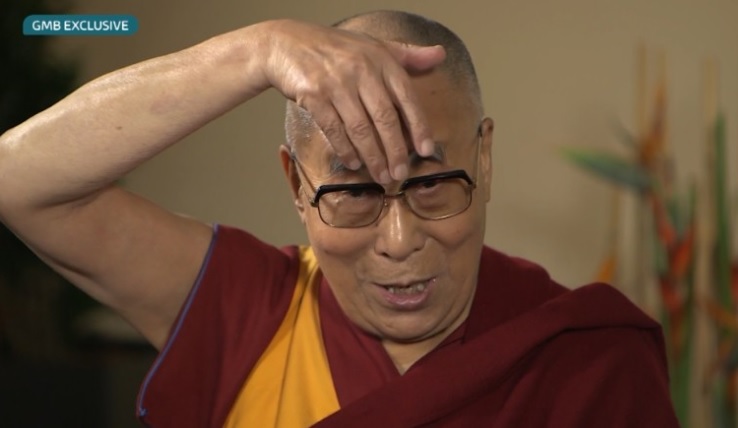
Dalai Lama impersonating Trump (Good Morning Britain)
Dalai Lama impersonating Trump (Good Morning Britain)


Emerging markets outlook for 2017

November 25, 2016

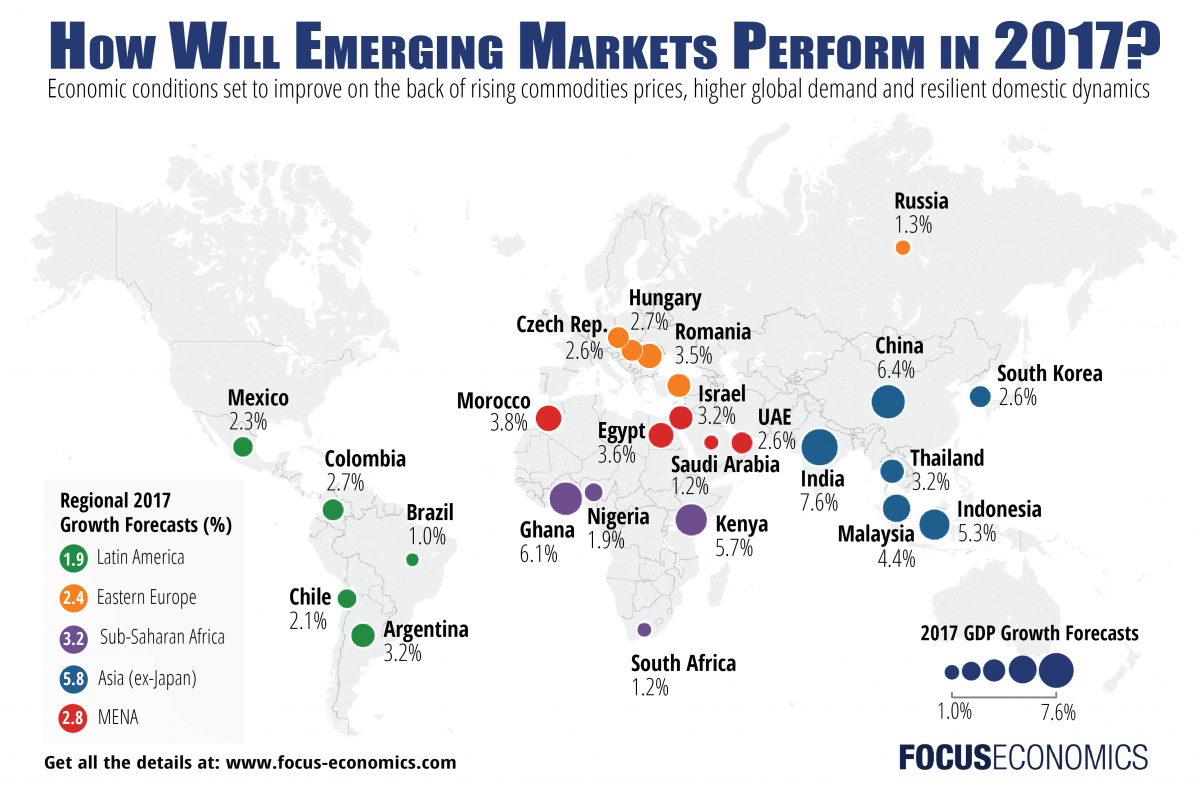
Focus Economics has published its emerging markets prediction for 2017.

  1. Latin America | External shocks to undermine potential growth in the region
  2. Asia | Growth will benefit from rising global demand and resilient domestic dynamics
  3. MENA | Higher oil prices promise to boost growth in 2017
  4. Eastern Europe | Economic conditions set to improve in 2017
  5. Sub-Saharan Africa | Weak growth urges policy action
Focus Economics: Emerging Markets outlook 2017

Focus Economics: Emerging Markets outlook 2017

It is in Asia and a recovering Russia that there may be some drive:

Asia | Growth will benefit from rising global demand and resilient domestic dynamics

  • China’s still resilient economic growth and the ongoing reform momentum in India will prompt the East and South Asia (ESA) region to expand a strong 6.0% in 2017, which will represent a slight deceleration from the expected 6.1% increase in 2016. Meanwhile, in the Association of Southeast Asian Nations (ASEAN), an improvement in the region’s external sector should support quicker growth along with resilient household spending. ASEAN will expand 4.8% in 2017, up from 2016’s 4.6% increase.
  • Inflationary pressures are expected to strengthen across Asia next year as a result of a low base effect, the gradual increase in commodity prices and scheduled subsidy cuts and tax hikes in some economies. While inflation in ESA will increase mildly from 2.4% in 2016 to 2.5% next year, the pick-up in ASEAN will be more pronounced and inflation is expected to rise from 2.3% in 2016 to 3.2% in 2017.
  • While economic growth in the region will benefit from a mild improvement in global demand and resilient domestic dynamics, some clouds are gathering on the horizon. Donald Trump’s victory in the U.S. presidential elections could disrupt the global economy if he implements his proposed protectionist policies. This has the potential to hit growth in the region, given the importance of the external sector for most Asian economies. Also, a more aggressive monetary policy normalization by the U.S. Federal Reserve could heighten volatility in the financial and exchange rate markets in the region.

………

Eastern Europe | Economic conditions set to improve in 2017

  • The stabilization of commodities prices and the economic recovery in Russia, the region’s largest economy, should support a return to growth in the Commonwealth of Independent States (CIS) region next year. GDP is seen growing 1.5%, after falling 0.3% in 2016. However, geopolitical risks and monetary tightening in the U.S. are casting a shadow on the outlook.
  • In Central & Eastern Europe (CEE), steady domestic demand should fuel a healthy 3.0% growth this year and next. Meanwhile, dynamics in South-Eastern Europe (SEE) will be dominated by escalating political uncertainty and security concerns in Turkey and the ongoing debt saga in Greece. GDP in SEE is seen expanding 2.8% in 2017, slightly above the 2.7% projected for this year.
  • Price pressures in the CIS region should fall steadily throughout 2017, supported by a tightening bias by most central banks in the region, and our panel sees inflation at 5.6% in 2017. For CEE, inflation is expected to rise in 2017 as the effect of low oil prices wanes, with our analysts projecting average inflation of 1.5%. Meanwhile, SEE will see a slight increase in price pressures on the back of rising inflation in Greece and Romania.
  • External risks to the Eastern European economy are high heading into 2017. The surprise outcome of the U.S. presidential election along with tense Brexit negotiations will increase volatility in the financial markets and weigh on currencies and assets across the region. In addition, an expected increase in U.S. interest rates has the potential to tighten global liquidity and spark capital outflows. For Russia, however, Trump’s election is seen as positive and some analysts speculate that he could end sanctions against Russia due to his close ties with the country. 

Maybe the financial crisis which started in 2008 is finally coming to an end. Eight years is long enough.

I blame the EU and the lack of drive from Barack Obama, not for the start of the crisis, but for prolonging the length of time it has lasted. But one reaction for the political cowardice of the last 8 years (some would say 20 years) is the disenchantment with liberal/social democratic, politically correct, elite and  “establishment” politics.

The disenchantment is showing itself to be a global phenomenon.


Cowardly French court bans video of smiling Downs syndrome kids because it may upset women after abortions

November 24, 2016

It is political correctness gone mad.

You might as well ban children with Downs syndrome from smiling. Or why not just order all Downs syndrome kids from being out in the open. After all they might be seen by a woman soon after having had an abortion.

“the freedom of expression of individuals with Down syndrome must bow to the right to abortion.”

The only logical conclusion is that in this French court’s eyes, a child with Downs syndrome really should not be alive.

The Stream:

French Court Upholds Ban on Video of Happy Children With Down Syndrome

The court claims the video might ‘disturb the conscience’ of post-abortive women.

Video of Downs syndrome children banned in France

Video of Downs syndrome children banned in France

An award-winning video entitled Dear Future Mom featuring happy children and young adults with Down syndrome is banned from French television.

France’s Conseil d’État (State Council) rejected an appeal to lift the ban on November 10, declaring that seeing happy people with Down syndrome was “likely to disturb the conscience of women who had lawfully made different personal life choices” — in other words, women who chose to abort their unborn babies diagnosed with the genetic disorder.

In a press release, Jean-Marie Le Mene, president of the Jérôme Lejeune Foundation, which partnered with other organizations to produce the video and appealed the Higher Council of Audiovisual’s ban, said the court’s decision indicates that “the freedom of expression of individuals with Down syndrome must bow to the right to abortion.”

A cowardly court! An unjust court!

Reading University shows Antarctic ice increased over last 3 decades and is largely unchanged over 100 years

November 24, 2016

You cannot have “global” warming which applies differently to different parts of the globe. If man-made CO2 is having any significant effect on “global” temperature it must be an effect that is visible in both the Arctic and the Antarctic. Even if all the Arctic ice melts but the Antarctic ice does not then “global” warming is clearly not “global”.

A new study by Reading University shows that Antarctic ice is largely unchanged over 100 years and increasing over the last 3 decades. The man-made “global” warming theory is just not possible with these results.

Research article
21 Nov 2016

Estimating the extent of Antarctic summer sea ice during the Heroic Age of Antarctic Exploration

Tom Edinburgh1,a and Jonathan J. Day11Department of Meteorology, University of Reading, Reading, UK
acurrently at: Department of Applied Mathematics and Theoretical Physics, University of Cambridge, Cambridge, UK

Abstract. In stark contrast to the sharp decline in Arctic sea ice, there has been a steady increase in ice extent around Antarctica during the last three decades, especially in the Weddell and Ross seas. In general, climate models do not to capture this trend and a lack of information about sea ice coverage in the pre-satellite period limits our ability to quantify the sensitivity of sea ice to climate change and robustly validate climate models. However, evidence of the presence and nature of sea ice was often recorded during early Antarctic exploration, though these sources have not previously been explored or exploited until now. We have analysed observations of the summer sea ice edge from the ship logbooks of explorers such as Robert Falcon Scott, Ernest Shackleton and their contemporaries during the Heroic Age of Antarctic Exploration(1897–1917), and in this study we compare these to satellite observations from the period 1989–2014, offering insight into the ice conditions of this period, from direct observations, for the first time. This comparison shows that the summer sea ice edge was between 1.0 and 1.7° further north in the Weddell Sea during this period but that ice conditions were surprisingly comparable to the present day in other sectors.


Citation: Edinburgh, T. and Day, J. J.: Estimating the extent of Antarctic summer sea ice during the Heroic Age of Antarctic Exploration, The Cryosphere, 10, 2721-2730, doi:10.5194/tc-10-2721-2016, 2016.

Ice observations recorded in the ships’ logbooks of explorers such as the British Captain Robert Scott and Ernest Shackleton and the German Erich von Drygalski have been used to compare where the Antarctic ice edge was during the Heroic Age of Antarctic Exploration (1897-1917) and where satellites show it is today.

The study, published in the European Geosciences Union journal The Cryosphere, suggests Antarctic sea ice is much less sensitive to the effects of climate change than that of the Arctic, which in stark contrast has experienced a dramatic decline during the 20th century. ……

……. Jonathan Day, who led the study, said: “The missions of Scott and Shackleton are remembered in history as heroic failures, yet the data collected by these and other explorers could profoundly change the way we view the ebb and flow of Antarctic sea ice.

“We know that sea ice in the Antarctic has increased slightly over the past 30 years, since satellite observations began. Scientists have been grappling to understand this trend in the context of global warming, but these new findings suggest it may not be anything new.

“If ice levels were as low a century ago as estimated in this research, then a similar increase may have occurred between then and the middle of the century, when previous studies suggest ice levels were far higher.”

The new study published in The Cryosphere is the first to shed light on sea ice extent in the period prior to the 1930s, and suggests the levels in the early 1900s were in fact similar to today, at between 5.3 and 7.4 million square kilometres. Although one region, the Weddell Sea, did have a significantly larger ice cover.

Published estimates suggest Antarctic sea ice extent was significantly higher during the 1950s, before a steep decline returned it to around 6 million square kilometres in recent decades.

The research suggests that the climate of Antarctica may have fluctuated significantly throughout the 20th century, swinging between decades of high ice cover and decades of low ice cover, rather than enduring a steady downward trend.


“Adjusting” temperatures is a political exercise in a politicised “science”

November 24, 2016

To pretend that politicised science does not exist is to be naive. To state as a religious conviction that man-made CO2 is causing global warming is little different to the religiously expressed beliefs by politically correct media that Brexit would not happen or that Trump could not win. Climate “scientists” and their gullible followers need to remember that all beliefs can only exist in the space of ignorance.

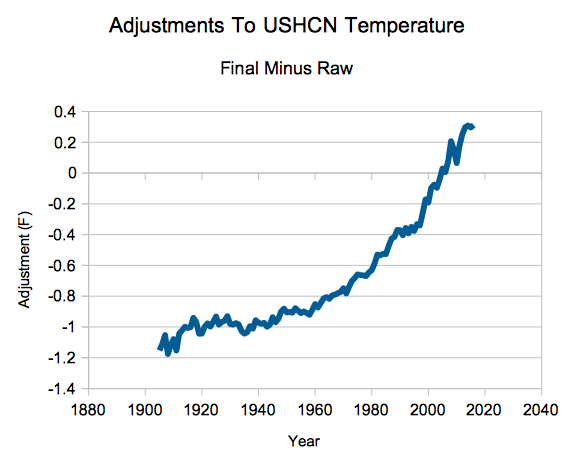
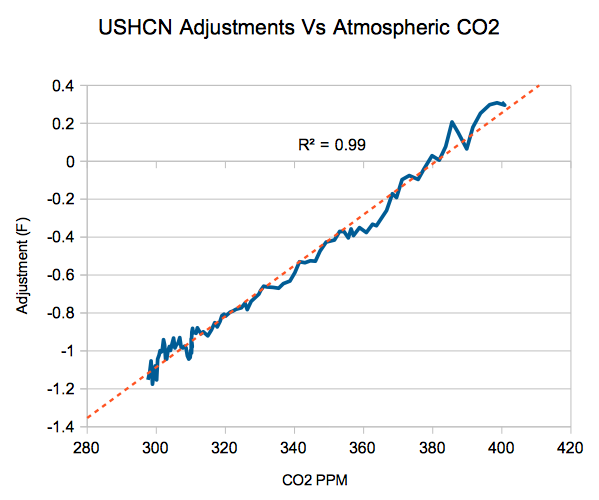
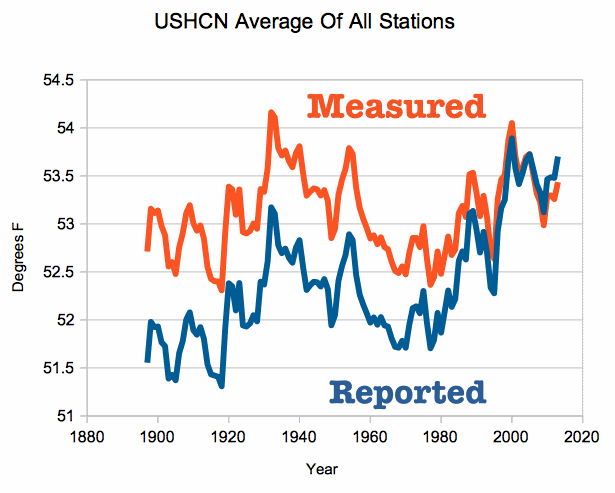
I dislike algorithms for “calculating” an artificial “global temperature” by “adjusting” and “weighting” raw data to suit pre-conceived notions of what final result should be. It gets worse when the “adjustments” about past temperatures are variable and are themselves “adjusted” every year. The reports about every year being hotter than the last are actually just a statement that “adjustments” every year are greater than the last.

I reproduce Tony Heller’s post about the US temperatures in realclimatescience:

NOAA Adjustments Correlate Exactly To Their Confirmation Bias

Thermometers show the US cooling since about 1920, but NOAA massively cools the past to create the appearance of a warming trend.

screen-shot-2016-11-21-at-9-31-19-am

These adjustments make a spectacular hockey stick of data tampering.

screen-shot-2016-11-21-at-9-36-49-am

When plotted against atmospheric CO2, the correlation is almost perfect.  NOAA is tampering with the data exactly to match their theory.

screen-shot-2016-11-21-at-9-26-17-am


Brexit – Trump market booms

November 23, 2016

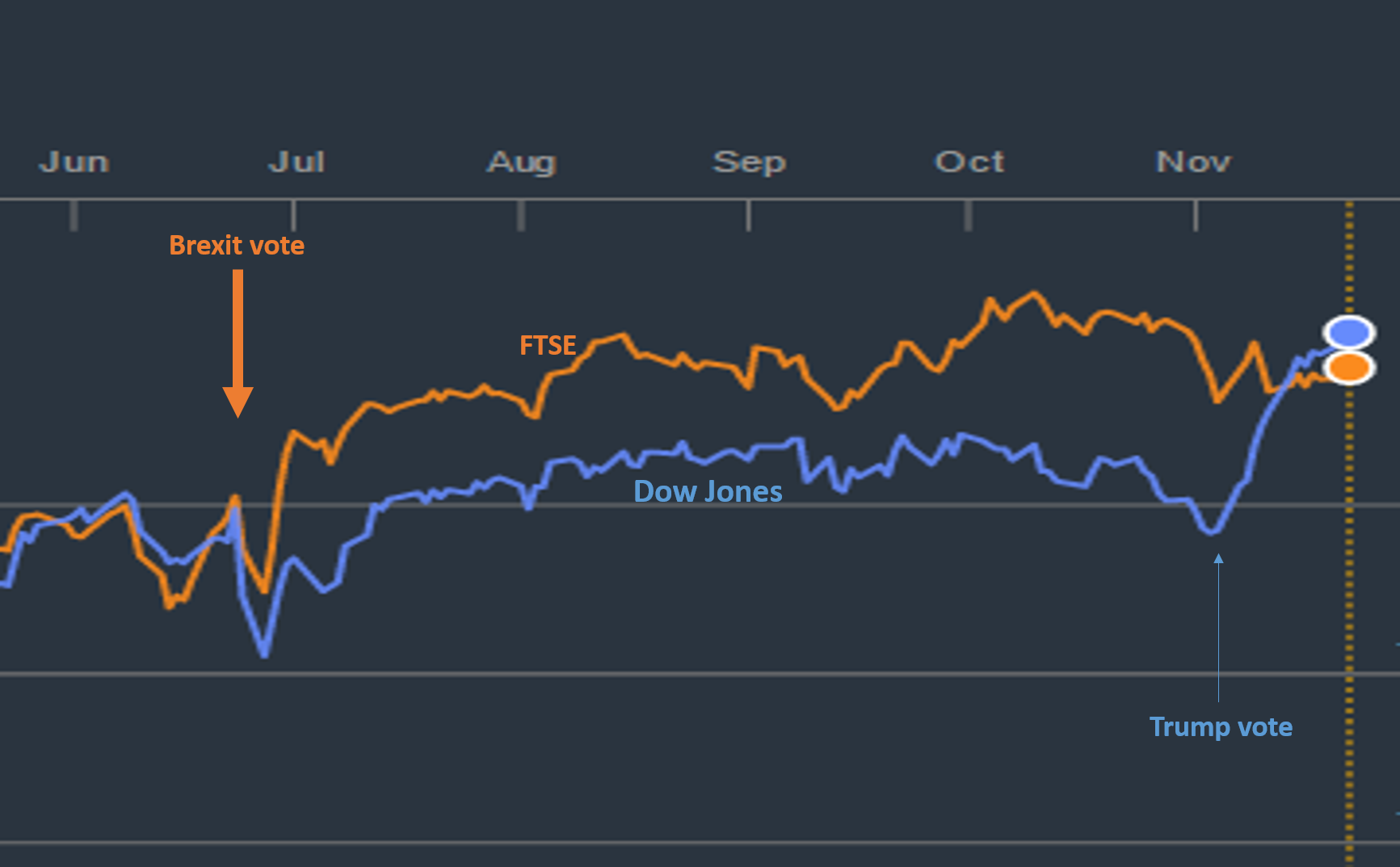
The gloom and doom was a little overdone.

(original graphic Bloomberg)

(original graphic Bloomberg)

The Brexit and Trump effects have been to cause markets to boom.


Sarkozy gets the ignominious boot and a Le Pen – Fillon presidential contest is likely

November 21, 2016

Sarkozy tried to adopt many of Le Pen’s positions but while he has provided Marie Le Pen’s positions with legitimacy, he has apparently only lost his own credibility. He has suffered a humiliating defeat coming behind both Fillon and Juppe in the centre-right primary.

France 24:

French ex-president Nicolas Sarkozy saw his ambition to lead the country for a second time dashed as he suffered a crushing defeat to his former prime minister, François Fillon, in the first round of a centre-right primary on Sunday.

Fillon will now face off against another former prime minister, Alain Juppé, in a November 27 run-off to become the centre-right Les Republicains’ nomination in May’s presidential election. With ballots counted at 8,709 polling stations out of a total 10,229, Fillon was seen gathering 44.1 percent of the votes, Juppé 28.2 percent and Sarkozy 21.0 percent.

Sarkozy, president from 2007-12, said he would now back Fillon, a surprise frontrunner in what is the centre-right’s first ever presidential primary, in the run-off vote.

As results trickled in Sunday evening and the gap between Sarkozy and Juppé became ever wider, Sarkozy had little choice but to concede defeat.

This was the first ever centre-right primary and anybody with 2€ was eligible to vote. With an unknown electorate, opinion polls were very circumspect. But those few which dared to make any predictions expexted Juppe to lead, Sarkozy to come second and for Fillon to be eliminated. Fillon’s margin over Juppe was surprising and gives him the edge for the run-off on November 27th.

francois-fillon

Francois Fillon

But Fillon’s first-round win over Juppe and Sarkozy is also consistent with the narrative that opinion polls can no longer pick up trends which go against “political correctness”. The establishment are seen as the high priests of “political correctness” and nobody will admit to heresy in advance. Those who intend to vote against what is deemed “politically correct” just do not admit it. They neither admit to going against conventional wisdom whether in opinion polls or in exit polls. There were many secret voters against Brexit and many secret voters for Trump.

I expect also that France will have many secret voters for Marie Le Pen. While Fillon probably has a better chance against her than Sarkozy, opinion polls for the French Presidential elections (first round on 23rd April 2017 and the run-off round on May 7th) will almost certainly miss her “secret voters”. The polls will underestimate her strength. Her own party supporters probably can get her up to 30%. The left have no one to back and while many could force themselves to back Juppe just to keep Marie Le Pen out, they may abstain rather than back Fillon. After all for the unions Fillon is as bad as Margaret Thatcher.

For Marie Le Pen the best result would have been if Sarkozy had won. Fillon winning the primary run-off would be the next best thing since many of Sarkozy’s supporters at yesterday’s primary may well find a safe harbour with Le Pen.


Time to stop pretending that Islamic terror and ISIS have nothing to do with Islam

November 19, 2016

The paranoia about being considered Islamophobic now often leads to the abandonment of common sense. To be Islamophobic is not politically correct. That Islamic terrorists constitute a small number of all Muslims is obvious. But it borders on inanity to extend that to the claim that the terrorists have nothing to do with Islam. It is the concepts – sometimes medieval – contained within Islam which are currently providing the motivation and the justification for self-styled imams and “teachers” to spread the disease. They infect thousands (maybe millions) of immature and vulnerable minds and convert them into barbaric killers. To absolve – in these instances – Islam of being the source of the problem is to be naive. No doubt outdated values contained in Islam are being exploited but they are being exploited by Muslims to brainwash other Muslims. And that itself has something to say about Islam. There is no doubt either that the brainwashed  – who are also Muslims – are vulnerable and somewhat deficient in critical judgement. But that does not mean that Islam is not involved.

Anybody under 25 who claims to be a follower of any religion has of course been brainwashed into that belief as a child. Right now, among all the religions, Islam allows the creation of more terrorists than any other religion.

It is not often that I find the Archbishop of Canterbury in agreement with my views, but in this case he seems to have applied some of his common sense:

The Telegraph: Claims that the atrocities of the Islamic State have “nothing to do with Islam” are harming efforts to confront and combat extremism, the Archbishop of Canterbury has insisted.

Religious leaders of all varieties must “stand up and take responsibility” for the actions of extremists who profess to follow their faith, the Most Rev Justin Welby said.

He argued that unless people recognise and attempt to understand the motivation of terrorists they will never be able to combat their ideology effectively. 

It follows calls from a series of high profile figures for people to avoid using the term Islamic State – also known as Isil, Isis and Daesh – because, they say, its murderous tactics go against Islamic teaching and that using the name could help legitimise the group’s own propaganda.

But the Archbishop said that it is essential to recognise extremists’ religious motivation in order to get to grips with the problem. ……

His comments came during a lecture at the Catholic Institute of Paris, as he was awarded an honorary doctorate.

Of course the Archbishop did not say much about the fact that the vast majority of all Catholics and all Anglicans are brainwashed into following those religions as children by their parents.

I wonder what would happen if parents did not force children to follow a particular religion. Over 99% of all who claim to have a particular religious belief have been forced into that belief as children.


Paradoxes for our times / 6

November 18, 2016

paradoxes-6


A “no” in the Italian referendum would be the beginning of the end of the Euro

November 18, 2016

The Italian referendum on 4th December is actually about the constitution. The intention with a yes vote would be to reduce the size and limit the power of the upper house to make it easier for governments to govern. But it is indirectly also a referendum on the Euro. While a “yes” vote would allow Matteo Renzi to continue as Prime Minister, and though it will be a great relief for the Eurocrats, it would be far from a ratification or an approval of the EU or the Euro. A “no” vote on the other hand would be a Brexit-like, hammer blow to the Euro and to the misguided concept of a Holy European Empire. I suspect it would be the beginning of the end of the Euro.

The Spectator:

Though he is a big fan of the European Union, Barack Obama brings bad karma to it. …… His farewell visit is, if not a kiss of death, surely a bad omen for the EU and most immediately for one of those present in Berlin to bid him goodbye: Italy’s prime minister, Matteo Renzi, who has called an all–important referendum on constitutional reform for 4 December. If he loses, as looks ever more likely, it could cause a run on Italy’s sclerotic banks that could engulf the eurozone. ….

….. In essence, Renzi wants to curtail the powers of the upper house, the senate, and to cut the number of senators — who would no longer be elected, but appointed by regional governments — from 315 to 100. If he succeeds, his economic reforms should be easier to pass. ……… 

Grillo has dismissed the referendum question as ‘incomprensibile’. His movement and most of what remains of media tycoon Berlusconi’s party, Forza Italia, will vote ‘no’ in the referendum. So too will the right-wing populist Northern League party, which also wants Italy out of the euro and illegal immigrants out of Italy. On top of that will be a significant tranche of Renzi’s own party.

So this has become a referendum not just on constitutional reform but on Renzi — and if not on Italian membership of the EU, certainly on the euro. The Brexit vote, the triumph of Trump and the populist spring tide sweeping Europe are sure to convince many Italians to vote against Renzi.

The connection between a constitutional question (almost imcomprehensibly phrased) and the Euro is obscure but real.

Italy: Performance in the Eurozone (graphic via Forbes)

Italy: Performance in the Eurozone (graphic via Forbes)

ForbesKnow this: The European Monetary Union does not work very well, if at all, without Italy. A “no” vote would be the death knell of the euro. …….

……… If he loses, Renzi has promised to step down—a pledge that has turned the referendum into a popular vote of confidence in the unelected prime minister, his Europhile policies, and—by extension—Italy’s membership of the eurozone itself. As a result, a “no” vote in October will not just precipitate the fall of Renzi’s government; it could throw Italy’s long-term membership of the eurozone into doubt, plunging the single currency area once again into crisis. 

Italy’s fundamental problem is that it’s stuck in a policy no man’s land. Its old economic model, in place for much of the last three decades of the 20th century, relied on a combination of currency devaluation to maintain international competitiveness together with fiscal spending to support the poorer regions of the country’s south.

Signing up to the euro put an end to all that, preventing devaluations and prohibiting budget deficits at 10% of gross domestic product. However, the design of Italy’s bicameral parliamentary system, in which the upper and lower house—the Senate and the Chamber of Deputies—wield equal legislative power, made it almost impossible for any government to push through the structural reforms necessary for Italy to compete and prosper within the eurozone. The result has not just been depressed growth and relative impoverishment, but an outright decline in living standards as Italy’s real GDP per capita has slumped to a 20-year low.

Such a below-par economic performance has led to a build-up of bad assets on the balance sheets of Italy’s banks, where 18% of all loans are now classed as non-performing. In turn, this bad loan overhang has eroded the ability of the banking sector to extend new credit to the thousands of small businesses which are the engine of Italy’s economy and which normally power employment growth. The result is stagnation. ……..

………. All this means that the possibility of a “No” vote in Italy’s constitutional referendum ……. is the biggest clear and present danger to the euro’s survival. …… the only economic choice for Italy would be between continued stagnation, or a return to the old economic model of successive devaluations. The latter course would naturally mean exiting the eurozone anyway. ……..

…….. If Renzi wins ……. the eurozone has fresh hope. But if he fails, Italy fails—and very likely the eurozone fails too.