The Obama legacy: Syrian chaos abroad and a failed Obamacare at home

October 2, 2016

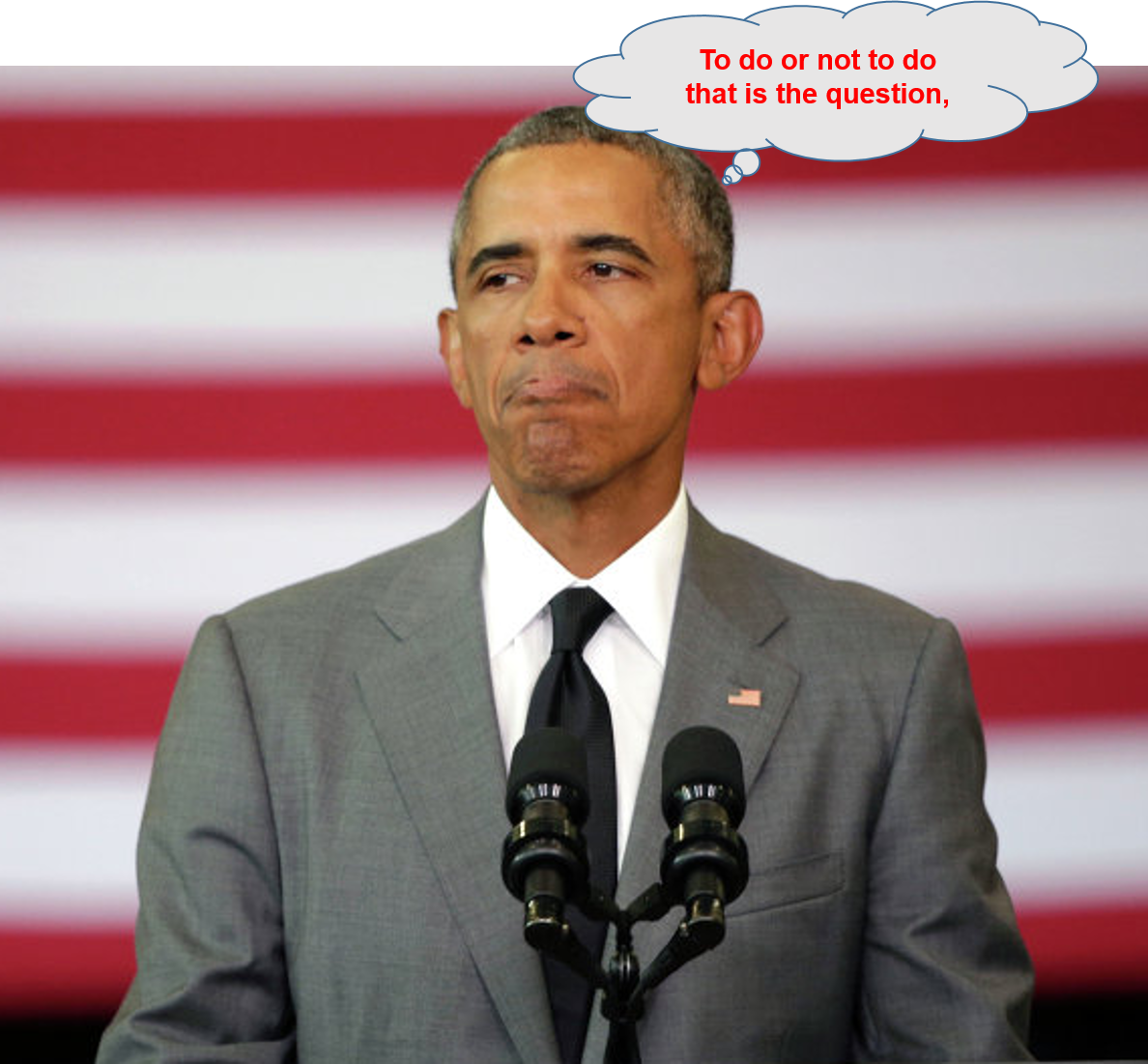
History may remember Barack Hussein Obama mainly for being the first half-black President. The successes and failures of today which loom so large at the moment may not be of any great significance from the distance of another century or two. Just looking back over the last 8 years, the dominating story about the world would be the financial crisis which started in 2008 and which we have not yet recovered from. In that picture there is nothing that Obama has done which stands out. History will only record that Obama’s efforts to first stop and then recover from the crisis were not particularly noteworthy – neither catastrophic nor very successful. It will surely be recorded that this period was extremely violent in the middle east and saw heavy intervention by the US and Europe to try and effect regime change in a number of countries. History will also record that the interventions in Iraq, Syria and Libya, in particular, in support of rebel groups to the existing regimes caused the rise and explosive growth – and success – of the Islamic State terrorists. It will be recorded that the reluctance of the US to challenge Saudi Arabia allowed easy financing of Sunni terrorist groups. Syria and the Middle East will go down as a spectacular failure of US foreign policy under Barack Obama (aided and abetted by Hillary Clinton and John Kerry). Right now it is the visible face of inept US foreign policy. Depending on what happens in the next year or two, this failure may become something that history will recall and connect with Obama. Or it may just get lost in the continuing maelstrom of the middle east’s bloody and barbarous politics.

When Obama was elected there was an expectation that he would improve the lot of US blacks. That has not happened. If anything it has become somewhat worse. There was a huge expectation of job creation but that has dawdled along in the wake of the financial crisis. During his term the introduction of “health care for all” and the Affordable Care Act was hyped to an extraordinary degree. Obamacare was going to revolutionise health care and make it affordable and available to all. This was going to be his primary domestic legacy.

But it seems that Obamacare has already failed. It does not seem that it could be the kind of success that would be remembered by history. For now it seems to be the most important domestic failure of Obama’s term in office. Whether the failure will be big enough to be remembered by history remains to be seen – but probably not.

obama-7-years-on-image-time

obama-7-years-on-image-time

Chicago Tribune:

  1. Obamacare failed because it flunked Economics 101 and Human Nature 101. It straitjacketed insurers into providing overly expensive, soup-to-nuts policies. It wasn’t flexible enough so that people could buy as much coverage as they wanted and could afford — not what the government dictated. Many healthy people primarily want catastrophic coverage. Obamacare couldn’t lure them in, couldn’t persuade them to buy on the chance they’d get sick. 
  2. Obamacare failed because the penalties for going uncovered are too low when stacked against its skyrocketing premium costs. Next year, the penalty for staying uninsured is $695 per adult, or perhaps 2.5 percent of a family’s taxable household income. That’s far less than many Americans would pay for coverage. Financial incentive: Skip Obamacare.
  3. Obamacare failed because insurance is based on risk pools — that is, the lucky subsidize the unlucky. The unlucky who have big health problems (and big medical bills) reap much greater benefits than those who remain healthy and out of the doctors’ office. But Obamacare’s rules hamstring insurers. They can’t exclude people for pre-existing conditions, and can’t charge older customers more than three times as much as the young. Those are good goals, but they skew the market in ways Obamacare didn’t figure out how to offset. Result: Young and healthy consumers pay far more in premiums than their claims (probably) would justify in order to subsidize the unexpectedly large influx of older, sicker customers who require expensive care. Too many unlucky people, too few lucky people: That will collapse any insurance scheme. 
  4. Obamacare failed because it allowed Americans to sign up after they got sick and needed help paying all those medical bills. Insurance should be structured so that, although you don’t know if you’ll need it, you pay for it anyway, just in case; your alternative is financial doom. But if you can game the system and, for example, buy auto coverage after you crash into your garage, then you have no incentive to buy insurance beforehand. 
  5. Obamacare failed because it hasn’t tamed U.S. medical costs. Health care is about supply and demand: People who get coverage use it, especially if the law mandates free preventive care. Iron law of economics: Nothing is free; someone pays. To pretend otherwise was folly. Those forces combined to spike the costs of care, and thus insurance costs. 
  6. Obamacare failed because too many carriers simply can’t cover expenses, let alone turn a profit, in this rigidly controlled system. Take Blue Cross and Blue Shield of Illinois, the state’s dominant Obamacare insurer. Last year, for every dollar the carrier collected, it spent $1.32 buying care and providing services for customers, according to BCBS President Maurice Smith. No wonder BCBS is proposing rate increases from 23 percent to 45 percent for its individual plans.

So while the failures of Syria and Obamacare will be the immediately remembered heritage of Obama’s presidency, neither may be of great significance in historical terms.

And then all that remains is that Barack Hussein Obama was the first half-black president of the United States.


Man smart – woman smarter

October 1, 2016

i was 34 when my son was born. My father was 37 when I was born and his father was 41 when he was born. However my mother was 22 when I was born and her mother was 25 when she was born. My great grandmother was 19 when my grandmother was born.

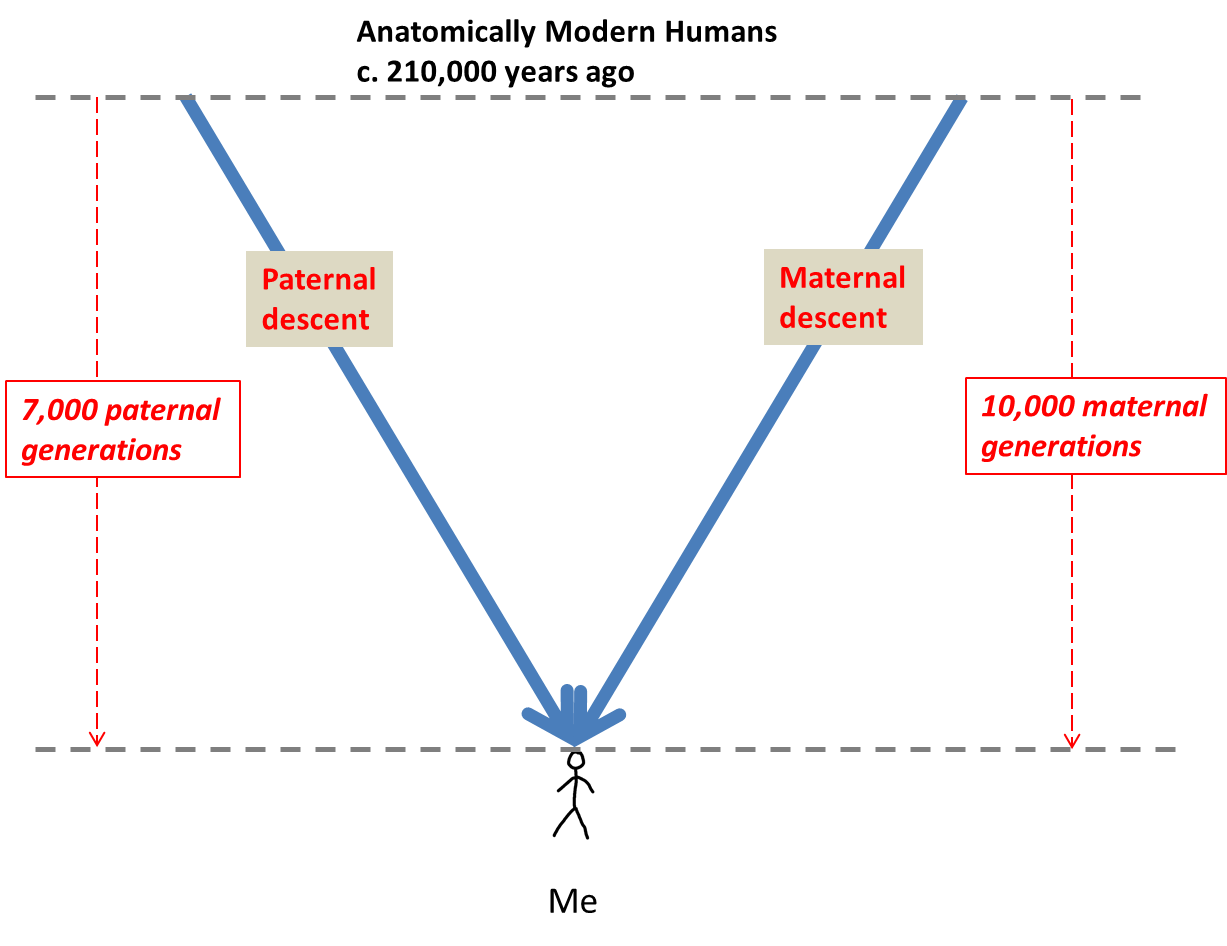
So my grandfather’s grandfather was born at about the same time as my grandmother’s, grandmother’s grandmother. From just about 1860, I am the product of 4 generations on my paternal line but of 6 generations on my maternal line. The same pattern is reproduced all the way back to when Anatomically Modern Humans began some 210,000 years ago and possibly even before that. But that means that everybody living today, for any given time period going back, has a maternal line of descent containing around 40% more generations than the paternal line of descent.

The conclusion is simply that the maternal line, generationally (and therefore also in evolutionary terms), is almost half as long again and therefore, that much more advanced than the paternal line.

Woman smarter (by 3,000 generations)

Woman smarter (by 3,000 generations)

Since the “start” of modern humans we have 3,000 more generations on the line of all our mothers than the line of all our fathers (7,000 fathers of fathers and 10,000 mothers of mothers).

Much is explained.

Remember the Harry Belafonte song, “Man smart – women smarter”.

I say let us put man and a woman together
To find out which one is smarter
Some say man but I say no
The woman got the man de day should know

And not me but the people they say
That de man are leading de women astray
But I say, that the women of today
Smarter than the man in every way

………..

Garden of Eden was very nice
Adam never work in Paradise
Eve meet snake, Paradise gone
She make Adam work from that day on

Methusaleh spent all his life in tears
Lived without a woman for 900 years
One day he decided to have some fun
The poor man never lived to see 900 and one

……


EU farm subsidies to a Saudi billionaire for breeding racehorses

September 29, 2016

The EU is replete with examples of how a bureaucratic process is made into a god and they lose sight of the objectives intended to be achieved by that process. Process keepers in Brussels have become more important than process objectives.

The latest example is of subsidies paid to a Saudi billionaire for a farm he owns in the UK where he breeds racehorses.

BBC:

Taxpayers are paying more than £400,000 a year to subsidise a farm where a billionaire Saudi prince breeds racehorses.

The Newmarket farm of Khalid Abdullah al Saud – owner of the legendary horse Frankel – is among the top 100 recipients of EU farm grants in the UK.

The system’s critics say Brexit will let the UK redirect £3bn in subsidies towards protecting the environment.

A spokesman for the prince declined to comment.

Farm subsidies swallow a huge chunk of the EU’s budget. They were started after World War Two to stimulate production, but led to food mountains that had to be dumped.

A compromised reform process – the so-called “greening” of the Common Agricultural Policy – resulted in farmers mostly being paid depending on how much land they own.

Frankel (horse).jpg

Frankel owned by Khalid Abdullah al Saud


Is Saudi Arabia giving up on its oil wars?

September 29, 2016

There is a faint whiff of realism entering into Saudi Arabian government policy. They have started to curb public expenditure, they have flagged salary cuts for public employees (not just now but in 2 years), they are desperately trying to diversify their economy. Much of the change has been forced due to self-inflicted collateral damage to their various “oil wars” against shale oil, against Iranian oil and against Russian oil. They have tried to use low oil price as a weapon in their political and ideological battles. But Saudi Arabia has not yet developed the capabilities (and competence) among its indigenous work force to cope without the fat cushion of oil revenues. Without foreign competence and labour, Saudi would collapse and the only thing keeping the foreign competence and labour there is oil money.

It may be a faint hint of an increasing pragmatism that for the first time in 8 years the Saudis and OPEC have agreed to a modest cut in oil production.

It is not the end of the  oil wars but it may be the beginning of the end.

Reuters: 

OPEC agreed on Wednesday modest oil output cuts in the first such deal since 2008, with the group’s leader Saudi Arabia softening its stance on arch-rival Iran amid mounting pressure from low oil prices.

“OPEC made an exceptional decision today … After two and a half years, OPEC reached consensus to manage the market,” said Iranian Oil Minister Bijan Zanganeh, who had repeatedly clashed with Saudi Arabia during previous meetings.

He and other ministers said the Organization of the Petroleum Exporting Countries would reduce output to a range of 32.5-33.0 million barrels per day. OPEC estimates its current output at 33.24 million bpd.

“We have decided to decrease the production around 700,000 bpd,” Zanganeh said.

The move would effectively re-establish OPEC production ceilings abandoned a year ago.

However, how much each country will produce is to be decided at the next formal OPEC meeting in November, when an invitation to join cuts could also be extended to non-OPEC countries such as Russia.

Oil prices jumped more than 5 percent to trade above $48 per barrel as of 2015 GMT. Many traders said they were impressed OPEC had managed to reach a compromise after years of wrangling but others said they wanted to see the details.

“This is the first OPEC deal in eight years! The cartel proved that it still matters even in the age of shale! This is the end of the ‘production war’ and OPEC claims victory,” said Phil Flynn, senior energy analyst at Price Futures Group. 

Jeff Quigley, director of energy markets at Houston-based Stratas Advisors, said the market had yet to discover who would produce what: “I want to hear from the mouth of the Iranian oil minister that he’s not going to go back to pre-sanction levels. For the Saudis, it just goes against the conventional wisdom of what they’ve been saying.”.

Saudi Energy Minister Khalid al-Falih said on Tuesday that Iran, Nigeria and Libya would be allowed to produce “at maximum levels that make sense” as part of any output limits.

That represents a strategy shift for Riyadh, which had said it would reduce output to ease a global glut only if every other OPEC and non-OPEC producer followed suit. Iran has argued it should be exempt from such limits as its production recovers after the lifting of EU sanctions earlier this year.

…….. Saudi Arabia is by far the largest OPEC producer with output of more than 10.7 million bpd, on par with Russia and the United States. Together, the three largest global producers extract a third of the world’s oil.

Iran’s production has been stagnant at 3.6 million bpd in the past three months, close to pre-sanctions levels although Tehran says it wants to ramp up output to more than 4 million bpd when foreign investments in its fields kick in. … Saudi oil revenue has halved over the past two years, forcing Riyadh to liquidate billions of dollars of overseas assets every month to pay bills and cut domestic fuel and utility subsidies last year.

It may even be that the Iranians and the Saudis are actually talking to each other.

Opec Countries (image pinterest.com)

Opec Countries (image pinterest.com)


Social class is necessary for any society and does not have to be unjust

September 28, 2016

One of the great “politically correct” myths is that people are born equal. A fundamental strength of the human race is that we are all unique individuals and not identical copies rolling off a production line. Our genes fix the envelope of our potential capabilities, and our upbringing determines to what extent we fulfill our potentials. The fundamental fallacy in Marxist theory is in the assumption that a classless society is desirable. In fact it is not even possible. Forcing or coercing unequal people to be “equal” is always unjust.

Some have considered class a “necessary evil” and most social theories assume that having classes is, in itself, unfair and a “bad thing”. But there is no example of a successful (sustainable and growing) society which has not had social classes of some kind. Ruling and ruled, rich or poor, aristocracy and peasants, masters and slaves, the political class and the great unwashed, workers and bosses, union members and others, employers and employees, producers and consumers, Brahmins and the Dalits. The Guilds were about capability and competence to begin with but later became contaminated when they became “closed”. Secret societies grew to try and create new classes which cut across other class boundaries. My hypothesis is that in any society, the inherent variations in human capabilities and competences make social classes both inevitable and necessary. Human diversity (genetic and epigenetic) is (I assume) a fundamental component for the success of the human race (again defined as being sustainable and growing). That diversity is what makes people unequal. The inequality is not, in itself, unjust. It just is. We are not clones  – thank goodness.

Since the French revolution, “egalite” has been made into a fashionable – but false god. A search for “equality” is not just incompatible with, it is also opposed, to a search for justice. It is just for a sick person to receive more care than a healthy person but it is unequal. Affirmative action may be one way of approaching fairness – but it is unequal. The “better man wins” in the Olympics is a celebration of the inherent inequality among humans. If we wanted equality of result, Usain Bolt would have to be handicapped (about 10 m would do). The capitalist goal of “to each as he deserves” and the socialist objective of “to each as he needs” are both expressions which inherently acknowledge the reality of inequality. They both seek their definitions of what is just – not what is equal.

The real issue is not, I think, to seek a classless condition which would cause society to break down, but to achieve classes which are not unjust. Classes will appear as a natural consequence of humans being gregarious. The real solution, which may well have to be a dynamic solution to fit the times, is to design the class system to be used, rather than let it appear by default. Most of the perceived injustices of class are connected to either the classes being hereditary or because movement between the classes is forbidden. The Indian caste system is grossly unjust because it is both hereditary and it forbids movement between castes. Having a class system does not necessitate oppression or injustice. At any given time, even the much vaunted “open” Swedish society also has its functioning classes, but to its credit – and even though there is a not an insignificant hereditary component – movement of individuals across class lines is possible, regular and continuous.

The real question is what attributes to use in defining classes which help a society to function and which are not unjust. It cannot be along just hereditary lines and it cannot be just based on wealth. However any class system must be able to accommodate the realities of ancestry and wealth. Parents will always seek to give their children an advantage  and wealth will always be able to purchase more. Whatever classes we invent must be capable of juxtaposing different levels of wealth within each class and must allow membership from any parentage. It should be possible to move from one class to another.

My choice of class system would then be one where the classes themselves did not create a hierarchy and where the main classification criterion would be based on the predominant, gainful occupation of the individual.  Each class would have its share of rich and poor, idiots and geniuses, and its share of parasites. Classification would not be until the prefrontal cortex was fully developed (at 25). Everybody under 25 would be a non-adult and classless. Marriage across class lines would be permitted. Voting would then be restricted to adults.

I think 5 classes will do.

5-classes


US shale gas arrives in Scotland today

September 27, 2016

The SNP’s idiotic environmental policies means that Scotland has to import shale gas from the US even though there is plenty available locally. North Sea revenues for Scotland have collapsed and Scottish energy policy is a self-inflicted wound. In Europe generally, it is misguided, meaningless, environmental constraints on energy policies which have been a major contributor to holding back the economic recovery.

The low oil price in 2016 has effectively postponed any new independence referendum for a few years to come. Without North Sea revenues Scotland – if it wants to be an independent EU country – would be the “poor man of Europe” for 2 decades.

Image result for Scotland north sea revenue collapse

graphic: market oracle

BBC: 

The first shipment of US shale gas is arriving in Scotland amid a fierce debate about the future of fracking in the UK.

A tanker carrying 27,500m3 of ethane from US shale fields is due to dock at Grangemouth, the refinery and petrochemicals plant owned by Ineos.

The company said the gas would replace dwindling North Sea supplies and secure the future of the plant’s workforce.


When “star” athletes are permitted to dope and get a dispensation to cheat

September 25, 2016

UPDATE: Guardian article (see below).


Following on from my previous post, the BBC had this today. It reduces even further the very little confidence I have in WADA and the way in which the “sporting establishment” have permitted “stars” to cheat.

Of course these doped up athletes could do nothing wrong because they were officially permitted to “do wrong”.

Legal but unfair.

Compliant but unethical.

BBC: 

Sir Bradley Wiggins has insisted he was not trying to gain an “unfair advantage” from being allowed to use a banned steroid before major races. 

The Olympic cyclist told the BBC’s Andrew Marr Show he took the powerful anti-inflammatory drug triamcinolone for allergies and respiratory problems.

Sir Bradley said he sought therapeutic use exemptions (TUEs) to “put himself back on a level playing field”.

TUEs allow the use of banned substances if athletes have genuine medical need.

Sir Bradley’s TUEs were approved by British authorities and cycling’s world governing body, the UCI.

What is worse is the manner in which the licence to dope is justified:

Sir Hugh Robertson, vice-chairman of the British Olympic Association, told BBC Radio 5 live’s Sportsweek:Whatever you think about whether he should have been allowed to do this, the fact is the anti-doping rules at the time allowed him to do so”.

If Bradley Wiggins had not been a star, and from a “sporting power”, I wonder if he would have got dispensation to cheat.


Epilog: 26th September

The article in today’s Guardian is more of the same but it seems pretty clear that Bradley Wiggins was given official sanction to “cheat” by the UK cycling authorities.

Guardian: …… which invited more questions than it answered in dealing with the trio of therapeutic use exemptions granted to Wiggins in 2011, 2012 and 2013 to allow him to take the powerful corticosteroid triamcinolone, for legitimate medical reasons before his biggest races of the season. …….

…….. “This was to cure a medical condition. This wasn’t about trying to find a way to gain an unfair advantage; this was about putting myself back on a level playing field in order to compete at the highest level,” Wiggins said, explaining why he had received an injection for 40mg of triamcinolone just before his triumphant 2012 Tour.

He said he had “really struggled” with respiratory problems in the run-up to the 2012 Tour one of the high points even among so many in that golden summer for British sport. But he did not really explain how that tallied with the account he gave in 2012 in his autobiography.

Then, Wiggins said: “I’d done all the work, I was fine-tuned. I was ready to go. My body was in good shape. I’m in the form of my life. I was only ill once or twice with minor colds, and I barely lost a day’s training from it.” 

Nor did he really manage to explain the contradiction between the “no needles” rhetoric espoused in the same book and the fact he received injections of a powerful drug just before the biggest races of his life; nor the fact that he has never discussed the TUEs in any of his books or since. His contention that he believed questions on needles to refer exclusively to doping is similarly hard to countenance.

It is time for WADA to be open about all athletes who have TUE’s. It’s difficult not to be cynical.


Remarkable how so many top athletes take asthma medication

September 23, 2016

When top athletes get out of breath while competing it is called “Exercise Induced Asthma”. Getting out of breath is surely a consequence of the athlete’s physical condition and it seems to me that EIA is an entirely invented medical condition. This allows them to get a “therapeutic use exemption” (TUE) and then use asthma medicine to improve their breathing. The TUE is effectively being used as a doping licence. Why inventing a “medical condition” and then using drugs is not considered cheating is beyond me.

tue-doping-licence

tue-doping-licence

Daily Mail: Six more Team GB athletes have had their medical data leaked by a group of Russian hackers calling themselves the Fancy Bears. In the latest batch of data stolen from the World Anti-Doping Agency, the Fancy Bears list the therapeutic use exemptions (TUEs) granted to 41 athletes.

The British athletes were revealed as sprinter Harry Aikines-Aryeetey, sailors Sophie Ainsworth and Saskia Clark, rower Richard Chambers, cyclist Steve Cummings and gymnast Nile Wilson. As with the vast majority of the previous batches, all six of these athletes have been allowed to take medication for their asthma via inhalers.

The drugs in question have since been removed from WADA’s banned list and therefore no longer need any special permission for their use.

Among the international athletes in this batch – the largest so far – are Swiss cycling star Fabian Cancellara, American golfer Patrick Reed and US distance runner Galen Rupp. 

Team GB now accounts for 23 of the 107 athletes named by the Fancy Bears, with top names such as Chris Froome and Sir Bradley Wiggins among those targeted. 

Under pressure from out of breath athletes and their trainers, these asthma inhalers are no longer banned.  WADA may as well remove all restrictions on all drugs.

I find WADA hypocritical. The acronym could just be for the “World Approved Drugs Association”.


2016 Ig Nobels are more embarrassing than satirical

September 23, 2016

The problem with the Ig Nobels has become that they actually take themselves seriously. Unfortunately what should be satirical and irreverent has become an embarrassing example of politically correct, science “humour”. The awards have turned into a glorification of non-science, science fraud and stupidity.


The 2016 Ig Nobel Prize Winners

 The 2016 Ig Nobel Prizes were awarded on Thursday night, September 22, 2016 at the 26th First Annual Ig Nobel Prize Ceremony, at Harvard’s Sanders Theatre. The ceremony was webcast live.

REPRODUCTION PRIZE [EGYPT] — The late Ahmed Shafik, for studying the effects of wearing polyester, cotton, or wool trousers on the sex life of rats, and for conducting similar tests with human males.

REFERENCE: “Effect of Different Types of Textiles on Sexual Activity. Experimental study,” Ahmed Shafik, European Urology, vol. 24, no. 3, 1993, pp. 375-80.

REFERENCE: “Contraceptive Efficacy of Polyester-Induced Azoospermia in Normal Men,” Ahmed Shafik, Contraception, vol. 45, 1992, pp. 439-451.


ECONOMICS PRIZE [NEW ZEALAND, UK] — Mark Avis, Sarah Forbes, and Shelagh Ferguson, for assessing the perceived personalities of rocks, from a sales and marketing perspective.

REFERENCE: “The Brand Personality of Rocks: A Critical Evaluation of a Brand Personality Scale,” Mark Avis, Sarah Forbes, Shelagh Ferguson, Marketing Theory, vol. 14, no. 4, 2014, pp. 451-475.

WHO ATTENDED THE CEREMONY: Mark Avis and Sarah Forbes


PHYSICS PRIZE [HUNGARY, SPAIN, SWEDEN, SWITZERLAND] — Gábor Horváth, Miklós Blahó, György Kriska, Ramón Hegedüs, Balázs Gerics, Róbert Farkas, Susanne Åkesson, Péter Malik, and Hansruedi Wildermuth, for discovering why white-haired horses are the most horsefly-proof horses, and for discovering why dragonflies are fatally attracted to black tombstones.

REFERENCE: “An Unexpected Advantage of Whiteness in Horses: The Most Horsefly-Proof Horse Has a Depolarizing White Coat,” Gábor Horváth, Miklós Blahó, György Kriska, Ramón Hegedüs, Balázs Gerics, Róbert Farkas and Susanne Åkesson, Proceedings of the Royal Society B, vol. 277 no. 1688, pp. June 2010, pp. 1643-1650.

REFERENCE: “Ecological Traps for Dragonflies in a Cemetery: The Attraction of Sympetrum species (Odonata: Libellulidae) by Horizontally Polarizing Black Grave-Stones,” Gábor Horváth, Péter Malik, György Kriska, Hansruedi Wildermuth, Freshwater Biology, vol. 52, vol. 9, September 2007, pp. 1700–9.

WHO ATTENDED THE CEREMONY: Susanne Åkesson


CHEMISTRY PRIZE [GERMANY] — Volkswagen, for solving the problem of excessive automobile pollution emissions by automatically, electromechanically producing fewer emissions whenever the cars are being tested.

REFERENCE: “EPA, California Notify Volkswagen of Clean Air Act Violations”, U.S. Environmental Protection Agency news release, September 18, 2015.


MEDICINE PRIZE [GERMANY] — Christoph Helmchen, Carina Palzer, Thomas Münte, Silke Anders, and Andreas Sprenger, for discovering that if you have an itch on the left side of your body, you can relieve it by looking into a mirror and scratching the right side of your body (and vice versa).

REFERENCE: “Itch Relief by Mirror Scratching. A Psychophysical Study,” Christoph Helmchen, Carina Palzer, Thomas F. Münte, Silke Anders, Andreas Sprenger, PLoS ONE, vol. 8, no 12, December 26, 2013, e82756.

WHO ATTENDED THE CEREMONY: Andreas Sprenger


PSYCHOLOGY PRIZE [BELGIUM, THE NETHERLANDS, GERMANY, CANADA, USA] — Evelyne Debey, Maarten De Schryver, Gordon Logan, Kristina Suchotzki, and Bruno Verschuere, for asking a thousand liars how often they lie, and for deciding whether to believe those answers.

REFERENCE: “From Junior to Senior Pinocchio: A Cross-Sectional Lifespan Investigation of Deception,” Evelyne Debey, Maarten De Schryver, Gordon D. Logan, Kristina Suchotzki, and Bruno Verschuere, Acta Psychologica, vol. 160, 2015, pp. 58-68.

WHO ATTENDED THE CEREMONY: Bruno Verschuere


PEACE PRIZE [CANADA, USA] — Gordon Pennycook, James Allan Cheyne, Nathaniel Barr, Derek Koehler, and Jonathan Fugelsang for their scholarly study called “On the Reception and Detection of Pseudo-Profound Bullshit”.

REFERENCE: “On the Reception and Detection of Pseudo-Profound Bullshit,” Gordon Pennycook, James Allan Cheyne, Nathaniel Barr, Derek J. Koehler, and Jonathan A. Fugelsang, Judgment and Decision Making, Vol. 10, No. 6, November 2015, pp. 549–563.

WHO ATTENDED THE CEREMONY: Gordon Pennycook, Nathaniel Barr, Derek Koehler, and Jonathan Fugelsang


BIOLOGY PRIZE [UK] — Awarded jointly to: Charles Foster, for living in the wild as, at different times, a badger, an otter, a deer, a fox, and a bird; and to Thomas Thwaites, for creating prosthetic extensions of his limbs that allowed him to move in the manner of, and spend time roaming hills in the company of, goats.

REFERENCE: GoatMan; How I Took a Holiday from Being Human, Thomas Thwaites, Princeton Architectural Press, 2016, ISBN 978-1616894054.

REFERENCE: Being a Beast, by Charles Foster, Profile Books, 2016, ISBN 978-1781255346.

WHO ATTENDED THE CEREMONY: Charles Foster, Thomas Thwaites. [NOTE: Thomas Thwaites’s goat suit was kindly released for Ig Nobel purposes from the exhibition ‘Platform – Body/Space’ at Het Nieuwe Instituut in Rotterdam, and will be back on display at the museum from 4 October 2016 till 8 January 2017.]


LITERATURE PRIZE [SWEDEN] — Fredrik Sjöberg, for his three-volume autobiographical work about the pleasures of collecting flies that are dead, and flies that are not yet dead.

REFERENCE: “The Fly Trap” is the first volume of Fredrik Sjöberg’s autobiographical trilogy, “En Flugsamlares Vag” (“The Path of a Fly Collector”), and the first to be published in English. Pantheon Books, 2015, ISBN 978-1101870150.

WHO ATTENDED THE CEREMONY: Fredrik Sjöberg


PERCEPTION PRIZE [JAPAN] — Atsuki Higashiyama and Kohei Adachi, for investigating whether things look different when you bend over and view them between your legs.

REFERENCE: “Perceived size and Perceived Distance of Targets Viewed From Between the Legs: Evidence for Proprioceptive Theory,” Atsuki Higashiyama and Kohei Adachi, Vision Research, vol. 46, no. 23, November 2006, pp. 3961–76.

WHO ATTENDED THE CEREMONY: Atsuki Higashiyama


Clinton eyes …

September 23, 2016

Clinton eyes,
Wobbling like jelly.
Clinton eyes,
Beginning to close and fail?
How can the hope that burned so brightly
Suddenly burn so pale?
Clinton eyes.

with apologies to rabbits

clinton-eyes-image-gateway-pundit

image gateway-pundit

The Hill:

In 2014 Conan O’Brien did a spoof of Hillary Clintons interview with Diane Sawyer about her lack of lingering health issues following her 2012 concussion. In an obviously photoshopped version Clinton’s eyes are made to oscillate crazily.

It was a very funny piece. Now, it may not seem so funny.

Hillary Clinton exhibited abnormal eye movements during her recent speech in Philadelphia and they were not photoshopped.

Her eyes did not always move in the same direction at the same time. It appears that she has a problem with her left sixth cranial nerve. That nerve serves only one function and that is to make the lateral rectus muscle contract. That muscle turns the eye in the direction away from the midline. 

It comes out of the base of the brain and runs along the floor of the skull, immediately beneath the brain before coursing upward to the eye. Dysfunction of that muscle causes the striking picture of the eyes not aiming in the same direction and causes the patient to suffer double vision.

Like all things medical, there is a long list of potential causes but in my opinion the most likely one, based on Clinton’s known medical history is an intermittent lateral rectus palsy caused by damage to or pressure on her sixth cranial nerve.

It is known that she suffered a traumatic brain injury in late 2012 when she fell and struck her head. What is also known is that she was diagnosed with a transverse sinus thrombosis — blood clot in the major vein at the base of the brain. Almost all patients with a transverse sinus thrombosis suffer swelling of the brain and increased intracranial pressure. Most have headaches, balance issues and visual disturbances — all of which Clinton was reported to have following that event.

Clinton’s physician reported that she was placed on Coumadin (a blood thinner) to dissolve the blood clot. Actually, that is incorrect, because Coumadin has no effect on an existing clot. It serves only to decrease the chance of further clotting occurring Clinton’s physician has also reported that on follow up exam, the clot had resolved. That is surprising since the majority of such clots do not dissolve. The way it was documented that the clot had resolved has not been reported.

If, as is statistically likely, Clinton’s transverse sinus is still blocked, she would still have increased pressure and swelling and decreased blood flow to her brain. That swelling would place pressure on the exposed portion of the sixth cranial nerve at the base of her brain, explaining the apparent lateral rectus palsy. And such a deficit can be partial and/or intermittent. 

Additionally, when patients who have decreased intracranial blood flow becoming volume depleted (dehydrated) or have a drop in blood pressure loss of consciousness can occur. That could explain her witnessed collapse in New York City on 9/11.

One thing that is taught early in medical school is that a patient’s history, physical exam, signs and symptoms should usually lead to a single diagnosis. ……..