Ecstasy

June 28, 2016

Ecstatic Icelandic commentary when their part-time amateurs defeated England’s team of the richest footballers in the world.


Sweden is one of 3 seeking two Security Council places today

June 28, 2016

Voting for 5 places on the UN Security Council (15 members) takes place today.

The elections are for five non-permanent seats on the UN Security Council for two-year mandates commencing on 1 January 2017. In accordance with the Security Council’s rotation rules, whereby the ten non-permanent UNSC seats rotate among the various regional blocs into which UN member states traditionally divide themselves for voting and representation purposes, the five available seats are allocated as follows:

  • One for Africa
  • One for the Asia-Pacific Group
  • One for Latin America and the Caribbean
  • Two for the Western European and Others Group

The five members will serve on the Security Council for the 2017–18 period.

Sweden, Italy and the Netherlands are competing for the two places on the Security Council reserved for the “Western European and Others Group”. To win a seat on the Council a country has to receive more than 2/3rds of the votes cast. 193 countries can vote and in a secret ballot each votes for two countries. If all eligible countries participate, a winning country must receive at least 129 votes.

The Security Council met for the first time in London on January 17, 1946. Sweden has been on the Security Council three time; in 1957–58, 1975–76 and 1997–98. That is after gaps of 11, 18, and 22 years. It is now 19 years since Sweden was last a member and has a pretty good chance of winning a place. I judge it is somewhat better than the nominal 2/3rds chance all 3 countries start with. The Swedish press has “exposed” that the Foreign Ministry has spent some 22 million kronor (less than $3 million) in its “campaign” to be chosen.

I expect that Sweden and the Netherlands will probably win the two places available.

 Italy

 Netherlands

 Sweden


Only a vote in parliament can trigger Article 50 say constitutional experts

June 27, 2016

Brexit is not going to happen any time soon.

If it happens at all.

It seems according to constitutional law experts that any government with any Prime Minister will need a vote in parliament to give authority to an Article 50 notification of intention to withdraw from the EU. Once triggered, withdrawal is inevitable and time-bound. But there is no majority in the current parliament for leaving. And it could be the best part of a year before such a vote in parliament can even be held. For any chance of such a vote being passed it will need a General Election fought on precisely such a question and that the party or parties in favour of an exit win such an election. But it is also possible that such a vote can not, in the reasonable future, be passed.

A new report from Nick Barber, a fellow at Trinity College, Oxford, Tom Hickman, a barrister at Blackstone Chambers and reader at University College, London, and Jeff King, a senior law lecturer at UC, write for the UK Constitutional Law Association:

In this post we argue that as a matter of domestic constitutional law, the Prime Minister is unable to issue a declaration under Article 50 of the Lisbon Treaty – triggering our withdrawal from the European Union – without having been first authorised to do so by an Act of the United Kingdom Parliament.  Were he to attempt to do so before such a statute was passed, the declaration would be legally ineffective as a matter of domestic law and it would also fail to comply with the requirements of Article 50 itself.

There are a number of overlapping reasons for this. They range from the general to the specific. At the most general, our democracy is a parliamentary democracy, and it is Parliament, not the Government, that has the final say about the implications of the referendum, the timing of an Article 50 our membership of the Union, and the rights of British citizens that flow from that membership. More specifically, the terms and the object and purpose of the European Communities Act 1972 also support the correctness of the legal position set out above.

The authors argue that a Prime Minister and his government alone cannot trigger Article 50 without the explicit authority of a parliamentary vote. David Cameron’s resignation statement where he said it is right that this new Prime Minister takes the decision about when to trigger Article 50 and start the formal and legal process of leaving the EU” does not specify the legal authority under which a Prime Minister alone could make the call:

The Prime Minster did not specify the legal authority under which he believed he or his successors might invoke Article 50, but the typical answer will be obvious to constitutional lawyers: it is the royal prerogative, a collection of executive powers held by the Crown since medieval times, that exist unsupported by statute. …… 

One of the earliest limits on the prerogative was that it could not be used to undermine statutes; where the two are in tension, statute beats prerogative.  In one of the seminal cases of the common law, The Case of Proclamations,(1610) 12 Co. Rep. 74 Sir Edward Coke declared:

“..the King by his proclamation… cannot change any part of the common law, or statute law, or the customs of the realm…”

A more recent statement of this principle can be found in the Fire Brigades Union Case[1995] 2 AC 513 in 1995, where Lord Browne-Wilkinson stated that:

“…it would be most surprising if, at the present day, prerogative powers could be validly exercised by the executive so as to frustrate the will of Parliament as expressed in a statute and, to an extent, to pre-empt the decision of Parliament whether or not to continue with the statutory scheme…”

…… The wider principle is that it is not open to Government to turn a statute into what is in substance a dead letter by exercise of the prerogative powers; and that it is not open to the Government to act in a way which cuts across the object and purpose of an existing statute. In our view the wider principle correctly states the law and is particularly apt here, as we are concerned with a constitutional statute upon which an extensive system of rights is founded.

They conclude

Our analysis leads to the possibility that the process of extraction from the EU could be a very long one indeed, potentially even taking many years to come about. Of course, the EU Member States have made clear that they will only negotiate once the Article 50 exit provisions have been triggered and are pressing the UK to pull the trigger “as soon as possible”. It is also clear that uncertainty is itself undesirable. But uncertainty needs to be weighed against other imperatives, such as the need to comply with the UK’s constitutional requirements and the need to ensure that Brexit is effected consistently with the national interest. A quick pull of the Article 50 trigger is unlikely to be feasible under the UK’s constitutional arrangements and may well not be desirable for any UK Government or Parliament, even one committed to eventual withdrawal from the EU.

Brexit is the most important decision that has faced the United Kingdom in a generation and it has massive constitutional and economic ramifications. In our constitution, Parliament gets to make this decision, not the Prime Minister.

Nick Barber, Fellow, Trinity College Oxford.

Tom Hickman, Reader, UCL and barrister at Blackstone Chambers

Jeff King, Senior Lecturer in Law, UCL

Citation: N. Barber, T. Hickman and J. King, ‘Pulling the Article 50 ‘Trigger’: Parliament’s Indispensable Role’, U.K. Const. L. Blog (27th Jun 2016) (available at https://ukconstitutionallaw.org/)

It seems to me that whether Brexit is initiated or not (and therefore happens or not) is entirely dependent upon a majority vote in parliament.

(It occurs to me that if Nicola Sturgeon wants to postpone, if not block, Brexit she should get the European Court of Justice to rule on whether or not a parliamentary vote is needed to give authority to a government to invoke Article 50. Even EU bureaucrats can not quibble with that).


Has Cameron’s resignation effectively annulled the referendum?

June 27, 2016

Interesting theory:

David Cameron’s decision to resign before enacting Article 50 of the Lisbon Treaty – which sets out how a country could leave the EU – may have some pretty shitty implications for whoever steps into his soiled size nines.

One person in the comments section of the Guardian put forward this very interesting hypothesis:

If Boris Johnson looked downbeat yesterday, that is because he realises that he has lost.

Perhaps many Brexiters do not realise it yet, but they have actually lost, and it is all down to one man: David Cameron.

With one fell swoop yesterday at 9:15 am, Cameron effectively annulled the referendum result, and simultaneously destroyed the political careers of Boris Johnson, Michael Gove and leading Brexiters who cost him so much anguish, not to mention his premiership.

How?

Throughout the campaign, Cameron had repeatedly said that a vote for leave would lead to triggering Article 50 straight away. Whether implicitly or explicitly, the image was clear: he would be giving that notice under Article 50 the morning after a vote to leave. Whether that was scaremongering or not is a bit moot now but, in the midst of the sentimental nautical references of his speech yesterday, he quietly abandoned that position and handed the responsibility over to his successor.

And as the day wore on, the enormity of that step started to sink in: the markets, Sterling, Scotland, the Irish border, the Gibraltar border, the frontier at Calais, the need to continue compliance with all EU regulations for a free market, re-issuing passports, Brits abroad, EU citizens in Britain, the mountain of legislation to be torn up and rewritten … the list grew and grew.

The referendum result is not binding. It is advisory. Parliament is not bound to commit itself in that same direction.

The Conservative party election that Cameron triggered will now have one question looming over it: will you, if elected as party leader, trigger the notice under Article 50?

Who will want to have the responsibility of all those ramifications and consequences on his/her head and shoulders?

Boris Johnson knew this yesterday, when he emerged subdued from his home and was even more subdued at the press conference. He has been out-manoeuvred and check-mated.

If he runs for leadership of the party, and then fails to follow through on triggering Article 50, then he is finished. If he does not run and effectively abandons the field, then he is finished. If he runs, wins and pulls the UK out of the EU, then it will all be over – Scotland will break away, there will be upheaval in Ireland, a recession … broken trade agreements. Then he is also finished. Boris Johnson knows all of this. When he acts like the dumb blond it is just that: an act.

The Brexit leaders now have a result that they cannot use. For them, leadership of the Tory party has become a poison chalice.

When Boris Johnson said there was no need to trigger Article 50 straight away, what he really meant to say was “never”. When Michael Gove went on and on about “informal negotiations” … why? why not the formal ones straight away? … he also meant not triggering the formal departure. They both know what a formal demarche would mean: an irreversible step that neither of them is prepared to take.

All that remains is for someone to have the guts to stand up and say that Brexit is unachievable in reality without an enormous amount of pain and destruction, that cannot be borne. And David Cameron has put the onus of making that statement on the heads of the people who led the Brexit campaign.


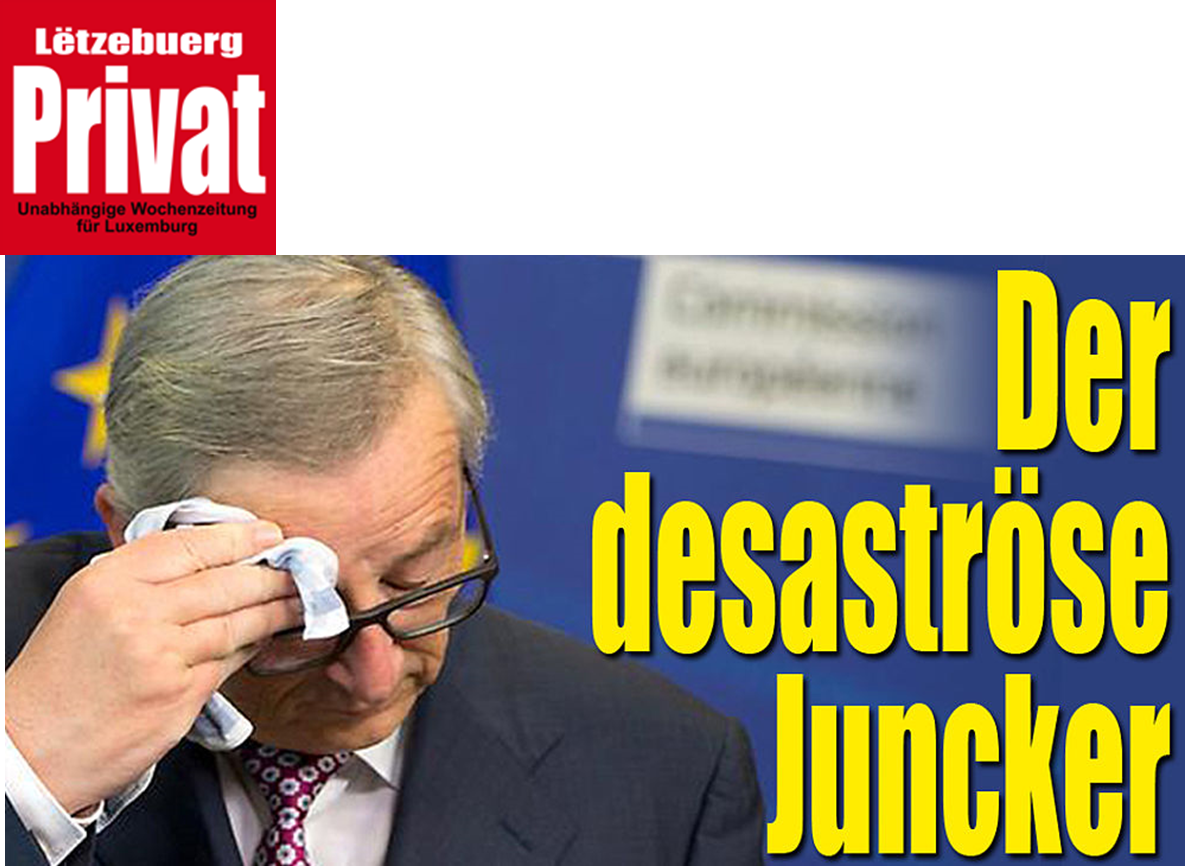
Why hasn’t Juncker resigned?

June 27, 2016

Why hasn’t  Jean-Claude Juncker resigned?

The European Commission, Council of Ministers and the European Parliament are answerable and accountable, theoretically to all the EU members but in practice to nobody.

MEPs are accountable in the sense that they are voted in every 5 years. But in many countries that use party list systems of voting, candidates are simply put on a list by their party and the voters have no or a limited say on who is going to be elected. 

In most countries it is very difficult to present a new list alongside the lists of the traditional parties represented in the national parliaments. Voters have a formal choice but not necessarily a real possibility to have their own views being represented by an MP or MEP.   ……..

MEPs receive €4,299 per month in a general expenses allowance. MEPs do not need to deliver any proof as to how their money has been spent.

Commissioners need to be accountable to the European Parliament. They are obliged to answer questions from MEPs both orally and in writing. Many MEPs do not feel that they receive satisfactory answers. Many believe that the Commissioners are hiding too much; ………. You should also have the right to know how the different Commissioners vote on the different topics put on their table, but at present one has no idea.

During 2004-14, under the mandate of Commission President Barroso, the Commissioners did not vote among themselves at all. Discussions took place behind closed doors on proposals for new EU laws. The Commission President often reads a text prepared by his official services. There is usually no real political debate. The President concludes. Most decisions are taken in the name of the Commission outside the Commission meeting room ……..

The Commission now publishes agendas and minutes of their decisions. However nowhere can it be seen how they actually came to those decisions. They do not provide access to documents relating to their discussions or preparations. EU Commissioners give information about the amounts spent on representation. Yet this does not happen for individual spending, unlike what journalists can receive or request in most countries from their national ministers. …… Commissioners may hire special advisors. These names are now published – but the information does not include the salaries paid for the special advice they may receive from political friends or others. 

Commissioners are proposed by the prime ministers or presidents of the member states. Often a prime minister or president proposes a candidate who could no longer be elected as an MP or appointed as a minister in his or her own country. When former Prime Minister Tony Blair appointed Peter Mandelson as an EU Commissioner he had already been twice rejected as a minister by the British Parliament at Westminster. 

Prime Ministers may sometimes propose the names of national politicians they want to get rid of. There is no election procedure safeguarding voters so that they may have the best candidate from their country. 

There is some EU accountability in some of the national parliaments. In Denmark the European Affairs committee has met in public every Friday since October 2006 and  it can  give negotiating mandates to Danish ministers before the latter can approve something in the  EU Council of Ministers.  

There is no other  EU country where ministers need to have a negotiating mandate for such votes at EU level. In most countries the national MPs are rather badly informed about EU law proposals and have no real influence. Even in Denmark it is normally the civil servants in the ministries who decide and implement the Danish position in the 275 Council working groups. 

They are assisted by 35 special committees composed of representatives from business organisations and NGOs in an tightly woven corporative system. 

The ordinary members of parliament, the media and citizens are sidelined in the important preparatory phase where most EU decisions are prepared and then adopted.

The President of the European Commission – a former PM of Luxembourg – is the living face of the privileged, protected, arrogant, unaccountable bureaucracy that is Brussels. The EC – more than anybody – else is the reason for the deep and widespread dissatisfaction in Europe with the way in which the EU operates and where it is headed.

It is time for Jean-Claude Juncker to resign. And that means that the leaders of the core countries need to tell him to go.


Is Brexit already dead?

June 26, 2016

The Brexit referendum was advisory and non-binding. There is no absolute requirement for the government or parliament to follow the result. There may be a moral obligation but with the split 52/48 result it is not all that compelling. It could be argued that since David Cameron called the election, he is responsible for implementing whatever result it produced. He has said that he will not start the formal Brexit process (invoking Article 50) and it seems unlikely that he will cave in to pressure from the EU, either in verbal or written form, such that the EU can “deem” the process to have started. Certainly if he stays he has some obligation, but he has got out of that by announcing his coming resignation.

The same parliament but with just a new Prime Minister – and even one from the Brexit camp – will not have a parliamentary majority in favour of Brexit. (In fact I am not convinced now that a Brexiteer could even win a majority among the current Conservative MP’s). Without a parliamentary majority no necessary legislation will get passed. Moreover the Scottish parliament will withhold consent for any legislation which makes any change to how EU laws affect Scotland. Theoretically, the UK parliament could overrule a Scottish withholding of consent, but, without a parliamentary majority for Brexit, that  probably could never happen. So the new Prime Minister has little option but to call a General Election asking for a mandate. But first he has to lead a party which takes on Brexit in its manifesto. And that today is not possible for either the Conservative or the Labour party. I cannot see a Conservative Conference in October accepting to put a Brexit in its manifesto. The Labour party is in shambles and it was labour voters defecting to a UKIP immigration agenda which tipped the balance in the referendum. The Liberal Democrats will not have any anti-EU manifesto and UKIP will. Even supposing that UKIP win a number of seats, they will never have enough to form a government. The bare majority in the referendum comes from across party lines. But any government, now or after a general election, will follow party lines.

So, even after a General Election, there can be no government committed to a Brexit and willing to set it in motion.

The EU is suffering from “interesting times”. Perhaps the EU will actually be reformed along the way. But I am beginning to wonder – just two days after an advisory, non-binding referendum – whether there can be a Brexit at all without a government and a parliament committed to implementing a Brexit. Is Brexit already dead?

My preference for a reformed EU without a Brexit is not – at least on this Sunday evening – not looking as impossible as it was yesterday.

Running away from Brexit


Expanded Panama Canal opens today

June 26, 2016


The EU cannot expel the UK and any UK government will need parliament’s approval to invoke Article 50

June 26, 2016

The key question for the timing of a UK exit becomes “Can any UK government invoke Article 50 merely on the strength of an advisory referendum and without the express approval of parliament?” I think not. It may be that merely changing Prime Minister will not create a majority in parliament and then a General Election on the question of Brexit will be needed. Without a government willing to apply for withdrawal, Brexit does not begin.

The core founding members of the EU met yesterday and have issued demands that the UK leave the EU quickly. But the EU bureaucrats and the core founding countries seem terrified of a slow measured process of withdrawal. It is not difficult to see that they are expecting a domino effect and further countries holding referenda about EU membership. No matter what they do referenda in the Netherlands and France are just a matter of time.

But their strident calls yesterday for a quick withdrawal seem to be a knee-jerk reaction. David Cameron and his government cannot now invoke Article 50 (he could theoretically do that but after his resignation speech he would then have to emigrate). Suppose the UK, by October, gets a pro-Brexit Prime Minister. He would have a new cabinet and it is inconceivable that he could invoke Article 50 without first getting that action approved by the UK parliament. That approval will not be so easy. Assume that such approval is forthcoming. The timing of an invocation of Article 50 would then be at the discretion of that new government and that would surely not happen until all member countries had been sounded at the political level (rather than the elite bureaucrats of the EU), as to the conditions of the withdrawal.

The EU bureaucrats can talk as tough as they like, but they know very well that there are no provisions in the EU treaties to expel a member.

Extract from : Withdrawal and expulsion from the EU and EMU. Legal Working Paper Series No 10 / December 2009.

Unlike the Charter of the United Nations (UN), Article 6 of which expressly provides for the possibility of a UN Member being expelled for persistently infringing the principles of the Charter, there is no treaty provision at present for a Member State to be expelled from the EU or EMU. The closest that Community law comes to recognising a right of expulsion is Article 7(2) and (3) TEU, allowing the Council to temporarily suspend some of a Member State’s rights (including its voting rights in the Council) for a ‘serious and persistent breach by a Member State of the principles mentioned in Article 6(1)’ of the EU Treaty. This might be thought of as a preliminary step to the expulsion of a Member State, but it is not the same as its definitive expulsion.

In fact the EU cannot expel a member without effectively negating all its treaties:

A Member State’s expulsion from the EU or EMU would inevitably result in an amendment of the treaties, for which the unanimous consent of all Member States is necessary under Article 48 TEU. Given that a Member State’s expulsion would, by definition, be contrary to the presumed wish of that Member State to continue its membership of the EU, a right of expulsion would be inconceivable, since it would have to entail an unauthorised Treaty amendment, in breach of Article 48 TEU. Besides, it is likely that some Member States would object to the introduction of a right of expulsion in the treaties, coupled with an amendment of Article 48 TEU to make that possible, since this would expose them to the risk of being forced out at some future date. 

In practice I begin to think that a General Election will be needed before Article 50 can be invoked and where the incoming government will need to have been elected to implement a Brexit.


An independent Scotland could probably not join the EU until 2030

June 25, 2016

Scotland’s desire to remain a part of the EU is not so easily satisfied even if a new independence referendum is carried out rapidly. Three different timetables (which can partly be in parallel) have to mesh.

  1. Exit process for UK from EU
  2. Independence process for Scotland from the UK
  3.  Application and accession process for an independant Scotland into the EU.

Looking at these 3 timetables, I reckon the earliest an independent Scotland could enter the EU in its own right would be around 2030.

Brexit now sets in motion an exit process for the UK from the EU. The only deadline is that the process will be completed 2 years after the UK invokes Article 50. However it is up to the UK to invoke Article 50. So the start point is flexible and is solely in the control of the UK government of the day. Even if Cameron is replaced by another Prime Minister, it will be up to his new government and the UK parliament to decide when they are comfortable enough to start the ball rolling (because then the 2 year deadline will apply). There is no reason for the UK to give up too early its current time pressure advantage which will pass to the EU once Article 50 has been invoked. I see the earliest that a UK government is prepared for this will be around March 2017. That would give an exit being effective in March 2019.

March 2017 is probably the earliest a new referendum on the independence of Scotland could be held. Using the timetable put forward by the SNP for the 2014 referendum, it would then be March 2019 before Scotland was an independent nation. This may be a little too optimistic both for when the referendum could be held and for the time required for the legal measures necessary. Whether the UK parliament could be handling the bills necessary for exiting the EU simultaneously with passing the bills for Scotland’s exit from the UK is also doubtful. Nevertheless I assume a referendum could be held by March 2017.

To apply for EU membership, Scotland would need to have, and be able to show, a “stable” economy and stable, established institutions. With the best will in the world, this is going to require at least 3 years (and probably more) as an independent nation. Assume anyway that Scotland can submit an application for membership sometime around 2022/2023. The minimum time needed for accession of a new member has been the 3 years for Finland and Sweden. It is more usually of the order of 10 years with countries with weaker economies taking longer. It is not unreasonable to assume that a newly independent Scotland would need 7 years for accession.

Accession times to the European Union (pdf)

And that would take us to 2030 for an independent Scotland’s accession to the EU.


Whiskyland after Brexit

June 25, 2016

Whiskyland within the EU and Wengland out.

It could get really painful if whisky is going to cost as much in Wengland as in – say – Sweden!

More Scotch whiskey is consumed in a month than cognac in a year.

Scotch Whisky adds £3.3 billion directly and its total impact is to add nearly £5bn overall to UK GDP. Every £1 of value added in the industry produces another £0.52 of value in the broader economy.  The industry is the UK’s largest single food and drink sector. It accounts for 25% of the UK’s food and drink exports.

In value added Scotch Whisky is bigger than the UK’s iron/steel, textiles, shipbuilding, or computer industries; about half the size of the UK’s pharmaceuticals or aerospace industries; and one third the size of the entire UK car industry.


Wengland and Whiskyland after Brexit