The “niqab” is a pre-Islamic, Jewish tradition

March 10, 2016

I didn’t know that.

In Egypt, a Member of Parliament has introduced a bill to ban the niqab in public places and in government institutions:

Independent:

The Egyptian parliament is drafting a law banning women from wearing the niqab veil. The ban will apply to wearing the clothing in public places and government institutions, it has been reported.

……..

MP Amna Nosseir, professor of comparative jurisprudence at Al-Azhar University, who has backed the ban, said that wearing the veil is not a requirement of Islam and in fact has non-Islamic origins. She has argued that it is a Jewish tradition which appeared in the Arabian Peninsula prior to Islam and that a variety of Quran passages contradict its use. Instead, she has advocated that the Quran calls for modest clothing and covered hair, but does not require facial covering.

Jewish niquab image - Faisal Kutty

Jewish niqab (image – Faisal Kutty)

There are some Jewish sects which today use the niqab or something similar – a frumka, (a Haredi sect and some Sephardic women). There are references in the Old Testament which refer to women putting on a veil before meeting with strange men.

Certainly there seems to be strong evidence that the full-face veil was in use for at least a 1000 years before Islam was invented. Even in Islam, the Qur’an seems to call for modesty rather than specifying a particular mode of dress.


Saudi Arabia seeks bank loans for first time in a decade

March 9, 2016

I am still of the opinion that the oil price war that Saudi Arabia has been waging against shale oil, Russia and Iran, was misguided and due primarily to a geopolitical machismo that was grossly overestimated. It was misguided because shale fracking is not a technology that is going to go away. In the short term some of the more expensive shale wells may close, but they can very soon start up again. But more importantly, shale gas and oil are available all over the world. They just haven’t been developed yet. And those that don’t have access to shale – like Japan – will have access to gas from methane hydrates within a decade. And there is more gas available from methane hydrate than from shale which, in turn, is more gas than all the natural gas resources known.

In the long run I expect the Saudis to be the losers. Their budget deficit climbed to approach $100 billion last year and now, for the first time in a decade, they are looking to borrow.

Reuters: 

Saudi Arabia is seeking a bank loan of between $6 billion and $8 billion, sources familiar with the matter told Reuters, in what would be the first significant foreign borrowing by the kingdom’s government for over a decade.

Riyadh has asked lenders to submit proposals to extend it a five-year U.S. dollar loan of that size, with an option to increase it, the sources said, to help plug a record budget deficit caused by low oil prices.

The sources declined to be named because the matter is not public. …

The kingdom’s budget deficit reached nearly $100 billion last year. The government is currently bridging the gap by drawing down its massive store of foreign assets and issuing domestic bonds. But the assets will only last a few more years at their current rate of decline, while the bond issues have started to strain liquidity in the banking system. …….. 

…… Analysts say sovereign borrowing by the six wealthy Gulf Arab oil exporters could total $20 billion or more in 2016 – a big shift from years past, when the region had a surfeit of funds and was lending to the rest of the world.

All of the six states have either launched borrowing programs in response to low oil prices or are laying plans to do so. With money becoming scarcer at home, Gulf companies are also expected to borrow more from abroad.

In mid-February, Standard & Poor’s cut Saudi Arabia’s long-term sovereign credit rating by two notches to A-minus. The world’s other two major rating agencies still have much higher assessments of Riyadh, but last week Moody’s Investors Service put Saudi Arabia on review for a possible downgrade. ……. 

The pricing of the loan is likely to be benchmarked against international loans taken out by the governments of Qatar and Oman in the last few months, according to bankers. Because of banks’ concern about the Gulf region’s ability to cope with an era of cheap oil, those two loans took considerable time to arrange and the pricing was raised during that period.

Oman’s $1 billion loan was ultimately priced at 120 basis points over the London interbank offered rate (Libor), while Qatar’s $5.5 billion loan was priced at 110 bps over, with both concluded in January.


MH370 – Two years on

March 8, 2016

Two years ago, today, MH370 disappeared. There were 239 people on board and not a trace of any thing has so far been found. After enormous search efforts – which still continue – we are no closer to knowing how or why this modern jetliner vanished without trace.

The theories are many. A new theory which I have seen recently is that the lithium-ion batteries on board over-heated, knocked out all electronic and electric systems, and started a fire which eventually caused the plane to crash.

Maybe the “burning plane” that an oil rig operator thought he saw over the South China Sea was MH370. But still no remains or debris has been found.

The search continues.

Narnia this morning

March 7, 2016

Winter hasn’t quite finished with us yet.

It was pure Narnia this morning.

Narnia 1

The “Oh God! Anybody but Hillary” effect could take Trump all the way

March 3, 2016

The US Presidential election is getting to be extremely entertaining and well beyond my expectations. It looks like it is going to be Trump (85%) versus Hillary (98%) in November. An additional and quite unexpected source of entertainment has emerged as Republicans become contortionists to escape from their previous criticisms of Trump and find a convoluted way to align themselves behind him.

(I note also that many of Trump’s critics in Europe are beginning to realise that it might not be very healthy to be too loud in their criticism and disdain of somebody who could be the next President of the US. The Pope has already backtracked. Some Scottish Nationalists are also becoming intellectual contortionists.)

The Republican “elite” are in abject disarray it seems (but they have been in disarray ever since the Tea Party gained ground). As an opposition they have been pathetic. Even with a resounding majority in the House their establishment chinless wonders (guess who I mean?), have been remarkably ineffective.  “Stop Trump” is their new game, but they can’t. They can – possibly – dislodge him from being the GOP nominee but then he goes independent and then the GOP disintegrates.

For a Trump – Clinton battle in November, all conventional thinking is going to be of little use. The play-book for that game does not yet exist. It will be written from now on. It would, I think, be quite wrong to assume that the Trump then (in the mind’s eye of the electorate) will be the Trump we see now. It will be the perceptions he creates from now on, not those he has created so far, which will turn out to be decisive. Trump is turning out to be a rather smart – and clever – operator, in a clown’s clothing. He is becoming the champion of common sense and seems immune to attacks from “liberal McCarthyism” and from the tyrants of “political correctness”.

The conventional wisdom seems to be that Hillary Clinton would beat Trump easily. Her grass-roots organisation and the “Clinton brand” would, it is thought, rally the hordes to her cause and Trump would be wiped away. But I think conventional wisdom will turn out to be conventional folly in such a battle. Even on the feminism front, Clinton does not appear to have any decisive edge over Trump’s over the top support of being “feminine” (as opposed to feminism), which is sexist only to the most ardent of feminists. Clinton versus Trump will not be about ideologies but will be a battle of perceptions engendered and the emotions that are aroused. Clinton versus Trump will be black-and-white TV versus colour, it will be Blackberry versus the iphone, it will be – put simply – boring but known versus exciting if unknown. Normally unknown would be frightening – but not if the status quo is even more hopeless.

I have a sneaking suspicion that in a Clinton – Trump match-up, Clinton will defeat herself. Boring but known has its attractions when things are going well and the voter wants the status quo to be maintained. But for an electorate wanting “change” there will be little enthusiasm for Hillary. She projects the antithesis of “change”. She represents the worst of the establishment entrenched in their towers of elitism. Even adopting some of Bernie Sanders’ socialist ideas does not lift her up from “boring”. Obama promised “change” and “hope” and delivered neither. “American values” which made America “great” seem to have been diluted by too many years of wishy-washy liberalism.

“Oh God! Anybody but Hillary” and an anti-establishment tsunami could make Donald Trump President of the United States.

Trump and Brexit are both manifestations of a “class revolution”

February 27, 2016

Glen Reynolds makes the case of anti-establishment, anti-elite revolution being the driver behind both the Trump wave in the US and the surge for BREXIT in the UK. He has a point.

In America, Donald Trump — who many of the experts thought had no chance — is dominating the polls. In Britain, meanwhile, much of the public seems to be mobilizing in favor of exiting the troubled European Union — a British Exit, or Brexit.

Writing in The Spectator, Brendan O’Neill puts this down to a class revolt on both sides of the Atlantic. And he’s right as far as he goes, but I think there’s more than just a class revolt. I think there’s also a developing preference cascade. O’Neill writes: “In both Middle America and Middle England, among both rednecks and chavs, voters who have had more than they can stomach of being patronised, nudged, nagged and basically treated as diseased bodies to be corrected rather than lively minds to be engaged are now putting their hope into a different kind of politics. And the entitled Third Way brigade, schooled to rule, believing themselves possessed of a technocratic expertise that trumps the little people’s vulgar political convictions, are not happy. Not one bit.”

Well, that’s certainly true. Both America and Britain have developed a ruling class that is increasingly insular and removed from — and contemptuous of — the people it deigns to rule. The ruled are now returning the contempt.

I think this is certainly partially correct. Every attack on Trump has contained a large degree of intellectual contempt, and every such attack has only increased his support. Now we may be seeing signs that the establishment is going to have to get off their superior backsides and treat with the contemptible. Similarly Cameron is being reduced to telling the UK electorate that he knows best what is best for them. He is treating the BREXIT supporters also with a contempt which is now back-firing. I expect that he, too, will have to come of his high horse. It does not help him that the bottom line is the EU will make their real concessions only after the UK votes – if they do – for a BREXIT. So far they have tried to fob him off with cosmetic changes.

This trend is visible across other parts of Europe as well and it has been brought to a head by the refugee/immigration issue. It has become the habit for the establishment, ruling elite to be contemptuous of the far right and in many cases, of avoiding debate with them. Just talking to the disaffected right has been seen as being beneath their interest. That disaffection has now spread to the middle ground and I expect that every election in Europe in the near future will be dominated by an anti-establishment wave.

Political correctness is taken as the child of the establishment elite and has therefore become the target of this new class revolution.


Population implosion has started

February 26, 2016

The 1960s and 70s was a period when the alarmists reigned supreme. It was the time of The Limits to Growth, peak-oil, peak-food, peak-resources, peak-water and the coming doom of the earth. Not one of their catastrophe scenarios has come to pass or shows any signs of coming to pass. The fear-mongering by alarmists about the catastrophic effects of the population explosion has been one of the most shameful examples of the prostitution of science by individual academics (like Paul Ehrlich) and cowardly institutions looking for sensational copy.

The fear-mongering of the 1960s and 1970s has continued through the 80s and 90s and beyond, but now about climate and bio-diversity and mass extinction and the ozone-hole and GM crops. These catastrophe scenarios will also gradually die out as it becomes apparent that they are just the ravings of those who make a living out of spreading alarm. The alarms are unjustifiable, but untestable, and each tends to take about 3 decades to burn itself out.

Paul Ehrlich in his The Population Bomb of 1968: “The battle to feed all of humanity is over. In the 1970s hundreds of millions of people will starve to death in spite of any crash programs embarked upon now. At this late date nothing can prevent a substantial increase in the world death rate …”

Within 50 years the world will be dealing with the challenges posed by the consequences of an ongoing population implosion in developed parts of the world (which will then include India and China) and the total world population will be in decline by 2100. The cold, relentless hand of demographics is inexorable and the decline is already visible in many countries.

Fastest shrinking countries WEF

Fastest shrinking countries WEF

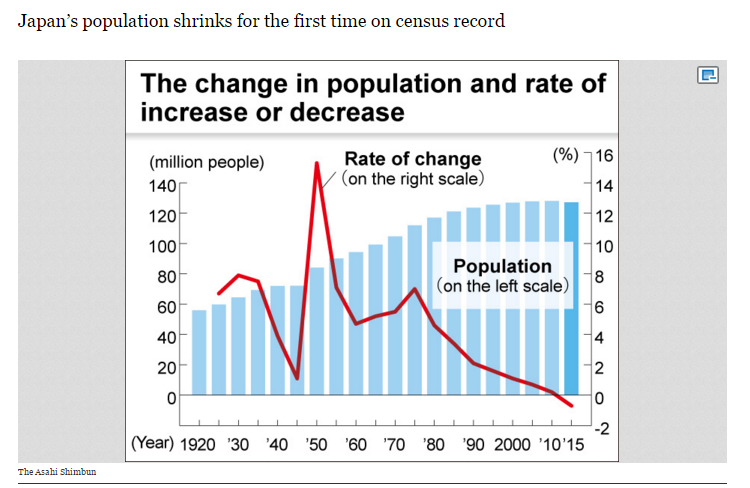
The future decline in Japan’s population has been recognised as inevitable for over 20 years and social engineering has not succeeded in reversing the inevitable. Now Japan has entered negative territory for the first time since the 1920s — entirely as expected.

Japan poulation decline - Asahi Shimbun

Japan population decline – Asahi Shimbun

In due course the fear-mongers will moan about the coming death of the species due to the population implosion, but this too shall pass. After about 100 years of a slow population decline I expect we shall see a new equilibrium for population and birth-rate, where longevity, fertility measures, incentives and a bright new world of genetic screening will be part of the mix.

By 2200, a form of non-coercive eugenics will no longer be a dirty word, but will instead seem eminently common-sensical.


The Paris Agreement sanctions a dash for coal

February 25, 2016

Now that the Paris Climate Agreement is out of the way (having actually achieved nothing while seeming to have solved everything), sensible countries that wish to implement their plans to utilise coal can do so without being castigated for it (since Paris has now solved everything). The non-sensible and sanctimonious countries – and Sweden leads all the rest – can refrain from using coal and other fossil fuels to their own self-inflicted disadvantage.

The real winners from the Paris Agreement are, of course, India and China. By using carbon emissions per unit of GDP as the measure, India has ensured that it can treble its coal consumption by 2030 (while GDP increases by a factor of 4) and still show a 30% decrease in emissions/GDP. Similarly China can double its coal consumption by 2030 while GDP increases by a factor of 2.65 and still show a 20% reduction in carbon emissions (based on my calculation from the Indian and Chinese INDC submissions for the Paris conference).

The 2012 global coal consumption (IEA report) was about 8.186 billion short tons of which China consumed 3.887 billion short tons and India consumed 0.745 billion short tons. By 2030, India alone would consume 2.235 billion short tons and still meet their Paris obligations. Similarly China would consume about 7.774 billion short tons and still meet their Paris promises. Effectively the Paris Climate Agreement sanctions that coal consumption in India and China alone will be about 10 billion short tons and exceed today’s global consumption. The global coal consumption in 2030 will then be above 14 billion short tons which is about 70% higher than the 2012 global consumption.

And now Reuters informs us that

A decision by Japan’s environment ministry to abandon its opposition to building new coal-fired power stations casts doubt on the industry’s ability to meet targets to cut greenhouse gas emissions, experts and environmental activists said …..

As Japan gets ready to open up its power retail market in April, companies are rushing to build 43 coal-fired plants or 20.5 gigawatt of capacity in coming years, about a 50 percent increase. ……. Coal is attractive because it is the cheapest fossil fuel source and prices have slumped in recent years. Japan has turned to the energy source in record amounts since the Fukushima disaster in 2011 led to the shutdown of reactors.

A group of 36 power companies, which supply 99 percent of the country’s electricity, have also formed a new body to take measures to trim emissions and meet the industry’s voluntary goal to cut emissions by 35 percent in 2030, compared with 2013.

The Paris Agreement has ensured that all those who wish to use coal can continue to do so.


Tiffin carrier lunch culture is alive and well (and thriving)

February 25, 2016

As a child in Poona (now called Pune to mollify the nationalists), my mother packed a “tiffin carrier” for my brother and myself with our school lunch. Our driver brought this to school arriving about half an hour before the lunch break and we grew up thinking that having a hot, home-cooked lunch every day at school was nothing out of the ordinary. A tiffin carrier was and still is a supremely practical way of carrying a meal consisting of a variety of dishes. The versions from my childhood were nearly always made of brass or stainless steel but modern versions come in a variety of materials.

traditional tiffin carrier (yk antiques)

traditional tiffin carrier (yk antiques)

In the 1960’s I worked at a research establishment in the UK and we often worked 12 hour shifts when conducting programmes on prototype test equipment – generally for about a week or 10 days at a time. For a while I took to using a tiffin carrier to take my meals to work when on shift, much to the envy of my colleagues with their plastic boxes of sandwiches. The tiffin carrier with the variety of food it carries is naturally conducive to sharing food and that kind of sharing creates – I think – a social environment somewhat deeper than merely eating a meal together at a cafeteria.

I have just returned from India and was more than a little pleased to see that the practice of groups of 5 – 8 people gathering in the work place, each with his or her own tiffin carrier, sharing their home-cooked lunches was not just alive, but well and thriving. The gathering at lunch time, with each person in turn opening his or her tiffin carrier to reveal the days delicacies was a ritual seriously observed. In this fast food world, the tiffin carrier may seem anachronistic but the pleasures of home-cooked food clearly still survive. Often the variety of food being shared was extremely wide, reflecting home cooking styles from across the sub-continent. It was possible to have dosais from the south with channa masala or jeera aalu from the north. Or bhaturas from the north being eaten with onion or coconut chutney from the south. Biriyanis being mixed with kootu and chapattis with sambar or avialParatthas with poriyal or aapams with a Bengali fish curry. And perhaps jelebis or mysore pak or sandesh for desert. Inevitably the conversation also included comments about food and cooking and the home environment, and an insight into the lives of colleagues which carried social bonding to a far deeper level than without the sharing of home-cooked meals

This account of using a tiffin carrier  to school by Krishnamurthy Yenugu predates my experiences by just a few years. I find it incredibly nostalgic about a world long gone. But the tiffin carrier culture is still going strong in the work place – and long may it continue into the fast-food world.

YK Antiques: This vintage brass 5-tier tiffin box was used by me during my school days to carry lunch to my school. I was born in the year 1940. My grandfather who was a head master for the only elementary school we had in our village Someswaram, in the East Godavari District of Andhra Pradesh, India, had admitted me into the school when I was five years old after doing proper pooja and ceremonial Akharabhyasam (writing OM first time on the slate). I started going to school along with my grandfather Sri Yenugu Krishna Murthy carrying a palaka and balapam (stone slate and stone pencil) in a cotton bag. This was all my school kit. I graduated from 5th standard when I was 10 years old and that was the maximum education my school could offer. The nearest high school was 5 kilometres away and the only way to reach there was by a bicycle. Since I was considered as too young to go alone on a bicycle, my grandfather decided I should stay with my uncle Sri Rajupanthlu garu in the town Peddapuram.

I was admitted in the ULCM High School, Peddapuramin the 1st form (now equivalent of 6th standard) and I successfully completed my 3rd form when I was 13 years old. By then, I was considered eligible to ride a bicycle. So I was shifted back to our village Someswaram and got admitted in a high school in a village named Rayavaram about 5 kilometres from my village. I got a new cycle and a tiffin carrier with 5 boxes in the year 1953. I do not know if I got a brand new lunch box or an already old one by then. Let us consider that as new at that time. That brings us to the age of this 5-tier brass tiffin box set at 60 years old.

Complete assembly of Tiffin carrier showing 5 dabbas, frame, spoon and handle

Complete assembly of Tiffin carrier showing 5 dabbas, frame, spoon and handle

This 13 inches tall lunch carrier has an assembly of five containers- a large one with 3 inches height, three medium sized ones with 2 inches height and a one small one (5th one) with one inch height. All the round boxes are 4.5 inches wide (diameter). All the five containers are held tight by a brass strap frame resembling an inverted “U”shape that has a bent at the top. The two parallel sections have grooves that fit snugly into the knobs on the lower container. The upper most box tightly fits into the bent part of the “U”. The top part of the “U” is used as a handle to carry the tiffin carrier assembly. There is an aluminium spoon that holds the boxes and the frame together. The brass frame has two holes at the bent, and the top vessel lid has a knob with one hole. When the frame is pushed on to the five container assembly, the two holes in the frame and the hole at the top box lid come in a single straight line and the aluminium spoon is inserted through the 3 holes. That seals the assembly tight.

The lunch carrier has a stamping on the top vessel cover reading as ” 41/2“meaning there are four and half containers in the assembly.The top box which is of 1 inch height is considered as half box. There is also another stamping giving the patent details reading as “Patent1937 HK22729”. This reveals that this design was patented in the year 1937. I do not know who the manufacturer is but with the help of patent number maybe we can find the manufacturer. All the vessels are coated with tin coating, locally known astagarampoota. This coating is given to prevent the contact of the food with brass metal since brass reacts chemically with certain types of food materials, particularly Tamarind juice, which is profusely used in Andhra food preparations, and also with lime juice.That is precisely the reason as to why an Aluminium spoon is used instead of a brass spoon.The spoon is used for locking purpose and also as a spoon for serving and eating purpose.You cannot eat food with brass spoon for the reason of chemical reaction. Hence aluminium spoon is used which serves both the purpose. …

I used to start from home at 9 a.m. every day to school and my mother used to keep my lunch carrier, which she used to call it dabba, ready by the same time packed with hot food for my mid-day meal. She used to pack rice in the big dabba at the bottom, the second one with the pulusu or pappu, the third one with vegetable curry, the fourth one with curd and the top one with pickle. The pickle will be eitherAavakaya with badda ( mango slice) or Maagaya with juicy tenka (mango seed). I used to keep the hot brass tiffin box into a cotton bag with handles and hang the bag on the left side of the handle bar of the cycle. My school books were pushed into another similar bag and it was hung on the right side of the handlebar. This was how my journey to school started. If there was an item of interest, it was the carrier. My mind would always be on the carrier instead of on the class subject and I would wait impatiently for the lunch time bell. The children of our village used to sit together and eat our lunch and most of the times we used to share our lunch. Our school used to be at the far end of the village amidst paddy fields.There used to be small canals (bodikalva) to irrigate the paddy fields. We would sit on the banks of these canals under a mango tree and eat lunch with a picnic atmosphere. After that we would wash our tiffin carrier in the canals, reassemble them and put it back in the cotton bag.

I was using this vintage brass lunch carrier for three years during my studies for 4th,5th forms and SSLC (Secondary School Leaving Certificate) which is equivalent to present day 10th. After my SSLC, I had gone to Kakinada to study my Intermediate in PR College. Thus, my cycle journey and my dear lunchbox carrier were given rest. While my cycle was disposed, I retained the brass lunch carrier, my companion for 3 years. It is now an integral part of my antiques collection. This fabulous 5-tier tiffin box is my goddess Annapoorna which fed me for three years in my life.

And the world keeps turning …

February 24, 2016

I have been away from my desktop for a couple of weeks and have not kept up (have not been able to keep up) with blogging on my ipad. I am afraid I find my inabilities with the tablet frustrating. I need the large keyboard to fit my thick fingers and I need my mouse!!

But the world hasn’t noticed (or cared) and has just kept turning.

  1. Transferring at Frankfurt airport was a pain – again.
  2. Security personnel at Frankfurt maintained their reputation for mindlessness (this is a little more offensive than the pseudoscience of “mindfulness” which permeates Germany). And that leads me to a few thoughts.
  3. First, why shouldn’t security robots be used instead of the personnel who are clearly charged not to use their minds.  They are – I am quite sure – instructed to switch their minds off and follow a protocol strictly without deviation. Surely lifeless robots would be less offensive than the Frankfurt mob. And since they clearly presume that the person they are body searching is a terrorist, perhaps they should apologise when they find nothing? (Of course not – that was a silly question. Apologies come from people with minds.)
  4. Second, why are humans so gullible that labelling common-sense as “mindfulness” causes them to enrich charlatans?
  5. Speaking of charlatans, did you note the social psychologist who expounds on the act of reading being brain-washing? Start always with the assumption that all social psychologists are guilty of being charlatans unless they can prove otherwise.
  6. Donald Trump is proving to be the right clown, at the right time, in the right place, for the right electorate. I’m still not totally convinced that the GOP may not try to get a brokered solution which crowds Trump out, but that may only backfire. Wow! Who could have imagined a Trump/Clinton fight for the Presidency? And if it is an anti-establishment wave that is washing out the muck in the Washington stables, come November, Hillary may be swept away with the rest of the manure. (The Pope needs to backtrack on his ill-judged nonsense a little more, since he surely can do without the risk of being taken to be personally against the next President of the United States).
  7. In India the Delhi police chief has forgotten the basic tenet of being innocent until proven guilty. He demanded that students of JNU accused of “sedition” prove their innocence against the unproved allegations. The BJP and the Hindu right have hijacked “nationalism” such that all leftists now need to prove that they are not anti-India. It was amusing to watch a national Communist leader desperately trying to claim that it was indeed possible for a communist to be a nationalist. Poor man. In one sense the police chief has a point. All staff and students of JNU – by definition – are guilty of something (just as everybody at the LSE is also guilty). It has been a long time since any academic work of value came out of the JNU.

The world keeps turning and as “tomorrow, and tomorrow, and tomorrow,
Creeps in this petty pace from day to day, to the last syllable of recorded time” it is hard not to think like Macbeth, that:

Humans are but walking shadows, poor players 
That strut and fret their hour upon the stage
And then are heard no more: it is a tale
Told by idiots, full of sound and fury,
Signifying nothing.