Posts Tagged ‘behaviour’

Noted in Passing 2nd February 2013

February 2, 2013

A weekly post on things that were interesting or which I would have liked to have blogged about …….

Science and Behaviour

GUINEA WORM--THIS ONE copy 2

Exercitationes de Vena Medinensis et de Vermiculis capillaribus infantium by G. H. Velschius (1674)

It seems that human infestation by guinea worms is sharply down pointing to the success of the program to eradicate them. Carl Zimmer writes an obituary for this creature which will not be missed (by humans) if it becomes extinct. But why is it that the intentional eradication of species inimical to man is perfectly OK, but the demise of other species which have failed to adapt and can no longer compete is considered a catastrophic loss of bio-diversity? In genetic survival terms the guinea worm or the mosquito might well be more important than tigers or panda bears.

There are those who would swear that the science of climate is well understood and settled. But it seems we know very little about clouds indeed and that bacteria which survive in the upper atmosphere could be one source for the nucleation of clouds.  In the same vein, it seems that irrigation in one area can cause storms elsewhere. A new study shows that agricultural irrigation in California’s Central Valley doubles the amount of water vapor pumped into the atmosphere, ratcheting up rainfall and powerful monsoons across the interior Southwest.

The British Museum and the Smithsonian teamed up to prove that their two crystal skulls, purportedly made by Aztecs in Mexico prior to Columbus’ arrival. are actually fakes. 

Kim Ryholt shows that in the ancient Egyptian city Tebtunis, 2,200 years ago, people voluntarily entered into slave contracts with the local temple for all eternity and they even paid a monthly fee for the privilege.

New findings suggest that free-ranging cats are likely the single greatest source of anthropogenic mortality for US birds and mammals.

Dienekes suggests that even with a generations long selective breeding program to select for Neanderthal genes, achieving a 100% Neandertal might be impossible.

Engineering and Technology

NASA will use the International Space Station that to test expandable space habitat technologyand will test a Bigelow Expandable Activity Module (BEAM), which is scheduled to arrive at the space station in 2015 for a two-year technology demonstration.

As they become easier to acquire and use, one of the obvious benefits of 3D printers is their ability to distribute the tools of production and manufacturing to the masses. But what they’re used to produce can create legal, regulatory, and even ethical concerns.

The PowerBuoy is a “smart” ocean-going buoy that uses piston-like motion in the float relative to its stationary spar to mechanically convert energy into electricity as it rides the waves.

Bad Science

The status of Harvard College’s investigation of student cheating has been distributed to faculty, staff and students by Arts and Science Faculty Dean Michael D. Smith.

Academics at the Institute for the Study of Coherence and Emergence are at war with an anthropologist at University of California at Berkeley and alleging that he stole ideas. Needless to say the UC Berkeley investigation report exonerates their own.

The Commonwealth Scientific and Industrial Research Organisation (CSIRO), Australia’s national science agency, may face further scrutiny into accusations of bullying and harassment of scientists and other employees.

Funding agencies may be paying out duplicate grants, according to an analysis by Harold R. Garner, Lauren J. McIver and Michael B. Waitzkin.

Forbes dumps on the unfortunate Lisa Jackson.

With the rapid growth of misconduct cases, scientific rehabilitation may have to become a necessary tool for research-integrity offices.
Noted in Passing 26th January 2013

January 26, 2013

A weekly post on things that were interesting or which I would have liked to have blogged about …….

Science and Behaviour

Half a million DVDs of data could be stored in gram of DNA according to Harvard researchers. Unfortunately the credibility of the claim is severely impaired since this comes from the lab of Dr. George Church of Neanderthal baby fame and I have to take even the memory claim with a large bushel of salt. Dr. Church seems very keen on publicity just now. (This item almost made it to the Bad Science category but the memory item gets the benefit of the doubt). The Neanderthal nonsense was taken down comprehensively by Svante Pääbo and others of the  Neanderthal Genome Project.

Protons are 4% smaller than was thought and new particles are expected to be found.

Ferdinand Balfoort posts on Stockholm’s violent past from the peaceful present and a New Zealander is causing waves with his campaign to rid his country of cats.

One hundred and one year old Fauja Singh will run his last marathon in Hong Kong in February just before his 102’nd birthday, but plans to continue running for 4 hours a day.

Scrolls of 2,000 year old Buddhist texts have been found  preserved on long rolls of birch-tree bark and written in Gandhari.

Against conventional wisdom earthquakes can occur even at zones considered stable and this is what may have happened in 2011 when the magnitude 9.0 Tohoku-Oki earthquake was followed by a devastating tsunami.

Alarmist conservationists would like us to believe that humans are on the verge of causing a catastrophic loss of biodiversity but as with most alarmist dogmas, extinction rates of species are not as bad as has been assumed.

We all believe to some extent that looks reveal  traits and humans have been associating facial features with criminality for at least 2,000 years  (“Cassius has a lean and hungry look”) and “scientifically” for at least 300 years. But a new study debunks some of the myths.

Comet ISON was discovered by Russian astronomers Vitali Nevski and Artyom Novichonok in Sept. 2012. It bears the name of their night-sky survey program, the International Scientific Optical Network and NASA reckons it could be spectacularly visible in broad daylight this year.  On Nov. 28, 2013, this “dirty snowball” will fly through the sun’s atmosphere little more than a million km from the stellar surface and if it survives it could be a grand display.

Are Asians disadvantaged in US academia and industry? Lilian Gomory Wu and Wei Jing think so. The makings of some new urban myths lies in that those who multi-task are least capable of multi-tasking.

Engineering and Technology

Being blinded by the sun low in the sky is a pretty common hazard while driving here during winter in Scandinavia. But the development of Haptic steering wheels which vibrate could help solve this problem until cars are built that drive themselves (and they are closer than one might think).

French car manufacturer PSA Peugeot  Citroen believes it can put an air- powered vehicle on the road by 2016. The system works by using a normal internal combustion engine, special hydraulics and an adapted gearbox along with compressed air cylinders that store and release energy. This enables it to run on petrol or air, or a combination of the two.

A team of scientists from Scotland and the Czech Republic has created a “tractor” beam – a la Star Trek – which for the first time allows a beam of light to attract objects.

Materials science has always been in symbiosis with the other sciences at the transition from science to engineering and the discovery of metamaterials which can bend light, X-rays and radio waves promise a wide array of new applications in radio communications, security and automotive safety and now in imaging.

Bad Science

Paul Brookes was forced to take down his Science Fraud website last week after receiving legal threats (from some who later retracted – or had retracted – the papers that ScienceFraud exposed). Now he is marshalling support to open a new web-site to expose bad science.

The European Food Safety Authority (EFSA) is accused of bowing to political pressure in a study of bee decline which implicates some specific insecticides. The insecticide manufacturers are not amused.

A study on the impact of banning affirmative action (a pseudonym of course for discrimination) seems not only misguided but also one with a high level of confirmation bias. It looks like advocacy posing as science.

Geoffrey K. Pullum takes bad science backed up by bad journalism at the New Scientist and the Washington Post severely to task.

Noted in Passing 19th January 2013

January 19, 2013

A weekly post on things that were interesting or which I would have liked to have blogged about …….

Engineering and Technology

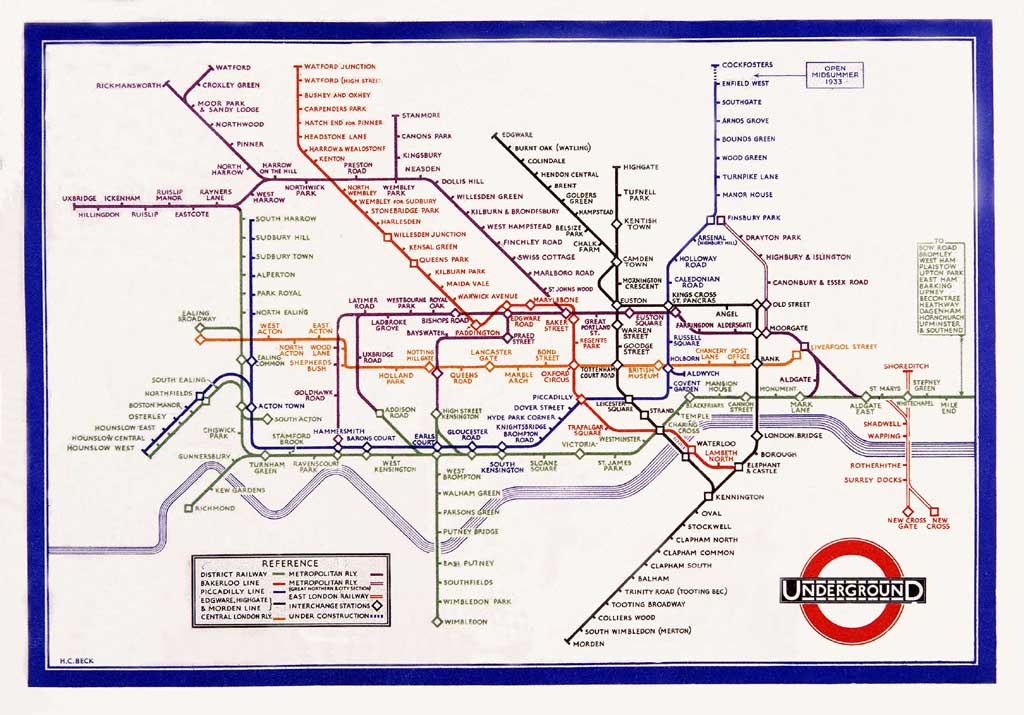
A work of genius: Harry Beck's map of 1933

A work of genius: Harry Beck’s map of 1933

The London Underground is 150 years old and the iconic London Underground Map is a work of some genius – by an electrical draughtsman Harry Beck – in focusing on connections and ignoring geography.

Boeing is facing a torrid time with the 787 Dreamliner and has stopped all further aircraft deliveries. This is going to hurt their cash flow even before all the claims from the airlines come in for the grounding of their aircraft.

The advent of hydraulic fracturing and the consequent availability of shale gas means that new lines are drawn on the energy map of the world and many of the oldest and most stable geopolitical truths will be turned on their heads.

If graphene turns out to be the wonder material that it promises to be then it is time to invest in graphite.

Science and Behaviour

The dangers with blindly assuming that correlations represent a causal relationship is well demonstrated by this study on milk, chocolate and Nobel prizes. Derby Proctor believes that chimpanzees have a sense of fairness but her “ultimatum game” experiments were not strictly ultimate games at all and are not convincing.  Altruism among chimpanzees is – if it exists at all – strictly limited and only after basic needs are satisfied and restricted to a very few.

Matt Ridley joins the list and also dumps on Mark Lynas and green orthodoxy

The curious case of Zuma’s deputies deals with the intricacies of politics in South Africa and in the ANC today. An interesting post on the French need to be relevant in the world and Hollande’s adventures in Africa.

How much of the chatter on Twitter or postings on Facebook are real communication and how much is noise? Nandana Sengupta looks at the pluses and the minuses of the explosion of opinions via social media in India.

Having spent a lifetime with contracts I have always taken “terms” of “terms and conditions” to signify “limits of time” but terms and conditions have now converged in usage to be almost identical in meaning.

On where Tolkien may have found the word “hobbit”.

For Wodehouse fans and for the first time since Ralph Richardson as Lord Emsworth in 1967, BBC are showing a  new TV series centred around Blandings Castle. The reviews were not very kind:

“The performances weren’t bad exactly, but there was an impression that the cast had raided the charity shop and were merely having a spiffing time in vintage clothing.”

Bad Science

Michael Marotta describes four books on bad science.

The British Met Office makes yet another misstep and demonstrates that massaging science to get a desired result makes for bad science.

Climate models are hardly worth the paper they are printed on and they don’t seem to have any idea of how to handle the effect of clouds. Models – which are pushing the alarmist cause – generally assume they have a positive feedback on global warming but in reality the feedback is negative.

Professor Debora Weber-Wulff reports on Multiple Retractions of Articles by Computer Science Professor

Noted in Passing 12th January 2013

January 12, 2013

My hope is to make “Noted in Passing” a regular, weekly post but I am not sure if I will have the discipline to maintain it. I shall try to confine myself to 3 topic areas: “Science and Behaviour”, “Engineering and Technology” and “Bad Science”. I’m trying to avoid politics as a topic in its own right but politics may well creep in under “Behaviour”.

Science and Behaviour

Polar bear numbers world-wide are up and here’s  a marvellous image of a polar bear in winter.

polar bear aurora_borealis_3-t2 free

Polar bear and the aurora borealis (from polar bear science)

Some people apparently believe that  too much genetic information could be a bad thing. Virginia Hughes disagrees strongly and I am inclined to agree with her. Genetic sequencing is here to stay and even if interpretation may lead to new challenges and new dilemmas, this genie cannot be stuffed back into the bottle.

Why did our fingers eveolve wrinkles? Was it perhaps to better be able to grip smooth objects?

John Hawks begins his descent through Darwin’s Descent of Man and has posted his “introduction” which is fascinating and – especially for a layman like me – eminently readable. “Experts” in my opinion are those who explain and not those who try to mystify (usually to inflate their own egos).

David McNeil believes that a gesture-speech unity lies at the origins of language but I am not convinced. When speech began – and that is a story in itself – gestures may well have added to man’s vocabulary but I am skeptical as to the role of gesture in the development of language and the grammar associated with language. But what seems obvious to me is that for the origins of speech as well as the origins of language we have to look to the increasing need for communication as the driving force.

In the meantime miR-941 is now being slated as a specific gene that contributed to how early humans developed tool use and language (in contrast to the FoxP2 gene which is thought to be a more general enabler). A study by psychologists claims that language learning begins before birth but I think they jump far too quickly from sound recognition to language learning and the study does not convince.

Recent excavations at an Australian site provides evidence of inhabitation ” certainly” at 41,230 years ago with the dating of charcoal found at the site. However the earliest inhabitation was much older since stone tools were found in deeper layers than the charcoal, but these have yet to be dated. This seems more consistent with the main human expansion Out of Africarabia first happening before Toba.

Even bloggers on the right are questioning the US love affair with semi-automatic weapons but I don’t expect any significant change to the gun laws in the US anytime soon.

Good grief! Greg Laden believes that summer in the Southern Hemisphere must be a sign of global warming. It’s -6°C outside my window right now and its been snowing in Jerusalem and the Lebanon, so I suppose the Northern Hemisphere must be entering a Little Ice Age.

The luminosity of our Sun varies just 0.1% over the course of its 11-year solar cycle. There is, however, a dawning realization among researchers that even these apparently tiny variations can have a significant effect on terrestrial climate. Tony Phillips from NASA comments on  “The Effects of Solar Variability on Earth’s Climate”  issued by the National Research Council.

Engineering and Technology

The technology for drones that today are used to kill could have more peaceful purposes. A Dronenet for a human free package delivery service  is attractive and does not sound so absurd.

Livefist reports that Airbus has beaten out the Russians to win the Indian Air Force’s new generation of  mid-refuelling tankers while Boeing is still going through teething troubles with the 787 Dreamliner.

The pressures on the supply of neodymium, dysprosium, and other rare-earth metals for the manufacture of strong magnets is leading to a surge in the use of nanotechnology to find alternatives.

Bad Science:

  1. Another idiot study about how our fists evolved in response to fighting!  An excellent takedown by  T. Ryan Gregory. “The most impressive thing about this study is that it managed to gain so much attention with so little substance”. 
  2. ChemBark has this update on serial data fabricator Bengu Sezen who has been hired by the Gebze Institute of Technology.
  3. Simon Kuper has some sympathy for Diederik Stapel who now finds himself in an unforgiving Dutch society. His take on the Stapel affaire is in the FT.
  4. The American Psychiatric Association would seem to be in thrall to the pharmaceutical industry as DSM -5 is adjusted to sell more drugs.
  5. John Hawks has a scathing post about Mark Lynas as “someone who had never read a scientific study on the subject, purporting to be an advocate in the popular press, and having his ignorant statements printed widely by multimillion-dollar media organizations” and the shoe fits whether Lynas is pontificating about GMO or global warming.
  6. Further retractions of social psychology papers: “Fraud committed by any social psychologist diminishes all social psychologists” and reinforces the view that social psychology is mainly for headlines and is still a long way from being a science.
  7. Most junior scientists accept academic theft by their advisors as a way of life and only a very few decide to make any noise about it.

Monster Breivik complains about “inhumanity”

November 10, 2012

I find most things about the monstrous behaviour of Anders Behring Breivik almost inexplicable. Now the killer of 77 people complains about the inhumanity of having to use a “bendy” pen!

Considering his rather luxurious incarceration for 21 years (extendable) for killing 77 people, his 27 page complaint about the inhumane conditions he is being held in ought to be dismissed out of hand. But instead it will probably waste a lot of people’s time and a lot of public money.

The Guardian: Anders Behring Breivik, who is serving a 21-year sentence for killing 77 people in a bombing and shooting rampage last year, has complained that he is being held in inhumane conditions and is being denied freedom of expression, his lawyer has said.

….. The Norwegian tabloid, VG, which said it had acquired a copy of the letter, quoted Breivik as saying he was allowed to use only a soft and bendable safety pen described by its manufacturer as “stab-resistant” because it yields at the slightest pressure and cannot be used as a weapon.

Living cell at Ilas Secure Department FOTO: ILA FENGSEL OG FORVARINGSANSTALT/GLEFS AS

The spirit of the Inquisition is alive and well

April 22, 2012

The recent BBC story about the Catholic Church’s Office of the Inquisition pressurising some US nuns who are considered too liberal by the Church hierarchy got me to wondering whether our behaviour today is much different to that in medieval times.

To make the parallel to medieval times we have to substitute modern institutions. Governments and their institutions ( such as the United Nations or the IMF or the ICC) are today the equivalent of the medieval monarchs and their Catholic Church. They bless some countries and excommunicate others. They tolerate the same behaviour (for example the quest for nuclear weapons) in favoured countries and condemn it in others. They support uprisings against some of their less-favoured member countries and help suppression of rebellion in others. They enforce sanctions – even with the use of collective force – against some and ignore the same behaviour in others. And like the college of cardinals a select group of 5 nations and the 15-member Security Council makes up the holy inner circle controlling these institutions.

(more…)

Russian taxman sues dead lawyer

February 8, 2012

This is probably something characteristic of tax authorities and not just the crazy Russian legal system at work. The unfortunate Sergei Magnitsky died in pre-trial detention 2 years ago after being denied urgent medical care but  a presidential human rights commission found last summer that charges against him had been fabricated. But the taxman won’t give up.

It does seem like a case of “kill him in detention” and then sue him!!!

Reuters: 

MOSCOW PLANS TO PUT DEAD LAWYER ON TRIAL

Russian investigators have said they may prosecute a dead lawyer who worked for a foreign investment fund in the latest bizarre twist to a case that has come to exemplify investor fears about Russia’s rule of law.

Source: Financial Times:  http://www.ft.com/cms/s/0/ef3b4172-51b5-11e1-a30c-00144feabdc0.html#ixzz1llc77Qbh


On courage and foolhardiness

December 30, 2011

A young friend recently faced a number of less than easy options regarding his employment and his career and our discussion turned to behaviour in the face of uncertainty and fears:

The fundamental characteristic of courage in actions is that the action remains central and fear is then the constraint or barrier to action which must be subordinated. I have heard it said that courage lies in confronting fear or defeating fear but this, I think, misses the central point. The focus of courage is on the actions not on the fears. Whatever purposeful action has been decided proceeds even though fear exists. Defeating the fear is not the focus where the action then becomes secondary or merely a by-product.

(more…)

The Art of Motivation

April 21, 2011

I have been conducting a workshop on motivation in the work place as part of an exercise to establish a performance based incentive scheme for a company trying to change from being a family run enterprise to one which can be floated on the stock exchange in a year or two.

Praise Loudly, Blame Softly

In human behaviour, motivation can be considered to be a force. It is brought to bear when performing actions. Where actions have no purpose motivation is undefined. Where there is purpose I take it to be without doubt that the purpose is better served when the required actions are carried out by people who are motivated rather than by people who are indifferent.

The motivated state can then be described as that biological, emotional or cognitive condition which generates a force – variously called incentive, enthusiasm, inspiration, drive, desire, impetus or commitment – which can be applied to a person’s actions. The difference between a motivated person and an unmotivated person lies in the force they bring to bear when performing the same action. It follows that motivation is that particular force within a person which infuses dynamism into his actions or his behaviour towards a particular purpose. The art of motivation then lies in the manner of generating such a force of engagement in people when acting towards a particular purpose.  It is the influencing of human desires and drives by addressing their needs and deficiencies such that they have a vested interest in achieving the purpose. ……

It is a universal and well established observation that when some dissatisfaction is acute, all other drives and actions are subordinated to the alleviation of the acute dissatisfaction. …

What constitutes satisfaction or dissatisfaction varies from one individual to the next. What levels of these are considered acute or tolerable or acceptable or unacceptable or mild satisfaction or ecstasy, also vary with the individual. To what extent and with what velocity a change of state will drive an individual towards reaching a different state of satisfaction or dissatisfaction also depends upon the individual. With this level of variation, and with this dependence upon the individual, motivating people is in the realm of art and is still a long way from being an exact science. The use of rewards and penalties to achieve the actions chosen to be elicited from specific individuals is the art of motivation

….. To be able to consciously engage in motivation, which is a necessary task for a manager, it is vital that some assessment be made of the current status of satisfaction or dissatisfaction of the subject. This in turn determines whether some other state of satisfaction or reduced dissatisfaction will be sufficiently separated from the current state for any motivation to be feasible. This applies irrespective of whether the subject is a subordinate, a superior or a complete stranger. Without such an assessment the drive actually generated by any motivator that is applied, will be nothing more than a guess. The objective is of course, to intentionally provide sufficient drive to the subject such that the desired action results and is carried out forcefully. In a few cases the manager will have sufficient information to be able to make a fairly accurate assessment. In most cases however, he will only have partial information. Nevertheless, the starting point must be an assessment of the current status. 

Human vultures out after Christchurch quake

February 25, 2011

Amid the stories of resilience and indomitable spirit that represent the heights to which human behaviour can ascend come also the stories of the human vultures and the depths to which behaviour can fall.

Police sickened by Christchurch looting

A view shows a damaged cathedral after an earthquake in central Christchurch February 22, 2011. A strong quake hit New Zealand's second-biggest city of Christchurch on Tuesday for the second time in five months, toppling buildings, causing multiple fatalities, trapping people beneath rubble and sparking fires.

Damaged cathedral after an earthquake in central Christchurch February 22, 2011: Photograph by: HO Credit: REUTERS

New Zealand police said Friday they were “sickened” at a spate of looting, email scams and bogus appeals for charity in the wake of the deadly Christchurch earthquake.

…. They said residents in the stricken city had reported conmen posing as government officials, wearing reflector vests and brandishing fake identification, going door to door trying to gain access to properties.

Looting and burglaries, including one at the home of a woman feared dead in the disaster, have also been reported, while fraudulent emails soliciting charity donations were also doing the rounds.

“I am frankly sickened by people like this, who see this disaster as an opportunity to prey on vulnerable people,” police superintendent Russell Gibson told Radio New Zealand.

District commander Dave Cliff said drunken disorder was also on the rise in the city, where stressed residents have endured two major earthquakes and thousands of aftershocks in the past six months.

Generators being used to restore infrastructure were among the items stolen.

The consumer affairs ministry warned of an email designed to look like it was from the Red Cross which redirected Internet users to a website where they were asked for credit card details.

“The scam website has the same look and feel as the genuine Red Cross website,” it said.

Another fraudulent email claimed to be from Donate4Charity NZ, a legitimate British-based charity, the department said.