Posts Tagged ‘Biology’

Life does not survive to reproduce; rather, it reproduces because survival must end

September 16, 2026

Introduction:

An off-shoot idea I have had for a long time is that the most primal characteristic of being alive seems to be the drive to survive and remain alive. This is probably even more primitive than the drive to reproduce which, I think, makes more sense as a risk mitigation action for the unavoidable risk of not surviving. This little essay expands on that theme.


I have come to realise that for living things (for life), it is survival which is primal and it is reproduction which follows only as a mitigation for the risk of mortality.

If we strip biology down to its first principles, traditional evolutionary theory asks us to accept a strange inversion: that reproduction is the ultimate engine of life, and survival is merely a clumsy mechanism organisms use to stick around long enough to pass on their genes. But when we examine the actual physics of living systems, this hierarchy reverses. The most primal, non-negotiable characteristic of life is not the drive to multiply. Instead, it is the fierce, unyielding drive to be, to remain intact. If a cell did not age and die of itself and, in principle, was immortal, reproduction would be both unnecessary and unsustainable.

Before a system can have the luxury of looking outward and indulging in replication, it must first establish an internal boundary against the relentless pull of not-being, of not surviving, of dying. This drive for continuing to be, for self-generation and self-maintenance is the core imperative of any living system. (The word autopoiesis was invented in the 1970s to describe this but I dislike its artificiality and do not see that it adds any great value). From single-celled bacteria avoiding or evading what they detect as chemical toxins, to complex organisms exhibiting flight or fight behaviour when faced by physical threat, the primary directive is always self-preservation. Living is always in hope, in the belief that even with the last breath that there is another breath to come. Life fights tooth and nail simply to continue to be. If any system lacked this primal will to maintain its own structural integrity against non-existence, it would dissolve before reproduction even entered the equation.

Why, then, does reproduction exist at all? If survival is the ultimate goal, a successful organism would logically lock into a permanent state of just necessary sufficiency, of bare self-preservation. Without inherent aging the organism would be immortal. Yet, every individual biological organism, without exception, is mortal. Empiricism tells us that immortality has never been observed. In the war against time and entropy and environmental friction, individual mortality is guaranteed and survival, inevitably and always, ends.

This is where the true nature of reproduction is revealed. It is not the primary goal, but actually a quite brilliant, insurance policy. It is mitigation for the risk of not surviving. Because an individual organism cannot permanently defeat dying, life invents replication as a structural workaround. It is a hedge against extinction where specific individuality is sacrificed. It is a mechanism which maintains a string of individuals but no single one. It employs the copying of software onto a fresh hardware drive because the original hardware will inevitably fail.

It is a masterpiece of elegance in that this insurance policy is dynamically tuned by a feedback loop between risk of imminent dying and reproductive output. Not for each individual but averaged across many individuals. If the chance of surviving another year is low, investing energy into long-term bodily maintenance (longevity) is a wasted bet. The insurance policy must pay out immediately. This is why small rodents or insects have short lifespans and massive, rapid litters. If the baseline survival rate is high, the “insurance policy” doesn’t need urgency or front-loading. The organism can afford to stick around, protect its investment, and nurture its offspring over a longer, more stable timeline. This is why large mammals, elephants, whales, and humans feature long lifespans and slow, deliberate reproduction. When an organism faces high extrinsic mortality, where harsh pressures make individual survival statistically unlikely, the system triggers an emergency response, accelerating reproduction and shortening focus at the expense of longevity. Conversely, when stable conditions allow for extended survival, life dials back reproduction, trading sheer volume for long-term somatic maintenance and quality control. The terms of the policy adapt, it seems, directly to the threat of not being.

My postulation is that reproduction comes downstream of survival. Framing reproduction as a risk-mitigation strategy allows us, I think, to change how we view the drivers of living systems. It moves us away, I believe, from a purely gene-centric utility model and instead, sets life in a deeper, more fundamental, existential struggle. It is the difference between living and being inert. Life is the aspiration of an organized system to continue to be against the void of non-existence. It is this aspiration manifested which – in my view –  we call the mystery that separates the living from the inert.

Life does not survive to reproduce; rather, it reproduces because it is certain that survival must end.


Physics came first and then came chemistry and later biology

August 19, 2015

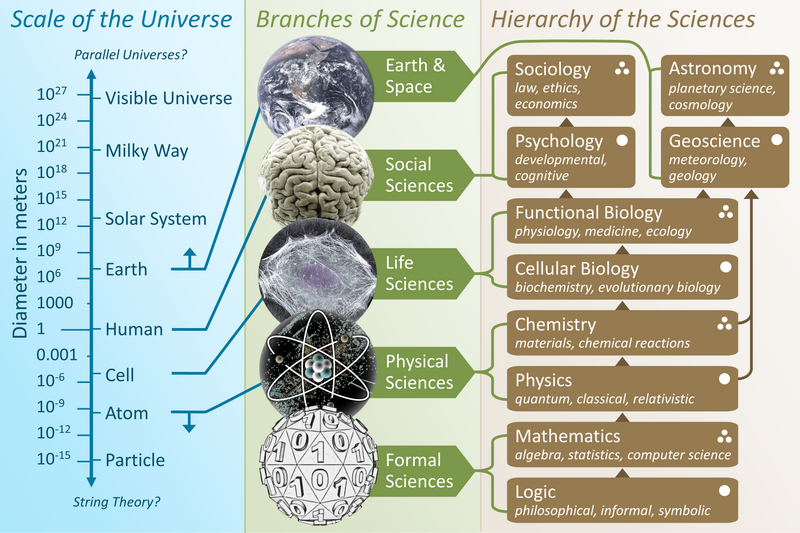
I generally take it that there are only 3 basic sciences, physics, chemistry and biology. I take logic to be the philosophical framework and the background for the observation of the universe. Mathematics is then not a science but a language by which the observations of the universe can be addressed. All other sciences are combinations or derivatives of the three basic sciences. Geology, astronomy, cosmology, psychology, sociology, archaeology, and all the rest derive from the basic three.

I was listening to a report today about some Japanese researchers  who generated protein building blocks by recreating impacts by comets containing water, amino acids and silicate. Some of the amino acids linked together to form peptides (chained molecules). Recurring lengths of peptide chains form proteins and that leads to life. What interested me though was the element of time.

Clearly “chemistry” had to exist before “biology” came into existence. Chemistry therefore not only comes first and “higher” in the hierarchy of the existence of things but is also a necessary, but insufficient, requirement for “biology” to exist. Chemistry plus some “spark” led to biology. In that case the basic sciences are reduced to two since biology derives from chemistry. I cannot conceive of biology preceding chemistry. The elements and atoms and molecules of chemistry had to exist before the “spark” of something brough biology into existence.

chemical reactions (chemistry) + “spark of life”(physics?) = biology

By the same token, does physics precede chemistry? I think it must. Without the universe existing (physics) and all the elements existing within it (which is also physics) and without all the forces acting upon the elements (still physics), there would be no chemistry to exist. Or perhaps the Big Bang was physics and the creation of the elements itself was chemistry? But considering that nuclear reactions (fusion or fission) and the creation of new elements are usually considered physics, it would seem that the existence of physics preceded the existence of chemistry. The mere existence of elements would be insufficient to set in motion reactions between the elements. Some other forces are necessary for that (though some of these forces are even necessary for the existence of the elements). Perhaps physics gives the fundamental particles (whatever they are) and then chemistry begins with the formation of elements? Whether chemistry starts with elements or with the fundamental particles, physics not only must rank higher as a science, it must have come first. Particles must first exist before they can react with each other.

Particles (physics) + forces (physics) = chemistry.

In any event, and by whatever route I follow, physics preceded chemistry, and physics must exist first for chemistry to come into being. That makes chemistry a derivative of physics as biology is a derivative of chemistry.

We are left with just one fundamental science – physics.

by elfbrazil wikipedia

A special gene for camouflage

November 1, 2010

C. Zhang, Y. Song, D. A. Thompson, M. A. Madonna, G. L. Millhauser, S. Toro, Z. Varga, M. Westerfield, J. Gamse, W. Chen, R. D. Cone. Inaugural Article: Pineal-specific agouti protein regulates teleost background adaptationProceedings of the National Academy of Sciences, 2010; DOI: 10.1073/pnas.1014941107

Science Daily


Like other bony fish, the peacock flounder can change the color and pattern of its skin to blend into the sea floor. (Credit: Photo by Jimmie Mack)


Researchers led by Vanderbilt’s Dr. Roger Cone have discovered a new member of a gene family that has powerful influences on pigmentation and the regulation of body weight.

The gene is the third member of theagouti family. Two agouti genes have been identified previously in humans. One helps determine skin and hair color, and the other may play an important role in obesity and diabetes. The new gene, called agrp2, has been found exclusively in bony fish, including zebrafish, trout and salmon. The protein it encodes enables fish to change color dramatically to match their surroundings, the researchers report this week in the early edition of theProceedings of the National Academy of Sciences (PNAS).

“When my graduate student, Youngsup Song, discovered a third agouti protein in the fish pineal gland, an organ that regulates daily rhythms in response to light, we initially thought we had found the pathway that regulates hunger diurnally,” said Cone, chair of the Department of Molecular Physiology & Biophysics and director of the Vanderbilt Institute for Obesity and Metabolism.

“That is the mechanism that makes you hungry during the day, but not at night,” he continued. “However, Chao Zhang, a graduate student who followed up the study, ultimately discovered that this agouti protein … is involved in the rapid pigment changes that allow fish to adapt to their environment.”

This phenomenon, called background adaptation, also has been observed in mammals. The coat of the arctic hare, for example, turns from brown in summer to white camouflage against the winter snow.

In contrast to mammals that have to grow a new coat to adapt to a changing environment, fish, amphibians and reptiles can change their skin color in a matter of minutes. The first agouti gene, which produces the striped “agouti” pattern in many mammals, was discovered in 1993. The same year, Cone and his colleagues at Oregon Health Sciences University in Portland reported the discovery of the gene that encoded the melanocortin-1 receptor, a key player in the pigmentation story.

In the current paper, Cone’s group reports that the newly discovered protein, AgRP2, regulates expression of the prohormone genes pmch and pmchl, precursors to melanin-concentrating hormone, which has a pigment-lightening effect. “Together, the versatile agouti proteins and melanocortin receptors are responsible for regulation of body weight, the banded patterns of mammalian coats, and even red hair in most people,” Cone said. The current work shows that agouti proteins are also involved in the camouflage mechanisms used in thousands of fish species.

Read the article.

If only the gene could be activated in humans as well!!!