Posts Tagged ‘China’

Horse fighting still allowed in China

October 29, 2013

It may be the 21st century but what passes for civilised behaviour is still in the mind.

And this – in my mind – does not pass the test.

Barbarism is alive and well.

Of course, just banning such events is not a sustainable answer. That will only come when the behaviour of humans becomes civilised – and then any ban will no longer be necessary.

People watch horses fight during a traditional local event held by the Miao ethnic minority in Rongshui county, Liuzhou, Guangxi ethnic Zhuang autonomous region, China October 26, 2013. Horse fighting is a 500-year-old custom for the Miao people.  REUTERS-Stringer

People watch horses fight during a traditional local event held by the Miao ethnic minority in Rongshui county, Liuzhou, Guangxi ethnic Zhuang autonomous region, China October 26, 2013. Horse fighting is a 500-year-old custom for the Miao people.
REUTERS/Stringer

Horse fighting has now been outlawed almost worldwide. It still thrives, however, in countries like the Philippines, Indonesia, China and South Korea.

To start the competition, two stallions are brought in. A mare in heat is then presented to them and removed. The horses who do not immediately go into battle for the mare are whipped into a fury or gunshots are fired to incite them through fear.

Countries staging horse fights defend it as a cultural tradition that has gone on for hundreds of years, and resist any attempts to ban it.  Gambling appears to be the real and primary reason for its continued existence.

Wang versus Wen at the Chinese Academy of Sciences

October 23, 2013

The Chinese Academy of Sciences (CAS), formerly known as Academia Sinica, is the national academy for the natural sciences of the People’s Republic of China. Collectively known as the “Two Academies”  along with the Chinese Academy of Engineering, it is an institution of the State Council of China, functioning as the national scientific thinktank and academic governing body, providing advisory and appraisal services on issues stemming from the national economy, social development, and science and technology progress. It is headquartered in Beijing, with branch institutes all over mainland China. It has also created hundreds of commercial enterprises, with Lenovo being one of the most famous.

Sun tzu

Being selected as  a full member of the Academy is the most sought after position for a Chinese scientist. Selection takes place every two years and this year there are 391 “candidates” and probably no more than 5 – 10% will be selected. At the end of 2008, there were 692 CAS members, including 40 female members and 51 foreign members. So roughly one in 2 million Chinese gets to be a member of the Academy.

Politicking and lobbying are not unknown in the selection of new members. This can be quite cut-throat and vicious as is quite normal in academic rivalry. In this particular case Physics Professors Wang and Wen were competing for a place. Wang – in a master-stroke worthy of Sun Tzu – accused Wen of academic misconduct with regard to a paper published in Nature Communications. Each fired off their ammunition on their blog posts. Three co-authors claimed – or were persuaded to claim – that their names had wrongly been included on the paper by Wen. This effectively killed Wen’s chances. While Wang had won the battle he may have lost the war. The Academy was not amused. Wang had rocked the boat too much. And in the latest development Wang  has now withdrawn – or has been persuaded to withdraw – his candidature. It could be some time before he is allowed to be a candidate again.

South China Morning Post:

A prominent physics professor at Nanjing University, Wang Mu, 51, announced on his blog on Monday his intention to withdraw from this year’s selection race for new members of the Chinese Academy of Sciences (CAS), a title only given to leading scientists and academic authorities in China.

His decision has shocked many in Chinese academic circles. To many, the reason behind it is even more shocking. Wang has withdrawn from the race so he can investigate another candidate, his colleague, 49-year-old physics professor Wen Hai Hu, for alleged academic fraud.

On September 15, Wang informed the Division of Mathematics and Physics of the Chinese Academy of Sciences that in May Wen had published a fraudulent research paper in Nature Communications, a journal focusing on advancements in the field of physical, biological and chemical science.

According to Wang, three co-authors of the published paper didn’t participate in any of the experiments or analysis mentioned in it, and they had never seen the article before it was published. Wang said that in July this year the editorial department of Nature Communications had received a request from the three co-authors to remove their names from the paper. …..

….. While many were disappointed by Wang’s decision, some questioned his motive, which provoked further discussion on whether the CAS member system should be abolished.

“As far as I know, it is a close race between them. To Wang, Wen has become an obstacle on his path to promotion. The fact that Wang bypassed the university and reported to CAS directly has killed Wen’s hopes of becoming a member of CAS. The last thing CAS wants is to see a dirty fight,” a commenter posted on sciencenet.cn.

On October 13, the Ministry of Education of China ordered Nanjing University to investigate the scandal. And the Chinese Academy of Sciences also formed a team to conduct an independent investigation.

UPDATE!

The paper in question seems to be this one:

Influence of microstructure on superconductivity in KxFe2−ySe2 and evidence for a new parent phase K2Fe7Se8, Xiaxin Ding, Delong Fang, Zhenyu Wang, Huan Yang, Jianzhong Liu, Qiang Deng, Guobin Ma,Chong Meng, Yuhui Hu & Hai-Hu Wen, Nature Communications 4, Article number: 1897 (2013) doi:10.1038/ncomms2913

 If the news story is correct Hai-Hu Wen is the senior author and 3 of the 9 other co-authors are the ones who have apparently written to the Editor complaining that their names have “been used in vain”!!

Chinese Li-Fi development moves faster than in Europe

October 22, 2013

“Light Fidelity” – Li- Fi  for using light from LED’s as a data carrier instead of radio frequencies was coined at the University of Edinburgh:

PhysOrg: Li-Fi is a term referring to “light fidelity” coined by Prof. Harald Haas from the University of Edinburgh and refers to a type of visible light communication (VLC) technology that delivers a networked, mobile, high-speed communication solution. He set up a private company, PureVLC, to continue exploring the technology.

But now it seems that the Chinese have developed this technology a lot faster than Prof. Haas’ company and could be closer to commercial application than the originators.

Xinhua: 

Successful experiments by Chinese scientists have indicated the possibility of the country’s netizens getting online through signals sent by lightbulbs (LiFi), instead of WiFi.

Four computers under a one-watt LED lightbulb may connect to the Internet under the principle that light can be used as a carrier instead of traditional radio frequencies, as in WiFi, said Chi Nan, an information technology professor with Shanghai’s Fudan University, on Thursday.

A lightbulb with embedded microchips can produce data rates as fast as 150 megabits per second, which is speedier than the average broadband connection in China, said Chi, who leads a LiFi research team including scientists from the Shanghai Institute of Technical Physics of the Chinese Academy of Sciences.

With LiFi cost-effective as well as efficient, netizens should be excited to view 10 sample LiFi kits that will be on display at the China International Industry Fair that will kick off on Nov. 5 in Shanghai.

The current wireless signal transmission equipment is expensive and low in efficiency, said Chi. 

“As for cell phones, millions of base stations have been established around the world to strengthen the signal but most of the energy is consumed on their cooling systems,” she explained. “The energy utilization rate is only 5 percent.”

Compared with base stations, the number of lightbulbs that can be used is practically limitless. Meanwhile, Chinese people are replacing the old-fashioned incandescent bulbs with LED lightbulbs at a fast pace.

“Wherever there is an LED lightbulb, there is an Internet signal,” said Chi. “Turn off the light and there is no signal.”

However, there is still a long way to go to make LiFi a commercial success.

“If the light is blocked, then the signal will be cut off,” said Chi.

More importantly, according to the scientist, the development of a series of key related pieces of technology, including light communication controls as well as microchip design and manufacturing, is still in an experimental period.

Prof. Haas and his company are not very amused and expressed some skepticism.

PhysOrg again: 

As for reactions to the report from China, a spokesperson, according to the BBC, said they thus far had not seen any evidence such as videos or photos in support of the claims. PureVLC spokesman Nikola Serafimovski said they did not know how valid was the report “without seeing more evidence.”

In 2011, Haas demonstrated how an LED bulb equipped with signal processing technology could stream a high-definition video to a computer. Haas performed the first public demonstration of visible light communications live at TED Global, where he showed an angle poise lamp fitted with an LED bulb transmitting high-definition video displayed on a screen. When he interrupted the light with his hand, the video froze and it was then restored when he removed his hand.

Women in the Chinese Navy

October 18, 2013

Women have been in the Chinese Military for a long time and the Chinese navy is a major force in the Indian and Western Pacific Oceans.

Xinhua is running a photo feature about women in the Chinese Navy.

(Photo: news.cn/Chinanews.com)

(Photo: news.cn/Chinanews.com)

(Photo: news.cn/Chinanews.com)

All very smart and photogenic.

The high heels and dress whites may be OK for members of the band, or for a party

but not I think for working with the rigging on a wet deck!! Of course posing with the rigging on a wet deck is another matter.

Chinese woman said to be 127 years old was born in 1886

October 17, 2013

It has been calculated that there is a high probability that somebody already born will live to see 200 years. That is just a probability of course but if in 2213 it turns out to be true it is likely to be a woman.

There are 54,000 Chinese who are over 100 years old and about 80% of them are women. And the oldest one is Alimihan Seyiti, an Uygur who is 127 years old and was born on June 25, 1886. She is said to have 56 descendants. The claim is still being verified and there are many so called “experts” who doubt the claim.

A Chinese government news portal has claimed that a woman in China's remote far west is 127 years old, making her the oldest person ever to have lived – but experts raised questions over the supposed record.

Alimihan Seyiti sitting in her home in Shule county of Kashgar, northwest China’s Xinjiang region Photo: AFP/Getty Images

Alimihan Seyiti from Kashgar, near the border with Kyrgyzstan, was born on June 25, 1886, said ts.cn, a government website in Xinjiang – when Grover Cleveland was president of the United States and William Gladstone the British prime minister. …. 

At the time of Seyiti’s supposed birth much of Xinjiang was ruled by Yakub Beg, a Tajik warlord, while Russia held other parts of the region.

Xinhua reports

About four-fifths of the more than 54,000 living Chinese centenarians are women, and a 127-year-old woman from northwest China is the oldest of them all, according to figures released on Wednesday.

The Geriatric Society of China (GSC) claimed the oldest person in China is Alimihan Seyiti, a Uygur who was born on June 25, 1886. She lives in Shule County in Xinjiang Uygur Autonomous Region.

If verified, Seyiti could be the oldest person in the world, beating by five years the Guinness World Record of 122 set by Jeanne Calment from France. Seyiti was honored by the GSC in June as the oldest person in China after the death of Luo Meizhen in Guangxi Zhuang Autonomous Region, who was born in 1885.

Xinjiang, Hunan, Yunnan, Shandong, Guangxi and Sichuan are home to China’s 10 oldest supercentenarians (those who have attained the age of at least 110), and their average age is 119.2 years.

According to GSC figures, rural centenarians outnumber their urban counterparts. Among the 54,166 Chinese centenarians, about three-quarters, or more than 74 percent, are from the countryside.

The GSC also published a list of the 10 oldest couples in China, who are now living in the provinces of Hainan, Henan, Liaoning, Fujian and Shanghai Municipality.

According to the GSC, the oldest living couple are Ping Muhu and his wife Zhang Xinniu from Yuzhou City in central China’s Henan Province, whose combined age stands at 213 years. The average combined age of the 10 oldest couples in China is 207.7 years.

14 baby pandas in one crib

September 24, 2013

Giant Pandas must be one of the most loved and yet most unsuccessful species ever. They have come to an evolutionary dead-end. They don’t seem particularly interested in their own survival either. They just don’t like to mate and eat only bamboo. They are not hunted by any predators but there are only some 2000 left in the wild. Apart from looking cute and cuddly they don’t play much part in any ecological balance. But these cubs are worth more than their weight in gold. A panda cub can be rented to a Western zoo for about $1 million per year.

Human “conservation” efforts seem to be focused on eradicating successful species and helping the unsuccessful ones. But pandas are incredibly cute.

14 pandas born between June and September 2013 at Chengdu Giant Panda Breeding and Research Base

BBC:

A group of 14 panda cubs have been put on display in China.

The 14 cubs were artificially bred in the Chengdu Giant Panda Breeding and Research Base in south-west China’s Sichuan province.

Born between July and September this year, they are currently being raised in two delivery rooms at the base.

The eldest, Meng Meng, is four times heavier than the youngest, Ya Yi.

A brown and white panda

August 29, 2013

A brown panda named Qizai in a wildlife research center in northwest China’s Shannxi Province. (Photo: CCTV)

http://news.xinhuanet.com/english/china/2013-08/25/c_132660293.htm

UPI:

The four-year-old male, named Qizai (“Little Seven”), is one of only five brown pandas discovered since 1985 and the only one in captivity, China’s state-run Xinhua news agency reported Monday.

Qizai was first spotted as a two-month-old cub in a mountainous region of Shaanxi Province — the only known area to contain brown pandas — nearly four years ago. Around 20 percent of China’s total panda population, around 300 animals, live in the region, researchers said.

One expert who has been conducting research in the region for 20 years suggests brown pandas may be a result of a recessive gene and inbreeding.

“The habitat in the Qinling Mountains is seriously fragmented and the population density is very high,” Tiejun Wang, a spatial ecologist at the University of Twente in Enschede, the Netherlands, was quoted as saying by the journal Nature. “The brown pandas could be an indication of local inbreeding.”


View of the US after Snowden

June 26, 2013

The Snowden affaire allows many to now point fingers at the apparent hypocrisy of the US supporting civil rights in other countries but not at home.

This from the China Daily of 13th June by Luo Jie:

China_statue_of_liberty_cartoon

The youth of the world in 2100

June 8, 2013

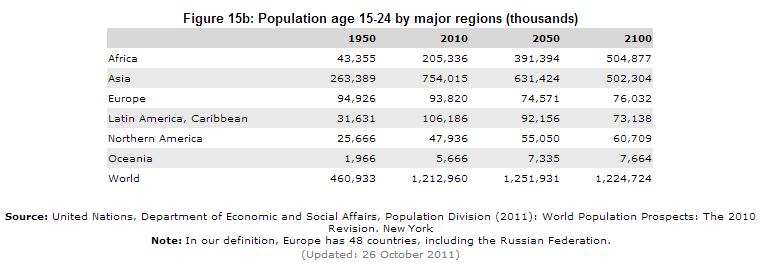
In China the youth (age 15 – 24) population is already declining. In India it will keep increasing till about 2050 and then decline. In Africa it will be growing until about 2100. Most of the youth of today will not be around in 2100 but the youth of that time who will see the world through to 2200 will be 500 million each in Africa and Asia and less than 300 million in the rest of the world – subject of course to any geographical population shifts that might take place. In the period till 2100 such migrations will probably not be so significant.

From the UN’s World Population Prospects (2012 Revision):

Population age 15-24

youth of the world 2100

US approves sale of taxpayer subsidised battery maker to China

January 30, 2013
Image representing A123 Systems as depicted in...

Image via CrunchBase

Not just irony but also further evidence that subsidies are fundamentally unsound.

Back in October last year the US lithium-ion battery maker, A123 Systems, filed for bankruptcy.

10/15/2012: A123 Systems, which had received a $249 million grant from the U.S. government, filed for Chapter 11 bankruptcy protection on Tuesday, giving Republicans fresh ammunition to attack the Obama administration’s subsidies for green energy.

The filing came after the lithium-ion battery maker’s $465 million rescue deal with Chinese auto parts supplier Wanxiang Group collapsed, hobbled by “unanticipated and significant challenges,” A123 said on its website. A123 has agreed to sell its automotive operations, including two factories in Michigan, for $125 million to Johnson Controls Inc, a leading battery supplier and another recipient of federal green subsidies.

….. The U.S. Department of Energy allotted about $90 billion for various clean-energy programs through the administration’s stimulus package. Of that, at least $813 million went to energy companies that eventually filed for bankruptcy, including A123, Solyndra, Beacon, Abound Solar and EnerDel.

But Wanxiang Group persevered and the US Committee on Foreign Investment (CFIUS) has granted its approval for a revised deal to go ahead. In addition to the automotive business divested to Johnson Controls, all government related business was also divested by the bankrupt A123 Systems to Navita Systems (at a fire-sale price of $2.25 million).

Bloomberg: Wanxiang Group Co., China’s biggest auto-parts maker, won approval from the Committee on Foreign Investment in the U.S. to buy most of the assets of A123 Systems Inc. (AONEQ), the bankrupt electric-car battery maker backed with U.S. government funds.

Approval from CFIUS, as it is known, was the final hurdle that Wanxiang needed to overcome to complete the deal. The federal interagency group led by the Treasury Department was reviewing the sale after members of Congress expressed national- security concerns over allowing a foreign competitor to obtain the technology developed with government backing. 

…… “Nothing provided by CFIUS has changed my opinion that the core technology developed by A123,” and the related intellectual property, “can be separated along A123’s business lines,” said Representative Bill Huizenga, a Republican representing Michigan’s 2nd Congressional District, in an e- mailed statement. “American taxpayers should not be funding technology that will in turn be used in competition against American companies,” he said, adding that he will look into legislation to prevent sales of taxpayer-funded “sensitive technologies” to foreign companies in the future.

….. “The Energy Department’s Recovery Act grant to A123 was used for the construction of brick and mortar advanced battery manufacturing facilities at two Michigan locations,” Bill Gibbons, a department spokesman, said in an e-mailed statement. The funds weren’t used for the company’s research and development of battery technology, he said.

“The purchase of these assets includes the Energy Department’s requirement that the plants and equipment partially paid for by the Recovery Act stay in Michigan and continue to operate, generating job opportunities for American workers,” Gibbons said.

….. As part of the purchase Wanxiang, based in Hangzhou, China, will get A123’s cathode powder plant in China and its share of a joint venture with Shanghai Automotive Industry Corp., called Shanghai Advanced Traction Battery Systems Co., in addition to the battery technology used in Fisker Automotive Inc.’s Karma sedan. Fisker, A123’s main customer, said it was awaiting the sale of the company’s Michigan plant so it could resume production of the $103,000 plug-in Karma sedan. A123, whose automotive business supplies electric-car batteries to about a dozen customers, has facilities in the Michigan cities of Livonia and Romulus.

The A123 Systems bankruptcy itself raised some questions about who had walked away with all the benefits. In a sense the subsidies have served the purpose of those investors who got away in time! For the US this now appears to be a damage control exercise to stop the bleeding where some local jobs are temporarily “saved” but the long term benefits are all to the account of Wanxiang. If indeed A123 Systems used government funds only for the building of factories and not for R & D, then Wanxiang have – fairly cheaply – bought themselves a foothold into the US market But if the US market develops – which it may not – then some or all of these jobs will eventually move to a low-cost country. Wanxiang has in any case bought themselves a technology cheaply which may address a world-wide market. But the jobs that creates will not be in the US. If the technology fails or the US market does not develop, then Wanxiang can just walk away from the US but they will retain the technology for whatever it is worth.

Paradoxically the only way in which the US taxpayer wins is if the technology is a dud and the deal represents future losses and liabilities being exported to Wanxiang!